
Approach to a Theory of the Epidemiology from General Medicine: Its Morphology, Ethology, Distribution and Ecology. “The Pampa is much more than a Bunch of Grass"
This article aims to show and reflect on the specific implications and contributions that general medicine offers to the field of epidemiology, and that they have not been sufficiently theorized systematically. Several specific areas of epidemiology can be conceptualized. Morphology: the form of epidemiology in general medicine and its evolution. The continued attention throughout the years of the general practitioner (GP) is a task of "naturalist" or "ethnographer" that performs a qualitative study. This presents a unique opportunity to study natural history of a disease, and allows a specific form of screening: opportunistic detection or "case finding", taking advantage of patient visits. Distribution: the configuration and structuring of the phenomena related to health and its determinants in specific populations, and the application of this study to the control of health problems. It implies the longitudinal and vertical vision that GP has about health / disease. The longitudinal view allows you to know the "numerator" and the "denominator" to obtain epidemiologic data. Vertical vision is based on family focus care, from the beginning of the life cycle to death. Ethology: the behavior of epidemiology. It is used variables limited in number, but significant and basic, which implies a common sense which comes from ordinary experience. Ecology: the relationships of living beings with each other and with the environment in which they live. It implies an emphasis in the simplification, the simplicity and the economy of means and techniques for the solution of scientific puzzles. It is confronted scientific problems from a completely different angle from that of other scientific fields. Therefore, general medicine faces epidemiological problems from a completely different angle than other medical fields and their epidemiological concepts are different. "The Pampa is much more than a bunch of grass", and under that bright mantle of grass, and in the forests of dry and brittle stems, the amount of living beings is extraordinary. But you can be there all your life without noticing it. It is necessary to be there and know how to look. There is practical epidemiology beyond academic epidemiology; this is the contribution of general medicine to epidemiology.
Introduction
The family doctor/general practitioner (GP) occupies a relevant place in the health care of the population, its role as health guardian, implies a performance fundamentally directed to the observation and action on any phenomenon or event that undermines the welfare of the community. The family doctor is the first element or fundamental component of an epidemiological surveillance system, and can be located within the clinical diagnosis subsystem, which is made up of the network of primary and secondary health care services, outpatient consultations and emergencies [1, 2].
Family medicine/General medicine (GM) is a major source of information about health problems and their variation. For most illnesses GP is the first point of contact in the health care system and he looks after a population whose age and sex composition is known [3, 4].
Medical records in GM are key sources for morbidity estimates, especially if all people are registered in a general practice and the GP is the gatekeeper of health care. In this case, the population registered in general practices is representative of the whole population outside of long term health care facilities. Furthermore, Turabian JL. Approach to a Theory of the Epidemiology from General Medicine: Its Morphology, Ethology, Distribution and Ecology. “The Pampa is much more than a Bunch of Grass". Epidemol Int J 2019, 3(2): 000124.
diagnoses from medical specialists and other health care providers will also be known by the general practitioner [5].
So, all of it allow to GP the estimation of the probability of health problems of the population (diagnoses, clinical onset, symptoms). From the epidemiological point of view this it is the access to the "numerator". Further, the GP is working with a population as a epidemiologic "denominator", and so it can be calculated attack rates, incidence and prevalence [6, 7, 8, 9].
The GP knows the life cycle of individual and family. The basics concepts of life cycle suggest an underground order of lifetime, where the individual or family illness exists only within a context that follows a basic development sequence. The family structure is a generic concept by which we mean a pattern, design or underground structure of the life of a person or a family at a given point in her life cycle. Its primary components include: occupation, relationships, marriage, family, and roles in different social contexts [1, 10]. The knowledge of all of these elements, including family life cycle, allows to GP to understand and study epidemiologically: 1. How in the stages of transition increases the stress that can manifest as physical symptoms in some member; 2. The strengths and weaknesses of the lives of Copyright© Turabian JL.
the members of a family along time; 3. Possibilities of the family to face difficulties; and 4. The family as an ecological space between society and the individual, in relation to behaviors, thoughts and feelings which are expressed from the personal and group level [11]. All these are specific and specific elements of the GM.
In addition, there is another main and specific element of GM: The continuity of care which is considered as a defining characteristic of GM. Thus, in this special scenario of this medical specialty, it presents the unique opportunity to develop an epidemiological vision that necessarily has its own nuances, and that includes aspects such as detecting new cases of disease and studying its natural history in family and community units [1].
Epidemiology is the study of the distribution patterns of diseases in human populations [12]. For years there has been interest in the epidemiological role of the GP. There is an area where epidemiology and FM are found. But there are others more specific implications from family medicine to epidemiology that have not been sufficiently conceptualized systematically.
Addressing these characteristics leads to the conceptualization and systematization of a series of specific epidemiological implications in GM that apply to acute and chronic diseases [12, 13, 14, 15].
In this context, this article aims to show and reflect on some specific implications and contributions that GM offers to the field of epidemiology, and that they have not been sufficiently theorized systematically.
Discussion
Several specific areas of epidemiology can be conceptualized from GM (Table 1):
| Morphology | The form of epidemiology in general medicine and its evolution. It is a task of "naturalist" or "ethnographer" that performs a qualitative study. With the observation and proper description of the natural history of the disease, it has been able to understand its course and in this way, detect the disease in an early manner and prevent its sequelae. This continued attention is the factor that implies a specific form of application of screening: the "Case-finding" |
| Distribution | Of the phenomena related to health and its determinants in specific populations, and the application of this study to the control of health problems. It implies a longitudinal and vertical visionThe longitudinal view allows knowing the "Numerator" of prevalence data (diagnoses: clinical onset, symptoms). Also, it is working with a population as a "Denominator" to obtain prevalence data (attack rate, incidence and prevalence) Vertical vision is based on family attention or family focus care. From the beginning of the life cycle to death: Genetic transmission, transmission of life habits and values, family events, the social interaction, the effects on the family of the patient and his treatment, the effects of the health / disease in the family relationship |
| Ethology | The behaviors of epidemiology: significant and basic limited variables. This characteristic implies a common sense which comes from ordinary experience: it is feasible to carry out epidemiologic studies, using the common means of family medicine, based on common experiences, and with an artisanal methodology |
| Ecology | The relationships of living beings and variables with each other and with the environment in which they live. Emphasis on simplification, simplicity and economy of means. The epidemiological experience of the family doctor is nourished by environments, contexts and spaces |
Table 1: Several Specific Areas Of Epidemiology Can Be Conceptualized From General Medicine.
Morphology
It refers to the form of the epidemiology in GM and its evolution. One of the differential aspects of epidemiology in GM is the epidemiological importance of continued care over long work years of GP.
This continued attention over the years is a task of "naturalist" or "ethnographer" who performs a qualitative study. Experienced naturalists warn the novice, that to capture animals there is no use disperse traps disorderly in the jungle, because although at first it seems that the movements of animals do not follow any order, immediately notice that most of them have very rooted, follow the same paths year after year appears in certain districts at certain times, and disappear in others, depending on the abundance of food, and will always drink water to the same places... So, before starting to place the traps there in any place, you wait patiently and carefully investigate the surroundings, you try to see which routes are used, where the wild fruits ripen and which holes are used as sleeping rooms, during the day, by night animals. In the same way the GPs uses many hours , perhaps many years, in their continued attention or care, contemplating the patients and studying their customs, problems, patterns..., so that it is easier for them to understand the new problems and solve them [16].
Truly, a look at the activities in the daily life of the GP shows great similarities between qualitative research and its practice. The experience of being a GP is similar to that of being an ethnographer who carries out a qualitative study. The GP works in the same surgery for a long time, developing relationships with his patients and their contexts, and realizing their visions and knowledge. In this way the GP is able to better interpret the signs and symptoms of the diseases that these people present. In the surgery, the GP, as an ethnographer, conducts an interview with a patient and, for this, he needs to establish empathy and to try to understand and interpret the perspective, experience, feelings and values of the patient. As an ethnographer, the GP has to interact with a great variety of people, many of who have different ways of understanding reality and vastly different stories and life experiences. Both GP and ethnographer negotiate their relationships with these different people in order to minimize the barriers to comprehension. But, unlike the ethnographer, the GP is orientated to practice and must therefore treat every patient [16].
Beyond being an experimenter or an orthodox epidemiologist, the GP should be a naturalist. To do so, he must look through the eyes of a researcher to see the nature of the pain that is presented to him. We rarely remember that many more than fifty per cent of modern medicine is due to the simple and pure observation of the pathological and its correct interpretation.
Detailed study of the natural history of the disease has been one of the most fruitful in the field of medicine. With the observation and proper description of the natural history of the disease, it has been able to understand its course and in this way, detect the disease in an early manner and prevent its sequelae [16, 17]. This continuity of care is the factor that implies a specific form of application of screening in GM: “Case- finding” [18]. The primary purpose of screening tests in a healthy population is to identify those individuals who have some pathology, but who still do not have symptoms. In GM, the most commonly used strategy is opportunistic detection or "case finding", in which a series of tests are performed according to age, sex and possible risk factors present in the person consulting for any reason thing. So, it involves actively searching and systematically in at risk people, rather than waiting for them to present with symptoms or signs of active disease. "Case-finding" is a epidemiologic method for taking advantage of patient visits [13, 19, 20, 21, 22]. Examples of case-finding can be: sexual partner ascertainment in syphilis outbreaks, or the study of family contacts in a family outbreak of keratoconjunctivitis, or household/work contacts in food-borne outbreaks, or the two-question case-finding instrument for detecting depression in primary care [1, 23].
On the other hand, individual disease depends on the context. The patient is a spokesman for the sick or problematic context (family conflict, social problem...). Therefore, symptoms may be forms of expression of biological alterations, or group or family alterations, or symbols or ways of coping with a situation. One of the factors that influence the type of symptoms is the stage of the family life cycle in which the patient is. This perspective considers that social and physical situations and the final behavior, and the biological and psychosocial processes, affect not only the possible risk of disease, but surround or frame the symptoms of the affected persons. For example, when an acute coronary syndrome occurs, the different stages of the patient's family life cycle may give rise to different symptoms for each of these stages [24].
In GM we can see "turning points" or transitions of patients and their contexts. These transitions are related to: a) The life cycle of the individual and the family; b) The sudden loss of stability c) The recurrence of problematic factors; and d) The accumulation of a number of problematic factors. During a transition, people experience stress and anxiety. But if it is exceeded there is an increase in knowledge and skills. Therefore, a practical epidemiological approach could be not only to see "problems" in the patients, but also their "transitions" or "turning points" as a part of continued care in GM [17, 25].
Distribution
It refers to the configuration and structuring of the phenomena related to health and its determinants in specific populations, and the application of this study to the control of health problems. In GM this implies both a longitudinal and vertical vision that the GP has on health / illness starting from the continuity of care [26]. GM is an important source of information on the occurrence and distribution of chronic disease in the population. So, GM has important epidemiological connotations, presenting a unique opportunity to study natural history of a disease. In medicine a priority objective of the studies must be the knowledge of the natural history of the disease. In developed countries around two-thirds of any population consults in a Family Medicine service at least once a year, and more than 80% contact once every 5 years.
Further, the collection of data in GM is cumulative and continuous: "The path of all patients begins and ends with the family doctor." Certainty of a diagnosis is not only important for the patient, but also for morbidity studies [13]. GP works includes the natural history of disease and the human life cycle, and so, no one is better able to observe, from family history, the ultimate consequences of any health problem [27].
The longitudinal view of the GP allows you to know the "Numerator" of prevalence data. A great accessibility of patients to their GP, and the role of first contact with the patient, it allowing in GM the estimation of the probability of health problems of the population (diagnoses, clinical onset, symptoms). Also, the GP is working with a population as a "denominator" to obtain prevalence data. Many health problems can only be identified within a population as a "denominator" (attack rate, incidence and prevalence) [6, 7, 8, 9, 28].
Vertical vision is based on family attention or family focus care. From the beginning of the life cycle to death, the family affects, and is affected, by the health of its members in many ways: Genetic transmission, transmission of life habits and values, family events, the social interaction, the effects on the family of the exponent patient, and his treatment, the effects of the health / disease in the family relationship, etc [29].
Ethology
It refers to the behavior of epidemiology. In GM this implies the use of significant and basic limited variables. The specific characteristics of the work in GM involve a "common sense• which comes from ordinary experience. A first particular piece of information that comes out of epidemiologic studies in GM is common sense: at this level of care it is feasible to carry out epidemiologic studies using the common means of family medicine, based on common experiences, and with an artisanal methodology that is not sophisticated, and the results of which do not differ substantially from other large sophisticated and complex studies. This fact is not usually highlighted. Common sense comes from ordinary experience in the GP surgery [30]. So, in the age of high technology, is there still any value in craft research? Yes, there is. As C. Wright Mills says, it is necessary to relativize the methodology and maximize the imagination [31, 32].
Epidemiology in MG plays with a limited number of pieces. It's like a kind of "puzzle" with only a few pieces but that are these basic determinants. We can remember that "puzzles" are games in which it is about correctly coupling the pieces. As they get more complicated they increase their number of pieces ..., from 30 to 100, up to a decidedly very high number: 2,000 to 15,000 pieces... But, basically between the "easy" and the "difficult" puzzle there is no difference: it is always to attach the bits or irregular shapes to form a figure or a whole with them. Certainly, a greater number of pieces requires more work, it is more difficult and that may have to be more sophisticated. However, it is common to fall into the false idea that with more number of elements also increases the difficulty of the game, when, in fact, it depends on other factors.
In this false premise, epidemiological studies are becoming increasingly difficult, with a greater number of variables included in the analysis, and increasingly sophisticated statistical techniques are required to be able to couple this set of variables and form an intelligible result.., although Sometimes it is clinically irrelevant or of little practical use, or the result is not even understandable. Epidemiology can happen as in puzzles: it is common to fall into the false idea that if more variables are included and the more complex the statistical analysis techniques are, the more important or better the results will be, when, in reality, it depends on other factors (not on the unthinking increase of variables to analyze, nor on the complexity of statistical techniques). It is part of the law that says "if we put garbage, we get garbage" [33].
From the point of view of GM, "the number and shape of the puzzle pieces of epidemiology" are invariable. There are a number of basic forms or variables, and the rest can be obtained, as in the Chinese Tangram or game of the seven elements, by division of the previous ones, and thus form with the basic elements certain variables or figures [34].
Epidemiology from GM has a specific number of elementary forms, which can be considered according to the old principle that "in the limitation of resources the teacher is seen." The results of some large or technically complex epidemiological studies were already known years earlier, from much more modest studies at the GM level. The same example could be applied here that the Pythagorean Theorem would have been already demonstrated thousands of years before in China by Li Hung Chang through the help of “Tamgram” [34]. But do this is necessary reflection and intelligence to increase and enrich the epidemiological imagination [31, 32].
The initial simple or "geometric" approach of the epidemiological view from GM can be converted into a more complex or "algebraic" approach. And vice versa, the epidemiological approach can be simplified and with this approach the majority (though not all) of the epidemiological problems in medicine can be solved; the limit of this simplifying transformation is in its coherence with the principles of the GM [35].
Ecology
It refers to the relationships of living beings and variables with each other and with the environment in which they live. In GM it implies an interrelated or integral panoramic vision of complexity. But also, in MG it implies an emphasis on simplification, simplicity and economy of means for the solution of scientific puzzles.
It is not often that a scientific advance arises from a single observation. Scientific advances are based on answers to a series of questions that have remained unanswered in the past. The solution of scientific puzzles is like a game of chess. The chessboard represents the problem as a whole. The black pieces represent all the basic questions without answering. The white figures represent the answers that the researcher offers to the basic questions. A scientific advance responds one after the other to all the questions that had been a mystery. Alternative explanations are discarded and the problem is being isolated: a scientific advance is equivalent to giving "checkmate" to a scientific or medical problem. The solution is generally seen as simple once it has been made.
Einstein said: "the most important scientific discoveries are so simple that they can be formulated in such a way that everyone understands them." It is not often that new fundamental discoveries, which can provide relevant elements and even change the course of medicine, are carried out inside a laboratory. Most are born in an environment that stimulates creative thinking. The solutions often have nothing to do with new surgical techniques, new medical instruments or new drugs ... The solutions are usually simple and partly known, extended and cheap ... The epidemiological work of the GP is much more than numbers and statistics; the quantitative can be the internal axis, but the GP sees the borders and in- between spaces of quantitative data, where generations of people leave their stories of health and disease. The epidemiological experience of the family doctor is nourished by environments, contexts and spaces [36].
Conclusion
Therefore, GM faces epidemiological problems from a completely different angle than other medical fields, and their epidemiological concepts are different. Thus, an external observer could differentiate when an epidemiological study starts from general medicine or not (Figure 1). As Linus Pauling, twice awarded the Nobel Prize, and who wrote part of twentieth-century science, said: "[Using a hand calculator and writing things down longhand] I was able to solve this problem because I do not have a computer. I know what I am doing every step, and the steps go slowly enough that I can think" [37]. The main thing is to face the scientific problems from a completely different angle than other scientists. That is the situation of GM in the field of epidemiology.
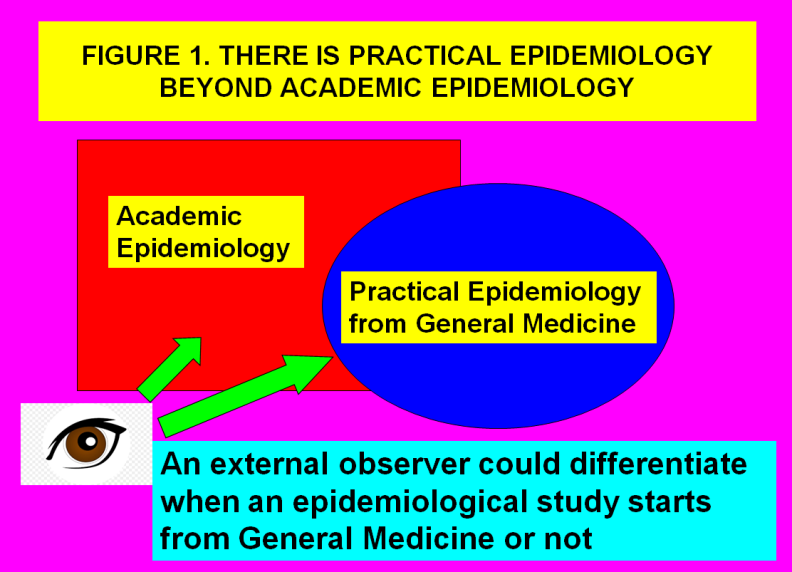
Error! Objects cannot be created from editing field codes.
Following Louis Armstrong on jazz ("Jazz is not music but a way to play it") [38], epidemiology at GM is not an academic discipline, but a way of doing medicine.
The Pampa is much more than "a bunch of grass", and under the bright mantle of grass, and in the forests of dry and brittle stems, the amount of living beings there is extraordinary. But, you can spend your life there without realizing it; It is necessary to know how to look. There is practical epidemiology beyond academic epidemiology; this is the contribution of GM to epidemiology.
References
-
Turabian JL (2017) A Large Family outbreak of Keratoconjunctivitis in General Practice: Specific Epidemiological Implications in Family Medicine. J Community Med Public Health CMPH-110.
-
Batista Moliner R (1997) The family doctor in health surveillance. Rev Cubana Med Gen Integr 13(1): 59-62.
-
Turabian JL (2017) The Variation of Seasonal Diseases in Family Medicine Depends on Infectious Diseases and these are Mainly Respiratory Diseases. J Gen Pract (Los Angel) 5: 309.
-
Turabian JL, Cucho-Jove R, Moreno-Ruiz S (2017) Conceptual Implications of Family Medicine in the Study of the Seasonal Variation of Diseases: A Narrative Review. CP Epidemiol 1(1): 001.
-
Boshuizen HC, Poos MJJC, van den Akker M, van Boven K, Korevaar JC, et al. (2017) Estimating incidence and prevalence rates of chronic diseases using disease modeling. Popul Health Metr 15(1): 13.
-
Kilpatrick SJ, Boyle RM (Editors) (1984) Prymary Care Research. Encounter records and the denominator problem. New York: Praeger.
-
Schlaud M, Brenner MH, Hoopmann M, Schwartz FW (1998) Approaches to the denominator in practice- based epidemiology: a critical overview. J Epidemiol Community Health 52 (1): 13-19.
-
Bartholomeeusen S, Kim CY, Mertens R, Faes C, Buntinx F (2005) The denominator in general practice, a new approach from the Intego database. Fam Pract 22(4): 442-447.
-
Bass MJ, Newell JP, Dickie GL (1976) An information system for family practice. Part 2: The value of defining a practice population. J Fam Pract 3(5): 525- 528.
-
Rolland JS (1994) Families, illness, and disability. An integrative treatment model. New York: Bassic Books.
-
Turabián JL, Perez Franco B (2016) Turning Points and Transitions in the Health of the Patients: A Perspective from Family Medicine. J Family Med Community Health 3(4): 1087.
-
Lilienfeld DE, Stolley PD (1994) The Foundations of Epidemiology. New York: Oxford University Press.
-
Turabián JL, Moreno-Ruiz S, Cucho-Jove R (2016) “Doctor, I have Chikungunya”. Conceptual systematisation of specific epidemiological implications in family medicine. Semergen 42(7): e101-e140.
-
Turabian JL (1995) Cuadernos de Medicina de Familia y Comunitaria. Una introducción a los principios de Medicina de Familia. [Family and Community Medicine Notebooks. An Introduction to the Principles of Family Medicine]. Madrid: Díaz de Santos.
-
Morrell D, editor (1988) Epidemiology in General Practice. Oxford: Oxford Medical Publications.
-
Green LA, Hickner J (2006) A short history of primary care practicebased research networks: From concept to essential research laboratories. J Am Board Fam Med19(1): 1-10.
-
Turabian JL, Perez-Franco B (2016) The Family Doctors: Images and Metaphors of the Family Doctor to Learn Family Medicine. New York. Nova Publishers.
-
Turabian JL (2017) A Narrative Review of Natural History of Diseases and Continuity of Care in Family Medicine. Arch Community Med Public Health 3(1): 041-047.
-
Turabian JL (2017) Opportunistic Prevention in Family Medicine: Anticipatory Care, Case- Finding and Continuity of Care. J Health Care Prev 1(1): 101.
-
Turabian JL (2018) Longitudinal Study of a Series of Cases on Trajectory of the Chain of Accumulating Health Problems in Certain People. Am J Family Med; 1(1): 1001.
-
Hart JT (1970) Semicontinuous screening of a whole community for hypertension. Lancet 2: 223-226.
-
Hart JT (1974) Milroy Lecture: the marriage of primary care and epidemiology: continuous anticipatory care of whole populations in a state medical service. J Royal College of Physicians London 8: 299-314.
-
Hart JT (1975) Management of high blood pressure in general practice. Butterworth Gold Medal essay. J Royal College of General Practitioners 25: 160-192.
-
Hart JT, Thomas C, Gibbons B, Edwards C, Hart M, et al. (1991) Twenty five years of case finding and audit in a socially deprived community. BMJ 302: 1509-1513.
-
Whooley MA, Avins AL, Miranda J, Browner WS (1997) Case-Finding Instruments for Depression. Two Questions Are as Good as Many. J Gen Intern Med 12(7): 439-445.
-
Turabián JL, Báez-Montiel B, Gutiérrez-Islas E (2016) Type of Presentation of Coronary Artery Disease According the Family Life Cycle. SM J Community Med 2(2): 1019.
-
Turabián JL, Franco BP (2016) Turning Points and Transitions in the Health of the Patients: A Perspective from Family Medicine. J Family Med Community Health 3(4): 1087.
-
White ES, Gray DP, Langley P, Evans PH (2016) Fifty years of longitudinal continuity in general practice: a retrospective observational study. Fam Pract 33(2): 148-153.
-
Morrell D (1991) The art of general practice. Oxford: Oxford University Press.
-
Bass MJ (1976) Approaches to the denominator problem in primary care research. J Fam Pract 3(2): 193-195.
-
Turabian JL (2017) The Importance of the Family Approach in General Medicine: An Introduction and Review of Concepts from a Case of Hereditary Renal Disease. Chronicle Med Surgery 1(1): 18-30.
-
Hart JT (1981) A new kind of doctor. J R Soc Med 74(12): 871-83.
-
Ashton J (Editor) (1994) Epidemiological imagination. Buckingham: Open University Press.
-
-Wright Mills C (1970) The Sociological Imagination. New York: Oxford University Press.
-
Jefferson T, Jørgensen L (2018) Redefining the ‘E’ in EBM. Evidence-Based Medicine 23(2): 46-47.
-
Elffers J (1976) El Tangram. Juego de formas chino. Barcelona: Barral Editores.
-
Turabian JL (2017) Fables of Family Medicine. A collection of fables that teach the Principles of Family Medicine. Saarbrücken, Deutschland/Germany: Editorial Académica Española.
-
Turabian JL (2018) The Varieties of the Epidemiological Experiences and the Contribution of the General Physician. J Community Prev Med 1(2): 1-5.
-
Durrell G (1963) Encounters with animals. London: Penguin Books.
- Epidemiological Surveillance and Rumors on Social Media
- Awareness and Treatment of Uncontrolled Hypertension in US Overweight/Obese Youths Aged 16–24 Years, NHANES 2021–2023
- Strengthening EPI Through Parental Engagement: Lessons from Dhaka Slums for IA-2030
- Mothers Knowledge of the Prevalence, Causes, Effects, Prevention and Control of Diarrhoea among Children in Ife East Local Government Area, Ile Ife, Osun State, Nigeria
- Covid-19 Reinfections Case Series from October 2023 to October 2024 in A General Medicine Office in Toledo (Spain)
- Water Contact! One Risk Too Many: Risk Factors Associated with Schistosoma haematobium infection in Osun State, Nigeria