
Epidemiological Aspect of the Activities Carried Out in the Urology and Andrology Department of the Central Hospital of Yaounde during the Covid 19 Period
Introduction: The measures imposed by the health crisis caused by COVID-19 are unprecedented. The COVID-19 pandemic has led to the reorganization of many health systems. As a result of this pandemic, urological surgical activity has been strongly impacted. Cameroon is one of the African countries with a high rate of infection and given the absence of studies on the subject in the country, it was decided to study the epidemiological profile of the urology and Andrology department of the Yaoundé Central Hospital during the COVID-19 pandemic. Methodology: This was an observational, retrospective and monocentric study that took place in the Urology and Andrology Department of the Yaounde Central Hospital over a three-year period from 2019 to 2021. All patients admitted to the Urology and Andrology Department of the Yaounde Central Hospital were included in the study, regardless of their pathology during the study period. Three groups of patients were collected, the first group consisting of records of patients admitted in 2019, the second group of records of patients admitted during the year 2020 in the midst of the COVID-19 pandemic, and the third group of records of patients admitted in the year 2021. The data collected were studied with the spss 20 software. Results: A total of 429 patient records were collected, including 145 (33.8%) in the first group, 128 (29.8%) in the second group and 156 (36.4%) in the third group. The average age of the patients was 48±27 years in the first group, 47±24 years in the second group and 47±26 years in the third group. The rate of hospitalized children decreased slightly with the pandemic while the rate of hospitalized adults decreased more in 2021. Patients from the central and western regions were the most common populations. Civil servants were the most common occupation during the pandemic in COVID 19. In this study, surgical activity and especially elective surgery remained the most important part of the hospital practice despite the COVID-19 pandemic. The rate of elective surgery has increased over time, while the rate of urological emergencies has decreased. Conclusion: The COVID-19 pandemic had an impact on the rate of patients coming to consultation. The average age was similar in all three periods. The majority of patients admitted to hospital were civil servants from the central and western regions. Elective surgery remained the most common in all three periods while urological emergencies decreased.
Introduction
The measures imposed by the health crisis caused by COVID-19 are unprecedented, due to the rapid spread of the virus [1, 2]. The COVID-19 pandemic has therefore led to the reorganisation of health systems worldwide [3] to the extent that in some countries elective surgery has been suspended. Puliatti S, et al. [4] in his study, said that all elective surgeries have to be postponed in areas with high COVID-19 workloads, due to the limited availability of ventilators, workforce and hospital beds [5] but also because studies have suggested a significant risk associated with elective surgery in the context of COVID-19 (A retrospective cohort study of 34 asymptomatic patients who underwent elective surgery during the incubation period of COVID-19 reported that 44% required intensive care and 20% died [6]. However, surgery should be considered for urological emergencies, for example, high-grade malignancies and unstable trauma patients. All healthcare workers, including urologists, should adopt sufficient protective strategies to guard against infection when dealing with patients with COVID-19 [5]. On the other hand, Alexandre Ingels argues that surgical activities should be maintained in view of this risk [7]. According to a study conducted in France, urological surgical activity was strongly impacted by the COVID-19 pandemic [5].
However, the number of medical and paramedical staff has decreased. In Cameroon, in terms of protection, there was a lack of everything, especially FFP2/FFP3/N95 masks, forcing health workers to obtain them at their own expense, to use on-board resources or to engage in dangerous recycling practices that are not supervised and do not respect their safety. In order to find solutions to this pandemic, African countries, including Cameroon, have been looking for local solutions, including traditional pharmacopoeia [8]. Binyom PR, et al. [9], in 2021, in their work on the impact of covid-19 on surgical activities in confessional hospitals in Cameroon showed a decrease in hospital attendance and that awareness of covid-19 is necessary to reduce the psychosis of the populations attending surgical services. It should be noted that his work covered the years 2018, 2019, 2020 [8]. This work does not show the state of surgical practice in Cameroon after COVID-19 [9]. Cameroon has been one of the African countries with a high infection rate [10]. As there is no epidemiological study on the impact of COVID-19 on urological activities before, during and after the COVID-19 period, it was decided to study the epidemiological profile of the urology and andrology department of the Yaoundé Central Hospital during the COVID-19 pandemic.
Materials and Methods
This was an observational, retrospective and mono- centric study that took place in the Urology and Andrology Department of Yaounde Central Hospital over a three-year period from 2019 to 2022. The study population consisted of all records of individuals admitted to the Urology and Andrology Department of Yaounde Central Hospital. The Urology and Andrology Department of the Yaounde Central Hospital used to have 5 urologists and 18 nurses but the staff has decreased considerably since the COVID-19 pandemic either due to health reorganisation or staff infections with COVID-19. Within the department, there is a surgical activity and a medical and hospital activity.
All patients admitted to the Urology and Andrology Department of the Yaounde Central Hospital were included in the study, regardless of their pathology. Any patient whose records were incomplete was not included. The variables used were demographic factors (age, sex, ethnic origin, and profession), reason for hospitalisation and diagnosis. The patient records collected were separated into three groups. The first group of patients consisted of records of patients admitted in 2019, the second group included records of patients admitted during the year 2020 in the midst of the COVID-19 pandemic, which was marked by a lockdown from March to May 2020 and the reorganisation of the health system, and the third group included records of patients admitted in 2021, which is a period marked by better management of the health crisis, with no return to lockdowns, and a decrease in the number of COVID-19 patients. The collected data were studied with SPSS20.
Results
Throughout the study, 429 records were collected after excluding 67 incomplete records. This Figure 1 shows that attendance has decreased slightly during the pandemic context at COVID-19. But in 2021, the number of patients received was higher than before the pandemic.
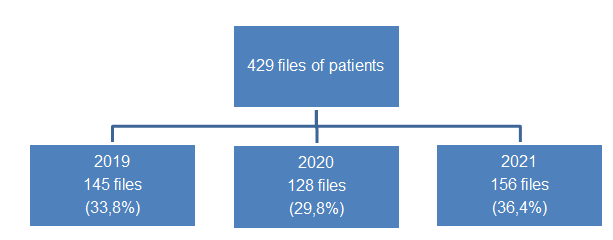
This result shows that the average age of the patients received remained similar before and during the COVID-19 pandemic, and also in the year following the COVID-19 confinements (Table 1) [6].
| First Group | Second Group | Third Group | |
|---|---|---|---|
| Mean’s age (years) | 48±27 | 47±24 | 47±26 |
| Minimum of age (years) | 1 | 1 | 2 |
| Maximum of age (years) | 107 | 89 | 86 |
Table 1: Distribution of patients by age.
The rate of children hospitalised decreased slightly with the pandemic but increased in 2021, while the rate of adults decreased in 2021 (Table 2).
| First Group | Second Group | Third Group | |
|---|---|---|---|
| Under 21 years old | 40% | 39% | 46,2% |
| 21 and over | 60% | 61% | 53,8% |
Table 2: Distribution of patients by paediatric and adult ages.
The number of patients coming for consultation has remained similar for all periods, but there is an increase in male consultations and a decrease in female consultations in 2021 (Table 3).
| First Group | Second Group | Third Group | |
|---|---|---|---|
| Female | 4,8% | 5,4% | 2,6% |
| Male | 95,2% | 94,6% | 97,4% |
Table 3: Gender distribution.
This table shows that the majority of patients received come from the central and western regions of the country in all periods. The percentages remained similar in all three periods. No foreigners were received at the height of the pandemic (Table 4).
| First Group | Second Group | Third Group | |
|---|---|---|---|
| Centre | 44,8% | 38,2% | 46,8% |
| West | 32,4% | 21,9% | 35,2% |
| Littoral | 2% | 8,6% | 4,5% |
| South | 4,8% | 14,1% | 3,2% |
| North and South-West | 2,1% | 3,1% | 3,2% |
| East | 2,8% | 5,5% | 2,5% |
| Big North | 10,3% | 8,6% | 3,8% |
| Foreign | ˂1% | ˂1% |
Table 4: Distribution of patients by ethnic origin.
Serving civil servants and retired civil servants were the most common occupations during the Covid-19 pandemic. However, during the COVID-19 pandemic, the most common occupation other than those mentioned above was that of tradesmen and farmers. It can also be seen that hospital admissions of people working on their own account or on behalf of another person increased over time (Table 5).
| First Group | Second Group | Third Group | |
|---|---|---|---|
| Trader | 17,2% | 16,4% | 8,9% |
| Farmer | 22,8% | 8,6% | 10,9% |
| Civil servant | 10,3% | 16,4% | 28,9% |
| Retired civil servant | 15,9% | 16,4% | 16% |
| Driver | 12,4% | 12,5% | 10,9% |
| Men of God | 4,2% | 8,6% | 1,9% |
| Housewife | 6,9% | 8,6% | 3,8% |
| Private | 10,3% | 12,5% | 18,7% |
Table 5: Distribution of patients by profession.
Surgical cases were the main hospital admission even in the year when the COVID-19 pandemic started. Surgical activity remained the most important part of the hospital practice despite the COVID-19 pandemic (Table 6).
| First Group | Second Group | Third Group | |
|---|---|---|---|
| Surgical Instance | 48,9% | 54,7% | 64,2% |
| Haematuria | 21,4% | 7% | 9,6% |
| Lumbar pain | 4,8% | 3,9% | 1,9% |
| Altered general condition | 3,4% | 7,8% | 5,1% |
| Pain in the penis | 2,2% | 1,6% | 1,9% |
| Scrotal swelling | 4,8% | 3,9% | 6,4% |
| Suprapubic pain | 9,7% | 13,3% | 4,5% |
| Urethrorrhagia | 1,4% | 3,1% | 3,8% |
| Bone pain | 3,4% | 4,7% | 2,6% |
Table 6: Distribution of patients by reason for hospitalization.
In 2019, in adult surgery, Trans urethral resection of the prostate followed by the cure of varicocele was the most common procedure. In children’s surgery, hydrocele cure was the most common procedure, followed by testicular lowering for cryptorchidism and hypospadias cure. In 2020, in adult surgery, varicocele cure followed by Trans urethral resection of the prostate was the most common. In children’s surgery, testicular abduction for cryptorchidism was the most common procedure, followed by hydrocele cure. In 2021, surgical activity predominated. In adult surgery, Trans urethral resection of the prostate followed by the cure of varicocele was the most common. As for paediatric surgery, testicular lowering for cryptorchidism was the most common procedure, followed by hydrocele and hypospadias cure. The surgical activity has rather increased over time while the rate of urological emergencies has rather decreased (Table 7).
| First group | Second group | Third group | |
|---|---|---|---|
| Elective paediatric urological surgery | 18,6% | 20,3% | 27% |
| Adult elective urological surgery | 31,7% | 34,4% | 37,2% |
| Tumour admissions | 20% | 23,5% | 16% |
| Urological emergencies | 17,3% | 14,8% | 10,2% |
| Infectious diseases | 12,4% | 7% | 9,6% |
Table 7: Distribution of patients by diagnosis.
Discussion
There are a low number of patients admitted to hospital in 2020. These figures were revised upwards in 2021. These results show that the single containment that took place from March to May 2020 in Cameroon had an impact on the rate of patient admission to the ward. This is confirmed by the increase in the number of patients in 2021, while the pandemic is not over. This is in line with the study by Quaglio G, et al. [11] who concluded that the pandemic has led to a reduction in the use of health services in sub-Saharan Africa [6].
Age
The average age of patients admitted to hospital remained similar before and during the COVID-19 pandemic and also in the year following the COVID-19 containment. The rate of children admitted to hospital decreased slightly with the pandemic but increased in 2021, while the rate of adults decreased in 2021. This result shows that despite COVID-19, patients were coming to consultation however, the decrease in the consultation rate of children can be due to the fear of parents to take their children to consultation during the pandemic while the decrease in the consultation rate of adults in 2021, would be related to the fact that the socio-economic activity has decreased in the country in 2020 and especially during the period of containment [7]. This may be because the adult population was more concerned with restoring their socio-economic balance than with managing their health problem, as long as it could be supported or managed in the traditional way.
Gender
The number of patients coming for consultation remained similar over the period, although there was an increase in male consultations and a decrease in female consultations in 2021. This may be related to the fact that the pattern of female urology consultations in terms of numbers has not really changed over the COVID-19 period in contrast to men. This may be confirmed by the fact that the government itself, recognizing the potential negative socio-economic impacts of COVID-19, has relaxed some of its barrier measures over time, modifying its response to the pandemic to meet new challenges [7].
The Profession
Serving civil servants and retired civil servants were the most common occupations followed by traders and farmers [12]. This result can be explained by the fact that in developing countries such as Cameroon, civil servants have a pre-determined salary whereas other service sector occupations do not have a pre-determined salary and live from day to day. It was also found that hospital admissions of self-employed and employed people increased over time. This can be due to the socio-economic impact [7] of the COVID-19 pandemic, which has motivated people in private practice to work even more.
Ethnicity
This table shows that the majority of patients come from the central and western regions of the country for all periods. The percentages of patients received remained similar in all three periods. No foreigners were received at the height of the pandemic. This may be related to the great cultural disparity found in these two large ethnic groups in addition to the fact that these regions are known to be home to traders and farmers in the central province.
The Reason for Hospitalization and Diagnoses
In the department, the surgical activity is the most practiced. This activity has continued to grow over time, despite the COVID-19 pandemic. In addition, the rate of paediatric urology surgery has increased over time. This can be explained by the fact that with the lifting of the lockdown which found students on holiday and socio- economic difficulties, parents are giving more priority to the health of their children. The decrease in urological emergencies and especially traumatic emergencies can be attributed to the government’s formal recommendation to respect barrier measures and to the sensitization of the Cameroonian people to the COVID-19 pandemic. There is a high level of elective surgical activity before and during the COVID period as opposed to emergency surgery. The result of elective surgery is contrary to that of Pinar U, et al. [10] but the result of emergency surgery remains similar to that of Pinar U, et al. [10]. For elective surgery, the difference can be explained by the psychological damage and the fear of the populations related to the percentages of COVID 19 deaths in the respective countries.
Conclusion
The COVID-19 pandemic had an impact on the rate of patients coming for consultation when a health system was sought to overcome it. The population that presented during the pandemic was a young population, originating from Central and Western Cameroon and the majority was civil servants. As for the functioning of the service, the surgical activity was the most practiced (elective surgery) and there was a progressive increase in paediatric surgery despite the COVID-19 pandemic.
References
-
Shimizu K (2020) 2019-nCoV, fake news, and racism. Lancet 395(10225): 685-686.
-
Heymann DL, Shindo N (2020) COVID-19: what is next for public health?. Lancet 395(10224): 542-545.
-
Ross SW, Lauer CW, Miles WS, Green JM, Christmas AB, et al. (2020) Maximizing the calm before the storm: tiered surgical response plan for novel coronavirus (COVID-19). Journal of the American College of Surgeons 230(6): 1080-1091.
-
Puliatti S, Eissa A, Eissa R, Amato M, Mazzone E, et al. (2020) COVID‐19 and urology: a comprehensive review of the literature. BJU Int 125(6): E7-E14.
-
Akwa TE, Muthini MJ, Ning TR (2020) Assessing the perceptions and Awareness of COVID-19 (Coronavirus) in Cameroon. European Journal of Medical and Educational Technologies 13(2): em2007.
-
Lei S, Jiang F, Su W, Chen C, Chen J, et al. (2020) Clinical characteristics and outcomes of patients undergoing surgeries during the incubation period of COVID-19 infection. EClinicalMedicine 21: 100331.
-
Ingels A, Bibas S, Abdessater M, Tabourin T, Roupret M, et al. (2020) Urology surgical activity and covid‐19: risk assessment at the epidemic peak the Parisian multicenter experience. BJU Int 126(4): 436-440.
-
Fogha JVF, Noubiap JJ (2020) La lutte contre la COVID-19 au Cameroun nécessite un second souffle. The Pan African Medical Journal 37(1): 14.
-
Binyom PR, Zaré C, NgaNomo S, Belemlilga GLH2,Yabré N, et al. (2021) Impact of COVID-19 on surgical activities in faith-based hospitals in Cameroon. Mali Médical 36(2): 37-41.
-
Pinar U, Anract J, Duquesne I, Dariane C, Kastler EC, et al. (2020) Impact of the COVID-19 pandemic on surgical activity in the urology departments of the Assistance Publique-Hôpitaux de Paris. Prog Urol 30(8): 439-447.
-
Quaglio G, Cavallin F, Nsubuga JB, Lochoro P, Maziku D, et al. (2022) The impact of the COVID-19 pandemic on health service use in sub-Saharan Africa. Public Health Action 12(1): 34-39.
-
Esso L, Epée E, Bilounga C, Abah A, Hamadou A, et al. (2021) Cameroon’s bold response to the COVID-19 pandemic during the first and second waves. The Lancet Infectious Diseases 21(8): 1064-1065.
- Epidemiological Surveillance and Rumors on Social Media
- Awareness and Treatment of Uncontrolled Hypertension in US Overweight/Obese Youths Aged 16–24 Years, NHANES 2021–2023
- Strengthening EPI Through Parental Engagement: Lessons from Dhaka Slums for IA-2030
- Mothers Knowledge of the Prevalence, Causes, Effects, Prevention and Control of Diarrhoea among Children in Ife East Local Government Area, Ile Ife, Osun State, Nigeria
- Covid-19 Reinfections Case Series from October 2023 to October 2024 in A General Medicine Office in Toledo (Spain)
- Water Contact! One Risk Too Many: Risk Factors Associated with Schistosoma haematobium infection in Osun State, Nigeria