
Safety of Heterologous mRNA Vaccine Booster in Healthy Adults
The emergence of SARS-CoV-2 variants of concern (VOCs) and the waning of vaccine-elicited neutralizing antibodies has generated significant international interest in assessments of heterologous boost vaccination. We evaluated the safety of the mRNA vaccine CS-2034 as a heterologous booster in participants who received a three-dose of the inactivated vaccines at least 6 months ago. Safety data presented here consist of solicited and unsolicited adverse events collected within 28 days after boost vaccination in participants. The heterologous booster was safe with no vaccine-related serious adverse events occurring. The overall incidence of adverse reactions within 28 days was 61.69% (504 cases), mainly grade 1 or 2 in severity. Our results suggest that heterologous boosting with mRNA vaccine CS-2034 has a favorable safety profile.
Introduction
The waning of immune responses has been observed after immunization with COVID-19 vaccines, with reduced protection against infection, hospitalization, and death, particularly among older adults. Moreover, the effectiveness of the vaccine showed varying levels of short-term efficacy against symptomatic COVID-19 [1, 2]. The urgent need for safe and effective interventions to mitigate the global spread of SARS-CoV-2 has prompted international efforts to assess vaccination boosters. Heterologous boosters across different platforms might provide greater protection and immunity against VOCs and influence the breadth of vaccine-elicited neutralizing antibodies compared with homologous boosters [3, 4].
mRNA-based vaccines encoding viral antigens are immunogenic against infectious pathogens with potent and broad protective immune responses with an acceptable safety profile in several clinical studies, including trials of COVID-19 vaccines [5, 6, 7, 8, 9, 10]. We conduct a clinical trial NCT05568693 to investigate the safety data of the heterologous boosting with the mRNA vaccine CS-2034 in healthy, young, and older Chinese participants. Here, we report the preliminary safety data within 28 days.
Materials and Methods
Trial Design and Participants
We conducted a single-center, open clinical trial to evaluate the safety of heterologous boosting with the mRNA vaccine CS-2034 in China. Adults 18 years of age or older who were healthy and had completed three-dose of inactivated vaccines at least 6 months ago were eligible for participation in the trial. Key exclusion criteria included a medical history of Covid-19 or other coronavirus infection, serious vaccine-related hypersensitive reactions, systemic allergic reactions, diagnosis with an autoimmune disease, treatment with immunosuppressive therapy, any serious chronic conditions (diabetes, hyperlipidemia, thyroid diseases), or female participants with positive urine pregnancy test results.
The trial was reviewed and approved by the Clinical Trial Ethics Committee of West China Second Hospital of Sichuan University, and the trial process follows the National Medical Products Administration, the requirements of Good Clinical Practice (GCP), the Declaration of Helsinki, and relevant domestic laws and regulations. All the participants provided written informed consent before enrollment. Clinical monitoring, laboratory testing, data management, and statistical analysis were carried out in accordance with relevant regulations and guidelines.
CS-2034 Vaccine
The mRNA vaccine CS-2034 is co-developed by researchers at the CanSino (Shanghai) Biotechnologies Co., Ltd and CanSino (Shanghai) Biological Research Co., Ltd. The sequence-optimized mRNA vaccine encodes the full-length SARS-CoV-2 spike protein based on the original strain and contains four convergent mutations across different variants: K417N, E484K, N501Y, and D614G. Each dose of the mRNA vaccine CS-2034 contains 30 μg mRNA.
Trial Procedures
The mRNA vaccine CS-2034 was administered as a 0.3-mL intramuscular injection into the deltoid on day 0 of the study; follow-up visits were scheduled for 0, 7, and 14 days after vaccination and on day 180. Adverse events and serious adverse events were medically coded using MedDRA and classified by SOC and PT. In addition, statistical classification of solicited adverse events will be conducted according to the program requirements by the adverse events at the inoculation site (local) and the adverse events at the non-inoculation site (systemic). This study focused on a statistical analysis of treatment-emergent adverse reactions that occurred after vaccination. Collection of specimens, as well as monitoring for medically attended adverse events, development of new chronic medical conditions, and serious adverse events, was scheduled to continue throughout 6 months after the booster. These initial findings will be updated with final safety data when the results are available.
Results
Trial Population
Between September 21, 2022, and October 27, 2022, a total of 877 participants aged between 18 and 59 years or 60 years older underwent screening at West China Second Hospital of Sichuan University in Sichuan Province, China. Of these participants, 58 participants met the exclusion rules and were excluded, while the other two were excluded for other reasons. A total of 817 eligible participants consented to participate in the trial and received the heterologous boost of mRNA vaccine CS-2034 at 30 µg (Figure 1). Among them, 58% were female, 20% were 60 years or older, and the mean age was 46 years. The participants had a mean body-mass index (the weight in kilograms divided by the square of the height in meters) of 25, and 42% had at least one underlying medical condition or medical history. The demographic characteristics of the participants are shown in Table 1. All enrolled participants completed vaccination and safety observation, and no participants withdrew from the study in advance.
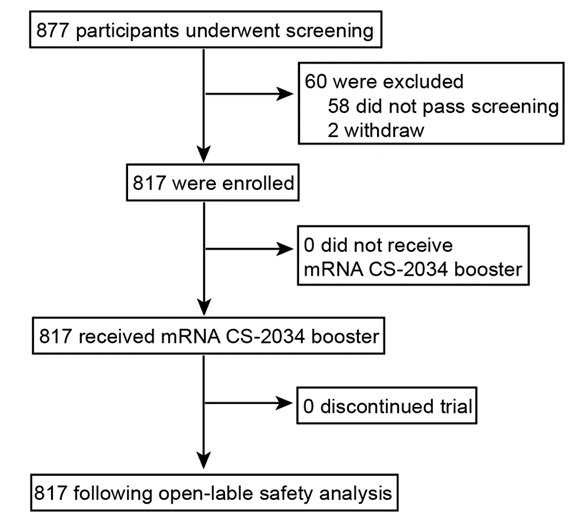
The diagram represents all enrolled participants through September 21, 2022. Figure 1: Trial profile.
| Characteristic | Age of 18-59 years | Age of ≥60 years | All Participants |
|---|---|---|---|
| Age, years, mean (SD) Sex-no (%) | |||
| Male | 208(42.55) | 58(36.48) | 338(41.37) |
| Female | 379(57.45) | 101(63.52) | 478(58.63) |
| Medical history or existing disorder | |||
| Yes-no (%) | 249(37.84) | 91(57.23) | 340(41.62) |
| No-no (%) | 409(62.16) | 68(42.77) | 477(58.38) |
| Body -mass index* | 24.44+3.45 | 25.32+3.32 | 24.61+3.44 |
Table 1: Demographic Characteristics of the Participants at Baseline.
*The body-mass index is the weight in kilograms divided by the square of the height in meters. #Plus-minus values are mean ±SD. Table 1: Demographic Characteristics of the Participants at Baseline.
Preliminary Safety Data
Within 28 days after boosting, all adverse reactions occurred within 14 days and no adverse reactions occurred within 30 min and 15-28 days after the booster (Table 2). 4 participants had serious adverse events, none of which were considered by the investigators to have been vaccine-related, and were not included in the following analysis. No deaths or adverse events led to discontinuation from the study within 28 days (Table 3). The overall incidence of solicited adverse reactions within 28 days was 61.57% (503 cases).
The main adverse events were grade 1 (43.21%) and grade 2 (15.67%), and no grade 4 or above adverse events occurred (Table 3). Local adverse events, when present, were nearly all mild or moderate, including pain (56.18%), pruritus (16.40%), swelling (13.46%), induration (13.34%), and erythema (11.26%) at the injection site (Figure 2 and Table 3). The most common systemic adverse reactions were fever (12.48%) and fatigue (12.00%). Grade 3 systemic solicited adverse reactions were fever, fatigue, headache, and myalgia, with incidence rates of 1.84% (15 cases), 0.49% (4 cases), 0.49% (4 cases), and 0.24% (2 cases), respectively (Figure
2 and Table 3). Moreover, the overall incidence of non- solicited adverse reactions within 28 days was 3.92% (32 cases), among which grade 1 adverse reactions were 2.82% (23 cases), grade 2 were 0.98% (8 cases), and grade 3 were 0.12% (1 case), manifested as upper abdominal pain. No grade 4 or above adverse reactions occurred (Table 3).
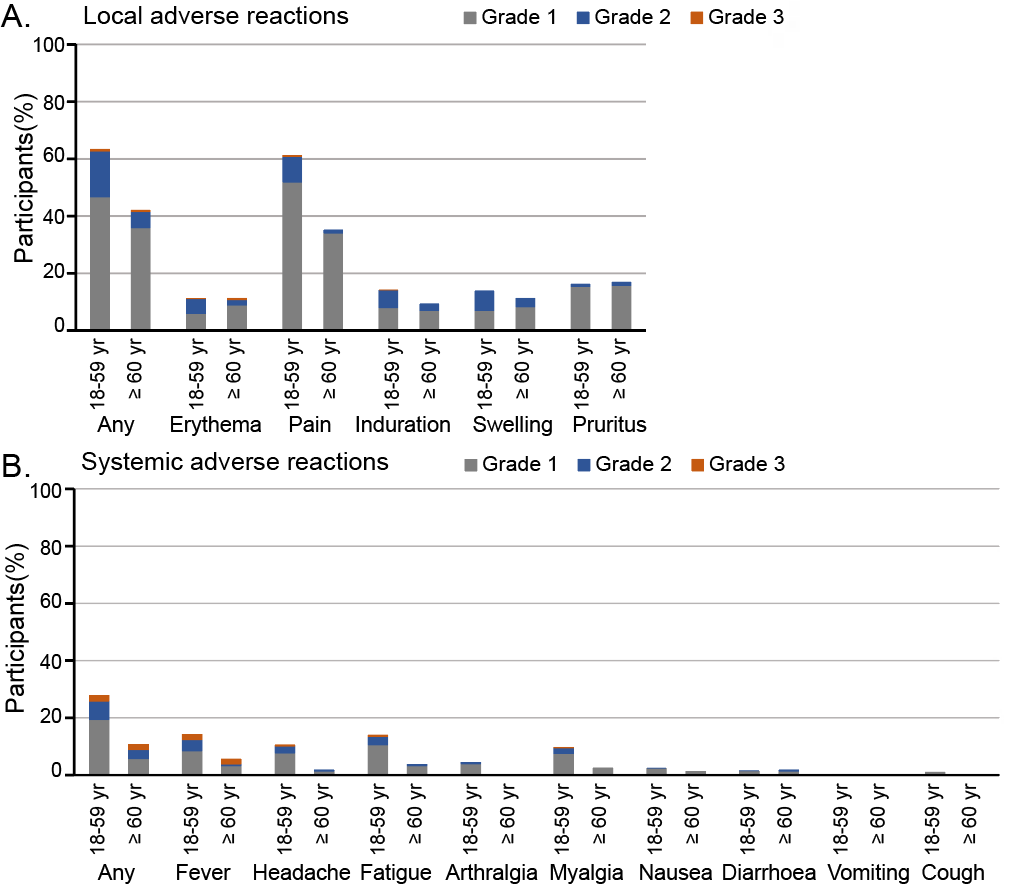
A: The local adverse reactions in participants aged 18-59 years or ≥ 60 years. B: The systemic adverse reactions in participants aged 18-59 years or ≥ 60 years. The severity of solicited adverse events was graded as Grade 1, Grade 2, Grade 3, or Grade 4. Figure 2: Solicited systemic and local adverse reactions within 28 Days after the heterologous booster.
| Age of 18-59 Years N=658 | Age of ≥ 60 Years | All participates N=817 | |
|---|---|---|---|
| Adverse reactions occurrence time n (%) | |||
| 0-30 min | 0 | 0 | 0 |
| 0-14 days | 435(66.11) | 69(43.40) | 504(61.69) |
| 15-28 days | 0 | 0 | 0 |
| Total | 435(66.11) | 69(43.40) | 504(61.69) |
Table 2: Adverse reactions occurrence time.
Reactogenicity events among the participants aged 18-59 years and 60 years or older were imbalance for the incidence of adverse events (66.11% vs. 43.40%), solicited adverse events (65.96% vs. 43.40%), and unsolicited adverse events (4.41% vs. 1.89%) (Table 3). The symptoms of adverse reactions were similar between the two age groups. Fever (14.13% vs. 5.66%), headache (10.64% vs. 1.89%), fatigue (13.98% vs. 3.77%), Myalgia (9.73% vs. 2.52%), and other symptoms were more common in participants between the ages of 18 and 59 years compared with age 60 or older (Table 3 & Figure 2). In general, the incidence of adverse reactions in participants aged 60 or older is lower than that in 18-59 years old. Safety monitoring will continue for 6 months after the administration of the heterologous mRNA vaccine CS-2034. Taken together, the mRNA vaccine CS-
2034 heterologous booster in healthy people aged 18 years or older is safe and well tolerated, and no serious adverse reactions related to the experimental vaccine have occurred.
| Age of 18-59 years N=658 | Age of ≥ 60 years N=159 | All participants N=817 | |
|---|---|---|---|
| Solicited adverse reactions n (%) | |||
| Any | 434(65.96) | 69(43.40) | 503(61.57) |
| Grade 1 | 300(45.59) | 53(33.33) | 353(43.21) |
| Grade 2 | 116(17.63) | 12(7.55) | 123915.67) |
| Grade 3 | 18(2.74) | 1(2.52) | 22(2.69) |
| Serious | 0 | 0 | 0 |
| Deaths | 0 | 0 | 0 |
| Solicited adverse reactions n (%) | |||
| Any | 417(63.37) | 67(42.14) | 484(59.24) |
| Grade 3 | 5(0.76) | 1(0.63) | 6(0.73) |
| Erythema | 74(11.25) | 18(11.32) | 92(11.26) |
| Pain | 403(61.25) | 56(35.22) | 459(56.18) |
| Induration | 94(13.98) | 15(9.46) | 109(13.34) |
| Swelling | 92(13.98) | 18(11.32) | 110(13.46) |
| Pruritus | 107(16.26) | 27(16.98) | 134(16.40) |
| Solicited adverse reactions n (%) | |||
| Any | 183(27.81) | 17(10.69) | 200924.48) |
| Grade 3 | 14(2.13) | 3(1.89) | 17(2.08) |
| Fever | 93(14.13) | 9(5.66) | 102(12.48) |
| Fever, grade 3 | 12(1.82) | 3(1.89) | 15(1.84) |
| Headache | 70(10.64) | 3(1.890) | 73(8.94) |
| Headache, grade 3 | 4(0.61) | 0 | 4(0.49) |
| Fatigue | 92(13.98) | 6(3.77) | 98(12.00) |
| Fatigue, grade 3 | 4(0.61) | 0 | 4(0.49) |
| Arthralgia | 29(4.41) | 0 | 29(3.55) |
| Myalgia | 64(9.73) | 4(2.52) | 6898.32) |
| Myalgia, grade 3 | 2(0.3) | 0 | 2(0.24) |
| Nausea | 16(2.43) | 2(1.26) | 18(2.20) |
| Diarrhoea | 10(1.52) | 3(1.89) | 13(1.59) |
| Vomiting | 2(0.30) | 0 | 2(0.24) |
| Cough | 7(1.06) | 0 | 790.86) |
| Solicited adverse reactions n (%) | |||
| Any | 29(4.41) | 3(1.89) | 32(3.92) |
| Grade 1 | 22(3.34) | 1(0.63) | 2392.82) |
| Grade 2 | 6(0.91) | 2(1.26) | 8(0.98) |
| Grade 3 | 1(0.15) | 0 | 1(0.12) |
Table 3: Solicited and unsolicited adverse reactions that occurred within 28 d after booster.
Discussion
This preliminary evaluation describes the safety of a heterologous booster dose of mRNA vaccine CS-2034 in 817 participants who had been vaccinated three-dose of the inactivated vaccines at least 6 months previously. The safety profiles after a single booster injection of mRNA vaccine CS-2034 were generally similar to those observed after the BNT162b2 (Pfizer–BioNTech) or mRNA-1273, mRNA- 1273.351 or mRNA-1273.211 (Moderna) injection [11, 12, 13]. In agreement with the previous trials, pain (56.18%) at the injection site was the most commonly solicited adverse reaction in this trial. The most common systemic adverse reactions after the booster doses were fever (12.48%), fatigue (12.0%), headache (8.94%), myalgia (8.32%), and arthralgia (3.55%), which occurred at similar-to-lower frequencies for the CS-2034 boosters than after receipt of the BNT162b2 or mRNA-1273 primary series. No grade 4 or above adverse reactions occurred (Table 3).
The mRNA vaccine CS-2034 booster had an acceptable safety and reactogenicity profile with mostly mild-to- moderate local and systemic adverse reactions which were transient and either managed with a simple standard of care or resolved spontaneously. Mild or moderate headache was more prevalent in the younger participants (10.64%, 18-59 years of age) than in older participants (1.89%, 60 years or older). Older participants had a lower frequency of several systemic adverse reactogenicity events than younger participants (any grade of fever (14.13% vs. 5.66%), headache (10.64% vs. 1.89%), fatigue (13.98% vs. 3.77%), Myalgia (9.73% vs. 2.52%), indicating a potential favorable systemic reactogenicity profile in the older population compared with younger populations.
This trial and its preliminary report have several limitations. With approximately 817 participants with a 2-month follow-up time after the booster, the study has a 95% probability of detecting at least one adverse event, if the true incidence is 0.5%, but it is not large enough to detect less common adverse events reliably. This interim report of follow-up of participants through day 28, the occurrence of adverse reactions more than 28 days after the booster remains to be determined. Collection of specimens, as well as monitoring for medically attended adverse events, development of new chronic medical conditions, and serious adverse events, was scheduled to continue through 6 months after the booster. These initial findings will be updated with final safety data when the results are available.
Conclusion
In conclusion, these preliminary findings show that in healthy people over the age of 18 years, the mRNA vaccine CS-2034 has a favorable safety profile, with adverse events mainly mild or moderate, and no grade 4 or above adverse reactions occurred. Moreover, CS2034 is more tolerant and safer in older people, a group that is particularly at risk for illness and death caused by COVID-19.
Acknowledgments
We would like to thank all the support staff, including public health personnel, laboratory staff, and the vaccine registry team for their support, assistance, and the data they provided.
Disclosure Statement
No potential conflict of interest was reported by the authors.
Funding
This work was supported by the Science and Technology Commission of Shanghai municipality under Grant 22YJ1900700 and the Key R&D Program of Yunnan Province under Grant 202003AC100009.
References
-
Costa Clemens SA, Weckx L, Clemens R, Almeida Mendes AV, Souza AR, et al. (2022) Heterologous versus homologous COVID-19 booster vaccination in previous recipients of two doses of CoronaVac COVID-19 vaccine in Brazil (RHH-001): A phase 4, non-inferiority, single blind, randomised study. Lancet 399(10324): 521-529.
-
Seki Y, Yoshihara Y, Nojima K, Momose H, Fukushi S, et al. (2022) Safety and immunogenicity of the Pfizer/ BioNTech SARS-CoV-2 mRNA third booster vaccine dose against the BA.1 and BA.2 Omicron variants. Med (NY) 3(6): 406-421.
-
He Q, Mao Q, An C, Zhang J, Gao F, et al. (2021) Heterologous prime-boost: breaking the protective immune response bottleneck of COVID-19 vaccine candidates. Emerg Microbes Infect 10(1): 629-637.
-
Li J, Hou L, Guo X, Jin P, Wu S, et al. (2022) Heterologous AD5-nCOV plus CoronaVac versus homologous CoronaVac vaccination: a randomized phase 4 trial. Nat Med 28: 401-409.
-
Nilyanimit P, Assawakosri S, Suntronwong N, Auphimai C, Kanokudom S, et al. (2022) Safety and Immunogenicity of the Third Booster Dose with Inactivated, Viral Vector, and mRNA COVID-19 Vaccines in Fully Immunized Healthy Adults with Inactivated Vaccine. Vaccines (Basel) 10(1): 86.
-
Feldman RA, Fuhr R, Smolenov I, Ribeiro AM, Panther L, et al. (2019) mRNA vaccines against H10N8 and H7N9 influenza viruses of pandemic potential are immunogenic and well tolerated in healthy adults in phase 1 randomized clinical trials. Vaccine 37(25): 3326-3334.
-
Alberer M, Vogt UG, Hong HS, Mehr KT, Backert L, et al. (2017) Safety and immunogenicity of a mRNA rabies vaccine in healthy adults: an open-label, non- randomised, prospective, first-in-human phase 1 clinical trial. Lancet 390(10101): 1511-1520.
-
Jackson LA, Anderson EJ, Rouphael NG, Roberts PC, Makhene M et al. (2020) An mRNA Vaccine against SARS-CoV-2 - Preliminary Report. N Engl J Med 383: 1920-1931.
-
Mulligan MJ, Lyke KE, Kitchin N, Absalon J, Gurtman A, et al. (2020) Phase I/II study of COVID-19 RNA vaccine BNT162b1 in adults. Nature 586: 589-593.
-
Chu L, McPhee R, Huang W, Bennett H, Pajon R, et al. (2021) A preliminary report of a randomized controlled phase 2 trial of the safety and immunogenicity of mRNA- 1273 SARS-CoV-2 vaccine. Vaccine 39(20): 2791-2799.
-
Choi A, Koch M, Wu K, Chu L, Ma LZ, et al. (2021) Safety and immunogenicity of SARS-CoV-2 variant mRNA vaccine boosters in healthy adults: an interim analysis. Nat Med 27: 2025-2031.
-
Polack FP, Thomas SJ, Kitchin N, Absalon J, Gurtman A, et al. (2020) Safety and Efficacy of the BNT162b2 mRNA Covid-19 Vaccine. N Engl J Med 383: 2603-2615.
-
Thomas SJ, Moreira ED, Kitchin N, Absalon U, Gurtman A, et al. (2021) Safety and Efficacy of the BNT162b2 mRNA Covid-19 Vaccine through 6 Months. N Engl J Med 385: 1761-1773.
- Epidemiological Surveillance and Rumors on Social Media
- Awareness and Treatment of Uncontrolled Hypertension in US Overweight/Obese Youths Aged 16–24 Years, NHANES 2021–2023
- Strengthening EPI Through Parental Engagement: Lessons from Dhaka Slums for IA-2030
- Mothers Knowledge of the Prevalence, Causes, Effects, Prevention and Control of Diarrhoea among Children in Ife East Local Government Area, Ile Ife, Osun State, Nigeria
- Covid-19 Reinfections Case Series from October 2023 to October 2024 in A General Medicine Office in Toledo (Spain)
- Water Contact! One Risk Too Many: Risk Factors Associated with Schistosoma haematobium infection in Osun State, Nigeria