
The Niosh Method Analysis Model Uses Digital Human Modeling
Niosh method is used to obtain Lifting Index (LI) for single task and Composite Lifting Index (CLI) for multi-task work. Getting the value of the Niosh variable as well as getting the results of the analysis requires people to do the work. In this research, Digital Human Modeling (DHM) Tecnomatix Jack is used as a simulator to get Niosh variables and software development using PHP programming language to get LI or CLI results. The result is that DHM can help get the Niosh variable even though the work station has not been created because it can be done by simulation. Software is tested by black box testing and the results are valid.
Introduction
The World Health Organization (WHO) and the International Labor Organization (ILO) have developed estimates of the burden of occupational diseases and injuries [1]. Diseases due to incorrect work posture include MSD [2]. Analysis methods related to occupational risks include: NIOSH, RULA, OWAS, REBA [3]. A work risk analysis method is needed that can be determined preventively so that work-related risks can be avoided. NIOSH (National for Occupational Safety and Health) is an institution that handles matters related to occupational safety and health issues in the United States [4]. The NIOSH lifting equation is a method for evaluating the risk of back injury with two-handed lifting activities and recommending solutions for identified hazards [5]. NIOSH is an institution that issues a Recommended Conceptual Paper Weight Limit (RWL), which is a recommendation for a load limit that can be lifted by humans without causing injury even though the work is done repetitively and over a long period of time [6]. After the RWL value is known, the next step is to calculate the Lifting Index value, to find out the lifting index that does not contain the risk of spinal cord injury. If the LI is less or equal to 1, then the activity does not carry the risk of spinal cord injury. If the LI is more than 1, then the activity carries a risk of spinal injury [6]. To get the value of the Niosh variable requires a work simulation on an existing workstation. For this reason, a method is needed so that the analysis can be carried out in a preventive manner. It is important for workers to know before working.
Digital Human Modeling is a technology of how to simulate a virtual human [7]. Currently, DHM is able to simulate work processes such as features in the Tecnomatix Jack software version 9 on the task simulation builder (TSB) menu [8]. TSB is able to make work process simulations. Created software using the PHP programming language with the Laravel framework to calculate the Lifting Index for single task work and Composite Lifting Index for Multi Task work.
A work analysis method is needed using the Niosh method related to the Lifting Index which can be applied preventively. A simulator is needed that can simulate the work process preventively so that the work station design can be done repeatedly until optimal conditions can be obtained. Preventive work risk analysis methods can avoid work-related risks because before working workers already know the risks that may occur. Digital Human Modeling and software development are needed that can solve these problems.
Objectives
The objective of this research is to solve the problem of how to get the Niosh variable if the work station has not been created. The use of DHM will be tested to get the Niosh variable. The data will be processed using software made using the PHP programming language.
Literature Review
Occupational injury prevention research in NIOSH, this paper provides a brief summary of the current strategic objectives, activities, and impacts of the NIOSH (National Institute for Occupational Safety and Health) occupational injury research program. Three key drivers (injury database, stakeholder input, and staff capacity) were used to define the focus of NIOSH’s research to maximize the relevance and impact of NIOSH’s injury prevention research program [6]. In the paper Improving the risk assessment capability of the revised NIOSH lifting equation by incorporating personal characteristics, calculating risk using the Niosh method with manual calculations [9]. The interpretation of the calculated result of the revised NIOSH Lifting Equation (RNLE) has been problematic because the relationship of the calculated result to back injury risk has not always been either well understood or consistently interpreted. During the revision of the ISO standard 11228–1 (Manual lifting, lowering and carrying), an extensive literature review was conducted on validation studies of the RNLE [10]. In the journal that discusses the Niosh method, there is no method to get the Niosh variable in a simulation. So, it is necessary to do research related to the Niosh analysis model using tools to make it easier to get variables and their analysis.
Methods
DHM Tecnomatic Jack version 9 is used to model and simulate work processes at work stations. From the work process, the variables needed by Niosh can be obtained. The data obtained is processed using software made using the PHP programming language. The test is carried out on workers who move boxes using a conveyor on single task work and workers who move boxes to valet on multitask workers. Software tested by black box testing method
Data Collection
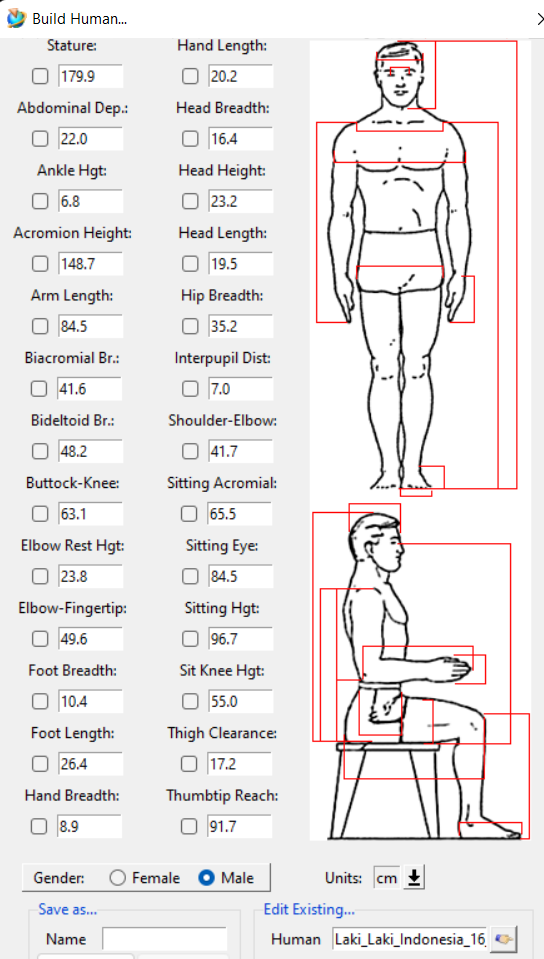
In this study, anthropometric data were obtained from https://antropometriindonesia.org [11] using the average data for males aged 16 to 47 years.
Results and Discussion
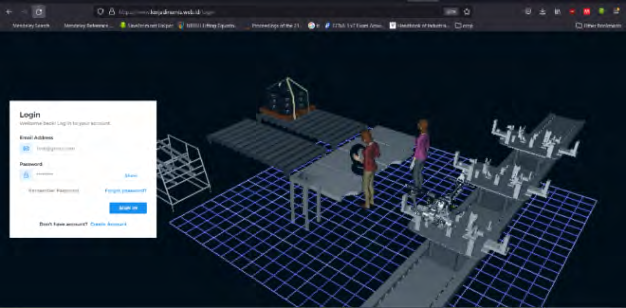
The software display is shown in Figure 1 which can be accessed at https://kerjadinamis.web.id. To be able to calculate work risk using the Niosh method, login with the username niosh@kerjadinamis.web.id with the password 123456. After logging in, you can choose whether to perform calculations for single task or multi-task. By entering the variables on the display the software can calculate the Lifting Index for single task jobs and calculate the composite lifting index for multi task jobs (Figure 1).
In Digital Human Modeling Tecnomatix Jack, it begins by entering human data that will perform the work on the simulation as shown in Figure 2.
The process is continued by making simulations, where in this study for single task work is the work process of moving boxes from one conveyor to another with different heights as shown in Figure 3 for single task work and Figure 4 moving boxes from conveyor to valet for multi task work (Figures 3 & 4).
From the simulation shown in Figure 3 and Figure 4, the value of the niosh variable can be obtained using the ruler in TSB. The value of the variable height, distance to the load, etc. can be obtained from the simulation results.
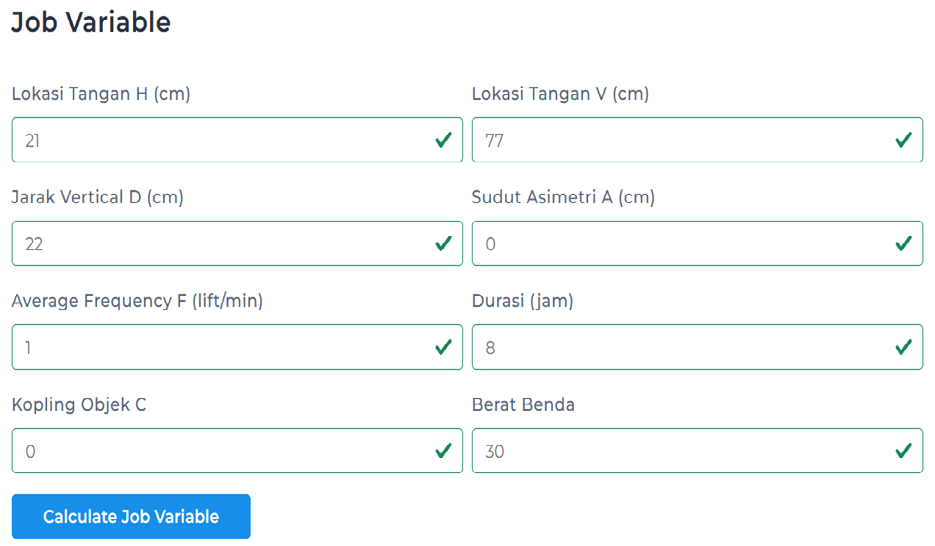
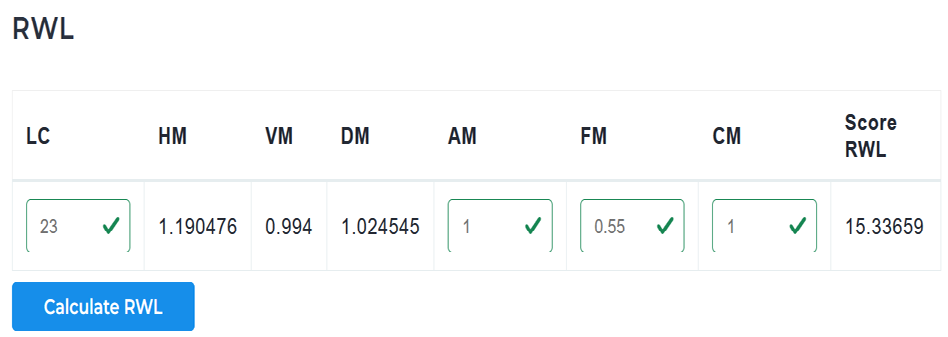
Calculations on a single task job on the software are shown in Figure 6 to include variables. Figure 5 to calculate RWL and Figure 7 to get the LI (Figures 5-7).
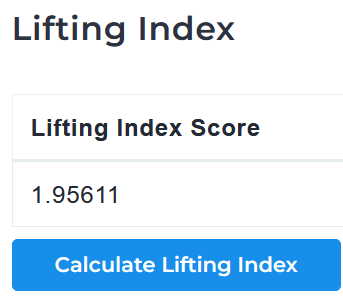
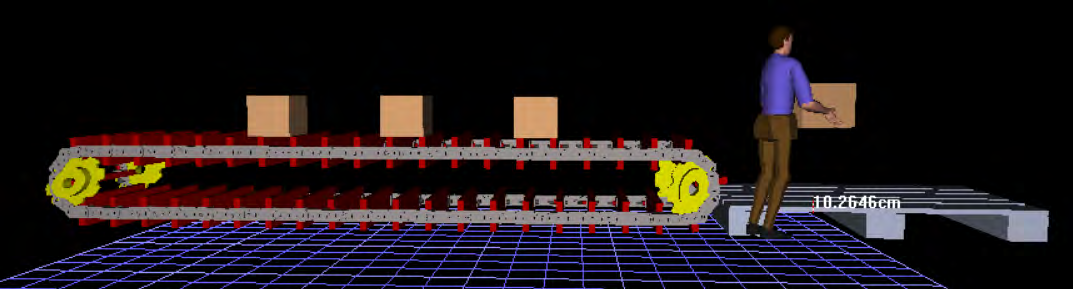
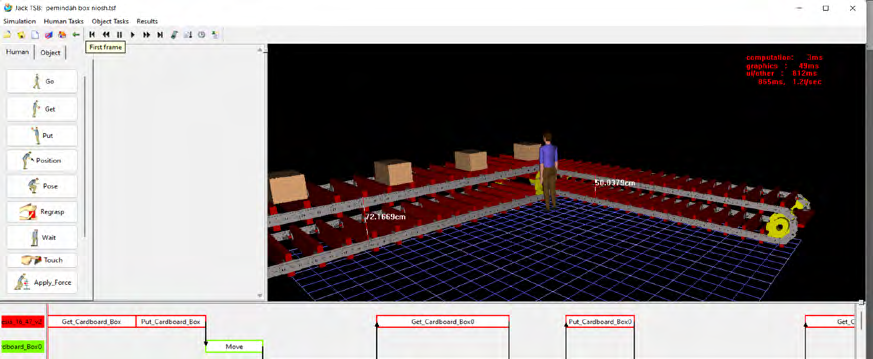
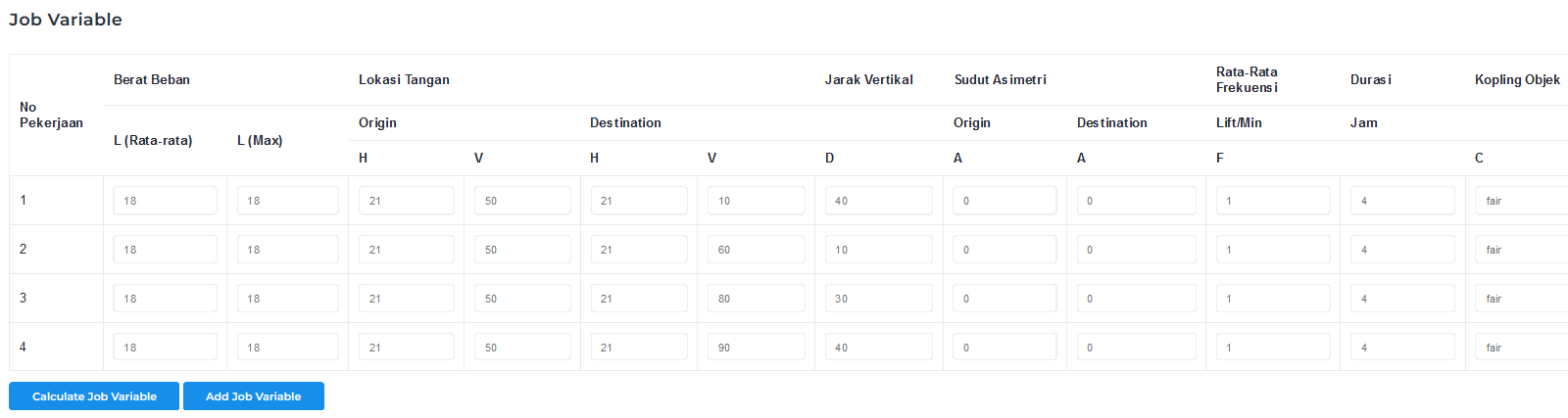
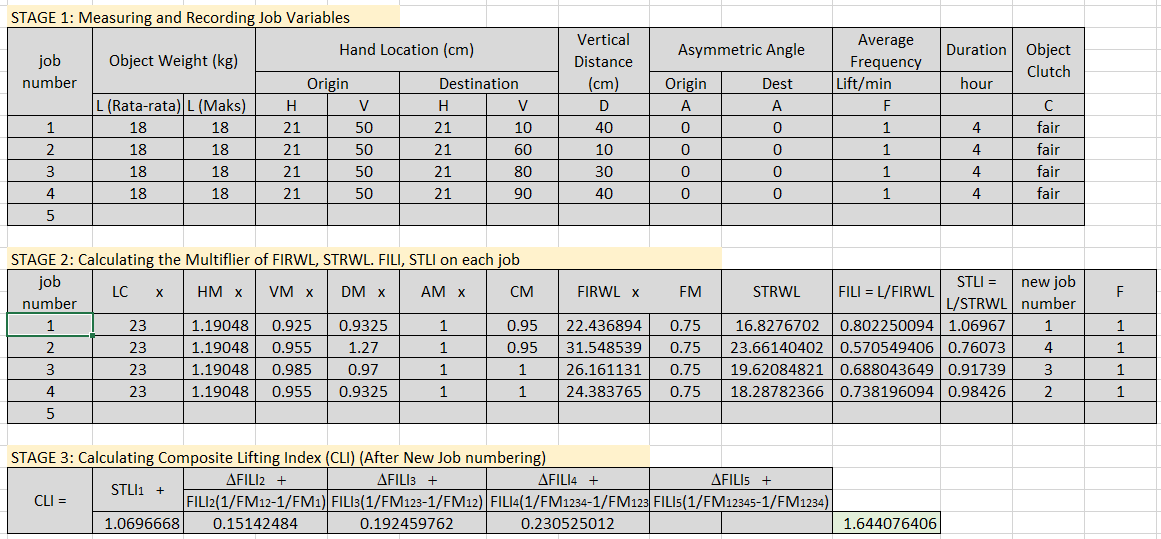
Figure 8 shows the variables entered in multi-task work. Then in Figure 9 calculates the multiflier component that will affect the number of boxes that are moved in different positions and Figure 10 shows the results of the calculation of the composite lifting index.

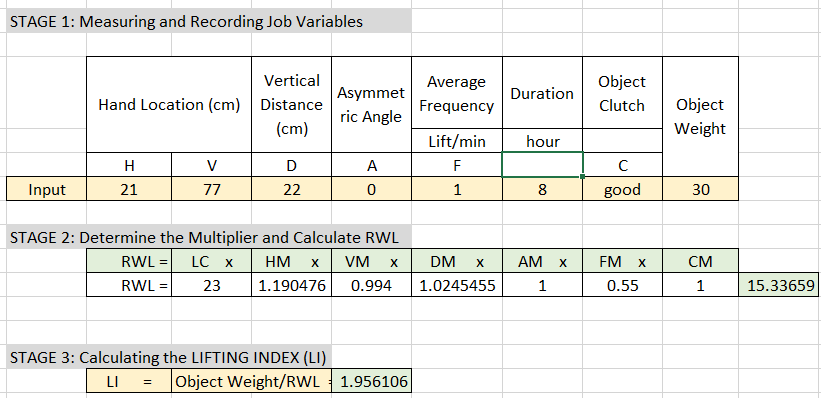
The comparison of the calculation results for a single task using excel software is shown in Figure 11
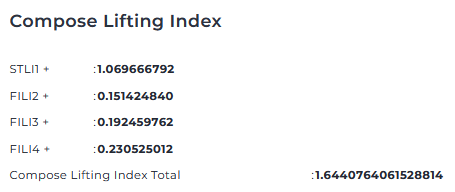
Figure 7 shows the LI calculation using the software made and Figure 11 the LI calculation using the excel software shows the same results.
It was continued by testing the results of the CLI calculations using excel software calculations and using the software created. Figure 12 shows the results of the CLI calculation using the excel program.
The results of the CLI calculations using the excel program and the program created show the same results (Figure 13).
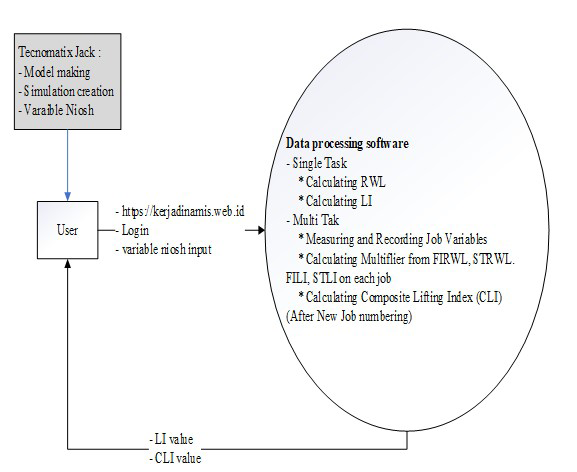
The analysis process diagram of the Niosh Method with DHM is shown in Figure 13. The validity of the Digital Human
Modeling Tecnomatix Jack to get the Niosh variable from the modeling process, the simulation was tested using the Black Box Testing Method. The same thing is done to test the validity of the software made. The test includes the process of logging into the https://kerjadinamis.web.id domain, the login process, and the process of getting the Lifting Index (LI) for single tasks and the Composite Lifting Index (CLI) for multi-tasking tested using the Black box testing method. The results obtained from the tests carried out stated that DHM and the software made obtained the expected results.
The results of the Black Box Testing test are shown in Table 1. By using DHM and software, an ergonomic analysis of the work process can be analyzed more quickly and accurately. Errors in the design of the work station in a simulation can be identified so that repairs to the work station can be carried out in a preventive manner so that the risks due to work can be avoided. Work station design can be repeated with the simulator until optimal results are obtained. Tecnomatix Jack’s Digital Simulator can simulate workers according to their anthropometry. Anthropometry can be obtained from Jack’s tecnomatix data or from secondary data such as those found at https:// antropometriindonesia.org or it can also be carried out by direct measurements with an anthropometer. The resulting model can be simulated using the task simulation builder menu. The simulation results can determine the required niosh variable so that the risk calculation of the lifting index or composite lifting index can be carried out according to the NIOSH method using the software created. This method can be done preventively before the actual work station is made.
| User Acceptance Test Document | Doc No: I | ||||||
|---|---|---|---|---|---|---|---|
| Niosh Method Using Digital Human Modeling | Tester: Software Developer | ||||||
| Test Items: Niosh Models with DHM | |||||||
| Test ID | Input Menu | Test Results | |||||
| Test description | Testing Procedure | Input Data | Expected output | Results obtained | Received | Rejected | |
| I. DHM | |||||||
| 1.1 | Modeling on the Tecnomatix Jack | 1. Human modeling 2.0bject model reaction 3. Environmental modeling | I. Human anthropometric data | Human Model, object, environment | Human Model, object, environment | Received | |
| 2. Modeling conveyor and valet | |||||||
| 3.The environment | |||||||
| 1.2 | Work simulation process | 1. TSB menu | 1.Creatinga work process 2.Gettingthe Niosh | Niosh variable | Niosh variable | Received | |
| 2. Make a simulation 3.Get the niosh. Variable | |||||||
| 2. Login Page | |||||||
| 2.1 | Login Page | l. https://kerjadinamis. web.id | 1.https://kerjadinamis.web. id | Web Page | Web Page | Received | |
| 2.2 | Login | l. https://kerjadinamis. web.id | 1. Username: niosh@ kerjadinamis.web. 2.Password : l23456 | Niosh page | Niosh page | Received | |
| 2. Select login | |||||||
| 3. Niosh Analysis for Single Task | |||||||
| Variable Value | Variable Jobs | LC, HM, VM, DM, AM, FM, CM | Variable Data | Variable Data | Received | ||
| 3.2 | RWL | Multiplying data variables | Enter variable value | RWI | RWI | Received | |
| 3.3 | LI | weight of load divided by RWL | 1. Load weight | LI | LI | Received | |
| 2. RWL | |||||||
| 4. Niosh Analysis for Multiple Tasks | |||||||
| 4.1 | Variable Value | Measuring and Recording Job Variables | LC, HM, VM, DM, AM, FM, CM | Variable Data | Variable Data | Received | |
| 4.2 | Calculating Multiplier from FIRWL, STRWL. FILI , STLI | Enter a variable to calculate the Multiplier of FIRWL, STRWL. FILI , STLI | LC, HM, VM, DM, AM, FM, CM, FIRWL, STRWL, FM, | job order number, the value of each data | job order number , the value of each data | Received | |
| FILI=L/ FIRWL, STLI=L/ STRWL. | |||||||
| 4.3 | CLI | Calculate using the CLI rumus formula | Enter a variable to calculate the CLI | CLI | CLI | Received |
Conclusion
- The use of DHM can be used to find the value of the Niosh variable. Because it is in the form of a simulation, it is easy to make design changes and can be done preventively.
- The work risk calculation software using the Niosh method is placed at https://kerjadinamis.web.id and can show the results of the Lifting Index calculation for single tasks and the Composite Lifting Index for multi task work.
Acknowledgements
Thank you to Siemens Software Industries for providing a free license for the tecnomatix jack ver.9 software to the Faculty of Engineering, Udayana University which was used as Digital Human Modeling software in this research. Thank you LPPM Unud for facilitating research at Udayana University.
References
-
Hulshof CTJ, Pega F, Neupane S, Colosio C, Daamsa JG, et al. (2021) The Effect of Occupational Exposure to Ergonomic Risk Factors on Osteoarthritis of Hip or Knee and Selected Other Musculoskeletal Diseases: A Systematic Review and Meta-Analysis from the WHO/ ILO Joint Estimates of the Work-Related Burden of Disease And Injury. Environ Int 150: 106349.
-
Sekkay F, DanielImbeau, Dubéa P, Chinniah Y, Marcellis- Warina N, et al. (2021) Assessment of Physical Work Demands of Long-Distance Industrial Gas Delivery Truck Drivers. Appl Ergon 90: 103224.
-
McAtamney L, Corlett EN (1993) RULA: A Survey Method for the Investigation of Work-Related Upper Limb Disorders. Appl Ergon 24(2): 91-99.
-
Iskandar MZ, Iqbal M (2019) Analisis Efektifitas Kerja Pengangkatan Beban Pada Bagian Pengantongan Di Pt. Pupuk Krueng Geukuh. Ind Eng J 8: 2.
-
Cahyawati AN (2018) Analisis Manual Material Handling Pada Pengangkatan Batu Bata Dengan Metode Lifting Index. Semin Nas Teknol dan Rekayasa.
-
Hsiao H, Stout N (2010) Occupational Injury Prevention Research in NIOSH. 1st(Edn.), Saf Health Work 1(2): 107- 111.
-
Duffy VG (2016) Handbook of Digital Human Modeling. 1st(Edn.),Technology & Engineering, CRC Press, America.
-
SPLM (2017) TSB User’s Guide. Siemens PLM.
-
Barim MS, Sesek RF, Capanoglu MF, Drinkaus P, Schall MC, et al. (2019) Improving The Risk Assessment Capability of the Revised NIOSH Lifting Equation by Incorporating Personal Characteristics. Appl Ergon 74: 67-73.
-
Fox RR, Lu ML, Occhipinti E, Drinkaus P, Jaeger M (2019) Understanding outcome metrics of the revised NIOSH lifting equation. Appl Ergon 81: 102897.
-
Indonesia PE, The Largest Antropometri Data in Indonesia, PEI.
- The Expanding Landscape of Road Rage: A Systematic Review of Conflicts Involving Drivers, Pedestrians, and Micromobility
- Validating Cognitive Models of Royal Navy Performance on Control Systems
- Comparing Standard and State-of-the-art Firefighter Coats on Postural Balance and Gait in a Live Burn Environment
- Investigating the Integration of Telemedicine into Clinicians Workflow: A Review of Methods
- Risk Assessment of Ergonomic Factors in a Textile Firm by RULA, REBA and Fine Kinney Methods
- Impact of Self-Esteem Training on Individuals with Disabilities Aged 17-30