
Dynamic Work Analysis of Manual Material Handling With Digital Human Modeling
The activity of loading and unloading rice in Indonesia is still carried out using human power. Porters transport rice manually from truck to warehouse or the otherwise. Manual material handling work (MMH) will pose a risk of musculoskeletal disorders (MSDs). The application of the work analysis method generates an analysis per one body position only. There is a need for a model that can perform a work analysis quickly for any change in body movement if it is carried out in dynamic work, for instances on rice porters. In this research, Digital Human Modeling Tecnomatix Jack is used in the Task Simulation Builder menu to simulate dynamic work and generate analysis. The dynamic work carried out is to compare the risk of transporting rice weighing 10 kg and 25 kg. The results obtained are Ergonomic Report, Static Strength Prediction (SSP), Low Back Compression Analysis (LBA), Fatigue, Cumulative Loading and Metabolic Energy Expenditure (MEE). The simulator also provides the SSV file extension as in SSP. If needed, this result can be entered in a formula according to work analysis method such as RULA or REBA so that every change in movement obtained results related to the risk that may occur.
Introduction
Manual material handling (MMH) work poses a risk of musculoskeletal disorders (MSDs), increasing local muscle fatigue due to the large number of muscle contractions involved and low back pain (LBP) [1]. National Institute of Occupational Safety and Health discovered NIOSH method that analysed posture according to the resulting compression force and recommended a safe load to work on [2]. Rapid Upper Limb Assessment (RULA) was a method developed in 1993. The use of the RULA posture assessment method was a method developed by McAtamney & Nigel Corlett [3] which invested and assessed working position performed by the upper limb [4]. Then in 1995 the Rapid Entire Body Assessment (REBA) method appeared [5].
Each work method provides analysis for each body position while working. If the work is done dynamically and calculation of the work analysis is done manually then the process of getting the results of the analysis takes a long time and there is the risk of calculation errors. To overcome this problem it is necessary to use technology in conducting analysis. The development of simulation technology using Digital Human Modeling (DHM) is currently growing rapidly [6].
DHM software are growing in the world, including: Tecnomatix Jack [7], Ramsis (Human Solutions), HumanCad (Nexgen Ergonomics), 3DSSPP (University of Michigan), Poser (Smith Micro), MakeHuman (freeware), Anybody (Anybody Technology), Catia (Dassault Systemes), Daz Studio (DAZ 3D Inc), Quidam (N-Sided), Santos (University of Iowa), Sammie (Sammie CAD Ltd) [8]. Each DHM has its own strength and weakness in its feature.
Tecnomatix Jack produced by Siemens has developed DHM software which currently adds the analysis of dynamic work through Task Simulator Builder (TSB) [9]. The current use of DHM still has several limitations in simulating activity carried out by the original porters. The digital human modeling automation system uses Kinect, a Microsoft Xbox data input device, to model human movement. This system is designed to utilize several Kinect, and data models convey and manage data from these devices to calibrate algorithms that can be used to create digital human models. Through this system it is possible to easily produce digital human models accurately, cheaply and efficiently [10]. However, if you want to include fatigue analysis from design, you will need the ability to create work simulations using DHM.
Materials and Methods
The research location is at Bulog, Kediri Village, Kediri District, Tabanan Regency, Bali Province, Indonesia. Due to COVID-19, the anthropometric data of workers uses anthropometric data from Indonesians on the Indonesian Ergonomics Association (PEI) website. The data used are male data with 50% percentile and age according to the data of porters at Bulog Kediri. Worker anthropometry data can be accessed on the website https://antropometriindonesia.org/ index.php/detail/article/4/10/data_anthropometry [11].
Anthropometric data becomes a human data input in tecnomatix Jack. Simulation of dynamic work processes is carried out in the Task Simulation Builder menu. The distance for the porters to transport rice is 20 m with the number of rice sacks being transported are as many as 3 sacks. The weight of the rice sacks carried is 10 kg and 25 kg, respectively. The simulation results were analysed using the data analysis menu that is available in the Task Simulation Builder (TSB) on the Teknomatix Jack software.
Results
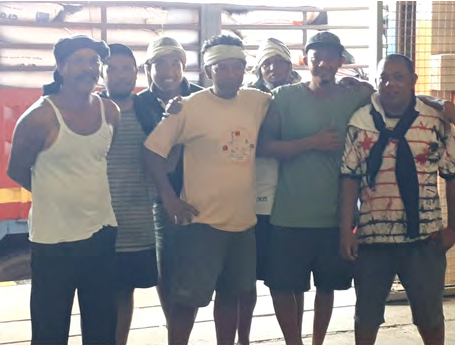
The survey at Bulog Warehouse in Kediri Tabanan found 8 rice porters, with the age of porters ranging from 38 to 47. At the time of the survey at the rice warehouse, the rice unloading process from truck was being carried out to be placed at the Bulog Warehouse. The work process carried out by porters was recorded using a handycam. Figure 1 shows porters transporting rice at Bulog Kediri Tabanan. Table 1 shows the data for workers, including age, weight and height.
| Name | Age (tahun) | Weight (kg) | Height (cm) | |
|---|---|---|---|---|
| 1 | Made Arteyasa | 47 | 65 | 170 |
| 2 | Nyoman Sumardika | 44 | 75 | 170 |
| 3 | Ketut Alit Parcaya | 44 | 63 | 171 |
| 4 | Pande Putu Suarsa | 41 | 80 | 166 |
| 5 | Made Turun | 41 | 69 | 167 |
| 6 | Ketut Parwata | 44 | 65 | 169 |
| 7 | Made Borbor | 38 | 70 | 175 |
| 8 | Made Kebo | 40 | 65 | 167 |
Table 1: Data of Rice Porters.
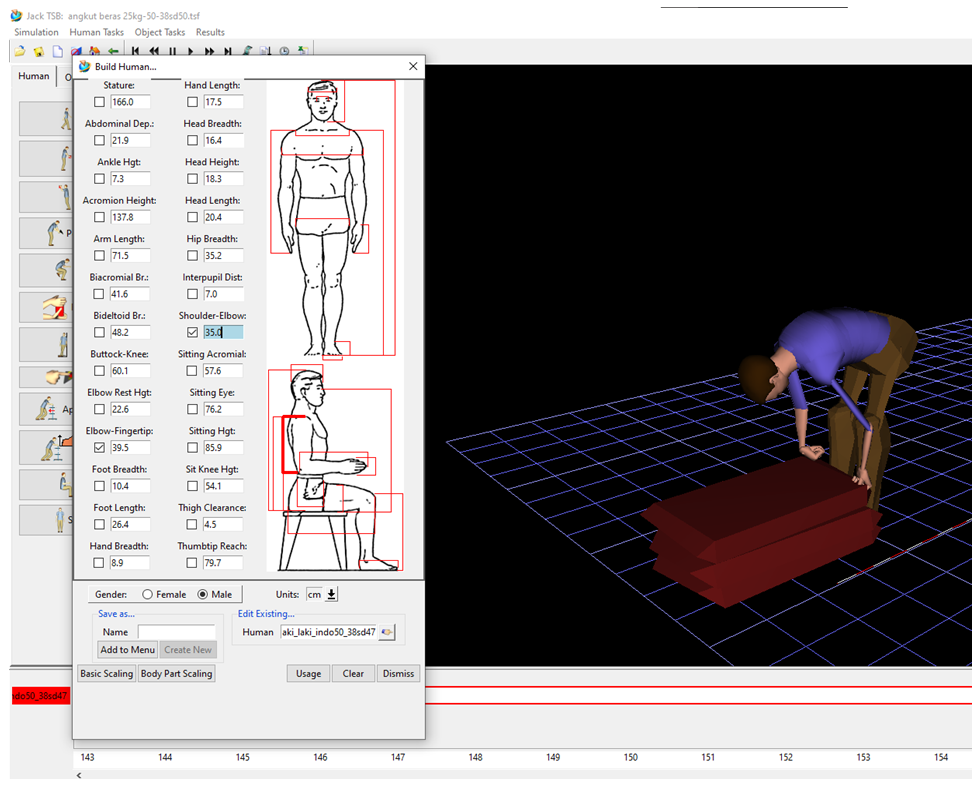
Porter’s data is being input on the Indonesian anthropometric site. The result is as an input for making human models on tecnomatix Jack as shown in Figure 2.
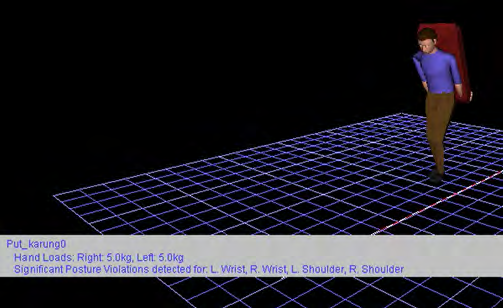
From the human model and rice sacks, they are being input into the TSB to simulate the work process, starting from lifting the rice sacks to lowering the rice sacks at a straight line with distance of 20 meters. The process is repeated for 3 sacks of rice. Figure 3 shows a photo of the simulated process of transporting rice sacks. The simulation uses a straight line with a flat floor. Taking and placing rice sacks on the floor.
The result of simulation generated by TSB include: Ergonomic Report, Static Strength Prediction (SSP), Low Back Compression Analysis (LBA), Fatigue, Cumulative Loading dan Metabolic Energy Expenditure (MEE). Figure 4 shows Ergonomic report analysis, the results obtained show less risk in transporting 10 kg rice compared to 25 kg.
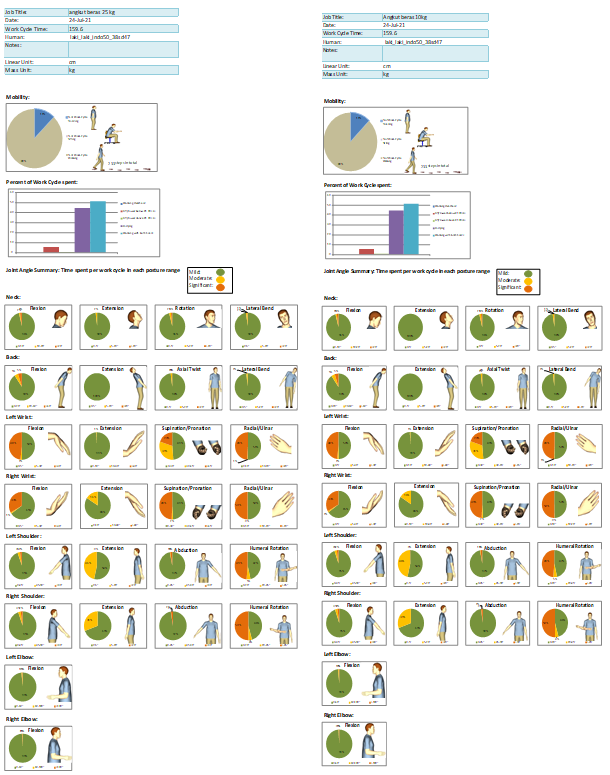
(a)10 kilos of rice (b)25 kilos of rice Figure 4: Analysis of the body parts of the rice porters that are exposed to work.
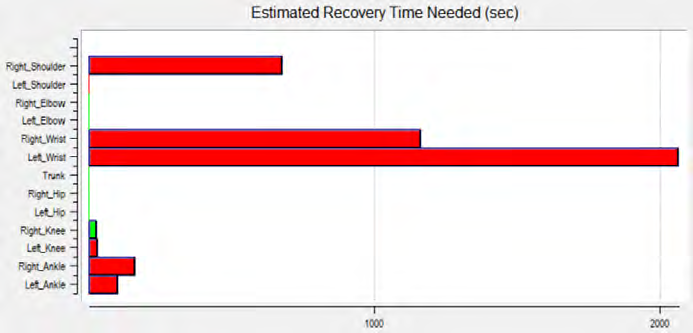
The analysis of worker fatigue is shown in Figure 5a for a weight of 10 kg each and Figure 5b for a weight of 25 kg. In the figures, it can be seen that each recovery time for Right ankle is 159.2 seconds for 25 kg rice sack and 85.1 seconds Left Ankle is required for 10 kg rice sack. For rice porters who carry 25 kg, recovery time required is 676 seconds for Right Shoulder, 1162 seconds for Right Wrist, 2064.9 seconds for Left Wrist, 27.4 seconds for Right Knee, 31 seconds for Left knee, 160.8 seconds for Right Ankle and 101.4 for left ankle. From the comparison result of recovery time, it can be seen that more body parts require more recovery time for workers carrying heavier loads.
In addition to the analysis of the body parts exposed to work, an analysis of fatigue due to the work carried out has also been done. An analysis of the fatigue of porters carrying rice weighing 10 kg and 25 kg, respectively, is shown in Figure 5a for a weight of 10 kg and Figure 5b for a weight of 25 kg. The picture shows that the recovery time for Right ankle is 159.2 seconds and Left Ankle is 85.1 seconds is required for porters carrying 10 kg of rice. For porters carrying 25 kg rice sack, recovery time required is 676 seconds for Right Shoulder, 1162 seconds for Right Wrist, 2064.9 seconds for Left Wrist, 27.4 seconds for Right Knee, 31 seconds for Left knee, 160.8 seconds for Right Ankle and 101.4 for left ankle. From the comparison result of recovery time, it can be seen that there are more body parts that require recovery time for porters carrying heavier loads. For each weight of the rice sack being transported, it is suggested to reduce the weight that must be carried in relation to the exposed body part.
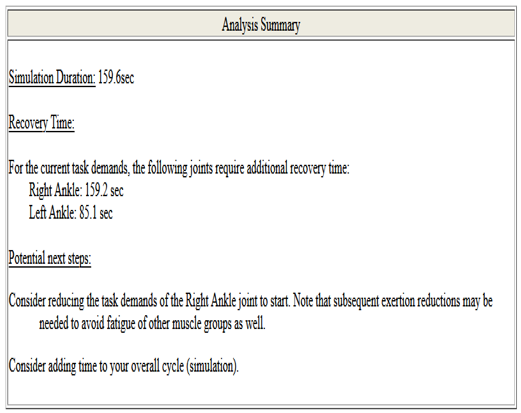
(a)berat beras 10 kg (b)berat beras 25 kg Figure 5: Fatigue analysis on rice porters.
The recovery time of the body parts is also shown respectively in these figures. Figure 6a shows the recovery time for a rice porters weighing 10 kg and Figure 6b shows the recovery time for a rice weight of 25 kg. Muscle Strain
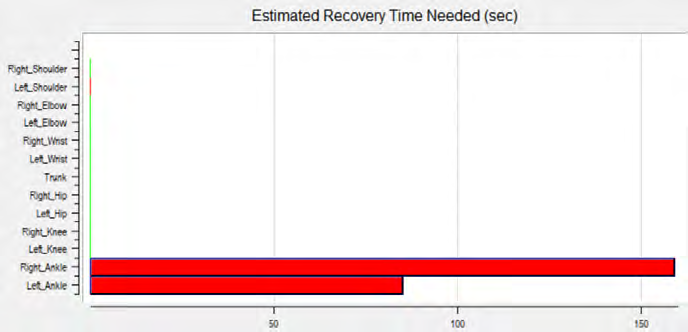
(a)10 kilos of weight (b)25 kilos of weight Figure 6: Estimated recovery time of rice porters.
Time History is shown in Figure 7a for a weight of 10 kg of rice and Muscle Strain Time History for a weight of 25 kg is shown in Figure 7b.
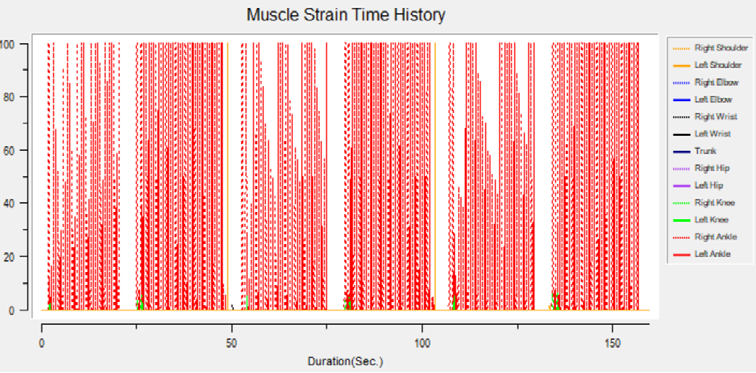
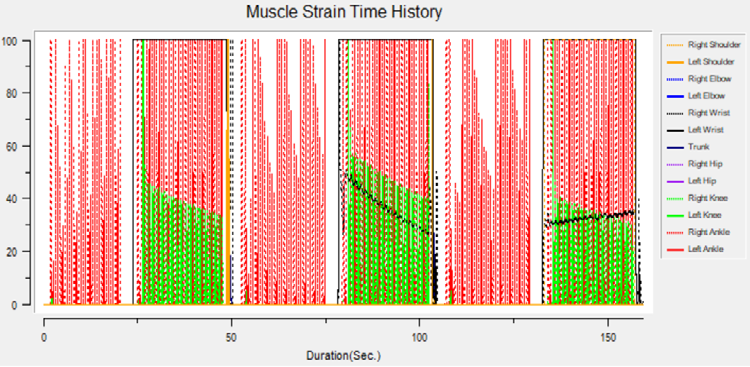
(a)10 kilos of weight (b)25 kilos of weight Figure 7: Muscle Strain Time History of rice porters.
Discussion
SSP and LBA are given in CSV file data on the result of TSB analysis. The resulting data table can be used for further analysis, for instances using the RULA or REBA method. By entering the formula according to the method used, the result for each condition in dynamic work will be obtained. If an interface program is made to translate the data obtained, it can be shown custom or in graphic form.
Conclusion
• Task Simulation Builder on Digital Human Modeling Tecnomatix can be used to analyse dynamic work risks by showing Ergonomic Report, SSP, LBA, Fatigue, Cumulative Loading and MEE.
- Using DHM for risk analysis of Rice Porters, we can compare the risks that occur at different transport loads
- The result of analysis on TSB for SSP and LBA can be developed further using a formula for work analysis method such as RULA or REBA.
References
-
Miswari N, Aulia L, Wahyudi R (2021) Penilaian Postur Kerja Manual Material Handling (Mmh) Pada Gedung Bertingkat Menggunakan Metode Rapid Upper Limb Assessment (Rula). Sebatik 25(1): 262-270.
-
Fox R, Lu M, Ocche, Jaeger M (2019) Understanding Outcome Metrics of the Revised Niosh Lifting Equation. Appl Ergon 81: 102897.
-
Namwongsa S, Puntumetakul R, Neubert MS, Chaiklieng S, Boucaut R (2018) Ergonomic Risk Assessment of Smartphone Users Using The Rapid Upper Limb Assessment (Rula) Tool. Plos One 13(8): e0203394.
-
Bintang N, Dewi SK (2017) Analisa Postur Kerja Menggunakan Metode OWAS Dan RULA. J Tek Ind 18(1): 43-54.
-
Joshi M, Deshpande V (2020) Investigative Study and Sensitivity Analysis of Rapid Entire Body Assessment (REBA). Int J Ind Ergon 79: 103004.
-
Wolf, Kruger D, Miehling J, Wartzack S (2019) Approaching an Ergonomic Future: An Affordance-Based Interaction Concept for Digital Human Models. Procedia Cirp 84: 520-525.
-
PLM S (2020) Academic Partner Program Grant Application. Siemens Industry Software INC., US.
-
Perhubungan D (2020) “Peraturan Menteri Perhubungan Nomor Pm 49 Tahun 2014.” Pusat Data Dan Informasi Kementerian Perhubungan Republik Indonesia.
-
Hovanec M (2017) Digital Factory as a Prerequisite for Successful Application in the area of Ergonomics and Human Factor. Theor Issues Ergon Sci 18(1): 35-45.
-
Jun C, Lee JY, Kim BH, Do Noh S (2019) Automatized Modeling Of A Human Engineering Simulation Using Kinect. Robot Comput Integr Manuf 55: 259-264.
-
P. E. Indonesia, “The Largest Antropometri Data In Indonesia.” Pei.
- The Expanding Landscape of Road Rage: A Systematic Review of Conflicts Involving Drivers, Pedestrians, and Micromobility
- Validating Cognitive Models of Royal Navy Performance on Control Systems
- Comparing Standard and State-of-the-art Firefighter Coats on Postural Balance and Gait in a Live Burn Environment
- Investigating the Integration of Telemedicine into Clinicians Workflow: A Review of Methods
- Risk Assessment of Ergonomic Factors in a Textile Firm by RULA, REBA and Fine Kinney Methods
- Impact of Self-Esteem Training on Individuals with Disabilities Aged 17-30