
Case Studies on the Body Postures and Technical Design of Small Angle Grinders
Our case studies refer to small angle grinders. Work tasks, physical stresses during use, and stresses on the hand-arm system are discussed. For this purpose, a survey was administered to 42 work persons from four different industries. Angle grinders were the most important hand tools for the respondents. They used angle grinders for eight activities (from flexing to polishing). In addition, 17 detailed video analyses of the work processes with 5 different angle grinder makes were carried out in selected workshops. The survey results on working postures in the last week as well as within the last year indicated mainly bent and twisted trunk postures, squatting and kneeling at work. To that extent, these results correspond with the OWAS studies by Ellegast R, et al. The video studies pointed out the very frequent twisted or bent hand-arm postures. The (ergonomically recommended) alignment of tool axis and hand-arm axis is not possible when using angle grinders. Nevertheless, the vast majority of our test subjects are satisfied with the dimensions and characteristics of small angle grinders. The analysis results are transferred into a list of ergonomic requirements for product designers.
Kurt Landau1*, Jurij Wakula2 and Matthias Schwarz2
Introduction and State of Research
In industry and construction, angle grinders are very often used for cutting, grinding, polishing and deburring different materials (e.g. metal, concrete, plastic). These hand-held tools have different weights, speeds, powers and are equipped with cutting or grinding discs of different types depending on the application. However, the design and handling of angle grinders are mainly determined by functionality and technical-technological construction. The ergonomic aspects, especially the analysis of physical workloads and strain, have been neglected to some extent, which means that the devices are adapted to the user to a limited extent only [1].
Overview of Technical and Ergonomic Angle Grinder Studies
We limit the introduction and the discussion of the state of research mainly to the topic of postures and angle grinder design:
An overview on the use of angle grinders is given by Oliveira JFG, et al. [2]. Products from 23 tool manufacturers are evaluated from a technical ergonomic perspective. Various tool manufacturers provide overviews of the technical features and safety aspects of angle grinders (Atlas Copco (without year) or Radionics (2022) as examples) [3]. OSHA [4] addresses user-friendly aids to avoid strenuous postures.
OSHA’s Ergonomics Program addresses measures to improve posture, including for angle grinders (OSHA) [5]. Postures when using handheld angle grinders are discussed using the JACK software in Sun Y, et al. [6]. Upright postures and angle grinders with as little weight as possible result in the lowest disc pressures and low recovery times. A study on the superposed loads of work tasks, posture, vibration, and work duration is available from Muzammil M, et al. [7]. Using 30 male subjects, blood pressure and heart rate were examined. The effects of redesigned angle grinders with rotating handles on the hand-arm system are investigated for a case study with 11 subjects in the publication by Reinvee M, et al. [8].
An OWAS analysis of body postures is available for shipbuilding applications [1]. Body postures before and after redesign was compared. In the redesigned condition, an angle grinder with an extended handle could be used. This allowed work to be done in a standing position. When working with the conventional angle grinder, it was found that the musculoskeletal system was heavily stressed. In particular, there was a strong static flexion of the spine in conjunction with twisting of the trunk and a kneeling posture. The use of the new tool, on the other hand, resulted in significant relief; it allowed working in a predominantly upright posture. Significant proportions of bending and twisting of the torso were not observed.
Also in shipbuilding, grinding has been investigated with several NIOSH-initiated intervention studies Huddock SD, et al. [9]. Four design interventions were compared:
- An ergonomics training program for all production workers,
- A nozzle holder for the waterjet process in the dry dock,
- Industrial knee pads for workers as PPE, and
- Adjustable work stools on wheels for welders, torch cutters, and grinders on board where feasible.
A study by Germann R, et al. [10] investigates the dependence of grip circumferences on effort and grip comfort. Mean correlations were found between the contact lengths and the circumferences determined with maximum force. The handle length can be used as the basis of the handle circumference for devices that are operated with high force.
A four-year follow-up study of 53 subjects on the effects of health risks associated with the use of hand-held angle grinders is available from Mirbod SM, et al. [11]. It primarily examines the physiological effects of vibration exposure. However, the postures assumed by workers are only marginally addressed, although this would have been necessary for highly superimposed loads during angle grinder use. In contrast, the stress-strain study by Armstrong TJ, et al. [12] does address the effects of upper body postures but in relation to the operation of pneumatic hammers, not angle grinders. Varley V, et al. [13] studied the effects of an accident with an angle grinder on the neck area. The worker had removed the protective guard of the grinding disc and mounted a larger than permissible disc.
Our Case Study Model
The literature review points to deficits in posture analysis with regard to workplace design, the particular work task and the use of specific small angle grinders. We understand “small angle grinders” to be those with a weight <3 kg and a disc diameter of up to 125 mm. For the most part, they can be operated with one hand. However, our literature discussion above shows that overview studies from various industries on the use of (small) angle grinders are lacking. Likewise, subjective findings of users on the handling of small angle grinders are not available. There is also a lack of statements on deficits in product design and possibilities for their elimination.
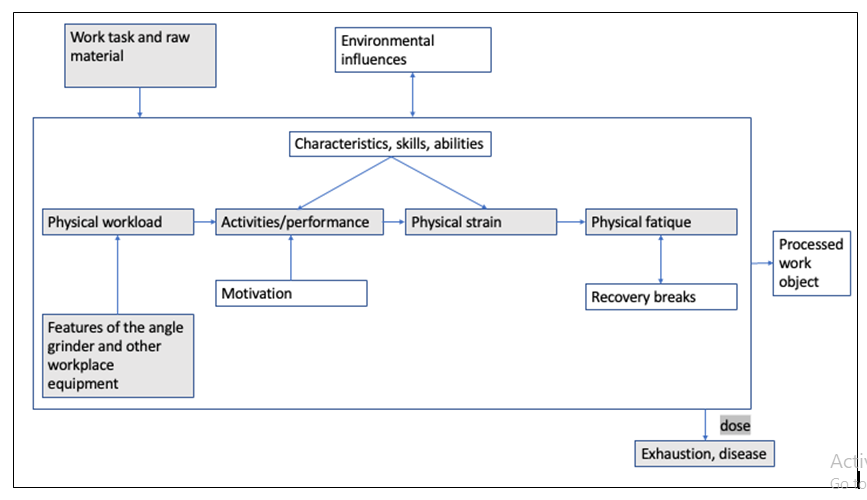
A model of the influences of work task and other physical factors on activities, psychophysical strain, fatigue, and possible diseases is shown in Figure 1. We are aware of the restrictions of Stimulus/Response models. Therefore, we intend here only a purely descriptive and not an explanatory presentation. We focused on the features highlighted in gray.
In our case study, we therefore focus on the analysis of the work task, the type of angle grinder and the design of the workplace in terms of posture. We limited ourselves to the use of small angle grinders with a disc diameter up to 125 mm.
Bullinger HJ, et al. [14] has systematized the influences of hand side and work side on the design of hand tools (Figure 2).
![Figure 2: Influencing variables in the design and use of a hand tool Bullinger HJ, et al. [14].](/fulltextimages/8480/fig_2.png)
From the graphic it is clear that a total of 17 influencing variables can affect the design and handling of a hand tool. We concentrated on: Activities/working tasks with angle grinders
- Body postures
- Working heights
- Hand-arm postures
- Hand-arm strain
- Strength of starting torque
- Device design and
- Geometric dimensions
Methods and Materials
Our case studies were divided into two parts:
- We carried out a questionnaire study with 42 work persons.
- On selected workplaces we carried out 17 detailed work systems and posture analyses on the basis of video recording.
- Questionnaire studies and video analyses were conducted in German workshops.
Questionnaire Study
The objectives of this study were to answer the following questions: • How are angle grinders used in practice today?
- How is their handling to be subjectively evaluated?
- What need for action exists?
- Which design details could be improved?
We considered angle grinders from the manufacturers Bosch Dewalt, Flex, Metabo, Milwaukee, and Würth.
A total of 62 questionnaires were sent to 29 companies in Germany. 42 completely filled out questionnaires were received back (response rate 68%). In detail, the following industries were represented (Table 1)
| Industry | Number of fully processed questionnaires |
|---|---|
| Metalworking | 15 |
| Building construction and civil engineering | 11 |
| Electrical/gas and water installation | 8 |
| Automotive repair | 8 |
| Total | 42 |
Table 1: Structure of the questionnaire study.
The following activities were carried out:
- Separating
- Flexing
- Grinding
- Ribs
- Deburring
- Derusting
- Brushing
- Polishing
In addition to personal data on age, sex, occupation, duration of activity and state of health, we asked:
- What activities were usually performed with the small angle grinder in the last 12 months? How often?
- How often was the small angle grinder used in the last week?
- In which postures work was performed?
- At what working heights was work performed?
- For which applications was an additional handle used in the last week?
- Which hand-arm positions were typical?
- How often was the small angle grinder used one-handed or two-handed?
- During which activities did you feel great effort in your hands and arms? What causes could be responsible for this?
- How strongly did you feel the start-up torque?
Work Process Studies
Work process studies were conducted along with video analyses and employee interviews at 17 workplaces. The video recordings lasted about 5 to 6 minutes per activity. For example, deburring a steel component at a work place in one company deals with the following tasks:
- Clamping of the workpiece in the cutting device and measuring (approx. 15 sec.)
- Marking of the trapezoidal blank to the nominal dimension (approx. 30 sec.)
- Cutting of the blank with the cutting torch (approx. 65 sec.)
- Deburring and chamfering of the cut edge of the workpiece (approx. 60 sec. for one edge).
- Repositioning the workpiece for deburring and producing chamfers on all other workpiece edges.
Results
Questionnaire Study
The analysis of all questionnaires shows that the small angle grinder is mostly used 1-2 times a week for cutting and flexing (42% of the answers; Figure 3). In 37% of the cases it was used 1-2 times per day. The multiple uses per hour were relatively rare for cutting and flexing (11%). In grinding, the use of the angle grinder several times per hour was the most frequent (about 33%). The use of the angle grinder for derusting/brushing was mentioned with few data (61% without data). The tendency is to speak of low use, i. e. About 1-2 times per week. Likewise, no information was given on polishing. We assume use in the range 1-2 times per day.
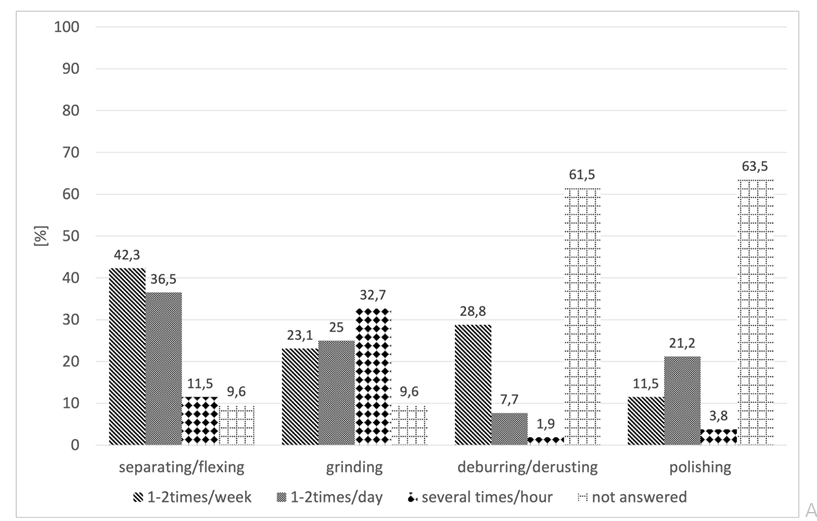
When analyzing the survey, the first thing that a stand out is that the respective question was not answered relatively often (marked in the graph). The limitations of a survey study become clear here, especially when the question refers to the past 12 months.
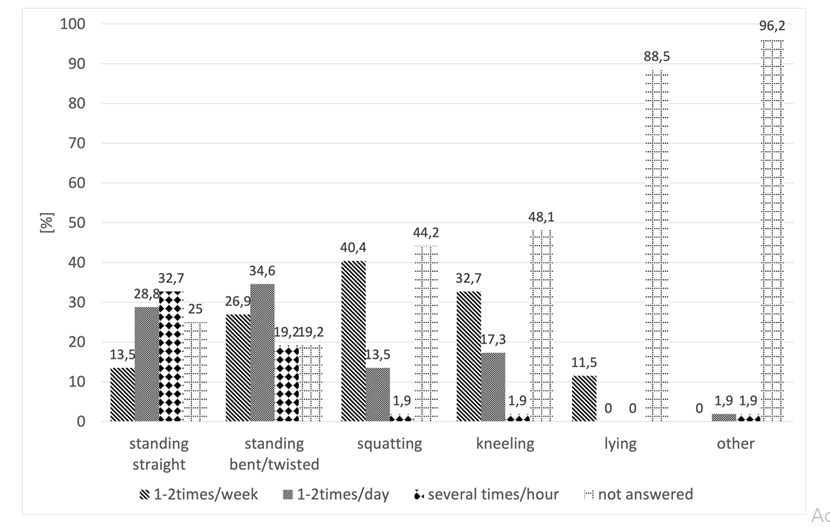
With the body posture “standing straight”, the angle grinder was mostly used several times per hour to 1-2 times per day (Figure 4). With the “standing bent” posture, the angle grinder was mostly used 1-2 times per week to 1-2 times per day. For the “squatting” posture, use 1-2 times per week clearly predominated, with use 1-2 times per day applying little and use several times per hour almost never applying. In the case of the “squatting” posture, the latter tendency predominated and can also be observed in the case of kneeling posture. The lying posture was mentioned only 1-2 times per week. The number of non-responses was very high (88%). Other postures are not significant.
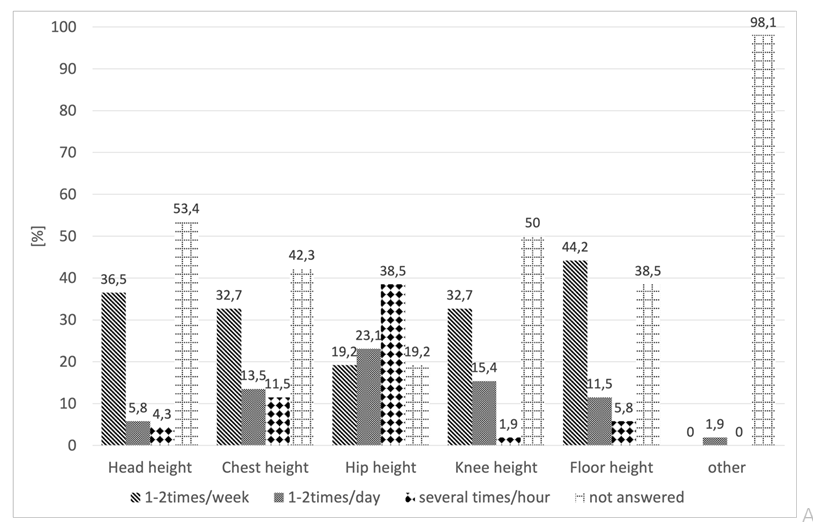
Working at head height is the most common, 1-2 times per week (36.5%; Figure 5). Working at chest height is also 1-2 times per day (32.7%). At waist height, the angle grinder is usually used several times per hour (38.5%). The frequency of work at knee height is high at 1-2 times per week (32.7%). This also applies to work at floor level (44.2%).
Twisted hand-arm positions occur especially when grinding (Figure 6). Approximately 23% of the workers stated that this posture occurs about the same 1-2 times per day during grinding and cutting/flexing. This posture was indicated less often when derusting and polishing.
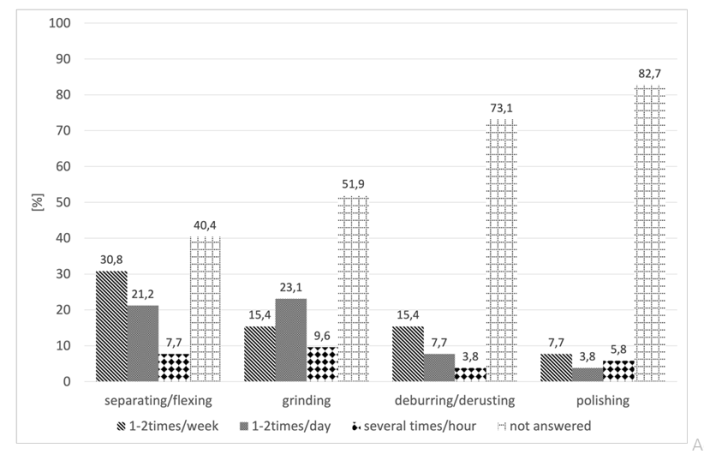
According to the respondents, they feel great effort in their hands when grinding (several times per hour, circa 17% (Figure 7). Cutting/flexing comes next, with statements from around 14%.
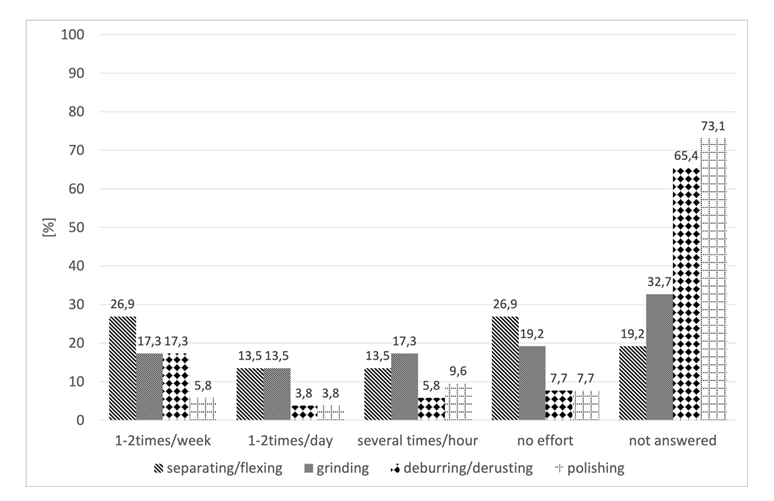
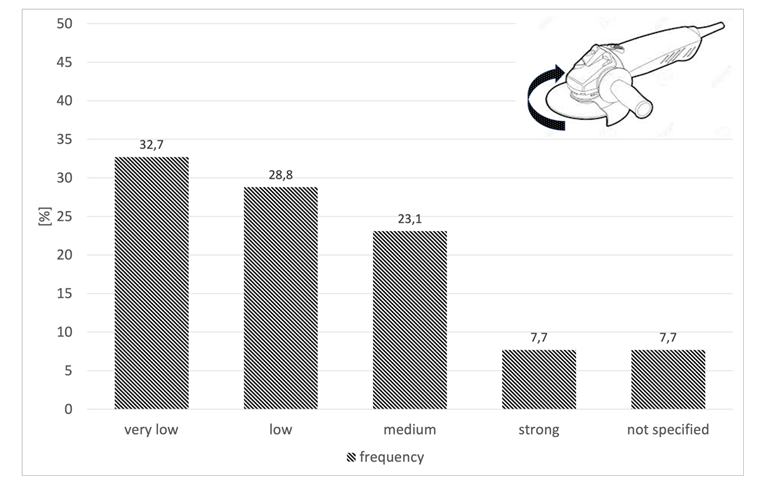
Figure 7: During which activities and how often do you feel great strain in your hands and arms? (n=42) About 60 % of the respondents hardly feel the starting torque of the small angle grinder (a different result would be shown for large angle grinders) (Figure 8). About 23% feel the starting torque medium strong and only 8% feel the starting torque a lot.
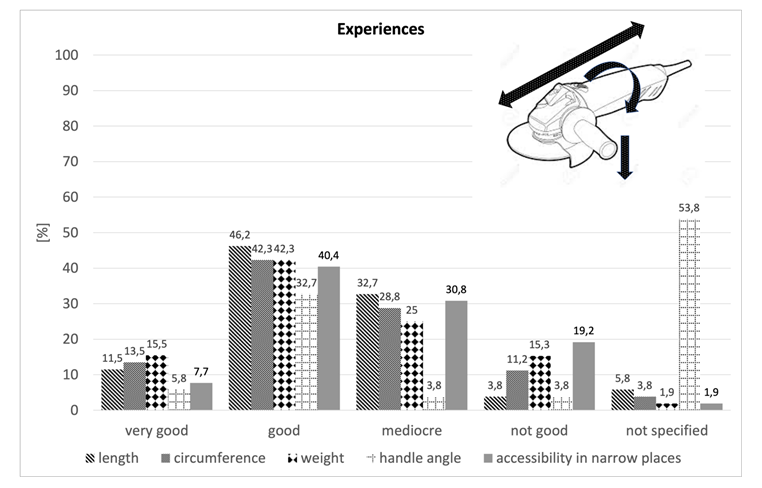
In the discussions with the working persons, it was mentioned several times that the diameter of the angle grinder was too large. Figure 9 shows that about 39% of the respondents had mediocre or no good experience with the gripping circumference. Similar statements also concern the weight and length of the equipment used. From this survey comes the statement that with regard to the accessibility of narrow places there is great design potential with the angle grinders.
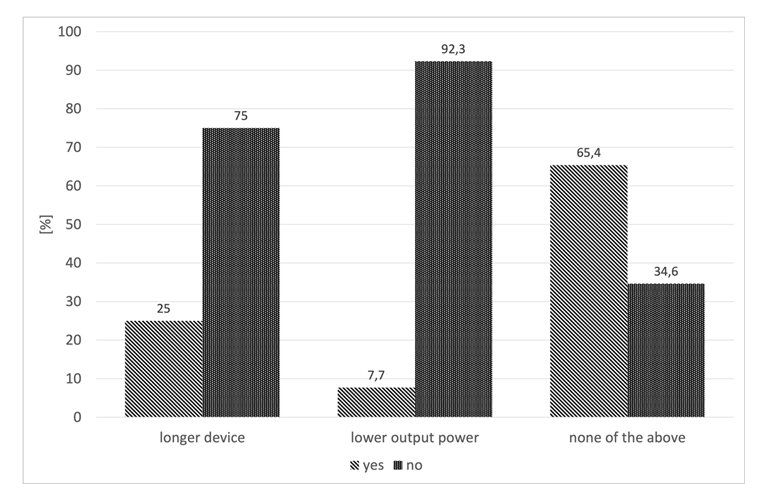
The majority of respondents (75%) would not accept a longer device (Figure 10). Even stricter statements were made about a possibly then necessary lower output power. Here, over 92% of the people are against it. On average, over 65% of respondents would prefer to retain the angle grinder with its current shape.
Workplace Studies
The following Figure 11 shows an example of the posture of the working person. The working height at this workplace was approx. at 0.75 m and at 0.50 m.
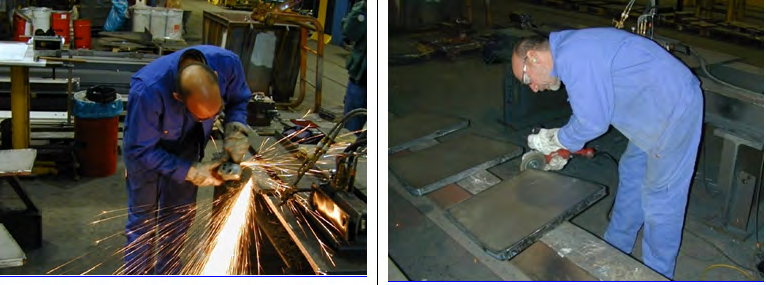
For deburring/grinding, the device was always operated with two hands. During grinding, the operator was constantly working in a bent-over posture. In this case, an increased load on the spine, especially in the lumbar region, must be suspected. In the hand-arm system, both a straight and a twisted or slightly bent wrist position could be observed when the arm was bent.
It was observed that the worker occasionally supported himself on the work piece with his elbow to reduce the postural work. In the hand-arm system, a predominantly straight, sometimes also a twisted or bent wrist position was observed in the angled arm posture (Figure 12).
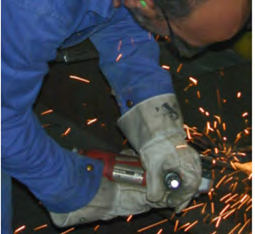
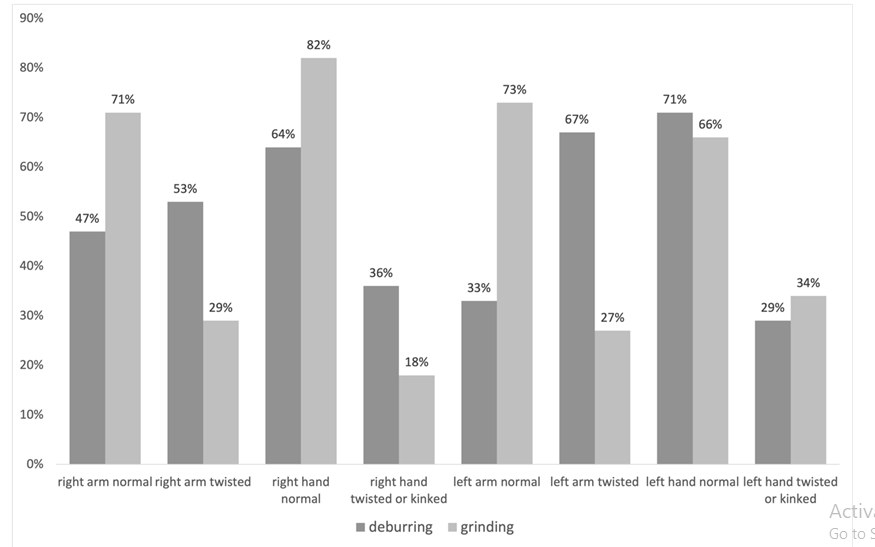
Figure 13 shows the results from the hand-arm posture analysis and device handling based on the video analysis. Particularly unfavorable hand-arm positions are found during deburring. Grinding tends to occur in “normal” hand- arm positions.
Discussion
Analysis and Evaluation of Postures
Ellegast D, et al. [15] OWAS analyses Karhu O, et al. [16] for conventional grinding yards show the following picture (Table 2).
| Postures | % of Work Postures | Posture Correction Needs / when | |
|---|---|---|---|
| Risk 1 | Natural /normal postures | 9,1 | No / - |
| Risk 2 | Positions which may be dangerous/with slight risk | 84,8 | Yes /Not immediate |
| Risk 3 | Dangerous position/ with high risk | 4,7 | Yes /short term |
| Risk 4 | Very dangerous position/ with excessive risk | 1,4 | Yes / Immediate |
Table 2: OWAS risk categories according to Ellegast (2013, 2014).
Thus, about 91% of the working postures are classified as questionable.
If we look at the ratings of the respondents (1-2times per day + several times/hour) for standing bent/twisted, squatting and kneeling according to Figure 4, then a similar picture emerges for our sample as for Ellegast (2013, 2014).
Equipment and Work Design
OSHA’s (2012) [4] publication identifies a variety of design improvements. The focus in the chapter “Grinders with user-friendly features” (OSHA 2012) [4] is on measures to avoid awkward hand-arm positions. Atlas Copco (without year) [2] gives an overview on the subject of grip and posture. Safe Work (without year) or Toolstop (2021) [17] have published a list of design requirements related to work safety, but not related to small angle grinders [18, 19]. Quantitative data and FR/MR/W references are missing (FR = Fixed requirements, MR = Minimum requirements, W = Wish).
From an ergonomic point of view, the following applies: As far as possible, the hand/arm axis and the tool axis should be aligned (Figure 14). This is often possible with a drill, but not with an angle grinder.
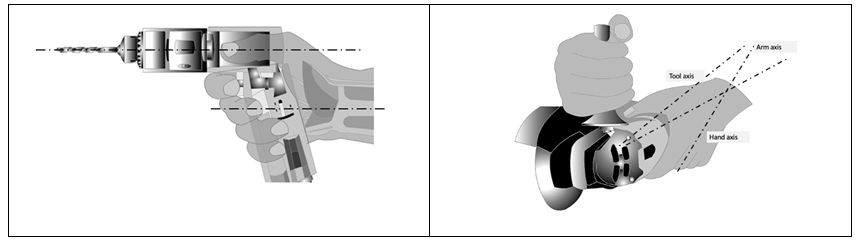
Other ergonomic requirements were derived from our study results:
- Rather smaller handle or housing diameters,
- Equally good operability for right-handed and left- handed users,
- Functional axis, direction of force and anatomical axis of hand/forearm should coincide as far as
- possible in the majority of work tasks,
- Good feelability and operability of the switch with protective gloves,
- Highest possible power output at the target,
- As good as possible accessibility in difficult working areas.
The following list of requirements resulted from our discussions with practical users (Table 3):
| FR/MR/W | Requirements/wishes | |
|---|---|---|
| Safety | FR | The operator must not be endangered by the electrical energy |
| Standstill of the disc in case of jamming / cogging in the work object (during cutting) | ||
| Weight | MR | Lowest possible weight, max. 1.6 kg complete (for one-handed operation) |
| Anthropometrics, Biomechanics | W | As little skin stress as possible during grasping, holding and shifting |
| FR | Low movement restrictions of the hand-arm-shoulder system | |
| FR | Minimization of stressful twisted and / or bent hand positions | |
| FR | Minimization of unfavorable directions of action/force through ergonomic handle design | |
| FR | Good coupling between hand and tool (also when working with gloves) | |
| FR | Force transmission should be optimal in each direction of action | |
| FR | Insensitive to dust, moisture and abrasion | |
| FR | Tool must also be easy to guide with one hand | |
| Handling | FR | Simple, intuitive operation of the device |
| FR | Device must be comfortable in the hand | |
| Function | W | Functional structure as simple as possible |
| Switch | MR | Lockable switch |
| Geometry | FR | Compact geometry, handiness & maneuverability in difficult working places |
| W | Dimensions: Length < 300mm | |
| Material | FR | Insensitive to weather influences |
| FR | Insensitive to mechanical influences such as impact etc. | |
| FR | Insensitive to chemical influences (but without special requirements) | |
| FR | Resistance of the material to aging | |
| Design | W | Appealing optical design |
Table 3: List of requirements and design wishes. FR = Fixed requirements MR = Minimum requirements W = Wish Selected dimensional
Table 3: List of requirements and design wishes. FR = Fixed requirements MR = Minimum requirements W = Wish Selected dimensional requirements:
- If the main handle remains as a grip around the housing, then the grip diameter should move towards the optimum < 50 mm.
- Otherwise, for the main and auxiliary handle, enclosure handles with a diameter of about 35-38 mm should be aimed for.
- The handle or housing design is cylindrical/ball-shaped.
- For the hand/grip contact, positive locking instead of frictional locking is aimed for.
- Limit angles of 30°/15° (ulnar/radial) and 75°/60° (dorsal/volar) should be avoided on the guide hand and holding hand.
- When cutting/flexing/grinding, a neutral range of 5°uln
ar/15°radial/15°dorsal/15°volar is preferred.
- For the angles of the main and additional handle depending on the working height and the work task and for the placement of the switch.
- Different mounting of main and additional handle at different places according to the choice of the worker depending on the work task.
- Material properties of housing (at gripping point) and additional handle: coupling surface without sharp edges, soft grip, e.g.. Multi-component surface, microfiber.
Conclusion
Our surveys showed that bent or twisted postures occur 1-2 times per day. Squatting or kneeling occurs about 1-2 times per week. Working at head or chest height can also be expected 1-2 times per week. Working at knee height occurs several times per hour. Twisted hand-arm postures are typical for cutting/flexing and grinding. At least one time per week, employees experience high levels of strain in their hands and arms. When working with the small angle grinder, the starting torque does not play a major role. The working persons are for the most part satisfied with the handle diameter of the small angle grinder. However, the anthropometric data regarding the mean gripping diameters of the hand in both males and females suggest a smaller diameter (Table 4).
| Age (years) | Men | Women | ||||
|---|---|---|---|---|---|---|
| 5% | 50% | 95% | 5% | 50% | 95% | |
| 16 - 20 | 29 mm | 33 mm | 38 mm | 26 mm | 31 mm | 37 mm |
| >20 | 29 mm | 33 mm | 39 mm | 27 mm | 31 mm | 37 mm |
Table 4: Mean gripping diameters of the hand in men and women.
The handle length of the small angle grinder is essentially perceived as good.
References
-
Ellegast R (2013) Ergonomic analysis of grinding tasks in structural steel engineering. Deutsche Gesetzliche Unfallversicherung, IFA Report 0177.
-
Oliveira JFG, Silva EJ, Guo C, Hashimoto F (2009) Industrial challenges in grinding. CIRP Annals 58(2): 663-680.
-
Atlas Copco (without year) Pocket guide to grinding. Nacka, Sweden.
-
OSHA (2012) Solutions for the prevention of musculoskeletal injuries in foundries. Occupational Safety and Health Administration, Washington.
-
OSHA (1999) Ergonomics program. Occupational Safety and Health Administration. Report RIN No. 1218-AB36, Washington.
-
Sun Y, Chen J, Lu Z, Yang B, Liu W (2019) Ergonomics Analysis of Hand-Held Grinding Operation Working Posture Based on Jack. Man–Machine–Environment System Engineering. Lecture Notes in Electrical Engineering 576: 733-740.
-
Muzammil M, Singh R, Ahmad S, Hasan F (2010) Effects of vibration push force, exposure duration and working posture on operators performing a grinding task. Occupational Ergonomics 9(1): 13-26.
-
Reinvee M, Aia S, Paasuke M (2019) Ergonomic Benefits of an Angle Grinder With Rotatable Main Handle in a Cutting Task. Human Factors 61(7): 1025-1036.
-
Huddock SD (2002) Final survey report, ergonomics interventions for ship repair processes at Todd Pacific Shipyards Corporation, Seattle, Washington. Cincinnati, OH: US Department of Health and Human Services, Public Health Service, Centers for Disease Control and Prevention, National Institute for Occupational Safety and Health, EPHB 229-18c.
-
Germann R, Schroeder N, Matthiesen S (2022) The contact length parameter as a geometric factor for user- centered design of pistol grip geometries of power tools. Appl. Ergonomics 99: 2.
-
Mirbod SM, Akbar KF, Onozuka M (1999) A Four-Year Follow-Up Study on Subjective Symptoms and Functional Capacities in Workers Using Hand-Held Grinders. Industrial Health 37: 415-425.
-
Armstrong TJ, Marshall MM, Martin BJ, FoulkeJA , Grieshaber DC, et, al (2002) Exposure to forceful exertions and vibration in a foundry. International Journal of Industrial Ergonomics 30(3): 163-179.
-
Varley V, Claydon M, Solomon J, Dean A, Lovelock Th, et al. (2020) Penetrating angle grinder injury. Trauma case Rep 32: 100378.
-
Bullinger HJ (1994) Ergonomie. Stuttgart (Germany) Teubner, pp: 307.
-
Ellegast D (2014) Physische Belastungen aktuelle Herausforderung für die Arbeitsgestaltung. IFA Institut für Arbeitsschutz Deutschen Gesetzlichen Unfallversicherung, Sankt Augustin.
-
Karhu O, Kansi P, Kuorinka I (1977) Correcting working postures in industry: a practical method for analysis. Appl Ergon 8(4): 199-201.
-
Toolstop (2021) Angle grinders. Safe Work SA.
-
Radinonics (2022) Angle Grinders-A Complete Buying Guide.
-
SafeWork SA, Angle grinder safety checklist
- The Expanding Landscape of Road Rage: A Systematic Review of Conflicts Involving Drivers, Pedestrians, and Micromobility
- Validating Cognitive Models of Royal Navy Performance on Control Systems
- Comparing Standard and State-of-the-art Firefighter Coats on Postural Balance and Gait in a Live Burn Environment
- Investigating the Integration of Telemedicine into Clinicians Workflow: A Review of Methods
- Risk Assessment of Ergonomic Factors in a Textile Firm by RULA, REBA and Fine Kinney Methods
- Impact of Self-Esteem Training on Individuals with Disabilities Aged 17-30