
Community Noise Analysis and Control Measures at Small Scale Forging Industry
Noise is one of the most prevailing environment factor whether inside industry, traffic, agricultural implements, defense machinery etc. Noise pollution is increasing day by and becoming a cause of stress and irritation. The present study envisage to investigate the effect of noise pollution due a forging industry (ABC) on people and surroundings so as to reduce its effects and attempt to find the measures for control of noise levels. The results of the study revealed that noise level during forging operations exceeds the permissible limits of 75 dB (A) and 70 dB (A) during day and night. The same resulted in noise annoyance and sleep disturbance nearby among the residents of village XYZ. After collecting noise data at different places around the industry and data is analyzed, implementation of the control measures so as to reduce the noise level which is under permissible limit prescribed by the Pollution Control Board.
Introduction
Noise pollution is a disturbance to the human environment that is escalating at such a high rate that it will become a major threat to the quality of human lives. In simple terms, noise is unwanted sound. Sound is a form of energy which is emitted by a vibrating body and on reaching the ear causes the sensation of hearing through nerves. Sounds produced by all vibrating bodies are not audible. The frequency limits of audibility are from 20 HZ to 20,000 HZ. Sound is a type of energy which is transferred through the air and recognized by the ear as rapid fluctuation in pressure [1]. The sound source, generally a vibrating surface or a turbulent flow, causes the air to move. A steady sound’s loudness and character are determine by its frequency measured in Hertz or Hz) and intensity in decibels or dB [2]. In this study, noise levels are indicated in dB (A) – this is the noise level measured by a meter that simulates the response of the human ear’s reaction to sounds of various frequencies. Noise levels in dB (A) are used almost universally for assessment of noise in community and workplace environment [3]. Stephen Mbuligwe [4] in his study determine levels and factors that influence noise pollution from small-scale industries (SSIs). Dasarathy et al. [5] focuses on the noise reduction by way of providing a noise enclosure which is an apt technique to reduce noise. The sound barrier of thatched leaves is installed as a rectangular shed of size 1.5 m × 1.2 m × 2.0 m on the side of the road .The percentage reduction of noise level ranges from 13 to 19 by the provision of thatched leaves. Berardi, et al. [6] studies the acoustical characterization of the following natural fibers, kenaf, wood, hemp, coconut, cork, cane, cardboard, and sheep wool. The measurements carried out on samples of natural fibers have shown that -similarly to traditional porous materials-these fibers have good sound absorption coefficients, especially at medium and high frequencies. Kiran, et al. [7] experimentally perform wheat straw being a versatile material was used to make thermal and sound absorber. Wheat straw of lesser density board can be used as good sound absorbing material at 400kg/m3. Putra, et al. [8] study the use of synthetic materials as acoustic absorbers is still applied extensively in building industry. Good acoustic performance is found at 1.2 - 4.5 kHz with average absorption coefficient of 0.65. On the other hand there has been significant evidences of noise exposure in the industry as reported by Singh, et al. [9], that about 95% of the workers were suffering speech interference though high noise annoyance was reported by only 20% and more than 90% workers are working 12 to 24 h over time per week which lead to very high noise exposure. ABC Ltd. is a shuttering equipment manufacturing company located in Jalandhar. The company uses forging operations (two hammers of 1.5 tones capacity) to manufactures its products. The noise generated during forging operations are at such high decibels that its nearby village XYZ was highly affected by it. So, in order to remove this problem, they contacted us.
Permissible Noise Level Criteria
- The permissible noise pollution criterion is shown in
Table 2: Day time shall mean from 6.00 a.m. to 10.00 p.m.
Night time shall mean from 10.00 p.m. to 6.00 a.m. Silence zone is defined as an area comprising not less than 100 meters around hospitals, educational institutions and courts. The silence zones are zones which are declared as such by the competent authority. Mixed categories of areas may be declared as one of the four above mentioned categories by the competent authority.
| S.No. | Category of area (Code) | Day time Intensity(dB) | Night time Intensity(dB) | |
|---|---|---|---|---|
| 1 | Industrial Area (A) | 75 | 70 | |
| 2 | Commercial Area (B) | 65 | 55 | |
| 3 | Residential Area (C) | 55 | 45 | |
| 4 | Silence Zone (D) | 50 | 40 |
Table 1: Permissible Noise Criteria in India.
Materials and Methods
The methodology adopted includes a study of existing condition, real- time work made to explore the general system followed in the noise pollution mitigation measure. The present study includes certain phases. Each phase laid foundation for next phase. The procedural steps adopted for the purpose of presented study is shown in Figure 1.
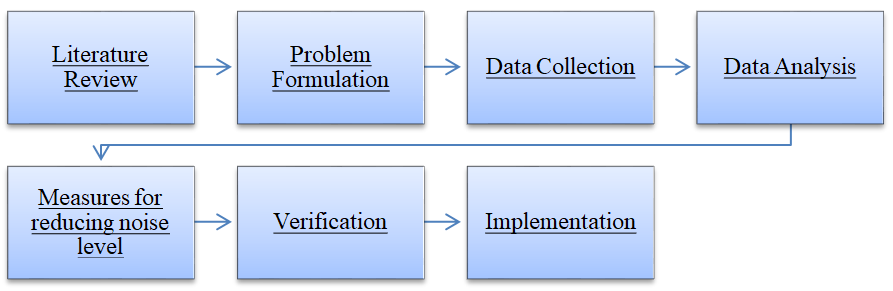
Based on the literature review and personal visits to the industry and sites problem was formulated. Subsequently, noise data at different places around the industry was collected. The data were analyzed and the solutions for the problem were sought. In next phase control measures recommended to the industry were implemented so as to reduce the noise level.
Data Collection
Data w.r.t noise level was measured using a Quest sound level meter “ANSI 43-1997 (R2002) Type-1, model SOUNDPRO SE/DL”. The protocol of data recording includes OSHA norms for hearing conservation were incorporated including an exchange rate of 5 dB (A), criterion level at 90 dB (A), criterion time of 8 h, threshold level=80 dB (A), upper limit=140 dB (A) and with F/S response rate. The measurements in A-weighted sound pressure level were done. The measurements were recorded through data logging facility of the sound level meter and then transferred to computer for further analysis. The inbuilt quest make software was used for calculation and analysis.
There were different machines in the industry like;
Hammers (H), Trimming Machine (T), Blank Cutting Machine (B), Coining (C), Grinding (G). The noise levels was measured on different combinations of machines as shown below in Table 2.
| Sr. No. | Equipment Combination |
|---|---|
| 1 | Single Hammer |
| 2 | Double Hammer |
| 3 | Double Hammer and Trimming Machine |
| 4 | Double Hammer ,Trimming Machine and Grinders |
| 5 | Double Hammer ,Trimming Machine ,Grinders and Coining Machine |
| 6 | Double Hammer ,Trimming Machine ,Grinders ,Coining Machine and Blank Cutting Machine |
Table 3: Combination of equipment (running simultaneously) used for measuring the sound pressure level. The noise level measured
Results
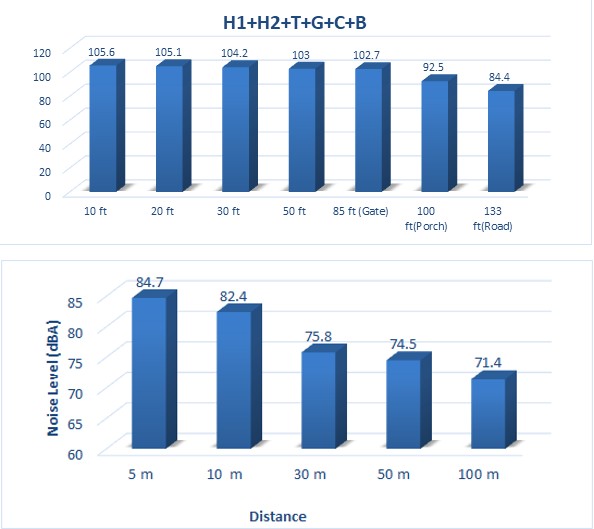
The results obtained from the study are presented and described below. Before and after implementing the control measures, the noise levels dB (A) w.r.t. distance from the source measured with when two hammer, trimming machine, grinders, coining machine and blank cutting machine were running simultaneously. The data is exhibited in Figures 2.1 & 2.2 respectively as follows.
Control Measure
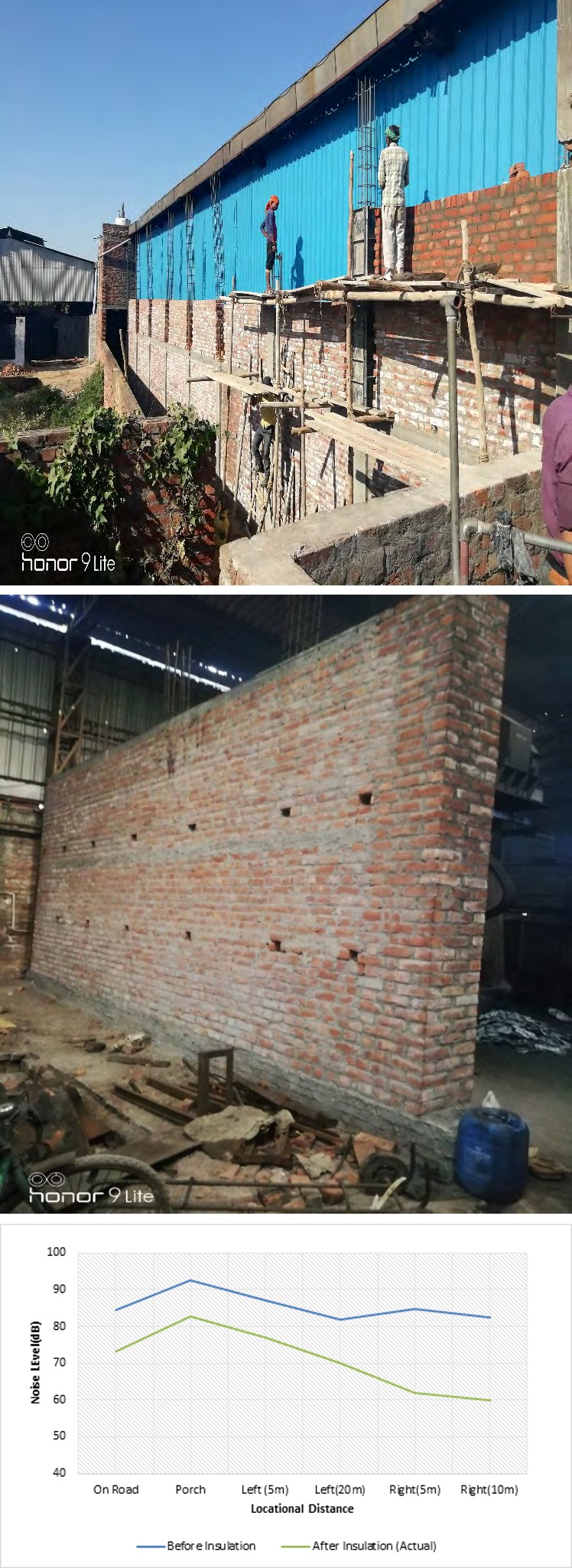
The control measures were taken to lower the noise levels include; construction of double brick wall of 9 inch with 100 mm airspace or gap towards the right side of the industry and to fill wheat straw (sound absorber) between it. The Second control measure is to construct a noise barrier (brick wall) with dimensions 15 feet height and 14 inch thickness in front of the hammer section. The same is exhibited in Figures 3.1 & 3.2 respectively.
Using wheat straw board can be also used as good sound absorbing material at less density. As the density increases the thermal conductivity of the boards will also increases, it indicates that wheat straw boards of higher densities can be used in heat sink applications and lower density boards can be used for thermal insulation applications. Wheat straw panels substantiate to be a material with potential for acoustics that range from 500 Hz to 2,000 Hz as shown in Tables 3 & 3.1.
| Density(kg/m3) | 300 | 400 | 500 |
|---|---|---|---|
| NRC | 0.34 | 0.29 | 0.22 |
Table 4: Variation in NRC of wheat straw with density.
Noise Reduction Coefficient (NRC) is an average rating of how much sound an acoustic board can absorb. It is the average values of absorption coefficients for a specific material at the octave band centre frequencies of 250, 500, 1000 and 2000 Hz. With the help of NRC we can calculate how much sound or noise pass through insulated wall or panel. The data were compared before and after insulation, there has been significant reduction with p value (0.00194 < 0.05) Graph 1.
| Location | Noise Level L dB(A) eq | |
|---|---|---|
| Before Insulation Noise Level | After Insulation Noise Level | |
| On Road | 84.4 | 73.1 |
| Porch | 92.5 | 82.7 |
| Left (5m) | 87.1 | 76.9 |
| Left(20m) | 82 | 70 |
| Right(5m) | 84.7 | 62 |
| Right(10m) | 82.4 | 60 |
Graph 1: Noise level before and after +insulation.
Discussion
Maintenance is one of the effective method for reduction of noise at the source .i.e. it can be obtained in forging hammer by aptly maintained all parts of the hammer in good working condition. Additionally, proper lubrication which reduce the friction, resulting in the reduction of noise in working environment.
Fans and blowers in the industry also contribute to the noise produced, since they are working from long time leading towards increase in sound level of industry. These can be replaced by new fans and blowers by which the sound level of industry can be further reduced. The air gaps in industry walls, roof also contribute towards the increase in sound level outside the industry as sound can easily travel in air than through walls. The solution for this problem is to fill and maintain these air gaps properly. Protect workers from hazardous noise is also an important task. To prevent them from hazardous noise provide them hearing protective equipment and aware that them to hazardous effect of noise and noise induced hearing loss (NIHHL). Ensuring that they always wear the personal protective equipment (PPE).
Need to implement noise working hours standard and hearing conservation Programme under ethical/legal control because Almost all the workers are highly exposed to high noise levels [>90 dB (A)], 60 to 72 hours/week without proper ear protection, which is very high as compared to OSHA norms [9, 10, 11, 12, 13].
Conclusion
The sound level observed before the control measures are beyond the permissible limits of 75 dB(A). However, when control measure implemented such as; double brick wall, 9 inch, 100 mm airspace or gap, fill with wheat straw (sound absorber), on the right side boundary wall (the observer is standing at the front of industry) shows a significant reduction in noise level from 84.7 dB(A) to 62 dB(A) and at 5 and 82.4 dB(A) to 60 dB(A) at10 meters, from right side boundary wall of industry. Therefore, there was significant reduction at the complaint point also the sound barriers of 15 feet height and 14 inch thick brick wall also help to significant reduction in sound level at front road of industry from 84.4 dB (A) to 73.1 dB(A), which is under permissible limit according to Punjab Pollution Board as shown in Table 1. After insulation on right side boundary wall of industry it was help to reduction in noise level at left side (the observer is standing at the front of industry) of industry because sound absorber used airspace or gap between the double brick wall. A reduction from 87.1 dB(A) to 76.9 dB(A), it also a significant and at the complaint point too.
References
-
Salandin A, Arnold J, Kornadt O (2011) Noise in an Intensive Care Unit. J Acoust Soc Am 130(6): 3754-3760.
-
Barron R (2002) Industrial Noise Control and Acoustics. 1st (Edn.).
-
Thepaksorn P, Siriwong W, Neitzel RL, Somrongthong R, Techasrivichien T (2018) Relationship Between Noise- Related Risk Perception, Knowledge, and the Use of Hearing Protection Devices Among Para Rubber Wood Sawmill Workers. Saf Health Work 9(1): 25-29.
-
Stephen M (2011) Levels and Influencing Factors of Noise Pollution from Small-Scale Industries (SSIs) in a Developing Country. Environ Manage 33(6): 830-839.
-
Dasarathy AK, Thandavamoorthy TS, Fie (2014) Atteunation Of Noise Using Barrier in the Form of Enclosures. Indian J Appl Res 3(8).
-
Berardi U, Iannace G (2015) Acoustic Characterization of Natural Fibers for Sound Absorption Applications. Build Environ 94(2): 840-852.
-
Kiran MC, Mamatha BS, Anand N, Prakash V (2018) Acoustic and Thermal Behavior of Low Density Wheat Straw Particle Board. IJSR 7(9): 543-547.
-
Putra A, Abdullah Y, Efendy H, Farid WM, Ayob MR, et al. (2013) Utilizing Sugarcane Wasted Fibers as a Sustainable Acoustic Absorber. Procedia Eng 53:632-8.
-
Singh LP (2016) Work Study and Ergonomics. Cambridge University Press.
-
Singh LP, Bhardwaj A, Deepak KK (2013) Occupational Exposure to Respirable Suspended Particulate Matter and Lung Functions Deterioration of Steel Workers: An Exploratory Study in India. ISRN Public Health.
-
Singh LP, Bhardwaj A, Deepak KK (2013) Occupational Noise-Induced Hearing Loss in Indian Steel Industry Workers. Hum Factors J Hum Factors Ergon Soc 55(2): 411-424.
-
Singh LP, Bhardwaj A, Deepak KK, Bedi R (2009) Occupational Noise Exposure in Small Scale Hand Tools Manufacturing (Forging) Industry (SSI) in Northern India 47: 423-430.
-
Singh LP, Bhardwaj A, Deepak KK (2013) Occupational Noise-Induced Hearing Loss in Indian Steel Industry Workers: An Exploratory Study. Hum Factors 55(2): 411- 424.
- The Expanding Landscape of Road Rage: A Systematic Review of Conflicts Involving Drivers, Pedestrians, and Micromobility
- Validating Cognitive Models of Royal Navy Performance on Control Systems
- Comparing Standard and State-of-the-art Firefighter Coats on Postural Balance and Gait in a Live Burn Environment
- Investigating the Integration of Telemedicine into Clinicians Workflow: A Review of Methods
- Risk Assessment of Ergonomic Factors in a Textile Firm by RULA, REBA and Fine Kinney Methods
- Impact of Self-Esteem Training on Individuals with Disabilities Aged 17-30