
Mechatronics- A Concept toward the Precision Planter
Farm mechanization is the key to provide a number of economic and social advantages to farmers. The most important of the economic benefits is the enhanced yield that comes as a result of increased mechanisation. Combination of mechanical linkage or systems replacing by some electronic components it’s become mechanical + Electronics = Mechatronics. Linear actuator is best example of mechatronics in term of combination of electronic and mechanical. In linear actuator no need to any hydraulic link, distributor, oil tank, hydraulic pump. In some cases its give better then the hydraulic control actuating devices. If we use mechatronics technologies into agriculture sector there have helpful in controlling system and compactness in whole mechanism.
Precision Planting
Precision seeding is a seeding technique being used in agriculture that involves sowing of seeds at precise spacing and proper depth. This differs from broadcast seeding, in which the seed is dispersed over a large region. Although accurate hand placement qualifies, precision seeding is more commonly associated with a mechanised procedure. For modest to large-scale projects, a variety of hand-push and motorised precision seeders are available. They all open the soil, deposit the seed, and then cover it to form rows, using a variety of methods. Precision seeders are also available for planting flats of seeds for indoor seed beginning. The depth and spacing can be adjusted to meet a variety of crops and plant densities; the degree of flexibility varies depending on the seeder used.
Precision seeding is a commercial alternative to dribbling seed or placing multiple seeds in each position, which is done by dibbling seed or setting several seeds in each position. Precision seeders may place only one or a few seeds per position, depending on the equipment. This has the advantage of saving seed and avoiding crowding or the need for thinning, allowing plants to grow as efficiently as possible. On the negative side, when fewer seeds are planted, a high germination rate is necessary to fully utilise the seeded area.
Concept of Mechatronics Sowing System
The mechatronics system works on the principle that a shaft encoder measures forward speed and sends digital signals to the microcontroller. In a 1:1 transmission ratio, the microprocessor synchronises the operation’s forward speed with the metering mechanism plate. The microprocessor transmits signals to the motor driver module, which in turn sends signals to an electric motor that rotates the seed plate of the metering mechanism.
Broadcasting, dibbling, sowing behind a country plough, seed drill, and pneumatic planting are some of the seed placement technologies available. The most precise of these methods are seed drill and pneumatic planting. Seed singulation potential is greater with the pneumatic planter, but it takes more energy.
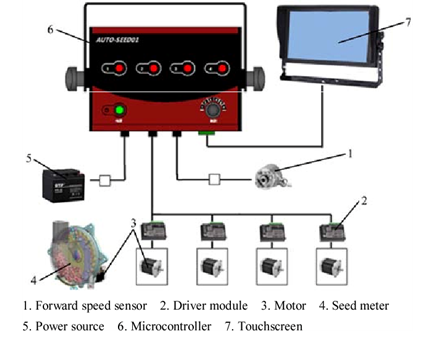
Mechanical metering devices have a number of drawbacks, including the system’s bulkiness and vibrations imposed on the planter or seed drill as it moves through the field. The third disadvantage of the mechanically driven approach is the lack of seed distribution communication between row units on an implement. According to present metering systems, the system currently has control over only the seeding population, but not the actual timing and placement of the seed.
This indicates that a seed falls into the furrow at a consistent rate, but the row-unit is unable to determine when and where the seed falls in relation to its neighbours. As a result, electronic seed singulation devices can address many of the inefficiencies found in mechanically driven seed metering systems, thereby boosting productivity and yield rates dramatically. The entire system will be controlled remotely, which will reduce operator fatigue and improve plant-to-plant distance accuracy.
References
-
Bolton W (1999) Mechatronics. 2nd (Edn.), New York: Addison Wesley Longman Publishing.
-
Myklevy M, Doherty P, Makower J (2016) The new grand strategy. New York: St. Martin’s Press.
-
Rovira-Más F, Zhang Q, Saiz-Rubio V (2020) Mechatronics and Intelligent Systems in Agricultural Machinery. Introduction to Biosystems Engineering.
- The Expanding Landscape of Road Rage: A Systematic Review of Conflicts Involving Drivers, Pedestrians, and Micromobility
- Validating Cognitive Models of Royal Navy Performance on Control Systems
- Comparing Standard and State-of-the-art Firefighter Coats on Postural Balance and Gait in a Live Burn Environment
- Investigating the Integration of Telemedicine into Clinicians Workflow: A Review of Methods
- Risk Assessment of Ergonomic Factors in a Textile Firm by RULA, REBA and Fine Kinney Methods
- Impact of Self-Esteem Training on Individuals with Disabilities Aged 17-30