
Ergonomic Risk Assessment of Hairdressers Using Rapid Entire Body Assessment
Work-related musculoskeletal disorders (WRMSDs) are one of the most prevalent causes of occupational injury and disability in both developed and developing nations, affecting a wide range of jobs. Hairdresser in their careers faces many harmful factors, including WRMSDs, especially in the neck, waist and shoulder areas. The study groups comprised 5 healthy males and 8 healthy female participants that work at the hair dresser saloons in Turkey. Hair-coloring and hair-cutting were the most common tasks completed by participants. The population ranged in age from 18 to 45 years old. The respondents' average age, height, and weight, as well as their standard deviations were 33.15 ± 8.97 years, 166.38 ± 8.84 cm, and 68.31 ± 10.14 kg, respectively. The aim of this research was to investigate the individual and occupational risks associated with the tasks on the prevalence and consequence of WRMSDs. In this descriptive analytical study, the risk of WRMSDs was evaluated using the Rapid Entire Body Assessment (REBA) method. The REBA results showed that working postures should be changed as soon as possible.
Introduction
Hairdressing has a lengthy history among the Egyptians, dating back to 5,000 years B.C. [1]. Hairdressing is a popular global profession, particularly among women [2]. There are several million hairdressers worldwide. Hairdressers are a significant occupational category, and their work within hairdressing salons is one of the least research area in occupational health. This occupation is predicted to grow faster than the average of all jobs in the next years [3]. Hairdressers are constantly working in indoor environments with a busy work schedule. Hairdressers’ employees are exposed to chemical, ergonomic and psychosocial hazards, musculoskeletal system and stress.
In the literature, several MSDs connected to physical risk factors for hairdressing have been studied. On the other hand, the relationship between hairdressing and the development of WRMSDs remains unknown. According to the literature, working as a hairdresser for an extended period of time may raise the risk of WRMSDs. WRMSDs are regarded as one of the most prevalent causes of occupational injury and disability in both developed and developing nations. Hairdresser in their careers faces many occupational health risks, including prolonged standing, long working hours with no rest breaks, and WRMSDs, especially in the neck, waist and shoulder areas.
WMSDs were determined to be the most important aspect of workers’ compensation in the United States, accounting for at least one third of all labor time losses, according to statistics from the Bureau of Labor Statistics (BLS) [4]. These illnesses not only have a negative impact on the employees’ quality of life, but they also place a significant financial burden on society [5]. Hairdressers reported the highest difficulty in their shoulders (94.4%), lower back (80.6%), and neck (77.8%) according to Wu, et al. [6]. Furthermore, Chuang [7] concluded that 94.4 % of hairdressers complained of shoulder pain, which was followed by lower back and neck pain. Mussi and Gouveia [8] reported a prevalence of up to 71% for work–related MSDs in recent years, while Aweto, et al. [9] reported an even higher frequency of 81%.
Hairdressing tasks are mostly related to ergonomic hazards such as prolonged standing, uncomfortable work postures, rigorous and excessive shoulder motions, forceful exertion, and repetitive motion [9, 10]. As a result, researchers discovered that hairdressers frequently experience musculoskeletal discomfort. For example, a survey of Taiwanese hairdressers found that 91.7 percent of them had shoulder discomfort, 83.3 percent had low back pain, and 75 percent had neck pain [11]. In a study conducted in Nigeria, the prevalence of low back, shoulder, and neck pain was found to be 76.3, 62.5, and 46.3 percent, respectively [9]. The objective of this study was to assess the individual and occupational risks associated with the tasks on the prevalence and consequence of WRMSDs.
The remainder of this research is structured as follows. Section 2 introduces methods and presents a study design. Ergonomics assessment tools are performed and the results are presented in Section 3 and finally Section 4 discusses the conclusions and suggestions for further studies.
Methodology
Participants
The study groups comprised 5 healthy males and 8 healthy female participants that work at the hair dresser saloons in Turkey. Hair-coloring and hair-cutting were the most common tasks completed by participants. The population ranged in age from 18 to 45 years old. The mean values and standard deviations of age, height and weight of the participants were 33.15 ± 8.97 years, 166.38 ± 8.84 cm, and 68.31 ± 10.14 kg, respectively. The study was explained to the participants, and they each verified their willingness to participate by signing a voluntary participation form and a demographic information form.
Ergonomics Assessment Tools and Study Steps
Rapid Entire Body Assessment (REBA): REBA is a tool that may be used to measure workloads for manual material handling operations [12]. This method has been used in investigations involving posture and lifting, and its effectiveness has been evaluated to establish the advantages and disadvantages of observational approaches for detecting postural load. In addition, this tool is the product of a combined effort by an ergonomics team, physiotherapists, occupational specialists, and nurses who identified over 600 industrial roles. Variation in neutral postures is one of the main advantages of the REBA tool [13, 14]. As a result, this tool can be effective for risk prevention and can be used to alert employees of unsafe working circumstances.
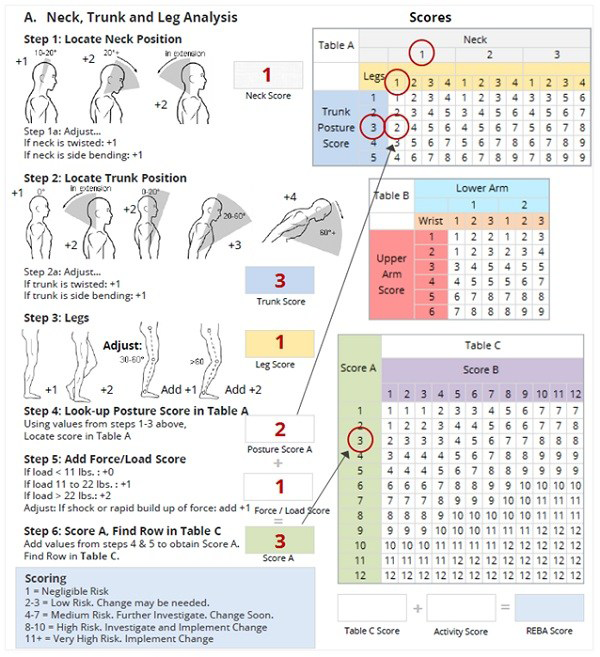
There are several objectives to develop REBA tool [12]: i) “Develop a postural analysis system sensitive to musculoskeletal risks in a variety of tasks”, ii) “Divide the body into segments to be coded individually, with reference to movement planes”, iii) “Provide a scoring system for muscle activity caused by static, dynamic, rapid changing or unstable postures”, iv) “Reflect that coupling is important in the handling of loads but may not always be via the hands”, v) “Give an action level with an indication of urgency”, vi) “Require minimal equipment -pen and paper method.” For REBA, “A” represents the score associated with the neck, trunk and legs, “B” represents the score associated with the arms and wrists (Figure 1), the “C” score is a composite score derived from a table of the “A” and “B” scores, the Activity score is based on static/dynamic works and frequency of works, and “Final” indicates the task’s total REBA score (the sum of C and Activity) (Figures 2,3). The results were compared using Table 1 after the scores were summed up to give one score for each position.
| Level of Risk | Action level | Actions | |
|---|---|---|---|
| 1 | “Negligible risk” | 0 | “No action required” |
| 2-3 | “Low risk” | 1 | “Change may be necessary” |
| 4-7 | “Medium risk” | 2 | “It is necessary” |
| 8-10 | “High risk” | 3 | “It is necessary to be done fast” |
| 11-15 | “Very high risk” | 4 | “Implement change” |
Table 1: REBA scores and risk level.
![Figure 1: Group A and B body part diagrams [12].](/fulltextimages/8292/fig_1.png)
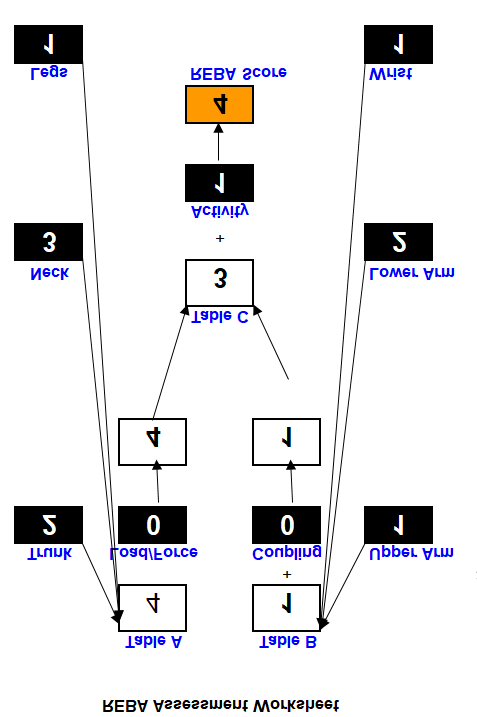
Study Steps: The research was divided into three sections. The first stage was preliminary and included the following activities:
- Briefing the subject on the experiment’s objective, technique, and risks.
- Obtaining the subject’s informed consent.
- Recording subject gender, age, height, weight, education, professional experience, working hours.
After that the REBA assessment portion of the study began. The process involved:
- Taking photographs for comparison with working postures of hairdressers.
- According to REBA Scoring System, working postures were evaluated by using REBA worksheets.
Results and Discussion
REBA Results
The study was performed in one of the hairdressing workplace and two basic operations (hair-coloring and hair- cutting) were considered for REBA analysis. For both sides of the body, the results for working posture were consistent. The average REBA score was 6.8 for hair-coloring and this score indicates that there is a medium risk level associated with this posture. Thus, the action is necessary. The average REBA score was 7.4 for hair-cutting and this score indicates that there is a medium risk level associated with this posture. Thus, the action is necessary. Similar results using REBA analysis in literature indicated that about 56% of the postures related to the right side of the body were classified as medium level and about 30% as high level, but about 76% of the postures related to the left side of the body were classified as medium level and about 16% were considered as high level [15]. Similarly, the results of another study by Miri, et al. [16] performed REBA analysis and they concluded that about 42% of the postures related to the right side of the body were classified as “medium level” and about 38% as “high level”, but about 46% of the postures related to the left side of the body were classified as “medium level” and about 40% as “high level”. Working with a lifted shoulder, leaning forward or sideways, turning the head forward or sideways, and twisting the neck are all factors that might lead to a high risk score in hairdressers.
Correlation Analysis
A correlation analysis was performed for assessing the relationship between REBA score and musculoskeletal disorders (MSDs) in the neck and wrist. This study’s findings revealed a strong relationship between REBA score and MSDs in the neck and wrist (Table 2). The duration of work and MSDs in the leg had a significant correlation in the study conducted by Miri, et al. [16]. It also revealed a relationship between the REBA score and MSDs in the legs and wrist. [16]. In another study, Best, et al. [17] concluded that 70% of hairdressers suffered from MSDs. Furthermore, poor working posture and prolonged standing are the leading causes of MRMSDs among hairdressers [17]. IBM SPSS Statistics (v.28) was used for descriptive statistics and correlation analysis of MSD parameters with REBA score.
| Shoulder | Neck | Elbow | Wrist and hand | Leg | Knee | Hip | Lower back | Upper back | |
|---|---|---|---|---|---|---|---|---|---|
| REBA Score | 0.675 | 0.024* | 0.345 | 0.034* | 0.0021* | 0.456 | 0.766 | 0.443 | 0.278 |
Table 2: Correlation of MSDs parameters with REBA score.*Correlations are significant at the p ≤ 0.05 level
Conclusions
In this research, the postural risks of hairdressing tasks, mainly focusing on hair-coloring and hair-cutting tasks, were performed. According to the findings of this study, hairdressers are at an increased risk of MSDs. Moreover, risk levels should be decreased by the design and use of ergonomic and suitable tools and equipment in order to reduce WRMSDs. Because of the small number of participants, these results are preliminary. Despite the small sample size, this research revealed that the hair-coloring and hair-cutting postures need to be changed as soon as possible. On the basis of this research, further work has to be done, and researchers will need to work with broader subject groups. More hairdressing procedures might lead to work- related injuries, which would have to be taken into account in any future research.
References
-
Lind ML (2006) Hairdressers-hand eczema, hair dyes and hand protection. Medicine.
-
Ferreira AP (2013) Occupational health hazards of female hairdressers in Jacarepagua´, Rio de Janeiro, Brazil. Journal of Environmental and Occupational Science 2(1): 27-32.
-
Bureau of Labor Statistics (2009) Barbers, Cosmetologists, and Other Personal Appearance Workers. In: Occupational Outlook Handbook, 2008- 2009 Edition.
-
(2015) Nonfatal Occupational Injuries and Illnesses Requiring Days Away From Work. BLS.
-
Morse TF, Dillon C, Warren N, Levenstein C, Warren A (1998) The economic and social consequences of work-related musculoskeletal disorders: the Connecticut Upper-Extremity Surveillance Project (CUSP). International Journal of Occupational and Environmental Health 4(4): 209-216.
-
Wu CYYC, Lu CW, Chang KF, Chang CH (2004) Evaluating the musculoskeletal disorders in the employee working in the beauty salon. Proceeding of the Health and Safety Conference.
-
Chuang W (2005) A research on the musculoskeletal disorders of hairdressers in beauty salons. Journal of Cheng-Shiu University, Taiwan 18: 65-67.
-
Mussi G, Gouveia N (2008) Prevalence of work- related musculoskeletal disorders in Brazilian hairdressers. Occupational medicine 58(5): 367-369.
-
Aweto HA, Tella BA, Johnson OY (2015) Prevalence of work-related musculoskeletal disorders among hairdressers. International journal of occupational medicine and environmental health 28(3): 545-555.
-
Mahdavi S, Mahdavi MR, Safary M, Rashidi R, Dehghani T, et al. (2013) Evaluation of the risk of musculoskeletal disorders using Rapid Entire Body Assessment among hairdressers in Khorramabad, Iran, in 2014. Journal of Occupational Health and Epidemiology 2(3): 138-145.
-
Fang HL, Chen RC, Fang HP, Xu Q (2007) An ergonomic approach to an investigation into the risk factors leading to work-related musculoskeletal disorders for Taiwanese hairdressers. Pro Int Assoc Societies Des Res Iasdr.
-
Hignett S, McAtamney L (2000) Rapid entire body assessment (REBA). Applied Ergonomics 31(2): 201- 205.
-
Cakit E (2015) Assessment of the physical demands of waste collection tasks. Glob Nest J 17(2): 426-438.
-
Cakit E (2018) Ergonomic assessment of airport shuttle driver tasks using an ergonomic analysis toolset. International journal of occupational safety and ergonomics 24(2): 286-293.
-
Hokmabadi R, Esmailzade KM, Mahdinia M (2012) Evaluation of Ergonomic Postures of Hairdressers by Reba (Rapid Entire Body Assessment). Journal of North Khorasan University of Medical Sciences 3(4): 49-54.
-
Miri MR, Hosseini MH, Sharifzadeh GR (2008) Evaluation of ergonomic postures of hairdressers by REBA in Birjand. The Horizon of Medical Sciences 14(2): 39-44.
-
Best M, French G, Ciantar JP, Didzys DG, Fitzgerald CM, et al. (2002) Work-related musculoskeletal disorders in hairdressers.
- The Expanding Landscape of Road Rage: A Systematic Review of Conflicts Involving Drivers, Pedestrians, and Micromobility
- Validating Cognitive Models of Royal Navy Performance on Control Systems
- Comparing Standard and State-of-the-art Firefighter Coats on Postural Balance and Gait in a Live Burn Environment
- Investigating the Integration of Telemedicine into Clinicians Workflow: A Review of Methods
- Risk Assessment of Ergonomic Factors in a Textile Firm by RULA, REBA and Fine Kinney Methods
- Impact of Self-Esteem Training on Individuals with Disabilities Aged 17-30