
Impact of Self-Esteem Training on Individuals with Disabilities Aged 17-30
Several studies showed that higher levels of self-esteem are correlated with lower levels of anxiety and of depression, and higher satisfactory interpersonal relationships such as security and closeness, whereas low self-esteem was found to play a pivotal role as a risk factor for anxiety, emotion regulation problems and depression. Self-esteem is a key determinant of the psychological and social well-being of individuals, particularly in people with disabilities, who often face unique challenges related to self-acceptance and social inclusion. There is a paucity of specific research on the effectiveness of psychotherapeutic interventions targeting self-esteem in people with disabilities. This experimental comparative study aims to analyse changes in self-esteem, psychological well-being, anxiety and depression in a sample of 30 individuals with mild intellectual disability, aged between 17 and 30 years, who participated in a psychotherapeutic program focused on self-esteem training and the interview technique (Semi, 1985), conducted in a public setting. The individual psychotherapeutic program was structured into 8 weekly sessions, each lasting 90 minutes, for a total duration of 8 weeks. The intervention, using an uncontrolled trial, was supported by objective measurements taken from the patients before (T0) and after the psychotherapeutic program (T1). Results analysed using SPSS 2.0 software revealed significant improvements in the participants' self-esteem and psychological well-being, as well as a reduction in anxiety and depression symptoms among the patients involved in the study.
Introduction
The concept of self-esteem and self-concept had been widely studied over the years. Literature shows that it’s important to consider self-concept distinct from self- esteem. Self-concept, or image, self-representation [1, 2, 3, 4, 5, 6, 7], is elaborated on the basis of experience and it influences the perception and attribution of meanings to events. Therefore, it preserves a sense of continuity and consistency of one’s image over time. On the other hand, self-esteem has always been defined as a positive or negative assessment of oneself [8]. Currently it’s described as the essential component of the self-concept, as it constitutes its affective orientation, helps to define the positive and negative evaluations about oneself [9] and it’s an individual’s subjective evaluation of their personal worth [10]. Self-esteem plays a critical role in psychological well-being [4]. During adolescence, a critical period in individuals’ development, characterized by significant physical, emotional and social changes, self- concept tends to become more complex and differentiated, directly affecting self-esteem [11]. A positive perception of one’s abilities and relationships can promote and encourage high self-esteem, while discrepancies between the real self and the ideal one can generate feelings of frustration and contribute to a low self-esteem.
Moreover, studies showed that higher levels of self- esteem are correlated with lower levels of anxiety and of depression, and higher satisfactory interpersonal relationships such as security and closeness [1], whereas low self-esteem was found to play a pivotal role as a risk factor for anxiety, emotion regulation problems and depression [2, 3, 4]. Finally, Trzesniewski, et al. [12] showed in 2006 that adolescents with low self-esteem developed depression more frequently than adolescents with higher self-esteem. Self-concept and self-esteem are crucial variables in the study of intellectual disabilities. Adolescence is a distinct time period in which many people with intellectual and developmental disabilities begin to recognize differences between themselves and peers. Adolescents may experience frustration, isolation and inadequacy [13, 14]. Many studies show that social comparison plays a pivotal role in the development of both self-concept and self-esteem [15]. People with intellectual disability compare themselves to not disabled peers, and therefore can interpret negative information as a threat to their self-esteem [15]. Moreover, Facchini [16] and colleagues showed in 1996 that people with intellectual disability obtain significantly lower scores in self-concept and self-esteem, than people who aren’t disabled. Given the association between well-being and high self-esteem, and the link between psychological disorders and low self-esteem, a large number of studies developed methods to boost self-esteem in the population. The effectiveness of interventions is significant [17].
Some studies have tried to increase self-esteem in children with intellectual disabilities using play-based training [18]. The results are promising, showing an increase in self-esteem and a decrease in social isolation [19]. Play therapy approaches have shown encouraging results in social and emotional functioning in children with intellectual disabilities. However, there are no specific trainings in the literature designed to increase self-esteem in adolescents and young adults with intellectual disabilities.
The aim of this study is to demonstrate how the integration of Shab’s self-esteem training into a psychotherapeutic program can lead to changes in self- esteem, personal psychological well-being, and perceived levels of anxiety and depression in a sample of 30 individuals with mild intellectual disabilities accessing public services.
Materials and Methods
Sample
The sample consisted of 30 people with mild intellectual disability, aged between 17 and 30 years, with an average age of 24.3 years (ds = 3.9), referred to the Disability Service S.C. Psicologia Aziendale on referral from the Neuropsichiatria Infantile Sud e Nord, Est ed Ovest and the S.C. Cure e Disabilità of the municipality of Turin. Disabilities included physical (n = 5), mild cognitive (n = 22) and sensory (n = 3) problems. The sample consisted of 13 females and 7 males. All participants live in Turin, in the Piedmont region. For what concerns the level of education, all subjects achieved a high school diploma. All participants were informed of the purpose of the study and gave informed consent.
Materials and Procedures
The individual psychotherapeutic program was structured into 8 weekly sessions, each lasting 90 minutes, for a total duration of 8 weeks. The intervention was centered on the self-esteem training from the Erickson manual ‘Self-esteem: my workbook. Activities for learning to accept yourself and recognise your own value”, which included cognitive-behavioral techniques (self-reflection exercises, cognitive restructuring, positive reinforcement and imaginative exposure) and activities aimed at improving social skills and self-image. Participants also did individual exercises between sessions to reflect on their own abilities and successes. The self-esteem training in the psychotherapeutic program was complemented by the interview technique [6]. In addition, for quantitative data collection, the following tests were used and administered before and after treatment: RSES, PWB and HADS. For simplicity, each test was read out to the patient by the psychotherapist during the first and last sessions. The purpose of the 10 item RSES – Rosenberg self-esteem scale is to measure self-esteem. Originally the measure was designed to assess the self-esteem of high school students. However, since its development, the scale has been used with a variety of groups including adults, with norms available for many of those groups [20]. This instrument has since been validated in Italy [21]. This scale, one of the most widely used internationally, is easy to understand and consists of only 10 items that assess self-esteem as a global concept. The person is asked to rate how satisfied they are with themselves on a 4-point Likert-type scale (1= strongly disagree; 2= disagree; 3= agree, 4= strongly agree). As far as the score is concerned, this varies from 10 to 40 points; a high score corresponds to high self-esteem, whereas a low score corresponds to low self-esteem [22].
The RSES does not have an established cut-off, due to the fact that a classification into high or low self-esteem does not have any kind of fixed reference standard [23]. Developed by psychologist Carol D Ryff [24], the 42-item Psychological Well Being (PWB) Scale measures six aspects of wellbeing and happiness: autonomy, environmental mastery, personal growth, positive relations with others, purpose in life, and self-acceptance [24, 25]. Subjects are asked to rate how satisfied they are with themselves on a 7-point Likert-type scale (1 = strongly agree; 2 = somewhat agree; 3 = somewhat agree; 4 = neither agree nor disagree; 5 = somewhat disagree; 6 = somewhat disagree; 7 = strongly disagree). Respondents rate how strongly they agree or disagree with 42 statements using a 7-point scale (1 = strongly agree; 7 = strongly disagree). The PWB Scale has six subscales: Autonomy (e.g., “I have confidence in my opinions, even if they are contrary to the general consensus”); Environmental Mastery (e.g., “In general, I feel I am in charge of the situation in which I live”); Personal Growth (e.g., “I think it is important to have new experiences that challenge how you think about yourself and the world”); Positive Relations With Others (e.g., “People would describe me as a giving person, willing to share my time with others”); Purpose in Life (e.g., “Some people wander aimlessly through life, but I am not one of them”); and Self-acceptance (e.g., “When I look at the story of my life, I am pleased with how things have turned out”).
The Hospital Anxiety and Depression Scale (HADS) is a self-rating scale used to measure symptoms of anxiety and depression. It’s a 14-item instrument used to screen for anxiety and depression, which commonly co-occur.
The HADS produces a subscale for anxiety (HADS-A) and a separate subscale for depression (HADS-D). HADS can be administered in 5 minutes. The sum of all values creates the total score. A score between 0 and 7 is within the normal range, between 8 and 10 at the borderline of normal, and between 11 and 21 above normal.
Data Analysis and Results
To test the effectiveness of the intervention using an uncontrolled trial, data were collected before and after the psychotherapeutic program. Statistical analyses were conducted using SPSS 2.0 software, and were performed using the paired sample t-test to compare pre and post intervention scores for self-esteem, personal well-being, anxiety and depression. In the analysis of the results and their comparison, a p-value < 0.05 was considered significant. The experimental design was within-subjects, meaning each subject was compared to themselves, with the results from the pre-intervention (pre) and post-intervention (post) questionnaires being correlated. Therefore, the change within each individual was measured to determine the effectiveness of the intervention concerning the analysed variables: self-esteem, psychological well-being, anxiety, and depression.
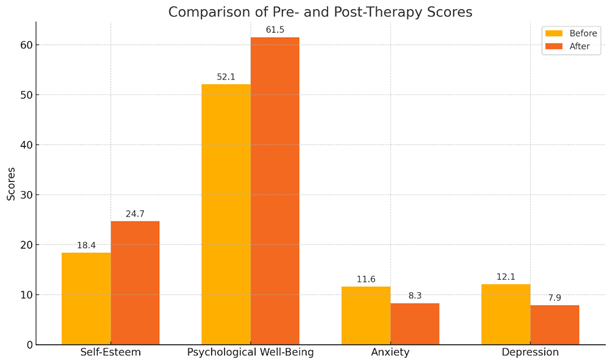
The mean score on the Rosenberg self-esteem scale (RSES) increased from 18.4 (SD = 4.2) pre-intervention to 24.7 (SD = 3.8) post-intervention, indicating a significant increase in self-esteem (t(29) = 6.95, p < 0.001). 80% of the participants showed an increase in score, with an average improvement of 34%. The mean scores of the Psychological Well-being Questionnaire (PWB) also showed a significant improvement, from a mean score of 52.1 (SD = 9.3) to 61.5 (SD = 8.7) post-intervention (t(29) = 5.48, p < 0.001). The dimensions with the greatest improvement were autonomy (+16%) and personal growth (+14%). Scores on the Hospital Anxiety and Depression Scale (HADS) showed a significant reduction for both anxiety (from 11.6 to 8.3; t(29) = 4.35, p = 0.002) and depression (from 12.1 to 7.9; t(29) = 5.12, p = 0.001). 65% of the participants showed a significant reduction in anxiety and depression symptoms. This experimental study followed standard research criteria, reporting quantitative and objective data to support the initial hypotheses and providing a rigorous statistical analysis. As can be seen, there is significant improvement in all areas, with increased self-esteem and psychological well- being and reduced levels of anxiety and depression (Figure 1).
Discussion
The results demonstrate how the described psychotherapeutic program, in which the interview technique [6] integrates a structured training such as the self-esteem program [5], can promote improvements in psychological well-being and self-esteem. It also helps individuals with mild intellectual disabilities reduce symptoms of anxiety and depression. The average increase in self-esteem scores of 34 percent demonstrates the effectiveness of the intervention, confirming the importance of working on self-image in people with disabilities.
In addition, analysis of psychological well-being dimensions showed significant improvements, specifically in autonomy and personal growth, which are two aspects often affected by psychological and social barriers related to mild intellectual disability. This contribution it’s important because it shows that as levels of self-esteem increase, levels of anxiety and depression decrease. Indeed, the results of the current study are in line with other research. Moon and Kim [26] suggested in their study that people with disabilities who presented low self-evaluation in both self- esteem and self-efficacy may have a higher risk of exhibiting self-report of depression and perceived stress compared to those with higher self-evaluations. Other studies found that individuals with low self-evaluation also report negative experiences, such as increased fatigue and pain [27]. Finally, a different research demonstrated the association between law self-evaluation and mental health [28, 29]. Furthermore, in Fernandes and colleagues’ research [2] has been found that low self-esteem plays an important role as a risk factor not only for anxiety, but also for emotion regulation (ER) problems [3, 4]. In fact, Guil and collaborators [3] highlighted the close relationship between individual self-esteem, anxiety and emotional intelligence, where self-esteem was found to predict anxiety traits and ability to attend to their own and others emotional states [3, 30]. These findings also highlight the importance of self-esteem in understanding this relationship, particularly as a mediator between trait and state anxiety and increased suppression [31, 32, 33, 34, 35, 36, 37].
This study has limitations. For example, the sample size is small and there isn’t a control group. In the future, it would be useful to conduct studies with a randomized experimental design to confirm these results, and to enlarge the sample. In addition, reading the questionnaires could be a variable to be modified for future research. This study provides preliminary evidence on the effectiveness of a psychotherapeutic course centered on self-esteem in people with disabilities. The results suggest that such interventions may improve not only self-esteem but also psychological well-being and reduce symptoms of anxiety and depression. This approach could be integrated into psychological support programs for people with disabilities, promoting higher quality of life and better social adjustment.
References
-
Murray LS (2005) Regulating the risk of closeness: A relationship-specific sense of felt security. Curr Dir Psychol Sci 14: 74-78.
-
Fernandes B, Newton J, Essau CA (2022) The mediating effects of self-esteem on anxiety and emotion regulation. Psychol Rep 125(2): 787-803.
-
Guil R, Gomez-Molinero R, Merchan-Clavellino A, Gil-Olarte P, Zayas A (2019) Facing anxiety, growing up. Trait emotional intelligence as a mediator of the relationship between self-esteem and university anxiety. Front Psychol 10: 567.
-
Manna G, Falgares G, Ingoglia S, Como MR, Santis SD (2016) The relationship between self-esteem, depression and anxiety: Comparing vulnerability and scar model in the Italian context. Mediterr J Clin Psychol 4(3): 1-16.
-
Shab LM (2016) Self-esteem: my workbook. Activities to learn to accept yourself and recognize your value. Erickson Publisher, Italy.
-
Semi A A (1985) Interview technique. Raffaello Cortina Editore, Italy.
-
Palmonari A (1993) Identity, self-concept and developmental tasks. In: Palmonari A (Ed.), Psychology of adolescence. The Mill: Bologna, Italy.
-
Rosenberg M (1979) Conceiving the Self. Basic Books, New York.
-
Arcuri L, Maass A (1995) The social dimensions of the self. In: Arcuri L (Ed.), Manual of social psychology. The Mill: Bologna, Italy.
-
Orth U, Robins RW (2013) Understanding the link between low self-esteem and depression. Curr Dir Psychol Sci 22: 455-460.
-
Minev M, Petrova B, Mineva K, Petkova M, Strebkova R (2018) Self-esteem in adolescents. Trakia J Sci 16(2): 114-118.
-
Trzesniewski KH, Donnellan MB, Moffitt TE, Robins RW, Poulton R, et al. (2006) Low self-esteem during adolescence predicts poor health, criminal behavior, and limited economic prospects during adulthood. Dev Psychol 42: 381-390.
-
Evans DW (1998) Development of the self-concept in children with mental retardation: Organismic and contextual factors. In: Burack JA, et al. (Eds.), Handbook of mental retardation and development. Cambridge University Press, New York, pp: 462-480.
-
Jones JL (2012) Factors associated with self-concept: Adolescents with intellectual and developmental disabilities share their perspectives. Intellect Dev Disabil 50(1): 31-40.
-
Garaigordobil M, Pérez JI (2007) Self-concept, self- esteem and psychopathological symptoms in persons with intellectual disability. Span J Psychol 10(1): 141- 150.
-
Facchini RL (1996) Self-esteem in young adults with mild mental retardation. Dissertation Abstracts Int B Sci Eng 56(10-B): 5793.
-
Lee J Y, Patel M, Scior K (2023) Self-esteem and its relationship with depression and anxiety in adults with intellectual disabilities: A systematic literature review. J Intellect Disabil Res 67(6): 499-518.
-
Bana S, Sajedi F, Mirzaie H, Rezasoltani P (2017) The efficacy of cognitive behavioral play therapy on self- esteem of children with intellectual disability. Iran Rehabil J 15(3): 235-242.
-
Wettig HH, Coleman A, Geider F J (2011) Evaluating the effectiveness of Theraplay in treating shy, socially withdrawn children. Int J Play Ther 20(1): 26.
-
Rosenberg M (1965) Society and the adolescence self- image. Princeton University Press, Princeton, New Jersey.
-
Prezza M, Trombaccia FR, Armento L (1997) The Rosenberg self-esteem scale: Italian translation and validation. Special Organizations Joints.
-
Heatherton FT, Polivy J (1991) Development and validation of a scale for measuring state self-esteem. J Pers Soc Psychol 60(6): 895-910.
-
Martin CR, Thompson DR, Chan DS (2004) Gender differences in self-esteem in Chinese acute coronary syndrome patients. Clin Effect Nurs 8(3-4): 202-204.
-
Ryff CD, Almeida DM, Ayanian JS, Carr DS, Cleary PD, et al. (2010) Documentation of psychosocial constructs and composite variables in MIDUS II Project 1. University of Wisconsin, USA.
-
Ryff CD, Keyes CLM (1995) The structure of psychological well-being revisited. J Pers Soc Psychol. 69(4):719-727.
-
Moon JY, Kim JH (2021) Association between self- esteem and efficacy and mental health in people with disabilities. PLoS One 16(10): e0257943.
-
Craig A, Tran Y, Guest R, Middleton J (2019) Trajectories of self-efficacy and depressed mood and their relationship in the first 12 months following spinal cord injury. Arch Phys Med Rehabil 100(3): 441-447.
-
Tan-Kristanto S, Kiropoulos LA (2015) Resilience, self-efficacy, coping styles and depressive and anxiety symptoms in those newly diagnosed with multiple sclerosis. Psychol Health Med 20(6): 635-645.
-
Popov S, Biro M, Radanovic J (2015) Self-evaluation and mental health: An experimental assessment. J Evid Based Psychother 15(2): 219.
-
Werner KH, Goldin PR, Ball TM, Heimberg RG, Gross JJ (2011) Assessing emotion regulation in social anxiety disorder: The emotion regulation interview. J Psychopathol Behav Assess 33(3): 346-354.
-
Farmer RF, Rita LRL, Berent MK, Corbett A (2001) Contributions to global self-esteem: The role of importance attached to self-concepts associated with the five-factor model. J Res Pers 35: 483-499.
-
Macdonald G, Saltzmann JL, Leary MR (2003) Social approval and trait self-esteem. J Res Pers 37: 23-40.
-
Marsh HW (1986) Global self-esteem: Its relation to specific facets of self-concepts and their importance. J Pers Soc Psychol 51: 1224-1236.
-
Pelham BW, Swann WB (1989) From self-conceptions to self-worth: On the sources and structure of global self-esteem. J Pers Soc Psychol 57: 672-680.
-
Shavelson RJ, Hubner JJ, Stanton GC (1976) Self- concept: Validation of construct interpretations. Rev Educ Res 46: 407-441.
-
Vanhalst J, Luyckx K, Scholte RHJ, Engels RCME, Goossens L (2013) Low self-esteem as a risk factor for loneliness in adolescence: Perceived – but not actual – social acceptance as an underlying mechanism. J Abnorm Child Psychol 41: 1067-1081.
-
Zigmond AS, Snaith RP (1983) The hospital anxiety and depression scale. Acta Psychiatr Scand 67(6): 361-370.
- The Expanding Landscape of Road Rage: A Systematic Review of Conflicts Involving Drivers, Pedestrians, and Micromobility
- Validating Cognitive Models of Royal Navy Performance on Control Systems
- Comparing Standard and State-of-the-art Firefighter Coats on Postural Balance and Gait in a Live Burn Environment
- Investigating the Integration of Telemedicine into Clinicians Workflow: A Review of Methods
- Risk Assessment of Ergonomic Factors in a Textile Firm by RULA, REBA and Fine Kinney Methods
- Effects of a Psychotherapeutic Pathway Based on Mindfulness, Acceptance and Commitment Therapy and Creative Contact with Nature in People with Mild Intellectual Disability