
Iatrogenic Cushing's Syndrome with Secondary Adrenal Suppression Misdiagnosed as Protease Inhibitor-Induced Lipodystrophy in an HIV Positive Patient: Case Report
Background: Ritonavir is a commonly prescribed protease inhibitor (PI) which is used in low doses to boost levels of other protease inhibitors pharmacokinetically. It is a potent inhibitor of hepatic cytochrome P450 3A4 (CYP3A4) isoenzyme and reduces the metabolism of systemic steroids leading to clinical Cushing's syndrome and secondary adrenal insufficiency. Despite occasional reports of Cushing's syndrome occurring with the use of injectable triamcinolone, even in the absence of CYP3A4 inhibition, it is unclear if caution should be exercised when considering local steroid injections in the setting of ritonavir therapy. We herein report the case of an iatrogenic steroid induced Cushing’s syndrome due to triamcinolone-ritonavir interaction misdiagnosed as PI induced lipodystrophy. Case Presentation: We present the case of a 47-year-old HIV positive African male patient, who was switched from Tenofovir/ Lamivudine/ Efavirenz combination therapy to Abacavir/ Lamivudine/ Atazanavir/ Ritonavir due to virologic failure and had been on this new regimen for 1 year. He had been on over-the-counter intramuscular triamcinolone for 3 months, for knee pain and presented with a 2-month history of weight gain, swollen face and distended abdomen. Clinical examination revealed a moon face, dorsocervical hump, central obesity, fair skin, and pitting edema. He was initially thought to have PI induced lipodystrophy but after thorough examination and laboratory investigations, a diagnosis of iatrogenic Cushing syndrome with adrenal suppression was made and he was managed with hydrocortisone replacement therapy with marked regression of symptoms thereafter.Conclusion: Cushing’s syndrome should be considered as an important differential in HIV positive patients on PI who develop abnormal fat deposition, especially in the context of steroid use. A high index of suspicion is required for early diagnosis and management. Whenever possible, the use of glucocorticoid therapy through any route should be avoided in patients on ritonavir-boosted protease inhibitor therapy.
Introduction
Morbidity and mortality have been substantially reduced in patients with human immunodeficiency virus (HIV) infection by the introduction of highly active antiretroviral therapy (HAART) [1]. The use of HAART for HIV-infected patients is sometimes associated with the development of abnormal fat-accumulation syndromes. These lipodystrophy syndromes primarily have been ascribed to protease inhibitor (PI) use [2]. However, other conditions such as Cushing’s syndrome and alcoholism may also cause abnormal fat accumulation in this patient population [3, 4]. Ritonavir, a PI is currently being used in low doses to pharmacokinetically boost levels of other PIs. It is a potent inhibitor of hepatic cytochrome P450 3A4 (CYP3A4) isoenzyme [5]. Ritonavir reduces the metabolism of systemic steroids, which may lead to clinical Cushing's syndrome and secondary adrenal insufficiency [6, 7, 8]. Despite occasional reports of Cushing's syndrome occurring with the use of injectable triamcinolone even in the absence of CYP3A4 inhibitors, it is not clear if caution should be exercised when considering the use of local steroid injections in the setting of ritonavir therapy [9, 10]. However, drug–drug interactions and long-term toxicity remain an important issue in aging HIV-infected patients who often suffer from other co-morbidities that require continuous or transient drug therapy. We herein report this case to creat awareness to the existence and association of Triamcinolone-Ritonavir interaction in causing Cushing’s syndrome.
Case Presentation
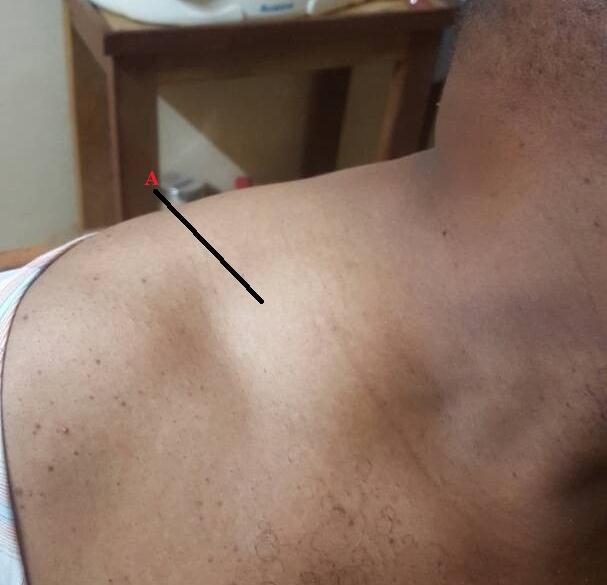
A 47-year-old Black African male presented to the outpatient department of our service with a 2-month history of weight gain, puffed jaws and a distended abdomen. He initially denied any use of steroids (inhaled, topical or systemic). He had been diagnosed HIV positive 5 years ago and was initially placed on Tenofovir 300 mg/Lamivudine 300 mg/Efavirenz 600mg (TDF/3TC/EFV), 1 tablet at bed time. He was later switched to Abacavir 600mg/Lamivudine 300mg/Atazanavir 300mg/Ritonavir 100mg (ABC/3TC/ATZ/r), 1 tablet at bed time after 4 years of treatment due to treatment failure – both virologic failure (viral load of 464000copies/ml after 4 years of treatment) and immunologic failure (CD4 count of 41cells/µl after 4 years of treatment). On examination, he was well-looking with vital signs as follows: blood pressure 120/80mmHg, body mass index 26.8Kg/m², Pulse 70beats/minute. He had puffed jaws (Figure 1), central obesity (abdominal circumference of 106cm) and supraclavicular fat pads (Figure 2). There was no dorsocervical hump, no striae and no distal muscle wasting.

An initial diagnosis of PI-induced (ATZ/r) lipodystrophy was made. He was, however, maintained on the same antiretroviral regimen due to non- availability of alternative regimens. A month later, he presented with similar initial symptoms, in addition to fair skin, mostly at the extremities and swollen limbs. Upon further evaluation he admitted the use of a total of 5 doses of intramuscular injections of triamcinolone (Kenacort®) 80mg, which he bought from a local chemist for knee pain, 3 months prior to the first consultation. Physical examination this time revealed a blood pressure of 140/100 mmHg, a moon face, dorso- cervical hump, central obesity and grade I bilateral pitting oedema. A tentative diagnosis of steroid-induced Cushing’s syndrome was postulated this time. Laboratory investigations revealed free 24 hour urine cortisol of <10nmol/l (NR 30-200nmol/l) as well as 8 am plasma cortisol of equally <10nmol/l (NR 8am- 10am: (172-497) nmol/l, 4pm- 12pm: (74-286) nmol/l). A final diagnosis of steroid-induced Cushing’s syndrome due to triamcinolone- ritonavir interaction with secondary pituitary-adrenal axis suppression was retained. The patient was placed on oral Hydrocortisone 10mg in the morning and 5 mg at 4pm over a period of 3 months with marked regression in symptoms.
Discussion
Lipodystrophy syndromes have primarily been related to the use of PIs [2]. Ritonavir, which is itself a PI, is used to boost the levels of other protease inhibitors and it also significantly slows down the metabolism of systemic steroids, thereby increasing the risk of developing Cushing’s syndrome [5]. Our patient was on 100mg of ritonavir daily and also received over- the-counter intramuscular triamcinolone. Glucocorticoids are generally deactivated by CYP3A4 enzymes and therefore when ritonavir is given together with glucocorticoids the systemic levels of glucocorticoids increase dramatically due to inhibition of CYP3A4 [8]. PIs inactivate CYP4503A4 by acting as substrates for the enzyme, leading to the formation of a metabolic intermediate complex, a process called mechanism-based inactivation [11]. Ritonavir in particular, in relatively low concentrations produces maximal rate of CYP450 3A4 inactivation, which makes it one of the most potent and most efficient inactivator of CYP450 3A4 among HIV protease inhibitors [12]. Triamcinolone, fluticasone and methylprednisolone are steroids that have been reported to cause Cushing’s syndrome when used concomitantly with protease inhibitors [13, 14]. This interaction has been documented to occur after the use of inhaled, intra- articular, epidural, periradicular, intramuscular, and subacromial injection of glucocorticoids [13, 15, 16]. Our patient, while on ritonavir, received 5 intramuscular shots of triamcinolone, which caused his Cushing’s syndrome secondary to triamcinolone-ritonavir drug- drug interaction. The initial presentation of Cushing’s syndrome shares some similarities with PI-associated lipodystrophy, which usually leads to delays in the diagnosis of the former [17]. These symptoms include puffed face, weight gain and abdominal distension, as was the case with our patient. However, the absence of peripheral lipoatrophy and central lipoaccumulation, both of which the patient in this case lacked, in the presence of breast hypertrophy may lower the suspicion of PI-associated lipodystrophy [18] The presence of supraclavicular fat pads, dorsocervical hump, and a fair skin raises the suspicion of Cushing’s syndrome [19]. Schwarze Z, et al. [16] reviewed the course of 15 patients who had received a triamcinolone injection and showed that symptoms of adrenal insufficiency could appear as early as 2 weeks after a single injection in ritonavir-boosted protease inhibitor- treated patients [16]. The patient reported in this case report was on a ritonavir-boosted regiment and received 2 intramuscular doses of triamcinolone a month prior to the onset of symptoms. Several tests are usually combined to establish the diagnosis of Cushing’s syndrome due to limited specificity and sensitivity of individual test in isolation. These test include: failure to suppress serum cortisol with low doses of oral dexamethasone; loss of the normal circadian rhythm of cortisol, with inappropriately elevated late-night serum or salivary cortisol and increased 24-hour urine free cortisol [20]. In the case of Iatrogenic Cushing’s syndrome with secondary pituitary-adrenal axis suppression, the exogenous steroid suppresses Pituitary production of corticotropin (ACTH), leading to atrophy of the adrenal cortex and adrenal insufficiency [21]. As a result, the diagnosis is confirmed by low early morning serum cortisol levels and subnormal response to standard ACTH stimulation test. An early morning serum cortisol level <80 nmol/L strongly suggests adrenal insufficiency [22]. The treatment for exogenous Cushing syndrome and adrenal insufficiency is gradual withdrawal of the causative drug, with the aim of discontinuing the causative drug if possible [23]. Other treatment options, especially in the context of iatrogenic Cushing syndrome and adrenal insufficiency secondary to the interaction between ritonavir and an invaluable exogenous steroid include replacing ritonavir with another antiretroviral agent, replacing the exogenous steroid with another less potent steroid or leukotriene antagonists or long acting anticholinergic agent such as tiotropium [21]. In our case, we had no other alternative to ritonavir and the exogenous steroid was not a prescription drug. The patient was therefore withdrawn from triamcinolone and placed on hydrocortisone replacement therapy for over a period of 3 months with a marked regression in initial symptoms.
Conclusion
Cushing syndrome should be considered as an important differential in HIV positive patients on PI with fat deposition and a high index of suspicion is necessary for early diagnosis and management. If possible, the use of glucocorticoid therapy through any route in patients on ritonavir-boosted protease inhibitor therapy should be avoided unless absolutely necessary.
References
-
Kim JH, Psevdos G, Gonzalez E, Singh S, Kilayko MC, et al. (2013) All-cause mortality in hospitalized HIV- infected patients at an acute tertiary care hospital with a comprehensive outpatient HIV care program in New York City in the era of highly active antiretroviral therapy (HAART). Infection 41(2): 545-551.
-
Carr A (2000) HIV protease inhibitor-related lipodystrophy syndrome. Clin Infect Dis 2: 135-142.
-
Tauveron I (1994) The Cushing Syndrome Associated with AIDS. Ann Intern Med 120(7): 620.
-
Miller KK, Daly PA, Sentochnik D, Doweiko J, Samore M, et al. (1998) Pseudo- Cushing’s syndrome in human immunodeficiency virus- infected patients. Clin Infect Dis Off Publ Infect Dis 27(1): 68-72.
-
Rock BM, Hengel SM, Rock DA, Wienkers LC, Kunze KL (2014) Characterization of ritonavir-mediated inactivation of cytochrome P450 3A4. Mol Pharmacol 86(6): 665-674.
-
St Germain RM, Yigit S, Wells L, Girotto JE, Giratto JE, et al. (2007) Cushing syndrome and severe adrenal suppression caused by fluticasone and protease inhibitor combination in an HIV-infected adolescent. AIDS Patient Care STDs 21(6): 373-377.
-
Foisy MM, Yakiwchuk EMK, Chiu I, Singh AE (2008) Adrenal suppression and Cushing’s syndrome secondary to an interaction between ritonavir and fluticasone: a review of the literature. HIV Med 9(6): 389-396.
-
Busse KH, Formentini E, Alfaro RM, Kovacs JA, Penzak SR (1999) Influence of antiretroviral drugs on the pharmacokinetics of prednisolone in HIV- infected individuals. J Acquir Immune Defic Syndr 48(5): 561-566.
-
Gondwe JS, Davidson JE, Deeley S, Sills J, Cleary AG (2005) Secondary Cushing’s syndrome in children with juvenile idiopathic arthritis following intra- articular triamcinolone acetonide administration. Rheumatol Oxf Engl 44(11): 1457-1458.
-
Kumar S, Singh RJ, Reed AM, Lteif AN (2004) Cushing’s syndrome after intra-articular and intradermal administration of triamcinolone acetonide in three pediatric patients. Pediatric 113(6): 1820-1824.
-
Silverman RB (1995) Mechanism-based enzyme inactivators. Methods Enzymol 249: 240-283.
-
Ernest CS (2004) Mechanism-Based Inactivation of CYP3A by HIV Protease Inhibitors. J Pharmacol Exp Ther 312(2): 583-591.
-
Samaras K, Pett S, Gowers A, McMurchie M, Cooper DA (2005) Iatrogenic Cushing’s syndrome with osteoporosis and secondary adrenal failure in human immunodeficiency virus-infected patients receiving inhaled corticosteroids and ritonavir- boosted protease inhibitors: six cases. J Clin Endocrinol Metab 90(7): 4394-4398.
-
Hyle EP, Wood BR, Backman ES, Noubary F, Hwang J, et al. (2013) High frequency of hypothalamic- pituitary-adrenal axis dysfunction after local corticosteroid injection in HIV-infected patients on protease inhibitor therapy. J Acquir Immune Defic Syndr 63(5): 602-608.
-
Maviki M, Cowley P, Marmery H (2013) Injecting epidural and intra-articular triamcinolone in HIV- positive patients on ritonavir: beware of iatrogenic Cushing’s syndrome. Skeletal Radiol 42(2): 313- 315.
-
Schwarze-Zander C, Klingmüller D, Klümper J, Strassburg CP, Rockstroh JK (2013) Triamcinolone and ritonavir leading to drug-induced Cushing syndrome and adrenal suppression: description of a new case and review of the literature. Infection 41(6): 1183-1187.
-
Hirsch HH, Battegay M (2002) Lipodystrophy Syndrome by HAART in HIV-Infected Patients: Manifestation, Mechanisms and Management. Infection 30(5): 293-298.
-
Handelsman Y, Oral EA, Bloomgarden ZT, Brown RJ, Chan JL, et al. (2013) The clinical approach to the detection of lipodystrophy – an AACE consensus statement. Endocr Pract 19(1): 107-116.
-
Lawrence F Kirk J, Hash RB, Katner HP, Jones T (2000) Cushing’s Disease: Clinical Manifestations and Diagnostic Evaluation. Am Fam Physician 62(5): 1119-1127.
-
Walker BR, Colledge NR, Ralston S, Penman ID, Britton R (2014) Davidson’s principles and practice of medicine. 22nd (edn), Edinburgh, New York: Churchill Livingstone/Elsevier, pp: 1372.
-
Epperla N, McKiernan F (2015) Iatrogenic Cushing syndrome and adrenal insufficiency during concomitant therapy with ritonavir and fluticasone. SpringerPlus 4: 455.
-
Hägg E, Asplund K, Lithner F (1987) Value of basal plasma cortisol assays in the assessment of pituitary-adrenal insufficiency. Clin Endocrinol (Oxf) 26(2): 221-226.
-
(2017) Iatrogenic Cushing Syndrome.
- How to Identify and Overcome Barriers in Developing Blood Systems?
- Why Was Transfusion Medicine Not Recognized as a Clinical Discipline?
- Outcomes of Lenalidomide Relapsed/Refractory Patients
- Is Transfusion Always Necessary?
- The Logistics of Production and Use of Blood and Blood Components
- The Challenge for Component Therapies