
Treating SARS-CoV-2 Based Upon the Fleming InflammoThrombotic Response (ITR) & Cardiovascular Disease Theory
This paper discusses the importance of addressing, measuring and treating the infectious, inflammatory and thrombotic tissue effect resulting from the body’s immunologic response to SARS-CoV-2 using methods previously detailed in the medical literature, in an effort to reduce SARS-CoV-2 morbidity and mortality. Successful treatment of SARS-CoV-2 requires addressing each of the four stages of the viral infection including oxygenation, acute cytotoxic immune response, adaptive humoral-antibody response, and viral cellular attachment and replication. Information obtained from the National Clinical Trial NCT04349410 has proven the benefit of treating each of these four factors. A paper detailing the NCT04349410 results has been published elsewhere.
Key Points
- The majority of deaths following SARS-CoV-2 infections are the result of people dying with SARS-CoV-2 due to the InflammoThrombotic responses (ITR) to the viral infection.
- Awareness of the ITR following SARS-CoV-2 infection in the immunologically naïve and patients with comorbidities, and treatment directed to that ITR is critical to the care and management of SARS-CoV-2 patients.
Introduction–Understanding and Measuring the Effect of SARS-CoV-2
In 2019 SARS-CoV-2 validated the Fleming InflammoThrombotic Response (ITR) and Cardiovascular Disease Theory confirming the role that viruses, including SARS-CoV-2, and other factors play in the InflammoThrombotic Response (ITR) to disease. This
paper looks at critical information needed by clinicians and researchers alike, as they diagnose and treat SARS-CoV-2 patients.
In 1994 the Fleming Inflammation and Cardiovascular Disease Theory was initially presented [1, 2] at the American Heart Association (AHA) meetings in an effort to explain the continued increase in heart and other blood vessel diseases despite improvements in lipid management. The Fleming Theory established 12-fundamental factors responsible for InflammoThrombotic and vascular diseases including infections [3, 4]. The initial presentation was followed by subsequent AHA presentations and publication of the Theory in a Cardiology Textbook [5] in 1999. Further research demonstrated the effectiveness of treating bacterial infections [6] and reversing coronary artery disease (CAD) and the ITR process using this Theory. Portions of this work were discussed in 2004 on 20/20 [7].
Measurement of changes in tissue caused by the SARS- CoV-2 viral infection and the resulting ITR within pulmonary and other tissue is made possible using the Fleming Method for Tissue and Vascular Differentiation and Metabolism (FMTVDM) [8].
FMTVDM (Figure 1) provides quantitatively objective measurements of the severity of the infection and when performed serially can measure the exact effect of treatment; saving time, money, resources and lives.
![Figure 1: Inflammothrombotic interactions between infection, inflammation, interleukins, cytokines and the blood-clotting complement cascade. FMTVDM tissue measurement of the viral and InflammoThrombotic Response (ITR). Legend: The left half of the figure [5] shows the interactions between infectious agents, the complement clotting cascade, cytokines, interleukins, and glycoprotein IIb/IIIa as they worsen already existing InflammoThrombotic coronary artery (vascular) disease in addition to other inflammatory diseases including inter alia obesity, cerebrovascular (CVA) disease, diabetes, cancer, advanced age, and hypertension. The right half of the figure [8] shows FMTVDM measurement of regional differences in blood flow and metabolism at the tissue level resulting from SARS-CoV-2 and the associated ITR [FMTVDM U.S. patent # 9566037; NCT04349410; reference 11] making it possible to measure both the severity of SARS-CoV-2 as well as treatment success or failure.](/fulltextimages/9688/fig_1.png)
Figure 1: Inflammothrombotic interactions between infection, inflammation, interleukins, cytokines and the blood-clotting complement cascade. FMTVDM tissue measurement of the viral and InflammoThrombotic Response (ITR). Legend: The left half of the figure [5] shows the interactions between infectious agents, the complement clotting cascade, cytokines, interleukins, and glycoprotein IIb/IIIa as they worsen already existing InflammoThrombotic coronary artery (vascular) disease in addition to other inflammatory diseases including inter alia obesity, cerebrovascular (CVA) disease, diabetes, cancer, advanced age, and hypertension. The right half of the figure [8] shows FMTVDM measurement of regional differences in blood flow and metabolism at the tissue level resulting from SARS-CoV-2 and the associated ITR [FMTVDM U.S. patent # 9566037; NCT04349410; reference 11] making it possible to measure both the severity of SARS-CoV-2 as well as treatment success or failure.
Early Intervention and Treatment during the Viral Attachment and Replication Phase
Early intervention is not the equivalent of merely PCR
testing. Early intervention requires medical treatment of those who are symptomatic, and who are suspected of having been infected. Treatment must be initiated during the early stages of viral replication while waiting for test results. This
has been the medical practice of treating infections for the last century if not longer.
Early intervention can minimize the ITR by reducing viral replication and in those with comorbidities the subsequent over activation of the immune system. Potential treatments available in this early pre-hospital stage are shown in Table
1 and Figure 2 and focus on the use of medications that inhibit the attachment of SARS-CoV-2 to cells and the ability of the virus to replicate within cells. The current list of such drug candidates includes inter alia hydroxychloroquine, primaquine, zinc, azithromycin, doxycycline, clindamycin, remdesivir and interferon a-2b.
| Treatment | Viral Attachment and Replication | Innate T-cell Cytotoxic Response | Oxygenation and ARDS | Adaptive Humoral (Antibody) Response. |
|---|---|---|---|---|
| 1,25-Dihydroxycholecalciferol (Vit. D3) | Improved immune response. | Improved immune response. | ||
| Ascorbic Acid (Vit. C) | Improved immune response. | Improved immune response. | ||
| Atrovent | b-2 bronchodilator to increase airway diameter and reduce bronchial secretions without the increase in heart rate and potential QTc prolongation associated with b-1 agonists. | |||
| Azithromycin | Inhibition of viral protein translation. | |||
| Clindamycin | Potential inhibitor of viral attachment by inhibiting Transmembrane protease serine 2 (TMPRSS2). | |||
| Clindamycin | Inhibition of viral protein translation. | Inhibits cytokine release decreasing tissue necrosis factor – alpha (TNF-a) and IL-1b (Interleukin-1 beta). | Inhibits cytokine release decreasing tissue necrosis factor – alpha (TNF-a) and IL-1b (Interleukin-1 beta). | |
| Convalescent Plasma | Provides passive immunity reducing potential ITR although the increased fibrinogen levels associated with plasma transfusions may increase thrombus formation. | |||
| Cyanocobalamin (Vit. B12) | Improved immune response and reduction of InflammoThrombotic homocysteine. | Improved immune response and reduction of inflammatory homocysteine. | ||
| Doxycycline | Inhibition of viral protein translation. | |||
| Folate (Vit. B9) | Improved immune response and reduction of inflammatory homocysteine. | Improved immune response and reduction of inflammatory homocysteine. | ||
| Hydroxychloroquine | Inhibits viral RNA replication. | Inhibits toll-like receptor 7 (TLR7) to reduce inflammatory response. | Inhibits glycoprotein IIb/IIIa thereby interfering with thrombus formation. | |
| Hydroxychloroquine | Inhibits viral attachment at ACE2 receptor site. | Reduces the production of pro-inflammatory cytokines. | ||
| Hydroxychloroquine | Enhances entry of zinc through zinc ionophore. | |||
| Hydroxychloroquine | Increases cytosol pH to reduce removal of viral envelope required for replication. | Increases cellular pH decreasing major histocompatability complex (MHC) viral antigen presentation to b-cells thereby decreasing release of inflammatory cytokines. | ||
| Hydroxychloroquine | Enhances production of Type I Interferons. | |||
| Interferon a-2b | Interferes with viral replication. | Reduction of IL-6 levels. | Reduction of IL-6 levels. | |
| Losartan*** | Potential to decrease ARDS. | |||
| Magnesium | Improved immune response and reduction of QTc prolongation potential. | Improved immune response and reduction of QTc prolongation potential. | ||
| Methylprednisolone | Reduces IL-6 levels. | Stimulates b-2 receptors improving airway flow. | Reduces IL-6 levels. | |
| Methylprednisolone | Decreases endothelial leakage producing ARDS. | |||
| Oxygen (supplemental) other than ventilator.* [Prone positioning, BiPAP, V-V ECMO, V-A ECMO, NC, Venti Mask.] | Reduced inflammatory stretching of alveoli and subsequent worsening of ARDS. | |||
| Primaquine | Inhibits entry of Virulent Newcastle Disease (VND) virus. | |||
| Primaquine | Inhibits viral RNA replication and protein translation. | |||
| Pyridoxine (Vit. B6) | Improved immune response and reduction of inflammatory homocysteine. | Improved immune response and reduction of inflammatory homocysteine. | ||
| Remdesivir | Interferes with formation of mRNA via RdRP.**** | |||
| Tocilizumab | Blocks IL-6 receptors reducing ITR. | Blocks IL-6 receptors reducing ITR. | ||
| Zinc | May reduce ACE2 receptor activity. | Improved immune response. | Improved immune response. | |
| Zinc | Interferes with RdRP and polyprotein transcription. |
Table 1: Proven and proposed SARS-CoV-2 treatments based upon mechanism of action. * BiPAP = Bilevel Positive Airway Pressure, V-
Table 1: Proven and proposed SARS-CoV-2 treatments based upon mechanism of action. * BiPAP = Bilevel Positive Airway Pressure, V-V is vein to vein, V-A is vein to artery, ECMO = extra corporeal membrane oxygenation, NC = nasal cannula, and Venti = Venturi. Acute Respiratory Distress Syndrome. * Originally included in study design with prior pre-clinical studies in animals suggesting a possible mechanism of action inhibiting ARDS with H5N1 virus. Excluded from study after IRB review and consideration of concerns for angiotensin-converting- enzyme (ACE) inhibitors and angiotensin II receptor blockers (ARBs). Included in this table for completeness. **** RdRP = RNA dependent RNA polymerase.
The rapid initiation of these treatments can dramatically reduce the potentially devastating ITR to SARS-CoV-2 worsening patient comorbidities, including myocardial infarction, thrombosis leading to cerebrovascular (CVA) strokes, pulmonary emboli (PE), peripheral thrombosis (DVT), acute respiratory distress syndrome (ARDS) and death.
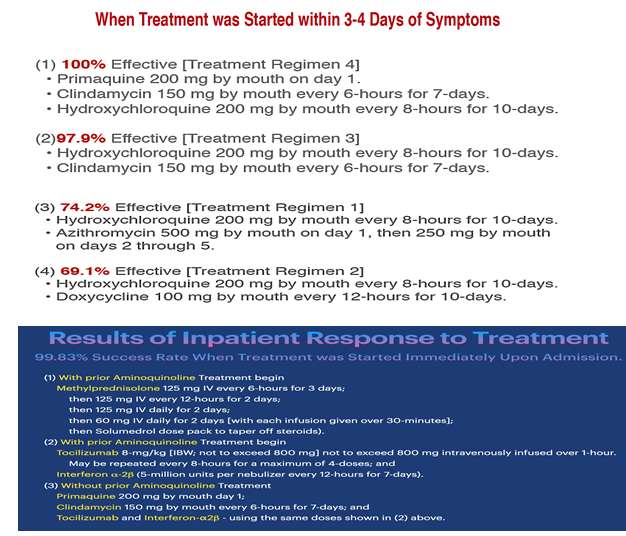
Oxygenation and the Early Innate Cytotoxic Immune Phases
Successful treatment of SARS-CoV-2 requires careful attention to the patient’s oxygen status and the immunologic response associated with the innate T-cell cytotoxic phagocytosis and presentation of viral antigens resulting in the release of interleukins, cytokines and initiation of the ITR [5].
Oxygen (O2) is not the primary determinant of the patient’s respiratory rate. Hydrogen ions are, and these ions are primarily determined by the patient’s carbon dioxide (CO2) level. It is CO2 not O2 that determines the correct ventilator settings in these patients including tidal volumes (VT) and back up respiratory rate.
These settings are substantially different for patients with SARS-CoV-2 whose inflammatory pulmonary edema results in Acute Respiratory Distress Syndrome (ARDS), respiratory failure and the need for intubation. An ARDS complicated by both the inflammatory edema and potential for ITR thrombosis of pulmonary blood vessels further compromising the patient’s oxygen status [9]. Failure to recognize and treat this ITR to SARS-CoV-2 has arguably resulted in more than one million of deaths [10].
Progression of disease resulting in hospitalization does not mean the initial treatments have failed or should be abandoned. In fact, absent FMTVDM, there is no true method for measuring the actual treatment effect of these drugs. If FMTVDM shows improvement with prior treatments or stabilization with treatment, physicians should seriously consider continuation of current treatment; with the addition of new treatment if no improvement is measured. If however FMTVDM shows progression of disease in the face of current treatment, alternative treatment should be considered [11].
Treatment of failing oxygenation should be addressed either by prone positioning, supplemental oxygenation, or reduced ventilator tidal volume. The use of specific bronchodilators [11] should also be employed to improve oxygen and carbon dioxide exchange. If the only problem is oxygenation and not cardiac function, patients may also be treated using vein-to-vein (V-V) extracorporeal membrane oxygenation (ECMO); alternatively if there is cardiac compromise, one can consider using vein-to-artery (V-A) ECMO.
Having addressed the oxygenation factor, attention also needs to be paid to the innate acute T-cell cytotoxic immune response. In this early stage of SARS-CoV-2 treatment, the immune system is phagocytosing the virus while simultaneously releasing cytokines, interleukins, interferons, and other chemical mediators – all with the expressed purpose of eradicating the virus. However, the unrestrained ITR can and does result in other tissue damage and consequences [10].
The goal of medical treatment is to minimize viral replication while simultaneously minimizing the damage resulting from the release of interleukins (e.g. IL-6) and other InflammoThrombotic mediators that will ultimately produce systemic InflammoThrombotic damage elsewhere in the body – particularly among the immune naïve and those with comorbid InflammoThrombotic health problems. Treatment during this still relatively early stage (Table 1, Figure 2) of the disease includes – if not already started – immune support including Folate, Vitamins C, B6, B12 and D3. In addition to these and other vitamins and minerals detailed in NCT04349410 [11], this is the time to begin treatment with IL-6 receptor antagonists e.g. Tocilizumab and/or other agents that can reduce or inhibit the release and effect of IL-6; including Interferon a-2b and Methylprednisolone – remembering that the administration of steroids will shift the immune response away from T helper 1 cells promoting cytotoxic response by CD8 suppressor/cytotoxic cells, towards T helper 2 cells promoting humoral antibody response, which through the Fc component of the antibodies produced can promote further thrombotic activity via the complement cascade as shown in Figure 1. It must also be remembered that excessive administration of steroids can shut down the immune response, allowing potential further activation of the ITR to the SARS-CoV-2 infection.
Treating the Late Adaptive Humoral Immune Response
While one of the presumptive desired responses to any viral infection is the production of host antibodies following the interaction between T-cells and B-cells resulting in both the production of antibodies by plasma cells and memory B-cells for any future infections, it must be remembered that this late adaptive humoral immune response only occurs with the continued release of cytokines, interleukins and the InflammoThrombotic process.
Patient treatment during this progressed stage of the disease – essentially within the first week of hospitalization – must continue to focus on balancing the ITR to the virus. Failure to be familiar with the ITR [5, 7, 8] including the correct management of patients on ventilators can easily result in poor measureable outcomes [8] including death.
Treatment of SARS-CoV-2 means finding the homeostatic balance – control of the virus without causing extensive harm to the patient. Journalists, lawyers, judges, insurance companies, and politicians do not treat patients – physicians do. Every SARS-CoV-2 patient’s ITR must be looked at from the perspective of each individual patient’s immune response – is it too much or too little for that patient? Treatment must be individualized, focused [3, 11] and based upon what is happening to that specific patient.
It is during this period of time the physician must – presuming it has not already been initiated – treat the patient for possible tissue thrombosis and blood clotting. This includes CVAs, MI’s, renal damage, PEs, DVTs, et cetera. Clearly any one of these ITR consequences will further complicate the patient’s clinical course and care, resulting in undesirable complications and death [12].
Treatment during this stage of the disease continues to rely upon tailoring medications shown in Table 1 and Figure 2, and when possible focusing on the patient’s actual measured treatment response (FMTVDM). One potential treatment option should be relegated to this later phase of the ITR using passive humoral antibody treatment from convalescent plasma remembering that the administration of plasma with fibrinogen includes potential thrombotic concerns and transfusion reaction problems. It must also be remembered that convalescent plasma can only provide passive immunity. Once an antibody is used to bind to a viral antigen – it is forever used. The Fleming Corona Virus Disease (Covid) Treatment Protocol Based Upon the Hyper- Inflammothrombotic Response (Hyper-Itr) To Sars-Cov-2 It should now be obvious after more than one million of deaths that the morbidity and mortality associated with SARS-CoV-2 is the result of the body’s hyper-ITR to SARS- CoV-2 viral infection [1, 5] occurring in two major groups of individuals: (a) those who are immune naïve including the young, diabetic and those with immune deficiency syndromes, and (b) those with a variety of comorbid conditions including inter alia obesity, heart disease, cancer, hypertension, cerebrovascular disease, the elderly, and those with diabetes.
Treatment of this hyper-ITR to SARS-CoV-2 therefore requires careful attention to the consequences of this ITR [2]. Addressing each of these four fundamental issues: (1) viral infection and replication, (2) oxygenation, (3) innate cytotoxic immune response, and (4) adaptive humoral immune response, and addressing them in a timely manner is critical to treatment success or failure. Failure to do so – as we have repeatedly seen – can easily result in morbidity and death. As the incidence of SARS-CoV-2 infections continue to increase and hospitals continue to admit these patients for treatment, we offer this proposed treatment guideline (Table 1) (Figure 2] and information for consideration and use by others [5, 20].
Addressing Sars-Cov-2 Vulnerability; Underlying Chronic Inflammatory Diseases
Let us look at a final problem that SARS-CoV-2 has made blatantly apparent; the vulnerability that occurs when the diet and lifestyles currently promulgated produce comorbidities that increase our susceptibility to hyper-inflammatory scenarios whereby the very immune system evolved to save lives now predisposes people with comorbidities to develop a hyper-ITR response; now associated with so many deaths.
The much talked about curve was flattened providing more than adequate time for treatment to focus on the ITR to the virus. However, treatment of patients with SARS-CoV-2 did not focus on treating the ITR despite this knowledge having been disseminated more than a quarter of a century earlier [1, 2, 3, 4, 5, 6, 7, 8, 9].
While the immune naïve and those with immune deficiency syndromes have little they can do to correct their status there is much that could have been done to eliminate to prevalence of the comorbid InflammoThrombotic states that have plagued modern society.
We have repeatedly emphasized the role that dietary and lifestyle factors play in exposing so many to the InflammoThrombotic consequence of heart disease, cancer, diabetes, obesity, hypertension, advanced age, et cetera [5, 13, 14, 15, 16], and the need to address these practices.
We now know that these people have been placed in extremely vulnerable situations when exposed to viruses like SARS-CoV-2 or other pro-InflammoThrombotic circumstances and absent correcting the underlying cause of these diseases, they will continue to be so exposed [3, 17, 18].
The introduction of SARS-CoV-2 has ushered in an era of human awareness of the spread of viruses and their potential harm [19] to everyone with these InflammoThrombotic diseases [1, 2, 3, 4, 5]. The need to address the underlying health problems associated with these comorbid diseases and the need to accurately measure treatment responses [8, 20] have never been greater.
Failure to address the InflammoThrombotic effect of these diseases and failure to measure the effect of SARS-
CoV-2 treatment(s) [8] has resulted in millions of people dying.
Conclusion
The medical caveat of treating the underlying cause of the disease and not just the symptoms should have resulted in far fewer deaths than we have seen. However, the consequences of an overwhelmed medical system coupled with lack of understanding of the underlying pathogenesis of the resulting ITR to SARS-CoV-2 provided by the Fleming InflammoThrombotic Response (ITR) and Cardiovascular Disease Theory [5], the FMTVDM measurement [20] of the severity and treatment response, and failure to address ventilator settings in these patients resulted in a significant uncontrolled pandemic with millions of deaths.
Acknowledgements and Potential COI
Quantitative nuclear imaging FMTVDM is the IP of the first author and was provided without cost to participants in NCT04349410. The Fleming InflammoThrombotic Response (ITR) and Cardiovascular Disease Theory [5] is the IP of the first author who expressly permits publication of this material, table and figures.
References
-
Fleming RM, Fleming DM, Gaede R (1994) Improving the Accuracy of Reading Percent Diameter Stenosis from Coronary Arteriograms: A Training Program. The Council on Arteriosclerosis for the 67th Scientific Sessions of the AHA, pp: 101.
-
Fleming RM (1994) Arteriosclerosis as Defined by Quantitative Coronary Arteriography. The Council on Arteriosclerosis for the 67th Scientific Sessions of the AHA, pp: 102.
-
https://fmtvdm.wixsite.com/fhhi-omnific/ inflammation-heart-disease
-
Fleming RM (2003) Stop Inflammation Now! Published by Putnam Books and Avery Books.
-
Fleming RM (1999) The Pathogenesis of Vascular Disease (Chapter 64). Textbook of Angiology. John C. Chang Editor, Springer-Verlag New York, NY, pp: 787- 798.
-
Fleming RM (2000) The Fleming Unified Theory of Vascular Disease: A Link Between Atherosclerosis, Inflammation, and Bacterially Aggravated Atherosclerosis (BAA). Angiol 51(1): 87-89.
-
Hidden Heart Disease (2004) Could a simple, inexpensive test save your life?” 20/20 - ABC Network with Barbara Walters and Dr. Timothy Johnson.
-
(2017) The Fleming Method for Tissue and Vascular Differentiation and Metabolism (FMTVDM) using same state single or sequential quantification comparisons. Patent Number 9566037.
-
Fleming RM (2021) Is COVID a Bioweapon? A Scientific and Forensic Investigation. Skyhorse Publishing Company ISBN 978151077019595.
-
Why Surviving the Virus Might Come Down to Which Hospital Admits You. Written by Brian M Rosenthal, Joseph Goldstein, Sharon Otterman and Sheri https://www.nytimes.com/2020/07/01/nyregion/ Coronavirus-hospitals.html
-
Fleming RM, Fleming MR (2021) FMTVDM Quantitative Nuclear Imaging finds Three Treatments for SARS-CoV-2. Biomed J Sci & Tech Res 33(4): 26041-26083.
-
Frank Miles (2020) Nick Cordero dead at 41 after coronavirus battle, wife Amanda Kloots announces. ISBN: 0399151117. https://www.foxnews.com/ entertainment/nick-cordero-coronavirus-death- broadway-star-amanda-kloots
-
Fleming RM (2003) Stop Inflammation Now! with Tom Monte. Published by Putnam Books and Avery Books.
-
Fleming RM (1999) Atherosclerosis: Understanding the relationship between coronary artery disease and stenosis flow reserve (Chapter 29). Textbook of Angiology. John C. Chang Editor, Springer-Verlag, New York, NY, pp: 381-387. https://www.youtube.com/ watch?v=Hvb_Ced7KyA&t=22s
-
Fleming RM, Fleming MR (2020) The Impact of Low Carb – KETO Diets on CAD. Why more Research is needed. J Cardiovasc Med Cardiol 7(2):110-121.
-
Fleming RM, Fleming MR, Chaudhuri TK, Harrington GM (2019) Cardiovascular Outcomes of Diet Counseling. Edel J Biomed Res Rev 1(1): 20-29.
-
h t t p s : / / w w w . y o u t u b e . c o m / watch?v=mGyEvutNkvs&t=1s
-
https://fmtvdm.wixsite.com/fhhi-omnific/covid- inflammothrombotic-response
-
Fleming RM (2000) Reversing Heart Disease in the New Millennium-The Fleming Unified Theory. Angiology 51(10): 617-629.
-
Fleming RM, Fleming MR, Dooley WC, Chaudhuri TK (2020) The Importance of Differentiating Between Qualitative, Semi-Quantitative and Quantitative Imaging–Close Only Counts in Horseshoes. Eur J Nucl Med Mol Imaging 47(4): 753-755.
- How to Identify and Overcome Barriers in Developing Blood Systems?
- Why Was Transfusion Medicine Not Recognized as a Clinical Discipline?
- Outcomes of Lenalidomide Relapsed/Refractory Patients
- Is Transfusion Always Necessary?
- The Logistics of Production and Use of Blood and Blood Components
- The Challenge for Component Therapies