
Trends of Road Traffic Accident, Fatalities in Benghazi City from 2011- 2015
Road Traffic Accident (RTA) is a great concern, particularly in developing country as it has a socio-economic and financial impact on persons and community. Therefore, there is a need to pay attention about this issue. In this work, the observed data was collected from RTA statistical files in AL- Jalaa Hospital, Benghazi, Libya from 2011 to 2015 to draw a RTA profile during this period. The data was collected, figured, and analysed. The total number of deaths during this period was 1575. Among them, 496 (31%) were RTAs deaths. The number of deaths were peaked in 2012 and 2013. The majority of the accident victims were in the age group 21- 30 years (122 cases) and 31-40 years (78 cases), and about 429 (86%) of the victims were males. Based on the above, the RTA deaths were increased in Benghazi city in the years after the Libyan revolution (2012 and 2013), most of deaths among males who in their prime working lives.
Introduction
Road traffic accidents (RTAs) are an incident on the public road involving an automobile and resulting into harm to people and community [1] as it has a huge impact on socio-economic development of a country [2]. In developing countries, according to estimates by 2030, road traffic accident claims more than 2.5 million people losing their lives and in addition around 60 million people got injured in these road accidents. Most of the accident involve pedestrian, cyclist, public transport users and children. Lack of suitable road standard safety measures and breach of traffic laws took more than 100,000 lives in last 10 years. However, three main factors of road accident were identified. These are human error, vehicular defect and failure in road environment [3]. Human error seems to be the main cause in majority of vehicular accidents. Using mobile phone while driving a vehicle, ignoring the red signal, emerging from a side road into the path of another vehicle, young unfit drivers, and over speeding are examples of the human error [2]. On the other hand, many developed countries have shown reduced road traffic mortality rates in recent decades [4] due to adequate road traffic safety actions. Therefore, it has been expected that without direct successful intervention, RTAs will become the fifth leading cause of death by 2030 resulting in an estimated 2.4 million fatalities annually [5]. For that reason, the road traffic accidents are becoming the greatest concern. Because raising the RTAs awareness and suggesting a strict traffic law can be achieved by positively relating the frequency and pattern of RTA, in this study, trends of road traffic accidents in Benghazi, Libya for 5 years were investigated.
Aim
The present study was conducted to collect the observed data of RTAs mortality cases during (2011 to 2015) and clarify the trends of RTAs during this period, in order to motivate a relevant authority suggesting appropriate traffic regulations and awareness programs.
Material and Methods
This study was conducted on 496 RTA fatalities brought to AL- Jalaa Hospital, Benghazi during (2011 to 2015). The data sources were from statistical files of those victims. Data consequently collected, figured and analysed.
Results
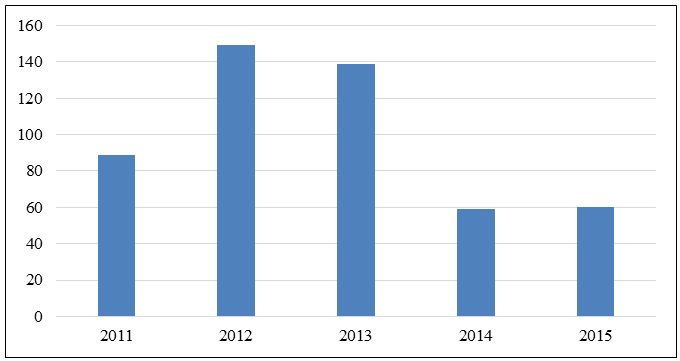
The total number of deaths during the period of the study (2011 to 2015) was 1575; the RTA deaths were 496 cases. Most of the cases reported in 2012 (149 cases) and
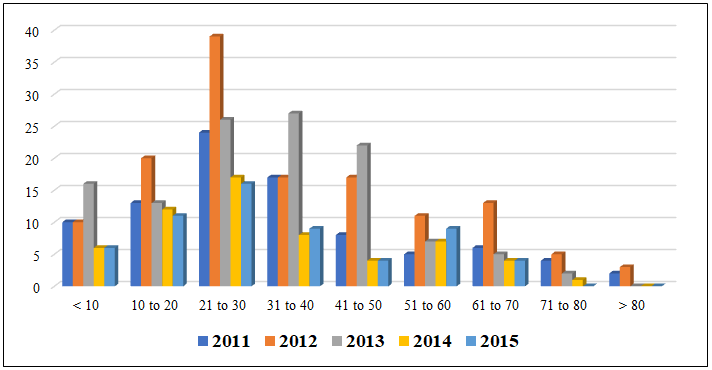
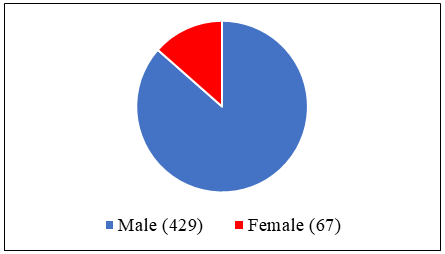
2013 (139 cases) (Table 1 and Figure 1). In this study, the majority of the victims were in the age group 21- 30 years (122 cases), followed by 31-40 years (78 cases) (Figure 2), and males (429 cases) more than females (67 cases) (Figure 3). The type and the site of the injuries on body’s victims were not involved. The manner of death in all cases was accidental; however, the causes and the time of the accidents were not included.
| Year | Total no. of cases | Male | Female |
|---|---|---|---|
| 2011 | 89 | 77 | 12 |
| 2012 | 149 | 132 | 17 |
| 2013 | 139 | 112 | 27 |
| 2014 | 59 | 54 | 5 |
| 2015 | 60 | 54 | 6 |
| Total | 496 | 429 | 67 |
Table 1: Number of fatal accidents per year.
Discussion
Road traffic accidents lead to disability and death, and consequently financial cost to both society and the individual involved. Annually, it causes about 1.2 million deaths worldwide [6]. Moreover, it is a leading cause of death in adolescents and young adults globally. However, majority of mortalities and morbidities occur in developing countries [7, 8, 9, 10, 11] because this issue has not been sufficiently managed and no enough strategies have been taken to prevent its occurrence [6] in these countries, and Libya is one of them. In Benghazi, Libya, there is a dramatic increase in a number of road traffic accidents [5]. A study was conducted in Benghazi and concluded that deaths in 2011 due to RTAS (32.9%) were more than deaths from other cause, particularly gunshot (28.8%). Although, 2011 was a year of war and weapons were available and accessible to everyone [5].
The total number of deaths received in AL- Jalaa Hospital in Benghazi city during the study period (2011-2015) was 1575. The death from RTAs during this period was 496. Most of deaths due to RTAs shown in 2012 and 2013 (Figure 1). These years were the years after the Libyan revolution, when the people lived in a state of confusion and lacked law enforcement, including traffic laws. Adolescent who are not legally qualified for driving had been noticed to drive. Many other unsafe and illegal acts had been occurred, for example, no respecting to traffic light, absent of vehicle registration number, using car windshield tinted, evolving from a side road into the path of another vehicle, or driving the car in the opposite direction. Logically, all of these behaviours were contributed to increase the accident rate. On analysis of the age group of victims showed that the majority of the age group was 21 to 30 followed by 31-40 years (Figure 2), which means that the victims were in adulthood. This confirm that the road traffic accidents occur to be a leading cause of death between younger people [12, 13, 14, 15]. From the thorough literature review, the main causes of road traffic accidents were found to be human cause, i.e., younger untrained drivers, use of mobile phones during driving, risks of drugs and alcohol [2, 16], because of that driver education is suggested to be introduced in schools to change the behaviour of the person with its future success [17]. Moreover, this age group is the most active and important segment of society; they represent the dreamy, productive, working segment. Therefore, losing of those people in traffic accidents or other events is considered a loss for the country. The present study exposed that most of victims of RTAs were male victims; they represented 429 deaths while female victims were 67 cases (Figure 3). Similar result was stated by some other authors [15, 18].
Conclusion
This study has exposed the documented data for road traffic accidents from 2011 to 2015 for the largest hospital (Al-Jalaa hospital) in Benghazi, Libya. The study concluded that deaths from RTAs were increased post Libyan’s revulsion (2012 and 2013), most of victims were in reproductive age group, and about 86% of accidents victims were males.
References
-
Balogu SA (2007) Importance of Research and Statistic as Road Traffic Accident Reduction Strategy. 2007 Conversation Course. Jos Plateu State.
-
Muthusamy AP, Rajendran M, Ramesh K, Sivaprakash P (2015) A Review on Road Traffic Accident and Related Factors. International Journal of Applied Engineering Research 10(11): 28177-28183.
-
Detho A, Samo SR, Mukwana KC, Samo KA, Abubaker MH (2019) Road Traffic Accidents (RTAS) Safety Issues on Highways: A Review. Quest Research Journal 17(1): 34- 40.
-
Murray CJL, Lopez AD (1996) The Global burden of disease: a comprehensive assessment of mortality and disability from diseases, injuries, and risk factors in 1990 and projected to 2020. World Health Organization. World Health Organization, World Bank & Harvard School of Public Health.
-
Elmrghni S, Kaddura M (2019) Road Traffic Accident Deaths in Benghazi during (2011). Journal of Forensic Science 4(1): 35-39.
-
Balantine E (2019) Road Traffic Accidents in Nigeria: A Public Health Problem. Afrimedic Journal 3(2): 34-35.
-
Asogwa SE (1978) Road Traffic Accidents: A Major Public Health Problem in Nigeria. Public Health 92(5): 237-245.
-
Odero W, Garner P, Zwi A (1997) Road Traffic Injuries in Developing Countries: a Comprehensive Review of Epidemiological Studies. Tropical Medicine & International Health 2(5): 445-460.
-
Ekere AU, Yellowe BE, Umunne S (2005) Mortality Patterns in the Accident and Emergency Department of an Urban Hospital in Nigeria. Nigerian Journal of Clinical Practice 8(1): 14-18.
-
Labinjo M, Julliard C, Kobusingye OC, Hyder AA (2009) The Burden of Road Traffic Injuries in Nigeria: Results of a Population-Based Survey. Injury Prevention 15(3): 157-162.
-
Hussain T, Shu LY, Sosorburam T, Adji AS, Khan AH, et al. (2011) Road Traffic Accidents; An observational and Analytical Study Exploring the Hidden Truths in Pakistan and South East-Asian Countries. Healthline, Journal of Indian Association of Preventive and Social Medicine 2(1): 52-57.
-
Ezenwa AO (1986) Trends and Characteristics of Road Traffic Accidents in Nigeria. Journal of the Royal Society of Health 106(1): 27-29.
-
Yang BM, Kim J (2003) Causes of Road Accidents in Pakistan. Injury Control and Safety Promotion 10(1âAS2): 89âAS94.
-
Despande P (2014) Road Safety and Accident Prevention in India: A Review. International Journal of Advanced Engineering Technology 5(2): 64-68.
-
Anantharaman VV, Logaraj M (2015) Epidemiology of Road Traffic Accidents (RTA) Reported at a Tertiary Care Hospital in Chennai. National Journal of Research in Community Medicine 4(1): 101-105.
-
Gopalakrishnian S (2012) A Public Health Perspective of Road Traffic Accidents. Journal of Family Medicine and Primary Care 1(12): 144-150.
-
Daigavane P, Bajaj P (2009) Analysis of Selective Parameters Contributing to Road Accidents on Highways for Establishing Suggestive Precautionary Strategies. 2009 Second International Conference on Emerging Trends in Engineering and Technology, ICETET, pp: 576- 580.
-
Mishra B, Sinha ND, Sukhla SK, Sinha AK (2010) Epidemiological Study of Road Traffic Accident Cases from Western Nepal. Indian J Community Med 35(1): 115-121.
- Forensic Implications of Adverse Drug Reactions in Schizophrenia A Case Series
- Narcotics and Digital Forensics: Bridging Crimes in the Digital Age
- Ethics in Forensic Psychiatry: Principles, Dilemmas, and Human Rights
- Impact of Acute Stress on Attentional Orienting to Social Cues
- Head Injury and Intracranial Hemorrhage in Western Region of Libya
- A Forensic Study on Handedness: Examination of Handwriting Features in Right and Left Handed Writers