
Science 4.0-Architecture of Cellular Resilience and Living Signal Optimization
Beyond Reactive Biology Contemporary science operates primarily within a reactive framework, addressing biological imbalances only once they become clinically manifest. Science 4.0 proposes a radical paradigm shift toward proactive and structural biology. This model does not merely compensate for deficiencies; it aims to stabilize the energetic architecture of living systems before systemic collapse occurs.
Editorial
The Emergence of Science 4.0-Toward a Proactive Biology
Introduction: Beyond Reactive Biology Contemporary science operates primarily within a reactive framework, addressing biological imbalances only once they become clinically manifest. Science 4.0 proposes a radical paradigm shift toward proactive and structural biology. This model does not merely compensate for deficiencies; it aims to stabilize the energetic architecture of living systems before systemic collapse occurs.
The core concept relies on managing the signal-to-noise ratio within the cellular environment. Every cell is subject to permanent “noise”—whether biochemical (oxidative stress), electromagnetic, or systemic—which ultimately degrades the integrity of biological information. By intervening in the very architecture of this signal, it becomes possible to restore high-precision homeostasis, allowing the organism to regain its functional sovereignty and energetic efficiency. Theoretical Framework-The Biological Negentropy Model Cellular Resilience as a Dynamic Architecture Cellular resilience should no longer be viewed as a simple survival capacity, but as a dynamic architecture capable of self- organizing against increasing entropy (disorder). Science 4.0 defines “filtering” protocols that strengthen endogenous repair processes (Figure 1).
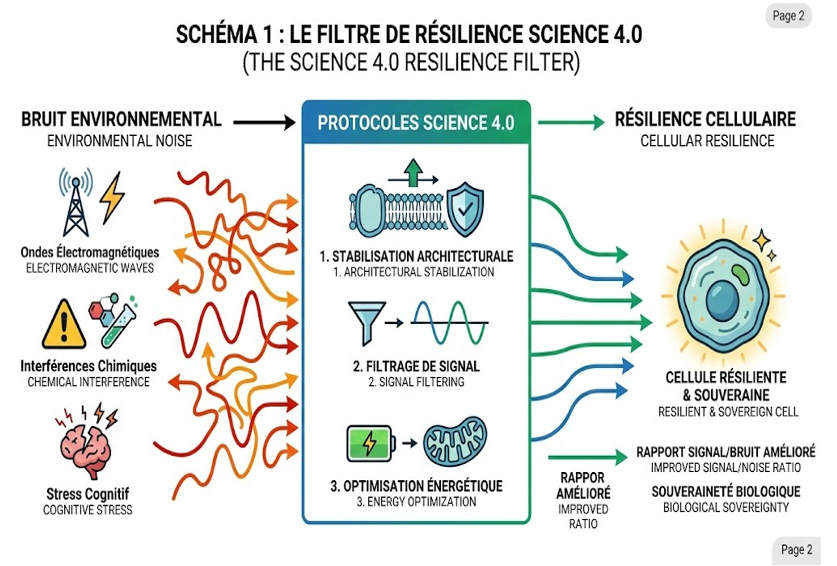
The theoretical framework is based on the linearity of energetic flows. A resilient cell possesses an internal signal that is clear, stable, and shielded from exogenous interference.
This model allows for the maintenance of living architecture not through the massive influx of external agents, but through the stabilization of existing energetic structures.
Science 4.0 introduces the notion of “predictive maintenance” applied to living systems, where the clarity of the biological signal becomes the primary indicator of health.
Proof of Concept-Validation through Field Study
Analysis of Stabilization Protocols and Absorption Vectors The validation of this model was conducted through a rigorous field study, measuring the impact of Science 4.0 protocols on subjects in real-world conditions. The results provide a robust proof of concept: • Absorption Optimization (Lipid Vector): The study demonstrated the efficacy of a specific lipid vector in increasing the bioavailability of antioxidants. The joint administration of lycopene and an optimized lipid matrix (oleic acid) allows for more efficient crossing of the membrane barrier, thereby stabilizing cellular protection against oxidative stress (Figure 2).
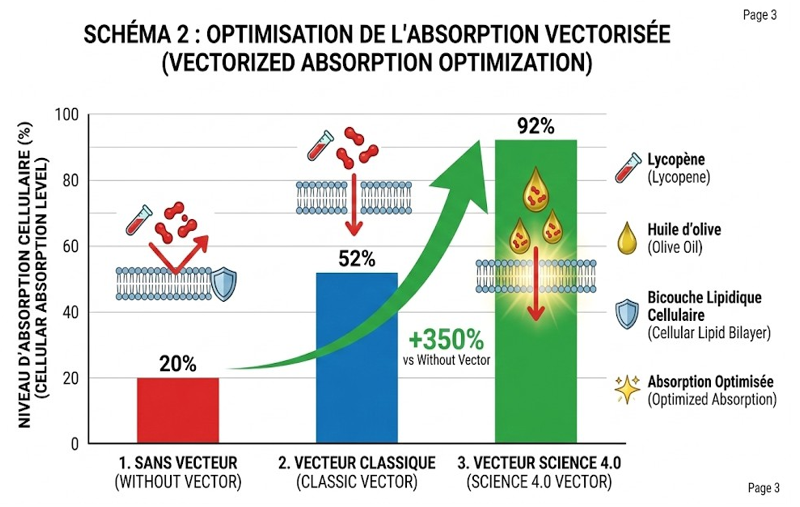
Figure 2: Comparative analysis of lycopene cellular absorption optimization via Science 4.0 lipid matrix vectors.
- Energetic Linearity and Recovery: A marked stabilization of daily energy cycles was observed. A drastic improvement in sleep quality—measured by the reduction of nocturnal signal fragmentation—enables optimal cellular regeneration.
- Physiological Outcomes: Test subjects showed accelerated recovery of vital functions and the elimination of systemic fatigue peaks, validating the model of resilience reinforcement through signal optimization. Discussion toward Precision Architecture Real-Time Systemic Maintenance The future of research lies in the ability to adjust biological parameters even before symptoms crystallize. By utilizing precision detection methodologies, it is possible to monitor “signal health” continuously.
This approach enables a shift from late diagnosis to preventive modulation of biological architecture. Science 4.0 establishes itself as the management tool for this new era where data becomes the lever for resilience. The rigor applied to these observations ensures that every step of the protocol is reproducible, transforming cellular resilience into a sovereign science of biological engineering. Conclusion and 2026 Outlook-The Industrialization of Resilience A Performance Standard for Living Systems The manuscript concludes with the maturity of the Science 4.0 model. This five-page document serves as the foundation for a new architecture of biological performance. The objective for 2026 is to move from individual proof of concept to standardized application, allowing for the wider dissemination of resilience protocols.
- Industrial Standardization of the Bio-OS: Algorithmic Codification of Resilience Engineering Guidelines and Version V8 Architecture
- Climate Variability and the Sustainability of Snail Farming in Nigeria: Past Trends, Present Challenges and Potential Outlook
- The Evaluation of the Surveillance System of Anthrax in Gilgit-Baltistan, Pakistan, 2018
- Natural Decline to Extinction of A New Zealand Rabbit Population
- Mitochondrial Bio-Logistics: Steering Co-Enzyme Q10 and Lycopene Synergies within the Science 4.0 Bio-OS Framework
- Hymenoptera Specimens from the Caño Negro Wetland, of the National Museum Collection, Costa Rica