
Biological Characteristics of the Echiura worm Urechis unicinctus
The Echiura worm Urechis unicinctus, is a marine biota which belongs to the annelids. Due to various animals are frequently found in Urechis' tunnels, they are known as the innkeeper echiuran. Secondary metabolites found in these animals are significant for biological study. The majority of these animals also serve as deposit feeders, gathering detritus from the sea. This short article describes its biological characteristics and functions in order to utilization a marine biota be useful for consumption and biomedicine.
Introduction
The Classification of Echiura worm
The classification of Echiura worm is as follows: Kingdom: Animalia Phylum: Annelida Class: Polychaeta Ordo: Echiuroidea Family: Urechidae Genus: Urechis Species: Urechis unicinctus
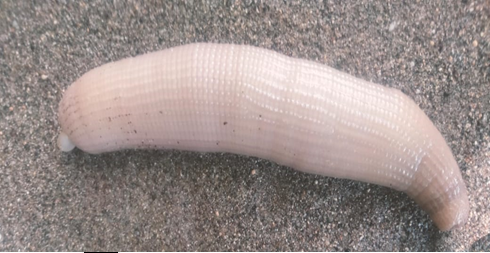
The Habitat and Biological Characteristics of Echiura worm
Echiura worms have purple sausage-like bodies (Figure 1). Adult length ranges from 10-25 cm, while body width ranges from 1.5-3 cm [1]. The front of the body is represented by the snout, which serves for swallowing and breathing. The base of the snout has a pair of neurosetae and the middle part is the mouth. The back of the mouth has two pairs of pharyngeal nephridia connected to the nephridium and filled with germ cells during the breeding period [2]. The back of the body is a transverse anus with 9 to 13 hairs around the anus [3].
In general, the morphology of Urechis has several similarities with other worm species. The body wall is a dermomuscular sac consisting of outer muscles, muscle layers, deep muscles and deep oblique muscles [3]. The body wall contains well-developed gland cells, gland cells can survive for 72 hours at a temperature of 7°C and a relative humidity of 69.7% in open air [1]. Urechis worms have a developed body cavity filled with coelomic fluid without a vascular system [3]. The coelomic fluid contains round brown body cavity balls (containing red pigment) [1]. The long, twisted digestive tract consists of the mouth, pharynx, esophagus, hernial sac, gizzard, stomach, midgut, pneogaster, hindgut, and anus The pneogaster is a specialized part of the digestive tract. The front part is connected to the midgut, and the back part is connected to the rectum [1].
Regarding habitat and distribution, Urechis worms are echiurans that live in marine sediments of the intertidal and lower subtidal zones in coastal mud or sandy areas. Worms build U-shaped burrows and filter suspended material from seawater pumped through the burrows using slime nets [3]. These worms play an important role in improving the quality of polluted sediment and as prey for several types of demersal fish. Meanwhile Abe, et al. [4] stated that Urechis swims energetically, mostly at night, as opposed to drifting passively. This activity is intimately related to their reproductive cycle.
Regarding the location of the Urechis worms in the sea and their swimming ability are described as follows. They live in shallow to deep water sediments throughout the world’s oceans, tropical seas to subpolar regions [5]. A common species that lives in high densities in tidal flats and neritic waters. During swimming, the front end of the body is consistently positioned upwards, while the middle of the body becomes the helical axis and is relatively immobile. The ventral body surface is directed consistently inward. This eyeless fish moves peristaltically like an intestine.
Water quality parameters that influence the presence of Urechis worms are explained as follows. Urechis worms are poikilothermal animals. The highest and lowest temperatures that an adult can tolerate are 32.5°C and -4°C respectively. The suitable water temperature for survival is from -2°C to 31°C, and the optimal temperature range is between 8-26°C [1]. The ability of larvae to withstand high temperatures is slightly reduced compared to adults. Water temperatures exceeding 31.6°C are not compatible with larval survival. Even in the case of brief exposure to temperatures above the tolerable upper limit, adverse reactions cause high mortality, the survival rate does not exceed 10% even if the temperature is [3]. Urechis worms are benthic organisms that prefer low temperatures in accordance with their geographical and ecological distribution under natural conditions.
Dissolved oxygen and salinity also need attention regarding the presence of these worms. Urechis worms have a strong tolerance to low dissolved oxygen and can tolerate low dissolved oxygen from 0.34 to 0.45 mg/L for more than 46 hours [6]. It lives normally in sea water with dissolved oxygen above 1.14 mg/L. However, when dissolved oxygen drops to 0.28-0.34 mg/L, they will die from suffocation [7]. Urechis worms tolerate a wide salinity range, and can live normally at a salinity of 15 to 36 ppt. However, ideal salinity levels are from 24.94 to 35.77 ppt. This animal lives better in weakly alkaline sea water with a pH of 7.5 to 8.5. The adult adapted pH range is 4.46-9.5 [1].
Regarding their eating habits, Urechis worms are filter feeders and eat sediment left over from life around them. It has no selectivity towards food particles and its consumption is continuous [3]. The snout is the organ for swallowing. The surface of the body has many cilia that form many folds. The flow of water is caused by beating cilia pushing suspended Chlamydomonas, small zooplankton larvae and organic waste into the mouth along the food pipe [1].
Urechis worms live by building tunnels in the sand or mud around the beach. This animal lives by eating carrion or the remains of life around it, so it is classified as a detritivorous creature [8]. While below the surface of the soil, the Urechis worm moves peristaltically like an intestine, forming a U-shaped burrow. The glands at the front of its head are able to produce mucus which then covers the hole that was previously dug. This mucus is net-like and sticky and will continue to be released while moving backwards deeper into the soil. If enough food has been entangled, the fish will turn to move outwards.
Economic Importance of Echiura Worm for Humans
Some people are starting to show interest in consuming worms which have special nutritional content. The Urechis worms served in restaurants are thought to lose this sweet taste because they have been washed with water. Urechis worms can also be served grilled first into satay or stir- fried with vegetables and eaten as a main dish or side dish. Urechis, is commonly used as food in Japan, China and especially Korea [9, 10]. In Japan it is served thinly sliced like sashimi, known as ruttsu with a taste described as similar to mirugao shellfish. Therefore, this organism can be said to be an important economic commodity because it has a fairly high selling price with a selling price on the local market of IDR. 40,000-80,000/kg.
The worm’s body consists of several parts with different nutritional contents. The edible part of the Echiura worm is the body wall, which accounts for about 32% of the body weight. Nutrients in body wall muscles, especially amino acids. Li, et al. [1] found that there are 18 kinds of amino acids in the body wall muscle of Urechis which contributed 57.39% of the dry weight of the parietal muscle, make it a good choice to regularly consume in order to improve human health [11].
What’s more, it contains 8 types of essential amino acids (17.9%). The amino acid content (glutamic acid, aspartic acid, arginine, alanine, and glycine) of the Echiura worm wall is high, accounting for about 56% of the total amount of amino acids, similar to the amino acid content (41.39%) in the body wall of Sipunculus nudus, a species of marine worm [12]. Glutamate plays an important role in body metabolism and it is the main amino acid in the biochemistry of brain tissue metabolism with brain stimulating effects [13]. Wen [14] measured using an automatic amino acid analyzer, the content of glutamic acid in the body wall of Urechis and found it in high concentrations (12.39%). The composition of essential amino acids is close to the needs of the human body, so that all essential amino acids can be utilized optimally with a correct diet [3].
The viscera of Urechis accounted for approximately 68% of the total weight (wet weight ratio) and 61% (dry weight ratio). The main part of its use is the body wall, and the viscera often become waste [15]. Wen [14] measured the nutritional composition of offal and found it to be rich in protein, polyunsaturated fatty acids and trace elements. It has great potential value. The Ca content (2.1%) in inorganic elements is the highest, followed by Mg (0.41%), Fe (0.32%), and Zn (0.03%). Meanwhile, Pb, As, Hg, Cd and other heavy metals are lower. The fatty acids were analyzed in worm, it was discovered that EPA and DHA were comparatively plentiful, accounting for 21.61% and 3.67% of the total fatty acids, respectively [16]. EPA has significant hypolipidemic capacity, antithrombotic capacity and platelet aggregation inhibition. It can also prevent arteriosclerosis and cholesterol deposition on artery walls. The DPA content in the total fatty acids of obsolete offal was the highest, namely 56.24%.
DPA is a long-chain unsaturated fatty acid found in human colostrum and can improve human immunity [17].
Their natural resources are clearly insufficient given the rising demand for Urechis and the increased intensity of fishing. Therefore, various efforts need to be made to ensure the availability of these worms can be continuous. Research on Urechis artificial cultivation has already started at this time [11]. Presently, pond farming, factory culture, and wild stocking are the primary techniques utilized to cultivate the worm. Pond farming and factory farming involve growing Urechis in artificially controlled environments by building aquaculture ponds in coastal regions and employing industrialized indoor pools, respectively. While, under wild stocking, Urechis grow in an entirely natural environment. Li, et al. [18] stated that when compared to the factory culture group, the weights of adult Urechis in the pond farming and wild stocking groups were much larger because the individuals raised in the wild were richer in important nutrients. Important nutrients like eicosapentaenoic acid and docosahexaenoic acid were abundant in them. Meanwhile, the amounts of glucose, triglycerides, lactic acid, and total cholesterol were all considerably lower in the wild samples.
From the description above, it is clear that the innards of Urechis can be utilized, and even have high economic value and great social benefits. To summary, Echiura worm offers prospective use in the pharmaceutical sector, aquaculture, and other fields related to fish health and biomedicine. Therefore, more study is needed to support their development.
• Conflict of Interest The authors state that they have no conflict of interest.
• Acknowledgment The author would like to thanks the International Journal of Zoology and Animal Biology for invitation to publish this article free of cost.
References
-
Li N, Song S, Tang Y (1998) Studies on culture and enhancement biology of Urechis uniconctus. Shandong Fisheries 15(1): 11-14.
-
Ma X, Liu X, Zhou D, Bai Y, Gao B, et al. (2016) The NF-κB pathway participates in the response to sulfide stress in Urechis unicinctus. Fish & shellfish Immunology 58: 229- 238.
-
Li N, Song S, Tang Y, Wang BG (1997) Reproductive biology of Urechis unicinctus along the coast of Shandong province. Acta Zool Sin 43: 433-435.
-
Abe H, Sato-Okoshi W, Tanaka M, Okoshi K, Teramoto W, et al. (2014) Swimming behavior of the spoon worm Urechis unicinctus (Annelida, Echiura). Zoology (Jena) 117(3): 216-223.
-
Biseswar R (2010) Zoogeography of the echiuran fauna of the Indo-West Pacific Ocean (Phylum: Echiura). Zootaxa 2727(1): 21-33.
-
Wu Z, Shen X, Sun M, Ren J, Wang Y, et al. (2009) Phylogenetic analyses of complete mitochondrial genome of Urechis unicinctus, (Echiura) support that echiurans are derived annelids. Molecular Phylogenetics & Evolution 52(2): 558-562.
-
Li Y, Wei-chao F, Geng-rui Z, CAO K, Chang-wen C, et al. (2016) Accumulated chilling hours during endodormancy impact blooming and fruit shape development in peach (Prunus persica L.). Journal of Integrative Agriculture 15(6): 1267-1274.
-
Walls JG (1982) Encyclopedia of Marine Invertebrates. TFH Publications pp: 262-267.
-
Nishikawa T (1995) Some historical considerations on the Japanese ethnobiological nomenclature of the echiurans (Phylum Echiura). J Global 17(6): 512-517.
-
Murina GVV, Chernyshev AV (2008) Phylum Echiura Newby, 1940 – spoon worms. In: Adrianov AV (Ed), Biota of the Russian Waters of the Sea of Japan. Dalnauka, Russia 6: 267-289.
-
Liu F, Li X, Ji Y, Liu C, Sun T, et al. (2019) The biological characteristics and utilization of Urechis unicinctus. Agro Life Scientific Journal 8(1): 146-152.
-
Meyer A, Lieb B (2010) Respiratory proteins in Sipunculus nudus-implications for phylogeny and evolution of the hemerythrin family. Comparative Biochemistry and Physiology Part B: Biochemistry and Molecular Biology 155(2): 171-177.
-
Jinap S, Hajeb P (2010) Glutamate. Its applications in food and contribution to health. Appetite 55(1): 1-10.
-
Wen YG (1999) A review on the researches of fish mucous cells. J Fish China 23(4): 403-408.
-
Wang L, Zhao Q, Zhang Y (2016) Life habits and tolerance to environmental factors of Urechis unicinctus. Shandong Fisheries 33(7): 10-12.
-
Huang M, Wu G, Jiao B (2007) Research Advance in Physiological Function of DHA and EPA. Food and Drug 9(2): 69-71.
-
Pedersen MH, Molgarard C, Hellgren LI, Lauritzen L (2010) Effects of fish oil supplementation on markers of the metabolic syndrome. The Journal of pediatrics 157(3): 395-400.
-
Li Y, Ding Y, Zhang S, Zhang A, Song X, et al. (2021) Effects of culture methods on the nutrient levels, physiological characteristics and intestinal microbiota of the innkeeper worm Urechis unicinctus. Aquaculture Research 52(8): 3843-3853.
- California Red-Legged Frog and Non-Listed Amphibians Response to Non-Native Fish Removal
- Industrial Standardization of the Bio-OS: Algorithmic Codification of Resilience Engineering Guidelines and Version V8 Architecture
- Climate Variability and the Sustainability of Snail Farming in Nigeria: Past Trends, Present Challenges and Potential Outlook
- The Evaluation of the Surveillance System of Anthrax in Gilgit-Baltistan, Pakistan, 2018
- Natural Decline to Extinction of A New Zealand Rabbit Population
- Mitochondrial Bio-Logistics: Steering Co-Enzyme Q10 and Lycopene Synergies within the Science 4.0 Bio-OS Framework