
The Capybara (Hydrochoeus Hydrochaeris)
The Capybara (Hydrochoerus hydrochaeris) is an animal rodent in the Family of the Cavidae. There are two subspecies: Hydrochoeus hydrochaeris isthmius, which smaller (live only in Panamá, Venezuela and Colombia and Hydrochoerus hydrochaeris hydrochaeris which larger and live in South America. It lives in the land area of tropical forests and savannahs up to almost 2000 m, above Sea Level Rivers and lagoons, or slashes and wetlands. It is related to the agouties, chinchillas and guinea.
Fernandez Abella D* and Irabuena O
Keywords: Capybara; Legs; Body; Lipids
Mini Review
It has a heavy barrel-shaped body and a small head, with reddish brown fur on the upper body that turns brownish yellow. At the bottom you usually find fur with dots on the back. It can grow up to 1.30 m long and weigh 65 kg. It has slightly palmed feet and like the pork it lacks a tail and has 20 teeth. Its hind legs are somewhat longer than the previous ones. On the front legs they have four fingers and in the posterior three. All fingers are joined together by swim membranes and end with strong, thick nails. Like other Caviomorphs it lacks a tail [1, 2, 3, 4].
The snouts are blunt, with eyes, nostrils and ears on top of the head. Females are a little heavier than males [2]. Its longevity in the natural state varies between eight and ten years, while captive specimens can reach twelve years [3, 5].
It is the largest and most important living rodent in the world. The body, which lacks a tail, is solid and round in shape, with a thick trunk and four short legs [2, 3]. The fore legs have four fingers and the hind legs have three, exposed radially. The thick, hoof-like fingers have small membranes that cross them interdigitally. The Capybaras achieve a length of 1 to 1.30 m and a height at the back of 50 to 60 cm [6] and the females are usually slightly larger than males. The average weight is 50 kg in males and 61 kg in females. However, the actual weight can vary between 27 and 65 kg [7, 8, 9].
The meat is lean and of good quality, having a low content of lipids and cholesterol [10, 11]. Its fat is used as a nutritional supplement for animals [12].
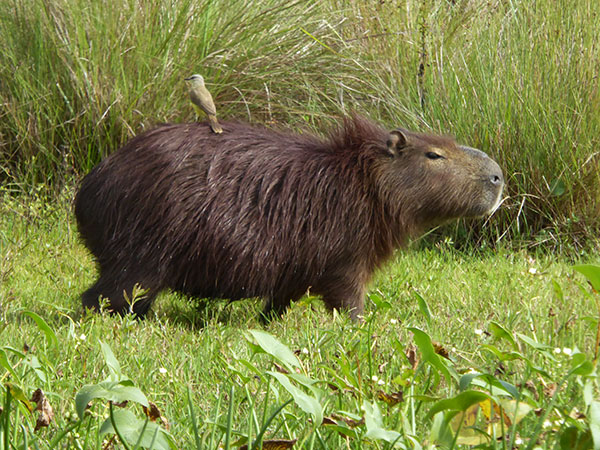
The fur is long and rough, but in some parts it is so thin that you can see the skin through it. This makes them sun- prone animals, and to prevent this, they scramble in the mud to protect the skin from the sun [2]. The coloration ranges from a reddish brown to gray at the top, while the underside has a yellow brown colour. The fur is long and rough, but in some parts it is so thin that you can see the skin through it. This makes them sun-prone animals, and to prevent this, they scramble in the mud to protect the skin from the sun [2]. The coloration ranges from a reddish brown to gray at the top, while the underside has a yellow brown color. Some specimens have black spots on the face, on the outer side of the legs and at the back, the length of the hair ranges from 30 to 120 millimeters.
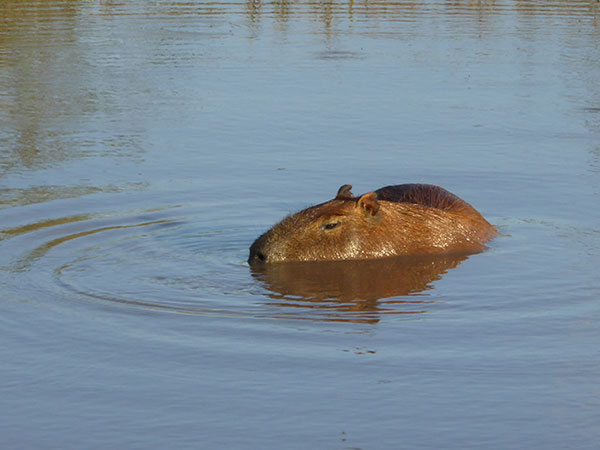
They have a remarkably wide and large head. In relation to the relatives closest to the capybara, the snout is larger and rounded; while the nostrils are small and quite separate. In male specimens, the tip of the snout is bald and endowed with a prominence corresponding to the olfactory gland. The ears are small and round, while the eyes are located on the sides and are also small. As in many animals that have a partially aquatic lifestyle, the eyes, ears and nostrils of the Capybara are located at the top of the head, so that when they come out to breathe from the water or observe what surrounds them, they hardly stand out from the surface [2, 5].
The dental formula of this animal is 1-0-1-3; which means that each half of the jaw has an incisive tooth, a premolar and three molars, with a total of twenty teeth [2]. Incisive whites are endowed with a groove and, as in all rodents, are enlarged and transformed into rootless incisors. Behind the incisors opens a space called diastema. The posterior teeth also have no roots and have a complex morphology; consist of heart- shaped tooth enamel prisms or bars, which are separated by layers of cement (Figure 1). As in other rodents, the incisor and molar teeth of Capybaras grow steadily to compensate for the continuous wear and tear caused by eating so much grass [2, 3].
Distribution and Habitat
Its huge range comprises almost all of South America east of the Andes in the basins of the Orinoco River, the Amazon and the Río de la Plata; covering from eastern Venezuela and Guyana to Uruguay, Paraguay in much of and northern Argentina, mostly in the province of Corrientes [2] They can live in different types of habitat, but show preference for some in particular. They are usually found near lakes, rivers, marshes or mangroves [2]. They also need a firm floor to sleep, ideally with thick vegetation that serves as protection. To feed, they have no problem entering the savannah and grasslands. The highest density of capybara population is found in the vast wetlands of South America, such as the Pantanal, or the Plains region of the north of the continent, bathed by the Orinoco River. They live mostly in the plains, but also live at altitudes of up to 1300 meters above sea level. Compared to other animal species in South America, Capybaras tolerate habitat changes caused by human activity quite well, and can also survive in areas transformed into plantations or pastures [13]. Capybaras are mainly twilight animals. They spend the heat of the day in holes in the mud or inside the waters [4]. To sleep they hide among thick vegetation; they don’t need any caves. In contrast, in areas where they are disturbed by human activities, they change and adopt a nocturnal lifestyle.
Behavior
If a Capybara warns of danger, it warns others with a short bark, and immediately everyone runs at a speed comparable to that of a horse in order to get safe in the water. They can dive and stay underwater for up to five minutes, and are able to swim with their entire body submerged except ears, nostrils and eyes. They live in groups and can be made up of a couple and their young, or a larger group of adult specimens. The measure of groups varies between six and twenty animals. In some rare cases solitary specimens, almost always adult males [2, 3, 14, 15] can also be observed. The dominant male maintains this status through agonistic behaviors towards subordinates (including persecutions, bites, and threats) in which subordinates are displaced. The dominant leads the group and defends its females and offspring, but that does not guarantee absolute success in mating [16, 17]. Nearly 80% of copulations were performed by the dominant male [18, 19].
Males should be sterilized, to prevent them from becoming aggressive when adulthood reaches. Castration must be performed between 6 and 9 months [3].
The size of the groups and their lifestyle depends on the season and habitat. During the rainy season, they extend over a large region, so that the measure of the group decreases. During this season, they eat a lot and accumulate a fat reserve. Newborn breeding also occurs mainly during the rainy season (winter in the tropics).
During the dry season, many specimens gather around the largest rivers and lakes, forming larger groups. During this season, mortality is significantly higher, as hunger and disease increase and with the disappearance of protected plants; Capybaras are more vulnerable to predator attacks.
Researchers from Venezuela indicate an average of groups 5 to 6 animals during the rainy season (winter) and 15 to 16 in the month of March, the driest. In prolonged periods of dryness, large groups of up to 100 specimens can be formed, gathering near the remaining waters. Although these groupings are unstable and do not last long [5].
Each family and mixed group is led by a dominant male [5], who normally occupies this position for many years. Then come one or more females with their young and sometimes subordinate males are also part of the group. The hierarchy is usually stable and well-marked between both males and females, and is established through partially aggressive combat.
Each group inhabits a territory of between 5 and 17 hectares [20], although the animals usually remain within a region of about 10 hectares of area, which defend against incursions by other specimens of the same species. Mark the territory by means of odoriferous glands; males are located on the nose, and the two sexes have in the anus region (anal glands) [20].
They communicate with each other through a variety of vocalizations. Among them is a sound similar to the purring of cats, indicating submission, an alarm cry similar to a bark of dog, a clicking way that expresses happiness, similar to a bark of dog [13], a raucous whistles and grunts. The diet consists mainly of terrestrial grass and complements it from time to time with aquatic plants. Sometimes they enter plantations and feed, for example, on sugar canes, watermelons or corn. The widespread belief that fish are also part of the capybara diet is false. They have an extremely efficient digestive system that allows them to subsist on a diet 75% of which consists of only four to six species of plants and then stop eating them for a while, allowing the plants of these species to recover before re-eating them Their digestive system presents various adaptations to their diet, such as a longer intestine and an enlarged sac-shaped blind. Similar to other rodents, such as guinea pigs, or lagomorphs, Capybaras practice coprophagia or occasional ingestion of excrement. Fecal faeces are a soft, adhesive form of excrement, which is fermented by special bacteria in the blind, and which is re- ingested immediately after excretion [2].
In this way, they can extract maximum nutrients from their cellulose-rich foods when the droppings are definitively expelled a second time, they are oval and dry. Capybaras, such as guinea pigs, cannot produce vitamin C on their own, so they must obtain it through their diet (Figure 2). Cases of scurvy [21] have been observed in some captive specimens, which had been evidently poorly fed. In captivity they eat fruits and vegetables in general, although they like watermelon, corn and lettuce [3].
Reproduction
The male does not have a properly defined scrotum, and the testicles are subcutaneously located in the inguinal region. At rest the penis has a subcutaneous position, so, for accurate identification of newborns and juveniles, it is necessary to press the anus-genital region to expose the limb. In the adult male the distal third of the free part of the penis lacks resilient cavernous bodies, and this portion is occupied by the penile bone. It provides stiffness and thickening but does not cause female and male genitalia to become jamming during copulation as in dogs [18, 22].
The Capybaras reach sexual maturity in free living conditions at 10-12 months females and at 15-18 months males, depending on the season and the quality of the habitat [23, 24]. The average duration of the estral cycle is 7-8 days, ovulation is spontaneous and the receptivity period lasts about 8 h [25].
The male takes the lead in copulation, as it is he, who pursues the female, first by land and then in the water. Mating takes place in shallow water, after between six and eight rapid thrusts, the sexual act comes to an end. Intercourse can be repeated after a while, up to twenty times either with the same partner or with different partners. . The Capybara female has a proactive role during reproduction, with behaviors that indicate her proceptivity to the male, as vocalizations and rubbings of her supranasal gland [26]. The average duration of courtship was 15 m and mating lasted 28 min. Mounting frequency is of 2 events each 5 min, during 8 ±1 s. Sequential analysis of pattern behavior during the courtship period revealed that male-female pursuits were followed at a high frequency by female vocalizations [26].
Mating can take place at any time of the year, but most births are usually in the rainy season (April to May in northern South America and October to the south of the continent).
Generally, each female stops once a year, but if the weather conditions are favorable they can do it twice. The gestation period lasts about 110 days in the northern subspecies and about 150 days in the south. Capybaras are multipara, and each birth consists of an average of four offspring, but can vary between two and eight [16, 27]. Females have ten nipples that are placed in pairs in the belly. Two to three weeks after partum, sexual activity restarts [28, 29].
They don’t build nests, and they can give birth anywhere in their territory. The young are markedly precocious, weigh approximately 1.5 kg at birth, have a full fur and with permanent teeth. Shortly after birth, the young are able to eat grass and become independent after three or four months. The young form their own group within the main group [2, 5]. Both sexes assume sexual maturity at approximately twenty-two months of age [2]. Their most important natural predators are felines such as jaguars, pumas or ocelots, and also jungle foxes, anacondas and alligators often attack them. Sometimes the young fall victim to birds of prey such as harpies [2].
Relationship with Humans
South American indigenous peoples already hunted them to consume meat by processing the skin and using incisor teeth for decorative purposes. They also play a role in the mythology of these peoples.
They are hunted for their skin and meat [30]. In the regions of the American southern there are professional hunters known as “Capybaras”, who practice hunting the aforementioned mammal for commercial purposes. There are also very numerous people who hunt them life force: if the double animal dies, the person will also die for their own use, and from it they usually take advantage of their skin as a leather, light brown and with small lighter spots, which is especially appreciated for the woodworking in Venezuela, Paraguay and in Argentina for the manufacture of gloves, shoes, belts and leather jackets. Also from it are made flanges, mounts and whips [6]. Its oil, which is used as a naturally sourced medicine, is extracted from the fat of the Capybara.
Its meat is lean, with a strong smell and good quality, with its meat is lean, strong smell and good quality, with low fat and has very low cholesterol content. It is especially consumed in the plains of Colombia and Venezuela, where they salt it after drying it, pickle it and eat it on withdrawal days. It is widespread belief in South America that there would be an ancient official ecclesiastical document that would classify it among the “fish”, because of its aquatic way of life, its fish-like smell and its little hairy skin [28, 31, 32, 33] although it is a legend, and there are similar legends in other religions of the Earth over other aquatic animals, such as beavers.
In Argentina, Brazil and Uruguay, meat is mainly used to make sausages. In Argentina and Uruguay there are even commercial hatcheries of the species in some provinces of the river coast [30, 31, 32, 33]. In the plains region of Colombia and Venezuela, due to the multiple uses of this animal, there are already attempts to breed the Capybaras, similar to the Argentina experience; farms for commercial purposes [32].
References
-
Alho CJR (1986) Criação e Manejo de Capivaras em pequenas propriedades rurais. EMBRAPADPP. Documentos 13: 48.
-
Chester Zoo (2008) Capybara (Hydrochaeris hydrochaeris).
-
(2015) La Capibara como mascota. Experto Animal.
-
Mayor Aparicio P, Santos Fita D, López Béjar M (2007) La cría de Capibara (Hydrochoerus hydrochaeris). In: Sostenibilidad de la Amazonía y la Cría de Animales Silvestres. Centro de Mendes A, Nogueira SSC, Lavorenti A, Nogueira-Filho SLG (2000) A note on cecotrophy behavior in capybara (Hydrochoerus hydrochaeris) Appl Anim Behav Sci 66: 161-167.
-
(2019) Wildlife Rescue FAQs.
-
(1910) The Encyclopedia Britannica. Capybara.
-
Maldonado Chaparroa A, Blumstein DT (2008) Management implications of capybara (Hydrochoerus hydrochaeris) social behavior. Biological Conservation 141(8): 1945-1952.
-
Smith NJH (1981) Caimans capybaras others manatees and man in Amazonia. Biological Conservation 19: 177- 187.
-
Saadoun A, Cabrera MC (2008) A review of the nutritional content and technological parameters of indigenous sources of meat in South America. Meat Science 80(3): 570-581.
-
Oda SHI, Bressan MC, Fonseca de Freitas RT, Miguel GZ, Vieira JO, et al. (2004) Composição centesimal e teor de colesterol dos cortes comerciais de capivara (Hydrochaeris hydrochaeris L. 1766). Ciências agrotecnicas Lavras 6: 1344-1351.
-
Bressan MC, Oda SH, Cardoso MG, Miguel GZ, Fonseca de Freitas RT, et al. (2004) Composição de ácidos graxos dos cortes comerciais de capivara (Hydrochaeris hydrochaeris L). Ciências agrotecnicas Lavras 6: 1352- 1359.
-
García A, Fernández A, López B, Santurión F (2000) La crianza del carpincho (Hydrochoerus hydrochaeris) Parámetros técnicos y recomendaciones en alimentación y reproducción. En: Producciones alternativas: Ranas, Martineta y Carpincho. Serie FPTA - INIA 03. Editorial Agropecuaria Hemisferio Sur SRL. Montevideo – Uruguay. Pp: 51-84
-
Ellsworth B (2005) In Days Before Easter, Venezuelans Tuck Into Rodent-Related Delicacy. Brian, New York.
-
Ojasti J (1968) Notes on the mating behavior of the capybara. J Mammal 49(3): 534-535.
-
Yáber MC, Herrera EA (1994) Vigilance, group size and social status in capybaras. Animal Behavour 48(6): 1301-1307.
-
Herrera EA, Macdonald D (1987) Group stability and the structure of a capybara population. Symposium Zoo Society London 58: 115-130.
-
Herrera EA, Macdonald D (1993) Aggression, dominance, and mating success among capybara males (Hydrochaeris hydrochaeris) Behavour Ecology 4(2): 114-119.
-
Herrera EA (1992) Size of testes and scent glands in capybaras, Hydrochaeris hydrochaeris (Rodentia: Caviomorpha). Journal Mammal 73: 871-875.
-
Herrera EA (2013) Capybara social behavior and use of space: patterns and processes. En: Capybara: biology, use and conservation of an exceptional neotropical species. JR Moreira et al (eds.), Springer Science &Business Media New York Cap 11: 195-207.
-
(2014) Capybara Page.
-
Ian Willoughby (2002) Predation Defense.
-
Paula TAR, Walker NJ (2013) Reproductive morphology and physiology of the male capybara. En: JR Moreira et al (eds.), Capybara: biology, use and conservation of an exceptional neotropical species. Springer Science + Business Media New York. Cap 6: 107-129.
-
Zara JL (1973) Breeding and husbandry of the capybara (Hydrochaeris hydrochaeris). Int Zoo Yearb 13: 137-139.
-
Mones A, Ojasti J (1986) Hydrochoerus hydrochaeris. Mammalian Species 264: 1-7.
-
Miglino MA, Dos Santos TC, Kanashiro C, Dos Santos Ferraz RH (2013) Morphology and reproductive physiology of female capybaras. In: Capybara: biology, use and conservation of an exceptional neotropical species. In: JR Moreira, et al. (Eds.), Springer Science & Business Media New York. Cap 7: 131-146.
-
Minteguiaga M (2016) Descripción de cortejo, cópula e interacción madre - cría en carpincho (H. hydrochaeris), en condiciones de cría intensiva. Tesis de Maestría en reproducción animal. Facultad de Veterinaria. Uruguay pp: 90.
-
Herrera E, Macdonald DW (1989) Resource utilization and territoriality in group-living capybara. Journal of Animal Ecology 58: 667-680.
-
Azcate T, Beaza F, Alvarez F (1979) Observaciones sobre La reproducción Del Capibara (Hydrochoerus hydrochaeris) en los Llanos de Venezuela. Doñana. Acta Vert 2: 244-247.
-
Costa DS, Paula TAR, Fonseca CC, Neves MTD (2002) Reprodução de capivaras. Artigo de revisão. Arquivos ciência veterinária zoológica UNIPAR 1: 111-118.
-
Cueto GR, Allekotte R, Kravetz FO (2000) Scurvy in Capybaras bred in captivity in Argentine. Journal of Wildlife Diseases 36(1): 97-101.
-
Lipske M (2009) The Ranchers’ Favorite Rodent.
-
Quintana RD, Monge S (1998) Feeding patterns of Capybara Hydrochaeris hydrochaeris (Rodentia, Hydrochaeridae) and cattle in the non-insular area of the Lower Delta of the Parana River, Argentina. Mammalia 62: 37-52.
-
Alvarez MR, Kravetz F (2006) Reproductive performance of capibaras (Hydrochoerus hydrochaeris) in captivity under different management systems in Argentina. Animal Research 55: 153-164.
- Natural Decline to Extinction of A New Zealand Rabbit Population
- Mitochondrial Bio-Logistics: Steering Co-Enzyme Q10 and Lycopene Synergies within the Science 4.0 Bio-OS Framework
- Hymenoptera Specimens from the Caño Negro Wetland, of the National Museum Collection, Costa Rica
- Science 4.0: Comprehensive Architecture of the Biological Operating System (Bio-OS) A Framework for Systemic Resilience and Industrialized Bio-Governance
- Rabbit on, or Hare Back? Understanding Climate Change
- Clinical Validation of Science 4.0: Flow Steering and Epigenetic Drift Inversion on a 76-Year-Old Hybrid System