
A Natural Science Museum as a Resource for Teaching and Learning
Nowadays, museums are conceived as places of educational value; they enable areas to promote learning related to specific topics, and they allow visitors to understand and interpret their environment, among other potentialities. This work presents the results of an experience carried out at the La Plata Museum (MLP) in which teachers and students of the Teaching Training Course in Natural Sciences participated through the Workshop “Learning science between showcases, tablets and biological collectionsâ€. In this workshop, the participants were proposed to explore the potentialities of the strategies used in the MLP Exhibition Rooms, resorting to information and communication technologies, and approaching the Biological Collections, so that they can incorporate them into their teaching practices and respond to a survey. The workshop included four moments (start-Interactive area; Exhibition Hall; Biological collections; End-interactive area) with the aims of acquiring scientific skills, recognizing biological collections as valuable teaching resources, and promoting the importance of the teacher-museum relationship.
Introduction
Visits to science museums offer a space for exchanging and building scientific knowledge [1] and provide a valuable opportunity for situated and contextual learning [2], not only for the community but also for the students and teachers who visit them [3]. It is important to consider that learning in museums per se, is an autonomous experience [4] with visitors taking an active role in tour planning, monitoring, control and reflection. Instead of visiting like a spectator only, museums should be reviewed as locations to interact with items in display [5]. Therefore, museums are propitious areas to promote learning related to specific topics, allowing visitors to understand and interpret their environment, based on their different objectives, patterns of planning visits, learning strategies, and they leave the museum with different results [6].
Although over time museums have sought to expand and reinforce their educational function, in line with their role as social institutions [7], the difficult economic moments that the world has been going through for more than a decade have made us all watch closely as museums across the country layoff their educators and interpretive staff.
In general, museum executive directors have very little interaction with these workers, so they prioritize staff for activities considered “basic” (e.g. lightning, maintenance, collections management); interpretation and education are generally considered of minor importance.
In short, teaching staff are considered to be less qualified for the operation of museums or easier to replace than curators, fundraisers or marketing staff. However, the current period of pandemic that crosses the globe (COVID-19) poses a “new reality”, and the described situation tends to reverse [8].
The experience presented in this paper guides the participants, teachers and students of Teaching Training Course in Biology, to set up their visit pattern and their learning experience, on the basis of learning units [9], used for informal learning, the student benefits as with the proven structure in a formal environment, but without the pressure of a formal evaluation. Based on the above mentioned, the activity proposed is a Workshop named “Learning Sciences among showcases, tablets and scientific collections” in which the participants are proposed to explore the potential of the Exhibition Halls of the La Plata Museum (MLP) [10]. To this end, situated education strategies, the Information and Communication Technologies (ICT) [11] and an approach to the Museum’s Biological Collections are used, so that they can incorporate these resources into their teaching practices [12].
The Workshop allows the participants to adopt an inclusive mindset within museums [13] through to get closer to the practices of educational spaces in the MLP, as well as reflect on the didactic potentials that Museums and their heritage offer to their visitors; particularly in this experience, to teachers and students of the Teaching Training Course in scientific disciplines.
The significance of the educative task in museums is greater than can be circumscribed by any list of specific tasks. A Museum education is at the center of museum activities [14]. This educational activity aims to highlight the importance of the teachers-museum relationship. This practice of education in museums constitutes teaching and learning processes situated and contextual in the area of Natural Sciences with the tendency to apply the three learning dimensions proposed by Chong C [9] (adding to museum online offerings, connecting formal and informal learning, motivating learning in bite-sized portions and repurposing content). As users fluidly move between online and in person engagement, museums will need to develop strategies and/or structures to ensure these experiences are considered as a cohesive whole [15].
Similarly, these experiences make it possible to discover the potentialities that the Exhibition Halls present (from the origin of the universe to the evolution of living beings, including the human species, their characteristics and productions) and how ICT mediation favors dimensioning those ideas. The framework between learning at the participants’ educational institution, the experience located in the Exhibition Halls and the experience of using ICT, merges the real and virtual dimensions of the museum heritage with its own environment. In this Workshop it has been included to visit a space which is normally restricted to the public, the Biological Collections, and give the participants the opportunity to discover and explore a space that constitutes a repository and reserve of national heritage and interest for the humanity, a primary source of knowledge and information on biodiversity [16]. Visits to Biological Collections are in themselves the visual appeal that serves an objective linked to the acquisition of scientific competences.
Museums promote the acquisition of scientific competences. Therefore, the Workshop addresses the development of conceptual and methodological biology content in educational contexts existing in MLP. The Workshop planification allows guiding participants to regulate their learning experiences; choosing what, where, and when to get involved and learn through integrating learnings from disciplinary aspects, contributing to the knowledge of educational spaces and know the diversity of teaching materials and implementing the use of ICT through those present in the MLP.
Materials and Methods
Introduction to the Workshop
The activity was held at the MLP. This is a university museum, opened in 1888, which is part of the Facultad de Ciencias Naturales y Museo (FCNyM) of the Universidad Nacional de La Plata (UNLP). Its Collections are the institutional scientific / educational heritage, and encompasses both Natural Sciences and Anthropology of Argentina (mostly) and South America. Furthermore, it generates scientific knowledge, disseminates such collections through exhibitions and scientific dissemination, and generates spaces for education. It also runs a Digital Lab or Interactive Classroom (IC), to provide opportunities for experiments in emerging technologies and visitor experience.
In order to highlight the educational and motivational value of science museums, an agreement between the Department of Natural Science of the Facultad de Humanidades y Ciencias de la Educación (UNLP) and the Educational and Scientific dissemination Area of the MLP
was generated to coordinate and plan a learning unit [9], with the components of a complete practice (learning objectives, introduction, activity, and a conclusion), such as the Workshop called “Learning science between showcases, tablets and biological collections” to promote educational practices through situated and contextual education [2, 17, 18].
Workshop Structure
The Workshop was held at the MLP with 18 participants, who were teachers and advanced students of the Teaching Training Course in Natural Sciences, and was developed in four stages:
- Interactive Classroom (IC),
- Exhibition Halls,
- Biological Collections
- Closing activity in the IC Supply 1.
The topic selected for the learning unit was “Mollusks”, which is the animal group with the second place in diversity on the planet, after the Insects. The mollusks are linked to humans over time, in a positive (e.g. food) and negative way (e.g. bioinvasions) [19]. On this basis, the Workshop through digital learning [9], may or may not require Internet connection (online learning) and onsite presence (learning virtual or in person). In effect, digital learning can be as simple as reading an e-book or browsing the Internet. In this workshop besides highlighting the role of the museums as science educators, brings into dialogue the approach to local problems, addresses the importance of biologists in society, and the characteristics of the Biological Collections in general and the Malacological Collection (Mollusks) in particular.
The IC is the digital learning space for ICT- mediated scientific knowledge. It is equipped with 40 tablets and a 75- inch touch screen board, creating a propitious environment to develop playful and participatory educational activities. The topic on situated and contextual education in museums was presented, and the Biological Collections were developed through discussion based on three questions presented on the e-board (How would you define a Biological Collection? What potentialities do you think the Biological Collections possess in the education field? What value do you think has a Virtual Biological Collection?). In summary, the appeal of digital learning is not only the devices used, but rather the opportunities that they provide. Some digital resources involve the student by allowing some degree of choice and control over the flow of information by clicking the mouse or touching the screen. These functions are commonly known as interactivity [9].
The Exhibition Halls are the center of attention of all visitors, since heritage objects are exhibited there and they constitute the axis of situated educational practice. Permanent (mollusks in the “Invertebrate Zoology” Hall) and Temporal (Argentine Marine Mollusks and their Consumption) Exhibition Halls were visited in the Workshop.
The Biological Collections house the lots (organism or set of organisms of the same taxon from a single sampling event) that are located in the Institution. It is one of the most precious assets of the MLP, and the access to it is restricted, according to their scientific-patrimonial value. The Curator (professional who protects the Biological Collections) of the Malacological Collection, was the host and dialogued with the Workshop participants, responding to their doubts and curiosities, showing the diversity of the lots and commented on the conservation and systematization procedures used. It is very important for museum curators and museum staff to understand and be able to analyses the activity and behavior of visitors in the museum [1].
At the closing of the Workshop in the IC, besides systematizing new learnings, what was worked on the previous stages was reviewed by observing images and discussing the topics covered (e.g. mollusks and their relationship with humans; invasive species; natural and virtual biological collections; roll of collections in education).
Example Topic: the different impacts generated by the introduction of invasive species. Participants are divided into six groups (maximum 4 members) and each group is assigned a tablet with images where, for example, according to the group’s interest, they observe an invasive species and they can continue investigating the evidence of the impact it causes on the human infrastructure, natural environment, or native organisms. Participants are encouraged to consider the risk to human health for being in contact with introduced snails or the serious economic consequence that these species can cause in human engineering works or become crop pests are analyzed too.
Finally, control practices shown by social networks or mass media are discussed.
Workshop Analysis
Through a descriptive research survey, the degree of knowledge about Natural and Virtual Biological Collections and their didactic potential that each of these collections may have in Educational Institutions was evaluated.
Continuing with the use of the tablets available in the IC, the survey was formulated in “Google Drive” and it can be consulted in Supplementary material.
Results
Through the survey (answered by 61% of the participants – n total: 18) an average age of the participants of 31 years is estimated. Most of them (n:6) are from the Teaching Training Course in Biology, three from the Teaching Training Course in Natural Sciences and two from the Teaching Training Course in Science Education (postgrad). 55% of the participants present University level training, while 45% present Higher Education Institute level. They all practice their profession at the secondary level; 27% also practice at University and 18% at Higher Education Institutes.
First Moment: IC from MLP
At this stage, the idea of the Museum as a teaching and learning space is built; the concept of situated and contextual Education in the museum is worked on as well as the potential of its Exhibition Halls as teaching and learning spaces. After this, the aim, use and value educational of Natural and Virtual Biological Collections in educational institutes are investigated.
The technological mediation of the IC enables, through digital learning, to dynamize complex processes that are difficult to understand, which by their level of abstraction require the interactivity of technology. This helps to show internal processes, explore material at different scales, contextualize parts, geo-reference locations and temporarily place events. These strategies seek concordance with what is being worked on in the second moment (Exhibition Rooms), strengthening the processes of situated and contextual cognition.
Second Moment: MLP Exhibition Halls
At this stage, on the basis of the digital learning carried out in the CI the idea of the Museum as a teaching and learning space is built. With this purpose, in addition to working with the topic selected for the learning unit “Mollusks”, the concept of situated and contextual Education in the museum is worked on as well as the potential of its Exhibition Halls as teaching and learning spaces. After this, the objective, use and educational value of Natural and Virtual Biological Collections in educational institutes is investigated.
Third Moment: MLP Malacological Collection
The possibility of visiting the Biological Collections becomes an enriching and unique experience, since the Workshop participants enter an area of the MLP only open to scientists; this instance allows rethinking its value for the generation of scientific knowledge and for the development of specific scientific competences.
During visit to the Malacological Collection, the participants approach the collections and their lots, which are grouped into taxonomic categories (e.g. species, genus, and family); they have the opportunity to express their concerns, doubts, ideas, interact with the researchers and curator of the collection and discuss the methodology of scientific work.
Fourth Moment: Workshop Closure
The possibility of articulating, through a transdisciplinary approach, the Mollusks with other themes present in the Exhibition halls of the museum is analyzed. The participants relate the constructed knowledge to the presence of mollusks in, for example, the Mesozoic Paleontology Room or the Ethnography Room, and are oriented to argue their articulation and to think about narratives around it.
In the same manner, the problem of invasive mollusks is linked to the curricular content of educational design in the different subjects and different strategies to approach this topic were suggested.
It is proposed to use social networks or mass media, and to produce and disseminate information for educational purposes for society; possible actions are suggested to prevent the introduction of invasive species.
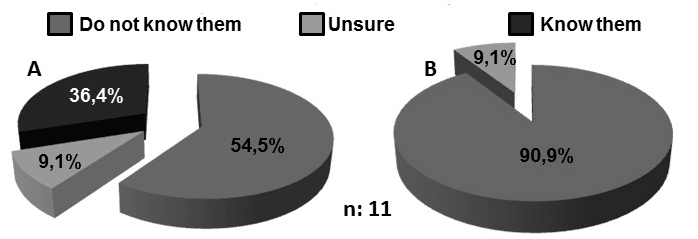
Finally, the survey developed on Google Drive is answered. Through this, it is considered that: The degree of knowledge of most respondents on Biological Collection is, in general, low. They do not know them (Figure 1).
Most teachers (Figures 2A-C) do not agree with the assumption that: Biological Collections exist only in scientific institutions. Specimens are difficult to acquire. Only scientific researchers can build them.
Even if there is a Didactic Biological Collection in educational establishments, teachers do not use them because they do not have the adequate capacity to work with them (Figure 2D).
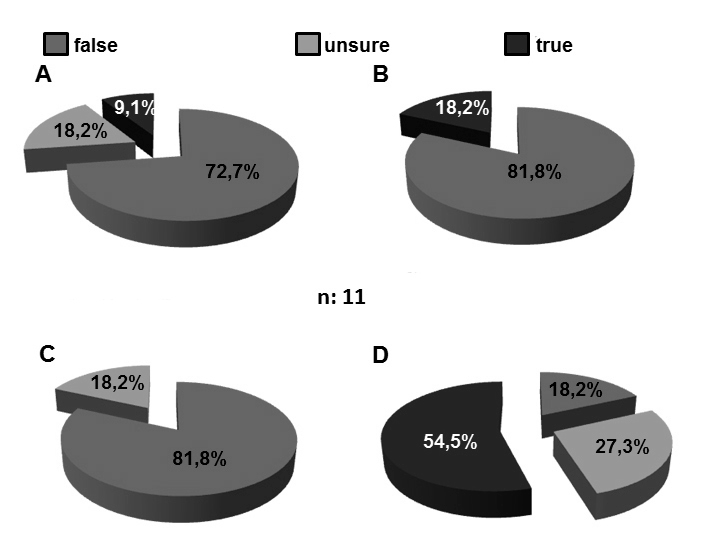
Figure 2: State of knowledge of Biological Collections (BC). A: The BC exist only in Museums or in Scientific Institutions. B: The BC can only be built by scientific researchers. C: The specimens needed to generate a BC are difficult to acquire. D: Even if there is BC in educational establishments, teachers do not use them because they do not have the adequate capacity to work with them. n: number of respondents.
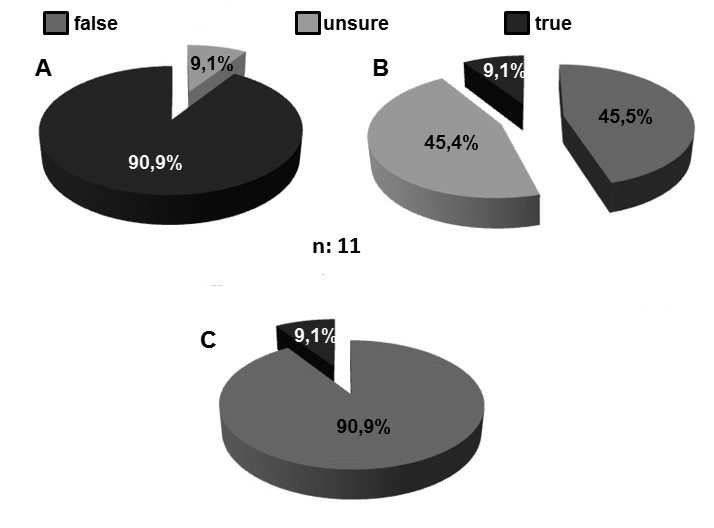
Although for more respondents (Figure 3A), Biological Collections are valuable teaching resources and their use promotes learning:
Teachers do not generate Biological Collections in educational establishments (Figure 3B).
Teachers do not encourage their students to use them (Figure 3C). Lastly, when consulting the participants on which of the Biological Collections, Natural or Virtual, was the most appropriate to use as a support in the classroom, the results indicate a favorable trend for Virtual Biological Collections (VBC) over Natural Biological Collections (NBC) (Figures 4A&B).
The majority of the participants agree that both collections are valuable educational resources. For their part, the majority of the participants agree that both collections are valuable educational resources (Figure 4C).
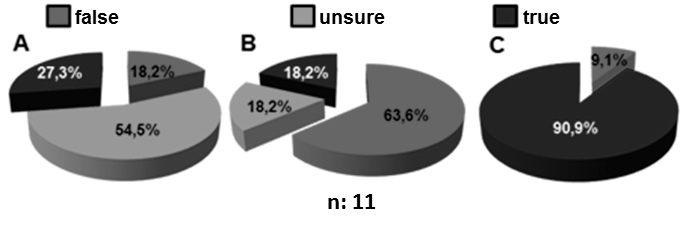
Figure 4: State of knowledge of Biological Collections (BC). Which of the two types of BC, Natural or Virtual, is more appropriate to use? A: It is more appropriate to use Virtual BC rather than those which present specimens in jars or boxes for observation. B: It is more appropriate to use Natural BC rather than Virtual Biological Collection C: Virtual and Natural Collections can be complementary and constitute valuable teaching resources. n: number of respondents.
Discussion
On the basis of the challenge that museums are currently facing, in which a key challenge for them is to connect exhibitions and visitors in ways that promote reflection and learning, but yet, it is difficult to define where and how learning is happening. In the Workshop “Learning science between showcases, tablets and biological collections” the participants explored the potential of the strategies used by situated education [2, 17, 18] in the Exhibition Halls of the MLP, using the ICTs, which do not just help them to understand how learning happens in museums, they can also be a potential part in their own teaching resources. Although over time, museums have sought to expand and reinforce their educational function, in line with their role as social institutions [7], still exist preconceived notions, a sense of exclusion, and barriers to access [6]. On the other hand, the difficult economic moments that the world has been going through for more than a decade, have made us all watch closely as museums across the country layoff their educators and interpretive staff. In general, museum executive directors have very little interaction with these workers, so they prioritize staff for activities considered ‘basic’ (e.g. lightning, maintenance, collections management); interpretation and education are not generally considered ‘core activities’ for a Museum or perhaps of minor importance that the above mentioned. Greater importance should be attached to school-museum relationship. Greater education should be provided to the teachers about importance of the museums [5]. In short, teaching staff are considered to be less qualified for operation of museums or easier to replace than curators, fundraisers or marketing staff. However, the current period of pandemic (COVID-19) poses a ‘new reality’ and the situation described tends to reverse for post-pandemic times [8].
Additionally, in the Workshop it was demonstrated that effective use of museums can lead to multifaceted learning, development of critical thinking skills and acquisition of lifelong learning skills. Is to raise public awareness, knowledge and active support for example, conservation of the flora and fauna of the earth. This Workshop develops values among the teacher’s professional competences that generate spaces for reflection on their ideas of science and technology, typical of meaningful learning based on a situated and experiential teaching. Although the survey revealed a certain lack of knowledge on the subject of Biological Collections and contradictions when comparing both types of Collections (Natural and Virtual) [12] the interest in knowing and using them as didactic resource is implicit. According to Porter J, et al. [8] a future where digital engagement must be faced- which for a long time was the ‘extra’ component of our interpretive work- is now the main way we will connect with our visitors and communities.
Museums are spaces that promote the acquisition of scientific competences, including knowledge, skills, strategies and favor the exchange with spaces where scientific knowledge is produced as a process of social construction. However always embracing an inclusive mindset within museums is necessary to further the role of museums in a changing society to more effectively foster diversity [13]. According to Mujtaba T, et al. [3] the Museums provide students with new knowledge and perspectives, with impacts that can last for years. Through visits and their on-line presence, Museums can help see science in ways that the school classroom rarely can, with opportunities to meet scientists, explore whole topic exhibitions. The Work shop addresses, according to Mortensen MF, et al. [20], the development of conceptual and methodological contents of Biology and in a certain type of exhibition (Museographic Organization) such as the educational context in the La Plata Museum and the interaction with its ICTs. The position of stands out, which states that while many museum educators already facilitate programming in a range of physical and virtual learning environments, others may need to learn new skills to effectively facilitate programs in diverse program platforms and engage users from around the world [15].
Conclusion
This experience reveals how a Museum can support and be part of teachers’ and students’ learning and engagement in science. A particular biological theme is addressed by developing the content in different Exhibition Halls and relating them to other disciplines (e.g. natural and social sciences). This Museum offers this opportunity because of the richness of its Biological, Anthropological and Paleontological Collections.
The theme Mollusks is contemplated from the food perspective and from the problem of non-native species. It covers both biological and social perspectives and provides knowledge and tools, so that teachers have a critical, skeptical and sustainable vision of the situation, so that they can deconstruct and rebuild it with their students.
Finally, referring to the work in the classroom, the participants highlighted the value of having visited the Biological Collections, of working directly with the Curators and dimensioning their work with the lots.
In relation to Biological Collections (Natural and Virtual), teachers were concerned about using and building their own Biological Collection to work in the classroom, in which for its construction they propose the participation of both teachers and students.
The fact that Biological Collections are not yet used or made is mainly the result of the lack of teacher training in this regard.
Acknowledgment
This research was carried out at the Laboratory for Research and Innovation in Education in Exact and Natural Sciences (LIIECEyN-IdIHCS-FaHCE-UNLP, CONICET) and in the Educational and Scientific Dissemination Area (MLP- FCNyM-UNLP); within the framework of a Cooperation Agreement between the FCNyM and the FaHCE (UNLP). This work was partially with operational support, not economic, by the UNLP (11/ H949 and 11/N927) and PICT-2019- 01417-Res.n° 015/2021.
Conflicts of Interest
NO potential conflict of interest was reported by the authors.
References
-
EDU culture (2020) Museum Education-Behavioral and cognitive practices in the field of museum-related adult education /LIMASSOL.
-
Barnett J, Hodson D (2001) Pedagogical context knowledge: Toward a Fuller understanding of what good science teachers know. Science Education 85(4): 426- 453.
-
Mujtaba T, Lawrence M, Oliver M, Reiss M J (2018) Learning and engagement through natural history museums. Studies in Science Education 54(1): 4-67.
-
Pitts P (2018) Visitor to Visitor Learning: Setting up Open Ended Inquiry in an Unstaffed Space. Journal of Museum Education 43(4): 306-315.
-
Ruso L, Topdal EB (2014) The Use of Museums for Educational Purposes Using Drama Method. Procedia Social and Behavioral Sciences 141: 628-632.
-
Kluge Pinsker A, Stauffer B (2021) Non-visitors: Who Are They and What Should We Do About Them?. Journal of Museum Education 46(1): 61-73.
-
Lee, J (2020) Museum as a Space for Digital Learning.
-
Porter J (2020) Making the Case for Museum Education in the Midst of a Crisis.
-
Chong C, Smith D (2017) Interactive Learning Units on Museum Websites. Journal of Museum Education 42(2): 169-178.
-
UMAC Worldwide Database of University Museums and Collections Compiled by the ICOM Committee UMAC (University Museums and Collections).
-
Rabanaque C (2014) Educación mediada por TIC en el Museo de La Plata. The Congreso Iberoamericano de Ciencia, Tecnología, Innovación y Educación OEI, La Plata pp: 31-37.
-
Custodio H, Dietrich D, Amoia A, Vilches A, de Freitas Novais L, et al. (2018) Percepción de las Colecciones Biológicas en estudiantes de Profesorado de Ciencias Biológicas. The XIII Jornadas Nacionales, VIII Congreso Internacional de Enseñanza de la Biología, VI Seminario Iberoamericano CTS and X Seminario CTS, Buenos Aires 1: 56-60.
-
Bradford L, Diaz A, Schilling R (2021) Expanding Museum Communities: International Perspectives on Access in Exhibition Design and Public Programs. Journal of Museum Education 46(1): 38-47.
-
Hein GE (2005) The Role Of Museums In Society: Education And Social Action. The Museum Journal 48(4): 357-363.
-
Moore C (2015) Embracing Change: Museum Educators in the Digital Age. Journal of Museum Education 40(2): 141-146.
-
Darrigran G (2012) Las Colecciones Biológicas ¿para qué?. Boletín Biológica 23: 28-31.
-
Moreno TJ, Parada TE, Hernandez PLJ (2011) La actividad situada como estrategia para la enseñanza y aprendizaje de las matemáticas en un grupo de niños de primaria. Eureka 8(1): 55-67.
-
Frida DBA (2003) Cognición situada y estrategias para el aprendizaje significativo. Revista Electrónica de Investigación Educativa 5(2): 105-117.
-
Darrigran G (2013) Los Moluscos Bivalvos. Aportes para su enseñanza: teoría y métodos. (1º Edition) EDULP (Editorial of the University of La Plata) La Plata Argentina pp: 90.
-
Mortensen MF (2011) Analysis of the educational potential of a science museum learning environment: visitors’ experience with and understanding of an immersion exhibit. International Journal of Science Education 33(4): 517-545.
- Natural Decline to Extinction of A New Zealand Rabbit Population
- Mitochondrial Bio-Logistics: Steering Co-Enzyme Q10 and Lycopene Synergies within the Science 4.0 Bio-OS Framework
- Hymenoptera Specimens from the Caño Negro Wetland, of the National Museum Collection, Costa Rica
- Science 4.0: Comprehensive Architecture of the Biological Operating System (Bio-OS) A Framework for Systemic Resilience and Industrialized Bio-Governance
- Rabbit on, or Hare Back? Understanding Climate Change
- Clinical Validation of Science 4.0: Flow Steering and Epigenetic Drift Inversion on a 76-Year-Old Hybrid System