
Climate Change and Agricultural Sustainability: Perceptions, Impacts and Adaptation Strategies among Smallholder Farmers in Gombe State, Nigeria
The reality of climate change and how it will affect the livelihoods of small scale farming communities in agrarian economies is an increasingly growing concern. The realization that climate change is here to stay has compounded the need to understand its occurrence in a bid to devise coping mechanisms among the most affected people. The ability of smallholder farmers to effectively adapt to this new reality requires adequate information as to how they perceive it, what impact it has on their livelihoods in order to adequately design coping strategies. This study, therefore examined the perceptions of climate change and its impact on smallholder farmers, as well as the adaptation strategies adopted by the farmers in Gombe state, Nigeria. The primary data used in this study were collected through the use of a structured questionnaire administered to 240 randomly selected members of farming communities in Gombe state. Data was analyzed using both descriptive and factor analysis methods. Results show a widespread acknowledgement and understanding of the seriousness of climate change, with various impacts on crop and livestock production, such as poor rains, increased occurrence of pests, poor harvests, animal diseases, loss of pasture and water for animals among others. Results also show that farmers have adopted various strategies in a bid to adapt to climate change, including: use of drought resistant crop species, local irrigation techniques, crop rotation, use of local fertilizers, animal paddocking, use of pesticides, rainwater harvesting and conservation of feed. The study concluded that the understanding of the severity of climate change has helped farmers in devising effective adaptation strategies, and recommended that more assistance from government is required, especially in sensitizing farmers, and supporting them with subsidizing the costs of adaptation.
Abdulrashid Abdullahi2
adaptation.
Keywords: Agrarian Economies; Adaptation Strategies; Climate Change; Coping Mechanism; Livelihoods; Smallholder Farmers
Introduction
Climate change resulting from increases in greenhouse gases is expected to result in increase in temperatures and shifting rainfall patterns, significantly affecting human livelihoods [1]. UNFCCC (2007) [2] emphasizes the important connections between climate change and poverty and its implications on livelihoods. Climate change is a global phenomenon that will affect all countries in some way [1]. The Intergovernmental Panel on Climate Change (IPCC) predicts that sub-Saharan Africa (SSA) is and will be worst affected by climate changes despite being the least contributor to global warming. Its climate is warming faster than anywhere else in the world and it is also the poorest region socio- economically [1]. The continent’s exposure to changes in climate is very high with up to 40 per cent of the total population residing in arid and semi-arid areas and 25 percent of the population living in coastal areas, places predicted to be most vulnerable to climatic changes [1].
There still exists some uncertainty on how climate change is related to and influences extreme events, but according to O’Brien, et al. [3], there is a need for increased knowledge of the relations, in order to facilitate action that reduces vulnerability. Frequencies, intensities and impacts of disasters have increased dramatically over the recent decades, affecting the poorest in less developed countries the most [1]. These disasters are a consequence of the subjection of vulnerable households, communities and ecosystems to shocks or stresses that they are not able to withstand or recover from without the assistance of external agents [4]. Climate change has become important in redefining development and the prospects for growth of communities and households will be determined by how they respond to the impacts of climate change. Agrawal [5] observed that going by possible scale of imminent changes in institutional and social relationships, there remains a large gap in knowledge about the role of government institutions in adaption to climate change. A study on the role of local institutions in adaptation to climate change in informal settlements may be well addressed through ethnographic research in relation to climate adaptation [3].
The link between climate change and disasters is not always clear, but increased frequency and or intensity of Menwo Ukechi Osigwe, et al. Climate Change and Agricultural Sustainability: Perceptions, Impacts and Adaptation Strategies among Smallholder Farmers in Gombe State, Nigeria. J Ecol & Nat Resour 2019, 3(4): 000171.
extreme weather events such as increased precipitation and heat waves have been identified as the main manifestations and likely impacts of climate change in SSA, and have been identified as the major causes of disasters [1]. Moser, et al. [6] noted that environmental refugees affected by climate related stressors are already swelling the tide of rural-urban migration in many parts of SSA. According to the IPCC [1], many places in SSA are affected by climatic changes, including increasing the risk of flooding, landslides, droughts, heat waves and strains on local food production. Natural hazards are socially constructed and are therefore strongly affected by vulnerability and adaptation. While natural hazards often cause, the change into risk and potential for disaster is contingent upon human exposure and lack of capacity to cope with negative impacts. For people with high vulnerability and low adaptive capacity and resilience, such events can be particularly destructive [4].
Individuals, government institutions, civil society organizations and businesses operating at the local level most directly experience on-the-ground effects of climate change. Adaptation to the impacts of climate change demands changes in response to multiple stresses, across multiple scales and by many institutions [7]. Indeed, the role of government institutions such as local government units, both formal and informal local organizations such as cooperatives, women/youth groups and NGO’s is broadly accepted in a lot of studies of climate change adaptation. Two studies, one by Adger [8] and the other by Agrawal [9] indeed highlighted the importance of government institutions in facilitating adaptation to climate change at local level by among other things managing and implementing locally driven adaptation initiatives, creating opportunities for collective learning and by mediating interventions suitable to the local context [10].
Adger, et al. [8] and Berkhout [11] also described the roles of government including protecting vulnerable population, providing information to plan and stimulate adaptation, and protecting important public goods such as social infrastructure. Others have prescribed the role of government in relation to the role of the market. For example, Fankhauser, et al. [12] argues for a reserved role for government, stating that ‘the main role of government will be to provide the right legal, regulatory and Copyright© Menwo Ukechi Osigwe, et al.
socioeconomic environment to support autonomous adaptation’, which occurs through the natural force of the free market.
Most of these studies are, however, prescriptive or normative suggestions on the role of government. There are only a handful of studies that have actually provided empirical assessments on what type of roles government is actually assuming. Swart, et al. (2009) [13] and Biesbroek, et al. [14] were some of the first studies in this aspect. These studies identified priority sectors that are addressed in national adaptation strategies (NAS) among seven European countries. However, the focus of these studies was drivers and processes in which these NASs were formulated. This study was not able to find any previous work that provides an empirical assessment of types of roles or rationales for government intervention, in particular, at the national level. Possible reasons could be that most adaptation strategies (at national level) have not existed for a long period of time and many of these strategies lack a concrete action plan and specific budget allocation that is necessary to understand where the priorities are Crane [7].
From the works of Fankhauser, et al. (1999) [12], some adaptation literature that discusses the role of government in relation to the role of the market has followed the normative theory of government intervention, where market forces are dominant in deciding adaptation actions. Government intervention is justified when it can improve overall efficiency of the market by correcting any market imperfections. After all, this is the mainstream approach for most environmental policies in western democracies [15]. However, it is unclear whether such an approach that emphasizes efficiency of public intervention can be easily applied to an adaptation policy where there are so many inherent uncertainties. As Stern [16] admits, quantitative information on the costs and benefits of adaptation is currently limited. Such uncertainties can make efficient adaptation decision-making very difficult to achieve.
There are two other relevant theories that provide an alternative explanation on how government intervention is determined in adaptation. One is based on the budget maximization theory that has taken a critical view of government intervention, and the other is based on social contract theory that has provided a more dynamic view on the relationship between the role of the government and the market [8, 9]. Government institutions refer to formal and informal organizations, social groups and individuals, mainly with accountability and legitimacy Menwo Ukechi Osigwe, et al. Climate Change and Agricultural Sustainability: Perceptions, Impacts and Adaptation Strategies among Smallholder Farmers in Gombe State, Nigeria. J Ecol & Nat Resour 2019, 3(4): 000171.
established within the jurisdictions in which they operate in. These are classified into three broad categories including public (bureaucratic administrative units, and elected local governments), civic (individuals, households, membership and cooperative organizations) and market (service and business organizations) [5].
The term climate refers to a measure of the average pattern of variation of prevailing weather conditions such as temperature, humidity, precipitation and other meteorological variables of a given location over a long period of time. IPCC [1] defines climate change as the change in climate over time as a result of natural variability or human activities. It contends that although the climate has always been changing, the current rate and magnitude is unprecedented largely due to human activities.
Climate change adaptation (CCA), according to IPCC [1], is the adjustment in human or natural systems to actual or anticipated weather changes or their effects that curbs their harmful effects or exploits beneficial opportunities. It is the taking of action in anticipation or response to the impacts of climate change which cannot be mitigated. CCA action is carried out by institutions in both the public and private sectors using policies, development of infrastructure and technologies and through behavioral change. There are several typologies that classify adaptation activities including based on the purposefulness of adaptation (spontaneous vs. planned), timing (anticipatory vs. reactive), adapting agent (private vs. public) and scope (short-term vs. long term; localized vs. regional).
In Nigeria, there are two dimensions to the issue of climate change. The first, already acknowledged by households and communities across Nigeria, and reported by the Nigerian Meteorological Agency (NIMET, 2008), are the changes that have already been observed in climate parameters such as temperature, rainfall and extreme weather events. The second deals with changes that are to be expected in the future. According to NIMET, between 1941 and 1970, only patches of the country, in the northeast, northwest, and southeast experienced late onset of rains. However, from 1971 to 2000 late onset of rains had spread to most parts, leaving only a narrow band in the middle of the country with normal conditions. From 1941 to 2000 there was evidence of a long-term temperature increase in most parts of the country. The main exception was in the Jos area, where a slight cooling was recorded. The most significant increases were recorded in the extreme northeast, extreme northwest Copyright© Menwo Ukechi Osigwe, et al.
and extreme southwest, where average temperatures rose by between 1.4℃ and 1.9℃.
The objective of this study was to develop an understanding of how smallholder farmers’ perceive climate change and its impacts, as well as examine the coping mechanisms by farmers in Gombe state, Nigeria. Specifically, the study aimed to: to examine the smallholder farmers’ perceptions of climate change and impacts on crop and livestock production in Gombe State, Nigeria.
Materials and Methods
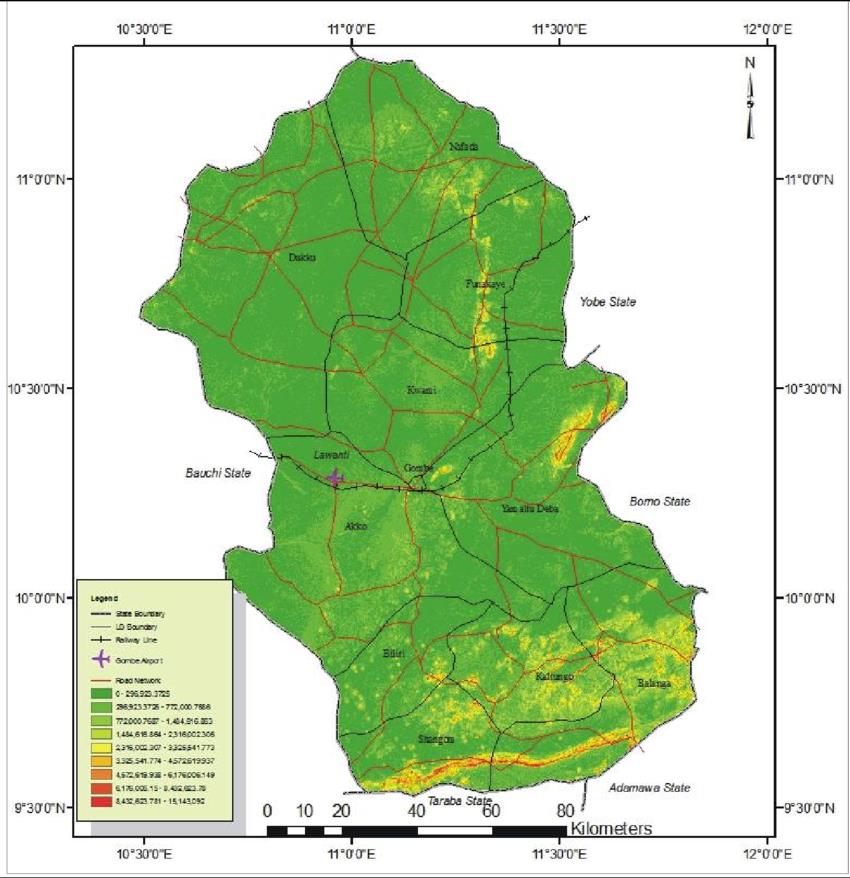
The study area is Gombe Local Government Area in Gombe State, North Eastern region of Nigeria (Figure 1). It is located between 10°17'N to 11°10' E, and has a land cover of 52sq. kilometers. It shares common borders with Bauchi State in the West, Yobe State in the North East, Borno State in the East and Taraba and Adamawa States in the South. The population of Gombe Local Government Area was projected to be 268,000, according to the 2006 Census. The area is mainly peri-urban with approximately
60% of the people living in rural settings. From the 2006 census figures there are 8,570 households living in 5852 houses in the area. The major economic activity of the people is agriculture, which employs about 64% of the total working population. The service and commercial sector employs an estimated 29% while the industrial sector employs the least with an expected 7% of the area’s total work force.
Major crops farmed in the area include maize, soya beans, groundnuts, rice, beans, cassava and cotton. Animals kept by farmers include cattle, sheep, goats, pigs and poultry. The area falls within the Tropical continental climate zone of Nigeria and thus, experiences a long dry season followed by a short rainfall season which begins in April/May and lasts till September/October. High temperatures are experienced most times of the year with the mean monthly temperature ranging between 21°C and 32°C, highest temperatures are recorded just before the onset of the rains with temperatures rising to about 40ºC. The vegetation of Gombe is Guinea Savannah, which is characterized by grasses, scattered trees and shrubs.
Menwo Ukechi Osigwe, et al. Climate Change and Agricultural Sustainability: Perceptions, Impacts and Adaptation Strategies among Smallholder Farmers in Gombe State, Nigeria. J Ecol & Nat Resour 2019, 3(4): 000171.
Copyright© Menwo Ukechi Osigwe, et al.
Sampling and data collection procedures
The population of the study comprised of local leaders and members of the local farming communities. The sample size used in the study comprised of 240 people, selected using purposive and simple random sampling techniques to select the required sample for the study. Purposive sampling was used to select the respondents from among the local farmers and simple random sampling was used to select respondents from among the local leaders. Questionnaires were used to collect primary data and document review helped in collecting secondary data.
Data Analysis
The data with similar characteristics were edited, classified, grouped, coded and tabulated into tables and charts before interpretation. The template used in the interpretation is presented in Table 1. Descriptive statistics were used to analyze the demographic data
| S/No | Mean range | Respond mode | Interpretation | ||||||||
|---|---|---|---|---|---|---|---|---|---|---|---|
| 1 | 4.20 – 5.00 | Strongly agree | Very satisfactory | ||||||||
| 2 | 3.40 – 4.20 | Agree | Satisfactory | ||||||||
| 3 | 2.60 – 3.40 | Undecided | Fairly satisfactory | ||||||||
| 4 | 1.80 – 2.60 | Disagree | Not satisfactory | ||||||||
| 5 | 1.00 – 1.80 | Strongly agree | Poor satisfactory |
Table 1: Interpretation guides. Source: field survey, 2017
The Table 1 above show how the result was interpreted in the study with the mean range of 4.20 -5.00 responded strongly agree and interpreted very satisfactory, 3.40–4.20 responded agree and interpreted as satisfactory, 2.60-3.40 responded undecided interpreted fairly satisfactory, 1.80 – 2.60 responded disagreed and interpreted not satisfactory, and the last Likert scale with a mean range 1.00 – 1.80 with a respond mode strongly disagree and interpreted poor satisfactorily.
Farmers’ Perceptions of Climate Change and its Impacts on Crop and Livestock Production
The first specific objective of the study was to examine the farmers’ perceptions of climate change and impacts on crop and livestock production. The results on the perceptions of climate change are presented in Table 2. The result showed 37% of the respondents strongly agreed that there is widespread knowledge among farmers about climate change in the study area, 35% agreed, 12% of the respondents were undecided, 14% of them disagreed while 2% of the respondent strongly disagree, with a mean 3.91 and interpreted as satisfactory. This is a confirmation that indeed farming communities in Gombe state are aware of the problem of climate change. In addition, on the fact that farmers understand the reality and severity of climate change, its long term challenge and need to adapt to it, 40% of the respondents strongly agreed, 41% of them agree, 7% of them were undecided while 7% of them disagreed and Menwo Ukechi Osigwe, et al. Climate Change and Agricultural Sustainability: Perceptions, Impacts and Adaptation Strategies among Smallholder Farmers in Gombe State, Nigeria. J Ecol & Nat Resour 2019, 3(4): 000171.
the last one were strongly disagree which account for 5% with a mean of 4.05 and interpreted as satisfactory. On the assertion that farmers understand that climate change is a long term challenge and that they have to adapt to it, 37% of the respondents strongly agreed, 37% of them agreed, 15% were undecided while 9% of them disagreed and 2% of the respondents strongly disagree with a mean of 3.98 and interpreted as satisfactory. Also, on the assertion that local farmers experience long spells of drought as a result of climate change, 28% of the respondents strongly agreed, 40% of the respondents agreed, 16% of them were undecided and 2% of them disagreed and 14% of them strongly disagreed. Furthermore, on the fact that irregularity of rainfall is a manifestation of climate change in the region, 56% of the respondent strongly agreed, 26% of them agreed, 9% of the respondents were undecided, 7% disagreed and 2% of them strongly disagreed with the mean = 4.26, interpreted as very satisfactory. On the assertion that water shortages are on the rise because of climate change in the region, 28% of the respondents strongly agreed, 44% of them agreed, 13% of the respondents were undecided, 7% of them disagreed and 5% of them strongly agreed. This implied that the overall mean of perception of climate change was 3.95, interpreted as satisfactory. Therefore, there is widespread awareness about the problem of climate change and the need for adaptation measures. This is because of the realization that climate change is a long term challenge which needs to be dealt with.
Copyright© Menwo Ukechi Osigwe, et al.
| Statements on perceptions of climate change | Percentage responses (%) | Mean | Interpretation | ||||||
|---|---|---|---|---|---|---|---|---|---|
| SA | A | U | D | SD | |||||
| There is widespread knowledge by farmers about climate change in this region | 37 | 35 | 12 | 14 | 2 | 3.91 | Satisfactory | ||
| Farmers understand the reality and severity of climate change in this region | 40 | 41 | 7 | 7 | 5 | 4.05 | Satisfactory | ||
| Farmers understand that climate change is a long term challenge and that they have to adapt to it | 37 | 37 | 15 | 9 | 2 | 3.98 | Satisfactory | ||
| Local farmers' experience longer spells of drought as a result of climate change | 28 | 40 | 15 | 2 | 15 | 3.65 | Satisfactory | ||
| Irregularity of rainfall is a manifestation of climate change in the region | 56 | 26 | 9 | 7 | 2 | 4.26 | Very satisfactory | ||
| Water shortages are on the rise because of climate change in the region | 28 | 44 | 13 | 7 | 5 | 3.86 | Satisfactory | ||
| Average mean | 38 | 37 | 12 | 8 | 5 | 3.95 | Satisfactory |
Table 2: Farmers’ perceptions of climate change in the study area. Source: Field data, 2017 KEY: SA - Strongly Agree, A –Agree, U
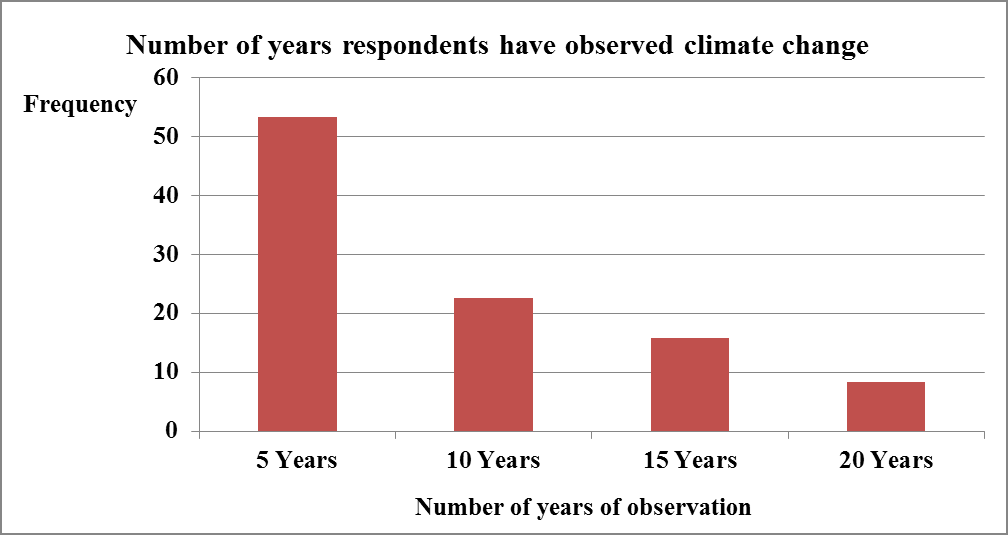
Results presented in Figure 3 shows that, about 53.3% of the respondents stated that they had observed faster changes in the climate within the past 5 years. Respondents who stated that they had observed changes in the climate patterns over the past 10 years constitute 22.5% of the sample population. The findings further showed that, about 15.8% of respondents had observed climatic changes in the past 15 years and 8.4% of the respondents claimed that they had witnessed climate change over the past 20 years in the study area.
Copyright© Menwo Ukechi Osigwe, et al.
Results on the Impact of Climate Change on Crop Production
The results of the impact of climate change on crop production as presented in Table 3 show that on the assertion that unreliable rainfall affects the planting schedules, 73% of the respondents agreed, 16% of them were undecided, and 11% of them disagreed, with mean of 3.88 and interpreted as satisfactory. On the assertion that low rainfalls lead to drying of crops, resulting in poor harvests, 77% of the respondents agreed, 4% of the respondents were undecided, while 19% disagreed, with a mean of 3.81 and interpreted as satisfactory. On the assertion that flooding leads to rotting of crops in the fields, resulting in poor harvests, 70% of the respondents agreed, while 30% of the respondents disagreed, with a mean of 3.86 and interpreted as satisfactory. On whether there is an increased occurrence of crop pests that affect harvests, 70% of the respondents agreed, 12% of them were undecided, while 18% of the respondents disagreed, with a mean of 3.84 and interpreted as satisfactory. Furthermore, on the assertion that there is massive loss of soil fertility which results into poor harvests, 76% of the respondents agreed, 14% of them were undecided, while 10% of the respondents disagreed, with a mean of 3.95 and interpreted as satisfactory. This implies that climate change has had various observed impacts on local crop farmers in Gombe state, Nigeria with an average mean of 3.86 interpreted as satisfactory.
| Impact on crop production | Percentage responses (%) | Mean | Interpretation | ||||
|---|---|---|---|---|---|---|---|
| SA | A | U | D | SD | |||
| Unreliable rainfall seasons affect the planting schedules | 33 | 40 | 16 | 7 | 4 | 3.88 | Satisfactory |
| Low rainfalls lead to drying of crops, resulting in poor harvests | 30 | 47 | 4 | 12 | 7 | 3.81 | Satisfactory |
| Flooding leads to rotting of crops in the fields, resulting in poor harvests | 40 | 30 | 0 | 12 | 18 | 3.86 | Satisfactory |
| There is an increased occurrence of crop pests that affect harvests | 40 | 30 | 12 | 12 | 6 | 3.84 | Satisfactory |
| There is a massive loss of soil fertility which results into poor harvests | 32 | 44 | 14 | 5 | 5 | 3.95 | Satisfactory |
| Average mean | 35 | 38 | 9 | 10 | 8 | 3.86 | Satisfactory |
Table 3: Showing responses on the impact of climate change on crop production **Source:** Field data, 2017 **KEY: SA -** Strongly
Table 3: Showing responses on the impact of climate change on crop production Source: Field data, 2017 KEY: SA - Strongly Agree, A–Agree, U –Undecided, D–Disagree, SD - Strongly Disagree Impact of Climate Change on Livestock Production The results of impact of climate change on livestock production as presented in Table 4 show that with the assertion that longer spells of dry season result in loss of pasture for animals, leading to death, 77% of the respondents agreed, 16% of them were undecided, while 7% of the respondents disagreed, with a mean of 4.02 and interpreted as satisfactory. On whether seasonal variations result in an increased occurrence of animal pests and diseases, 84% of the respondents agreed, 7% of them were undecided, while 9% of the respondents disagreed, with a mean of 4.12 and interpreted as Menwo Ukechi Osigwe, et al. Climate Change and Agricultural Sustainability: Perceptions, Impacts and Adaptation Strategies among Smallholder Farmers in Gombe State, Nigeria. J Ecol & Nat Resour 2019, 3(4): 000171.
satisfactory. On the assertion that dry seasons lead to lack of enough drinking water, resulting in poor milk production and death of animals, 86% of the respondents agreed, while 14% of them disagreed with a mean of 4.23 and interpreted as very satisfactory. And on the assertion that flooding results in death of animals, and increased incidence of diseases, 81% of the respondents agreed, 15% of them were undecided, while 4% of the respondent disagreed, with a mean of 4.07 and interpreted as satisfactory. This implied that there were various impacts experienced by livestock producers as a result of climate change in Gombe state, Nigeria with an overall average mean of 4.11 and interpreted as satisfactory.
Copyright© Menwo Ukechi Osigwe, et al.
| Support of government institutions towards adaptation | Percentage responses | Mean | Interpretation | ||||||
|---|---|---|---|---|---|---|---|---|---|
| (%) | |||||||||
| SA | A | U | D | SD | |||||
| Long spells of the dry season result in loss of pasture for animals, leading to death | 35 | 42 | 16 | 5 | 2 | 4.02 | Satisfactory | ||
| Seasonal variations result in an increased occurrence of animal pests and diseases | 39 | 45 | 7 | 7 | 2 | 4.12 | Satisfactory | ||
| Dry seasons lead to lack of enough drinking water, resulting in poor milk production and death of animals | 39 | 47 | 0 | 12 | 2 | 4.23 | Very satisfactory | ||
| Flooding results in death of animals, and increased incidence of diseases | 32 | 49 | 15 | 2 | 2 | 4.07 | Satisfactory | ||
| Average mean | 36 | 46 | 10 | 7 | 2 | 4.11 | Satisfactory |
Table 4: Showing responses on the impact of climate change on livestock production Source: Field data, 2017 KEY: SA - Strongly Ag
Table 4: Showing responses on the impact of climate change on livestock production Source: Field data, 2017 KEY: SA - Strongly Agree, A–Agree, U –Undecided, D–Disagree, SD - Strongly Disagree The study examined the farmers’ perceptions of climate change in Gombe state, Nigeria. The results of this showed that the perceptions of the majority of the respondents about climate change are largely tilted towards the acceptance that climate change is a big problem that needs to be addressed. The results show that respondents understand the severity of climate change and have observed its various impacts on their livelihoods.
The results on the impact of climate change on crop production showed that the majority of the respondents attested to the fact that unreliable rainfall seasons affect the planting schedules, that poor rains lead to drying of crops, resulting into poor harvests, that flooding leads to rotting of crops in fields, resulting into poor harvests, that there is an increased occurrence of crop pests that affect harvests, and that there is massive loss of soil fertility which results into poor harvests. These results show that the majority of the respondents are fully aware of the negative impact of climate change on crop production in Gombe state, Nigeria.
On the impact of climate change on livestock production, the study findings show that majority of the respondents agreed that longer duration of dry season result into loss of pasture for animals, leading to death, that seasonal variations result into increased occurrence of animal pests and diseases, that dry seasons lead to lack of enough drinking water, resulting into poor milk production and death of animals, and that flooding results into death of animals, and increased incidence of diseases.
Menwo Ukechi Osigwe, et al. Climate Change and Agricultural Sustainability: Perceptions, Impacts and Adaptation Strategies among Smallholder Farmers in Gombe State, Nigeria. J Ecol & Nat Resour 2019, 3(4): 000171.
These findings are echoed by the IPCC [1], which found out that there is a consensus that many natural systems are affected by global and regional climate changes, particularly in terms of increasing temperatures. Pelling, et al. [17] also stated that weather related hazards and human vulnerability are as a consequence of continuations from the root causes such as global climate change, thus emphasizing the relationship between the global and local. Owusu (2009) [18] in a study of the climatic patterns of Nigeria, found out that significant changes in rainfall and temperature have been recorded over the years throughout the country. These changes have serious implications for farmers as their production is largely rain-fed and non-mechanized, thus, increasing their vulnerability to climatic shocks [19, 20, 21].
Conclusion
The study has examined the farmers’ perceptions of climate change in Gombe state, Nigeria. The results of the study showed that the perceptions of the majority of the respondents about climate change are largely tilted towards the acceptance that climate change is a big problem that needs to be addressed. The results show that respondents understand the severity of climate change and have observed its various impacts on their livelihoods over the years. The results show that adaptation strategies adopted by local farmers in crop production include selecting crop species that are more drought resistant in order to ensure higher crop yields, the use of local irrigation techniques, crop rotation and application of local fertilizers to improve soil fertility. In Copyright© Menwo Ukechi Osigwe, et al.
terms of livestock production, the farmers have adopted paddocking to minimize spread of animal pests and diseases, increased use of pesticides to control animal pests and diseases, tree planting to prevent further effects of climate change, rain water harvesting to conserve drinking water for animals during dry season and conservation of animal feed (dry grass) for the dry seasons. The findings of the study show that most of the farmers believe that the adaptation mechanisms they have adopted are effective in combating the effects of climate change in their communities.
From the above findings, the study concluded that the impacts of climate change are real and farming communities are one of the most vulnerable to climatic change. This is a major concern since smallholder farmers form the largest employment group worldwide and the major staple food producer. Consequently, adaptation of farmers to climate change is needed to ensure the sustainability of their livelihoods and to safeguard food security. Overall, the study concludes that given the widespread awareness of the long term problem of climate change, adaptation is the only way of ensuring livelihood sustainability among farming communities in Gombe state, Nigeria.
Recommendations
From the findings of the study, the following recommendations are made: i. The Government, the private sector and other stakeholders should come together to draw a plan on how irrigation can be improved upon to help farmers adapt to climate change in the area. ii. There is a need for the Government to put in place policies that ensure that farmers have access to physical, human and social capital to help increase their flexibility to change production strategies in response to climate conditions. Extension workers should be well trained in research centers and properly oriented on how to make their services available to local farmers. iii. Government should also establish functional metrological centres in the rural areas to make available climate information to farmers via radio and television, in order to strengthen farmers’ adaptability to climate change. Policies should be devised to enhance farmers’ incomes through increased productivity as a way of coping with the effects of climate change.
References
-
Menwo Ukechi Osigwe, et al. Climate Change and Agricultural Sustainability: Perceptions, Impacts and Adaptation Strategies among Smallholder Farmers in Gombe State, Nigeria. J Ecol & Nat Resour 2019, 3(4): 000171.
-
Intergovernmental panel on Climate Change (IPCC) (2007) Climate Change 2007: Impacts, Adaptation and Vulnerability - Contribution of Working Group II to the Fourth Assessment Report of the Intergovernmental Panel on Climate Change. Cambridge University Press, Cambridge.
-
United Nations Framework Convention on Climate Change (UNFCCC) (2007b) Home: Full Text of the Convention. From United Nations Framework Convention on Climate Change.
-
O’Brien K, Sygna L, Leichenko R, Adger N, Barnett J, et al. (2009) Disaster Risk Reduction, Climate Change Adaptation and Human Security. The Global Environmental Change and Human Security Project (GECHS), Oslo.
-
Ireland P (2010) Climate change adaptation and disaster risk reduction: Contested spaces and emerging opportunities in development theory and practice. Climate Development 2(4): 332-345.
-
Agrawal A (2008) The role of local institutions in adaptation to climate change. International Forestry Research and Institutions Program (IFRI) Working Paper.
-
Moser C, Norton A, Stein A, Georgieva S (2010) Pro- Poor Adaptation to Climate Change in Urban Centers: Case Studies of Vulnerability and Resilience in Kenya and Nicaragua” Social Development Department, World Bank, Washington DC.
-
Crane TA (2013) The Role of Local Institutions in Adaptive Processes in Climate Variability. The Cases of Southern Ethiopia and Southern Mali.
-
Adger WN (2012) Adaptation as social contract. Presented at the Symposium ‘The Governance of Adaptation’. Amsterdam, The Netherlands.
-
Agrawal A, Perrin N (2008) Climate Adaptation, Local Institutions and Rural Livelihoods. Michigan: International Forestry Resource and Institutions Programmed.
-
Moser SC, Ekstrom JA (2010) A Framework to Diagnose Barriers to Climate Change Adaptation. Proceedings of the National Academy of Sciences of the United States of America 107(51): 22020-22031. Copyright© Menwo Ukechi Osigwe, et al.
-
Berkhout F (2011) Rationales for adaptation in EU climate change policies. Climate Policy 5(3): 377-391.
-
Fankhauser S, Smith JB, Tol RSJ (1999) Weathering climate change: some simple rules to guide adaptation decisions. Ecological Economics 30(1): 67- 78.
-
Swart R, Biesbroek R, Binnerup S, Carter TR, Cowan C, et al. (2009) Europe Adapts to ClimateChange: Comparing National Adaptation Strategies. Partnership for European Environmental Research (PEER). Helsinki, Finland.
-
Biesbroek GR, Swart RJ, Carter TR, Cowan C, Henrichs T, et al. (2010) Europe adapts to climate change: Comparing National Adaptation Strategies. Global Environmental Change 20(3) 440-450.
-
Thampapillai V (2011) Liberal Theoretical Foundation for Government Intervention in the Water Market, Government Failure and Government Institutions in the Murray Darling Basin. Menwo Ukechi Osigwe, et al. Climate Change and Agricultural Sustainability: Perceptions, Impacts and Adaptation Strategies among Smallholder Farmers in Gombe State, Nigeria. J Ecol & Nat Resour 2019, 3(4): 000171.
-
Stern N (2006) The Economics of Climate Change. Cambridge University Press, Cambridge, UK.
-
Pelling M (2013) Natural Disasters and Development in a Globalizing World. Routledge,
-
Owusu K, Waylen P (2009) Trends in Spatio- Temporal Variability in Annual Rainfall in Ghana (1951-2000). Royal Meteorological Society 64(5): 115-120.
-
Nigeria (1951-200) Weather. 115-120.
-
United Nations Framework on Climate Change (UNFCCC) (2007a) Impacts, Vulnerabilities and Adaptation in Developing Countries. Bonn, Germany: Produced by the Information Services Department, UNFCC.
-
World Bank (2013) Home Topics Social Development RICC: Background. World Bank 5(3): 377-391. Copyright© Menwo Ukechi Osigwe, et al.
- Lessons to Learn: Trees are More than the Lungs of the World
- Community Forestry Enterprises as a Model for Sustainable Forest Development: The Case Of The "Baja Tarahumara" in Chihuahua, Mexico
- Ecological and Socio-Economic Impacts of Chromolaena odorata and Mesosphaerum suaveolens, Two Invasive Alien Species in Central and Southern Benin, West Africa
- Epigenetic Sustainability: Modeling the Human Factor as a Natural Resource through Science 4.0 and the NR3C1 Biological Pilot
- Growth-at-Risk: A Framework for Assessing Economic Vulnerability
- The Rural Territory as a Socioecological System for the Management of Public Policy for Sustainable Rural Development