
Evaluation of the Antioxidant Properties of Cultivated Edible Mushroom: Agrocybe Aegerita
The antioxidant activity of an edible mushroom Agrocybe aegerita was analysed by testing its methanolic extracts with that of cultivated mushrooms Lentinus edodes and Calocybe species. Results showed predominant activity with respect to all the assays with different chemical systems including reducing power, DPPH free radical scavenging, ferric reducing antioxidant power (FRAP), superoxide scavenging, peroxide scavenging, ferrous ion chelating, total phenolic & flavonoid content. Scavenging effects on 2,2-diphenyl-1-picrylhydrazyl radicals were moderate to high (66.23-92.27%) at 1.5 mg/ml. Chelating effects on ferrous ions were moderate to excellent (78.41-96.65%) at 20 mg/ml. At 12 mg/ml, the reducing powers were excellent (84.04 – 92.82%). FRAP results were moderate in the range (18.60 – 72.35%) at 12 mg/ml. The ability to scavenge super oxide (% SOD scavenging) was moderate to excellent (26.21-92.32 %) at 20 mg/ml. The total phenols in the extracts ranged from 0.64 – 0.26 at 20 mg/ml. The total flavonoid content in the extracts ranged from 0.307 – 0.055 at 10 mg/ml.
Introduction
“An antioxidant is essentially a molecule that inhibits the oxidation of other molecules.” Oxidation, a chemical reaction transfers electrons or hydrogen from substance to the oxidizing agent. It is an essential process during which energy is produced in biological systems. However, there are many reactive oxygen species and free radicals that are related or formed as a result of the oxidation process. These reactive species frequently cause cell death and are involved in other degenerative processes associated with ageing (WWW. en.wikipedia.org/wiki/Antioxidant). Reactive oxygen species (ROS) along with free radicals are also found to play an essential role in functional changes which are associated with diseases like cancer, rheumatoid arthritis, cirrhosis etc. Cells are equipped with enzymes like superoxide dismutase, catalase and also chemicals like vitamin E, vitamin C, polyphenols, carotinoids and glutathione [1]. Antioxidants are also known as reducing agents such as ascorbic acid, thiols or polyphenols [2]. Antioxidant containing natural foods are used to reduce the oxidative damage. Mushrooms are extensively used as food because of their unique taste and fine flavour. Experimental evidence shows that mushrooms contain many biologically active components which offer health benefits and protection against degenerative diseases [3]. Mushrooms have been rich sources for compounds like lectins, terpenoids, beta-glucans, ascorbic acid, tocopherols, carboxylic acids and various dietary fibres [4, 5, 6, 7].
Agrocybe aegerita is the most widely cultivated edible mushroom in the regions of Chile, Japan, and the Far East, as well as southern Europe. They have also been developed as the primary valuable source possessing varieties of bioactive secondary metabolites such as indole derivatives with free radical scavenging activity, cylindan with anticancer activity, and also agrocybenine with antifungal activity [8]. Agrocybe aegerita has unique flavor, good nutritive and medicinal values. This mushroom is known to have an anti-tumour lectin (www.nrcmushroom.org). Wheat straw or sawdust supplemented with wheat bran is commonly used as substrates for its cultivation. Calocybe spp_. (Milky mushroom) is a well-recognized tropical edible mushroom and promising for cultivation in India [9]. _Lentinus edodes apart from being delicious, it has an added medicinal value with excellent nutritional profile and high levels of B vitamin and pro-vitamin D2 (ergosterol) [10]. Mushroom properties are known to change with the substrate. Antioxidant activity of Agrocybe aegerita has not been reported earlier. Invitro antioxidant assays have been used to investigate the antioxidant activity of mushroom. The mushroom Agrocybe aegerita was cultivated on paddy straw to assess the antioxidant activity by comparing it with two other cultivated edible mushrooms.
Materials and Methods
Mushroom samples
All the mushroom samples namely, Agrocybe aegerita, Lentinus edodes, and milky mushroom (Calocybe spp) were collected from the Mushroom Lab, Indian Institute of Horticultural Research (IIHR), Hessaraghatta, Bangalore. All the mushrooms have been identified by Dr.Meera Pandey, Principal scientist, IIHR. Agrocybe aegerita and Calocybe spp were cultured under laboratory conditions using paddy straw as substrate. For L.edodes, saw dust was used as substrate. Voucher specimens of the three species were deposited at the herbarium of Department of Biosciences, Sri Sathya Sai Institute of Higher Learning.
Sample Preparation
Fresh mushrooms were harvested, separated and dried in tray drier at 38°C for 48 h. The dried material was ground into a coarse powder using mortar and pestle. Dried powders, 50 grams each, were defatted by refluxing with petroleum ether (60–80°C) for 6 h. The defatted material was then dried and the extracts were prepared by taking each of the powdered mushrooms in to a 1 lit round bottom flask with 500ml of methanol and refluxed at 25°C for 3 hours. The extract was then filtered through Watman paper. The remaining residue was put for re- extraction with methanol. The procedure was repeated thrice after which the combined extracts were concentrated to 10ml at 40°C by using Rota evaporator and kept for complete dryness in a china dish and stored at 4°C till further analysis. The dried extracts were dissolved in methanol to a concentration of 20 mg/ml and used for analysis.
Reagents and Chemicals
Homovanillic acid (HVA), L-ascorbic acid, nitro blue tetrazolium salt (NBT), butylatedhydroxytoluene (BHT), 2,2-diphenyl-1-picrylhydrazyl (DPPH), quercetin, gallic acid, Horseradish peroxidase (HRP) type II, methionine, ferrozine, riboflavin, ethylenediaminetetraacetic acid (EDTA) and 6-hydroxy-2,5,7,8-tetramethylchroman-2- carboxylic acid (TROLOX) were all purchased from Sigma- Aldrich Chemicals (India) Ltd. All other chemicals used are of analytical grade.
Chemical Assays
DPPH radical scavenging activity: Various concentrations of the methanolic extracts of mushrooms (0.25–1.5 mg/ml, 2.5 ml) were mixed with methanolic solution containing DPPH radicals (1 mM, 0.5 ml). The mixtures were shaken vigorously and left to stand in dark for 30 min. The reduction in the DPPH radical concentration was then determined by measuring the absorbance at 517 nm (Shimadzu UV-spectrophotometer, UV-2450). Methanol was taken as blank and DPPH solution without the extracts was taken as control. The percentage of DPPH scavenged was calculated using the equation: % Scavenged = [(AC–AS)/ AC] × 100, where AC is the absorbance of control, and AS is the absorbance of solution containing sample extracts. Trolox and ascorbic acid were used as standard. Ferrous ion chelating activity: The chelating of ferrous ions by the mushroom extracts was estimated by the method of Dinis, et al. [12, 13]. The Fe2+ chelating ability was monitored by measuring the absorbance of the ferrous iron–ferrozine complex at 562 nm. Briefly, methanolic mushroom extracts (2–20 mg/ml, 0.4 ml) were added to a solution of 2mM FeCl2 (0.2 ml). The reaction was initiated by adding 5 mM ferrozine (0.4 ml). The total volume was adjusted to 4 ml with methanol. The mixture was shaken vigorously and left at room temperature for 10 min. The absorbance’s of the solutions were measured spectrophotometrically at 562 nm (Shimadzu UV-spectrophotometer, UV-2450). The percentage of chelation was calculated by using the equation: % Chelation = [(AC–AS)/ AC] × 100, where AC is the absorbance of control, and AS is the absorbance of solution containing sample extracts. Control contains only FeCl2 and ferrozine. Ascorbic acid was used as standard. Reducing power: The reducing power was measured by the method of Oyaizu [14]. Methanolic extracts of mushroom (2– 12 mg/ml, 2.0 ml) were mixed with sodium phosphate buffer (0.2 M, pH 6.5, 2.0 ml) and potassium ferricyanide [K3Fe(CN)6] (1%, 2.0 ml). The mixture was then incubated at 50°C for 20 min. Tricloroacetic acid (10% w/v, 2.0 ml) was then added and the mixture was centrifuged at 3000 rpm for 10 min (REMI R23). To the supernatant layer (1.5 ml), 1.5 ml of deionised water and ferric chloride (0.1%, 0.25 ml) were added and the absorbance was measured at 700 nm (Shimadzu UV-spectrophotometer, UV-2450). Higher absorbance indicates better reducing power. Trolox and Ascorbic acid were used as standard. Ferric reducing antioxidant power (FRAP): In FRAP method, the complex formed when ferric tripyridyltriazene (Fe3+ TPTZ) complex was reduced to the ferrous (Fe2+) ion was determined using UV-Vis Spectrophotometer. The oxidant in the FRAP assay was prepared by mixing TPTZ (10 mM in 40 mM HCl, 2.5 ml), acetate buffer (0.3 M pH 3.6, 25 ml), and 2.5 ml of FeCl3.6H2O (20 mM). To 1800 μl of freshly prepared FRAP reagent, 180 μl of water and 60 μl of mushroom extracts (2–12 mg/ml) were added. The mixture was then incubated at 37°C for 30 min. The absorbance was measured spectrophotometrically at 595 nm (Shimadzu UV-spectrophotometer, UV-2450). Higher absorbance indicates better ferric reducing ability of the extracts. Trolox and ascorbic acid were used as standard [15, 16]. Superoxide scavenging activity: This assay is based on the capacity of the extracts to inhibit the superoxide radical formed by photochemical reduction of nitro bluetetrazolium (NBT) in the riboflavin–light–NBT system. The method followed was used by Rajesh Babu [17]. Each 3 ml reaction mixture contained sodium phosphate buffer (200 mM, pH 7.8, and 0.5 ml), methionine (104 mM, 0.25 ml), riboflavin (8 μM, 0.5 ml), EDTA (100 μm, 0.5 ml), NBT (600 μM, 0.25 ml) and 1 ml test sample solution. The production of blue formation was followed by monitoring the increase in absorbance at 560 nm after 40 min. illumination from a fluorescent lamp. The percentage of superoxide scavenged is calculated using the equation: % Scavenged = [(AC–AS)/ AC] × 100, where AC is the absorbance of control, and AS is the absorbance of solution containing sample extracts. Trolox was used as standard. Determination of total phenolic content and total flavonoid content: Total phenolic content was measured at 20 mg/ml concentration of the extracts. To 0.1 ml of mushroom extracts in 13% HCl / MeOH (60:40, v/v), 2 ml of 2% sodium carbonate was added. The mixture was incubated at room temperature for 3 min. Folinciocalteu reagent (0.1 ml) was added to the mixture. After 30 min. absorbance was measured at 750 nm [18]. Gallic acid was used as standard. The results were expressed as mg of gallic acid equivalents (GAEs) per gram of mushroom extract.
Total flavonoid content was measured at 20 mg/ml concentration of the extracts. To 1 ml of mushroom extracts, 1 ml of 10% AlCl3, potassium acetate (1 M, 0.1 ml) and 3.8 ml of MeOH were added and the mixture was incubated for 40 min at room temperature. Then absorbance was measured at 415 nm [19]. The results were expressed as μg of quercetin equivalents (CEs) per gram of mushroom extract. Statistical Analysis All the analyses were carried out on triplicate samples and the mean values of the results were reported. The experimental results were analyzed using one-way ANOVA (analysis of variance) followed by student’s t-test to determine the least significant difference at α=0.05 using Microcal Origin ver. 6.0 software.
Results and Discussions
DPPH radical scavenging activity
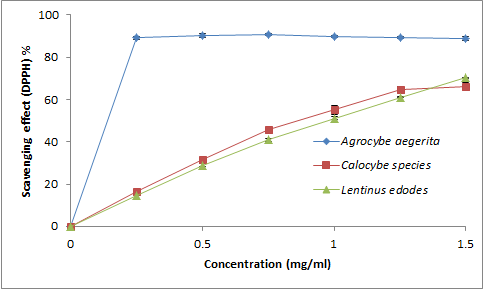
The methanolic extracts of the three cultivated mushrooms exhibited increasing scavenging effect with increased concentration (Figure 1). The activity of Agrocybe aegerita was found to be excellent even at 0.75mg/ml concentration (90.70%) when compared to that of Calocybe sp. and Lentinus edodes whose activity, even at 1.5mg/ml concentration, was observed to be 66.23% and 70.28% respectively. The radical scavenging activity of Agrocybe aegerita exhibited excellent scavenging activity of nearly 81% at 0.02 mg/ml concentration when compared with other edible mushrooms reported by Mujić I [20]. The scavenging effect of Trolox at 10 µg/ml was 89.79% and the scavenging effect of Ascorbic acid at 100 µg/ml was 65.96%.
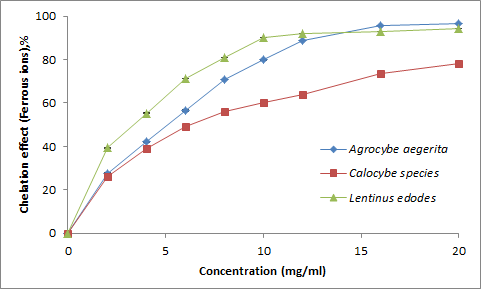
The study of the chelating effects on the ferrous ions is advantageous since they are the most active pro-oxidants in the food system [21]. The methanolic extracts from the three cultivated mushrooms exhibited increasing chelation effect on ferrous ions with the increased concentrations and were high to excellent (78.41- 96.65%) at 20 mg/ml (Figure 2). Among the three
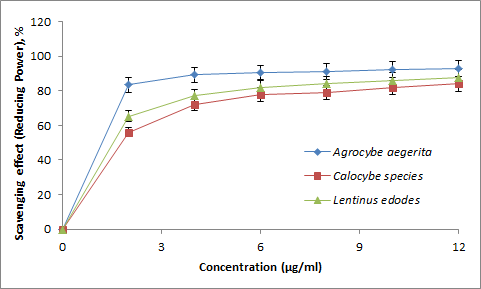
The reducing power ability of the methanolic extracts were excellent and increased steadily with increase in Agrocybe aegerita is excellent when compared to the value reported by Barros L [3]. The reducing power of Agrocybe aegerita according to Mujić I [20] showed good activity of 55% at 1 mg/ml concentration. The high reducing power presented by the extracts might be suggestive of the hydrogen donating ability of active species present in the extracts [23]. Results show that Agrocybe aegerita presented excellent reducing power (83.33%) followed by Lentinus edodes (65.32%) and Calocybe sps (56.16%). However the reducing power of TROLOX and Ascorbic acid at 60 μg/ml and 6 μg/ml was 82.27% and 71.05% respectively.
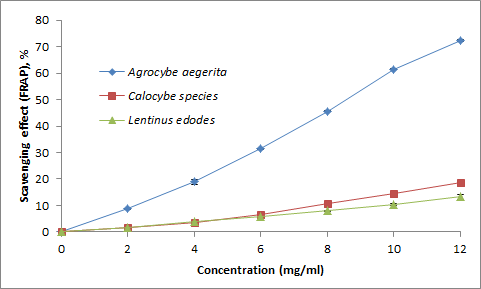
The mushroom extracts showed increased FRAP with increased concentration (Fig.4). At 12 mg/ml concentration the FRAP values of measured absorbance at 595nm were 13.25 – 72.35%. The FRAP values presented by these extracts were good when compared to the values
Superoxide scavenging activity
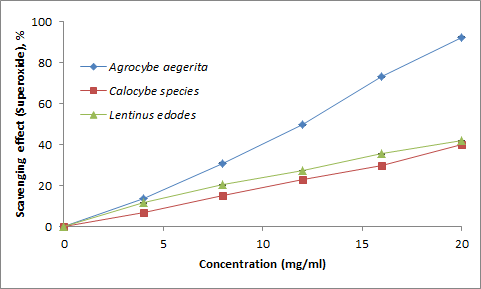
The SOD activity of methanolic extracts of edible mushrooms which were assayed by the non-enzymatic riboflavin-light-NBT system, showed increased activity with increased concentrations (Figure 5) and were 92.32 – 39.81% at the concentration of 20 mg/ml. Results showed that the % Superoxide scavenging activity was more exhibited by Agrocybe aegerita 92.32%. This was followed by Lentinus edodes 41.73% and Calocybe spp_._ 39.81%. The SOD values exhibited by these extracts were excellent when compared to the values reported by Babu and Rao [24]. However the scavenged activity of Trolox was found to be 77.75% at 25 mg/ml of concentration.
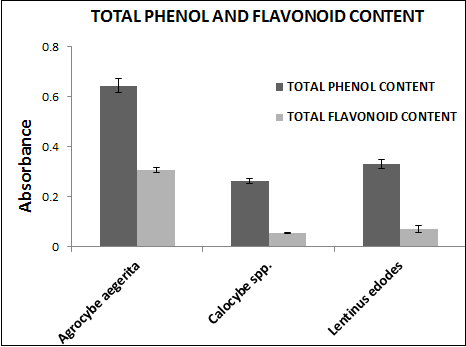
The major antioxidant components found in the methanolic extracts of the mushrooms are total phenols. Phenols such as tocopherols, BHT and gallate are found and are known to be effective antioxidants [22]. The total phenol and flavonoid content of all the extracts are summarized in Table 1. The total phenolic content of mushroom extracts recorded at concentration of 20 mg/ml was ranging from 0.64 – 0.26. The total phenolic content was observed to be more in the extracts of Agrocybe aegerita 0.64, which was followed by_, Lentinus_ edodes 0.33 and the least was shown by Calocybe spp 0.26_. However, the absorbance of gallic acid at 0.6 mg/ml concentration was found to be 0.693. The highest total phenol content in _Agrocybe aegerita might account for the The total flavonoid content of mushroom extracts recorded at concentration of 10 mg/ml was ranging from 0.307 – 0.055. The total flavonoid content was observed to be more in the extracts of Agrocybe aegerita 0.307_, which was followed by _Lentinus edodes 0.072 and the least was shown by Calocybe spp 0.055_. However, the absorbance of quercetin at 100 μg/ml concentration was found to be 0.457. The highest total flavonoid content in _Agrocybe aegerita might account for enhanced results found in ferrous ion chelation and superoxide scavenging activities. Total flavonoid content of Agrocybe aegerita is good when compared to the value reported by Barros [3]. The total phenol and flavonoid content of the mushroom extracts were shown in Figure 6.
| Compound concentration (mg/ml) | Agrocybe aegerita | Calocybe sps. | Lentinus edodes | ||||||||
|---|---|---|---|---|---|---|---|---|---|---|---|
| Total Phenolic Content | 26.91±0.03(a) | 10.41±0.01(b) | 13.32±0.02(c) | ||||||||
| Total Flavonoid Content | 3.328±0.011(a) | 0.594±0.002(b) | 0.773±0.014(c) |
Table 1: Content of total flavonoids and total phenols of methanolic extracts of edible mushrooms (a) Each value is expressed as
| Mushroom | DPPH Scavengin | g | FRAP | Ferrous Ion Chelation | Reducing Power | Super Oxide Scavenging | ||||||||||
|---|---|---|---|---|---|---|---|---|---|---|---|---|---|---|---|---|
| Agrocybe aegerita | 0.128 | 7.116 | 3.501 | 1.114 | 11.443 | |||||||||||
| Calocybe sps. | 0.576 | 10.770 | 2.989 | 1.496 | 10.360 | |||||||||||
| Lentinus edodes | 0.687 | 6.395 | 2.401 | 1.341 | 9.073 |
Table 2: The IC50 values of the methanolic extracts from edible mushrooms for various antioxidant assays
Conclusion
In the present study, we have compared the antioxidant activity of Agrocybe aegerita with that of Calocybe spp and Lentinus edodes. The activities increased steadily with increase in the concentration. Agrocybe aegerita has excellent DPPH radical scavenging, peroxide scavenging, FRAP and reducing power abilities. This may be attributed to its highest total phenol content. The excellent ferrous ion chelation and superoxide scavenging abilities exhibited by Agrocybe aegerita may be attributed to its highest flavonoid content. Of all the assays studied, total phenol content of the extracts showed better relationship with chelation with ferrous ions and peroxide scavenging abilities and the total flavonoid content of the extracts showed excellent correlation with DPPH scavenging, FRAP and reducing power abilities. In Table 2, the IC50 values were calculated form the plots for each assay are summarized. The results indicate that Agrocybe aegerita is a promising mushroom with excellent antioxidant potential than that of Lentinus edodes and Calocybe spp. The active components of the mushroom Agrocybe aegerita responsible for these activities needs to be further investigated.
Acknowledgement
This work is dedicated to Bhagawan Sri Sathya Sai Baba, Founder Chancellor of Sri Sathya Sai Institute of Higher Learning (SSSIHL). Authors acknowledge Sri Sathya Sai Institute of Higher Learning- Central Research Instrument Facility (SSSIHL-CRIF) for providing the characterization facilities.
References
-
Niki E, Shimaski H, Mino M (1994) Antioxidantism- free radical and biological defense. Gakkai Syuppn Center, Tokyo 3.
-
Sies H (1997) Oxidative stress: oxidants and antioxidants. Exp Physiol 82(2): 291-295.
-
Barros L, Falcão S, Baptista P, Freire C, Vilas-Boas M, et al. (2008) Antioxidant activity of Agaricus sp. mushrooms by chemical, biochemical and electrochemical assays. Food Chem 111(1): 61-66.
-
Parslew R, Jones K, Rhodes J, Sharpe G (1999) The antiproliferative effect of lectin from the edible mushroom (Agaricus bisporus) on human keratinocytes: preliminary studies on its use in psoriasis. British J Dermatol 140(1): 56-60.
-
Mau JL, Chao GR, Wu KT (2001) Antioxidant properties of methanolic extracts from several ear mushrooms. J Agricu Food Chem 49(11): 5461-5467.
-
Wasser SP, Weis AL (1999) Therapeutic effects of substances occurring in higher Basidiomycetes mushrooms: a modern perspective. Crit Rev Immunol 19(1): 65-96.
-
Wasser SP (2002) Medicinal mushrooms as a source of antitumor and immunomodulating polysaccharides. Appl Microbiol Biotechnol 60(3): 258-274.
-
Zhong JJ, Bai FW, Zhang W (2009) Biotechnology in China I: from bioreaction to bioseparation and bioremediation. Springer.
-
Purkayastha R, Chandra A (1976) A new technique for in vitro production of Calocybe indica-an edible mushroom of India. Mushroom J 40: 112-113.
-
Wasser SP (2005) Shiitake (Lentinus edodes). Encyclopedia of Dietary supplements: 653-664.
-
Aquino R, Morelli S, Lauro MR, Abdo S, Saija A, et al. (2001) Phenolic Constituents and Antioxidant Activity of an Extract of Anthurium v ersicolor Leaves. J Nat Prod 64(8): 1019-1023.
-
Ak T, Gülçin İ (2008) Antioxidant and radical scavenging properties of curcumin. Chem Biol Interact 174(1): 27-37.
-
Dinis TC, Madeira VM, Almeida LM (1994) Action of phenolic derivatives (acetaminophen, salicylate, and 5-aminosalicylate) as inhibitors of membrane lipid peroxidation and as peroxyl radical scavengers. Arch Biochem Biophy 315(1): 161-169.
-
Oyaizu M (1986) Studies on products of browning reaction: antioxidative activity of products of browning reaction. Jpn J Nutr Dietetics 44(6): 307- 315.
-
Benzie IF, Strain JJ (1996) The ferric reducing ability of plasma (FRAP) as a measure of “antioxidant power”: the FRAP assay. Analytical Biochem 239(1): 70-76.
-
Pulido R, Bravo L, Saura-Calixto F (2000) Antioxidant activity of dietary polyphenols as determined by a modified ferric reducing/antioxidant power assay. J Agri Food Chem 48(8): 3396-3402.
-
Babu DR, Pandey M, Rao GN (2012) Antioxidant and electrochemical properties of cultivated Pleurotus spp. and their sporeless/low sporing mutants. J Food Sci Technol 51(11): 3317-3324.
-
Mau JL, Lin HC, Chen CC (2002) Antioxidant properties of several medicinal mushrooms. J Agricu Food Chem 50(21): 6072-6077.
-
Öztürk M, Aydoğmuş-Öztürk F, Duru ME, Topçu G (2007) Antioxidant activity of stem and root extracts of Rhubarb (Rheum ribes): An edible medicinal plant. Food Chem 103(2): 623-630.
-
Mujić I, Zeković Z, Lepojević Ž, Vidović S, Živković J (2011) Antioxidant Properties of Selected Edible Mushroom Species. J Central European Agriculture 11(4): 387-392.
-
Yamauchi R, Tatsumi Y, Asano M, Kato K, Ueno Y (1988) Effect of Metal Salts and Fructose on the Autoxidation of Methyl Linoleate in Emulsions (Food & Nutrition). Agricul Biological Chem 52(3): 849-850.
-
Yang JH, Lin HC, Mau JL (2002) Antioxidant properties of several commercial mushrooms. Food Chem 77(2): 229-235.
-
Shimada K, Fujikawa K, Yahara K, Nakamura T (1992) Antioxidative properties of xanthan on the autoxidation of soybean oil in cyclodextrin emulsion. J Agric Food Chem 40(6): 945-948.
-
Babu DR, Rao GN (2013) Antioxidant properties and electrochemical behavior of cultivated commercial Indian edible mushrooms. J Food Sci Technol 50(2): 301-308.
- Lessons to Learn: Trees are More than the Lungs of the World
- Community Forestry Enterprises as a Model for Sustainable Forest Development: The Case Of The "Baja Tarahumara" in Chihuahua, Mexico
- Ecological and Socio-Economic Impacts of Chromolaena odorata and Mesosphaerum suaveolens, Two Invasive Alien Species in Central and Southern Benin, West Africa
- Epigenetic Sustainability: Modeling the Human Factor as a Natural Resource through Science 4.0 and the NR3C1 Biological Pilot
- Growth-at-Risk: A Framework for Assessing Economic Vulnerability
- The Rural Territory as a Socioecological System for the Management of Public Policy for Sustainable Rural Development