
Field Persistence of Some Entomopathogenic Nematodes
Inoculation of some entomopathogenic nematodes (EPN) in the field was carried out to evaluate their ability to persist in the soil. The experiment was carried out in a chestnut grove on the slopes of Mount Etna and some native species strains were introduced: Steinernema feltiae, S. kraussei, Heterorhabditis bacteriophora, H. megidis. Checks were carried out to ascertain the presence of nematodes over time, for S. megidis the number of larvae present in the soil after 39 days from the introduction was calculated and the distribution of S. feltiae in the various layers of the land was followed. Persistence times varied according to the species: S. feltiae was found for several days and H. bacteriophora for a shorter time, in any case 14 weeks were never exceeded. The nematodes are able to penetrate deeply into the soil and this allows them to face adverse environmental conditions (mainly excessive drought) and to have more chances to meet the host insect.
Introduction
Entomopathogenic nematodes (EPN) are used in agriculture for biological control against crop pest insects. One of the advantages of using nematodes is their reduced environmental impact compared to that of traditional chemical pesticides. In order for this advantage to be considered decisive in increasing the use of biological control, it must be accompanied by real effectiveness and low cost. These aspects are related to the ability of nematodes inseminated into the soil to remain there long enough and with sufficient population density to avoid the necessity of repeating the treatment several times to obtain the desired results. Moreover, repeated treatments, in addition to being economically unattractive, could lead to intraspecific competition that is more damaging than profitable. The problem of persistence is therefore a crucial problem. The main causes that can hinder the persistence of nematodes introduced into the soil are to be found in dehydration and exposure to UV at the time of treatment Gaugler, et al. [1] and, subsequently, especially in microenvironmental factors, in the presence of antagonists and competitors and in the absence of suitable guests.
In recent decades, numerous studies have been conducted on the persistence of different species of entomopathogenic nematodes in the soil. These have shown that the introduced population is drastically reduced already in the first hours after the treatment, continues to decline in the following days and, in most cases, is reduced to less than 1% after 2-6 weeks [2]. At these low levels the population, if it finds a suitable host to reproduce in, can last even for quite long periods. Generally, Steinernema spp. appears to persist longer than Heterorhabditis spp. under laboratory and field conditions [3, 4]. Several authors Forschler and Gardner [5]; Geden, et al. [6]; Warshaw [7]; Buhler and Gibb [8] have reported a rather short persistence, from one to eight weeks, of populations belonging to different species of Steinernema and Heterorhabditis. In other cases it was possible to demonstrate a much longer persistence. The limit case is that of S. glaseri, introduced on a large scale in New Jersey in the period 1939 to 1942 and still present fifty years later, albeit in limited and limited areas [9].
In our study, in order to establish the persistence ability of some native EPN species, these were released into the soil of a chestnut grove; the soil was then tested periodically to ascertain their presence. The tests on persistence were carried out using different sampling techniques.
Any EPN strain was introduced after verifying with absolute certainty, by means of a careful and repeated screening, the absence of any native EPN species in the inseminated site.
Materials and Methods
The experiment started on 07/25/2016. We proceeded to enter 500,000 IJ larvae of each EPN species into the soil through a watering can. The soil was wet before and after the nematodes was introduced. The native species used in the experiments had previously been determined morphologically and molecularly Tarasco, et al. [10] and they were reproduced in the laboratory according to the Bedding and Akhurst [11] technique using Galleria mellonella as target insect.
Research Site
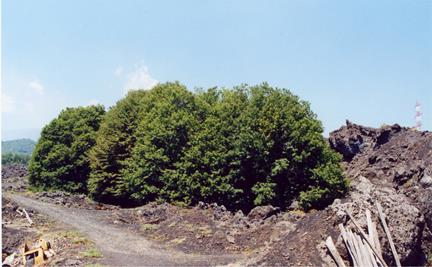
The experiments were carried out in a chestnut uncultivated on the slopes of Mount Etna, the site is represented by an isolated wood, surrounded by lava flows (dagala), in the territory of Fornazzo (Catania-Italy) at 800 m of altitude (Figure 1).
Techniques Used
- Non-quantitative assessment: collection of approximately 2 kg of soil from each parcel treated using a gardening shovel. Check of the presence of nematodes using the Bedding and Akhurst technique [11]. In some cases the sampling was carried out by separating the surface layer (0-7 cm) from the underlying layer (7-15 cm) to test the possible different vertical distribution of the nematodes. In this case the percentage of infested larvae in each layer was calculated. - Quantitative assessment: to determine the number of nematodes still present in the soil, the technique of Koppenhöfer, et al. [12] was used. This consists in extracting 150 cc of soil with a corer up to a depth of 15 cm, placing 10 G. mellonella larvae per 150 cc of soil, replacing the larvae every 3 days, counting the infected ones and applying the relation Y = 10 -0.25 + 2.08log (x) which gives the number of infectious nematodes present in the 150 cc (Y) knowing the number of infected larvae (X) .The sampling was carried out with a core drill of 10 mm diameter up to the depth of 15 cm. 9 carrots, each of 150 cc of soil, were taken using two different sampling methods:
- On a continuous surface of 10 cm2 (sampling 1).
- Random (sampling 2).
Species Entered
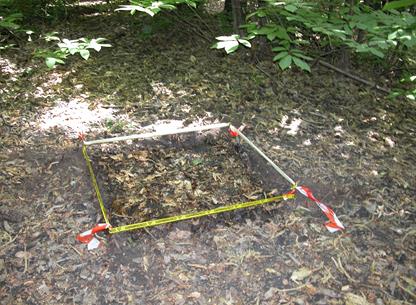
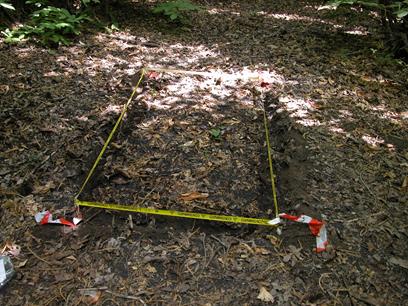
Steinernema feltiae strain ESA, 1 parcel of 1 m2 (Figure 2): non-quantitative verification and by layers; S. kraussei strain EPL, 2 parcels of 1 m2 (Figure 2): non-quantitative assessment; Heterorhabditis megidis strain PR4, 1 parcel of 2 m2 (Figure 3): non-quantitative and quantitative assessment (sampling 1 and 2). H. bacteriophora strain CTSA10, parcel of 1 m2 (Figure 2): non-quantitative and quantitative assessment (sampling 1).
Results
Non-quantitative assessment (Table 1) S. feltiae: found until 10/21/2016. Persistence time ascertained 98 days. S. kraussei: placed in two areas of 1 square meter each; one of the areas had been cleaned from the litter. In the uncleaned area the nematodes were never found. 10/21/2016 was the last date of finding nematodes in the area without litter. Persistence time: 88 days H. megidis: found until 10/21/2016 with an established persistence time of 88 days. H. bacteriophora: found until 08/10/2016. Established persistence 75 days.
| Sampling date | Temperatures and soil conditions | EPN Species | |||||||
|---|---|---|---|---|---|---|---|---|---|
| S. feltiae ESA | S. kraussei EPL | S. kraussei EPL | H. megidis | H. bacteriophora | |||||
| Area without | Area with chestnut | ||||||||
| chestnut litter | litter | ||||||||
| 31/07/2016 | Ext. Temp.: 27 °C Soil Temp.: 24 °C Very dry soil | Present | present | absent | present | present | |||
| 06/08/2016 | Ext. Temp.: 24 °C Soil Temp.: 21 °C Slightly damp soil surface | Present | present | absent | absent | present | |||
| 03/09/2016 | Ext. Temp.: 30 °C Soil Temp.: 25 °C Dry soil | Present | present | absent | present | present | |||
| 10/09/2016 | Ext. Temp.: 24 °C Soil Temp.: 22 °C Slightly damp soil surface | Present | present | absent | present | present | |||
| 19/09/2016 | Ext. Temp.: 17 °C Soil Temp.: 15 °C Slightly damp soil surface | Present | present | absent | absent | present | |||
| 08/10/2016 | Ext. Temp.: 17 °C Soil Temp.: 15 °C Damp soil | Present | absent | absent | present | present | |||
| 21/10/2016 | Ext. Temp.: 20 °C Soil Temp.: 16 °C Damp soil | Present | present | absent | present | absent | |||
| 31/10/2016 | Ext. Temp.: 19 °C Soil Temp.: 16 °C Damp soil | Present | absent | absent | absent | absent | |||
| 10/11/2016 | Ext. Temp.: 22 °C Soil Temp.: 18 °C Damp soil | Absent | absent | absent | absent | absent | |||
| 27/11/2016 | Ext. Temp.: 20 °C Soil Temp.: 16 °C Damp soil | Absent | absent | absent | absent | absent |
Table 1: Presence/absence of species introduced at various sampling dates and environmental conditions Quantitative assessment (T
| EPN | Num. of infected larvae | N. EPN/m2 | ||||||
|---|---|---|---|---|---|---|---|---|
| H. megidis Sampling 1 | 5 | 120 | ||||||
| H. megidis Sampling 2 | 6 | 137 | ||||||
| H. bacteriphora Sampling 1 | 0 | 0 |
Table 2: Number of EPN per m2 calculated using the Koppenhõfer, et al. technique. Assessment by layers (Table 3)
| DATE | Num. of infected larvae (0-7 cm) | Num. of infected larvae (7-15 cm) | ||||||
|---|---|---|---|---|---|---|---|---|
| 31/07/2016 | 16 i.l. / 20 (80%) | 15 i.l. / 20 (75%) | ||||||
| 06/08/2016 | 13 i.l. / 20 (65%) | 0 i.l. / 20 (0%) | ||||||
| 03/09/2016 | 15 i.l. / 20 (75%) | 13 i.l. / 20 (65%) |
Table 3: Percentage of G. mellonella larvae infected in the two soil layers. (i.l.= infected larvae).
Discussion and Conclusion
The persistence times of the species placed did not deviate too much from one another. S. feltiae showed to be the most resistant species, 14 weeks, while H. bacteriophora was not found again after about 12 weeks.
The absence of nematodes in some samples does not necessarily indicate the disappearance of the species but can be linked to the aggregate and non-uniform distribution of nematodes in soil. Only the absence in numerous samples can be indicative. The failure to find S. kraussei from the first check sampling probably shows that the presence of the litter hinders the penetration of nematodes into the soil and therefore it is advisable to clean the area to be treated before entering them.
There seems to be no correlation with atmospheric conditions: the only date, in which there was a noticeable drop in temperature, on September 19, we found nematodes almost everywhere. The quantitative assessment showed that the degree of persistence is very low even after 5 ½ weeks. Apparently, the sampling technique does not determine significant changes in the outcome of the number of nematodes.
The study of the distribution by layers showed that the nematodes tend to penetrate deeply into the soil, especially if the ground surface is dry, arranging themselves uniformly in both the analysed layers. This enables these animals to escape drying and increases their likelihood of encountering host larvae.
Taking into account, as previously mentioned, that the nematodes are strongly reduced in number immediately after having been introduced into the ground, that their persistence is often limited in time and that the possible stabilization of the population is linked to the presence of potential host larvae. It appears very important to evaluate case by case which is the right moment to enter the biological control agent nematodes in the soil to be treated to obtain a successful result.
References
-
Gaugler R, Bednarek A, Campbell JF (1992a) Ultraviolet inactivation of heterorhabditid and steinernematid nematodes. Journal Invertebrate Pathol 59(2): 155-160.
-
Smits PH (1996) Post-application persistence of entomopathogenic nematodes. Biocontrol Sci Technol 6(3): 379-388.
-
Baur ME, Kaya HK (2001) Persistence of entomopathogenic nematodes. In: Baur ME and Fuxa JR, (Eds.), Factors affecting the survival of entomopathogens. Southern Cooperative Series Bulletin 400.
-
Khan Y, Javed N (2018) Entomopathogenic Nematodes Survey, Persistence in Soil, Reproductive Potential and their Effects on Meloidogyne incognita. Egyptian J Agronematol 17(2): 109-120.
-
Forschleri BT, Gardner WA (1991) Field efficacy and persistence of entomogenous nematodes in the management of white grubs (Coleoptera: Scarabaeidae) in turf and pasture. J Economic Entomol 84(5): 1454-1459.
-
Geden CJ, Arends JJ, Axtell RC (1987) Field Trials of Steinernema feltiae (Nematoda: Steinernematidae) for Control of Alphitobius diaperinus (Coleoptera: Tenebrionidae) in Commercial Broiler and Turkey Houses. J Economic Entomol 80(1): 136-141.
-
Warshaw AR (1992) Control of the western spotted cucumber beetle using a predaceous nematode. J Nat Resour Life Sci Educ 21: 101-103.
-
Buhler WG, Gibb TJ (1994) Persistence of Steinernema carpocapsae and S. glaseri (Rhabditida: Steinernematidae) as Measured by Their Control of Black Cutworm (Lepidoptera: Noctuidae) Larvae in Bentgras. J Economic Entomol 87(3): 638-642.
-
Gaugler R, Campbell JF, Selvan S, Lewis EE (1992b) Large-scale inoculative releases of the entomopathogenic nematode Steinernema glaseri: assessment 50 years later. Biological Control 2(3): 181-187.
-
Tarasco E, Clausi M, Rappazzo G, Panzavolta T, Curto G, et al. (2014) Biodiversity of entomopathogenic nematodes in Italy. J Helminthol 89(3): 359-366.
-
Bedding RA, Akhurst RJ (1975) A simple technique for the detection of insect paristicrhabditid nematodes in soil. Nematologica 21(1): 109-110.
-
Koppenhöfer AM, Campbell JF, Kaya HK, Gaugler R (1998) Estimation of entomopathogenic nematode population density in soil by correlation between bait insect mortality and nematode penetration. Fundamental Applied Nematol 21(1): 95-102.
- Lessons to Learn: Trees are More than the Lungs of the World
- Community Forestry Enterprises as a Model for Sustainable Forest Development: The Case Of The "Baja Tarahumara" in Chihuahua, Mexico
- Ecological and Socio-Economic Impacts of Chromolaena odorata and Mesosphaerum suaveolens, Two Invasive Alien Species in Central and Southern Benin, West Africa
- Epigenetic Sustainability: Modeling the Human Factor as a Natural Resource through Science 4.0 and the NR3C1 Biological Pilot
- Growth-at-Risk: A Framework for Assessing Economic Vulnerability
- The Rural Territory as a Socioecological System for the Management of Public Policy for Sustainable Rural Development