
Factors Influencing Coping Strategies for Drought-Affected Households in Northern Cameroon
The recent escalation of natural disasters globally has stimulated a burgeoning of theoretical and empirical scholarship on the subject. While the disaster management discourses in high income countries largely focus on resilience and adaptation, developing countries are still grappling with vulnerability and coping issues. This trend has been frequently attributed to the failure of formal (state and market) disaster management institutions in many developing countries. Formality failure provides justification for including informality in the disaster narrative in developing countries. This contribution explores determinants for adopting formal or informal risk management strategies with regard to droughts in Cameroon, using a random sample of 1208 drought-affected Cameroonian households. Data is based on a structured questionnaire developed following the World Bank’s Social Risk Management Framework. Quantitative data are supplemented by 64 in-depth interviews and 17 focus group discussions. A larger proportion of the sample depended on informal than formal strategies to cope with drought effects (78 percent and 22 percent respectively). Binary logistic regression analysis revealed that the age of the household head and perceived severity positively and significantly influenced these decisions (p = 0.001). Due to distrust of state management as a result of previous corruption experience, victims only appropriated state support when survival was a priority or informality was insufficient for coping. We conclude with the need to progressively include informality into the coping package, at least for the studied drought-affected Cameroonian households.
Introduction1
The global escalation of extreme events such as droughts is causing tremendous negative human, socio-economic, environmental and psychosocial effects. Boamah, et al. [1] for instance estimate that at least 2.8 billion people were affected by natural hazards between 1980 and 2009; with around 2.4 million rendered homeless. Currently, over half a
1 An earlier version of this paper (Nji et al. 2020) is part of conference proceedings of the Disaster Research Days 2020.
billion people globally are estimated to be affected by natural disasters per annum, a figure that is predicted to jump to about two billion annually by 2050 [2, 3]. Natural disasters continue to exert heavier impacts especially in developing countries, given the wide-spread failure of formal (state and market) institutions for disaster management, which increases vulnerability [4, 5, 6, 2]. Therefore, while the disaster management discourse in the high income countries drifts more towards resilience and adaptation with an indisputable and more engaging role of formal institutions, scholars in developing countries are still largely grappling with issues of vulnerability and coping [7, 4]. Formality failure justifies inclusion of informality in the disaster narrative in developing countries; allowing scholars to explore the extent to which their inclusion can influence mitigating, coping and adaptive capacities of people highly exposed to extreme events, such as droughts. This hypothesis has been supported by the contention that informality (e.g. solidarity and reciprocal exchanges) are sufficiently abundant in many developing countries [8]. If this is the case, which endogenous factors additionally influence the coping decisions of natural hazard victims in developing countries? We contribute to this knowledge gap, by understanding the determinants for household decision to adopt formal or informal risk management strategies to droughts in Cameroon, given the rapid upsurge of droughts recorded in Cameroon in the last three decades [9, 10, 11, 12].
Conceptual Framework
This paper draws on the World Bank’s Social Risk Management (SRM) Framework [8]. SRM highlights the existence of multiple finance and insurance markets (formal/ informal, public/private sector/NGOs) provided at the Micro (individual/household) level, Meso (community/local) level, and Macro (national/international) level to help improve household (HH) risk management capacity [13]. SRM also recognizes the lack of availability and access by many poor and near-poor HHs to such finance/insurance markets and the need for proactive financial inclusion; including micro- finance and micro-insurance - principally for informal- sector households. By taking a forward-looking approach to disasters management, SRM implies that individuals/HHs can make decisions and take actions in the present that can lower their probability to be more vulnerable in the future [14].
Thus, SRM assumes that individuals/HHs and society can (to some extent) anticipate hazard/risky events and take proactive actions to prevent them from happening and/ or lessen the negative impacts if they are realized [14, 15, 16]. This key behavioural assumption about risk management is not always valid; because HHs who are vulnerable to disasters tend to have differential world views reinforced by religious, cultural and social norms that are shaped by their contextual realities and fashioned to adjust to some prevailing environmental changes such as those introduced by disasters like drought. Though these strategies may prove to be weak depending on the nature of the disaster(s) they are confronted with. SRM acknowledges that there are many cognitive failures by HHs to accurately assess the hazards/ risks and make the rational decisions and choices on how to manage their asset portfolios and lessen (potential) negative impacts on HH well-being.
Based on this framework, informal disaster management strategies (e.g. solidarity) capable of accommodating idiosyncratic shocks (e.g. death of a household member) will disintegrate in the face of covariate shocks (e.g. drought), leading to full blown disasters. By implication, disasters can only be avoided by appropriating formal strategies (e.g. state-driven disaster relief and insurance). We explore this interesting contention in Cameroon, where informal management strategies are abundant; and formal (state and market) ones are highly deficient. The absence of trust in formal institutions resulting from continuous failures by these institutions in meeting the needs of the disaster victims resulted in the building of safety-valves to serve as community fall-back positions among local households.
Methodological Issues
Study Design
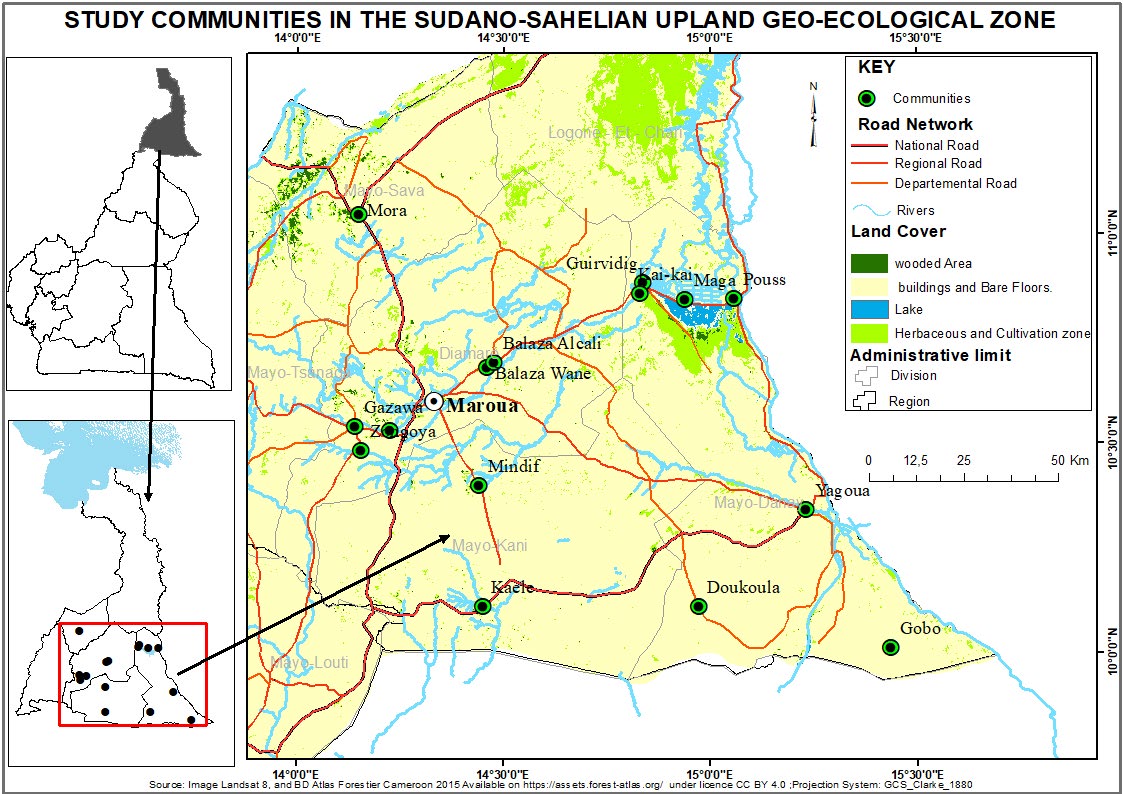
We employ a household-based cross-sectional survey design to collect data from a random sample of 1208 drought-affected households from 17 communities in the Sudano-Sahelian upland agro-ecological zone (North and Far North Regions) of Cameroon. All selected communities have witnessed at least one drought in the last five years prior to the data collection, which took place between August and December 2017. We used a structured questionnaire inspired by the Social Risk Management Framework [8]; in combination with (64) In-depth Interviews (IDIs) and (17) Focus Group Discussions (FGDs) to collect primary data.
Study Area
The Sudano-Sahelian geo-ecological zone of Cameroon, also known as the territory occupied by North and Far North Regions extending between latitudes 700 30’ and 130 N and longitudes 90 to 150 is characterized by a large diversity in terms of biophysical (climate, landscape, hydrology) and socio-economic (land, labour, resources, marketing and tenure practices). More than 60 household ethnic groups can be distinguished in the zone. It distinguishes itself from the rest of the country by its geographical position and its socio-cultural situation, to the extent of being considered almost a separate entity from the rest of the country. It is dominated by Guinean Plateaux and Forest Savannah. The stretching of this enclave into Nigeria and Chad partially situates Cameroon in the Semi-arid part of Africa, thus confronting her with the problems inherent with this type of environment, such as the fragility of the environment and resources and the permanent mobility of the populations. In this area data collection was focused around the areas with a history of drought and included the following Divisions: Diamare, Mayo Danay, Mayo Sava and Mayo Kani.
Due to its peripheral position and communication challenges, this geo-ecological zone has always witnessed a comparatively very slow development but has been a focal point for several climate related and population based projects developed by government, local and International Non-governmental Organisations and humanitarian funding bodies. This has also been the case with the average income level per inhabitant in the northern regions as it is only valued at about 50% when compared with that of the inhabitants of the Centre, South and West Regions. This zone is embedded with a unique cultural heritage and a viable economic system sourcing its origin from the pre-colonial epoch.
Data Management and Analysis
Data processing included designing a template using EPI Info version 7 for quantitative data entry. After the phase of data entry, the data were exported to MS Excel, cleaned and later exported to SPSS version 20 (IBM SPSS Statistics 22; Armonk, NY) for statistical analysis.
Qualitative data were collected in both English and French. The data in French were later on translated to English and together with the ones in English transcribed and saved in Microsoft Word 2013 documents. The transcribed data were then exported into NVivo 11 Pro (QSR international, 2015) and coded following the Thematic Framework Approach. This analysis technique involves a process of familiarisation with the data, developing a coding framework, coding the transcripts to the codes, charting and synthesising the data into themes and sub-themes. This approach permitted us to develop a rigorous and transparent process in documenting the analysis process [5]. An initial thematic framework was constructed based on key ideas and recurrent themes from all interviews by grouping the contexts as codes and sub- codes. The data were coded into corresponding NVivo Nodes that were later exported to MS Excel 2013 for further analysis by variables such as age, sex, level of education, religious affiliation, household size, income level and social network ties. The results were summarised and synthesized in MS Excel. The synthesized data were then analysed identifying trends, patterns and relationships between key themes and presented as verbatim in-text.
A binary logistic regression was performed with the quantitative data to identify household determinants for preferring either formal or informal drought management strategies to reduce livelihood risks:
Adopted disaster (drought) management strategy:
$$ D ^ {*} \left\{ \begin{array}{l} 1 = f o r m a l s t r a t e g y \\ 0 = i n f o r m a l s t r a t e g y \end{array} \right\} = f \left(\alpha + \beta X _ {i}, \varepsilon\right) $$ (1) Whereby economic and non-economic predictors and error term. (Disaster management strategy adopted) is the dependent variable, taking on 1 when the household preferably adopts a formal strategy (e.g., state-driven disaster relief) and 0 for adopting an informal strategy (e.g., community based solidarity).
Fourteen explanatory variables were used. These variables include: age of respondent, household size, number of disasters faced, number of years living in the community, income before disaster, income after disaster, level of education, gender, religious affiliation, main occupation, membership in groups and networks, marital status, disaster effect (direct or indirect) and household ownership. The number of observations per predictor in the model clearly exceeds the recommended minimum of 10 [13].
Results and Discussion
Socio-Economic and Demographic Profile of Study Participants
The general trend for all the socio-economic and demographic parameters identified as useful for this study based on their application and impact on drought coping strategies employed by different households in the study area have been analysed and presented in the Table below.
A total of 1208 respondents (household heads) were enrolled in the study. Most of the study participants were within the age range of 20 – 39 (44.2%). The mean age of the respondents was 44.6 years with a standard deviation of 3.5. The age distribution followed a pyramidal shape majority being male (67.6%). Majority of households had between 6 – 10 (58.8%) inhabitants. The mean household size was 7.5 with a standard deviation of 1.3. 59.6% of the respondents owned a house. Majority (72.4%) of the respondents had completed primary school.
Majority (82.6%) of the respondents were either married or cohabiting. Sixty-two percent (62.3%) of the respondents were farmers, 30.8% were traders and 7% were employed (private or state employed). The respondents were largely Muslims (82.7%). Majority (66.9%) of the respondents had lived for more than 20 years within the Sudano-Sahelian Zone. The mean monthly income of the respondents was 20,754 FCFA (~41.508USD) with a standard deviation of 13,457 FCFA. The most common (85.5%) mode of saving was through “Njangi” and “tontine”. Majority (97.9%) of the respondents were affiliated to a social network.
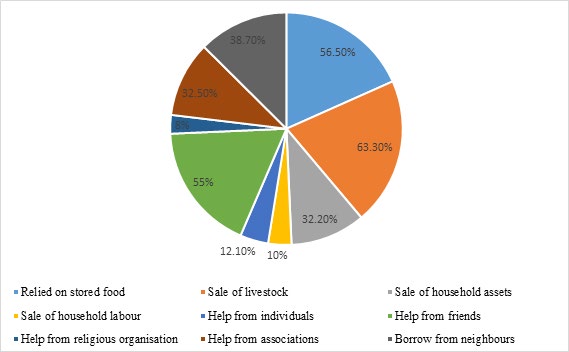
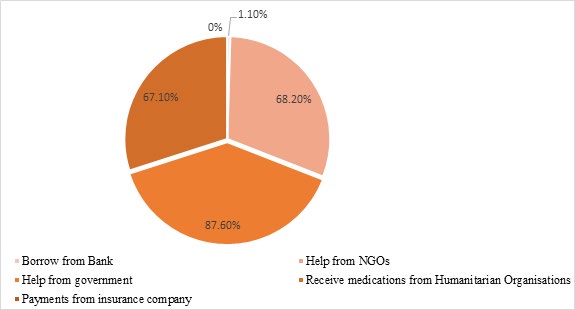
Almost 80 percent of all respondents reportedly relied on endogenous strategies such as drawing on food stocks and selling of livestock; as well as community based strategies, moral economic practices such as unconditional help from individuals, friends and community based organizations (Figure 1). In total, nine of such informal strategies were reported (Figure 1) compared to only three formal ones (Figure 2); supporting the hypothesis of dominant informal strategies in developing countries, opined by Holzmann & Jorgensen [8].
Some key results of the regression analyses are presented in Table 1. The regression outputs for the goodness-of-fit are within the standard range (X2 = 33.501, p = 0.004; -2 Log likelihood = 100.727); indicating the model’s ability to predict the determinants for adopting the choice form of disaster management strategy. The Nagelkerke R-square is 0.270 and the Cox & Snell R-square is 0,052 [13].
We observe that age of the household head, household size, owning a house, monthly income, social networking and perceived drought severity significantly influenced household choices for drought management strategies. However, with the exception of perceived severity, the regression coefficients for all the variables were negative, suggesting their inverse relationship with the household decision to adopt formal (state and market) drought management strategies. The FGDs revealed high levels of distrust in past state drought management schemes. This might explain why 78% of the sample relied primarily on informal response strategies, with only 22% of the respondents adopting the very limited formal management options. Focus group discussions (FGDs) and in-depth interviews (IDIs) revealed that high corruption and misappropriation which has characterized state donations meant for disaster victims in the past in Northern Cameroon (especially during the 2012 Maga floods) accounts for the high distrust in relying on Government disaster management initiatives.
The negative coefficient for social network was also explained from a religious perspective, through key informant interviews. In fact, the northern regions are predominantly inhabited by Moslems [9]. FGDs and IDIs revealed that it is considered a ‘noble gesture’ to donate to the poor in need (solidarity), without expecting anything in return (reciprocity).
| Variable | Coefficient | Std. Error | p-value |
|---|---|---|---|
| Age | 0.002 | 0.001 | 0.001** |
| Gender | -0.030 | 0.020 | 0.136 |
| Occupation | -0.029 | 0.015 | 0.063 |
| Education | -0.029 | 0.015 | 0.063 |
| Household size | -0.010 | 0.003 | 0.002** |
| House ownership | -0.060 | 0.023 | 0.010** |
| Monthly income | -0.001 | 0.001 | 0.004** |
| Social network | -0.114 | 0.006 | 0.036** |
| Perceived severity | 0.288 | 0.035 | 0.001** |
| Access to loan | 0.029 | 0.043 | 0.491 |
| Constant | 0.750 | 0.102 | 0.001 |
Notes: means significant at 5% Table1:** Determinants for adopting informal drought management strategies by households in northern Cameroon.
Contrary to theory therefore, informality expressed for instance through community based solidarity and consolidated through long term relation is continuously appropriated for drought management in Cameroon. However, when available, and at high levels of severity, households would ‘grap’ any additional resources emanating from the state or any formal institutions to cope with drought effects. Longstanding state, humanitarian and other international non-governmental organizations’ (NGOs) interventions in earlier drought and floods disasters in the Sudano-Sahelian part of the country has been recently reported [10]. This was confirmed during FGDs and IDIs, with respondents consistently noting that some local households still rely on government and other stakeholders to cope with drought hazards, and even undertake future (reductive) measures, such as tree planting in their communities. Many household members also received low-fuelwood consumption cooking stoves distributed by the relevant state authorities in charge of disaster management in Cameroon.
Conclusion
Natural hazards are important but unfortunate realities disrupting livelihoods across the globe. Their effects are higher in developing countries, where state and market institutions for disaster management are generally only timidly present. It is a reality that informal instruments are identified as abundant but insufficient to support disaster management in many developing countries [8]. Therefore, it seems promising to examine which factors influence victims’ decisions to adopt specific informal risk management strategies to cope with natural disasters. Our study suggests that six variables (i.e., household size, monthly income, house ownership, social network, age and perceived disaster severity) significantly affect households’ decision to adopt informal risk management strategies in the face of droughts. However, age and perceived disaster severity affect the adoption of informal, community based strategies positively. FGDs and IDIs further revealed that corrupt practices marred victims’ interest in state supportive efforts; supporting the contention of e.g. Boamah, et al. [1] that previous experience can influence disaster coping decisions. However, at high levels of (perceived) severity, victims additionally appropriate any formal (state-based and other) coping strategies made available to them in the form of immediate disaster relief and future (reductive) measures such as tree planting. Contrary to the World Bank’s SRM framework therefore, informality seems to play an important role in managing drought risks, at least as demonstrated by our Cameroonian study; with victims only turning to formal options when (1) survival becomes top priority; and (2) when informality is insufficient. It therefore seems plausible to advocate for a better consideration of informal strategies in managing drought events. In this light, combining both formal and informal strategies can enhance drought management, rather than relying only on formal strategies. Combining both is likely to provide optimum benefits to victims.
References
-
Boamah SA, Frederick AA, Vincent ZK, Iduwo A, Luginaah I, et al. (2015) Does Previous Experience of Floods Stimulate the Adoption and Coping Strategies? Evidence from Cross Sectional Surveys in Nigeria and Tanzania. Environments 2(4): 565-585.
-
Eludoyin AO, Eludoyin OM, Eslamian S (2017) Drought Mitigation Practices, In: Eslamian S and Eslamian FA (Eds.), _Handbook of Drought and Water Scarcity_. Boca Raton: CRC Press, pp: 798.
-
Few R (2013) Flood hazards and health: Responding to present and future Risks. London: Routledge, pp: 232.
-
Fondo S, Balgah RA, Nji TM (2018) Making decisions after floods: a consistency check of drivers across multiple flood types. MOJ Ecology and Environmental Sciences 3(6): 393-401.
-
Gale NK, Heath G, Cameron E, Rashid S, Redwood S (2013) Using the framework method for the analysis of qualitative data in multi-disciplinary health research. BMC Med Res Methodol 13: 117.
-
Helgeson JF, Dietz S, Hochrainer Stigler S (2013) Vulnerability to Weather Disasters: The Choice of Coping Strategies in Rural Uganda. Ecology and Society 18(2): 2.
-
Hisali E, Birungi P, Buyinza F (2011) Adaptation to climate change in Uganda: Evidence from micro level data. Global Environmental Change 21(4): 1245-1261.
-
Holzmann R, Jorgensen S (2000) Social Risk Management: A new conceptual framework for social Protection and beyond. Social Protection Discussion Papers No.0006, Washington DC: The World Bank.
-
Molua E (2012) Gendered Response and Risk-Coping Capacity to Climate Variability for Sustained Food Security in Northern Cameroon. International Journal of Climate Change Strategies and Management 4(3): 277- 307.
-
Nji TM, Balgah RA (2019) Determinants of Coping Strategies to Floods and Drought in Multiple Geo- Ecological Zones. In: Tiefenbacher JP (Ed.) Natural Hazards - Risk, Exposure, Response, and Resilience. Intech Open.
-
Scheffran J, Marmer E, Sow P (2012) Migration as a Contribution to Resilience and Innovation in Climate adaptation: Social Networks and Development in Northwest Africa. Applied Geography 33: 119-127.
-
Shiferaw B, Kindie T, Menale K, Tsedeke A, Prasanna BM, et al. (2014) Managing Vulnerability to Drought and Enhancing Livelihood Resilience in Sub-Saharan Africa: Technological, Institutional and Policy Options. Weather and Climate Extremes 3: 67-79.
-
Vittinghoff E, McCulloch CE (2007) Relaxing the rule of ten events per variable in logistic and Cox regression. American Journal of Epidemiology 165(6): 710-718.
-
Heitzmann K, Canagarajah RA, Siegel PB (2002) Guidelines for Assessing Risk and Vulnerability. SP Discussion Paper 0218. Social Protection Unit, Human Development Network, The World Bank: Washington, D.C.
-
Steen Lau Jorgensen, Paul B. Siegel (2019) Social Protection and Jobs. Social Protection in an Era of Increasing Uncertainty and Disruption: Social Risk Management 2.0. The World Bank Group. Washington DC.
-
Abera N, Asfaw M (2019) Impact of Microfinance on Rural Household Poverty in Ethiopia. Journal of Ecology and Natural Resources 3(5): 16000177.
-
Nji TM, Balgah AR, Buchenrieder G, Vubo EY (2020) Determinants for drought management strategies among Cameroonian households. “Disaster Research Days” of the Disaster Competence Network Austria (DCNA), Webinar Series, October, 13-15 & 20-21. Vienna, Austrica: DCNA (available at:https://www.dcna.at/ index.php/de/disaster-research-days.html).
- Lessons to Learn: Trees are More than the Lungs of the World
- Community Forestry Enterprises as a Model for Sustainable Forest Development: The Case Of The "Baja Tarahumara" in Chihuahua, Mexico
- Ecological and Socio-Economic Impacts of Chromolaena odorata and Mesosphaerum suaveolens, Two Invasive Alien Species in Central and Southern Benin, West Africa
- Epigenetic Sustainability: Modeling the Human Factor as a Natural Resource through Science 4.0 and the NR3C1 Biological Pilot
- Growth-at-Risk: A Framework for Assessing Economic Vulnerability
- The Rural Territory as a Socioecological System for the Management of Public Policy for Sustainable Rural Development