
Effects of Carbon Monoxide on Drivers of the Urban Transport Service in the City of Ayacucho
Among This research work was carried out with the following objectives: to determine the effect of carbon monoxide on public and private service drivers, using clinical laboratory techniques. Detect the age and models of the vehicles used by the public and private transport drivers of the city of Ayacucho and identify the semiology and clinical pathology of CO poisoned drivers. Of a total of 90 volunteer drivers (100%), 45 work in the public sector and 45 in the private sector. Of these, 86.6% were negative and 13.33% positive. Regarding the degree of intoxication in positive cases: 7.7% had moderate effects and 5.5% had severe effects. Regarding the methodology, the coximeter was used to measure the CO of the expired air, finding the percentage of carboxy hemoglobin. Regarding the predominant age group, ages between 18 to 34 cases were considered in 37.8% and less frequently for ages 36 to 41 years with 15.6%. The city of Ayacucho does not have large industries, it is slowly suffering from the contamination of its surroundings due to the accelerated increase in the gasoline and oil motor vehicle park, plus the burning of bricks, farmland, garbage and firewood for food processing, a public health problem.
Introduction
The city population is frequently exposed to a series of poisonings directly and indirectly. The population of the city of Ayacucho grew due to the social and political situation that occurred during fourteen years that has caused a continuous migration from the rural areas of various provinces and districts far from the region. What generated the increase in its inhabitants, began to form young towns or human settlements on the outskirts of the city, including invading the foothills of the hills, where they lack basic services such as: drinking water, sewerage, hygiene, schools, medical posts, etc [1, 2].
In the last decade of the last century, there were only a hundred vehicles that moved normally in the streets of this colonial city, still without traffic lights. In these first decades of this century, the vehicle fleet has increased, generating vehicle chaos, the delay in its displacement, the increase in environmental pollution, vehicles with different makes and models, new and old, gasoline and oil tankers which generate complete and incomplete combustion, whose toxic gases affect our environment [3, 4, 5].
If there is any civic, military, political or social act in the parade ground, the chaos is worse forcing motorists and transporters to concentrate on the surrounding streets and create enormous traffic, they even do not respect traffic signals.
For this reason, our research is part of the pilot study of the effect of carbon monoxide on voluntary drivers and transporters. In this way, the degree of intoxication and contamination will be known from the clinical point of view, even more so if the characteristic signs and symptoms appear [6, 7, 8].
The conclusions of the case will allow us to inform us and to diagnose, prevent and treat pollution problems in drivers and users, in the same way we can suggest the innovation of public and private transport vehicles [9, 10].
In this research work our objectives were as follows: To know the degree of intoxication presented by the drivers of the public and private transport service of the city of Ayacucho.
To determine the effect of carbon monoxide on the conductors of the public and private services, using clinical laboratory techniques. Detect the age and models of vehicles used by public and private transport drivers in the city of Ayacucho.
Identify the semiology and clinical pathology of drivers intoxicated with CO [11, 12, 13].
Material and Methods
This research work was carried out in the environments of the UNSCH Physiology and Natural Sciences laboratory in the city of Ayacucho.
Methodology
The used methodology is of the cooximetry to determine the carbon monoxide (CO) present in the expired air in ppm and% of carboxyhemoglobin (% COHb) that works by means of an electrochemical cell.
The patient must take a deep inspiration and maintain apnea for 9 seconds, then a slow, prolonged and complete exhalation was performed.
Wait a few seconds until the cooximeter indicator stabilizes and dials the exact number of ppm of CO for the patient. Then we proceed to obtain (% COHb = COHb / ctHb x 100) % COHb rating: Lightweight: 0 to 1.6 Moderate: 1.7 to 4.8 Severe: over 4.8 Under normal conditions, this fraction is usually less than 1% but increases more in net smokers. The assessment of the carbon monoxide level in ppm: No intoxication: 0 to 5 ppm Slight intoxication: 6 to 10 ppm Moderate intoxication: 11 to 30 ppm Severe poisoning: more than 30 ppm Test used for the evaluation of the% of COHb Cooximeter to measure expired air.
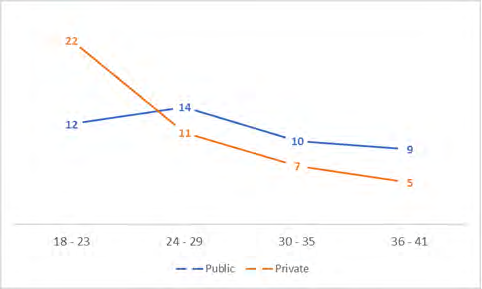
Regarding the results obtained in the present research work on the effect of carbon monoxide on urban Service drivers in relation to the type of transport they perform, it is shown so specifically in Figure 1. That of a total of 90 samples of drivers equivalent to 100%, 45 drivers belong to the public transport service and 45 to the private transport service, it turned out that the largest number of drivers belong to the age group of 18 to 23 years for the private service 24.4% and drivers of the Public service are in the age group of 24 to 29 years with 15.5% while the older drivers are between 36 to 41 years with 10% for public service and 5.6% for private service, that is, they are both passengers and cargo.
The responsibility to control the drivers of both services rests with the district and provincial municipalities who grant the route and the corresponding terminals, and those responsible for the Ministry of Transport and Communications (MTC) who grant the driving licenses.
This also indicates that the drivers are mostly young employees and unemployed who dedicate themselves to this work due to the need to bring a few pennies to their family and to a lesser extent are the adult drivers who are sometimes fired, underemployed and without another profession.
Nolla (17) carbon monoxide is a colorless, odorless gas that is formed by the incomplete combustion of substances that have carbon in their molecular structure. It is found in street lights with fuel and oils and it is dangerous in a locked room to smoke 55 and smoke from car exhaust reaches 7% and mine engines 60% Simone (20) specifies that azides, cyanides and carbon monoxide go to venous and arterial blood, inhibiting oxidative phosphorylation, affecting the last step of cytochromes in the respiratory chain, at the level of the cytochrome complex “a” towards cytochrome “a3” this inhibition of electron transport will cause cyanosis, paresthesia, anoxemia and total suffocation, the process known as sweet sleep.
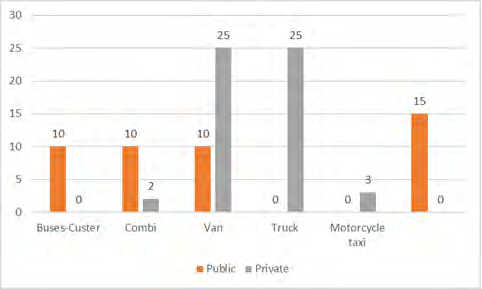
The results of the effect of carbon monoxide on urban service drivers based on the type of vehicle they drive are shown in Figure 2. 38.8% are cars and Costa Ricans that perform the passenger taxi service and 16.66% are light trucks. Official service of some institutions and others work as a cargo taxi, and 11.11% were buses known as buses or custers. The combis with 13.33% and to a lesser extent the trucks that transport construction materials with 3.33%
In the urban area, a large number of vehicles of different models and brands are observed more frequently. I think that every professional buys cars to go to work, others serve to make a taxi and some for urban and rural transport services, there are also many associations of motorcycle taxis and linear motorcycles making a taxi, we note that the expensive ones are second-hand.
In relation to the effect of carbon monoxide on urban service drivers according to the age of the vehicle unit, it is observed in figure 3, it has been found that there are a number of cars from different times, for example, 01 car of the 1970s Chevrolet brand, from 1980 there are 07 vehicles of brands Scania, Ford, Volswagen and Mustang. From the 1990s with 24 cars of Toyota, Honda, Mercedes, Cherokee brands and from the 2000s you have 48 cars of Kia, Lexus, BMW, Skoda, Jaguar brands among others. Many of them second-hand with kilometers of travel between 20,000 to 240,000 km, we have not taken into account the specific categories only the general ones such as L, M and N, because the drivers did not give references of their units.
Mezeldizic (15) in his book entitled “Environmental Pollution in Latin America” refers that poisonings by these gases were frequently noted in industrialized countries, but currently we who belong to underdeveloped or developing countries also observe it relatively frequently due to use of these second-hand and extremely worn engines.
In relation to the origin of the drivers of the urban service, it is observed in figure 4. Regarding the urban origin, the drivers of the public service are 16.6% and that of the private service 27.7%. Regarding the urban marginal origin, 27.7% of the public service 22.3% and the private 19.9% and in a lower percentage of rural or migrant origin with 11.1% of the public service and 2.2 of the private.
For a long time the city of Ayacucho has undergone radical changes in terms of population growth due to the socio- political situation that occurred in this part of our country, the continuous migration and the forced concentration of individuals creates the formation of new human settlements around the city, where The necessary resources are lacking and there are many living in overcrowding; in fact, these places are forgotten by the authorities. They also require using these services to go to the markets, to be procedures in city offices, their workplace, sale of ambulatory products, young people who study in various study centers, those who work in workshops or mechanics, where they are also contaminated with fuels, grease, dust, oxides and other products.
GUERCI (6) deduces that CO does not irritate the mucous membranes of the respiratory tract as does the CO2 through which it is breathed without causing apparent discomfort. In addition, they have an affinity for hemoglobin from red blood cells. Sometimes it generates the lack of oxygen in the different tissues of the body such as anoxemia, paresthesia and drowsiness.
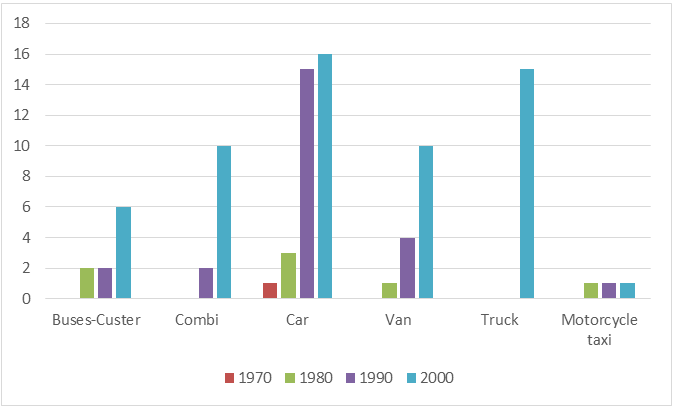
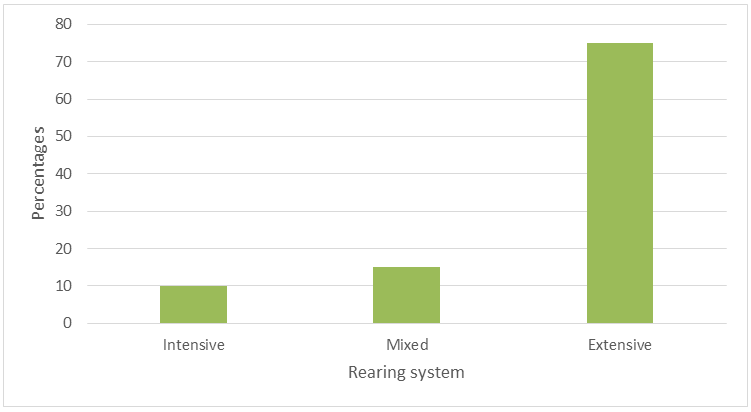
Table 1 shows the incidence of anaplasmosis and piroplasmosis in cattle according to sex. The classification by age groups of cattle with piroplasmosis and anaplasmosis is shown. Regarding the evaluation of piroplasmosis, cattle have been classified into three groups, in the first group are cattle between 0 to 12 months of age, we found 2 males and 1 female which constitutes the group with the lowest incidence, in the second group etareo are located between 12 to 24 months of age where 3 males and 6 females are noted, with moderate incidence and the third etareo group are those older than 24 months, where we note 5 males and 11 females, these animals are also infected with the diseases under study.
In populations where parasite transmission is continuous, the observed incidence of infection is the result of a balance between the rate of acquisition of the infection and the rate of recovery.
In 2003, Diaz found no significant differences in relation to the presence of marginal Anaplasma and the sex or age of the animals. All farms included in the investigation showed prevalences of Anaplasma marginale, equal to or greater than 75%, indicating that the studied area presents a stable condition for this blood parasite.
Its distribution coincides with the main vector, which is the tick that transmits Piroplasmosis to a height of 3,500 meters above sea level. In the case of Anaplsmosis, where the factors where many factors play an important role in transmission, today the distribution in cold areas, many animals are introduced to improve genetics or better milk production.
| Etareo group | Piroplasmosis | Anaplasmosis | TOTAL | ||
|---|---|---|---|---|---|
| (month) | Male | Female | Male | Female | |
| I | 2 | 1 | 1 | 1 | 5 |
| II | 3 | 6 | 1 | 4 | 14 |
| III | 5 | 11 | 3 | 12 | 31 |
| SUBTOTAL | 10 | 18 | 5 | 17 | 50 |
Table 1: Classification by age group and sex of cattle with piroplasmosis and anaplasmosis.
Conclusion
Livestock farmers buy cows in different fairs in the region, as well as in stables on the coast where they move to benefit them in litters or fattening stables, these animals come from the coast and jungle of the country where there are cases of anaplasmosis and piroplasmosis which already they have antibodies to these infectious agents.
References
-
Radostits O (2002) Examination and clinical diagnosis in animals. Edit. Harcout S.A. Madrid Spain.
-
FAO (1991) Epizootiology of hemoparasitic diseases of cattle. FAO regional office for Latin America. Santiago, Chile, pp: 54.
-
Oteo J, Bruiqui P (2005) Ehrlichiosis and human anaplasmosis. Enferm Infecc Microbiol Clin 23(6): 375- 380.
-
Guerrero Espejo A, Muñoz Parada C, Tomás Dols S (2017) Incidence of human babesiosis in Spain based on diagnoses at hospital discharge Med Clin 149(2): 84-85.
-
García-Magallón M, Cuenca-Torres F, Gimeno-Vilarrasa F (2015) Mediterranean botanical fever: epidemiology in Spain during the period 2009-2012. Rev Esp Salud Pública 89: 321-328.
-
Silva-Pinto A, Santos Mde L, Sarmento A (2014) Tick- borne lymphadenopathy, an emerging disease. Ticks Tick Borne Dis 5(6): 656-659.
-
Luciani (2003) Bovine sadness: babesiosis and anapalsmosis. INTA. E.A.E. Chaco Argentina.
-
Ortiz M, Franco B (2005) Experience of a strategic control program in Boophilus microplus and Amblyoma cajennense, using growth inhibitors, fluazuron, ivermectin and conventional baths in Mexico.
-
Benavides O, Hernandez E (1993) Resistance to cacricides in 40 strains of the tick Boophilus microplus collected in the department of Meta: XX Congress of the Colombian Entomological Society, Cali Colombia.
-
Machado C, Torres O. The agri-food system. an integral vision of the agrarian question in Latin America. Colombia, pp: 2-20.
-
Díaz D, Valera Z, Andrade O, Parra F, Stages R (2003) Prevalence of Anaplasma marginale in cattle in the piñata sector. esatdo from Zulia Venezuela. Scientific magazine 13(3): 193-198.
-
Portillo A, De Sousa R, Santibáñez S, Duarte A, Edouard S, et al. (2017) Guidelines for the Detection of Rickettsia spp. Vector Borne and Zoonotic Diseases 17(1): 23-32.
-
De Sousa R, Nóbrega S, Torgal J (2003) Mediterranean spotted fever in Portugal: risk factors for fatal outcome in 105 hospitalized patients. Ann N & Acad Sci 990: 285- 294.
- Lessons to Learn: Trees are More than the Lungs of the World
- Community Forestry Enterprises as a Model for Sustainable Forest Development: The Case Of The "Baja Tarahumara" in Chihuahua, Mexico
- Ecological and Socio-Economic Impacts of Chromolaena odorata and Mesosphaerum suaveolens, Two Invasive Alien Species in Central and Southern Benin, West Africa
- Epigenetic Sustainability: Modeling the Human Factor as a Natural Resource through Science 4.0 and the NR3C1 Biological Pilot
- Growth-at-Risk: A Framework for Assessing Economic Vulnerability
- The Rural Territory as a Socioecological System for the Management of Public Policy for Sustainable Rural Development