
Food Supply of Purple Heron Disturbed by Local Fishing in Bung Khong Long Lake, Thailand
Abundant wetlands are generally considered providing the fundamental niche to multi- diet feeders like Purple Heron (Ardea purpurea L) whereas the realized niche may be over-looked. This study hypothesized that the fluctuation of observed number of A. purpurea at Bung Khong Long Lake (Ramsar Site) has influenced by local fishing since the maximum number was observed decreasing to 6 individuals between 2009/ 10 and 2010/ 11 even though the status is least concern for the country. Due to its feeding behavior on not specific preys, all possible food sources was sampled following the feeding route of Purple Heron and then was compared with fish-caught by local fishing per day, as well as observed fishing activities to cross check with feeding time of Purple Heron. Field investigation was conducted in early (EP), middle (MP), and late (LP) period of migratory season 2009/ 10 and 2010/ 11 and cross check with the official recorded number of Purple Heron obtained from the Department of National Parks, Wildlife and Plant Conservation, Bangkok. Size and type of preys (seven fish species; medium size ~5- 15 cm) appeared to be the priority preference for Purple Heron’s feeding that was sampled higher in 2010/11 compared to 2009/10 migratory season (p = 0.003) and also seemed to be the common fish caught by local anglers. In addition, fish biomass has more or less influenced on the frequency of feeding rather than the number of fish and it showed significant highest in EP (p = 0.002) and less in LP as well as higher observed-number of Purple Heron in EP than LP. Based on daily required 200g/ day/individual, all food sources (mainly fish) sampling in the field insufficiently played a role as the hypothesized-realized niche for the maximum number of A. purpurea (606.08 g m-2 day-1; EP, 256.75 g m-2 day-1; MP, and 343.37 g m-2 day-1 ; LP, respectively). Whereas, fish caught on the seven species by local anglers resulted around 66,707 g m 2 day-1, which is higher than the hypothesized-realized niche that might push the birds to move out and shift to the better foraging places.
Introduction
Purple Heron (Ardea purpurea L.) was globally classified as endangered to vulnerable and currently as least concern in the IUCN red list [1, 2, 3]. However, Ardea purpurea manilensis in Thailand was noted as vulnerable Sanguansombat [4] and it has been observed in small numbers at Bung Khong Long Lake (Ramsar Site). A. purpurea is reported to be commonly found as non-breeding visitor in the suitable environment and habitat across Thailand Robson [5] especially mostly found during the migratory season between Octobers to Aprils. During the migratory season in Thailand, the weather is comparatively warmer than original places in Russia that is the wintertime where they moved from McClure [6]. The non-breeding visitors have moved to join the resident in some areas in the north, northeastern, central, and south of Thailand [5]. Most research on A. purpurea were carried out in breeding grounds, thus information on their ecology and feeding behaviors at the migratory areas is still lacking and unclear. An attempt to study the food sources of Purple Heron at the breeding area in the south of Thailand was conducted by Kanjanasaka [7]. Their study serves as basic knowledge of a type of preys preferably fed by the Purple Heron that supported sampling design in this study. A. purpurea manilensis at Bung Khong Long Ramsar Site has not yet been clearly defined whether it is the resident or visitor or previously it used to be the visitor and had become resident until present. However, the maximum number observed at this Ramsar Site was ever high up to 20 individuals DNP [8] but there were only 6 individuals observed during migratory season of 2009/10 and 2010/11. The decrease in the maximum number of Purple Herons at Bung Khong Long Lake was hypothesized that has been influenced from local fishing that likely making the birds have difficulty to access to food sources or insufficient food supply or both cases.
Reviewed Literatures
Study Site
Bung Khong Long Lake, the largest freshwater lake (approximately 22. 4 km2), is located in the Northeastern Thailand (17°18´-17°58´ N and 103°59´-104° E; 160-170 m) and was dominated as the second Ramsar Site in Thailand, whilst it has been also holding the status wildlife non-hunting area in 1982 proclaimed by the Royal Forest Department [9]. The lake has a narrow oxbow shape and has backed up the drainage of streams and rivers especially Songkram River before flooding into Mekong River. Adjacent areas around the lake are paddy fields, Para rubber crops, and local inhabitants. The lake also serves as natural food and income sources for local people living in this area through fishing or wild resource collecting.
Scattered emergent hydrophytes covered water surface in wide area in the lake that becomes an important factor attracting many kinds of animals to survive. They play a role of being habitat and food sources of some fish, invertebrates, little birds, and others, as well as being a pathway for some birds to rest and camouflage during foraging time such as Purple Heron. The lake was eligible for being a Ramsar Site due to the threatened fish species, namely Betta smaragdina and B. splendens, as well as other crucial fish, such as Kryptopterus bicirrhis and Clarias batrachus that have been also classified as the national vulnerable species of Thailand [10]. Bung Khong Long also serves as an important habitat of the endemic fish species such as Boraras micros, Brachygobius sp. , Clupeichthys aesarnensis, Monotrete leiurus (previous named Tetraodon leiurus), Neodontobutis auramus, and Rasbora spilocerca ONEP [11] Wetlands International [10] and they play significant role as economic fish that provide income to local fishers. Several kind of avian species have been observed at this place both residences and passing- visitors. Some of those birds have been reported as the nationally endangered species including Ardea cinerea, A. purpurea, and Milvus migrans. Some vulnerable species observed at the lake such as Aythya nyroca and Vanellus duvaucelii [10]. A. nyroca has been also globally recorded as a near threatened species and three species are nationally near threatened species namely Haliastur indus, Nettapus coromandelianus, and Vanellus cinercus [10].
Food of Purple Heron
A. purpurea has been observed and reported feeding mainly on fish [12, 13, 14, 15] but also have other alternative food sources [7, 13, 14, 16, 17, 18, 19, 20, 21, 22, 23]. In India, A. purpurea has been reported fed on mainly fish about 57%, reptiles 20.57% which are mostly snakes, shrimps and crabs 14.34%, and insects 7.65% [24]. Barbraud [16] reported that A. purpurea are able to shift the preys from fish like Anguilla anguilla, Lepomis gibbosus, Rutilus rutilus to insects such as larvae of Hydrous sp. The study of Kushlan and Hancock (2005) also indicated the group of fish mostly fed by A. purpurea included Esox, Cyprinus, Tinta, Abramis, Scardinius, Perca, Anguilla, Acerina, Lota, and Mugil. However, other food types are included frogs, aquatic insects [16, 13, 14, 15], shellfish, small mammals, reptiles and small birds Barbraud [15, 16]. Kanjanasaka [7] also reported that other food sources found at the breeding areas in Thailand are crustaceans (e.g. Metapenaeus sp.) and reptiles (mainly snakes of family Acrochordia e. g. Acrochordus javanicus and Homalopsinae e.g. Enhydris enhydris). Crayfish (Procambarus clakii) was reported as a major prey for adult A. purpurea in Portugal Correia [18] whereas sunfish and insect larvae were reported as a major prey in Italy [25]. Hockey [21] defined mainly fish species fed by A. purpurea in Africa comprise with Clarias sp. (catfish), Labeo altivelis (Rednos Labeo), Labeo cylindricus (Redeye Labeo), Oreochromis macrochir (Greenhead Tilapia), Tilapia rendalli (Redbreast Tilapia), and Brycinus imberi (Spot-tail).
According to Kushlan and Hancock [22], A. purpurea predate on large fish with size varied between 2 and 35 cm. As well as the study of Moser [23], he reported that Cyprinus of size 2-5 cm, mullet or Mugil of size 4-5 cm, and eel (Aguilla) of size 25-35 cm were mainly fed by A. purpurea in France. Moltoni [25] also reported the fish of size 2-10 cm were fed by this bird but not mentioned the species or group of fish. However, it is likely possible that Purple Heron feed on the small size of fish because they need such a size for feeding their chicks since most researches were conducted at the breeding grounds [26]. In Thailand, Kanjanasaka [7] reported the fish from 8 families fed by young A. purpurea at the nest included Cyprinidae (Rasbora aurotaenia or Rasbora retrodorsalis), Channidae (Channa striata or Ophicephalus striatus), Anabantidae (Anabas testudineus), Notopteridae (Notopterus notopterus), Clariidae (Clarias sp.), Belonidae (Xenentodon cancila), Aplocheilidae (Aplocheilus panchax), and Mugil sp.
Food uptake of A. purpurea was estimated 200 g per day Bauer [27] that make the bird to meet metabolic rate of between 4.36 and 5.21 kcal per day [28]. Campos and Lekuona [17] suggested that in breeding area, fish size between 1 and 12.5 cm have the most profitability than size of 12. 5 – 25 cm where frequently observed in Bung Khong Long Lake that A. purpurea mostly predate on fish size between 5 and 12.75 cm [26]. However, Campos and Lekuona [29] suggested that A. purpurea captured fish of size 12.5-25 cm more frequent than the size of 1-12.5 cm in the breeding areas. In case of capturing larger fish, high number of fish is not the matter.
Methodologies
Field Observation
Field investigation was conducted within the area of Bung Khong Long Lake in 2 migratory seasons of year 2009/10 and 2010/11 (October to April). An entire area of the lake was estimated 22.14 km2 or 22,140 m2. To make the feeding area comparable with the lake area, gridding was applied for creating a section covering on the body of lake as shown in Figure 1. One grid was counted as 1 unit and the area covered by a half of grid was counted as 0.5 unit, and other proportions depended on the areas presented in the grid. The potential feeding areas of A. purpurea were calculated as a proportion of the total area of lake. Abbreviations present in the Figure 1 represent the name of investigated stations (DMT = Don Mor Tong, DST = Don Seo Tai, BCS = Ban Chareon Suk, HPT = Huai Pong Tao, DSW = Don Sa Wan, NEY = Noan Eee Yord).
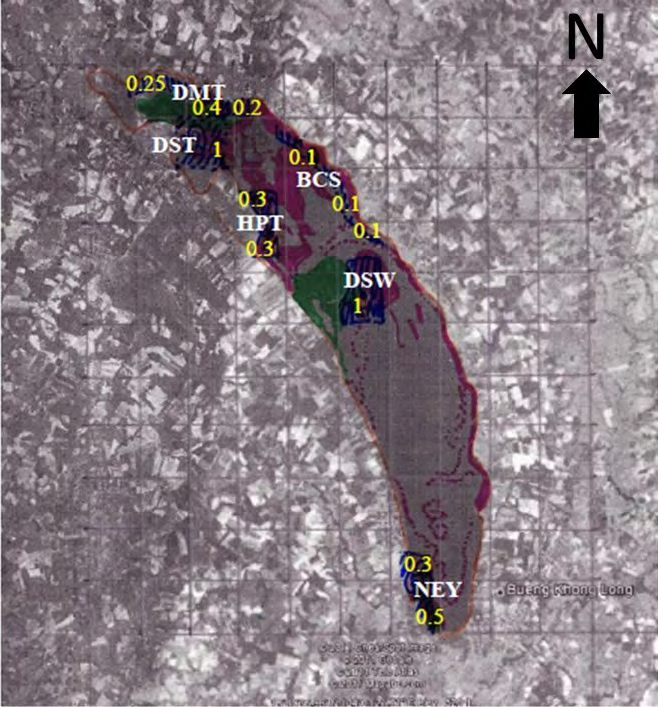
All grids were 23.9 units in total covering the entire area of lake. Only 11.5 grids cover the potential feeding areas of A. purpurea that implies for about 50% of entire lake (11.07 km2 or 11,070 m2). Area size of each station presents in Table 1.
| Station | Grids (units) | Calculation | Area size (m2) |
|---|---|---|---|
| Don Mor Tong (DMT) | 0.85 | (11,070/11.5)x0.85 | 818.22 |
| Don Seo Tai (DST) | 1.00 | (11,070/11.5)x1.00 | 962.61 |
| Ban Chareon Suk (BCS) | 0.30 | (11,070/11.5)x0.30 | 288.79 |
| Huai Pong Tao (HPT) | 0.60 | (11,070/11.5)x0.60 | 577.57 |
| Don Sa Wan (DSW) | 1.00 | (11,070/11.5)x1.00 | 962.61 |
| Noan Eee Yord (NEY) | 0.80 | (11,070/11.5)x0.80 | 770.09 |
Table 1: Area size in approximately at each station of the potential feeding areas of A. purpurea Bird observation in the field a
Table 1: Area size in approximately at each station of the potential feeding areas of A. purpurea Bird observation in the field aimed to investigate on feeding behaviors, time- spent on predation, a pathway, and frequency of visiting at the potential feeding areas within the lakes (when applicable). However, the observation was conducted manually with limited resources that we therefore spent time for this activity only in 20 days between 7.00
am and 6.00 pm during October 2010-April 2011. Mainly primary data on the bird regular observation obtained officially from Bung Khong Long Non-Hunting Area Office and the Department of National Park Wildlife and Plant Conservation Thailand.
Fish Sampling
Due to the shallow areas (water level less than 1. 5 m) characterized around the potential feeding stations, fish traps and fish net-bags were applied in this study during the 2 migratory seasons of A. purpurea at Bung Khong Long Lake between 2009/ 10 and 2010/11. A sampling was conducted in 3 periods (early period (EP) in October; middle period (MP) in January; late period (LP) in April. Fish identification and counting a number of individuals including wet biomass measurement were done in the field.
Two fish traps at each station were placed in between the hypolimnion and benthic zone by covering with aquatic plants. The mesh size is 4 cm2 and volume of a fish trap is 0.14 m3 (r2 x length x number of traps, see equation 1). These traps expected to catch bottom feeder fish and living around the hypolimnion zone. Some particular species were expected such as Anabas testudineus, Channa striata, Clarias sp., Notopterus, and Xenentodon cancila because they were reported predating by A. purpurea in other places. Most of these fish performed economic value for local anglers including Channa lucius and Channa micropeltes.
A fish net-bag with a volume of 157 m3 (r2 x length x distance, see equation 2) was dragged along the shoreline about 100-200 m of distance at the depth around 30-50 cm at each station. It targeted the small pelagic fish that likely move freely from the surface to the hypolimnion zone. Volume of a fish trap = πr2 x length (m) x number of traps 1 = 3.14 x 0.15 x 0.15 x 1 x 2 m3 = 0.14 m3 Volume of a fish net-bag = πr2 x length (m) x distance (m) 2 = 3.14 x 0.5 x 0.5 x 1 x 200 m3 = 157 m3 In this study aimed to compare available preys per area that A. purpurea likely explored and spent time for foraging rather than the volume of water. Therefore, areas from fishing gears were estimated following equation 3 and 4. The width of a fish net-bag implies the water depth of 50 cm from surface.
Areas of a fish trap= width (m) x length (m) x number of traps 3
= 0.3 x 1 x 2 m2 = 0.6 m2 Area of a fish net-bag = width (m) x length (m) x distance
$$ \begin{array}{l} (\mathrm {m}) 4 \\ = 0. 5 \times 1 \times 2 0 0 \mathrm {m} ^ {2} \\ \end{array} $$ = 100 m2 Amphibians, shrimps, and insect larvae were also sampled in addition at the same station of fish sampling within the area of approximately 25 m2. However, they were not the focus as the major prey for A. purpurea in this study.
Fish catch by local anglers was collected data through interview from 82 local fishers who do fishing every day.
Data Analysis
The biomass of preys was analyzed compared with the daily requirement of A. purpurea (200 g/day/individual, Bauer [27], which interpreted the expected number of A. purpurea to be available. One-way ANOVA on ranks for non- parametric data was a tool for statistical analysis in this study. It used to measure the difference in number of fish and amphibians between 2 migratory seasons of A. purpurea and the difference of total biomass of preys among periods within the second migratory season. Wet weight (g) represented biomass of preys that expected to be food of A. purpurea in a day that categorized in 7 types including: (1) All preys (2) All fish of size between 5-15 cm (3) All fish of size less than 5 cm (4) Only Seven species of fish (Anabas testudineus, Channa striata, Channa Lucius, Channa micropeltes, Clarias sp., Notopterus notopterus, and Xenentodon cancila) of all size (5) Amphibians (6) Shrimps (7) Insect larvae
Results
Purple Heron Observation
Six individuals of A. purpurea were observed as the maximum in both migratory seasons in EP (October). The numbers decrease to one in the MP (January) and LP (April) of the first migratory year, and decrease to four in the MP and two in LP of the second year. A pathway of A. purpurea for foraging from 7 am to 6 pm in Bung Khong Long Lake was shown in Figure 2. DST was the station observed the mostvisiting frequency by A. purpurea (65%) follow with HPT 60%, DST 50%, DMT 15% within 20 days. The pathway for foraging within Bung Khong Long Lake of A. purpurea was observed for 3 patterns Figure 2. Pattern 1: the bird from HPT moved to small patches of floating plants nearby for a while then moved ahead to BCS and sometimes to DST. Then, the bird moved further to DMT or returned to the floating plants nearby HPT. It moved back to HPT before DSW in the evening of the day. Pattern 2: the bird started their fly from DSW and directed to HPT and after that, it followed the pattern 1. Pattern 3: the bird started from the floating plant in between HPT and DSW namely Lad Taae which was excluded as a sampling station in this study. This pattern the bird took quite long distance directed to the north of the lake at DST or DMT and then followed the same pathway of pattern 1. During the observation period for 20 days, we did not find any A. purpurea at NEY.
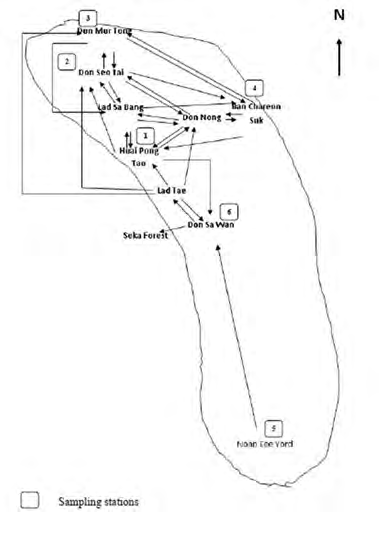
Foraging behavior of A. purpurea observed at Bung Khong Long Lake during its migratory season was not much different from other reports at the breeding grounds. It was habitually standing among dense vegetation of reed swamp or emergent hydrophytes for camouflage by making its height to the same level of the vegetation. It normally predated alone, kept a distance from each other, and mostly observed one individual at one station. This bird was sensitive to a motorboat, which used for fishing or commuting in the lake that it had reflection to the noise from the distance approximately 50 meters or less. It also responded to the paddle by moving away to the vicinity or perching on the big tree. It could stand waiting for a prey quite a long time among the reeds and did not move to anywhere at least within 5 minutes. In case it was unable to find a prey, it moved to the distance approximately one meter away from the last point. When it sighted a prey, it took about 10 minutes to rise up head before bend down its neck very fast to catch a single prey. The difference breaking time between first catch and the next was about 5 minutes depending on a size of prey that sometimes could be for an hour. It took also about 5 minutes to get a prey in the mouth and swallow. At least Clarias sp. of size approximately 5 cm, Channa sp. of size 13 cm were observed caught by A. purpurea during the observation.
Fish Sampling and other food sources
There were 40 species of fish in total caught in both migratory years (Appendices). In the first year, the number of fish caught less than the second year in all periods (Table 2). Trichopsis vittata was the highest number caught in every period of the first year whereas Channa Lucius was the highest in the middle period of the second year. Channa micropeltes and Nandus oxyrhynchus were highest in LP of the second year. Kruskal-Wallis one-way ANOVA on ranks indicated that the average number of fish per square meter among different periods in both migratory years was significantly different (p<0. 001). Holm-Sidak one-way ANOVA tested the number of seven fish species (Anabas testudineus, Channa striata, Channa lucius, Channa micropeltes, Clarias sp., Notopterus, and Xenentodon cancila) per square meter showing the significant higher numbers in the first year than the second year (F = 4. 545, p < 0. 05). In addition, the size of fish from traps was about 10- 30 cm, which was larger than the ones caught by a fish net- bag especially those among seven fish species such as Channa Lucius.
| Migratory year | EP (October) | MP (January) | LP (April) |
|---|---|---|---|
| 2009/10 | 15 | 13 | 15 |
| 2010/11 | 35 | 22 | 27 |
Table 2: The number of fish caught at sampling stations in migratory years of A. purpurea.
Kruskal-Wallis one-way ANOVA on ranks resulted that the average of biomass from all prey types was not significantly different among periods (p<0.001). However, in EP resulted that the biomass of all prey types was not significantly different among sampling stations (p < 0.5), but was significantly different among sampling stations in MP and LP (p < 0. 001, p < 0.004, respectively). This result shows in Figure 3.
![Figure 3: Biomass of all prey types among periods in the second migratory year of A. purpurea at Bung Khong Long Lake [26].](/fulltextimages/7727/fig_3.png)
All fish of size between 5 and 15 cm played a major role for biomass from all preys. The highest biomass of fish was from traps for 750 g/m2, which caught in EP. The lowest biomass was from insect larvae in all periods, which was less than 1 g/m2. Channa lucius was the highest biomass among other species counted for 345 g/m2 in EP and LP. The highest biomass of Channa striata was measured in MP counted for 160 g/m2, and of Channa micropeltes was counted for 22 g/ m2 in EP. In the MP, Notopterus notopterus and Xenentodon cancila had the lowest biomass counted for less than 1 g/m2.
In the LP, Anabas testudineus has the lowest biomass counted for 16 g/m2. In addition, the studied found that the highest biomass of the seven fish species was at HPT station (298 g/m2 in EP; 187 g/m2 in MP; 159 g/m2 in LP). The lowest biomass was measured at DST station in EP counted for 26 g/m2; at DMT and NEY stations in MP counted for 0 g/m2; and at BCS station in LP counted for 0 g/m2. Biomass of the seven fish species and other food sources in the different periods of the migratory season of A. purpurea is shown in Table 3.
| Fish species | Biomass (wet weight: g/m2) | ||
|---|---|---|---|
| EP (October) | MP (January) | LP (April) | |
| Anabas testudineus | 45.50 | 17.79 | 15.67 |
| Channa lucius | 344.74 | 61.05 | 193.33 |
| Channa micropeltes | 21.50 | 0 | 0 |
| Channa striata | 31.35 | 160.33 | 53.86 |
| Clarias sp. | 81.67 | 17.5 | 38.83 |
| Notopterus notopterus | 112.67 | 0.06 | 41.48 |
| Xenentodon cancila | 0 | 0.02 | 0 |
| Sum | 637.43 | 256.75 | 343.37 |
| Shrimp | 1.72 | 0.67 | 1.21 |
| Insect larvae | 0.04 | 0.01 | 0 |
| Amphibians | 13.48 | 7.30 | 23.60 |
| Sampling Station | Migratory period /Weight (g/m2) | ||
| EP (October) | MP (January) | LP (April) | |
| HPT | 297.83 | 187.17 | 158.67 |
| DST | 26.00 | 15.33 | 96.67 |
| DMT | 97.50 | 0.00 | 23.83 |
| BCS | 65 | 26.17 | 0.00 |
| NEY | 59.83 | 0.00 | 20.83 |
| DSW | 91 | 18.33 | 43.33 |
Table 3: Biomass of the seven fish species as a result from sum of six stations in different periods of the migratory season of A
Table 3: Biomass of the seven fish species as a result from sum of six stations in different periods of the migratory season of A. purpurea Kruskal-Wallis one-way ANOVA on ranks resulted in the significant difference of biomass of the seven species of fish among the periods and highest in EP (p<0. 5). Moreover, the biomass of the seven species of fish was also highest at HPT station (Table 4).
Food supply for supporting the number of A. purpurea
Food supply (g/m2) as categorized in the method was analyzed by comparing with the minimum daily requirement for one individual of Purple Heron (200 g/day/individual, Bauer [27] (Table 5). This is an extrapolation of food available for A. purpurea of the migratory season 2010/2011 at Bung Khong Long Lake. Total biomass from all preys was 766.70 g/m2 suggested that it was likely to make only 4 individuals of A. purpurea as the maximum numbers to meet the daily requirement in EP; 337.63 g/m2 and 375.27 g/m2 for 2 individuals of A. purpurea as the maximum numbers in MP and LP, respectively. This was extrapolated in the same direction when considered only the seven fish species only as a prey.
| Category of prey | Extrapolation of number of A. purpurea by food suuply/ Periods | |||||
|---|---|---|---|---|---|---|
| EP (October) | MP (January) | LP (April) | ||||
| A. purpurea | Wet weight (g/m2) | A. purpurea | Wet weight (g/m2) | A. purpurea | Wet weight (g/m2) | |
| 1. All preys | 4 | 766.70 | 2 | 337.63 | 2 | 357.27 |
| 2. All fish (5-15 cm) | 4 | 750.00 | 2 | 327.00 | 2 | 347.00 |
| 3. All fish (less than 5 cm) | 0 | 1 | 0 | 3 | 0 | 3 |
| 4. Only seven fish species | 3 | 637.43 | 1 | 256.75 | 2 | 343.37 |
| 5. Amphibians | 0 | 13.48 | 0 | 7.30 | 0 | 23.60 |
| 6. Shrimps | 0 | 1.72 | 0 | 0.67 | 0 | 1.21 |
| 7. Insect larvae | 0 | 0.04 | 0 | 0.01 | 0 | 0 |
Table 4: Extrapolation of the number of A. purpurea due to food supply in different periods of the migratory season 2010/2011 of
Local Fishing
Active local anglers responded to the questionnaires for 82 in total. They normally fished at the shallow areas overlapping with the foraging areas of A. purpurea around the lake. Out of these numbers, 26 local anglers catch fish every day and this group sample was the focus of analysis. The higher number of anglers have had active fished at 7.00 to 10.00 am and 3.00 to 6.00 pm, the same of active feeding time observed in A. purpurea. A common fishing gear used by these anglers was a net, a long-lined-fish hook, a fish trap, a harpoon, and a dip-net. In addition, they widely placed several shrimp traps across the lake. The highest number of local anglers fishing between 4.00 and 10.00 was at DSW and followed at HPT, NEY, DST, and DMT as same as the fishing between 3.00 and 6.00 pm.
Local anglers caught fish for at least 23 species including Hampala dispar, Notopterus notopterus, Osteochilus lini, Channa stratia, Oreochromis niloticus, Barbonymus goniootus, Clarias sp., and Channa Lucius. These mentioned species were highly frequency of local catching. The seven fish species caught by the anglers around 66,707 g/m2 in average per day. Especially, Notopterus notopterus was the highest biomass among other fish caught. The high biomass of fish caught by local anglers in particular those seven fish species was higher than what extrapolated to be available for observed numbers of A. purpurea in all periods during its migratory season. With regarded to the amount of fish caught by local anglers (66,707 g/m2/day), it was extrapolated to be supply about 333 individuals of A. purpurea following the minimum daily requirement for 200 g/m2/day [27]. This should be sufficient to support the maximum number of A. purpurea (6 individuals) observed during the migratory season, but the observed number of this bird rather decreased to the minimum of one individual throughout the season. It suggested that fishing by local anglers was likely an influence to make A. purpurea had difficulty to access to their food supply in this lake. Fish caught per day by local anglers and fish available extrapolation at the feed area were shown in Table 6. In addition, this group of local anglers also hunted the same prey with A. purpurea such as frogs or toads. This activity was normally at night that likely caused the reduction in number of these prey for other daytime.
| Species of fish | Fish caught by local anglers (g/m2/day) | Fish available extrapolation for A. purpurea (g/m2/day) | ||
|---|---|---|---|---|
| EP | MP | LP | ||
| Anabas testudineus | 1,000 | 45.50 | 17.79 | 15.67 |
| Channa Lucius | 12,575 | 344.74 | 61.05 | 193.33 |
| Channa micropeltes | 3,348 | 21.50 | 0 | 0 |
| Channa striata | 6,848 | 31.35 | 160.33 | 53.86 |
| Clarias sp. | 2,450 | 81.67 | 17.50 | 38.83 |
| Notopterus notopterus | 40,486 | 112.67 | 0.06 | 41.68 |
| Xenentodon cancila | 0 | 0 | 0.02 | 0 |
| Total | 66,707 | 637.43 | 256.75 | 343.37 |
Table 5: Local fish caught and fish available extrapolation in the migratory season of A. purpurea Apart from fishing gears and c
Table 6: Local fish caught and fish available extrapolation in the migratory season of A. purpurea Apart from fishing gears and catching frequency of local anglers, a vehicle such as a motor boat or even non-motor boat was also observed that disturbed A. purpurea during foraging time in the Bung Khong Long Lake. A. purpurea was sensitive with the noise making by the motor boats from 10-50 meters away. The noise forced the bird to camouflage whereas non-motor boats did not make noise but the angler stood on and move the paddle had driven the bird to also camouflage or move away from the feeding areas.
Discussion
Abundance wetlands especially for those of holding a status as a Ramsar site normally provide enormous food for both resident and migrant birds from all over the world. Bung Khong Long Lake is a Ramsar site in Thailand expected to support the migrant birds during their migratory time such as Purple Herons (A. purpurea). However, the maximum observed numbers of these birds at Bung Khong Long Lake had decreased since 2004 to 2011 [8]. This is probably due to several factors such as mortality at the origins before migrating to the resting areas or during the migration, which has the route from Russia and Northern China to Southern Korea, Thailand, and Malaysia [6]. A. purpurea observed in this study at Bung Khong Long Lake was more likely only a migrant group rather than a resident because no breeding nests observed around the lake and vicinity that is in line with Robson [5]. This could be another reason for the small number of individuals observed during the migratory seasons at Bung Khong Long Lake. A. purpurea manilensis migrates to join the non-migratory populations in southeast China, Korea, Taiwan, Japan (Ryuku Islands), Pakistan, Thailand, Malaysia, and Indonesia to the Lesser Sunda Islands Kushlan and Hancock [22] but there was no report on the number of individuals visiting at each place including at Bung Khong Long Lake. The migratory route of this bird follows the route of other water birds in South East Asia known as the East Asian- Australasian Flyway EAAF [30] illustrated by Chaibhakdee and Chaibhakdee [31]. Another cause of the decreasing in number of A. purpurea could be due to the decreasing trend of a size of the bird’s population in Russia since 1994 [32]. A. purpurea manilensis observed at Bung Khong Long Lake was also probably decreasing even though this particular subspecies has a different migratory route from other two subspecies [33, 34]. Interestingly, the migrant groups from Russia have been reported comparatively lower than the breeders in Singapore that hypothesized the migrants have gradually changed to the residents [15]. Therefore, the decreasing in number of individuals around the world could also influence the maximum observed number of A. purpurea at Bung Khong Long Lake but the question of this study was “Why not the number of individuals of A. purpurea remain equally from the early to late period of its migratory season at Bung Khong Long Lake?” The finding of this study explained that amount of food supply might not be the cause but the difficulty to access preys was more reasonably. It is in line with the study of Fasola and Alieri [35] that the distribution of heronries was determined by food competition with neighboring heronries which could be local anglers for the case of Bung Khong Long Lake.
According to Kanjanasaka [7], fish species as food of A. purpurea at the breeding areas included Rasbora aurotaenia ( Rasbora retrodorsalis) , Channa striata ( Ophicephalus striatus) , Anabas testudineus, Notopterus notopterus, Clarias sp., Xenentodon cancila, Alocheilus panchax and Mugil sp. Five species among these fish were also observed at Bung Khong Long Lake. In addition to Channa striata, C. lucius and C. micropeltes were observed at this Ramsar site that were likely possible to be a source of food for A. purpurea as same as C. striata. These seven fish species could play a major role of being preferable prey of A. purpurea at Bung Khong Long Lake, compare to other types of food sources such as amphibians, larvae insects, etc. In addition, other species with similar characteristics such as eels were reported for other breeding areas on different continents [13, 16, 21, 22, 23]. However, specific species for feeding might not be the main factor to make A. purpurea meet the daily food require of average 200 g/individual [27], but total biomass of feeding was rather the case that influenced its shifting places of foraging. In this case, it was likely due to higher biomass and larger size of those seven fish species than other preys or due to abundancy of these species, made A. purpurea frequently fed on before predated on another prey to full fill the requirement. In this study found that food from all preys per a square meter provided approximately 766.70 g that can support at least 4 individuals of A. purpurea in early period of migratory season (EP); 337.63g and 357.27g for at least 2 individuals in MP and LP. It suggested that the reduction in food available at the feeding area had likely influenced the decrease in number of A. purpurea actively feeding in the same area throughout the migratory season.
Bauer [27] also reported that Grey Heron (Ardea cinerea) required approximately 330-500g a day per individual but the fish to feed for this bird per day was approximately 1,000 g in the Wittig Zoo of Cottbus, Germany. This suggested that the birds including A. purpurea needs more food than the average of requirement for feeding per day in the natural environments and likely, more frequent predating the preys or prolong feeding time in case there is scarce food in the feeding areas. We also observed this situation at Bung Khong Long Lake. Frequently observed in this study, A. purpurea caught the fish of size between 5 and 15 cm which weight was average of 90 g that it needs at least 3 to 4 fish of this size or more. This could be due to larger size of fish were not abundant at Bung Khong Long Lake as reported in Jewyam [36]. However, the difficulty of get this size of fish could be the reason making the birds spent considerably long at feeding areas and move around from one to other stations all day at Bung Khong Long Lake. Other wetlands close to Bung Khong Long Lake could be alternative food sources for A. purpurea such as rice fields [37]. A. purpurea starts predating quite early morning and spending time all day until evening Ward and Zahavi [38] that also observed at Bung Khong Long Lake. They were comparatively active quite early morning since before 7.00 to 10.00am and between 3.00 and 6.00pm, which was the same time of higher number of local anglers to do fishing. Since the A. purpurea was quite sensitive to the movement of things around [15], fishing activity by boats caused the bird flee Pierce [39] that suggested the disturbance making them difficult to access to food sources [40, 41, 42, 43]. Apart from fishing frequency, types and sizes of fish caught by local anglers were mostly the major preys of A. purpurea that likely caused overfishing of this size and resulted in only small and medium sizes of fish available in the lake [36]. Jewyam [36] reported that the overfishing in Bung Khong Long Lake was exceeds the capacity of natural production rate (approximately 5.36 g/m2) that commonly insufficient for local use and demands (950 g/day and 418,300 g/day, respectively) [44]. The catch per unit effort (CPUE) of local fishing by using a gill net was about 246 g/m2/ day/one local angler [36] that was exceeded the availability for one individual of A. purpurea to forage especially when there were high number of local anglers and high frequency of fishing at the same area.
For all these reasons, the difficulty to access to food sources of A. purpurea at Bung Khong Long Lake during its migratory season could be influenced by local fishing. It likely caused the decline in number of individuals from early to late period when considering Bung Khong Long Lake as the resting and feeding area since they migrated to the place. However, the fluctuation of number of these birds in vicinity area of Bung Khong Lake was not studied at that time. This is suggested for further studies as well as application of advance technologies to investigate and monitor the birds’ behaviors in longer time.
Conclusion
In conclusion, local fishing was our finding in the study that it relatively disturbed the feeding area of A. purpurea at Bung Khong Long Ramsar Site, Thailand resulted in the bird had difficulty to access to its prey. Even though this bird species has multi-foraging on several kinds of prey, fish of size between 5 and 15 cm had rather more important for predating in order to full fill daily requirement of approximately 200 g/ day/ individual. Specific species predated by A. purpurea from other breeding grounds were also observed abundance in Bung Khong Long Lake especially Anabas testudineus, Channa striata, Channa lucius, Channa micropeltes, Clarias sp., Notopterus notopterus, and Xenentodon cancila which were also reported as major food of this bird in the south of Thailand at its breeding ground. However, a number of fish fed by A. purpurea seem not to be a case to explain the decline of its number of individuals from early to late period of the migratory season. Wet weight (g) of fish and other food sources was rather the hint of that situation. In this study we measured biomass of prey from all types mainly fish of size 5-15 cm and found that this food available likely support for 4 individuals of A. purpurea in early period (EP) of the migratory season and for 2 individuals in mid and late periods (MP, LP). Meanwhile, the maximum number of A. purpurea observed during the study was 6 individuals in EP and became left only 1 in LP, thus insufficient food available was relatively clear as one factor that drove these birds moved out of the lake. In addition to the insufficient food available at the feeding area, local fishing per day suggested that large amount of fish caught per day was exceeded the supply that should make at least one individual of A. purpurea met the daily require food. As well as the active time of feeding of A. purpurea that was the same time for active fishing with higher frequency of number of local anglers, this rather made the bird had difficulty to access to its prey.
The results of this study suggested that even though the feeding area of the migrant birds is holding a Ramsar site status, which expected to be under conservation programs and provide abundance food, the highly competitive foraging between birds and humans might be overlooked. In particular, with the bird of least concern status globally, its global population was not the problem but it could be one indicator to express the status of its feeding area at the local level especially for the Ramsar wetlands. Therefore, monitoring program of the migrant birds at the resting areas during their migratory seasons should be considered. In addition, advance technology to study food intake of this bird species could be applied regularly at the migratory feeding areas so that the more data collection the more understanding the behaviors of A. purpurea, and that can lead to the better conservation program on wetlands in their resting areas during the migratory season.
Conflicts of Interest
This study is a part of dissertation entitled Driving forces influencing the fluctuation of the number of Purple Herons (Ardea purpurea) at Bung Khong Long Ramsar Site, Thailand, graduated for PhD of Environmental Science (General Ecology) in 2012 from Brandenburg University of Technology Cottbus-Senftenberg, Germany. Some results were presented in the virtual annual meeting ESA Conference 3-6 August 2020- Harnessing the ecological data revolution. The presentation titled Impact of local fishing on food supply of Purple Heron in Bung Khong Long Lake, Thailand.
Acknowledgements
I would like to express my gratitude to my supervisor Prof. Dr. rer. nat. Habil. Gerhard Wiegleb and my co-supervisor PD Dr. rer. nat. habil. Udo Bröring for their advice and all supports throughout the study. It is very thankful to Dr. Seth Nii- Annang for all suggestions and grammar correction. I would like to express my sentimental and appreciate to all officers from Bung Khong Long Non-Hunting Area office: Mr. Chareon Bumrungsaksanti, Mr. Tongdee Wongkumkaew, Mr. Boontom Prompanhaow, and from other colleagues and friends: Mr. Wanlop Preechamart, Miss Apiradee Hanpongkittikul, Mr. Nared Namueangrak, and Miss Anocha Pichaisiri.
References
-
Bird Life International (2009) Ardea purpurea.
-
Bird Life International (2010) 2009 IUCN Red List Category (as evaluated by BirdLife International- the official Red List Authority for birds for IUCN), Least Concern.
-
IUCN (2011) IUCN Red List of Threatened Species ( International Union for Conservation of Nature and Natural Resources).
-
Sanguansombat W (2005) Thailand Red Data: Birds. Office of Natural Resources and Environmental Policy and Planning and United Nations Development Program, Bangkok.
-
Robson C (2002) Birds of Thailand: Princeton Field Guide. Princeton University Press, Princeton and Oxford. Round P (2008) The Birds of the Bangkok Area. White Lotus, Bangkok.
-
McClure H (1974a) Ardeidae, Bird families of the world, 14. Herons. In: James A. Kushlan and James A. Hancock 2005 (editors), The Herons: Ardeidae, Bird families of the world. Oxford University Press Inc., New York, pp:
-
Kanjanasaka B, Tongaree S, Laong S (1987) Food Habits and Breeding Biology of Purple Heron. Forestry Documentary in Forestry Conference 1987, Bangkok.
-
DNP (2011) Population of Purple Herons at Bung Khong Long Lake; Raw data (unpublished). Department of National Parks, Wildlife and Plant Conservation, Bangkok.
-
ONEP (2006) Office of Natural Resource and Environmental Policy and Planning.
-
Wetlands International (2007) Information Sheet on Ramsar Wetlands (RIS).
-
ONEP (2002) Biodiversity in Wetland of Bung Khong Long (in Thai); Vol 4. Office of Natural Resources and Environmental Policy and Planning, Bangkok.
-
Grewal B, Harvey B, Pfister O (2003) A photographic guide to the birds of India: And the Indian Subcontinent, Including Pakestan, Nepal, Bhutan, Bangladesh, Sri Lanka, and the Maldives. Princeton University Press.
-
Montesinos A, Santoul F, Green A (2008) The diet of the Night Heron and Purple Heron in the Guadalquivir Marshes. Ardeala 55(2): 161-167.
-
Round P (2008) The Birds of the Bangkok Area. White Lotus, Bangkok.
-
Tan R (2001) Purple Heron (Ardea purpurea): Pucung Serandau (Malay).
-
Barbraud C, Lepley M, Lemoine V, Hafner H (2001) Recent changes in the diet and breeding parameters of the Purple Heron Ardea purpurea in Southern France. Bird Study 48(3): 308-316.
-
Campos F, Lekuona J (2001) Are rice fields a suitable foraging habitat for Purple Herons during the breeding season? Waterbirds 24(3): 450-452.
-
Correia A (2001) Seasonal and interspecific evaluation of predation by mammals and birds on the introduced red swamp crayfish Procambarus clarkia (Crustacea, Cambaridae) in a freshwater marsh (Portugal). Zoology of London 255(4): 533-541.
-
Fasola M, Canova L (1993) The diets of squacco herons, little egrets, night, purple and grey herons in their Italian breeding range. Revue d’Ecologie 48: 35-47.
-
Fasola M (1994) Opportunistic use of foraging resources by heron communities in southern Europe. Ecography 17(2): 113-123.
-
Hockey P, Dean W, Ryan P (2005) Roberts birds of southern Africa 7th (Edn.), Trustees of the John Voelcker Bird Book Fund, Cape Town.
-
Kushlan J A, Hancock J (2005) The Herons: Ardeidae (Bird families of the world). Oxford University Press, Oxford.
-
Moser M (1984) Resource partitioning in colonial herons with particular reference to the Grey Heron Ardea cinerea L. and the Purple Heron Ardea purpurea L. in the Carmargue, south France (PhD Thesis). Durham University, Durham.
-
Mukherjee A (1976) Food-Habits of water-birds of the Sundarban, 24-Parganas District West Bengal, India- II. Jour Bombay Natural History Society 68(1): 37-47.
-
Moltoni E (1936) Scarlino, Italy. In: Huntsman (Eds.), Working with Biodiversity-A Natural History of Tioxide, Scarlino, Italy.
-
Kanongdate K (2012) Driving forces influencing the fluctuation of the number of Purple Herons ( Ardea purpurea) at Bung Khong Long Ramsar Site, Thailand (PhD dissertation). Faculty of Environmental Sciences and Process Engineerin, Brandenburg University of Technology Cottbus-Senftenberg, Germany.
-
Bauer H, Bezzel E, Fiedler W (2005) Das Kompendium der Vögel Mittelleuropas. Band 1: Nonpasseriformes / Nichtsperlingsvögel. Freiburger Graphische Betriebe, Freiburg.
-
Kendeigh S (1970) Energy requirements for existence in relation to size of bird. The Condor 72(1): 60-65.
-
Campos F, Lekuona J (1997) Temporal variations in the feeding habits of the Purple Heron Ardea purpurea during the breeding season. Ibis 139: 447-451.
-
EAAF (2008) The Partnership for the East Asian- Australasian Flyway.
-
Chaibhakdee M, Chaibhakdee W (2006) Migratory Bird of Thailand: The fly way of water birds in South East Asia in Thailand water birds census project. Wildlife Research Division, National Park, Wildlife and Plant Conservation Department, Bangkok.
-
BirdLife International (2011) Ardea purpurea PURPLE HERON.
-
Cramp S, Simmons K (1977) The Birds of the Western Palearctic, Oxford University Press, Oxford, Vol 1.
-
McClure H (1974b) Migration and survival of the Birds of Asia. In: United States Army Medical Component, South- East Asia Treaty Organization (SEATO) Medical Project, Bangkok, Thaailand VI, Bangkok.
-
Fasola M, Alieri R (1992) Conservation of heronry Ardeidae sites in North Italian agricultural landscapes. Biological Conservation 62(3): 219-228.
-
Jewyam W (2011) A Study on Water Quality and Status of Fishery Resources for Conservation of Wetland: Bung Khong Long, Nong Khai Province 2009. Office of the national research council of Thailand, Bangkok.
-
Fasola M, Canova L, Saino N (1996) Rice fields support a large portion of herons breeding in the Mediterranean Region. Colonial Water birds 19: 129-134.
-
Ward P, Zahavi A (1973) The importance of certain assemblages of birds as ‘information centers’ for food finding. Ibis 115: 517-534.
-
Pierce G, Spray C, Stuart E (1993) The effect of fishing on the distribution and behavior of water birds in the Kukut area of Lake Song Kla, Southern Thailand. Biological Conservation 66(1): 23-34.
-
Cooke A (1987) Disturbance by anglers of birds at Grafham Water. In: Maitland P & Turner A (Eds.), Angling and Wildlife in Fresh Waters. Huntingdon: ITE Symposium, No. 19. Institute of Terrestrial Ecology, pp: 15-23.
-
Mitchell J, Moser M, Kirby J (1988) Declines in midwinter- counts of waders roosting on the Dee Estuary. Bird Study 35(3): 191-198.
-
Mueller A, Glass P (1988) Disturbance tolerance in a Texas waterbird colony. Colonial Water birds 11(1): 119- 122.
-
Tuite C, Hanson P, Owen M (1984) Some ecological factors affecting winter wildfowl distribution on inland waters in England and Wales, and the influence of water based recreation. Applied Ecology 21(1): 41-62.
-
WWF (2007) Community Management of Wetlands in Thailand and Mekong River Basin Project (unpublished). WWF Thailand, Bangkok.
- Lessons to Learn: Trees are More than the Lungs of the World
- Community Forestry Enterprises as a Model for Sustainable Forest Development: The Case Of The "Baja Tarahumara" in Chihuahua, Mexico
- Ecological and Socio-Economic Impacts of Chromolaena odorata and Mesosphaerum suaveolens, Two Invasive Alien Species in Central and Southern Benin, West Africa
- Epigenetic Sustainability: Modeling the Human Factor as a Natural Resource through Science 4.0 and the NR3C1 Biological Pilot
- Growth-at-Risk: A Framework for Assessing Economic Vulnerability
- The Rural Territory as a Socioecological System for the Management of Public Policy for Sustainable Rural Development