
White Storks Ciconia ciconia L. became Victims of Environmental Pollution of Ararat Plain of Armenia
The novelty threat to White Storks Ciconia ciconia in Armenia was investigated in 33 villages of Ararat Plain in 2019-2021. The Storks were becoming smeared with the undetermined agent of plant oil and/or fish fat nature, which was impeding their flying abilities. In 2019 smeared Storks were found in five villages, with total number of 125 smeared nestlings and 84 smeared adult storks. In 2020 smeared Storks were found in 15 villages, in 95 nests, totaling to 285 smeared nestlings and 192 smeared adults. In 2021 smeared Storks were found in 28 villages, in 178 nests, totaling to 534 smeared nestlings and 356 smeared adults. Average percent of the polluted nestlings grew from 5% in 2019 to 21% in 2020 (t=3.62, df=32, p<0.001), and then to 58% in 2021 (t=7.17, df=32, p<0.05). The most likely causes of environmental pollution and Storks’ smearing are Sturgeon farms and producers of canned food. Current legislation provides with necessary tools to deal with possible polluters; however there is a need to enforce the laws. Therefore, a number of short-term and long-term measures are suggested to improve the situation.
Introduction
In Armenia the White Storks (Ciconia ciconia L., hereafter Storks) occupy Ararat Plane, Arpa River Valley, Shirak and Lori Plateau (Figure 1), and nest in villages located in close proximity to wetlands [1, 2, 3]. In Armenia the wetlands are of high conservation importance, hosting number of breeding waterbirds of global and national conservation concern, such as White-headed Duck (Oxyura leucocephala), Ferruginous Pochard (Aythya nyroca), Common Pochard (Aythya ferina), Northern Lapwing (Vanellus vanellus), and White-tailed Lapwing (Vanellus leucurus). Despite on that, the wetlands of Ararat Plain have declined during last 70 years from 31,000 ha down to about 20,000 ha [4]. Also, the wetlands of Ararat Plain are potentially susceptible to pollution, being located in the region of intensive agriculture and high-level of urbanization [2, 3, 4]. Throughout Europe the Storks are used as a flagship species, serve as an indicator of wetland ecosystems and a species that signifies positive associations with humans [5, 6, 7]. This situation has encouraged the development of citizen science around Storks with volunteers assisting in determining abundance of the Storks. In Armenia, a long-term effort has been initiated since 2005 with the aim of determining the value of the Storks as indicator of wetland ecosystems [3, 4]. Among other things, the effort is dedicated to: (1) the identification of the Stork population size and dynamics, (2) the measurement of trends in Stork breeding success in Armenia, (3) justification of the conservation status of the species in Armenia and development of conservation measures, if necessary.
![Figure 1: Distribution of the White Storks (Ciconia ciconia) in Armenia (from Aghababyan [3]).](/fulltextimages/8517/fig_1.png)
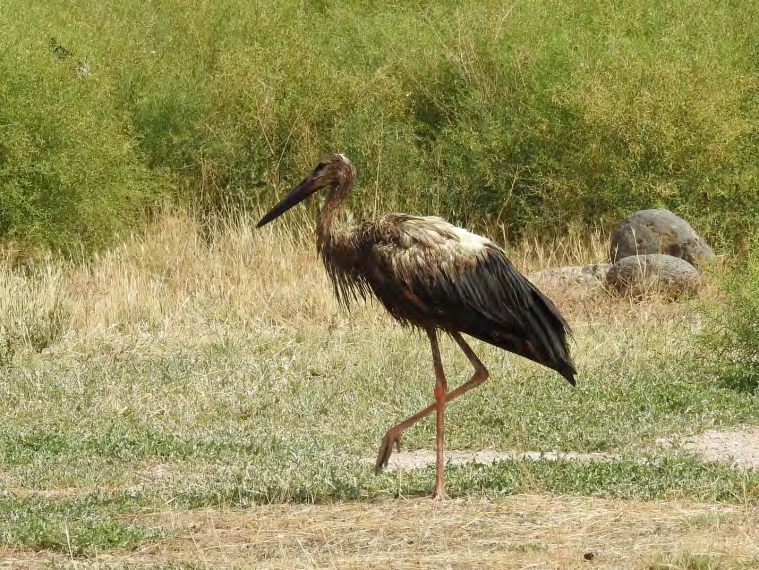
Since the initiation of the effort, Storks have shown an increasing population trend alongside increasing breeding success [3, 4]. However, in 2019 a large-scale and highly unusual threat was recorded on the Storks: a number of birds were smeared with an unknown substance (Figure 2), which impeded their ability to fly. In this paper, we provide details from monitoring of this novel threat conducted during 2019-2021. Our primary aims were to determine the scale of the threat for the population, its potential demographic characteristics, and to determine whether the smearing represented environmental pollution of the wetland and terrestrial habitats of Ararat Plain.
Methods
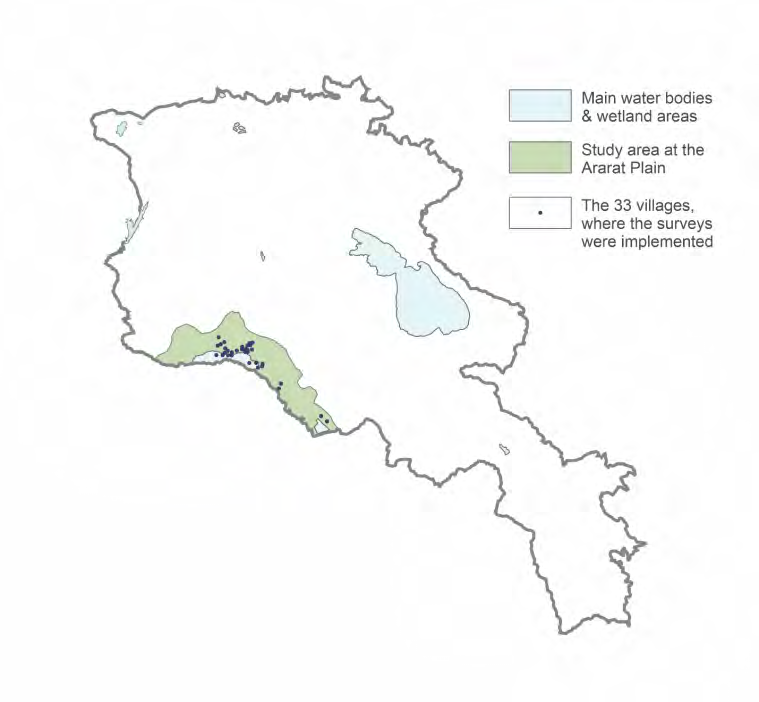
We conducted annual monitoring program of the Storks starting in 2006 covering the Ararat, Armavir, Aragatsotn, Yerevan, Lori, Shirak and Vayots Dzor provinces. A few additional studies of the polluted Storks were conducted in 2019-2021 and covered only the Ararat Plain (Figure 3). Data collection involved 12 expeditions lasting a total of 12 days and covering 42 locations.
Monitoring included counts of breeding pairs and nest success from 320 Stork nests. The data were collected via direct observations by our team and with the assistance of villagers who served as citizen scientists. The nests were labeled with individual numbers and villagers provided quick feedback on every unusual occasion – e.g., construction of new nests in the village, Storks’ injury cases, and starting since 2019, Storks with smearing on their plumage.
At each nest, we also recorded the number of Storks with smears. Storks with smears were categorized into three levels based on how much smearing each had. Storks were “slightly polluted” when the lower part of neck and belly was smeared having a pale greyish-buff color, “medium polluted”, when the neck, belly and part of wings are smeared having a dark greyish-buff, and “strongly polluted” when smearing covered almost the entire Stork.
Villagers were provided wall calendars to collect data on Stork nests. In addition, to try and understand the possible source of pollution that was smearing Storks, we conducted semi-structured interviews with villagers.
The collected data were stored in a Microsoft Access 2003 database (later transferred into Microsoft Office 2010) for further data analysis. Statistical analyses were carried out with Excel 2010 (MS Office 2010) and R program package. The analyses include measurement of central tendencies and calculation of statistically significant differences between variables. The paired samples t-test and/or Wilcoxon test were used to determine whether there is statistical evidence that the average differences between observations for different years are significantly different from zero [8]. Mapping was conducted with ArcMap GIS 10.1 (ESRI, Redlands, CA).
In parallel to the research works, the rescue works have been implemented and although they do not have direct relation to the conducted study, they have decreased mortality of the Storks.
Results
Distribution and scale of the Storks’ pollution in 2019-2020
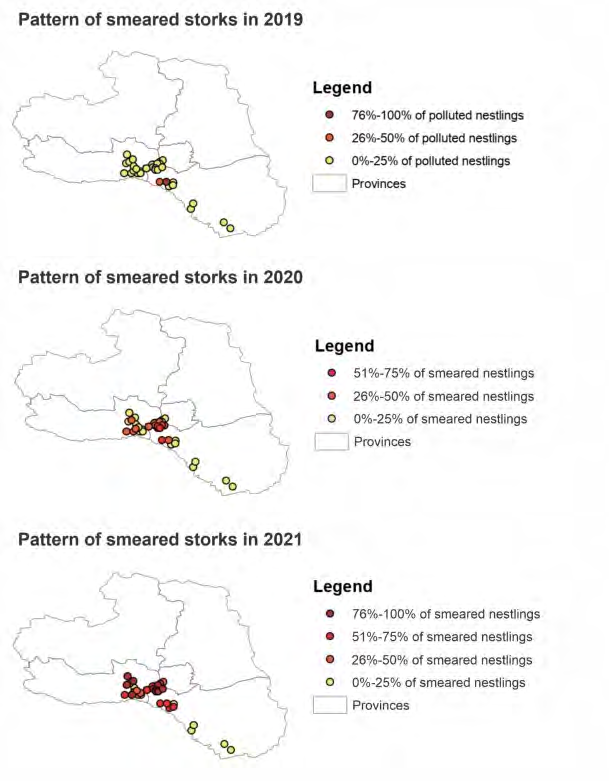
In 2019 smeared Storks were found in five villages and mainly in Hovtashen village in 42 nests (Figure 4 and Table 1). The total number of smeared Storks included 125 nestlings and 84 adult Storks, with most being smeared at a medium level, and several at strong levels.
| # | Village | Number of nests | Conditional level of polluted White Storks in the nests | Number of nestlings | Number and % of polluted Storks | ||||
|---|---|---|---|---|---|---|---|---|---|
| Clean | Slightly | Medium | Strong | ||||||
| 1 | Geghanist | 2 | 6 | 0 | 0 | 0 | 6 | 0 | 0% |
| 2 | Azatashen | 2 | 5 | 0 | 0 | 0 | 5 | 0 | 0% |
| 3 | Khachpar | 18 | 52 | 2 | 0 | 0 | 54 | 2 | 4% |
| 4 | Hayanist | 9 | 24 | 3 | 0 | 0 | 27 | 3 | 11% |
| 5 | Howtashat | 25 | 77 | 0 | 0 | 0 | 77 | 0 | 0% |
| 6 | Nizami | 6 | 18 | 2 | 0 | 0 | 20 | 2 | 10% |
| 7 | Zorak | 5 | 15 | 0 | 0 | 0 | 15 | 0 | 0% |
| 8 | Dashtavan | 18 | 51 | 0 | 0 | 0 | 51 | 0 | 0% |
| 9 | Darakert | 11 | 34 | 0 | 0 | 0 | 34 | 0 | 0% |
| 10 | Norabats | 2 | 4 | 0 | 0 | 0 | 4 | 0 | 0% |
| 11 | Darbnik | 4 | 11 | 0 | 0 | 0 | 11 | 0 | 0% |
| 12 | Ghukasavan | 2 | 6 | 0 | 0 | 0 | 6 | 0 | 0% |
| 13 | Hovtashen | 36 | 0 | 21 | 71 | 22 | 114 | 114 | 100% |
| 14 | Noramarg | 4 | 8 | 4 | 0 | 0 | 12 | 4 | 33% |
| 15 | Yeraskhahun | 41 | 118 | 0 | 0 | 0 | 118 | 0 | 0% |
| 16 | Jrarat | 8 | 22 | 0 | 0 | 0 | 22 | 0 | 0% |
| 17 | Metsamor | 2 | 7 | 0 | 0 | 0 | 7 | 0 | 0% |
| 18 | Haykashen | 4 | 11 | 0 | 0 | 0 | 11 | 0 | 0% |
| 19 | Gay | 8 | 26 | 0 | 0 | 0 | 26 | 0 | 0% |
| 20 | Lusagyugh | 4 | 13 | 0 | 0 | 0 | 13 | 0 | 0% |
| 21 | Aknashen | 3 | 9 | 0 | 0 | 0 | 9 | 0 | 0% |
| 22 | Griboyedov | 8 | 22 | 0 | 0 | 0 | 22 | 0 | 0% |
| 23 | Aratashen | 3 | 8 | 0 | 0 | 0 | 8 | 0 | 0% |
| 24 | Khoronk | 2 | 7 | 0 | 0 | 0 | 7 | 0 | 0% |
| 25 | Artimet | 3 | 10 | 0 | 0 | 0 | 10 | 0 | 0% |
| 26 | Haytagh | 2 | 8 | 0 | 0 | 0 | 8 | 0 | 0% |
| 27 | Mkhchyan | 2 | 7 | 0 | 0 | 0 | 7 | 0 | 0% |
| 28 | Dimitrov | 4 | 14 | 0 | 0 | 0 | 14 | 0 | 0% |
| 29 | Araksavan | 16 | 48 | 0 | 0 | 0 | 48 | 0 | 0% |
| 30 | Pokr Vedi | 12 | 37 | 0 | 0 | 0 | 37 | 0 | 0% |
| 31 | Lusarat | 6 | 19 | 0 | 0 | 0 | 19 | 0 | 0% |
| 32 | Surenavan | 24 | 74 | 0 | 0 | 0 | 74 | 0 | 0% |
| 33 | Armash | 22 | 67 | 0 | 0 | 0 | 67 | 0 | 0% |
| Totals | 318 | 838 | 32 | 71 | 22 | 963 | 125 |
Table 1: Distribution of smeared White Storks among 33 surveyed villages in 2019.
On average, 5 ± 0.03% nestlings were smeared in the observed 33 villages. Table 1: Distribution of smeared White Storks among 33 surveyed villages in 2019.
In 2020 smeared Storks were found in 15 villages, in 95 nests (Figure 4 and Table 2). The total number of smeared nestlings was 285, and the number of smeared adult Storks was 192, with all of the adults showing some smearing.
| # | Village | Number of nests | Conditional level of polluted White Storks in the nests | Number of nestlings | Number and % of polluted Storks | ||||
|---|---|---|---|---|---|---|---|---|---|
| Clean | Slightly | Medium | Strong | ||||||
| 1 | Geghanist | 2 | 6 | 0 | 0 | 0 | 6 | 0 | 0% |
| 2 | Azatashen | 2 | 5 | 0 | 0 | 0 | 5 | 0 | 0% |
| 3 | Khachpar | 18 | 32 | 22 | 0 | 0 | 54 | 22 | 41% |
| 4 | Hayanist | 9 | 20 | 11 | 0 | 0 | 31 | 11 | 35% |
| 5 | Howtashat | 25 | 45 | 35 | 0 | 0 | 80 | 35 | 44% |
| 6 | Nizami | 6 | 5 | 6 | 5 | 3 | 19 | 14 | 74% |
| 7 | Zorak | 5 | 8 | 6 | 2 | 0 | 16 | 8 | 50% |
| 8 | Dashtavan | 18 | 18 | 29 | 7 | 2 | 56 | 38 | 68% |
| 9 | Darakert | 11 | 11 | 16 | 7 | 2 | 36 | 25 | 69% |
| 10 | Norabats | 2 | 3 | 3 | 0 | 0 | 6 | 3 | 50% |
| 11 | Darbnik | 4 | 9 | 5 | 0 | 0 | 14 | 5 | 36% |
| 12 | Ghukasavan | 2 | 7 | 0 | 0 | 0 | 7 | 0 | 0% |
| 13 | Hovtashen | 35 | 59 | 40 | 5 | 7 | 111 | 52 | 47% |
| 14 | Noramarg | 4 | 5 | 4 | 3 | 0 | 12 | 7 | 58% |
| 15 | Yeraskhahun | 41 | 78 | 46 | 3 | 0 | 127 | 49 | 39% |
| 16 | Jrarat | 8 | 13 | 11 | 0 | 0 | 24 | 11 | 46% |
| 17 | Metsamor | 2 | 7 | 0 | 0 | 0 | 7 | 0 | 0% |
| 18 | Haykashen | 4 | 11 | 0 | 0 | 0 | 11 | 0 | 0% |
| 19 | Gay | 8 | 23 | 0 | 0 | 0 | 23 | 0 | 0% |
| 20 | Lusagyugh | 4 | 8 | 3 | 0 | 0 | 11 | 3 | 27% |
| 21 | Aknashen | 3 | 9 | 0 | 0 | 0 | 9 | 0 | 0% |
| 22 | Griboyedov | 8 | 25 | 0 | 0 | 0 | 25 | 0 | 0% |
| 23 | Aratashen | 3 | 10 | 0 | 0 | 0 | 10 | 0 | 0% |
| 24 | Khoronk | 2 | 4 | 2 | 0 | 0 | 6 | 2 | 33% |
| 25 | Artimet | 3 | 10 | 0 | 0 | 0 | 10 | 0 | 0% |
| 26 | Haytagh | 2 | 7 | 0 | 0 | 0 | 7 | 0 | 0% |
| 27 | Mkhchyan | 2 | 7 | 0 | 0 | 0 | 7 | 0 | 0% |
| 28 | Dimitrov | 4 | 14 | 0 | 0 | 0 | 14 | 0 | 0% |
| 29 | Araksavan | 16 | 47 | 0 | 0 | 0 | 47 | 0 | 0% |
| 30 | Pokr Vedi | 12 | 34 | 0 | 0 | 0 | 34 | 0 | 0% |
| 31 | Lusarat | 6 | 22 | 0 | 0 | 0 | 22 | 0 | 0% |
| 32 | Surenavan | 24 | 73 | 0 | 0 | 0 | 73 | 0 | 0% |
| 33 | Armash | 22 | 68 | 0 | 0 | 0 | 68 | 0 | 0% |
| Totals | 317 | 703 | 239 | 32 | 14 | 988 | 285 |
Table 2: Distribution of polluted White Storks among 33 surveyed villages in 2020.
On average, 22 ± 0.05% of the nestling were smeared in the monitored villages. Table 2: Distribution of polluted White Storks among 33 surveyed villages in 2020.
In 2021 smeared Storks were found in 28 villages, in 178 nests (Figure 4 and Table 3). The total number of smeared nestlings was 534, along with 356 smeared adults, and all adults were slightly smeared.
| # | Village | Number of nests | Conditional level of polluted White Storks in the nests | Number of nestlings | Number and % of polluted Storks | ||||
|---|---|---|---|---|---|---|---|---|---|
| Clean | Slightly | Medium | Strong | ||||||
| 1 | Geghanist | 2 | 3 | 0 | 2 | 0 | 5 | 2 | 40% |
| 2 | Azatashen | 2 | 0 | 6 | 0 | 0 | 6 | 6 | 100% |
| 3 | Khachpar | 18 | 6 | 12 | 17 | 21 | 56 | 50 | 89% |
| 4 | Hayanist | 9 | 9 | 7 | 2 | 11 | 29 | 20 | 69% |
| 5 | Howtashat | 25 | 23 | 28 | 25 | 0 | 76 | 53 | 70% |
| 6 | Nizami | 6 | 0 | 8 | 6 | 4 | 18 | 18 | 100% |
| 7 | Zorak | 5 | 0 | 2 | 4 | 9 | 15 | 15 | 100% |
| 8 | Dashtavan | 18 | 0 | 9 | 19 | 26 | 54 | 54 | 100% |
| 9 | Darakert | 11 | 0 | 12 | 8 | 13 | 33 | 33 | 100% |
| 10 | Norabats | 2 | 0 | 4 | 2 | 0 | 6 | 6 | 100% |
| 11 | Darbnik | 4 | 0 | 6 | 3 | 4 | 13 | 13 | 100% |
| 12 | Ghukasavan | 2 | 2 | 4 | 0 | 0 | 6 | 4 | 67% |
| 13 | Hovtashen | 36 | 32 | 39 | 21 | 16 | 108 | 76 | 70% |
| 14 | Noramarg | 4 | 4 | 4 | 2 | 0 | 10 | 6 | 60% |
| 15 | Yeraskhahun | 41 | 59 | 24 | 26 | 14 | 123 | 64 | 52% |
| 16 | Jrarat | 8 | 0 | 16 | 5 | 2 | 23 | 23 | 100% |
| 17 | Metsamor | 2 | 4 | 3 | 0 | 0 | 7 | 3 | 43% |
| 18 | Haykashen | 4 | 10 | 2 | 0 | 0 | 12 | 2 | 17% |
| 19 | Gay | 8 | 15 | 7 | 3 | 0 | 25 | 10 | 40% |
| 20 | Lusagyugh | 4 | 8 | 3 | 0 | 0 | 11 | 3 | 27% |
| 21 | Aknashen | 3 | 7 | 2 | 1 | 0 | 10 | 3 | 30% |
| 22 | Griboyedov | 8 | 18 | 5 | 0 | 0 | 27 | 5 | 22% |
| 23 | Aratashen | 3 | 2 | 2 | 5 | 0 | 9 | 7 | 78% |
| 24 | Khoronk | 2 | 4 | 3 | 0 | 0 | 7 | 3 | 43% |
| 25 | Artimet | 3 | 2 | 5 | 2 | 0 | 9 | 7 | 78% |
| 26 | Haytagh | 2 | 0 | 2 | 4 | 2 | 8 | 8 | 100% |
| 27 | Mkhchyan | 2 | 7 | 0 | 0 | 0 | 7 | 0 | 0% |
| 28 | Dimitrov | 4 | 5 | 0 | 6 | 4 | 15 | 10 | 67% |
| 29 | Araksavan | 16 | 19 | 18 | 12 | 0 | 49 | 30 | 61% |
| 30 | Pokr Vedi | 12 | 35 | 0 | 0 | 0 | 35 | 0 | 0% |
| 31 | Lusarat | 6 | 20 | 0 | 0 | 0 | 20 | 0 | 0% |
| 32 | Surenavan | 24 | 75 | 0 | 0 | 0 | 75 | 0 | 0% |
| 33 | Armash | 22 | 69 | 0 | 0 | 0 | 69 | 0 | 0% |
| Totals | 318 | 438 | 233 | 175 | 126 | 976 | 534 |
Table 3: Distribution of polluted White Storks among 33 surveyed villages in 2021.
On average, 58 ± 0.06% nestlings were smeared. Table 3: Distribution of polluted White Storks among 33 surveyed villages in 2021.
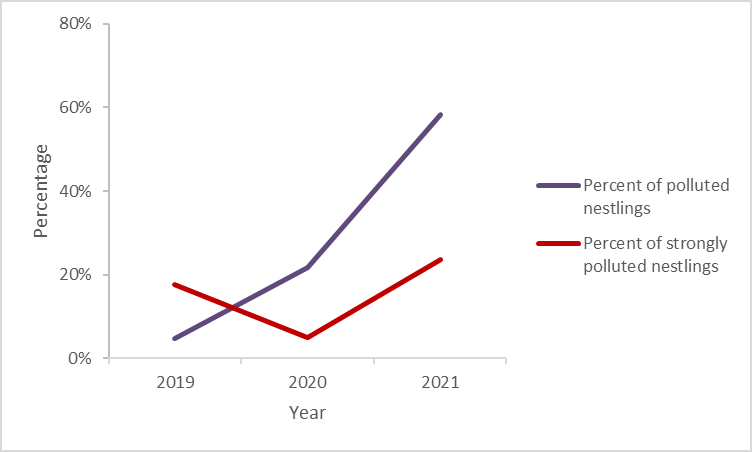
Thus, the average percent of the polluted nestlings in 33 observed villages grew from 5% in 2019 to 21% in 2020 (t=3.62, df=32, p<0.001), and then to 58% in 2021 (t=7.17, df=32, p<0.05) (Figure 5). Meanwhile, the number of strongly polluted nestlings, which were in critical condition, didn’t change significantly from 2019 to 2020 (t = -0.51, df = 32, p = 0.6146), although their percentage of total number of polluted nestlings, declined from 18% in 2019 to 5% in 2020. The number and percentage of strongly polluted nestlings (out of total number of polluted nestlings) again increased to 24% in 2021 (t = 3.09, df = 32, p = 0.0042).
Possible sources of smearing on Storks in 2019- 2020
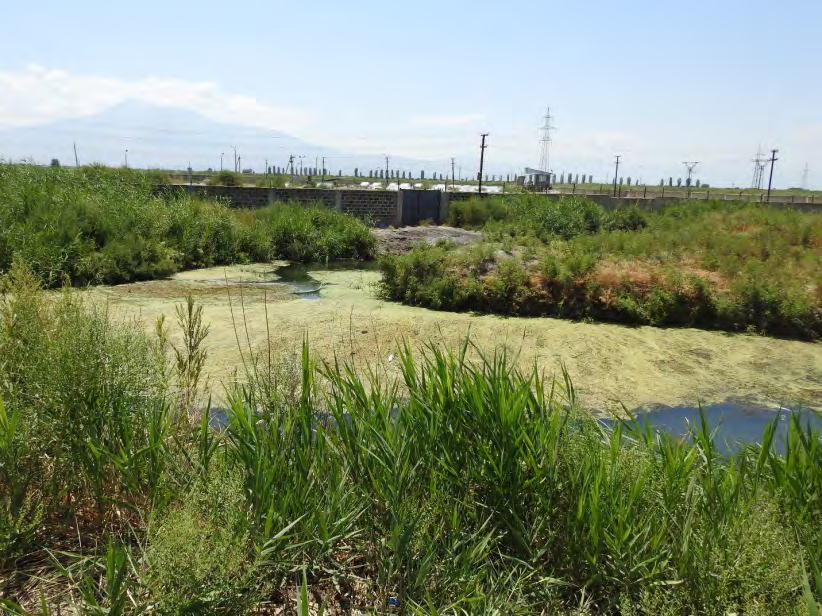
During 2019, the surveys of the local inhabitants and our own observations allowed us to identify the Sturgeon farm, which was troughing the waste, namely the internal organs of the gutted fish to the nearby canal, where it was getting clogged (Figure 6). The Storks were observed visiting this site for feeding, and were likely getting smeared by the fat of the Sturgeons.
During 2020, the surveys of the local inhabitants, our own observations, and observations of the State Inspectorate Body, allowed us to identify the Masis municipal damp (Figure 7), where the waste of the Sturgeon farms, as well as the plant-oil containing waste was thrown in some sites.
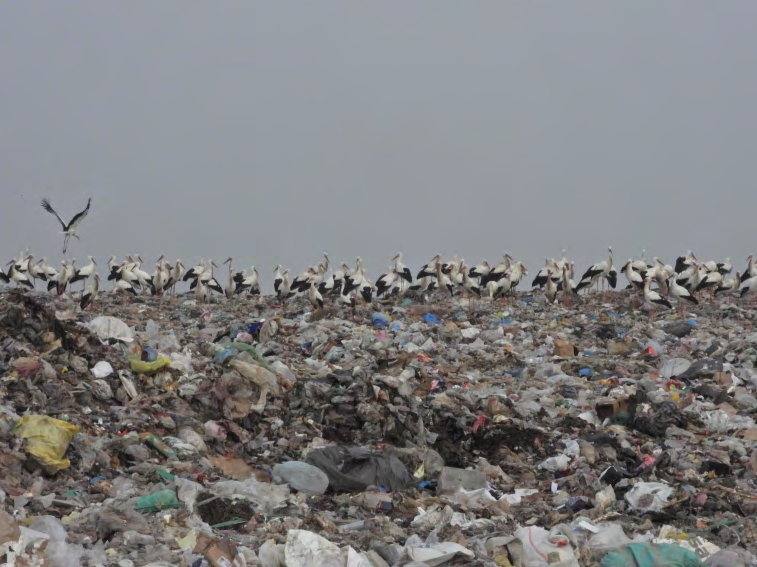
It appears, that the Storks, which have the scavenging in their behavior Elliott [9] find the food in the waste of fish- farms and producers of the preserves (canned food). When the waste was disposed in canal, like in the case of Sturgeon farm, the adult Storks were mainly smeared as they move to that liquid manure and the fat covers their feathers. When the waste was disposed to the terrestrial area, like in case with the Municipal dump, the adult Storks were gathering food in their crops, and then regurgitated the food together with the oil on the nestlings in the nest, smearing the feathers of nestlings. That is why; the flightless nestlings in the nests were becoming smeared.
White Storks’ mortality and rescue
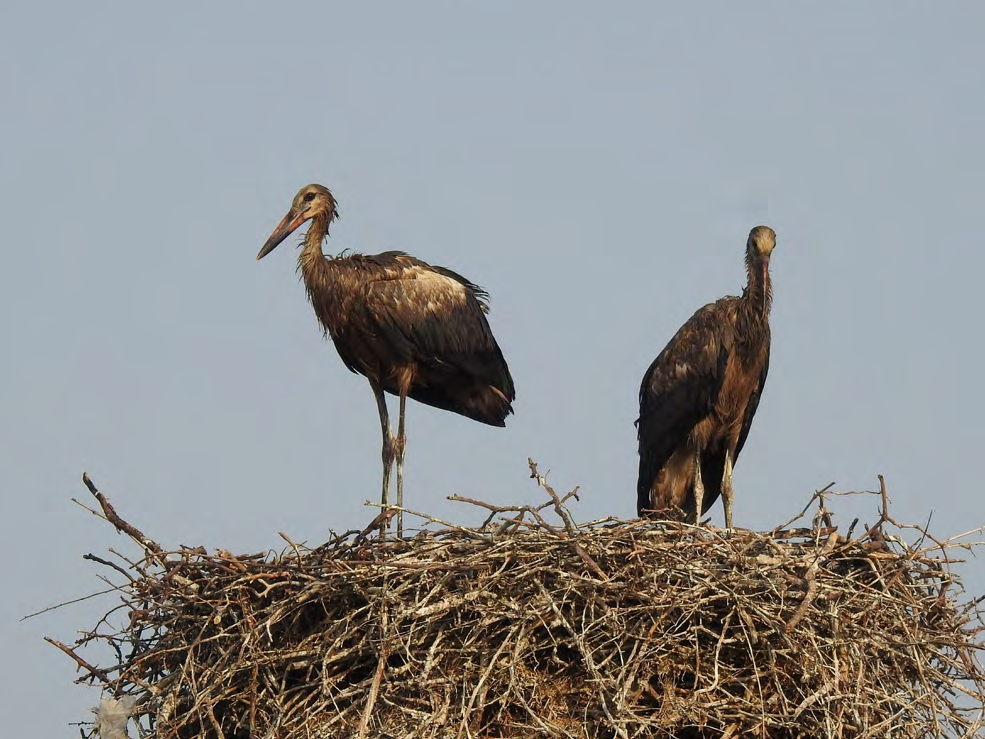
During 2019 mortality of four Storks was recorded, but 22 Storks were rescued. In 2020, none of dead Storks have been recorded though four had to be rescued and cleaned. In 2021, over 200 Storks died with 24 birds being rescued and cleaned. Most of the birds which died in 2021 were fledglings that had been severely smeared at their nests (Figure 8). The smearing disallowed them from flying, and nestlings that attempted their first flight dropped from the nests breaking their legs and wings.
Discussion
Our observations constitute the first known instance of Storks being smeared by animal and plant oil due to improper waste management. More infamous examples of birds being impacted negatively by oil include the various waterbirds and sea birds affected from oil spills worldwide [10, 11, 12], until now the problem was only touching the sea birds.
Currently, it is not yet definitely determined, what are the agents, which are smearing the Storks. The maximum narrowing down of the possible pollutants gave a response that we deal with the fish-fat and plant-oil. Thus, the investigation of the pollutants is being continued. However, it raises two questions: (1) why the Storks have not been polluted before 2017 [2, 3, 4], and (2) why the Storks are being polluted in late June – early July only, although the Storks stay in Armenia over winter [2, 3, 4]. The possible answers to the first question are the following: (1) Armenia started exporting the Sturgeon in large scale quite late and before that all the fish was sold alive to the local market [13]; number of producers of the various preserves (canned food) started growing in last decade (National Statistical Service, pers. comm.), while the waste disposal was operating in the old mode, and probably cannot supply the growing number of producers. The possible answer to the second question is: the fat, which is covering the Storks, becomes liquid under the temperature over 20°C of water or over 45°C of the air, which is happening in late June and July (Armenian State Hydrometeorological and Monitoring Service pers. comm.).
While at current, there is a certain catastrophe, which is happening to the Storks in Armenia, such a pollution can have another long-term negative effect on the reproductive performance of the Storks [14], and so tracking of the further reproductive success of the Storks, which were polluted can help in understanding of the possible influence of the current spills.
Legislation and Necessary Measures
Currently, Armenian Legislation provides the necessary framework for waste management including the hazardous waste.
According to the Law on Waste [15], waste generators, installers, processors, users or disposers of waste must register and submit quarterly administrative statistical reports of payments for their disposal. Meanwhile, according to the Decisions of the Government of RA Government of RA [16, 17] waste disposal facilities must apply for the registration in the manner prescribed by law and be registered in the relevant databases of waste treatment facilities which is maintained by the Ministry of Environment. In the same time, those who generate hazardous waste, should get the hazardous waste passports approved by the authorized body [15, 18]. Legal entities involved in the disposal of hazardous waste, before engaging in the use of that waste must undergo a process of environmental impact assessment and expertise [19]. Organizations, which have received a positive conclusion as a result of the expertise may apply to the Ministry of Environment for a license to operate hazardous waste in the Republic of Armenia. The license is issued on the basis of the conclusion of the interdepartmental licensing commission, it is valid for an indefinite period [19, 20]. In order to prevent harmful effects on the environment, economic operators and authorized bodies should monitor the state of the environment in the waste disposal facilities and adjacent areas [21, 22, 23]. Eventually, in the field of waste management, the Environmental Protection and Mining Inspection Body supervise the observance of the requirements of the legislation, and in case of detection of violations, record those [15, 24, 25]. To support this, the Code of Administrative Offenses Parliament of RA [25] provides for a number of measures of liability in order to ensure compliance with the rules established by the legislation and the requirements for the prevention of harmful effects on the environment due to use of the waste.
Currently, Armenia is at the stage of planning the creation and maintenance of a state electronic waste cadaster in order to combine information on the qualitative properties of the volume of waste generated and used in the Republic of Armenia. The Ministry of Environment is currently working on the legislation necessary to monitor landfills in their area of impact (Anahit Aleksandryan pers. comm).
Therefore, it can be concluded that the existing Legislation of the country guides the food producers to have annual report on the waste, which has to describe the volume of the waste, the way and terms of its disposal. However, currently, there is no tracking system, which can allow understanding the pattern: what the various food producers have done with the waste. Also, there is now system, which can enforce the producers to utilize or exterminate their waste properly.
Conclusion
Taking into account the existing situation, the following short-term measures are suggested to be implemented urgently. 1) Inventory of all the producers, which can possibly have a fat or oil containing waste; this is already being implemented by the State Inspectorate. 2) Enforcing all producers to provide annual reports according to the legislation. 3) Development of the annual cycle of comparison of the volume of the waste recorded in the annual report with the production volume in order to find possible violations. Also, it is important to develop long-term measures, which can improve the waste management and support in decrease of pollution of Ararat Plain. Those include increase of punishments for violation of waste disposal, develop recycling of the waste in Armenia, starting with municipal waste and continuing with the plastic and glass, and increase of punishments for harming White Storks. This species should be considered as one of the national symbols of Armenia to ensure that their habitats and populations can be properly protected. Currently, the species is not included in the Red
Book of Animals of Armenia [26]. We strongly suggest that this be revised to ensure that this iconic species can be better preserved.
Acknowledgement
We are greatly thankful to: Whitley Fund for Nature, which supported the project by Whitley Award donated by The Friends of Whitley and further – with Continuation Funding. We are very thankful to the Ministry of Environment of the Republic of Armenia for administrative support. We are very thankful to Caucasus Nature Fund and the private donors for their financial support of the Storks’ study and cleaning, as well as to ZooFauna Art LLC, Mankus Ecopark LLC, Jambo Exotic Park, and Municipality of Hovtashen village for their support in the rescue of the birds. In the same time, we thank Dr. Anahit Aleksandryan for her valuable comments on the modern situation with the legislation, Armenian State Hydrometeorological and Monitoring Service for their comments on the temperature parameters in Ararat province, and National Statistical Service for their comments on the dynamics of canned food production. Also, we are especially thankful to over 60 volunteers, which helped us with rescue of the Storks and over 1,000 residential families in the villages of Ararat, Armavir, Lori, Shirak and Vayots Dzor provinces, for their consistent efforts on monitoring White Storks in Armenia.
References
-
Adamian MS, Klem D (1999) Handbook of the Birds of Armenia. Amer. Univ. of Armenia, Oakland, California, pp: 1-649.
-
Aghababyan K, Kochinyan M, Stepanyan L (2013) White Storks (Ciconia ciconia L.) in Armenia: population, trend, and relationships to humans. In: Hötker H & Thomsen KM (Eds.), White Stork on the top? - Results of the 6th International White Stork Census 2004/05. NABU (Naturschutzbund Deutschland e.V.), Berlin.
-
Aghababyan K, Khanamirian G, Ter Voskanyan H, Khachatryan A, Gevorgyan V (2019) White Storks (Ciconia ciconia L.) in Armenia: over ten years of research for conservation. Bird Census News 32(2): 3-10.
-
Aghababyan K (2011) White Storks (Ciconia ciconia L.): Population tendencies in Armenia. Proceedings of the International Conference “Biological Diversity and Conservation Problems of the Fauna of the Caucasus”. September 26–29, Yerevan, Asoghik, pp: 9-13.
-
Hornberger F (1967) Der Weiss-Storch. Wittenberg, Lutherstadt.
-
Hötker H, Thomsen KM (2013) White Stork on the top? - Results of the 6th International White Stork Census 2004/05. NABU (Naturschutzbund Deutschland e.V.), Berlin.
-
Ilichev VD (1990) The White Stork as a model-problem species in optimization of relationship of human and birds. In: Storks: distribution, ecology, protection. Navuka I tekhnika, Minsk, (In Russian).
-
Daniel WW, Cross CL (2013) Biostatistics. A Foundation for Analysis in the Health Sciences. JohnWiley & Sons, Inc. Hoboken, NJ, USA.
-
Elliott A, Garcia EFJ, Boesman PFD (2020) White Stork (Ciconia ciconia), version 1.0. In Birds of the World In: del Hoyo J, et al. (Eds.), Cornell Lab of Ornithology, Ithaca, NY, USA.
-
Burger AE (1993) Estimating the mortality of seabirds following oil spills: Effects of spill volume. Marine Pollution Bulletin 26(3): 140-143.
-
Haney JC, Geiger H, Short JW (2014) Bird mortality from the Deepwater Horizon oil spill. II. Carcass sampling and exposure probability in the coastal Gulf of Mexico. Marine Ecology Progress Series 513: 239-252.
-
Hampton S (2021) Estimating Spill Related Bird Mortality. California Department of Fish and Wildlife.
-
Aghababyan K, Khanamirian G (2014) Opportunities and restrictions for sustainable development of aquaculture in Armenia. Rybovodstvo i rybnoe khozyaistvo 6: 41-49.
-
Baos R, Jovani R, Serrano D, Tella JL, Hiraldo F (2012) Developmental Exposure to a Toxic Spill Compromises Long-Term Reproductive Performance in a Wild, Long- Lived Bird: The White Stork (Ciconia ciconia). PLoS ONE 7(4): e34716.
-
Parliament of RA (2004) The RA Law on Waste HO- 159-N of 24.11.2004.
-
Government of RA (2006a) The Decision of the RA Government on the Establishment of the Conduct of Waste Certification N47-N of 19.01.2006.
-
Government of RA (2006b) The Decision of the RA Government on Establishment of Conduct of Waste Formation, Recycling, and Utilization Objects Registry N500-N of 20.04.2006
-
Ministry of Nature Protection of RA (2006) The Decree of the RA Minister of Nature Protection on Confirmation of the List of Consumer and Industrial waste (including Waste from Natural Resource Use) formed in the Area of the Republic of Armenia N342-N of 26.10.2006.
-
Parliament of RA (1995) The Law of the Republic of Armenia on Environmental Impact Assessment N110-N of 20.11.1995.
-
Government of RA (2003) The Decision of the RA Government on Confirmation of the Licensing Procedure for Hazardous Waste Management Activities in RA N121-N of 30.01.2003.
-
Government of RA (2006c) The Decision of the RA Government on Establishment of Registry Conduct of Waste Disposal Sites N1180-N of 13.07.2006
-
Government of RA (2006d) The Decision of the RA Government on Establishment of Conduct of Waste Registration, Formation, Disposal (Destruction, Neutralization, Installation) and Utilization N1343-N of 14.09.2006.
-
Government of RA (2006e) The Decision of the RA Government on Establishment of Waste State Registration Procedure N1739-N of 07.12.2006.
-
Government of RA (2005) The Decision of the RA Government on Confirmation of the Conduct of the Projects of Waste Formation Standards and their Installation Thresholds N2291-N of 09.12.2005.
-
Parliament of RA (1985) The RA Administrative Offences Code.
-
Aghasyan A, Kalashyan M (2010) Red Data Book of the Republic of Armenia. Ministry of Nature Protection, Yerevan. Asoghik.
- Lessons to Learn: Trees are More than the Lungs of the World
- Community Forestry Enterprises as a Model for Sustainable Forest Development: The Case Of The "Baja Tarahumara" in Chihuahua, Mexico
- Ecological and Socio-Economic Impacts of Chromolaena odorata and Mesosphaerum suaveolens, Two Invasive Alien Species in Central and Southern Benin, West Africa
- Epigenetic Sustainability: Modeling the Human Factor as a Natural Resource through Science 4.0 and the NR3C1 Biological Pilot
- Growth-at-Risk: A Framework for Assessing Economic Vulnerability
- The Rural Territory as a Socioecological System for the Management of Public Policy for Sustainable Rural Development