
Potential Impact of Climate Variability on Tea Farming on the Mambilla Plateau, Taraba State, Nigeria
This study examined the potential impact of climate variability on tea farming on the Mambilla Plateau, Taraba State, Nigeria. Data for this study was generated through primary and secondary sources. The primary data were generated from field observation. Secondary desk review of existing literature and online resources were used. Archival data on climatic elements were obtained from the Upper Benue River Basin Development Authority (UBRBDA) Meteorological stations at Gembu and Maisamari, both on the Mambilla plateau. The data was analyzed using inferential statistics such as simple correlation coefficient (r), regression and time series analysis. The result of the findings on the trends of annual rainfall in the study area shows that rainfall amount, length of rainy season (LRS) and relative humidity were decreasing, with late onset and cessation of rains in the area. The trend of maximum and minimum temperature as well as wind speed was increasing owing to increasing rate of deforestation in the area. Climate variability and change has both advantages and disadvantages to the growth and development of tea which ultimately affect its production. Variability in precipitation and temperature has considerable impacts on tea quality and yields by altering the quantities and types of pests and weeds in and around tea farms. The findings of the study reveal that the global surface temperature has changed and will continue to change in the nearest future. Hence, the need to devise suitable means of adaptation and mitigation to the challenges of climate change in the area. Based on the findings, the study recommends the use of improved tea crop variety, involvement of local communities in climate change adaptation strategies, increase dissemination of climate information and education of the farmers on most suitable local adaptation strategies.
Introduction
The increasing impact of climate change around the world has become a great source of concern to the global community. More worrisome is the increasing exposure of crop production system to risk of failure as a result of drought, floods, wild fire, fluctuation in temperature and other unfavorable weather conditions which tend to extend the geographical range that a crop can be cultivated. The spatial and temporal variability in climatic elements affects agricultural activities immensely in recent times especially in Sub Saharan countries of Africa and Nigeria in particular. Taraba State thus, suffer greatly from spatial and temporal variability in rainfall distribution, temperature fluctuation and heavy windstorms. The length of growing season had always been uncertain due to high variability of onset and cessation of the wet season [1, 2]. The rains start early in some years and late in other years. Also, in some years the rains ceased early and at other times ceased late. This yearly variation makes the planning of selection and sowing of crop types and varieties difficult [2].
Previous studies in Taraba state show that rainfall distribution pattern follows a South-north regime with well- marked variability in onset and cessation of rainfall. Evidence of climate change in the state includes delayed onset date of rains, increase in number of dry days during the raining season and increase in maximum temperature [3, 4, 5, 6]. Other scholars have also observed that countries that depend on rainfed agriculture could experience decline in agricultural yield of up to 50% between 2000 to 2020, due to increasing impact of climate change [7, 8, 9]. Climate change threatens many social, biological, and geophysical systems. The state’s main problem is figuring out how to minimize and adapt to climate change. As a result, it’s critical to create action plans that will help people manage with the various climate change scenarios that exist in the state.
Mountain areas are very important ecosystem. They are important water shed supplying water to downstream regions and repositories of biological and cultural diversity. They provide important services of economic values such as water, power, tourism, minerals, medicinal plants, and fibres to their host communities and downstream communities. Despite this importance, mountain areas have been observed to be vulnerable to climate and other drivers of change because mountain system is already a marginal environment as a result of its fragility, poor accessibility and marginalization from the mainstream [10]. The marginality of the environment is as a result of their high relief, steep slopes, shallow soils, adverse climatic conditions and geological variability [11]. This interlinks between climate change and the mountain environment has serious implication on mountain people’s livelihoods. Mountain people have lived with and survived great hazards such as flash floods, avalanches and droughts for millennia [12]. At the same time, mountain people’s livelihood depends to a great extent on natural resources which are vulnerable to change and people already tend to be poorer than in the plains and thus less able to cope with challenges of climate change and variability [10]. Available scientific evidence suggests that climate variability and change will impose significant stress on the rural livelihoods of mountain people [12].
Tea is one of the most important cash crops worldwide, playing a significant role in rural development, poverty reduction and food security in developing countries [13]. Tea plant is found in 58 countries spread over five continents most of which are found in Asia and Africa. The total area of land under tea cultivation is 4.37 million ha, with an annual production of 5.30 million tons in 2015 [14].
Tea farming is carried out mostly in mountainous area (highland tea) predominantly by small scale farmers. Small scale farmers make up to 73%, 60% and 47% of the total tea production in Sri Lanka, Kenya and Indonesia, respectively [13]. On the Mambilla plateau, there are over 5 thousand small scale farmers engaged in tea farming in the area. It has been observed that tea play a very important role in economic development of countries engaged in tea production. For example, in Sri Lanka, it generates 1.3 billion US dollars in exports, comprising 14.84% of the total export earnings or 59.72% of the agricultural export earnings. Tea exports contributed 20% to the total national foreign exchange earnings in Kenya [15]. Tea plant is a monocrop that is mostly rain-fed which makes it highly dependent on good weather conditions for optimal growth. However, on the Mambilla plateau, tea farming is also supplemented with irrigation especially during the short dry season.
Selena [16] observed that climate change has the likelihood of greatly impacting tea farmers and tea production as well as the growing global market of the commodity which worth over $20 billion annually. Farmers can only respond to the challenges of climate change if they have the required knowledge of how the climate has changed and impacted their crops [17]. The adverse effects of climate variability and change are already noticeable in many parts of the study area. This makes it imperative to develop a better understanding of the likely changes and how they will affect livelihoods in the area.
The Mambilla plateau is one of the important highland area in Nigeria whose unique climatic condition of rainfall and temperature favours large scale cultivation of tea plant in the country. The heavy rainfall, low temperature for a greater part of the year, fertile soil and altitude has supported the cultivation of tea plant for so many decades in the area. This has given rise to the establishment of the Nigerian Beverage Production Company Limited, later known as the Mambilla Beverages Nigerian Limited.
Although many studies have been carried out on the impact of climate change and variability on crop yield and farmers income, not much has been done to document this in the study area. This makes it very important to examine the impact of climate variability on tea farming on the Mambilla plateau. This study sought to understand the impact of climate variability on tea farming on the Mambilla Plateau, Taraba State, Nigeria. Tea crop was selected because it is the most important cash crop for the majority of people in the study area.
Materials and Methods
Description of the Study area
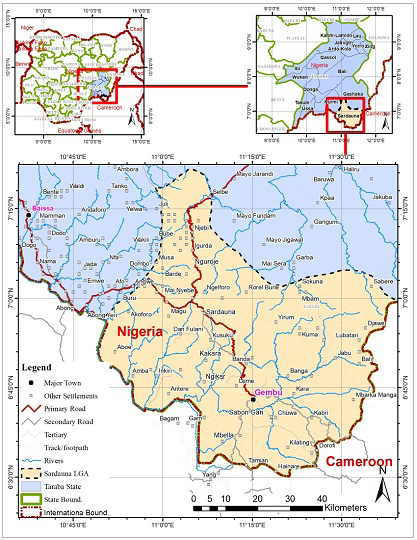
The Mambilla plateau is located between latitude 5o 30’ to 7o 18’ N and longitude 10o 18’ to 11o 37’E with a total land mass of 3,765.2km2 forming the southernmost tip of the North eastern part of Nigeria [18] (Figure 1). The entire area of the plateau falls under the Sardauna Local Government Area (LGA) in Taraba State, Nigeria. The plateau is ‘Cameroon-locked’ in its Southern, Eastern and almost half of its Western part [18]. The plateau is the highest elevation in West Africa [19]. Agriculture forms the economic mainstay of the people with estimated total land areas of about 83.6% and 8.3% devoted to range land and crop cultivation [20]. The area is inhabited by the Mambilla people and Fulani cattle rearer alongside with other smaller ethnic groups like Panso, Kambu and Kaka. The Mambilla people and the other ethnic groups are mainly crop farmers. Mambilla plateau is a land of beauty and wonders, replete with vast arable lands suitable for a wide range of agricultural crops such as maize, guinea corn, banana, plantain, beans (not cowpea), cassava, Irish potato, yam, cocoyam and cash crops such as tea, coffee, kolanut (accumulata), cocoa, avocado pear, soya beans, groundnut, apple and wheat. There exists coffee, tea, cocoa and palm oil plantations on Mambilla plateau. The forest of the Mambilla plateau provides lumberable trees that are felled for timber production and taken to different parts of the state and country for sale. Hence, lumbering is an important economic activity undertaken by the local people. The lumberable trees are sawn into different timber products. The Mambilla plateau also provides a good grazing ground for livestock. The plateau is free from tsetse fly infestation which characterizes the plains. It has been observed that over six million heads of cattle exist on the Mambilla plateau in the 1980s [18, 19]. Grazing is the major land use on the plateau which has resulted in frequent clashes with crop farmers. There exist different springs and waterfalls on the Mambilla plateau, which include the Njeke falls, the Chama and Mbujum falls and the Tiyi falls at Dorofi.
Data Collection and Analysis
Data for this study was generated through primary and secondary sources. The primary data were generated from field observation. Secondary data include archival data obtained from the Upper Benue River Basin Development Authority (UBRBDA) Meteorological stations at Gembu and Maisamari, both on the Mambilla plateau, desk review of existing literatures online, newspapers, journal publications and textbooks. The archival data include information on rainfall (rainfall totals and rain days per annum), temperature, relative humidity and wind speed for the period of 39 years (1981 - 2019). The rainfall data was used in calculating the mean monthly rainfall, annual rainfall, the onset, cessation and length of rainy season. Although, there are many methods of calculating the onset and cessation of rains, the Walter’s method Walter [21], which utilizes monthly rainfall data, was adopted in this study.
The decadal and inter annual variability in the time series of annual temperature and rainfall were analyzed using the trend analysis. Minitab statistical package was used for the analysis. The decadal and inter annual variability in the time series of annual rainfall, length of rainy season, onset and cessation was determined using coefficient of variation (CV), while the trends in the time series of these parameters (annual rainfall, length of rainy season, onset and cessation) were determined using simple regression and correlation analysis. The coefficient of variation is given as;
$$ 1 = \frac {\sigma}{\bar {x}} \times 1 $$
100% CV
Where x the mean of the entire series and σ is the standard deviation from the mean of the series.
In order to determine the trend in the time series of the annual rainfall, length of rainy season, onset, cessation and temperature in all the stations considered for the period 1981-2019, the simple regression analysis was used where by the values in the time series were regressed on time. The equation of the line of best fit was then computed using the Minitab statistical software. The equation is as follows;
$$ Y = a - b \bar {x} + c $$
Where a = intercept of the regression, b = regression of the coefficient and c = error term or residuals of the regression.
To determine whether the trend line in the time series analysed is upward or downward, the simple correlation coefficient (r) was used and defined as follows;
∑ xy xy N r x y σ σ $$ \cdot = \frac {\frac {\sum x y}{N} - x}{\sigma x - \sigma y} $$ where r is correlation coefficient, N is total number of observations in the series, Y is the observation in the series, x is the time in years, σx is the standard deviation of x and σy is the standard deviation of y. Where the value of (r) is positive, it indicates upward trend in the time series analysed and where the value of (r) is negative, it indicates down ward trend in the time series analysed. The data were presented using tables, frequencies, figures and percentages.
Results
Trends of Climatic Elements on the Mambilla
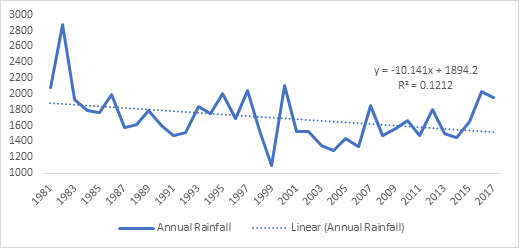
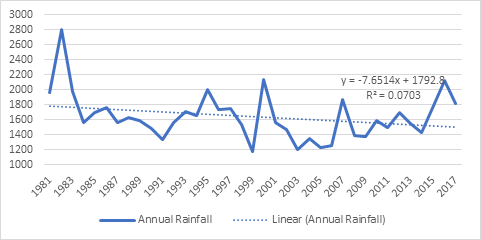
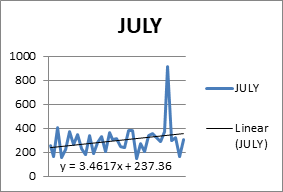
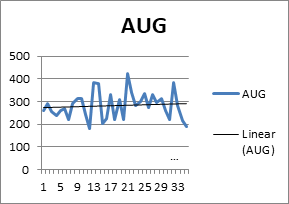
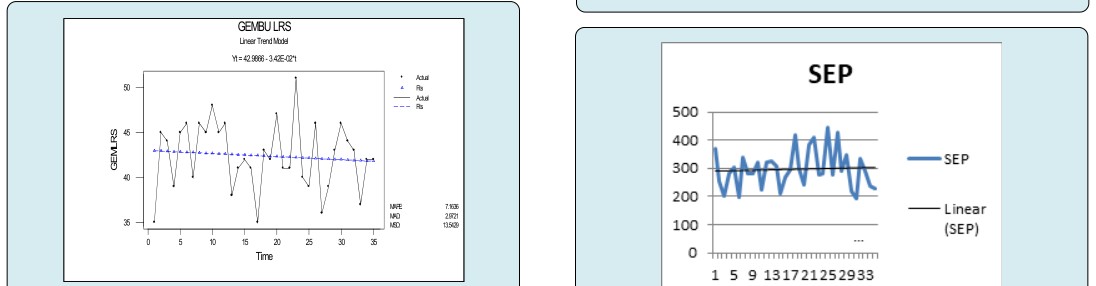
The summary of the findings on the trends of climatic elements at the stations are presented in Table 1 and 2. The trends of annual rainfall in the study area show that it is decreasing in both stations (Figures 2&3). The mean length of rainy season (LRS) shows a decreasing trend with mean length of 210 days (Table 1) (Figure 6). The result of the findings shows late onset and cessation of rains in the area (Figures 4&5). This indicates that the rain starts late and hence the beginning of growing season is being delayed. The mean onset date of rainfall in the area is 25th March. This corroborated the early report of Adebayo [6] in the area. The trend of rainfall cessation shows delayed trend with mean dates of 21st October. The rainfall for the months of July, August and September shows an increasing trend (Figures 7-9). Increase in rainfall in August and September is usually accompanied with floods. The rainfall distribution is significantly influenced by the altitude of the plateau because of orographic factor [6, 22].
| Climatic variable | Gembu (6°41'N) |
|---|---|
| TemperatureMean (°C)Coefficient of variation (%) | 21.36 |
| Annual rainfallMean (mm)Coefficient of variation (%) | 1807.412 |
| Onset date of rainsMean (date)Coefficient of variation (%) | 25th March 19 |
| Cessation date of rainsMean (date)Coefficient of variation (%) | 21st October 3 |
| Length of rainy season (LRS)Mean (date)Coefficient of variation (%) | 210 days |
Table 1: ** Summary Analysis of Climatic Data.
Source: Computer analysis 2019 Table 1: Summary Analysis of Climatic Data.
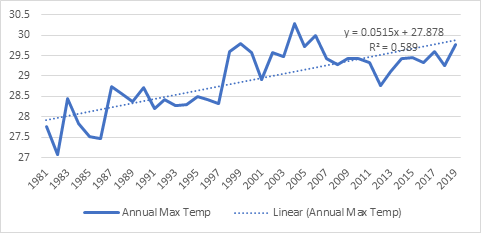
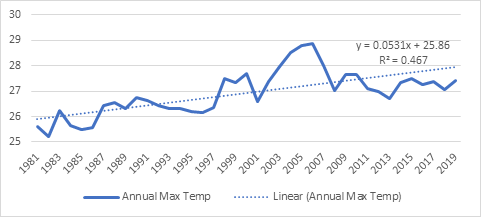
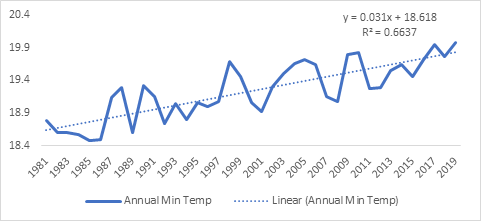
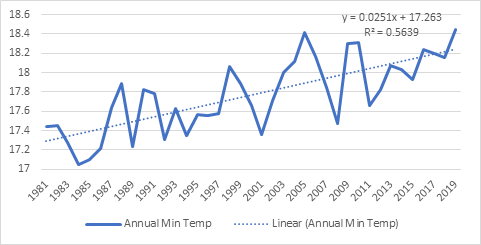
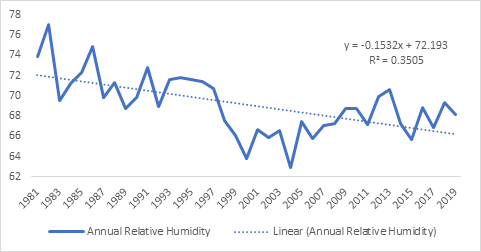
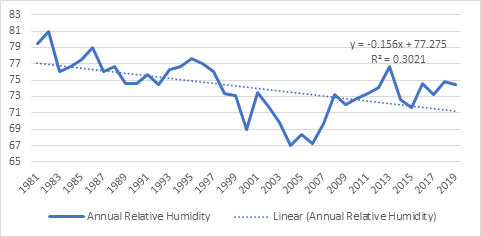
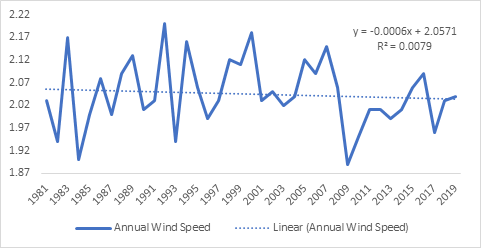
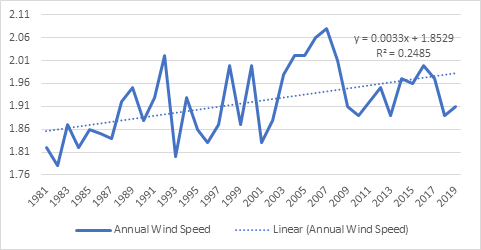
The trend of maximum and minimum temperature in the study area shows an increasing trend (Figures 10-13) with mean temperature of 21.3oC. The findings of the study revealed that the trend of relative humidity is decreasing in the study area. The trend in wind speed is increasing in recent time owing to increasing rate of deforestation in the area (Figures 16 & 17).
| Climatic elements | Trend of climatic element | |
|---|---|---|
| 1 | Temperature | Increasing |
| 2 | Annual rainfall | decreasing |
| 3 | Onset date of rains | Late |
| 4 | Cessation date of rains | Late |
| 5 | Length of rainy season (LRS) | Decreasing |
| 6 | July monthly rainfall | Increasing |
| 7 | August monthly rainfall | Increasing |
| 8 | September monthly rainfall | Increasing |
| 9 | Relative Humidity | Decreasing |
| 10 | Wind speed | Increasing |
Table 2: ** Description of the Trends of Climatic Elements studied.
Source: Computer analysis, 2019 Table 2: Description of the Trends of Climatic Elements studied.
Tea Farming on the Mambilla Plateau
In Nigeria, tea is exclusively grown in the humid, high altitude regions of Mambilla Plateau in Taraba State and Obudu in Cross River State [23]. Nigeria produces black tea with the CTC method, labeled ‘Highland tea’. According to Esan [24], the average yield of tea on commercial plots on the Mambilla is estimated at 1.5 t/ha [24]. Omolaja and Iremiren [25] observed that the total land area planted to tea is about 1,200 ha with an average annual national production of 1,640 tonnes, which meets only 10% of domestic need. There are over 6000 tea farms on the Mambilla used for the production of tea leaves [26]. This notwithstanding, Omolaja and Esan [27] argued that only less than 30% of the tealeaf raw material requirement of the local processing industries in the area is met. This corroborated earlier report by Obatolu and Ipinmoroti [28] that at present, the supply of tea from the Mambilla plateau is inadequate to meet the demand of the local tea processing industries in the country.
Because of the low quantity of tea production in the area, there have been several efforts to expand the land under tea cultivation which has not been successful as a result of so many problems which include shortage of farmland and perennial land use conflict in the area. Thus, the increasing variability in climatic element is further constraining tea production in the area.
Impact of Climate Variability on Tea Farming
Climate variability and change has both advantages and disadvantages to the growth and development of tea which ultimately affect its production. Variability in precipitation and temperature has considerable impacts on tea quality and yields by altering the quantities and types of pests and weeds in and around tea farms [16]. Alterations in the trend of wind, humidity, and temperatures would present additional challenges to tea farming.
The decreasing trend of rainfall amount and duration and relative humidity observed in the study area has a potential adverse impact on tea farming in the area. Also, increase in climate extremes and variations, such as drought, flood and extremely cold and hot weather can equally affect tea farming adversely in the area. Increasing incidence of dry spell in the study area is detrimental to tea production. Already, the declining amount of rainfall in the study area has compelled the Mambilla beverage company to develop a
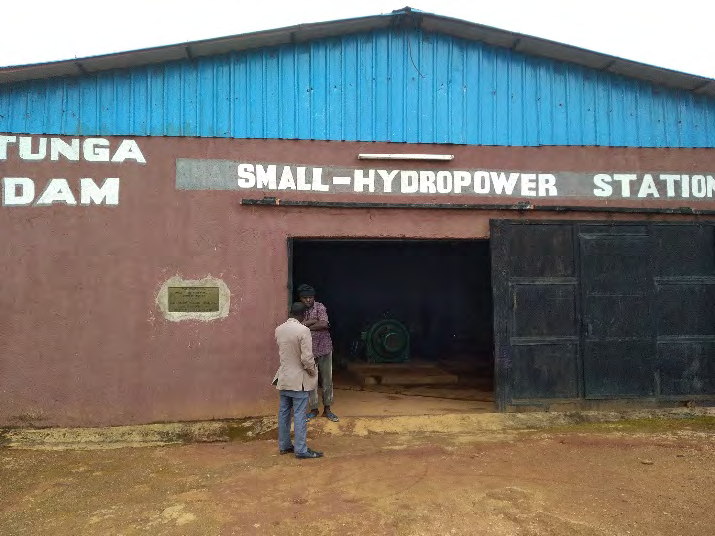
small hydro dam (Tunga dam) to supplement the water need of the tea farm during the short dry season through irrigation. The challenges become more when we consider the fact that there are so many small-scale tea farmers scattered all over the plateau that cannot afford to develop such small hydro dam and cannot access any surface water close to their tea farm (Plate 1 & 2).
The increasing temperatures in the study area, especially in the minimum temperature, have the tendency to extend the growing area of tea crop to either higher latitudes or higher altitude ecosystems. If this happens, it can make areas that are presently suitable for tea farming to become unsuitable thereby leading to a shift in suitable locations for the cultivation of some varieties of high-quality tea.
It has been observed that the global mean surface temperature has increased since the late nineteenth century. Each of the past three decades has been successively warmer at the Earth’s surface than any of the previous decades in the instrumental record period [13]. As with many other regions of the world, the major tea-producing countries such as China, India, Sri Lanka and Kenya have witnessed a significant change in climate in the last few decades. It has been observed that the global surface temperature will continue to change in the nearest future and is likely to exceed 1.5°C relative to 1850–1900, and warming will continue beyond 2100 [29].
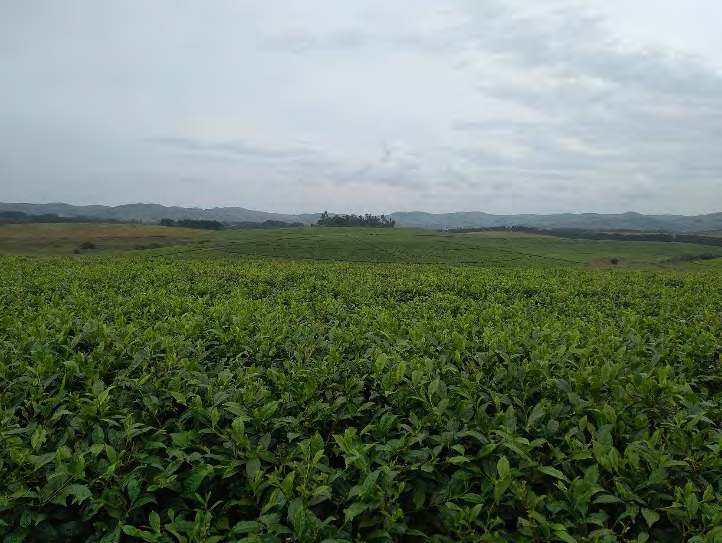
Plate 1: Tunga Small Hydropower dam. Plate 2: Tea Farm on the Mambilla Plateau.
Tea farming has a peculiar climatic requirement which include heavy rainfall well distributed and moderate temperature and high relative humidity among others. Considerable changes in these climatic elements will not only directly affect tea yield and quality, but will also affect the immediate physical characteristics that are basic to the growth and development of tea, such as soil pH, water content, organic matter, nutrient availability and pest and disease management [30].
Climate changes also bring about increase in the incidence and proliferation of pests, diseases and weeds [31]. Warmer weather helps insects and pathogens to survive in winter, which is a critical time for their reduction, and thus helps to shorten the damaging period by increasing the number of annual generations and reproduction rates in some pests [13]. Also, higher temperature, together with lower relative humidity, favours the emergence and growth of some pests that affects tea production.
Conclusion
This study has examined the potential impact of climate variability on tea farming on the Mambilla Plateau, Taraba State, Nigeria. The study used archival climate data of Upper Benue River Basin Development Authority (UBRBDA) Meteorological stations at Gembu and Maisamari, both on the Mambilla plateau. The data was analyzed using inferential statistics such as simple correlation coefficient (r), regression and time series analysis. The result of the findings on the trends of annual rainfall in the study area shows that both the rainfall amount, length of rainy season (LRS) and relative humidity are decreasing with late onset and cessation of rains in the area. The trend of maximum and minimum temperature and wind in the study area shows an increasing trend and increasing trend in wind speed owing to increasing rate of deforestation in the area. These observed climatic trend has potential adverse effects on tea farming on the Mambilla plateau.
Recommendations
Based on the findings of the study, the following recommendations are made; • Use of improved tea varieties, such as pest and drought resistant varieties.
• Enhance tea production ecosystems as a whole. Climate change adaptation strategies should include conservation agriculture, precision agriculture, organic agriculture, and other sustainable farming systems.
• Community participation in technology development. The development of new climate change adaptation technologies and techniques must include smallholder tea farmers.
• More public education and information exchange on indigenous and community-based adaptation strategies that are best suited to the local environment are required.
• Increasing the scope of mitigation and adaptation measures. Mitigation and adaptation measures for climate change should be extended to the most vulnerable areas in key tea-producing areas on the Mambilla plateau. Drought tolerant cultivars, increased organic fertilizer application, irrigation and water harvesting techniques, mulching, intercropping for greater diversity and balanced ecosystems, and better infrastructure are all common mitigation and adaptation measures.
References
-
Odekunle TO (2004) Rainfall and the length of the growing season in Nigeria. Int J Climatology 24(4): 467- 479.
-
Sobowale A, Sajo SO, Ayodele OE (2016) Analysis of Onset and Cessation of Rainfall in Southwest Nigeria: Food Security Impact of Variability on the Length of Growing Season. Hungarian Agricultural Engineering 30: 23-30.
-
Adebayo AA, Oruonye ED (2012a) An Investigation of Local Farmers Assessment of Climate Change in Northern Taraba State, Nigeria. Proceedings of the Conference of the Nigerian Meteorological Society (NMetS), held at the University of Benin, Benin City, Edo State, Nigeria, pp: 75.
-
Adebayo AA, Oruonye ED (2012b) An Assessment of the level of Farmers Awareness and Adaptation to Climate Change in Northern Taraba State, Nigeria. Proceedings of Climate Change and ICT Conference held at Osun State University Okuku campus, Osun State, Nigeria, pp: 13- 22.
-
Adebayo AA, Oruonye ED (2013) An Assessment of Climate Change in Taraba State, Nigeria. Nigerian Journal of Tropical Geography 4(2): 602-612.
-
Adebayo AA (2012) Evidence of Climate Change in Taraba State: A Preliminary Report. A paper presented at the Faculty of Science Seminar Series, held at the lecture hall on 13th September, 2012. Taraba State University, Jalingo, Nigeria.
-
Kowalzig J (2007) Adaptation to Climate, Poverty and Justice: What the Poznan UN Climate Conference needs to deliver for a fair and effective global climate regime. Oxfam International briefing paper.
-
Parry Martin L, Canziani Osvaldo F, Palutikof Jean P, van der Linden, Paul J, et al. (2007) Climate Change 2007: Impacts, Adaptation, and Vulnerability. Contribution of Working Group II to the Third Assessment Report of the Intergovernmental Panel on Climate ChangeCambridge University Press, Cambridge, United Kingdom, pp: 1000.
-
Ifeanyi obi CC, Etuk UR, Jike wai O (2012) Climate Change, Effects and Adaptation Strategies: Implication for Agricultural Extension System in Nigeria. Greener Journal of Agricultural Science 2(2): 53-60.
-
International Centre for Integrated Mountain Development (ICIMOD) (2010) Rural Livelihoods and Adaptation to Climate Change in the Himalayas. Information Sheet #5/10. Nepal.
-
Sonesson M, Messerli B (2002) The Abisko Agenda: Research for mountain area development. Ambio Special Report 11. Stockholm: Royal Swedish Academy of Sciences, pp: 3-301.
-
Eriksson M, Jianchu X, Shrestha AB, Vaidya RA, Nepal S, et al. (2009) The Changing Himalayas: Impact of Climate Change on water Resources and Livelihoods in the greater Himalayas. International Centre for Integrated Mountain Development, Nepal.
-
Wenyan H, Xin L, Peng Y, Golam JA (2018) Tea cultivation under changing climatic conditions. In: Sharma VS, Gunasekare MTK (Ed.), Burleigh Dodds Science Publishing, Cambridge, UK.
-
International Tea Committee (ITC) (2016) Annual Bulletin of Statistics. International Tea Committee LTD, London, pp: 52.
-
Azapagic A, Bore J, Cheserek B, Kamunya S, Elbehri A (2016) The global warming potential of production and consumption of Kenyan tea. J Clean Prod 112(5): 4031- 4040.
-
Selena A, John RS, Colin O, Timothy G, Corene M, et al. (2014) Effects of Extreme Climate Events on Tea (Camellia sinensis) Functional Quality Validate Indigenous Farmer Knowledge and Sensory Preferences in Tropical China. PLoS One 9(10): e109126.
-
Maddison D (2006) The perception of and adaptation to climate change in Africa. CEEPA Discussion Paper No. 10. Special Series on Climate Change and Agriculture in Africa Centre for Environmental Economics and Policy in Africa, University of Pretoria, Republic of South Africa.
-
Tukur AL, Adebayo AA, Galtima M (2005) The Land and People of the Mambilla Plateau. Heinemann Educational Books (Nig.) Limited.
-
Frantz C (1981) Development without Communities: Social Fields, Networks and Action in the Mambilla Grasslands of Nigeria. Human Organization 40(3): 211- 220.
-
Tukur AL, Zemba AA (2005) Agriculture. In: Tukur AL, Adebayo AA, Galtima M (Eds.), The land and people of the Mambila Plateau: Heinemann Educational Books (Nig) PLC.
-
Walter MW (1967) The length of the rainy season in Nigeria. Nigerian Geography Journal 10(2): 121-128.
-
Adebayo AA (2001) Dry spells and rice yield in Yola, Adamawa State. Environment and Development 4: 6-9.
-
Esan EB, Obatolu CR (1988) Transfer and adaptability studies of selected tea clones. Annual Report of the Cocoa Research Institute of Nigeria (CRIN), pp: 73
-
Esan EB (1989) Progress in tea (Camellia sinensis L.) in Nigeria. Progress in Tree Crop Research. 2nd (Edn.), Published by Cocoa Research Institute of Nigeria. pp: 209-216.
-
Omolaja SS, Iremiren GO (2012) Tea Improvement in Nigeria. Global Tea Breeding. Advanced Topics in Science and Technology in China. Springer, Berlin, Heidelberg, pp: 323-342.
-
(2018) Where tea grows in Nigeria. Online Newspaper, 18th February 2018. The Sun.
-
Omolaja SS, Esan EB (2018) Evaluation of high-altitude tea (Camellia sinensis (L.) O. Kuntze) for adaptability and yield in lowland ecologies of Nigeria. Plant Genetic Resource Newsletter 148: 32-37.
-
Obatolu CR, Ipinmoroti RR (2000) The comparative study of five tea clones underplantain shade in Ibadan, South- Western Nigeria. Proceedings of the 18th HORTSON Conference, held at the Institute of Agricultural Research, Ahmadu Bello University, Zaria, Nigeria, pp: 207-214.
-
Intergovernmental Panel on Climate Change (IPCC) (2013) Climate Change 2013: The Physical Sciences Basis. Cambridge University Press, pp: 33-118.
-
Ranjitkar S, Sujakhu NM, Lu Y, Wang Q, Wang M, et al. (2016) Climate modelling for agroforestry species selection in Yunnan Province, China. Environmental Modelling & Software 75(3): 263-272.
-
Lal R (2005) Climate change, soil carbon dynamics, and global food security. In: Lal R, et al. (Eds), Climate Change and Global Food Security. CRC Press, Boca Raton (FL), pp: 113-143.
- Lessons to Learn: Trees are More than the Lungs of the World
- Community Forestry Enterprises as a Model for Sustainable Forest Development: The Case Of The "Baja Tarahumara" in Chihuahua, Mexico
- Ecological and Socio-Economic Impacts of Chromolaena odorata and Mesosphaerum suaveolens, Two Invasive Alien Species in Central and Southern Benin, West Africa
- Epigenetic Sustainability: Modeling the Human Factor as a Natural Resource through Science 4.0 and the NR3C1 Biological Pilot
- Growth-at-Risk: A Framework for Assessing Economic Vulnerability
- The Rural Territory as a Socioecological System for the Management of Public Policy for Sustainable Rural Development