
Impact of Rainfall Variability on Maize Production in the NDOP Plain, North West Region of Cameroon (1990-2015)
This study assesses the impact of rainfall patterns from 1990-2015 on maize production in the NDOP Plain of the Bamenda Highlands of Cameroon since maize is a staple food and cash crop in the area. Data on rainfall and maize output were collected from 1990 to 2015 and represented in time series. The rainfall data were further analysed using Rainfall Anomaly Index (RAI), to establish critical periods of rainfall deficiencies. Results indicate that rainfall and maize production trends were increasing from 146.94 mm/month in 1990 to 220.03 mm/month in 2015 and ~0.28 tons/ha in 1990 to ~4.2 tons/ha in 2015 respectively. With uncertainties on the future of the rainfall pattern, the coefficient of variation was 22.03% (unreliable), and farmers should build resilience through agroecology, climate-smart agriculture, conservation agriculture and diversification of production systems.
Introduction
Precipitation is projected to increase over high latitudes and some parts of the monsoon regions, but will decrease over the tropics and sub-tropics [1]. Climate variability and change including increases in frequency and intensity of extremes, has adversely impacted food security and terrestrial ecosystems [2]. Climate change affects rain-fed agricultural systems as changes in trends and variability in rainfall reduce crop productivity [3]. At the same time, the food system generates negative externalities (environmental effects of production and consumption) in the form of greenhouse gas emissions and disruption of ecosystem services. These activities have direct and indirect impacts on climate change and reduced resilience to climate variability of local farmers [4].
In tropical agricultural systems, heavy rainfall and inundation can delay planting, increase soil compaction and cause crop losses through anoxia and root diseases [5]. Maize production has decreased across Africa, widening the food insecurity gap. In the Sahel and some rural communities of the Western Highlands of Cameroon, a decrease in maize production has exacerbated an increasing level of malnutrition. This is partly due to the impact of climate change since harsh climatic conditions lead to agro- meteorological droughts and crop failure [6]. However, there are no studies have assessed trends of rainfall changes and their likely relationships with the trends of maize production by smallholder farmers of the Bamenda Highlands of Cameroon over a long period of cropping seasons (1990- 2015). Therefore, the objectives of the study were: (1) To assess rainfall pattern in the study area for the period of twenty years (1990-2015); and (2) assess the impact of rainfall changes on maize production over the same period.
Study Area and Methodology
NDOP Plain in the North West Region of Cameroon is located between latitude 5°37’N to 6°14’N of the equator and between longitudes 10°23’E to 10°33’E of the Greenwich Meridian and an average altitude of about 700 metres above sea level (Figure 1). The area is made up of four agroecological zones which are Bamunka, Bamali, Bambalang and Bamesseng. The average annual temperature is about 26°C with an average daily maximum temperature of 27.22°C and a minimum average of between 11°C and 14°C which fluctuates rapidly than the maximum [7].
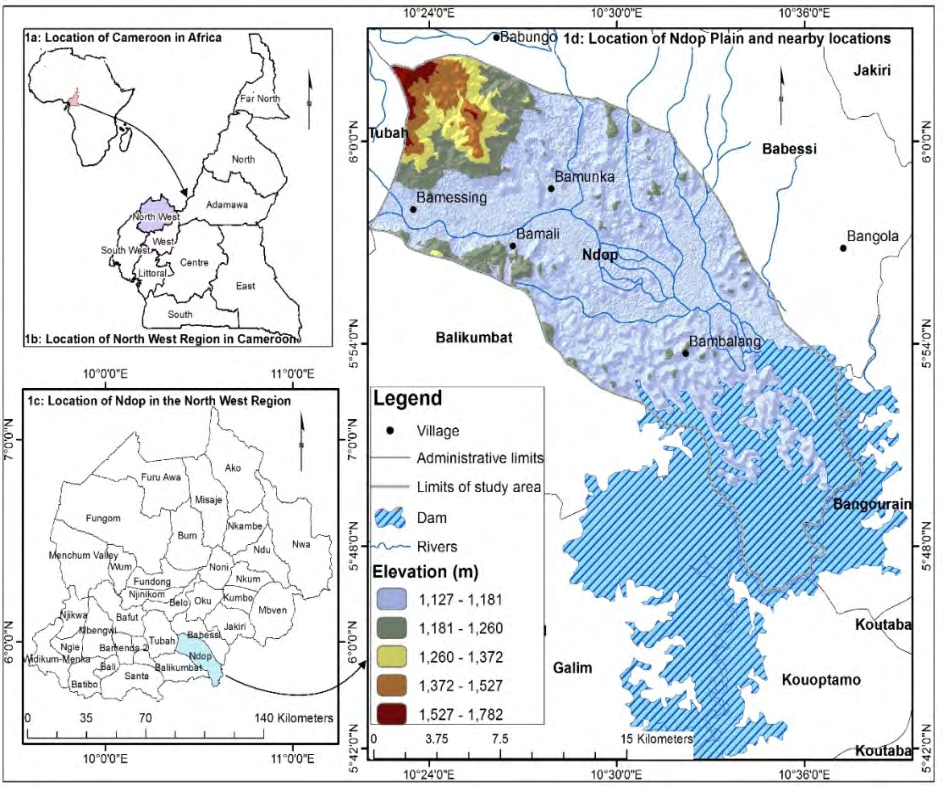
Inter-annual total rainfall varies between 1,524 mm and 1,770 mm and the rainy season lasts for 7-8months (March to October). The gentle sloping nature of the topography lends itself to the predominance of extensive wetlands, which have favoured intensive lowland cereal (maize and rice) cultivation. The north and south combination of hills and mountainous chains are separated by the NDOP flood plain which is studded by numerous marshes or swamps into which a host of tributaries unite to form the main irrigation river into the cereal fields called the noun river downstream [7].
Rainfall and maize output data were collected from 1990 to 2015 from the Upper Noun Valley Authority (UNVDA) and the Divisional Delegation of Agriculture and Rural Development respectively. The data were organized using time series to establish the trends. The rainfall index Rainfall Anomaly Index (RAI) was used for this study as it is dimensionless and also used to determine rainfall variation. This range is from ≥3.0 (extremely wet) to ≤-3.00 (extremely dry) (Table 1).
| RAI range | Class description | |
|---|---|---|
| ≥3.0 | Extremely wet | |
| 2.00 to 2.99 | Very wet | |
| 1.00 to 1.99 | Moderately wet | |
| 0.50 to 0.99 | Slightly wet | |
| 0.49 to -.49 | Near normal | |
| -0.50 to -0.99 | Slightly dry | |
| -1.00 to -1.99 | Moderately dry | |
| -2.00 to -2.99 | Very dry | |
| ≤-3.00 | Extremely dry |
Table 1: RAI classification. Source: van Rooy [8].
Results
Rainfall changes in the NDOP Plain
The inter-annual rainfall in NDOP Plain has been increasing slightly from 1990-2010 (Figure 2) with a mean annual rainfall of 158.15 mm, rainfall Standard Deviation of 38.84 and a Coefficient of Variation (CV) of 22.03% (unreliable).
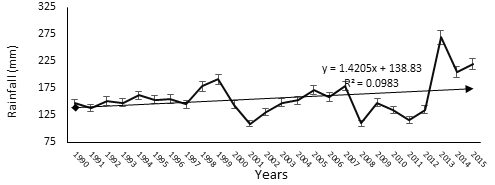
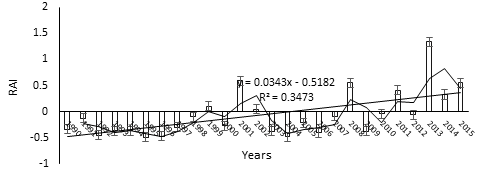
The inter-annual Coefficient of Determination (R2) was 0.0983 (9.83%). Results also indicated that in the same vein, the RAI has been increasing, but depicting unreliable rainfall shown by the CV of 22.03% and the inter-annual R2 for was 0.3473 (34.73%) (Figure 3).
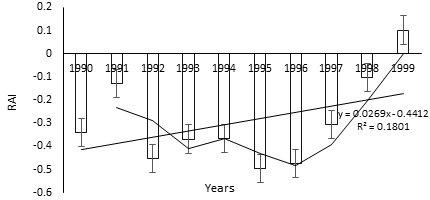
From 1990 to 1999, the RAI was increasing below the baseline and the rainfall was unreliable. During this period, rainfall conditions were not normal as the RAI values ranged from -0.49 to 0.1 (Figure 4).
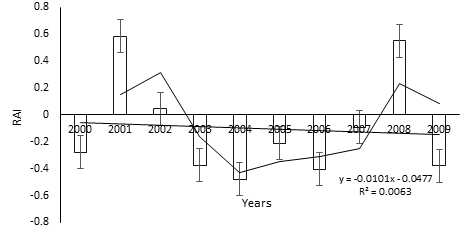
From 2000 to 2009, the RAI trends were decreasing below the baseline, showing some degree of rainfall reliability (Figure 5). This period was dominated by near normal conditions and two incidents of slightly dry conditions (-0.58 in 2000 and 0.55 in 2008).
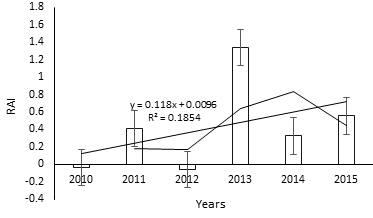
Further, RAI had an increasing trend from 2010 to 2015 (Figure 6). The period was characterised by near normal conditions.
Impact of rainfall change on maize production
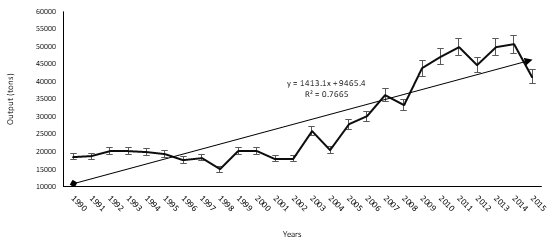
The output of maize has been increasing from 1990-
2015 (Figure 7).
Results indicated that a correlation between rainfall and maize output was positive (Figure 8).
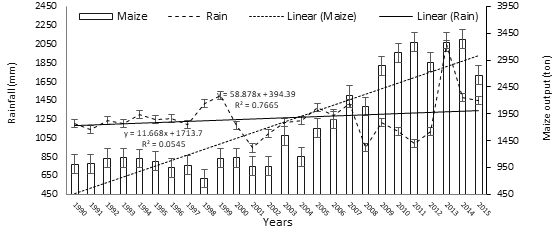
There is a slight disparity in the increasing trends because the slope for maize output is steeper than that of rainfall. This is because maize production has maintained a steady increase despite rainfall unreliability.
Discussion
NDOP Plain is found within the Cameroon Mountain type climate with two distinct seasons: the dry season which begins in Mid-November and ends in Mid-March. The average total annual rainfall is about 2500mm and is fairly distributed within the rainy season [7, 9]. A rainfall of 100 mm/month distributed evenly during the growing period is preferable to 200 mm/month, which fell in two or three days. Maize can grow and yield with as little as 300 mm rainfall (40% to 60% yield decline compared to optimal conditions) but prefers 350 to 500 mm as the optimal range which is prevailing conditions in NDOP Plain with an annual average rainfall of about 2,500 mm. Approximately 10 to 16 kg of maize grain are produced for every millimetre of water used. A yield of 3,152 kg/ha-1 (~3.2 tons/ha-1) requires between 350 and 500 mm of rain per annum. At maturity, each plant will have used 250 litres of water in the absence of moisture stress [10]. Depending on soil type and stored soil moisture, crop failure would be expected if less than 300 mm of rain is received per growing season in the tropics [11].
The maize crop is not too sensitive to water changes during its development unlike other cereals like rice and wheat. Rainfall thresholds of 85-275mm are required for a successful maize crop cycle (in the equatorial climate, Cameroon Mountain). Rainfall is highly unreliable at the beginning of the wet season in terms of the number of rainy days to support tender crops that are highly susceptible and sensitive to the least changes in water requirements [12]. Both evaporation and transpiration are driven by a tremendous drying force the atmosphere exerts on plant surfaces. The magnitude of daily evapotranspiration will vary with atmospheric conditions. For example, high solar radiation and air temperatures, low humidity, clear skies and high wind increase evapotranspiration, while cloudy, cool and calm days reduce evapotranspiration [13]. Seasonal maize water use is also affected by growth stage, length of the growing season, soil fertility, water availability and the interaction of these factors.
Maize water requirements change throughout the season and location. Young plants transpire less than larger plants due to a smaller leaf surface area. Maize requires more water just before and during the reproductive growth stages. It generally follows a pattern of gradual increase of water requirements from the beginning of the growing season, when the maize crop is sown to a maximum threshold of about 0.3 inches/day during tasseling and development of cobs. As such, water requirements reduce gradually for the maize crop from blistering to maturity phase. Water requirements for the growth and development of the maize cycle indicate that the water requirements at the stage of germination (establishment), vegetative, tasseling, cob setting or filling and maturity are not uniform. High yielding maize requires approximately 20 to 30 inches of water per year depending on planting date, maturity group, location, and weather conditions [14].
Conclusion
Maize production in the NDOP Plain has been increasing despite unreliable rainfall. In the face of an uncertain climate in the future, farmers must safeguard sustainable livelihoods and ensure food security through agroecological practices, climate-smart agriculture (CSA), conservation agriculture (CA) and diversification of production systems. Agroecology provides knowledge for designing and management, including social, economic, political and cultural dimensions. It builds systems resilience through knowledge-intensive practices relying on traditional farming systems and co-generation of new insights and information with stakeholders through synergies. The CSA is designed to be a pathway towards development and food security on three pillars: increasing productivity and incomes, enhancing the resilience of livelihoods and ecosystems and reducing, and removing greenhouse gases emissions from the atmosphere. The CA is based on the principles of minimum soil disturbance and permanent soil cover, combined with appropriate crop rotation. The CA responds with positive benefits to smallholder farmers under economic and environmental pressures. This agricultural production system uses a body of soil and residues management practices that control erosion and at the same time improve soil quality, by increasing organic matter content and improving porosity, structural stability, infiltration and water retention. Above all, diversification of production systems (with agroforestry and rice culture) can promote food security and provide many additional ecosystem services when compared with monoculture crop systems. Co-benefits for mitigation and adaptation include increased carbon sequestration in soils and biomass, improved water and nutrient use efficiency and the creation of favourable micro-climates.
References
-
Intergovernmental Panel on Climate Change-IPCC (2021) Summary for Policymakers. In: Climate Change 2021: The Physical Science Basis. Contribution of Working Group I to the Sixth Assessment Report of the Intergovernmental Panel on Climate Change. In: Masson Delmotte V, et al. (Eds.), Cambridge University Press, pp: 41.
-
Intergovernmental Panel on Climate Change-IPCC (2019) Climate Change and Land: an IPCC special report on climate change, desertification, land degradation, sustainable land management, food security, and greenhouse gas fluxes in terrestrial ecosystems. In: Shukla PR, et al. (Eds.), pp: 1-77.
-
Tume SJP, Kimengsi JN (2021) Indigenous and modern agro-based climate adaptation practices in rural Cameroon. International Journal of Environmental Studies 78(5): 1-10.
-
Arneth A, Denton F, Agus F, Elbehri SA, Erb K, et al. (2019) Framing and Context. Climate Change and Land, an IPCC special report on climate change, desertification, land degradation, sustainable land management, food security, and greenhouse gas fluxes in terrestrial ecosystems. Cambridge University Press, pp: 79-130.
-
Jia G, Shevliakova E, Artaxo P, De Noblet Ducoudré N, Houghton R, et al. (2019) Land–climate interactions. Climate Change and Land, an IPCC special report on climate change, desertification, land degradation, sustainable land management, food security, and greenhouse gas fluxes in terrestrial ecosystems. Cambridge University Press, pp: 131-247.
-
Mbow C, Rosenzweig C, Barioni LG, Benton TG, Herrero M, et al. (2019) Food Security. Climate Change and Land, an IPCC special report on climate change, desertification, land degradation, sustainable land management, food security, and greenhouse gas fluxes in terrestrial ecosystems. Cambridge University Press, pp: 439-550.
-
Nkiene AV, Nkwemoh CA, Tchawa P (2016) The vulnerability of swamp rice production to the observed effects of rainfall and temperature variability in NDOP Sub-Division, Cameroon. Canadian Journal of Tropical Geography 3(2): 1-14.
-
van-Rooy MP (1965) A Rainfall Anomaly Index (RAI), Independent of the Time and Space. Notos 14: 43-48.
-
Tume SJP, Nyuyfoni RS (2021) Rainfall Anomaly Index Valuation of Agricultural Production in Jakiri Sub-Division, Northwest Region, Cameroon. Modern Concepts & Developments in Agronomy 9(4): 931-943.
-
du Plessis J (2003) Maize Production. Department of Agriculture, Directorate Agricultural Information Services Private Bag X144, Pretoria, 0001 South Africa, pp: 38.
-
Mendoza PB, Rajagopalan M, Cortés C, McPhee J (2014) A robust multi-model framework for ensemble seasonal hydroclimatic forecasts. Water Resources Research 50(7): 6030-6052.
-
Tume SJP, Fogwe ZN (2018) Standardised Precipitation Index Valuation of Crop Production Responses to Climate Variability on the Bui Plateau, Northwest Region of Cameroon. Journal of Arts and Humanities 1(2): 21-38.
-
Kranz WL, Irmak S, van Donk SJ, Yonts CD, Martin DL (2008) Irrigation management for corn. NebGuide G1850, University of Nebraska-Lincoln Extension, pp: 2.
-
Schneekloth J, Andales A (2017) Seasonal Water Needs and Opportunities for Limited Irrigation for Colorado Crops. Fact Sheet No 4718, Crop Series/Irrigation L pp: 1-4.
- Lessons to Learn: Trees are More than the Lungs of the World
- Community Forestry Enterprises as a Model for Sustainable Forest Development: The Case Of The "Baja Tarahumara" in Chihuahua, Mexico
- Ecological and Socio-Economic Impacts of Chromolaena odorata and Mesosphaerum suaveolens, Two Invasive Alien Species in Central and Southern Benin, West Africa
- Epigenetic Sustainability: Modeling the Human Factor as a Natural Resource through Science 4.0 and the NR3C1 Biological Pilot
- Growth-at-Risk: A Framework for Assessing Economic Vulnerability
- The Rural Territory as a Socioecological System for the Management of Public Policy for Sustainable Rural Development