
Verification and Demonstration of Soil Test Based Phosphorous Calibration for Wheat Crop under Nitisols of Southeastern Ethiopia
The experiment was conducted in different farmer sites and provinces at Lemu-Bilbilo district, Southeastern Ethiopia. Two fertilizer treatments: blanket type of fertilizer recommendation and soil test based fertilizer recommendation laid out in Randomized Complete Block Design with four farmer’s field as replications. Data on yield and yield components of wheat were collected and the result indicates that the grain and straw yield for soil test based fertilizer recommendation were increased by 19% and 12% over the blanket type of fertilizer application (30 P kg ha-1 and 73 N kg ha-1), respectively. Hence, in this trial there was a significant grain as well as above ground biomass yield difference among the treatments. Generally the result indicated that application of soil test based phosphorus fertilizer recommendation rate calibrated in Lemu-Bilbilo district, Southeastern Ethiopia is recommendable treatment for improving productivity of wheat crop under the conditions of the present study area, similar agro-ecologies and soil types.
Introduction
Soil testing is well recognized as a sound scientific tool to assess inherent power of soil to supply plant nutrients and have been established through scientific research, extensive field demonstrations, and on the basis of actual fertilizer use by the farmers on soil test based fertilizer use recommendations [1]. Soil testing is the most reliable tool for making good economic and environmental decisions about applying fertilizers; hence it is helpful for efficient and effective use of P fertilizer [2].
Thus, Soil test based, site-specific nutrient management has become a major tool for increasing productivity of agricultural soils. Soil tests are designed to help farmers predict their soil’s available nutrient status. Once existing nutrient levels are established, producers can use the data to best manage what nutrients are applied, decide the application rate, and make decisions concerning the profitability of their operations while managing for impacts such as erosion, nutrient runoff, and water quality. Critical P value is the phosphorus level in the soil in which the probability of getting yield response due to the application of P fertilizers above this value is very low [3, 4]. P- Requirement factors, is the amount of P required per hectare to raise the soil test level by one mg kg-1.
Declining soil fertility is a major challenge on crop production and productivity in Ethiopia. The popularization of different types of fertilizers is increasing in the country from the last few years up to date. However, there is a major challenge facing the small holder farmers not only getting fertilizers at affordable price but also extension of fertilizer among the farmers. Thus, farmers are using blanket fertilizer recommendations which is not recommended based on soil fertility status and crop nutrient requirements.
Considering this Kulumsa Agricultural Research Center has developed soil test based phosphorus critical value and phosphorus requirement factor for wheat in Lemu- Bilbilo district of Nitisols. So, this trial was conducted with the objective to verify and demonstrate the soil test based calibrated phosphorus fertilizers findings for major crops and soil types, create awareness on soil test based fertilizer recommendation on end users, develop phosphorus fertilizer recommendation guide line; and enhance crops production and productivities per unit area in the project sites.
Materials and Methods
Experimental Site Description
On-farm field experiments were conducted in 2017 growing season at Lemu-Bilbilo district, southeastern Ethiopia. The study area is one of the major wheat growing areas and located from 070 35’ 300” to 070 27’ 530” N, and 0390 13’ 899” to 039015’ 133” E with an elevation ranging from 2226 to 2873 meters above sea level. The average weather data recorded on the weather station located at Bekoji sub-station near the study sites in the year 2016 and 2017 indicate that the mean annual rainfall were 3011.9 mm and 2973.6 respectively. The annual mean minimum and maximum air temperature for the consecutive years are (3.7, 4.2 0C) and (20.1, 20.3 0C), respectively.
Design and Treatments
The experiment was set with two treatments of phosphorus fertilizer rates and five farmers replications. The Blanket fertilizer recommendation containing TSP (30 kg ha-
1) and Urea (73 kg ha-1 N) is commonly used as fertilizer type. The soil test based fertilizer recommendation is taken as a treatment from the one which is recommended by Kulumsa Agricultural Research Center at Lemu-Bilbilo district of southeastern Ethiopia .The size of each experimental plot was 10 m * 10 m (100 m2) having a distance of 1.0 m between plots as a path. Data were collected from the net plot size of 3*(3 m*3 m) (27 m2) for each treatment. Triple supper phosphate (TSP) was used as a source of phosphorus and applied as side banding at sowing time. Urea fertilizer was split and applied at planting time and the remaining was applied after weeding. All crop management practices including sowing, harvesting, protection against diseases and pests damage, weeding etc. were done according to farmer’s practice in the area.
Soil Sampling and Analysis
Surface soil, 0 to 20 cm depth, were collected from the entire experimental field before planting and after harvesting. The soil was air dried and made fine by using mortar and pestle. The fined soil was passed through 2mm sieve and the soil pH, Available P, Total N and OC were determined at Kulumsa Agricultural soil Laboratory. Soil pH (H2O) was measured by using a pH meter in a 1:2.5 soil: water ratio. Soil organic carbon was estimated by the Walkley-Black wet oxidation method. Total nitrogen was determined by the micro-Kjeldahl digestion, distillation and titration method, and available P was determined using the standard Bray II extraction method.
Agronomic and Yield Data Collection
Data of tiller per plant, plant height, number of spike per 50cm, number of seed per spike, grain yield, and above ground biomass were collected in five trials average from each plot. The plant height was measured from the base of the plant to the apical bud of plant and expressed in centimeters. Number of spike per 50cm were taken by using quadrant 50 cm*50 cm and recorded as a mean value. Grain yield, and above ground biomass were analyzed gravimetrically by using sensitive balance and recorded in units of gram.
Results and Discussion
Soil Chemical Properties
The pH of the trial site soil (pH = 5.27) was strongly acidic (Table 1) as per the ratings of [5]. The organic carbon & Organic matter content of the soils were 3.70 % and 6.36 % (Table 1) which is rated as high [5]. The high organic matter (OM) content in cultivated land soil is resulted due to factors like remaining crop residues or biomasses return to the soil. Cultivated, temperate-region soils normally have 3-4% OM, while soils of semi-arid rain-fed areas have normally less than 1.5% OM [6].
The total nitrogen of the experimental site soil was 0.23% which is rated as in medium range (Table 1) as [7] rating. Large losses of total nitrogen in the cultivated land could be attributed to rapid mineralization of soil OM following cultivation, which disrupts soil aggregates, and thereby increasing aeration and microbial accessibility to OM.
| Fertilizer Rate | pH (1፡2.5) | Av. P (ppm) | TN (%) | OC (%) | OM (%) |
|---|---|---|---|---|---|
| Mean soil data before planting | |||||
| 5.27 | 12.02 | 0.23 | 3.70 | 6.39 | |
| Mean soil data after Harvesting | |||||
| Soil test based fertilizer recommendation | 4.99 | 18.69 | 0.28 | 3.37 | 5.80 |
| Blanket fertilizer recommendation | 5.03 | 15.12 | 0.28 | 3.31 | 5.72 |
Table 1: Soil analysis result of experimental site before planting and after harvesting.
Phosphorus Fertilizer Recommendation
According to Kulumsa Agricultural Research Center 2010/2011 (unpublished) soil test based phosphorus fertilizer recommendations were established as critical phosphorus concentration and P- requirement factor for wheat at Lemu-Bilbilo district. This was done by first deriving formula from successive field trials over years. The formula is expressed as, Rate of fertilizer to be applied (mg kg-1) = (Pc-Po)*Pf Where, Pc = Critical P concentration (21 mg kg-1) Po = Initial P values for the site (mg kg-1) As a result, phosphorus fertilizer (TSP) was added by calculating with the help of the formula derived for Lemu- Bilbilo district of Nitisols. Urea fertilizer was applied based on the previously blanket recommendation. After calculating the rate of P fertilizer in kg ha-1, it was converted in to the experimental plot size.
Pf = P-requirement factor (5.54 (kg ha-1 P)/ (mg kg-1)) The critical value of available phosphorus for wheat in Lemu-Bilbilo district of nitisols is 21 mg kg-1. As shown in Table 2, the soil laboratory result was found to be with deficits of phosphorus for the specified crop.
| Farmers | Po (mg kg-1) (Bray II) | Pc (mg kg-1) (Bray II) | Pf (Bray II) | P rate (kg ha-1 P) |
|---|---|---|---|---|
| F1 | 6.7 | 21.0 | 5.5 | 79.3 |
| F2 | 18.5 | 21.0 | 5.5 | 14.1 |
| F3 | 9.9 | 21.0 | 5.5 | 61.6 |
| F4 | 13.0 | 21.0 | 5.5 | 44.1 |
| mean | 12.0 | 21.0 | 5.5 | 49.8 |
Table 2: P fertilizer values at each farmer’s experimental site.
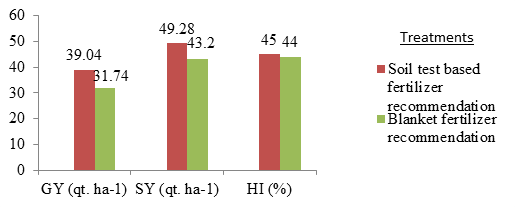
Effect of Phosphorus fertilizer on growth, yield and yield components of wheat Higher mean plant height, number of spike per 50 cm, number of seed per spike and harvest index (82 cm, 37,
46, and 45 (%) were recorded in soil test based fertilizer recommendation and the minimum was obtained in Blanket phosphorus fertilizer recommendation (Figures 1 and 2).
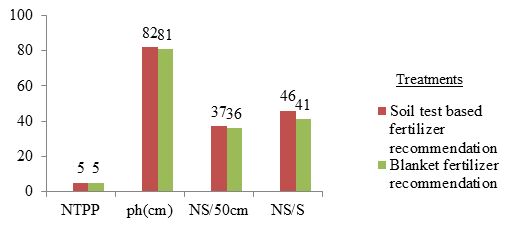
Figure 1: Effect of Phosphorus fertilizer rates on growth components of wheat NTPP = number of tiller per plant; ph = plant height, NS = number of spike; NS/S = number of seed per spike Moreover, the result revealed that grain and straw yields in soil test based fertilizer recommendation were 19% and 12% higher than the blanket type of application (30 P kg ha-1 and 73 N kg ha-1), respectively (Fig 2). Therefore the soil test based fertilizer application is suitable in such a way that it receives an optimal fertilizer to feed the crop.
Partial Budget Analysis
These costs and benefits calculated were based on the prices valued for each item in 2016 and 2017 cropping season. As a result, the soil test based fertilizer recommendation returns higher net benefit (27639.65 ETB ha-1) than the blanket type fertilizer application (23841.62 ETB ha-1) (Table 3).
The net return were calculated from the total revenue and total costs that vary (TCV) from each treatments so as to observe if there is a variation among the treatments [8].
| Adjusted grain yield (kg ha-1) | Gross field benefit (ETB ha-1) | TSP cost (ETB ha-1) | Urea cost (ETB ha-1) | TCV (ETB ha-1) | Net benefit (ETB ha-1) | |
|---|---|---|---|---|---|---|
| Blanket fertilizer recommendation | 3306 | 26450.62 | 1800 | 800 | 2609 | 23841.62 |
| Soil test based fertilizer recommendation | 3957 | 31654.65 | 3000 | 800 | 4015 | 27639.65 |
Table 3: Partial budget analysis of adjusted grain yield for the crop wheat.
Note: TCV = Total cost that vary Table 3: Partial budget analysis of adjusted grain yield for the crop wheat.
Conclusion
The result has indicated that there is a variation in grain and straw yield among the treatments. As a result, the soil test based fertilizer recommendation were 19% and 12% higher in grain and straw yield than the blanket type of fertilizer application respectively. Generally, almost all the dominant agronomic parameters such as response of plant height, number of spike per 50cm, number of seed per spike, grain yield, straw yield and harvest index shows significant difference among the treatments due to the soil test based fertilizer application when compared to blanket type fertilizer recommendation. Accordingly, treatments with the soil test based fertilizer application are economical for wheat production in the study area, similar agro-ecologies and soil types.
References
-
Corbeels M, Shiferaw A, Haile M (2000) Farmers’ knowledge of soil fertility and local management strategies in Tigray, Ethiopia. IIED-Dry lands Programme.
-
Dick WA, Blevins RL, Frye WW, Peters SE, Christenson DR, et al. (1998) Impacts of agricultural management practices on C sequestration in forest-derived soils of the eastern Corn Belt. Soil and Tillage Research 47(3-4): 235-244.
-
Nelson LA, Anderson RL (1977) Partitioning of soil test crop response probability. Soil testing: Correlating and interpreting the analytical results 29: 19-38.
-
Kelling KA, Schulte EE, Bundy LG, Combs SM, Peters JB (1991) Soil test recommendations for field, vegetable and fruit crops. Univ. Wisconsin Coop. Ext. Serv. Bull. A, 2809.
-
Tekalign T, Haque I, Aduayi EA (1991) Soil, plant, water, fertilizer, animal manure and compost analysis. Working Document No. 13. Soil Science and Plant Nutrition Section, ILCA, Addis Ababa, Ethiopia.
-
George E, Rolf S, John R (2013) Methods of Soil, Plant, and Water Analysis. A Manual for the West Asia and North Africa region. International Center for Agricultural Research in the Dry Areas (ICARDA), pp: 244.
-
Berhanu D (1980) The physical criteria and their rating proposed for land evaluation in the highland region of Ethiopia. Land use planning and regulatory department, ministry of agriculture, Addis Ababa, Ethiopia.
-
CIMMYT (1988) From Agronomic Data to Farmer Recommendations: An Economics training manual. Completely revised edition. Mexico, D.F.
- Lessons to Learn: Trees are More than the Lungs of the World
- Community Forestry Enterprises as a Model for Sustainable Forest Development: The Case Of The "Baja Tarahumara" in Chihuahua, Mexico
- Ecological and Socio-Economic Impacts of Chromolaena odorata and Mesosphaerum suaveolens, Two Invasive Alien Species in Central and Southern Benin, West Africa
- Epigenetic Sustainability: Modeling the Human Factor as a Natural Resource through Science 4.0 and the NR3C1 Biological Pilot
- Growth-at-Risk: A Framework for Assessing Economic Vulnerability
- The Rural Territory as a Socioecological System for the Management of Public Policy for Sustainable Rural Development