
Evaluation of assisted natural regeneration and stored carbon in Prioria balsamifera (Vermoesen) Bretteler plots of the Luki Biosphere Reserve in Central Kongo, Democratic Republic of Congo
Extensive programs of enrichment through natural assisted regeneration were implemented between 1946 and 1959 by INEAC (Institute National pour étude Agronomique du Congo belge). He has conducted several studies for the implementation of silvicultural techniques in tropical environments, particularly in the Luki Biosphere Reserve (RBL) in the DRC. The Prioria balsamifera natural assisted regeneration (RNA) plots were part of the various silvicultural treatments implemented between 1956 and 1962 after clear-cutting. Five decades after their establishment, no evaluation has been undertaken. The objective of this study is to evaluate the natural assisted regeneration in the P. balsamifera plots and to account for the carbon sequestered in the P. balsamifera RNA after clear-cutting. The methodological approach to floristic, dendrometric and allometric inventories was used to determine the specific richness and diversity of the different study plots and to account for the carbon of the RNA biomass of the fifteen sampling plots of 0,25 ha each at three sites: Camp1; Camp2 and the RBL Post. The study revealed a higher density per hectare in the Camp1 plot, almost double the last two plots of the sampling.
Introduction
The Mayombe forest in the Democratic Republic of Congo (DRC), once covered 15,000 km2 [1, 2]. It has been the subject of intensive exploitation which has led to its disappearance and to a depletion of species of commercial value [3]. The Luki Biosphere Reserve (RBL) remains to this day the last representative sample of an ancient primary forest, from the Mayombe forest preserved until now. Despite this degradation, it is still of great economic importance, due to its privileged location just a few kilometers from the port of embarkation of Boma. The RBL which is our study site and its surroundings continue to be under very strong illicit pressure from artisanal loggers in proportion to the needs of the markets of Kinzau-Mvuete, Boma, Matadi, Kinshasa and even Angola [4, 3].
In 2009, for example, Prioria balsamifera took second place in exports with an equivalent volume of 45,238.12 m³ or 18.43% of exports after Milicia excelsa with a volume of 82,578.74 m³ or 33.64% [5]. In the national and local economies of several countries, forests have always played multiple roles [6, 7, 8, 9], mainly for communities that have only to ensure their survival [10, 11]. Despite this, the sustainable management of these natural resources, which on the surface seems inexhaustible, is necessary because of the anthropogenic pressures they are subject to Bernard [3], Nkomwa [10].
Logging in the Mayombe forest began in 1933. It accounted for more than 80% of the colony’s timber exports in 1939, based especially on Terminalia superba and to a lesser extent on P. balsamifera [1]. However, between 1946 and 1959, major enrichment programs using assisted natural regeneration were implemented. To this end, the National Institute for the Agronomic Study of the Belgian Congo (INEAC) has conducted several studies for the implementation of silvicultural techniques in tropical environments, particularly in the RBL, in the DRC, including the installation of regeneration plots assisted natural of P. balsamifera not only to enrich the forest with valuable species, but also to assess the potential for natural regeneration of this same species [12]. In this way, since the installation of these plots of assisted natural regeneration, no assessment has been made to determine the potential for natural and assisted forest regeneration [13, 14, 15, 16].
The present study evaluates assisted natural regeneration (ANN) assays of P. balsamifera in RBL. This assessment is pioneering in tropical forests and highlights information on the regeneration potential of P. balsamifera.
It is a unique opportunity in the DRC insofar as it stimulated the regeneration of P. balsamifera until obtaining a stand with a very high density whose mother tree is no longer identifiable after the establishment between 1956 and 1962 after a massive clear cut.
The question of our research is to know if the RNA of P. balsamifera is a successful program when considering the dendrometric, floristic and structural aspect; thus does it contribute to the reduction of emissions due to degradation and deforestation? This study contributes to the expansion of knowledge on the assisted natural regeneration of some forest species of the RBL, for the reconstitution of the Mayombe forest. It will allow the updating of a database on the floristic composition of the reserve in addition to the accounting of the aboveground carbon of the plots in natural forest regeneration assisted by P. balsamifera. This is to support their conservation and/or sustainable management. The evaluation of assisted natural regeneration of P. balsamifera focused on specific richness and diversity, density/ha, stands structure and aerial biomass. The present study aims to inventory the assisted natural regeneration of P. balsamifera in the RBL. Specifically, it involves: i) Evaluating the RNA of P. balsamifera by considering the dendrometric and floristic parameters; ii) Determine the relationship between tree density and diameter; iii) Determine the diameter structure of P. balsamifera stands; iii) Determine the amount of forest carbon sequestered by assisted natural regeneration plots in Luki. To achieve this, the following hypothesis is put forward, namely: The lack of maintenance in the RNA plots has influenced the structural and ecological modifications which subsequently favored the invasion of species which lead to an evolutionary dynamic of the forest and aboveground biomass.
Material and Methods
Study site
The RBL where our study was carried out is located at 13°10’ and 13°15’ east longitude and 5°35’ and 5°43’ south latitude. The altitude varies between 150 and more than 500 m, rarely 600 m [17, 18]. The BRL covers nearly 33,811ha in total area. It is located in the Central Kongo Province, in the west of the DRC, 120 km from the Atlantic coast [19]. It is crossed by almost the entire watershed of the Luki River with tributaries: the Ntosi and the Monzi, which together flow into the Lukunga River which is one of the tributaries of the Congo River. It constitutes the extreme southern tip of the Guinean-Congolese forest massif Figure 1.
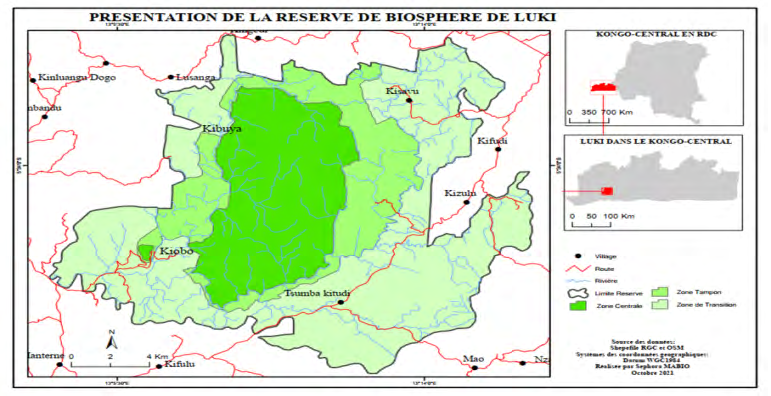
Figure1: floristic compositions of the different study plots.
The climate of Mayombe is dependent on the Atlantic Ocean. It belongs to the humid tropical climate of the Aw5 type according to the Köppen classification (1931). It is influenced by the cold sea current of Bengwela and the southeast trade winds which meet above the reserve a screen of low humidity vegetation thus preventing abundant rainfall. This cold sea current from Bengwela is responsible for the small dry season rains known locally as “masala” [20]. There are two major seasons, one rainy spanning the second half of October and the first half of May, the other dry covering the period between the second half of May and the first half of October. November and December are the rainiest months and June, July and August are the least rainy. The rainy season is interspersed with a short period of relative drought, which is not very marked, between December and January. The dry season lasts four months and is characterized by a slight drop in temperature and frequent morning fogs or mists which compensate for the soil water deficit [19]. The average annual temperature varies from 23 to 29°C. The relative humidity of the air remains high all year round; its annual average is 72.9% [21]. The altitudinal amplitude between the top of the hills and the bottom of the valleys varies from 40 to 70m and more in the central area. The slopes of the hills are sometimes very steep up to 15% [22]. As for the vegetation and its flora, the RBL has very heterogeneous and diversified vegetation. It ranges from grassy formations to dense humid forests of the semi-evergreen type, passing through edaphic formations on hydromorphic soils. It abounds in a specific diversity which varies between 205 and 373 species per hectare [23].
Experimental Device and Measurements Taken
The RNA plots of P. balsamifera were part of these different silvicultural enrichment treatments implemented between 1956 and 1962 after clearcutting. Fifteen plots of 0.25 ha, each of which five per block were installed in each of the blocks of Camp 1, Camp 2 and at the RBL Post, assisted natural regeneration of P. balsamifera. Each plot was the subject of a full floristic and dendrometric inventory of all ligneous subjects with a circumference greater than or equal to 31.4 cm circumference, i.e. 10 cm in diameter at breast height (Dhp). The woody elements within each plot that fulfilled the criterion constituted our sampling in the three sites (Camp 1, Camp 2 and at the RBL post). These trees and shrubs have been measured and identified, the circumference at 1.30m above the ground is the measurement taken on the ground using the graduated tape to the nearest millimeter. The floristic composition of the different plots sampled made it possible to determine the specific richness and diversity of natural forest regeneration assisted by P. balsamifera. The dendrometric inventories made it possible to assess the density per hectare, the structure in diameter of the sampled trees, the linking of the number of stems / ha with the different classes of diameters observed in the plots studied.
Data Analysis
The count of stems per hectare of the different species within the sampling plots made it possible to determine the quality of the forest stands of the RNA with P. balsamifera. The Shannon index was evaluated according to the method of Barbault [24, 25] and was used to determine the specific richness and diversity at stand level. Cubic regression made it possible to observe the response of the number of stems per hectare with the classes of tree diameter in the stands studied. It was chosen because of its high coefficient of determination (r²) and especially because it gives frequency values that reflect the reality of the data collected in the field. The analysis of variance (ANOVA) carried out to compare the DBHs of the three sites from dendrometric inventories revealed a significant site-related effect. The mathematical model underlying the analysis of variance is: Yij = µ + τi +ϵij. For each value taken by an observation (Yij) can therefore be explained as being the response observed for the jth observation of the ith treatment. µ = general mean, τi = effect of the ith treatment, ϵij = random error associated with the jth observation of the ith treatment. The floristic and dendrometric inventories made it possible to determine the structure and composition of the stands in the three sampling plots. The measurement of Dhp is the main parameter used in the quantification of the aboveground biomass using the equation of Chave [26] taking into account that the Dhp.
a) Calculation of aboveground biomass The biomass estimate was made on the basis of a single parameter: the diameter at breast height (Dhp), which was introduced into the equation of Chave [26]. To estimate anhydrous biomass; the equation is: AGB (kg) ꞊ ρ*exp (-1.562+2.148*(ln(Dhp) +0.207*(ln(Dhp2)-0.0281*(ln (dhp3))) Chave [26] Where ρ= wood density of each species, Dhp=diameter at the height of the breast and AGB=Individual aerial biomass of each stem. The wood density for each species was found in Zanne [27]. b) Calculation of the conversion of biomass to carbon To obtain an estimate of the carbon stock, the biomass was multiplied by a factor of 0.5 for the convenience of the calculations given the variability of the carbon content of the dry biomass of trees around this average value [28]. c) Calculation of the conversion of carbon stock into equivalent carbon To convert the carbon stock into carbon equivalent, we used the IPCC study (2007, 2011) as follows: TCO2 (tonne) ꞊ TC×3.67 Where TCO2: total carbon equivalent; TC: total carbon stock; conversion factor: 3.67.
Results
Enumeration of Assisted Natural Forest Regeneration Stems and Species in the Different Plots.
The dendrometric and floristic characteristics of the RNA in the different sampling plots are presented in Table I below. Observation of Table I above revealed a higher density per hectare in the Camp1 plot, nearly double the other two last plots of the sample. The density/ha varied between 380 to 980 stems/ha. The same trend was observed on the basal area (m2/ha). This varied between 43 and 68 m2/ha. The Shannon index used for the analysis of species richness and diversity varied between 0.8 and 1.6. The Camp1 plot showed low diversity compared to the other sample plots. This plot seems less heterogeneous than the other two. It is the most balanced of the others. It presented a Pielou equitability index close to zero.
| Site | Parameters Dendrometriques | Parameters Floristiques | ||||
|---|---|---|---|---|---|---|
| Densite (Tiges/ha) | ST(m2/ha) | R/ha | Famille/ha | H | J | |
| Camp1 | 980 | 68,47 | 68 | 48 | 0,805 | 0,439 |
| Camp2 | 448 | 43,19 | 60 | 40 | 1,319 | 0,742 |
| Poste de la BRL | 380 | 52,46 | 72 | 48 | 1,663 | 0,895 |
| Moyenne | 603 | 54,70 | 67 | 45 | 1 | 692 |
| Ecart-type | 328,54 | 12,79 | 6,11 | 4,62 | 0,43 | 0,23 |
Table 1: Dendrometric and floristic characteristics of assisted natural regeneration of Prioria balsamifera in the RBL. Where ST=
Floristic Composition of the Different Sampling Plots.
The floristic analysis of the different study plots showed great variability in all the inventories carried out. Figure 2 below shows the composition of the different sampling plots. Figure2 Examination of Figure 2 above shows significant regeneration of P. balsamifera regardless of the plot considered. Forest species Hylodendron gabunense; Deinbollia acuminata; Celtis mildbraedii and Antiaris toxicoria are common to all the sampling plots. The three plots of RNA in the RBL show a more abundant floristic composition in Fabaceae and the species Prioria balsamifera remains the most dominant, i.e. 61.6% of the stands.
Variation in assisted natural forest regeneration induced by silvicultural treatment based on the diameter structure within the study plots. The different sample plots showed great variability in the radial structure (Dhp) of the forest regeneration observed. This describes an inverted J gait, with a large number of class 1 and 2 stems, including stems from 10cm to 20cm and from 20cm to 30cm. There is a decrease in numbers or individuals with an increase in Dhp class. The classes of trees of the future and those of exploitation are weakly represented. The ANOVA carried out on the Dhp of the different plots revealed a significant effect with p<0.05. Figure 3 below shows the variation in assisted natural forest regeneration induced by the silvicultural treatment based on the diameter structure of the different study plots.
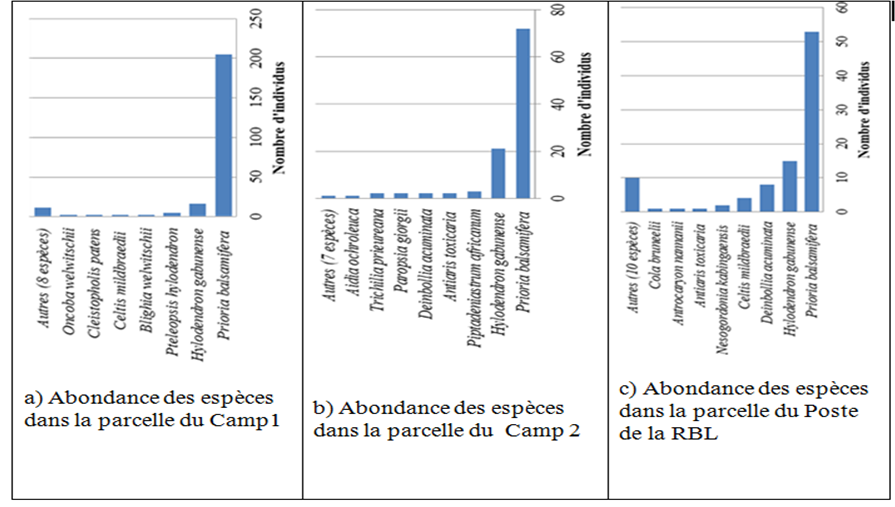
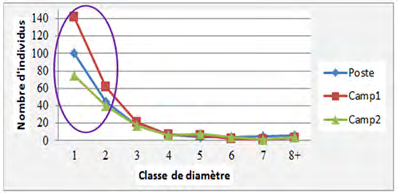
Figure 3: Variation in assisted natural forest regeneration induced by silvicultural treatment based on the diameter structure of different study plots. Note: Class 1 (10-20cm), Class 2(20-30cm), Class 3(30-40cm), Class 4(40-50cm), Class 6(50-60cm), Class 7(60-70 cm), class 8 (70-80 and >80cm). It emerges from Figure 3 above that the plots of Camp 1 showed significant assisted natural forest regeneration compared to the other sample plots. Eight different diameter classes were observed. The installed regeneration class is more important with a stem count that varied between 70 and 145 individuals. Diameter classes 1 and 2 constitute assisted natural forest regeneration. Plots at the RBL station showed average natural forest regeneration compared to plots at two other sites. Camp 2 plots showed low assisted natural forest regeneration compared to the other two previous plots.
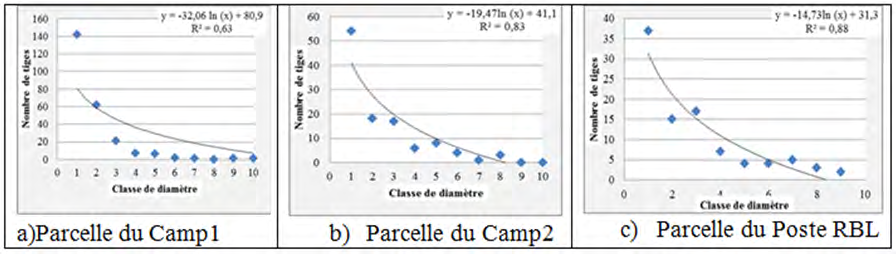
Relationship between the number of tree stems and the diameter of the different plots sampled. Figure4. Examination of Figure 4 above reveals a relationship between the number of stems and the different classes of DBH (cm). A significant effect was observed in all sample plots. The DBHs of different stems in the Camp1 plot alone explain 63% of the variation in numbers or density. The same trend is observed in the other inventory plots. The DBHs of different stems alone explain 83% in the Camp2 plot and 88% for the RBL Post office plot.
Variation of the carbon stock in the different sampling plots. The aerial biomass and the quantified carbon stock are recorded in Table 2. It appears from Table II above that the different forest species observed in the Camp 1 inventory plot showed great variability in the gain of biomass and carbon stock. The species P.balsamifera comes second after the Ceiba pentandra. The carbon stock varied between 1.6 and 703.01 teq CO2/ha. Corynanthe paniculata exhibited low biomass which resulted in low carbon dioxide sequestration. There is also a grouping of eight species that could not sequester more than one tonne of CO2 equivalent/ha Table 3.
Examination of Table 3 shows that the P. balsamifera species is in the lead with a significant biomass which has contributed to a sequestration of carbon dioxide in the inventory plot of Camp2. The carbon stock varied between 5.92 and 781.95 teq CO2/ha Table 4.
It appears from Table 4 that the P. balsamifera species presented a higher biomass than other forest companion species of the RBL Post inventory plot Table 5.
Observation of Table 5 above shows that the Camp1 plot presented a higher biomass than the other sampling plots. A significant gain in carbon dioxide sequestration is obtained with the Camp1 plot.
| Especes | AGB(Kg/ha) | SC(Kg/ha) | Teq Co /ha 2 |
|---|---|---|---|
| Ceiba pentandra | 383112,58 | 191556,29 | 703,01 |
| Prioria balsamifera | 257068,46 | 128534,23 | 471,72 |
| Pteleopsis hylodendron | 232524,93 | 116262,46 | 426,68 |
| Hylodendron gabunense | 44037,67 | 22018,83 | 80,81 |
| Celtis mildbraedii | 22017,42 | 11008,71 | 40,40 |
| Cleistopholis patens | 19419,97 | 9709,98 | 35,64 |
| Xylopia wilwerthii | 13096,22 | 6548,11 | 24,03 |
| Zanthoxylum gillettii | 1802,17 | 901,08 | 3,31 |
| Corynanthe paniculata | 910,08 | 455,04 | 1,67 |
| Autres (8 especes) | 3644,93 | 1822,47 | 6,69 |
| Toatal | 977634,43 | 488817,21 | 1793,96 |
Table 2: Composition, quantity of biomass and carbon stored by species within the Camp 1 plot: AGB (above ground biomass) = aeria
| Especes | AGB(Kg/ha) | SC(Kg/ha) | Teq Co /ha 2 |
|---|---|---|---|
| Prioria balsamifera | 426132,30 | 213066,15 | 781,95 |
| Dacryodes buettineri | 32904,61 | 16452,30 | 60,38 |
| Hylodendron Gabunense | 30859,05 | 15429,52 | 56,63 |
| Albizia gummifera | 12912,21 | 6456,10 | 23,69 |
| Deinbollia acuminata | 7652,34 | 3826,17 | 14,04 |
| Nesogordonia kabindensis | 5082,12 | 2541,06 | 9,33 |
| Newtonia glandulifera | 4676,00 | 2338,00 | 8,58 |
| Corynanthe paniculata | 4290,20 | 2145,10 | 7,87 |
| Aidia ochroleuca | 3227,24 | 1613,62 | 5,92 |
| Autres (8 especes) | 9203,36 | 4601,68 | 16,89 |
| Toatal | 536939,42 | 268469,71 | 985,28 |
| Prioria balsamifera | 469438,97 | 234719,48 | 861,42 |
| Antrocaryon nannanii | 92973,56 | 46486,78 | 170,61 |
| Celtis mildbraedii | 42664,53 | 21482,26 | 78,84 |
| Deinbollia acuminata | 32826,30 | 16413,15 | 60,24 |
| Hylodendron gabunense | 27444,69 | 13722,35 | 50,36 |
| Ricinodendron heudelotti | 20907,75 | 10453,87 | 38,37 |
| Nesogordonia kabindensis | 6437,28 | 3218,64 | 11,81 |
| Trichilia prieureana | 5378,69 | 2689,35 | 9,87 |
| Hexalobus crispiflorus | 4676,00 | 2338,00 | 8,58 |
| Autres (8 especes) | 8168,89 | 4084,45 | 14,99 |
| Toatal | 711216,66 | 355608,33 | 1305,08 |
Table 3: Composition, amount of biomass and carbon stored by species within the Camp 2 plot.
| Site | AGB(Kg/ha) | SC(Kg/ha) | Teq Co /ha 2 |
|---|---|---|---|
| Camp1 | 977634,43 | 488817,21 | 1793,96 |
| CAmp2 | 536939,42 | 268469,71 | 985,28 |
| Poste RBL | 711216,66 | 355608,33 | 1305,08 |
| Total | 2225790,50 | 1112895,25 | 4084,33 |
Table 4: Summary of biomass and carbon stock results by site.
Discussion
This study made it possible to make an inventory of the assisted natural regeneration of P. balsamifera in the Luki Biosphere Reserve. The enrichment silvicultural technique for FMNR has given encouraging results on stand dynamics after clearcutting in the primary mixed forest of Mayombe. These silvicultural treatments can further contribute to increasing the density of carbon captured by trees in this ecosystem and allow rapid resilience in time and space. The practice of enrichment restores the forest and contributes to the improvement of ecological conditions favorable to assisted natural forest regeneration. It also makes it possible to preserve biodiversity through the ripple effect of the association of companion species present in the different study plots. The density of P. balsamifera is far superior to that found by Kidikwadi [18] and for all other species but each time followed by Hylodendron gabunense. It is therefore a companion species of P. balsamifera. The ecological conditions of the Luki biosphere reserve are very favorable to the practice of RNA. The number of individuals of class 1 and 2 being important, is indicative of a recent installed natural regeneration of P. balsamifera. Lubini [23], reports that P. balsamifera establishes itself more easily than other species thanks to its dispersal capacity, its abundant production of samaroid fruits and its semi-ombrophilous character. Despite a dense canopy, many seedlings tolerate low light conditions. However, few individuals reach the juvenile stage because the seedlings need light to continue their development. This is confirmed with the pace of Dhp class distribution. These silvicultural treatments are artificial and generally lead to a reconstituted forest different from the initial forest because it is richer in valuable species. In this sense, assisted regeneration is not natural [29]. Thus, to avoid any ambiguity, Madoux [30] uses the expression unprovoked R.N. in the sense of ecologists and assisted or provoked R.N. in that of foresters. But the context is generally sufficient to remove any ambiguity, since it is in fact in opposition to the plantation techniques that characterize artificial regeneration (A.R.) that NR must be understood in the sense of foresters. The results of the Sahel study in Niger [31] showed that the practice of FMNR could provide enormous environmental, economic and social benefits. These impacts vary depending on the situation [10]. For example, farmers in the Matadi region often make an effort to diversify species in order to obtain a diversity of products and services.
According to Madoux [30], assisted natural regeneration is a technique that consists in choosing a seed tree below which the trees are felled and the undergrowth cleared. Dissemination by pterochory installs individuals at the foot and a few meters from the mother tree that will develop to form an even-aged stand. Indeed, assisted natural regeneration is made on the basis of seedlings or young plants grown from seeds. It is said to be assisted by benefiting from clearings and clearings [32]. This regeneration system creates a forest where all age classes are represented step by step and which can regenerate indefinitely.
However, work on the management of African forests has revealed that the regeneration of most commercial species still remains a fundamental concern and forms the basis for the establishment of forest plantations in many African countries [33]. For sustainable forest management in DR Congo, trials on assisted natural regeneration have been carried out in Yangambi and Luki to have biological data on commercial species such as Terminalia superba, Prioria balsamifera, Nauclea diderrichii, Milicia excelsa, Millettia laurentii, Aukoumea klaineana, Lovoa trichilioides [30].
The diameter structure clearly reveals a distribution curve with diameter classes (Dbh) with a significant proportion of individuals (trees) in the range between 10 cm and 20 cm Dbh. This suggests better forest regeneration as highlighted by the studies of Aubréville [34]; Schnell [35]. The presence of families such as Rubiaceae, Annonaceae, Sapindaceae, Meliaceae and Fabaceae in the different arboreta characterizes the forest vegetation. This confirms that our results agree with those obtained by Mandango [36] and Lubini [23]. The biomass gain of the stands under study is greater in the Camp1 plot, followed by that of the substation. The Camp2 plot has a lower aboveground biomass than the two previous ones. This suggests that environmental conditions contribute to the large variability observed in carbon stock accounting. The specific richness and diversity are basic elements of stand differentiation Lubalega [28]; Lubalega [11] and induce their influence through the different wood density for each species [37, 38, 39, 40, 41].
Conclusion
The edaphoclimatic conditions of the Luki biosphere reserve presented conclusive results and were very favorable to the silvicultural technique of FMNR, five decades after its establishment [42, 43, 44, 45]. The study highlighted a recent installed natural regeneration of P. balsamifera. This is the result of the stems placed under clear-cut felling, having served as the basic seed [46]. The diametric structure of the species expressed by the abundance and the relative dominance presents a curve very close to an exponential decrease, reassuring the potential of the stands as to their capacity as a future carbon stock where we notice the abundance of individuals in the three first classes alone covering 3/4 of the individuals in these plots, i.e. 74%. It is therefore possible to recommend RNA as a reforestation technique and/or strategy to generate carbon credits [47].
Acknowledgment
The authors would like to thank INERA and its RBL agents who kindly put their skills at their disposal, in the identification of scientific names, accompanied them to the different sampling sites.
References
-
Humblet P (1946) Development of climatic forests in Mayumbe. Belgian Congo Agricultural Bulletin.
-
(1955) Belgian Congo Agricultural Bulletin 46(3).
-
Bernard A, Gélinas N (2014) A step prior to REDD+ implementation: A socioeconomic study. Journal of Forestry Research, pp: 10.
-
Kangueja F (2010) Analysis of the diversity of woody trees of the main forest types in the North-East of the Luki Biosphere Reserve (Bas-Congo, DRC), DEA dissertation, Faculty of Sciences, Department of Ecology and Management of Plant Resources, University of Kisangani, unpublished, pp: 198.
-
DGF (2009) Annual report on the allocation of logging permits, allocation office and granting of logging permits, MECNT, Unpublished. Kinshasa, pp: 25.
-
Lubini A (2001) Phytogeographical analysis of the forest vegetation of the Kasai sector in Congo-Kinshasa, in Systematics and geography of plants 71(2) : 859-872.
-
Eba’a Atyi R (2009) Central African Forest States: Sub- Regional Synthesis.
-
Couralet C (2010) Community dynamics, phenology and growth of tropical trees in the rain forest Reserve of Luki, Democratic Republic of Congo, pp: 173.
-
Hairiah K, Dewi S, Agus F, Velarde S, Ekadinata A, et al. (2010) A manual: Measuring carbon stock across land use systems. Word Agroforestry Centre (ICRAF), Indonesia, pp: 155.
-
Nkomwa EC, Joshua MK, Ngongondo C, Monjerezi M, Chipungu F (2014) Assessing indigenous knowledge systems and climate change adaptation strategies in agriculture: A case study of Chagaka Village , Chikhwawa , Southern Malawi. Phys Chem Earth 67-69 : 164-172.
-
Lubalega TK, Lubini C, Ruel JC, Khasa DP, Kizungu R (2018) Carbon sequestration in trees and soil in natural and assisted reforestation on the Ibi Village Bateke plateau, Democratic Republic of the Congo. Revue africaine d’environnement et d’Agriculture 1(2): 14-20.
-
Donis C (1948) Essay on forest economy in Mayombe. INEAC publications, scientific series, Brussels 37: 92.
-
Campagna M (1996) Le cycle du carbone et la forêt : de la photosynthèse aux produits forestiers. Direction de l’environnement forestier, service de l’évaluation environnementale, pp: 56.
-
Fischlin A, Buchter B, Matile L, Hofer P, Taverna R (2006) Puits et sources de CO2 dans l’exploitation forestière : Prise en compte dans le cadre du Protocole de Kyoto. Connaissance de l’environnement. Office fédéral de l’environnement, pp: 49.
-
Watson C (2009) Forest carbon accounting: overview and principles. London School of Economics and Political Science, London, pp: 39.
-
Stocker TF, Qin D, Plattner GK, Tignor M, Allen SK (2013) Climate Change 2013.The Physical Science Basis. The Working Group I contribution to the Fifth Assessment Report of the Intergovernmental Panel on Climate Change (IPCC) provides a comprehensive assessment of the physical science basis of climate change since 2007 when the Fourth Assessment Report (AR4) was released. Cambridge University Press, United Kingdom and New York, pp: 1585.
-
Lubini A (1997) The vegetation of the Luki Biosphere Reserve in Mayombe (Zaire). Meise: National Botanical Garden of Belgiu, pp: 157.
-
Kidikwadi T, Lubini AC, Luyindula N, Belesi KH (2015) Preliminary note on the ecology and biomass measurement of Prioria balsamifera in the INERA Forest Stations of Luki and Kiyaka in DR Congo 11(4): 914-927.
-
Angoboy I (2006) Current state of the arboreta of the Luki biosphere reserve in Mayombe, Unpublished memory, Faculty of Agronomic Sciences, UNIKIN, pp: 75.
-
Lubini A (1984) The vegetation of the Luki Biosphere Reserve (Bas-Zaire): Department of Environment, Nature Conservation and MAB Tourism (Zaire), pp: 52.
-
Pendje G, Baya M (1992) The vegetation of the Luki Biosphere Reserve (Bas-Zaire): Department of Environment, Nature Conservation and MAB Tourism (Zaire). UNESCO, Paris, pp: 62.
-
Kapa B, NKiama M, Malele M, Ritvisay M (1987) Development of the Luki biosphere reserve, SPIAF, pp: 67.
-
Lubini A (1997) The phylogenetic resources of the savannahs of southern Zaire. Proceedings of the symposium “Management of plant genetic resources in savanna Africa, Bamako-Mali, pp : 24-28.
-
Barbault R (1992) Stand Ecology. Paris, Masson, pp: 273.
-
Barbault R (1997) General Ecology- 6th (Edn.), Structure and functioning of the biosphere, pp: 286.
-
Chave J, Andalo C, Brown S, Cairns MA, Chambers JQ, et al. (2005) Tree allometry and improved estimation of carbon stocks and balance in tropical forests. Oecologia 145: 87-99.
-
Zanne AE, Lopez-Gonzalez G, Coomes DA, Ilic J, Jansen S, et al. (2009) Global Wood Density Data base. Dryad.
-
Lubalega TK, Lubini C, Ruel JC, Khasa DP, Ndembo J, et al. (2017) Structure and floristic composition of shrub savannas in a system preserved from fire in Ibi, Bateke plateau, in the Democratic Republic of Congo. Revue de la RIFFEAC 9: 20-30.
-
Alexandre DY (1989) Dynamique de la régénération naturelle en forêt dense de Côte d’ivoire. Collection Etudeset Thèses, ORSTOM Paris, pp: 102.
-
Maudoux (1954) Natural regeneration in the reworked forests of Mayombe. Bull soc Bot. France 97: 156-157.
-
(2006) Impacts of Investments in Management of Natural Resources on Production Systems in the Regions of Maradi, Tahoua and Tillabery, in Niger, Cresa, pp : 31.
-
White L, Edwards A (2001) African Rainforest Conservation: Research Methods. The Wildlife Conservation Society, New York, USA, First French edition, pp: 455.
-
(1986) Data book on endangered tree and shrub species and provenances. FAO Forestry Paper, pp: 524.
-
Aubréville A (1949) Climates: Forests and Desertification of tropical Africa. Maritime et Coloniales, Paris, pp: 345- 351.
-
Schnell R (1970) Introduction to the phytogeography of tropical countries, general problems Environments. Plant groups. Gauthier-Villars, Paris 2: 500-951.
-
Mandango M (1982) Flora and vegetation of Tundulu Island in Kisangani (Haut-Zaire). Thèse Univ Kisangani, pp: 425.
-
Lubalega TK, Mananga PM (2018) Evaluation of the specific woody biodiversity of agricultural crops under tree cover in Patu, in Mayombe, in the Democratic Republic of Congo (DRC), Congo Sciences 6(2): 1-8.
-
Aquino A (2010) Carbone forestier dans le bassin du Congo : Expériences de la Banque, pp: 21-22.
-
Denman KL, Brasseur G, Chidthaisong A, Ciais P, Cox PM, et al. (2007) Couplings Between Changes in the Climate System and Biogeochemistry. Cambridge University Press, United Kingdom, pp: 587.
-
Donis C, Maudoux E (1951) Sur l’uniformisation par le Haut, INEAC.
-
de Wasseige C, Devers D, de Marcken P, Eba’a Atyi R, Nasi R, et al. (2008) Congo Basin Forests: State of the Forests. Office des publications de l’Unioneuropéenne, pp: 17-44.
-
(2011) Intergovernmental Panel on Climate Change, Who are we?.
-
(2007) Intergovernmental Panel on Climate Change, Synthesis Report, Geneva, Switzerland, pp: 104.
-
Koy H (2006) Central zone of the Luki Biosphere Reserve: Delimitation and evaluation of the degradation of its vegetation, Faculty of Agricultural Sciences, Université de Kinshasa, Mémoire, Inédit, pp : 63.
-
ONF (2006) Forest and Carbon. Dossier n°5, Office National des Forêts, Paris, pp: 6.
-
Saugier B (1999) The tropical rainforest. Editions Belin, Saint-Amand-Montrond 2: 239-253.
-
Puig H (2001) The tropical rainforest. Editions Belin, Saint-Amand-Montrond, France, pp: 447.
- Lessons to Learn: Trees are More than the Lungs of the World
- Community Forestry Enterprises as a Model for Sustainable Forest Development: The Case Of The "Baja Tarahumara" in Chihuahua, Mexico
- Ecological and Socio-Economic Impacts of Chromolaena odorata and Mesosphaerum suaveolens, Two Invasive Alien Species in Central and Southern Benin, West Africa
- Epigenetic Sustainability: Modeling the Human Factor as a Natural Resource through Science 4.0 and the NR3C1 Biological Pilot
- Growth-at-Risk: A Framework for Assessing Economic Vulnerability
- The Rural Territory as a Socioecological System for the Management of Public Policy for Sustainable Rural Development