
Determination of Optimum Nitrogen for Teff [Eragrostis tef (Zucc.) Trotter] Production in Bora District, East Shewa Zone, Oromia, Ethiopia
Field experiment was carried out on 6 farmer’s field to determine the effect of NPS and nitrogen on yield of teff. The study was conducted using three NPS levels (0, 100, and 200 kg ha-1) and six levels of nitrogen (0, 23, 46, 69, 92 and 138 kg ha-1) and the treatment was laid out in a randomized complete block design with two replications. The analysis of showed that yield of teff was significantly (p < 0.05) affected by the interaction effect of NPS and N fertilizer rates. However, biomass yield of teff was not significantly (p < 0.05) affected by the interaction effects of NPS and N fertilization. The highest biomass (5.600 ton/ ha) was obtained in response to application of 200 kg of NPS and 92 kg of N ha-1. While, the highest teff yield (1592 kg ha-1) was obtained from application of 200 kg NPS with 138 kg N (ha-1). But it is not economically profitable. Therefore the net benefit 45,278 Birr ha-1 which was obtained from application of 100 kg NPS and 46 kg N (ha-1) fertilization is profitable and recommended for teff in Bora District and areas with similar soil type and agro-ecological conditions.
Introduction
Background and Justification
Tef [Eragrostis tef (Zucc.) Trotter] is the major Ethiopian cereal grown for thousands of years [1, 2]. Teff is the major cereal crop in Ethiopia as well as in Oromia region and plays great role in supplying the society with protein, carbohydrates and minerals and it is a highly versatile crop with respect to adaptation to different agro-ecologies, widely grown from sea level up to 2800 meters above sea level under various rainfall, temperature and soil conditions. It performs well in the Ethiopian highlands between 1700 to 2400 meters above sea level. The annual rainfall requirement of the crop ranges from 950 to 1500 mm and requires temperatures of 10 to 27oC [2, 3].
Phosphorous (P) is one of the most limiting plant nutrients in the tropics required in the early stages of growth necessary for many plant processes including synthesis of phospho-lipids, energy transfer and enzyme activation for optimum crop production [2]. Teff responds differently to rates of fertilizers depending on soil type and cultivars [4]. There are different blanket recommendations for various soil types of Ethiopia for teff cultivation. For heavy soils (Vertisols) and sandy clay loam soils (Andosols), 55/30 and 60/26 N/P kg/ha, respectively are recommended. However, N/P recommendation rates by the Ministry of Agriculture are 55/30, 30/40 and 40/35 N/P kg/ha for teff crop on Vertisols, Nitosols and Cambisols, respectively across the country. However, 100 kg DAP/ha and 100 kg urea/ha were set by the Ministry of Agriculture and Rural Development later. Generally, the recommended rate of fertilizer for teff is 25 to 40 kg N/ha and 30 to 40 kg P2O5/ha on light soils such as Nitosols, Luvisols and Cambisols, and 50-60 kg N/ha and 30-35 kg P2O5/ha for heavy soils such as Vertisols [4, 5]. On the other hand, a study conducted at Hawassa and Areka using three teff varieties (Dabi, Dz 01-196 and Dz-01-354), representing early, intermediate and late maturing groups respectively, indicated that there was no need of applying urea on Nitosols and no fertilizer should be applied to teff grown on Fluvisols [5].
Crop production can be profitable if and only if balanced and adequate levels of phosphorus (P) and other nutrients are used. So, at this volatile grain and fertilizer prices condition, sound soil test calibration is essential for successful fertilizer program and crop production. It is essential that the results of soil tests could be calibrated or correlated against crop responses from applications of plant nutrients in question as it is the ultimate measure of a fertilization program. An accurate soil test interpretation requires knowledge of the relationship between the amount of a nutrient extracted by a given soil test and the amount of plant nutrients that should be added to achieve optimum yield for each crop [6]. Therefore, Calibrations are specific for each crop type and they may also differ by soil type, climate, and the crop variety. That means, fertilizer recommendations on soil test basis for economic crop production should be both location and situation specific and can be modified with changes in soil test value as well as input output ratios.
All the above considerations indicate that fertilizer recommendations are dynamic and change with time due to changes in soil nutrient status and environment. Those blanket recommendations brought generally, an increase in yield of improved cultivars ranging from 1700 to 2200 kg/ ha. Accordingly, the average national yield in the year 2010 reached 1200 kg/ha. However, the recommendations do not work for all production aspects of various soil types of different regions. It is in fact possible to increase the yield potential of teff via optimizing nutrient supply to the soil. Determination of optimum fertilizer rates for specific soil types is vital for overcoming the problem that arose from the use of blanket fertilizer recommendations. Systematic studies should be conducted under varying conditions and in various regions to determine the fertilizer requirements of teff for optimizing yield [4]. Based on this concept, the study was conducted on teff at Bora district with the following objectives.
Objectives: • To determine economically appropriate rate of Nitrogen fertilizer for teff production Materials and Methods
Description of the study area
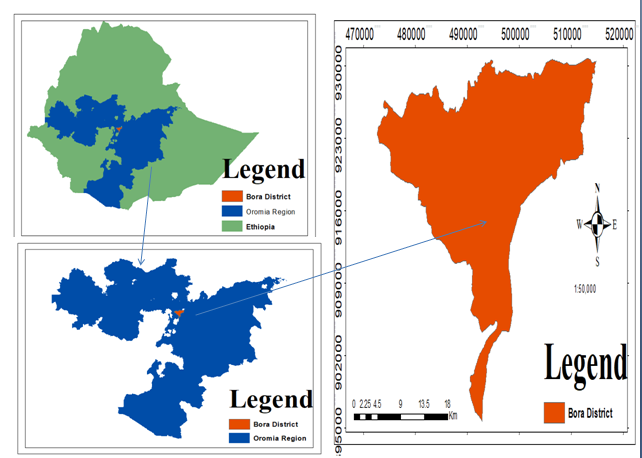
This experiment was conducted in Bora District during the cropping season of 2020. This place was situated in East Shewa, Oromia, Ethiopia and far from Finfine 109 kilometers to south. The geographical location of Bora District was 8°18′2.08” N and 38°57′4.15” E with an elevation of 1,611 meters above sea level. The average annual rain fall and temperature were 1025 mm and 24°C respectively and the soils are characterized by vertisol Figure 1.
Experimental Materials
Krosh teff variety, NPS fertilizer (19% N, 38% P2O5 and 7% S) and urea (46% N) were used for the experiment.
Treatments and Experimental Design
A composite soil samples were collected from farmer fields before planting at 0-20cm depth by zigzag method. So that available phosphorus was analyzed using Olsen method. Based on the level of P content a total of 6 farmers were selected. The experiment was laid out in randomized complete block design (RCBD) with two replications. The treatment considered were three levels of NPS (0, 100 and 200 kg ha-1) and six levels of N (0, 23, 46, 69, 92 and 138 kg ha-1) in a factorial combination (Table 1). The adjacent blocks and plots were separated by 1m wide-open space and 0.5 m blank rows, respectively. The gross plot size was 2 m x 6 m (12 m2) and harvested from 4m2 areas.
- Treatment # (T1-
- T6)
- (N:P2O5 kg ha-1)
- Treatment # (T7-
- T12)
- (N:P2O5 kg ha-1)
- Treatment # (T13-T18)
- (N:P2O5 kg ha-1)
- T1 (0:0)
- T7 (46:0)
- T13(92:0)
- T2 (0:46)
- T8 (46:46)
- T14 (92:46)
- T3 (0:92)
- T9 (46:92)
- T15 (92:92)
- T4 (23:0)
- T10(69:0)
- T16 (138:0)
- T5(23:46)
- T11(69:46)
- T17 (138:46)
- T6(23:92)
- T12(69:92)
- T18(138:92)
Table 1: Description of treatments.
Data Collection
Grain yield: The grain yield was taken by harvesting and threshing the grain yield from net plot area. The yield was adjusted to 12.5% moisture content and expressed as yield in kg ha-1.
Biomass yield: The aboveground dry biomass yield was determined from plants harvested from the net plot area after sun drying to a constant weight and expressed in ton/ ha.
Harvest index (HI): The harvest index was calculated as ratio of grain yield per plot to total above ground dry biomass yield per plot and expressed as percent.
Statistical data analysis The agronomic data which were collected across the locations was properly managed using the EXCEL computer software. The collected data were subjected to the analysis of variance (ANOVA) as per the experimental design using GenStat (15th edition) software (GenStat, 2012). The Least Significance Difference (LSD) at 5% level of probability was used to determine differences between treatment means.
Partial Budget Analysis To identify the Economic significance of the treatments, Partial budget analysis was employed and calculates the marginal rate of return (MRR) (CIMMYT, 1988), the treatments were significance, and economic analysis was done for optimum nitrogen fertilizer determination. The actual grain yield was adjusted by 10% to reduce the exaggeration of small plot management.
The concepts used in the partial budget analysis were the mean grain yield of each treatment, the gross benefit (GB) ha-1 (the mean yield for each treatment) and the field price of fertilizers (the costs of NPS and Urea and the application costs). Marginal rate of return, which refers to net income obtained by incurring a unit cost of fertilizer, was calculated by dividing the net increase in yield of durum wheat due to the application of each fertilizers rate. The net benefit (NB) was calculated as the difference between the gross benefit and the total cost that vary (TCV) using the formula NB = (GY x P) – TCV Where GY x P = Gross Field Benefit (GFB), GY = Adjusted Grain yield kg per hectare and P = field price kg of the crop.
Actual yield was adjusted downward by 10% to reflect the difference between the experimental yield and the yield farmers could expect from the same treatment. The dominance analysis procedure as described in CIMMYT (1988) was used to select potentially profitable treatments from the range that was tested. The discarded and selected treatments using this technique were referred to as dominated and none dominated treatments, respectively. For each pair of ranked treatments, % marginal rate of return (MRR) was calculated using the formula.
$$ \mathrm {M R R} (\%) = \frac {\mathrm {C h a n g e i n N B (N B b - N B a)}}{\mathrm {C h a n g e i n T C V (T C V b - T C V a)}} \mathrm {X} 1 0 0 $$ Where NBa = NB with the immediate lower TCV, NBb = NB with the next higher TCV, TCVa = the immediate lower TCV and TCVb = the next highest TCV.
The % MRR between any pair of un-dominated treatments was the return per unit of investment in fertilizer. To obtain an estimate of these returns, the % MRR was calculated as changes in NB (raised benefit) divided by changes in cost (raised cost). Thus, a MRR of 100% implied a return of one Birr on every Birr spent on the given variable input.
Results and Discussion
Site selection, Soil sample collection, Soil sample analysis, Land preparation, sowing, Field management (weeding 1st, 2nd and disease control), top dressing, harvesting, threshing were properly accomplished. Agronomic data such as grain yield and biomass were collected timely and analyzed using GenStat (15th edition) software (GenStat, 2012).
Grain yield
The analysis of variance showed that, yield of teff was significantly (p < 0.05) affected by the interaction effect of NPS and N fertilizer rates. The highest teff yield (1592 kg ha-1) was obtained from application of 200 kg NPS with 138 kg N (ha-
1) followed by 1540 kg and 1538 kg of teff yield which were obtained from application of 200 kg of NPS with 69 kg N (ha-1), and 200 kg of NPS with 92 kg N (ha-1) respectively. This result shows that the existence of positive interaction of P and N fertilizers for the production of teff crop, and the responsiveness to the application of high level fertilizer phosphorus. While the lowest yield (1017 kg ha-1) was recorded from control (Table 2). This result is in agreement with Kefyalew [6] who recorded the highest teff yield (1393.62 kg ha-1) by application rate of 200 kg NPS and 69 kg N ha-1.
| NPS (kg/ha) | N from Urea (kg/ha) | |||||
|---|---|---|---|---|---|---|
| 0 | 23 | 46 | 69 | 92 | 138 | |
| 0 | 1017i | 1341f | 1232gh | 1250g | 1158h | 1186gh |
| 100 | 1220gh | 1344ef | 1424cde | 1356ef | 1445cd | 1439cd |
| 200 | 1333f | 1367def | 1478bc | 1540ab | 1538ab | 1592a |
| LSD(0.05) | 82.20 | |||||
| CV (%) | 2.9 |
Table 2: Interaction effect of NPS and N fertilizer rates on teff yield (kg ha-1).
Biomass Yield (ton/ha)
The analysis of variance revealed that the biomass yield was not significantly (p < 0.05) affected by the interaction effects of NPS and N fertilization. However, it was significantly (p<0.05) affected by the main effects of both NPS and N fertilizers application (Table 3). The highest biomass (5.600 ton/ha) and (5.983 ton/ha) were obtained in response to application of 200 kg of NPS and 92 kg of N (ha-1) respectively. While the lowest biomass (4.717 ton/ha) and (4.567 ton/ ha) were recorded from control plots respectively. Also this result is in agreement with Tagesse [7] who recorded the highest biomass yield (16855 kg ha-1) by application rate of 200 kg NPS ha-1 and 92 kg N ha-1.
| Biomass yield (ton/ha) | Harvest index (%) | |
|---|---|---|
| 0 | 4.717b | 27.1 |
| 100 | 5.575a | 26.0 |
| 200 | 5.600a | 27.0 |
| LSD (0.05) | 0.32 | NS |
| CV (%) | 7.0 | 11.6 |
| N (kg ha-1) | ||
| 0 | 4.567e | 30.83a |
| 23 | 4.800de | 28.45b |
| 46 | 5.183cd | 27.79b |
| 69 | 5.483bc | 25.32c |
| 92 | 5.767ab | 24.33c |
| 138 | 5.983a | 23.53c |
| LSD (0.05) | 0.45 | 2.10 |
| CV (%) | 7.0 | 6.5 |
Table 3: Biomass and harvest index of teff as influenced by main effect of NPS and N fertilizers rates.
Partial budget analysis
To identify the treatments with optimum return to the farmer’s investment, marginal analysis was performed. For a treatment to be considered as worthwhile to farmers, 100% marginal rate of return (MRR) was the minimum acceptable rate of return (CIMMYT, 1988). The partial budget analysis showed that, the highest net benefit 47,337 Birr ha-1 was obtained from application of 200 kg ha-1 of NPS with supplemented 69 kg N ha-1 (table 3). But it is not economically profitable and the treatment with application of 100 kg NPS and 46 kg N (ha-1) fertilization that result in net benefit of 45,307 Birr ha-1 and 782 MRR (%) is economically accepted. This means a farmer’s investment of one Birr in 100 kg ha-1 NPS and 46 kg ha-1 of supplementation N on teff recoups the one Birr and gives an additional 7.82 Birr. Therefore the net benefit 45,307 Birr ha-1 and 782 MRR (%) which was obtained from application of 100 kg NPS and 46 kg N (ha-1) fertilization is profitable and recommended for teff in Bora District.
| NPS (kg ha−1) | Urea (kg ha−1) | AGY (kgha-1) | GNB (Birr ha-1 ) | TVC | NR (Birr ha-1 ) | MRR % |
|---|---|---|---|---|---|---|
| 0 | 0 | 915 | 33866 | - | 33,855 | - |
| 0 | 23 | 1042 | 38561 | 1344 | 37,217 | D |
| 0 | 46 | 1067 | 39494 | 2015 | 37,479 | 39 |
| 0 | 69 | 1109 | 41026 | 672 | 40,354 | D |
| 0 | 92 | 1125 | 41625 | 1008 | 40,617 | 78 |
| 0 | 138 | 1201 | 44422 | 336 | 44,437 | 2,422 |
| 100 | 0 | 1098 | 40626 | 1469 | 39,157 | D |
| 100 | 23 | 1207 | 44655 | 1805 | 42,850 | 1,100 |
| 100 | 46 | 1301 | 48119 | 2812 | 45,307 | 782 |
| 100 | 69 | 1220 | 45155 | 2476 | 42,679 | D |
| 100 | 92 | 1282 | 47419 | 2141 | 45,278 | 723 |
| 100 | 138 | 1295 | 47919 | 3484 | 44,435 | D |
| 200 | 0 | 1200 | 44389 | 2938 | 41,451 | 547 |
| 200 | 23 | 1230 | 45521 | 3274 | 42,247 | 237 |
| 200 | 46 | 1330 | 49217 | 3609 | 45,608 | 1,003 |
| 200 | 69 | 1386 | 51282 | 3945 | 47,337 | 515 |
| 200 | 92 | 1384 | 51215 | 4281 | 46,934 | D |
| 200 | 138 | 1433 | 53014 | 4953 | 48,061 | 97 |
NPS cost = 14.69 Birr kg-1, UREA cost = 14.60 Birr kg-1, teff grain = 37 Birr kg-1, AGY = Adjusted grain yield down wards by 10% (kg ha-1), GNB = Gross Net Benefit, TVC = Total variable cost (Birr ha-1), NR = Net return (Birr ha-1), MRR (%) = Marginal rate of return, D = Dominated treatment, Control = unfertilized. Table 3: Partial budget and marginal analysis for NPS and N rates of teff.
Conclusion and Recommendation
The treatments consisted of factorial combination of three levels of NPS (0, 100 and 200 kg ha-1) and six levels of nitrogen (0, 23, 46, 69, 92 and 138 kg ha-1) fertilizer. The experiment was laid out in randomized complete block design (RCBD) and replicated two times per treatment. The analysis of variance showed that biomass yield was not significantly (P < 0.05) influenced by the interaction effect of NPS and N fertilization. However, the main effect of both NPS and N fertilization significantly (P < 0.05) influenced the biomass yield. The analysis of variance showed that, yield of teff was significantly (p < 0.05) affected by the interaction effect of NPS and N fertilizer rates. The highest teff yield (1592 kg ha-1) was obtained from application of 200 kg NPS with 138 kg N (ha-1). However it was not economically acceptable and profitable. Therefore, the treatment with application of 100 kg NPS and 46 kg N (ha-1) fertilization that result in net benefit of 45,307 Birr ha-1 and 782 MRR (%) is economically accepted and profitable. This means a farmer’s investment of one Birr in 100 kg ha-1 NPS and 46 kg ha-1 of supplementation N on teff (Krosh variety) recoups the one Birr and gives an additional 7.82 Birr. Therefore the net benefit 45,307 Birr ha-1 and 782 MRR (%) which was obtained from application of 100 kg NPS and 46 kg N (ha-1) fertilization is profitable and recommended for teff production in Bora District. Farther verification of the result on farm land could be a pre request before disseminating the technology to the users.
Acknowledgements
First of all, we thank our God who enables us, in all circumstance, to perform our research activity properly. Secondly, we authors kindly thank the Oromia Agricultural Research Institute (IQQO) for financial sponsorship, Batu Soil Research Center (BSRC) for financially supporting the study and providing all the necessary facilities required for the research. Also would like to thank all staff members, especially to soil laboratory analysis team for their support and unreserved effort to provide reliable samples analysis data on time and technical assistances of the center. At last but not at least, our special thank also forwarded to experts of Bora Agricultural office, DA’s and participant farmers for their effective collaboration work voluntarily in this study.
References
-
Anteneh Abewa (2019) Teff Grain Physical and Chemical Quality Responses to Soil Physicochemical Properties and the Environment. Agronomy 9(6): 283.
-
Legesse Admassu (2017) Soils Test Phosphorous Calibration for Tef [_Eragrostis tef_ (Zucc.) Trotter] Production on Nitisols of Central Ethiopian Highlands. American-Eurasian J Agric Environ Sci 17(4): 320-331.
-
Mizan Tesfay Abraha (2016) Breeding Tef [_Eragrostis_ _tef_ (Zucc.)Trotter] for Drought Tolerance in Northern Ethiopia. A thesis submitted in partial fulfillment of the requirements for the degree of Doctor of Philosophy (PhD) in Plant Breeding, University of KwaZulu-Natal, and Republic of South Africa.
-
Temesgen Kebede Dubale (2019) Soil Test and Tissue Analysis Based Nitrogen and Phosphorus Fertilizer Applications on Teff [Eragrostis tef (Zucc.) Trotter] Cultivars in North Shewa Central Highlands, Ethiopia. Advances in Crop Science and Technology 7(1): 411.
-
Gidena Tasew Reda (2016) Verification and Demonstration of Soil Test Based Phosphorus Fertilizer Recommendation Rate on Yield of Teff (Eragrostis Tef(Zucc) Trotter) in Vertisols of Northern Ethiopia. Journal of Natural Sciences Research.
-
Kefyalew Assefa (2017) Phosphorus Critical Level and Optimum Nitrogen Rate Determination on Teff for Sustainable Soil Fertility Management and Economical Teff Production at Lume Area of Oromia Region, Ethiopia_._ Journal of Biology Agriculture and Healthcare 7(19).
-
Tagesse Abera, Ketema Belete, Tamado Tana, (2018) Effect of Blended NPS Fertilizer Supplemented with Nitrogen on Yield Components and Yield of Bread Wheat (Triticum aestivum L._),_ Journal of Natural Sciences Research 8(11).
- Lessons to Learn: Trees are More than the Lungs of the World
- Community Forestry Enterprises as a Model for Sustainable Forest Development: The Case Of The "Baja Tarahumara" in Chihuahua, Mexico
- Ecological and Socio-Economic Impacts of Chromolaena odorata and Mesosphaerum suaveolens, Two Invasive Alien Species in Central and Southern Benin, West Africa
- Epigenetic Sustainability: Modeling the Human Factor as a Natural Resource through Science 4.0 and the NR3C1 Biological Pilot
- Growth-at-Risk: A Framework for Assessing Economic Vulnerability
- The Rural Territory as a Socioecological System for the Management of Public Policy for Sustainable Rural Development