
Study of Ecological Condition and Contamination of Heavy Metals (Isp-Oes) of Aydar-Arnasoy Lake System by Optical Emission Spectrometric Method
Study of Ecological Condition and Contamination of Heavy Metals (Isp-Oes) of Aydar-Arnasoy Lake System by Optical Emission Spectrometric Method
Introduction
Man-made changes on the planet happen so fast that they can be compared to geological disasters. Despite all efforts to minimize the negative consequences of human life on the planet, man has changed and continues to change the living environment to one degree or another. If we look at the formation of the Aydar-Arnasay lake system formed as a result of such changes, Haydarkol (also known as Haydar Lake and Aydar Lake) is a lake at the northern foot of the Nurata Range. Haydarkol was formed in the late 1960s mainly due to excess water flowing from the Chordara Reservoir in southern Kazakhstan. The lake is located in Jizzakh and Navoi regions. The northern shores of Haydarkol are connected to the Eastern Kyzylkum.
Until 1969, small salt lakes and salt marshes were common in the Haydar salt marshes. Some scholars consider Haydar salt to be the ancient source of the Syrdarya. Due to heavy rainfall in 1968-69, part of the Syrdarya River (about 21 km3) was discharged into the Aydar Basin through the Chordara Reservoir and Arnasay, as not enough water could flow into the Aral Sea into the Syrdarya River. Haydarkul (Aydar Lake) was thus formed. Aydar Lake is saturated with Akbulak in Jizzakh region, Kili discharge of Sangzor River, Chordara reservoir and Central Mirzachol discharge into Arnasay.
Arnasay lakes are lakes at the confluence of Mirzachul and East Kyzylkum. Before the formation of the lakes, its location was geomorphologically composed of eolian sand relief, such as the Kyzylkum. The lowlands are occupied by salt and small lakes. In 1969, as a result of the large-scale removal of excess water from the Chordara Reservoir, the lowland was filled with water and several lakes were formed. The lakes are interconnected by narrow streams. Excess water from Arnasay lakes flows into Aydar Lake through a narrow corridor. Salt water is also discharged into the Arnasay lakes through the Central Mirzachul discharge. (volume 1.6-1.8 km3) salinity 4-5 g per 1 liter. In winter, a certain amount of water is discharged from the Chordara reservoir. Therefore, the mineralization rate of the lake water is not very high [1].
Literature Analysis and Methodology
Water mineralization in the 90s was 10-11 g / l in Lake Tuzkon and 14-15 g / l in Lake Aydar (the end of the basin). Since 1993, there has been an annual decrease in the salinity of the water due to the inflow of water from the Chordara Reservoir. 8.5 g / l in the central part of Aydar Lake (7.9 g / l in the central part), 7.4 g / l in Tuzkon Lake. In 2009-2010, the mineralization of the lake system ranged from 7.2 to 11.2 g / l, and in the Arnasay reservoir from 0.8 to 1.6 g / l. Between 2012 and 2016, salinity levels increased due to the lack of fresh water entering the lake as a result of the lack of water discharge from the Chordara Reservoir, which negatively affected the natural reproduction of fish.
The study of hydrology and hydrochemistry of the Aydar- Arnasay Lake System (AALS), ie analysis of water quantity, composition, mineralization, oxygen, nitrogen compounds and heavy metals, scientific study of the morphology and biological potential of the region plays an important role in fisheries and ecotourism [2].
Therefore, we have set the main task of studying the ecological status of the water of large lakes in the territory of Uzbekistan, monitoring the pollution of heavy metals and studying the pollution of heavy metals associated with ecotoxicants. The aim of ecotoxicology research is to study the structural changes of pollutants in the surrounding (aquatic) environment (migration, transformation, sedimentary rocks, interactions) and their effects on organisms, populations, communities and ecosystems.
According to their ecotoxicity, the elements are divided into the following:
- Important (biophilic): Fe, Co, Cu, Cr, Mn, Zn and others.
- Non-significant (highly toxic): As, Cd, Hg, Pb.
Important (biophilic) elements are characteristic of the functional presence of living organisms at certain concentrations, but have a highly toxic effect on the environment. Their accumulation in the body leads to a violation of a number of biochemical functions.
Non-essential metals can be toxic even in very low levels in the environment. They are highly bioaccumulative in the trophic structure of aquatic ecosystems. It is known that organisms have the ability to regulate metal concentrations and neutralize organic xenobiotics. However, they can accumulate in large quantities in living organisms. This leads to a violation of the most important functions of the body .
Analysis of the results of the study encourages us to study the laws of anthropogenic changes in ecosystems as a single system (organisms, populations, communities from environmental conditions). The set of heavy metals mainly corresponds to the list of “residual elements” required for plant and animal organisms. However, exceeding these “residual elements” within certain concentration limits makes them potent poisons.
Research Method
Currently, the use of methods for the detection of heavy and toxic metals is developing rapidly. One such method is that the Avio ™ (Avio200) system can perform even the most complex analysis. Efficient and flexible when working in liquid samples. The Avio200 is characterized by unprecedented ease of use combined with high performance, hardware features and intuitive software as easy as simple singleton analysis in ensuring the performance of multi- element research.
Avio200 has the following features:
- Minimum argon consumption among all ICP systems;
- Very fast start-up (power turned on after a few minutes, the spectrometer is ready for operation);
- Excellent sensitivity and resolution for all target elements;
- Extended linear range and dual plasma inspection.
Avio200 Functionality includes all the features required of an ICP system with reliability.
Analysis of heavy metals in the water sample taken from AALS was determined by the spectrometric method of optical emission Avio200 (ISP-OES) in the “Chemical Analysis” department of the Laboratory of Experimental Biology of Gulistan State University.
Results
The water sample from the Aydar-Arnasay Lakes System (AAKT) was filtered and directly analyzed. The solution in the flask is placed in special test tubes in the auto-sampling section and placed for analysis. The prepared sample was analyzed on an Avio200 ISP-OES inductively coupled plasma optical emission spectrometer (Perkin Elmer, USA) for analysis. The accuracy of the device is high, allowing to measure the elements in solution to an accuracy of 10-9 g.
Water samples from each sampling point were taken in pre-cleaned plastic containers. In the spring-autumn 2021
season, the lake water brought from the sampled areas was filtered and directly analyzed. The analysis of heavy metals in the lake water sample by the ICP-OES method is compared in Tables 1 & 2. The results of the analysis are as follows.
| № | Cr (mg/l) | Cо (mg/l) | Zn (mg/l) | Cu (mg/l) | V (mg/l) | Мо (mg/l) | Sn (mg/l) | Pb (mg/l) | Cd (mg/l) | Sb (mg/l) |
|---|---|---|---|---|---|---|---|---|---|---|
| 1 | 0.008 | 0.0002 | 0.007 | 0.0002 | 0.009 | 0.019 | 0 | 0 | 0 | 0 |
| 2 | 0.008 | 0.002 | 0.006 | 0 | 0.005 | 0.017 | 0 | 0 | 0 | 0 |
| 3 | 0.003 | 0.002 | 0.005 | 0.0002 | 0.007 | 0.020 | 0 | 0 | 0 | 0 |
| 4 | 0.005 | 0.003 | 0.004 | 0 | 0.009 | 0.020 | 0 | 0 | 0 | 0 |
| 5 | 0.002 | 0.002 | 0.003 | 0 | 0.008 | 0.020 | 0 | 0 | 0 | 0 |
| 6 | 0 | 0.001 | 0.005 | 0 | 0.013 | 0.023 | 0 | 0 | 0 | 0 |
Table 1: Water analysis (11.04.2021)
| № | Cr (mg/l) | Co (mg/l) | Zn (mg/l) | Cu (mg/l) | V (mg/l) | Mo (mg/l) | Sn (mg/l) | Pb (mg/l) | Cd (mg/l) | Sb (mg/l) |
|---|---|---|---|---|---|---|---|---|---|---|
| 1 | 0.003 | 0 | 0.002 | 0 | 0.013 | 0.020 | 0 | 0 | 0 | 0 |
| 2 | 0.0004 | 0.0005 | 0.0003 | 0 | 0.014 | 0.024 | 0.002 | 0 | 0 | 0 |
| 3 | 0 | 0.001 | 0.001 | 0 | 0.011 | 0.039 | 0 | 0 | 0 | 0 |
| 4 | 0.0004 | 0.001 | 0.002 | 0 | 0.015 | 0.027 | 0 | 0 | 0 | 0 |
| 5 | 0 | 0.002 | 0.002 | 0 | 0.014 | 0.032 | 0 | 0 | 0 | 0 |
Table 2: Water analysis (20.10.2021)
Discussion
Spring and autumn samples taken in the Aydarkol (Tuzkon) area revealed harmful (toxic) elements in excess of the permissible norm (PN). As can be seen from the table, no tin (Sn), lead (Pb), cadmium (Cd), antimony (Sb) was detected when the water sample for the above ten elements was filtered and directly analyzed. In two of the six samples analyzed, copper (Cu) was found to be slightly above the allowable amount (PN), while in the rest it was not detected at all.
As can be seen from the table above, the analysis of samples taken in the fall did not reveal copper (Cu), we observed a decrease in the amount of chromium (Cr), cobalt (Co), zinc (zinc) (Zn). But we can see that the amount of vanadium (V) has increased Figure 1.
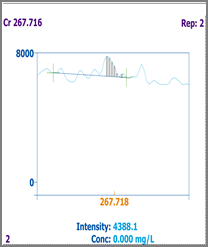
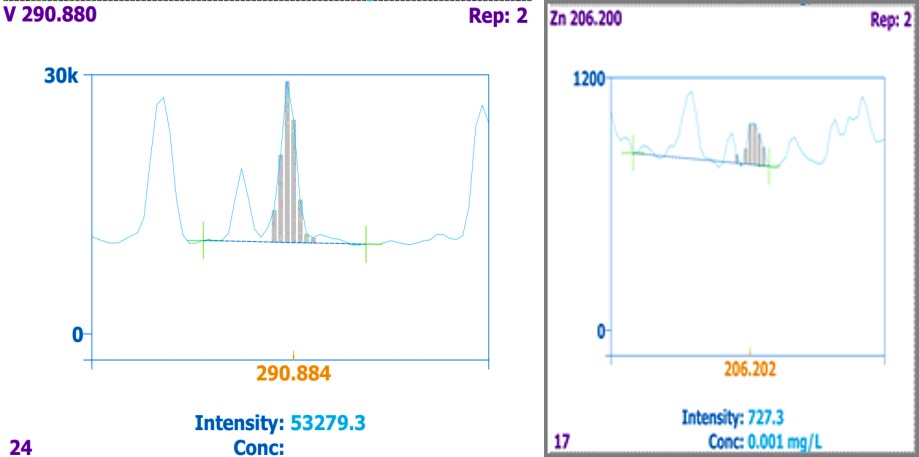
The analysis of the literature concluded that the heavy metals detected in the analysis can enter the water basins through ore processing plants, metalworking, electroplating shops, dyeing shops of textile enterprises, mining and chemical industries [3, 4, 5].
The amount in reservoirs for chromium (Cr) should not exceed PN for Cr (VI) - 0.001 mg / dm3, for Cr (III) - 0.005 mg / dm3.
Toxicity limit for zinc (zn) (toxic) REM Zn2 + - 0.01 mg / dm3 The PN of cobalt (Co) is 0.01 mg / dm3.
Vanadium (V) is mainly in the dispersed state and is found in iron ores, oils, asphalts, bitumens, shales, coal and others.
The limit of toxicity of vanadium (toxicological) PN is 0.001 mg / dm3.
The maximum allowable concentration of molybdenum (Mo) in sanitary water basins is 0.25 mg / dm3.
Copper (Cu) is one of the most important toxic elements. The main sources of copper in natural waters are aldehyde reagents used in the chemical and metallurgical industries to treat wastewater, mine water and algae. Copper can be formed by corrosion of copper pipes and other structures used in water systems. The maximum allowable concentration of copper in the water of reservoirs for sanitary and domestic use is set at 0.1 mg / dm3 (maximum amount of damage), in the water of fishery reservoirs - 0.001 mg / dm3 [6, 7, 8, 9, 10].
Conclusion
The importance of the pollution trajectory of an ecosystem in the context of increasing and decreasing anthropogenic pollution allows us to predict future changes, to minimize the anthropogenic impact of practical actions, and to direct practical actions aimed at accelerating ecosystem recovery processes [10, 11, 12]. Maintaining water quality within the established standards is a necessary condition for maintaining the health of the population, biodiversity, natural and industrial products, the aesthetic and reactionary potential of nature. Therefore, in order to scientifically study the Aydar-Arnasay lake system and its coastal areas, scientific research is being conducted on «Determination of heavy metal ions in the water of the Aydar-Arnasay lake system.» The following works are planned to be carried out during the study of the water content of the Aydar-Arnasay lake system:
The amount of some heavy metals in the lake water, except for the main ions and phenols, nitrates, pesticides, is determined, and the basic hydrochemical condition of the lake is assessed. These analyzes are necessary to study the effects of excess elements in the water on lake fish and some aquatic birds [12, 13, 14].
Therefore, one of the priorities for sustainable development in our country is to maintain a healthy ecological situation in the region. Wetlands play an important role in ensuring the stability and bus integrity of ecosystems as an important link in the system chain. From the above, it can be said that we are all equally responsible for maintaining the ecological sustainability of the lake for future generations [14, 15, 16].
References
-
Yakhshieva ZZ, Akhmadzhonova YT (2020) Ecological condition of Aydar-Arnasay lakes and its improvement. In Problems and prospects of innovative technology and technologies in the field of environmental protection// International scientific and technical on-line conference Part-I, pp: 38-140.
-
Gudalov M (2019) Foundation of Aydar-Arnasay lakes system and their effects on the environmental landscape. Nature and Science 17(11): 111-114.
-
Ziyatovna YZ, Tojimurodovna AY, Tojimurodovna AU (2021) Aydar-Arnasoy ko’llar tizimining gidrologik tavsifi va ekologik holati. Science and Education 2(7): 160-169.
-
Tailakov AA, Berdieva D (2015) Consequences of the ecological impact on the environment of the Aydar- Arnasai lake systems. young scientist (9): 488-493.
-
Tailakov AA (2021) The importance of changing the quality indicators of the water resources of the Aidar- Arnasay lake system when using their natural resources. Global Science and Innovations: Central Asia 3(4): 105- 109.
-
Ziyatovna YZ, Tojimurodovna AY, Akhmedovna SS (2021) The Concept and Principles of Nature Pollution Monitoring. Annals of the Romanian Society for Cell Biology 25(5): 1038-1043.
-
Yakhshieva ZZ, Akhmadzhanova YT (2021) Pollution of water bodies with inorganic toxicants. Science and Education 2(9): 106-121.
-
Akhmadjonova UT, Akhmadjonova YT, Yakhshieva ZZ (2021) Technogenic Transformations of the Aidar-Arnasay Lake System and their Geological Consequences. Annals of the Romanian Society for Cell Biology pp: 2912-2916.
-
Akhmadzhanova YT, Yakhshieva ZZ (2021) Analysis of the water of the Aydar Arnasay Lake for the content of heavy metals. Journal of Natural Sciences 1(4).
-
Akhmadzhonova YT, Yakhshieva ZZ (2020) Effects of heavy toxic metals on water quality. Science and Edification 7: 8-11.
-
Yaxshieva ZZ, Axmadjonova Yo T, Axmadjonova UT (2021) Methods and technologies of wastewater treatment. Science and Education 2(9): 199-209.
-
Yakhshiyeva Z, Akhmadzhanova Y (2020) Economy and society. Economics (9): 882-887.
-
Yakhshieva ZZ, Akhmadzhanova YT (2022) Toxicants pollution wastewater.
-
Tojimurodovna AY, Tojimurodovna AU (2021) Sustainable Development of Fishing, Increasing Production Volume, Strengthening Food Base. Academic Journal of Digital Economics and Stability pp: 551-557.
-
Axmadjonova YT, Axmadjonova UT (2021) Development of agroindustrial complex. Development issues of innovative economy in the agricultural sector pp: 761- 763.
-
http://www.cawater-info.net/water_quality_in_ca/ norm10.htm
- Lessons to Learn: Trees are More than the Lungs of the World
- Community Forestry Enterprises as a Model for Sustainable Forest Development: The Case Of The "Baja Tarahumara" in Chihuahua, Mexico
- Ecological and Socio-Economic Impacts of Chromolaena odorata and Mesosphaerum suaveolens, Two Invasive Alien Species in Central and Southern Benin, West Africa
- Epigenetic Sustainability: Modeling the Human Factor as a Natural Resource through Science 4.0 and the NR3C1 Biological Pilot
- Growth-at-Risk: A Framework for Assessing Economic Vulnerability
- The Rural Territory as a Socioecological System for the Management of Public Policy for Sustainable Rural Development