
Blasting Impact on Environment and their Control Measure Techniques in Open Cast Mining
Blasting is the most accepted and practiced technique for the breakage of rock. During blasting, the energy transformation takes place in the explosive. Rock breakage during blasting process is accompanied by the generation of ground vibrations, noise, dust, fumes and flies rock. Our paper deals with the impact of blasting on the environment which possess anger to the nearby structure transportation road and affect the people nearby the mines. Blasting operations cause several adverse environmental effects. With the development of new explosives systems and initiation devices, the blasting process has now become more efficient and safer than before. Use of software tools, blast monitoring and analysis makes it possible that damages and dangers from blasting can be predicted before blasting thus adverse impacts of blasting can be controlled and reduced. The researchers construct their empirical models based on the available research data in the field, future empirical model can also be build based on new specific site data. More than one approach to asses environmental impacts of blasting give more alternative ways to prevent the impacts. Also we have discussed different types of control blasting techniques which would help in achieving our goal and their relevance in content of India and which can be use convectively & efficiently on Indian mining sector for dealing the adverse impact of blasting with the help of virtual simulation.
Introduction
Blasting is the most accepted and practiced technique for the breakage of rock. During blasting, the energy transformation takes place in the explosive. Rock breakage during blasting process is accompanied by the generation of ground vibrations, noise, dust, fumes and flies rock. The environmental impacts of ground vibrations, noise and fly rock pose a great challenge to the safety of the nearby structures and the people.The opencast mining operations involve development of benches approach roads, haul roads, blasting, excavation and loading and unloading [1].
Impact on Climate
The climate is represented through three distinct seasons- summer, rainy and winter. The climate in the study area generally has tropical weather which is moderate but on a warmer side in summer [2].
Impact on Topography and Drainage
The proposed mining operations will alter the existing topography of the mining lease area. Proposed mining will require small hillock cutting for excavation of ore, which will result in creation of open pits in the lease area. The proposed lease area is devoid of any seasonal or perennial water body. One seasonal nalas present nearby lease applied area at a distance of 2 km [3, 4, 5].
Impact on Top Soil
The occurrence of top soil/lateritic soil in the mine is very insignificant and is encountered very thin in between rocks & boulders. However, during mining this soil will be preserved and utilized for plantation purpose only.
Impact on Surface Water Resources
Mining lease area is devoid of any seasonal or perennial water body. Some seasonal nalas are present nearby mine lease area. During the rainy season, there may be accumulation of surface water, which is proposed to be pumped out to keep the working area dry and it will be utilized for dust suppression. Mining activity inevitably leads into sediment and suspended load due to erosional activity of overburden dump and loosened soil by blasting activity.
Ground vibration and Fly Rocks
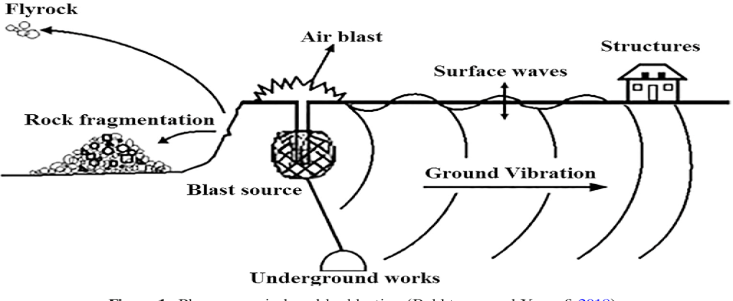
Ground vibration due to quarrying activities in the area are anticipated due to operation of mining machines like excavators, drilling and blasting, transportation vehicles etc. However, the major source of ground vibration from this mine is blasting. The major impact of the ground vibrations is observed on the domestic houses located in the villages surrounding the mine lease area. The kuchha houses are more prone to cracks and damage due to the vibrations. Apart from this, the ground vibrations may develop a fear factor in the nearby settlements Table 1 & Figure 1.
The empirical equation used for assessment of peak particle velocity (PPV) is: V=417.8{D/(Q0.5)}-1.265 Where V= Peak particle velocity in mm’s D= Distance between location of blast and gauge point in m Q= Quantity of explosive per blasting in kg
| Distance from blasting site, m | Quantity of Explosive/Blast Kg | PPV, mm/s |
|---|---|---|
| 1000 | 200 | 1.9 |
| 2000 | 200 | 0.8 |
| 3000 | 200 | 0.5 |
| 4000 | 200 | 0.3 |
| 5000 | 200 | 0.2 |
Table 1: Estimated peak particle velocity for different explosive charges.
Mining Blasting Dust
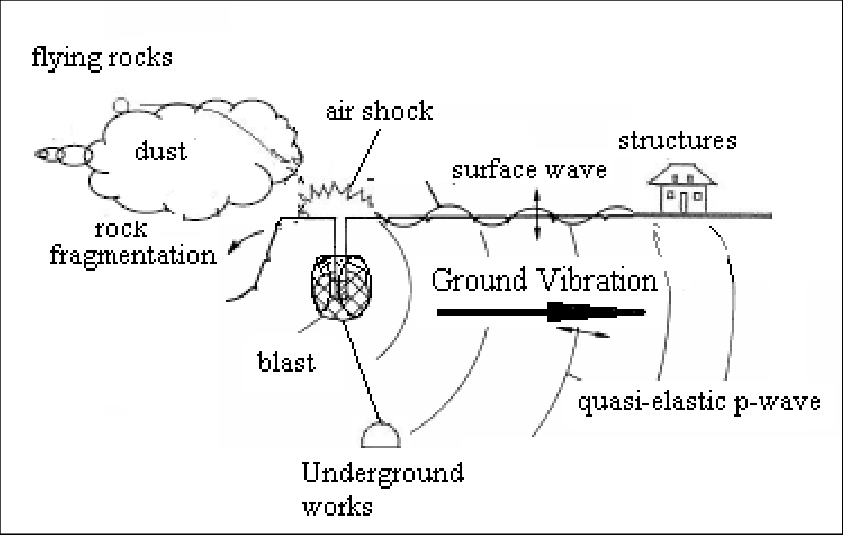
Dust particle from mining blasting floating in the air is closely related to the fine material that resulted from mining blasting process. A hypothesis about fines (dust) generation in the blasting process was initially formulated in which the crushing near the blast hole plays an important role. Several rock and blasting parameters affect dust generation. The type of rock is of course the most important parameter. Increase in number of joints may increase amount of dust produced. Filler material in the joints is released and may come out as fines and dust Figure 2.
Methodology
Techniques of controlled blasting in opencast mines
In both the mining and construction industries, blasting is the predominant method for fragmentation of consolidated mineral deposits and rocks. The public relation problems of users of explosives have increased greatly in the past few years as explosives are being consumed in increasing quantities. Increased population and spread of urbanization near to the construction & mining sites have affected more people by blasting. Controlled blasting methods are used to control adverse impacts of blasting in the environment also it help in the better fragmentation of the rock [6].
There are various controlled blasting methods:
- Line drilling.
- Trim (Cushion) blasting.
- Smooth blasting.
- Pre-splitting.
- Muffle blasting
Results
In order to achieve the objective of our project the data collected from the mine are analyzed. After analyzing we get very crucial information like controlled blasting technique and impact on environment of opencast mines. The current blasting scenario is required to be change in order to reduce the impact of blasting on the environment. This resulted design will help in control of fly rock, ground vibration and Dust. We have various option of control blasting techniques which will help to achieve our goal. These control blasting techniques can be apply in any of the large open pit mines to reuse the impact Some of the important method are pre- splitting & line drilling which can be efficiently use in Indian context. We have seen that in some of the mining area the practice of muffle blasting are done which help to reduce the impact but other method are not very popular in Indian context.
Discussion
Environmental impacts of blasting can be caused by controllable factors such as blast design as well as uncontrollable factors such as geological condition of rock mass. Environmental impacts of blasting that most often have an impact in the field on the surrounding environment are fly rock, vibration, air overpressure and dust. Dealing with controllable factors must be performed in serious effort in order to minimize environmental impacts so that the environmental impacts of blasting can be conditioned below the allowable standard limit.
Conclusion
The rock blasting leads to a number of impacts on the environment. Opencast mining near the residential areas has become inevitable and therefore environmental impacts are required to be mitigated. Ground vibrations, Dust and fly rock are the important environmental impacts as they may damage the properties and fly rock may cause fatalities a proper blast control ensures effective utilization of the energy of the explosives. From our project we found that blast controlled can be improved with the help of modern technology.
These are widely used in the foreign countries in modeling mining operation like Europe and U.S. But these are need of this type in Indian mining sector. We are mostly using the old & convention method for planning & designing of blasting control as well as whole mining operation. These tools will help us in all the stage of mining operation including drilling & Blasting to the production of minerals. Also the control blasting technique can be used to utilize the blasting energy and will help to prevent the adverse effect blasting. Some of the CBT are presently used in India like muffle blasting but not in large content.
Nowadays the primary focus of the mining industry is to more & more production of coal/ore. The safety of miners as well as environment should be our primary concern. From our project work we conclude that the blasting has major impact on environment like fly rock, dust, ground vibration, pollution etc.
References
-
Akande JM, Aladejare AE, Lawal AL (2014) Evaluation of the Environmental Impacts of Blasting in Okorusu Fluorspar Mine, Namibia. International Journal of Engineering and Technology 4(2): 35-42.
-
Dhekne PY (2015) Environmental impacts of rock blasting and their mitigation. International Journal of Chemical Environmental & Biological Sciences 3(1): 46-
-
Lubej S, Ivanič A, Toplak S, Ivanovski I, Jelušič P (2000) Ground Vibration Response due to Blast Induced Vibration: Simple Prediction Model Based on Fuzzy Logic. In Proceedings of The 22nd International Congress on Sound and Vibration 2015 (ICSV 22) pp: 1744-1753.
-
Mishra AK (2003) Air Blast and Fly Rock-Avoidable Hazards of Blasting. Mining engineer’s Journal, 4(12): 11-18.
-
Stojadinovic S, Zikic M, Pantovic R (2011) A new approach to blasting induced ground vibrations and damage to Slovaca 16(4): 344.
-
Sushil Bhandari (1977) “Engineering Rock Blasting”, AA Balkema, Rotterdam, Brookfield.
- Lessons to Learn: Trees are More than the Lungs of the World
- Community Forestry Enterprises as a Model for Sustainable Forest Development: The Case Of The "Baja Tarahumara" in Chihuahua, Mexico
- Ecological and Socio-Economic Impacts of Chromolaena odorata and Mesosphaerum suaveolens, Two Invasive Alien Species in Central and Southern Benin, West Africa
- Epigenetic Sustainability: Modeling the Human Factor as a Natural Resource through Science 4.0 and the NR3C1 Biological Pilot
- Growth-at-Risk: A Framework for Assessing Economic Vulnerability
- The Rural Territory as a Socioecological System for the Management of Public Policy for Sustainable Rural Development