
Evaluation of Thermal Maturation of Hydrocarbon Potential Source Rocks From Kombe-Kompina-Missole Areas of the Douala Sub- Basin Using Spore Color Variation Technique
The Douala sub-Basin is well-known as a highly prospective basin for petroleum generation. The depletion of some oil Wells originally discovered in Cameroon calls for further investigation on the maturity of potential source rocks so as to discover more oil fields. The current methods used by many researchers for evaluating the thermal maturity of potential source rocks are mostly the geochemical techniques which are pretty expensive. Thus, this study was set out to evaluate thermal maturation of potential source rocks exposed in the Kombe-Kompina-Missole areas of the Douala Sub-Basin through the use of spore color variation as an alternative cheaper method of determination with a higher precision than the former. This work had three specific objectives; to carry out loggings, to obtain and identify sporomorphs, to determine the extent of thermal alteration of sporomorphs present in the samples through microscopic examination of spore and pollen color variation. A total number of fifteen samples obtained from the sedimentary sequences encountered in the studied area were sent for laboratory analysis. The results obtained from palynological analysis showed that color index of organic matter at Kombe and Kompina ranges from 2 to 2/3 which are immature to early mature source rocks with kerogen type II, III and IV. While for Missole, color index ranges from 2/3 to 3 indicating early maturity to mature source rocks with kerogen type II. Facies identified from lithofacies analysis included: sandstones, shales, mudstones, siltstones, conglomerates. Therefore, palynological methods based on spore color variationis an efficient and cheaper method of determining thermal maturity.
Claudine Tankie Nchimb1, Josephine Fleur Matateyou2, Olivier Njoh Anoh1, Julius Ghogomu1 and Sampson M Ndenzem1
Introduction
Oil prospection in Cameroon began in 1947 and commercial production of Oil began in 1977 in the Kole Oil Field, of the Rio del Rey Basin. After this, new oil fields were subsequently discovered in the Ebome Oil Field of the Douala-Kribi-Campo Basin.The Douala-Kribi-Campo Basin comprises of the Early to Mid cretaceous periods of the Atlantic coast of West Africa. It is divided in to two sub-basins; the Douala Sub-Basin to the North and the Kribi-Campo Sub- Basin to the South [1]. Variation in the color of spores and pollen in sedimentary rocks is closely related to thermal alteration [2]. As temperature and pressure increases as a result of increase in depth of burial, spores and pollen undergo a series of changes in their chemistry structure which is seen as their color changes from pale yellow to black. This continuous change in color is as a result of the fact that fossilized pollen and spores have organic cell walls that are progressively altered, when subjected to continues heating, during which hydrogen and oxygen are lost in excess of carbon [3]. This progressive, cumulative and irreversible color change Pross can be qualified using spore and pollen color index that can be easily matched to Vtrinite Reflectance [4]. Many authors have successfully used dispersed kerogens in their studies: Chiadikobi [5] used it to determine the maturatation in the Anambra Basin; Zeinab [6] used it to evaluate the petroleum potentials and paleo-environmental interpretation of the Kazhdumi formation, Northern Persian; Njoh [7] also used it to determine the thermal maturity of Mid-Cretaceous lacustrine organic-rich sediments in the Mamfe Basin, Cameroon. The following geologic apects of this basin has been studied; the sedimentological aspect by Njike [8], the geochemical and paleodepositional aspects by Bachirou [9], the stratigraphic aspect by Dumort [10], the petroleum aspect by Nguene, Loule, Tamfu [11, 1, 12]; the tectonic evolutional aspect by Benkhelil, Djomeni [13, 14]. Despite all this work done, the application of Palynology especially spore color variation has not been well expanded in the Douala Sub-Basin of the Douala-Kribi- Campo Basin, although a few publications on palynology have been made such as: Njoh, Njike [15, 8]. The depletion of some oil wells originally discovered in Cameroon calls for further exploration to discover new oil fields. Furthermore, Geochemical techniques are the most frequently used methods in evaluating thermal maturation of potential source rocks which are very expensive, reason why this study was set out to examine thermal maturation of potential source rocks using Palynological technique (spore color variation) which is relatively cheaper but produces results of higher precision [7]. Palynological analyses are used mainly for chronostratigraphic correlations, paleoenvironmental studies and the evaluation of potential source rocks.
The Study Site
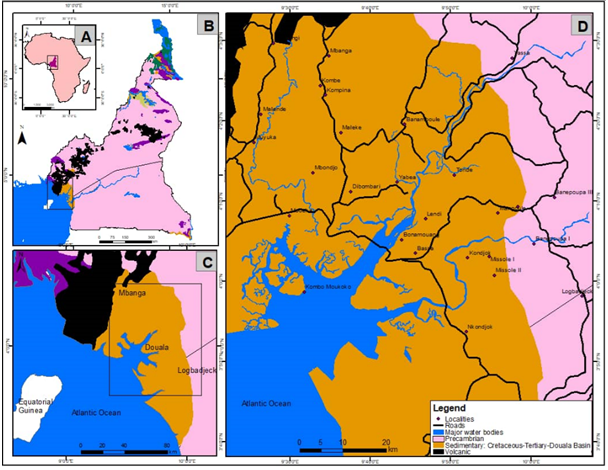
The Douala-Kribi-Campo Basin is predominantly an offshore basin extending from the Cameroon volcanic line (CVL) in the north to the Corisco arch in the south east of the Equatorial Guinea-Gabon border. The basin lies wholly within the territorial borders of Cameroon and Equatorial Guinea [15]. The Douala Sub-Basin of the Douala-Kribi Campo Basin lies between latitudes 3 ̊03’N and 4 ̊06’N and longitudes 9 ̊00’E and 10 ̊00’E, covering a total surface area of 12,805km2 [16]. The basin is bordered to the West and Northwest by the Cameroon Volcanic Line (CVL), to the South by the northern border of the Kribi-Campo Sub-Basin which is broadly delineated by the northern end of the Kribi Fracture Zone (KFZ), and to the East by the Precambrian Basement. Administratively, the Basin is found in the littoral region. The area of study is found in Kombe-Kompina-Missole and belongs to the Nkappa Formation of the Southeastern edge of the Douala Sub-Basin (Figure 1).
Geologic setting
The formation of the Douala Sub-Basin is linked to the formation of the Gulf of Guinea which was formed during the breakup of the Gondwanaland [17]. The Douala Sub-Basin resulted from the lower Cretaceous (Aptian-Albian) Rifting phase of the African and South American Plates followed by a Post Rift Thermal sag. This led to the formation of the passive Continental margin basins (Douala- kribi-Campo Basin) and the Benue Trough. This basin consists of several faults, fold, and fractured zones including the Cameroon fracture zone and the Sanaga fracture zone (Figure 2). The Douala Sub-
Basin has a history that is similar to all the basins of the West African margin [18]. These basins were formed by a rift phase in the early Cretaceous followed by an east-west drift phase during the widening of the South Atlantic in mid-Cretaceous times. The geodynamic context of their tectono-stratigraphic development has been summarized in three phases [9].
![Figure 2: The geologic map of Cameroon showing region of study, major litho-tectonic suite and domains. • Pre-Rift stage, ranging from Late Proterozoic to Late Jurassic • Syn-rift phase (Apto-Albian) • Post-rift phase that ranges from Late Cretaceous to Holocene The basal formation in the Douala Sub-Basin is the Mundeck Formation Njoh is Barremian-Aptian to Albian in age and unconformably overlies the Precambrian basement complex [7]. It comprises oft4r basal conglomerates, conglomeritic sandstones, siltstones, claystones and shales that were deposited in a continental fluvio-lacustrine setting (Figure 3). The Logbadjeck formation (Mungo River) is directly overlying the Mundeck Formation. It ranges in age from Cenomanin to early Campanian Nguene and lithofacies include [11]; sandstone, siltstone, limestone, marlstone and shale. Directly above the Logbadjeck formation lies the late Campanian-Maastrichtian Logbaba formation. It is made up of shale, sand and sandstone and in places, limestone, sandstone and shale alternate. The first tertiary formation is the Paleocene-Eocene N’kapa formation which is predominantly calcareous to slightly silty claystone that is locally inter-bedded with sandstone and glauconitic claystone. The Souelaba Formation overlies the N’kapa formation and has been dated Oligocene-Miocene. It comprises of clay stones with inter-bedded sandstones and sands, locally calcareous, argillaceous and glauconitic. The next is the Matanda formation whose age is late Pliocene-Pleistocene. Its lithology is made up of gravels, sands with inter-bedded clay stones and clays and sometimes calcareous. The basin is capped by the Pleistocene-Holocene Wouri Formation which directly overlies the Matanda formation. It is composed of sands, sandstones, clay stones with local development of tuffs and lavas.](/fulltextimages/8842/fig_2.png)
Figure 2: The geologic map of Cameroon showing region of study, major litho-tectonic suite and domains.
- Pre-Rift stage, ranging from Late Proterozoic to Late Jurassic
- Syn-rift phase (Apto-Albian)
- Post-rift phase that ranges from Late Cretaceous to Holocene The basal formation in the Douala Sub-Basin is the Mundeck Formation Njoh is Barremian-Aptian to Albian in age and unconformably overlies the Precambrian basement complex [7]. It comprises oft4r basal conglomerates, conglomeritic sandstones, siltstones, claystones and shales that were deposited in a continental fluvio-lacustrine setting (Figure 3). The Logbadjeck formation (Mungo River) is directly overlying the Mundeck Formation. It ranges in age from Cenomanin to early Campanian Nguene and lithofacies include [11]; sandstone, siltstone, limestone, marlstone and shale. Directly above the Logbadjeck formation lies the late Campanian-Maastrichtian Logbaba formation. It is made up of shale, sand and sandstone and in places, limestone, sandstone and shale alternate. The first tertiary formation is the Paleocene-Eocene N’kapa formation which is predominantly calcareous to slightly silty claystone that is locally inter-bedded with sandstone and glauconitic claystone. The Souelaba Formation overlies the N’kapa formation and has been dated Oligocene-Miocene. It comprises of clay stones with inter-bedded sandstones and sands, locally calcareous, argillaceous and glauconitic. The next is the Matanda formation whose age is late Pliocene-Pleistocene. Its lithology is made up of gravels, sands with inter-bedded clay stones and clays and sometimes calcareous. The basin is capped by the Pleistocene-Holocene Wouri Formation which directly overlies the Matanda formation. It is composed of sands, sandstones, clay stones with local development of tuffs and lavas.
![Figure 3: Tectono-lithostratigraphy of the Douala/Kribi-Campo Basin (adopted from Nguene FR [11]).](/fulltextimages/8842/fig_3.png)
Materials and Methods
Fifteen samples of shales, limestones, mudstones from river banks and roadside-cuts of the Kombe, Kompina and Missole-II areas were collected and investigated for their palynomorph content following standard palynological preparation techniques [4]. Visual color analysis was later carried out on the recovered sporomorphs based on visual comparison with the Munsell color Standard suggested Pearson DL [19]. The samples were washed to remove any contaminants and dried at temperatures between 50℃ to 70℃ in an electric oven. The sample was crushed (<5mm chips) using a mortar and pestle, to increase the surface area for the reaction to take place, 10-15g of each sample was weighed on an electronic balance and placed into a 1L polypropylene beaker. The crushed samples were treated with concentrated HCL (35℃) to digest any carbonates present and concentrated HF (40℃) to digest any silicate present and any vigorous reaction quelled with water. After this, the residues obtained were sieved using a 125µm brass sieve and 10µm nylon mesh, to ensure that they are neutral. The sieved organic residue was suspended in distilled water and allowed to air, and dry on a cover slip. No oxidants or alkalis were used in order to facilitate the study of kerogen particles. The cover slip was then inverted on to a microscope slide on which a few drop of Elvacite solution has been placed. Elvacite was used as a mounting medium because it has only weak or no fluorescence which allows one to see most of the fluorescence properties of the kerogen. The slides were then examined under transmitted light microscopy.
Spore Color Determination
Spore and pollen experience both physical and chemical alterations due to increased temperature, burial depth and time leading to its color change hence, microscopic examination of spore and pollen color change from the sporoderm of the specimen containing organic matter was utilized for the determination of thermal maturation index. From each samples, strew mounts of dispersed organic matter were investigated under transmitted light using an Olympus BX50 light microscope. To warrant reproducibility of the results, color determinations were carried out under constant optical conditions using a magnification of 630X [4]. The sporomorphs colors of the organic matter present in the sample were estimated on the recovered forms of the sporomorphs based on visual comparison with Pearson’s (1984) color chart, Marshall 1990 color chart and Peter’s maturity classification table (Tables 1-4).
| SPORES POILEN COLOUR | CORRELATION TO OTHE SCORES | |
|---|---|---|
| TAI 1-5 | VITRINITE REFLECTANCE | |
| 1 1+ 2- 2 2+ 3- 3+ 4- 4 (5) | 0.2% 0.3% 0.5% 0.9% 1.3% 2.0% 2.5% | |
| BLACK AND DEFORMED |
Table 1: Pearson’s, (1984) color chart for organic thermal maturity determination correlated with thermal alteration index (TAL)
| Spores colour | SCI | ||
|---|---|---|---|
| Pale yellow | 1 | ||
| Pale yellow-lemon | 2 | ||
| Lemon yellow | 3 | ||
| Golden yellow | 4 | ||
| Yellow orange | 5 | ||
| Orange | 6 | ||
| Orange brown | 7 | ||
| Dark brown | 8 | ||
| Dark brown black | 9 | ||
| Black | 10 |
Table 2: Color changes in spores and pollen, and Spore Color index (SCI).
| Ro (%) | Tmax (°c) | TAI | |
|---|---|---|---|
| Immature | 0.2-0.6 | <435 | 1.5-2.6 |
| Early mature | 0.6-0.65 | 435-445 | 2.6-2.7 |
| Peak | 0.65-0.9 | 445-450 | 2.7-2.9 |
| Late mature | 0.9-1.35 | 450-470 | 2.9-3.3 |
| Post mature | >1.35 | >470 | >3.3 |
Table 3: classification of thermal maturation.
| Colour of Palyno-fossils | TAI | VRo% | Tmax | Paleo- Temp oC | Hydrocarbon generation | ||
|---|---|---|---|---|---|---|---|
| (Staplin, 1968 Waples, 1985) | Oil Window | Wet Gas Window | Dry Gas | ||||
| Pale yellow | 1.0 | 0.20 | |||||
| Yellow | 1.3 | 0.24 | |||||
| Sunny yellow | 1.7 | 0.28 | |||||
| Yelloy orange | 2.0 | 0.30 | 420 | 75 | |||
| Bright orange | 2.3 | 0.42 | 430 | 80 | |||
| Orange | 2.7 | 0.70 | 445 | 130 | |||
| Yellow brown | 3.0 | 1.15 | 460 | 190 | |||
| Dark yellow brown | 3.3 | 1.26 | 470 | 200 | |||
| Very dark grayish brown | 3.7 | 2.00 | 500 | 235 | |||
| Very dark gray | 4.0 | 3.50 | 500 | 290 | |||
| Black opaque | 5.0 | 5.55 | 290 |
Table 4: Shows Parameters for measuring maturation with respect to Table 2.
Furthermore, from Tables 1 & 2 above, sporomorphs color showing pale yellow to yellow indicate that the sporomorphs has TAI of 1 hence, the hydrocarbon generation is immature. From yellow to light orange-medium orange indicate TAI of 2 perhaps, the source rock is at its oil window ready to generate petroleum. Dark brown indicates gas window with TAI of 3 and brownish black to black color of sporomorphs indicate that the petroleum generation is at wet gas limit to dry gas preservation characterized by TAI of 4 and 5 respectively.
Results
Field Results
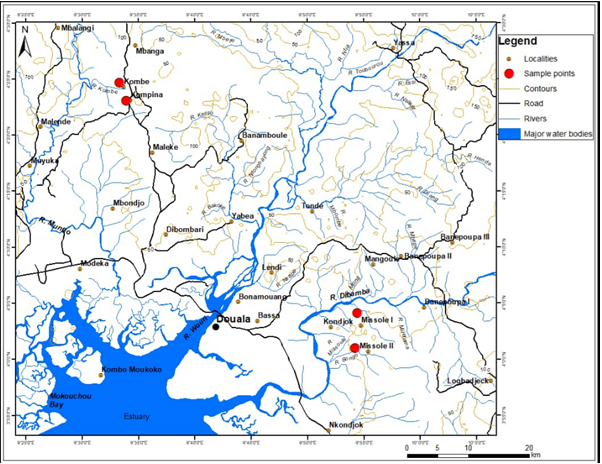
A total of four profiles were studied but fifteen samples were collected from just three of the areas kombe, kompina and missole II areas as represented on the map below (Figure 4).
Description of Geologic Profiles
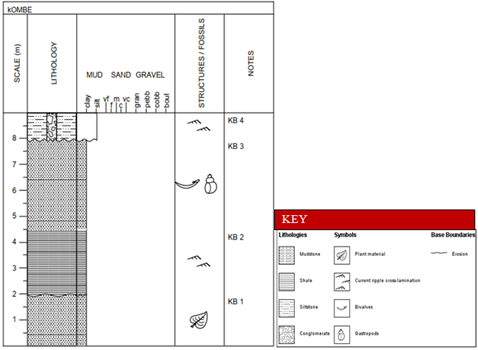
Profile one (Kombe) is located at latitude N040 23’ 05.06.0“and longitudes E0090 53’ 58.75“with an elevation of 79m above sea level. This profile is characterised by a v-shaped valley oriented in the E-W direction with a finning upward succession. The facies encountered along this profile can be divided into five major beds (Figure 5); the lower bed is made up of mudstones with no boundaries, containing bivalves and plant materials, with a thickness of 1.5-2m. The second unit is composed of shales, with hoizontal planar laminations and a thickness of 2.5m. The third unit is composed of siltstones with gastropods, bivalves and has a gritty texture with a thickness of 3.5m. The fourth unit is composed of conglomeritic siltstones with bivalves and it is 1m thick. The fifth unit comprises of conglomerates with embedded fragments of rounded to sub-rounded boulders.
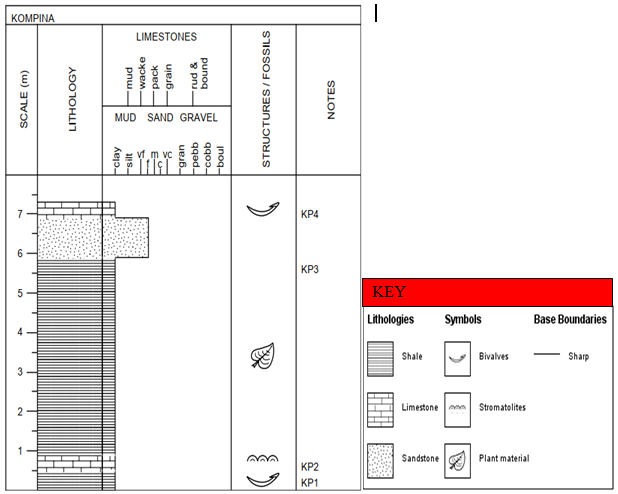
Profile two (Kompina) is located at latitudes N04021’36, 5’’ and longitudes E009037’13.8” with an elevation of 35m above sea level. The facies along the profile can be divided into five beds (Figure 6). The lower bed is composed of black shale, with a thickness of 5m. The second unit is composed of grey limestone, has a compact and massive structure with indurated grains ranging from rounded to sub-rounded quartz pebbles. The beds thickness ranged from 0.4m-0.5m with fossils of bivalves, gastropods, stromatolites. The third unit is dark fossiliferous shales with siltstone, thickness of 5m and with scattered sub-angular to sub-rounded gravels of quartz. The fourth unit is composed of a sand stone with ripped-off clasts of limestone, with a thickness 8m. The fifth unit is the topper most bed made up of limestone. The entire sequence coarsens upward.
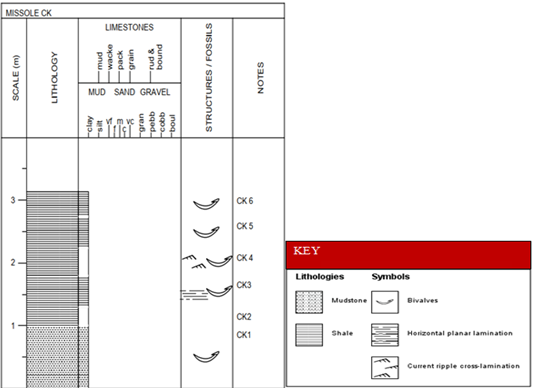
Profile three (Missole II-CK) is located at latitudes N040 00‘25.2“and longitudes E0090 52‘20.1“with an elevation of 14.1m above sea level. The facies encountered along this profile can be divided into six major beds (Figure 7). The lower bed is made up of mudstones with a thickness of 1m, rich in fossils of bivalves and shows fissillity. The second unit is composed of dark shales with thickness ranging from 0-0.29m. The third unit is composed of shales with a thickness of 0.5m, rich in fossils of bivalves and has horizintal planar laminations. The fourth unit is commposed of oxidized reddish brown shale with a thickness of 0.44m. This unit is covered with regolith materials and has current ripple-cross laminations. The fifth unit is composed of shales with a thickness of 0.5m and rich in fossils such as bivalves.
Laboratory Results
The following kerogen types were identified from the sporomorphs obtained as seen on the tables below.
| Sample codes | Kerogen types | Spore color |
|---|---|---|
| Kb1 | III | No yield |
| Kb2 | III | No yield |
| Kb3 | II/III | 2 |
| Kb4 | II | 2/3 |
Table 5: The various kerogen types and spore colors identified from section one (Kombe).
| Kerogen types | Spore color | |
|---|---|---|
| Kp1 | II/III | 2/3 |
| Kp2 | III/IV | 2/3 |
| Kp3 | II/III | 2 |
| Kp4 | II | 2/3 |
| Kp5 | II/III | No yield |
Table 6: The various kerogen types and spore colors identified from section two (Kompina).
| Sample codes | Kerogen types | Spore color |
|---|---|---|
| Ck1 | II | 2/3 |
| Ck2 | II | 3 |
| Ck3 | II | 2/3 |
| Ck4 | II | 2/3 |
| Ck5 | II | 2/3 |
| Ck6 | II | 2/3 |
Table 7: The various kerogen types and spore colors identified from section three (Missole II-Kendeck).
Interpretation of Results
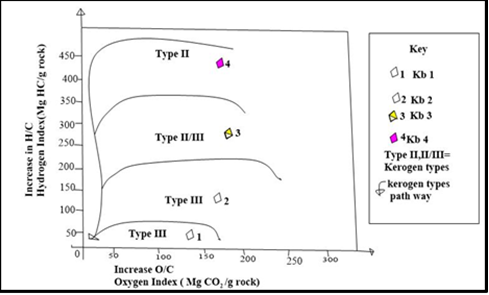
Paleo-environment of deposition-Section one (Kombe): Based on the kerogen types of this section, type II kerogen depicts a marine depositional environmental origin, Kerogen type III depicts a terrestrial environment of deposition while kerogen II/III (meaning type II and III) depicts a marine environment under continental influence. The kerogen pathways can be represented as seen on (Figure 8) below.
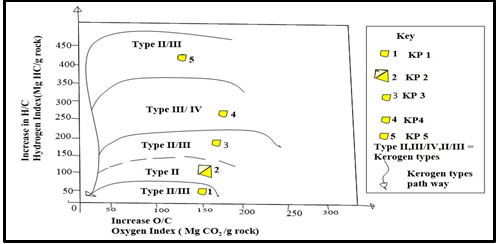
Section two (Kompina): From the kerogen types of this section; Kerogen type II depicts a marine environment of deposition, Kerogen type III/IV (meaning type III and IV) depicts that there are two environments of deposition, that is a terrestrial environment and a highly degrading environment respectively while kerogen II/III depicts a marine environment under continental influence as shown below (Figure 9).
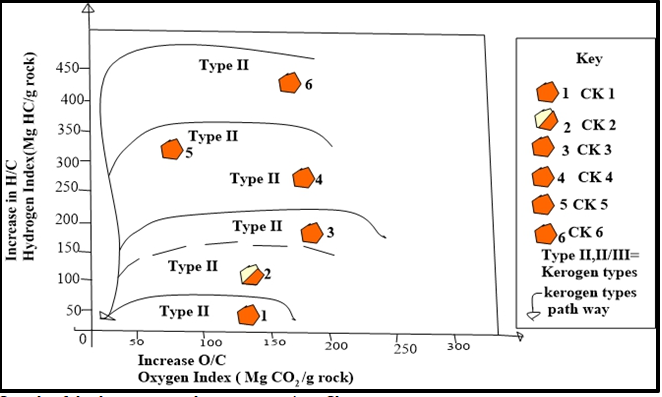
Section Three (Missole II-Kendeck): The kerogen type in this section is kerogen type II which depicts a marine environment of deposition (modrately deep marine environment) as represented below (Figure 10).
Thermal Maturation of Source Rocks
To determine the maturation of organic matter in these samples, spore color analysis based on Pearson’s spore color chart correlated with other maturation parameters such as Vitrinite Reflectance (R0 % ), Thermal alteration index (TAI), Maximum temperature (Tmax), depth were all considered. In this notice, R0 value of 0.45% corresponds to the lowest value associated with the generation of oil and values less than that defines diagenesis stage inwhich oil source rock is immature, R0 value between 0.5-0.7% is generally considered as the beginning of oil generation. However, R0 value of 0.9- 1.3% defines the, oil window, which is the main zone of oil generation. Moreover, R0 values of 1.3-2% represent the late catagenesis stages in wet gas condensate and R0 values greater than 2% shows the metagenesis stages in which source rock is over mature and methane gas is the only hydrocarbon. Furthermore, TAI of 1.5 to 2.6 and Tmax of < 435℃ defines immature source rocks, TAI of 2.6 to 2.7 and Tmax of 435-445℃ defines early mature, TAI of 2.7 to 2.9 and Tmax of 445-450℃ defines the peak of maturity, TAI of 2.9 to 3.3 and Tmax of 450-470℃ indicates late maturity and TAI of >3.3 with Tmax of >470℃ defines postmature. This information is represented on the following tables below based on the different sections studied (Table 8).
| Sample code | Spore color number | Spore color | TAI (1-5) | Temp (0c) | Depth (m) | R (%) 0 | Tmax (0c) | Maturation | Kerogen types |
|---|---|---|---|---|---|---|---|---|---|
| Kb3 | 2 | Pale yellow to lemon yellow | 1 to 1+ | 40-45 | 1360 to 1690 | 0.2- 0.3 | <435 | Immature | II/III |
| Kb4 | 2/3 | Lemon yellow | 2 to 2+ | ≤65 | >1690 | 0.3- 0.6 | ≤435 | Immature/Early maturation | II |
Table 8: Spore coloration of Kb – samples (section one).
From the above table (Table 9), sample Kb3 in section one falls under spore color number 2 which corresponse to spore color pale yellow to lemon yellow indicating that the organic matter in this sample was thermally altered with a TAI of 1 to 1+ under a paleo-temperature of 40 to 45℃ characterized by a corresponding vitrinite reflectance (R0) of 0.2 to 0.3% and a maximum temperature (Tmax) of <435℃. This shows that Kb3 is immature and is still at the stage of mid-diagenesis of hydrocarbon production process. The organic matter type, that is type II/III kerogen indicates oil/gas proness, meaning that the sample could have been able to generate oil and gas if subjected to the appropriate temperature for hydrocabon generation. Kb3 was subjected to a paleo-temperature of 40 to 450c , and due to that, its depth of burial was 1360m to 1690m. Moreso, sample Kb4 falls under spore color number 2/3 which corresponse to spore color lemon yellow indicating that the organic matter in this sample was thermally altered with a TAI of 2 to 2+ under a paleo-temperature of ≤65℃ characterized by a corresponding vitrinite reflectance ( R0) that ranges from 0.3 to 0.6% and a maximum temperature (Tmax) of ≤445. Thus, sample Kb4 is immature to early mature. This implies that, there is a transition from late diagenesis to early catagenesis which is the early stage of the oil window. From the kerogen type that is, type II indicates oil proness, meaning that the sample can produce oil. Since Kb4 was subjected to a paleo- temperature of ≤65℃, its corresponding depth of burial was >1690m.
| Sample code | Spore color number | Spore color | TAI (1-5) | Temp (0c) | Depth (m) | R (%) 0 | Tmax(0c) | Maturation | Kerogen type |
|---|---|---|---|---|---|---|---|---|---|
| Kp1 | 2/3 | Lemon yellow | 2 to 2+ | ≤65 | >1690 | 0.3-0.6 | ≤435 | Immature/Early maturation | II/III |
| Kp2 | 2/3 | Lemon yellow | 2 to 2+ | ≤65 | >1690 | 0.3-0.6 | ≤435 | Immature/Early maturation | III/IV |
| Kp3 | 2 | Pale yellow to lemon yellow | 1 to 1+ | 40-45 | 1360 to 1690 | 0.2-0.3 | <435 | Immature | II/III |
| Kp4 | 2/3 | Lemon yellow | 2 to 2+ | ≤65 | >1690 | 0.3-0.6 | ≤435 | Immature/Early maturation | II |
| Kp5 | 2/3 | Lemon yellow | 2 to 2+ | ≤65 | >1690 | 0.3-0.6 | ≤435 | Immature/Early maturation | II/III |
Table 9: Spore coloration of Kp – samples (section two).
Sample Kp1, Kp2, Kp4 and Kp5 of section two falls under spore color number 2/3 which corresponse to spore color lemon yellow indicating that the organic matter in these samples were thermally altered with a TAI of 2 to 2+ under a paleo-temperature of ≤65℃ characterized by a corresponding vitrinite reflectance (R0) that ranges from 0.3 to 0.6% and a maximum temperature (Tmax) of ≤445. This shows that the samples (Kp1, Kp2, Kp4 and Kp5) are immature to early mature implying that, there is a transition from late diagenesis to early catagenesis which is the early stage of the oil window. From their (Kp1, Kp2, Kp4, Kp5) respective organic matter types, that is Type II/III, III/IV, II and II/III indicating that, Kp1 is oil/gas prone (can produce oil and gas), Kp2 is gas prone and can produce dry gas only, Kp4 is oil prone and can produce oil only while Kp5 is oil/gas prone. All the samples were subjected to a paleo- temperature of ≤65℃, and thus, their burial depth was >1690m. Again, sample Kp3 of the same section falls under spore color number 2 which corresponse to spore color pale yellow to lemon yellow indicating that the organic matter in this sample was thermally altered with a TAI of 1 to 1+ under a paleo-temperature of 40 to 45℃ characterized by a corresponding vitrinite reflectance (R0) of 0.2 to 0.3% and a maximum temperature (Tmax) of <435℃. This shows that Kp3 is immature meaning, it is still subjected to the stage of mid-diagenesis of hydrocarbon production process. From its corresponding kerogen type, that is type II/III indicates oil/gas proness, meaning that the sample could have been able to generate oil and gas if subjected to the appropriate temperature for hydrocabon generation. Since Kp3 was subjected to a paleo-temperature of 40 to 450c, it implies that the depth of burial was 1360 to 1690m (Table 10).
| Sample code | Spore color number | Spore color | TAI (1-5) | Temp (℃) | Depth (m) | R (%) 0 | Tmax(℃) | Maturation | Kerogen type |
|---|---|---|---|---|---|---|---|---|---|
| Ck1 | 2/3 | Lemon yellow | 2 to 2+ | ≤65 | o | 0.3-0.6 | ≤435 | Immature/Early maturation | II |
| Ck2 | 3 | Lemon yellow to golden yellow | 2+ to 3- | 65 to <100 | 2025 | 0.6-0.9 | 435-445 | Early maturation to mature (oil window) | II |
| Ck3 | 2/3 | Lemon yellow | 2 to 2+ | ≤65 | >1690 | 0.3-0.6 | ≤435 | Immature/Early maturation | II |
| Ck4 | 2/3 | Lemon yellow | 2 to 2+ | ≤65 | >1690 | 0.3-0.6 | ≤435 | Immature/Early maturation | II |
| Ck5 | 2/3 | Lemon yellow | 2 to 2+ | ≤65 | >1690 | 0.3-0.6 | ≤435 | Immature/Early maturation | II |
| Ck6 | 2/3 | Lemon yellow | 2 to 2+ | ≤65 | >1690 | 0.3-0.6 | ≤435 | Immature/Early maturation | II |
Table 10: Spore coloration of Ck–samples (section three).
Sample Ck2 of section three (see Table above) falls under spore color number 3 which corresponse to spore color lemon yellow to golden yellow indicating that the organic matter in the sample was thermally altered with a TAI of 2+ to 3- under a paleo-temperature of 65 to <100℃ characterized by a corresponding vitrinite reflectance ( R0) that ranges from 0.6 to 0.9% and a maximum temperature (Tmax) that ranges from 435℃ to 445℃. This shows that Ck2 has reached the stage of catagenesis. The kerogen type here is the type II kerogen which depicts that Ck2 is oil prone and is at the oil window zone. Since Ck2 has a paleo-temperature of 65 to <100℃, it means the depth of burial was 2025m. Sample Ck1, Ck3, Ck4, Ck5, Ck6 of section two, falls under spore color number 2/3 which corresponse to spore color lemon yellow indicating that the organic matter in these samples were thermally altered with a TAI of 2 to 2+ under a paleo- temperature of ≤650c characterized by a corresponding vitrinite reflectance (R0) that ranges from 0.3 to 0.6% and a maximum temperature (Tmax) of ≤445. This shows that the samples are immature to early mature and are at a transition stage from late diagenesis to early catagenesis which is the early stage of the oil window. All the samples (Ck1, Ck3, Ck4, Ck5, Ck6) have kerogen type II which is oil prone. More so, they were subjected to a paleo-temperature of ≤65℃ which implies that, their depth of burial was >1690m.
Discussion
Assessment of the thermal maturity of potential source rocks exposed in Kombe, Kompina, and Missole II-Kendeck area was carried out based on the color variation with increasing depth, temperature and pressure on the organic matter contained within the rocks. Palynofacies analysis based on spore color evidence and the kerogen types indicates that the organic matter in Kombe and Kompina is a mixture of both sapropellic and humic organic materials of planktonic/terrestrial origin respectively. Deposition took place in shallow, very turbulent marine environment that was still undergoing continental influence. This result is similar to that in the Kazhdumi formation (with kerogen type II/III and III) of the Soroosh oil field in Northern Persia [20]. While that of Missole II is sapropellic organic matter of planktonic origin and deposition evidently took place in calm moderately deep to deep purely marine environment relatively anoxic or closed [21, 22]. The Kombe and Kompina areas are shown to be made up of immature to early mature source rocks based on palynofacies analysis that identifies a spore color change of pale yellow – lemon yellow, (for the immature source rocks; 0.2-0.3%Ro, <435°C Tmax, 1 to 1+ TAI, 1360m-1690m depth) and lemon yellow (for early mature source rocks; 0.3- 0.6%Ro, ≤435°C Tmax, 2 to 2+ TAI, >1690m depth). While Missole-Kendeck area is made up of early mature to mature source rocks based on palynofacies analysis that identifies a spore color of lemon yellow (early mature source rocks) and lemon yellow – golden yellow (mature source rocks; 0.6- 0.93%Ro, 435-445°C Tmax, 2+ to 3- TAI, 2025m depth). The result is slightly similar to that of the mature source rocks of the Abu Madi formation in Peter [23], having a TAI of 2 to 2+. Hence, the greater the depth of burial, the higher the temperature and thermal alteration index (TAI), the greater the vitrinite reflectance due to increase in age of burial, thus the higher the degree of maturation and this is confirmed as spore color changes from light to dark.
Conclusion
Hence, the greater the depth of burial, the higher the temperature and thermal alteration index (TAI), the greater the vitrinite reflectance due to increase in age of burial, thus the higher the degree of maturation and this is confirmed as spore color changes from light to dark. Thermal maturation of potential source rocks exposed in the Kombe, kompina and Missole areas of the Douala Sub-Basin was successfully determined using spore color variation technique as a cheaper plus efficient method of determination.
References
-
Loule JP, Jifon F, Bioule SEA, Nguema P, Spofforth D, et al. (2018) An opportunity to re-evaluate the petroleum potential of the Douala/Kribi-Campo Basin, Cameroon. First Break 36(3): 61-70.
-
Chuanben Z (1984) Thermal alteration of spores and pollen and maturity of organic matter of the Cretaceous System, Songliao basin, northeast China. Geochemistry 3(1): 84-92.
-
Al-Mashramah YAA (2011) Maturity of kerogen, petroleum generation and the application of fossils and organic matter for paleotemperature measurements. Lund University.
-
Pross J, Pletsch T, Shillington DJ, Ligouis B, Schellenberg F, et al. (2007) Thermal alteration of terrestrial palynomorphs in mid-Cretaceous organic-rich mudstones intruded by an igneous sill (Newfoundland Margin, ODP Hole 1276A). International Journal of Coal Geology 70(4): 277-291.
-
Chiadikobi KC, Chiaghanam OI (2018) Visual Kerogen Study of the Campano-Maastrichtian Nkporo Group of Anambra Basin, Southeastern Nigeria. World News of Natural Sciences 19: 142-154.
-
Rezaei Z, Ghasemi-Nejad E, Haji Kazemi E, Sheikhzakariaee SJ (2014) Organic Geochemistry, Petroleum Potential evaluation and paleoenvironmental interpretation of the Kazhdumi formation in the Soroosh oil field, Northern Persian Gulf, MAGNT Research Report.
-
Njoh OA, Atud T (2017) Spore and pollen color changes and thermal maturation of Mid-Cretaceous lacustrine organic- rich sediments in the Mamfe Basin, S W. Cameroon 10(1).
-
Nijke Ngaha PR (1984) Contribution à l’Etude géologique stratigraphique et structurale de la bordure du basin atlantique au Cameroun. Thèse 3ème cycle, Université de Yaoundé 8(4): 131.
-
NP Ricard NC, Bachirou M, Dieudonné B (2014) Paleogeographic evolution of the eastern edge of the Douala Basin from Early Cenomanian to Turonian. The Open Geology Journal 8: 124-141.
-
Dumort JC (1968) Explanatory Notice of the sheet Douala West. Geological Recognition Map at scale 1/500,000. Department of Mines and Geology, Cameroon.
-
Nguene FR, Tamfu S, Loule JP, Ngassa C (1992) Palaeoenvironments of the Douala and Kribi/Campo subbasins in Cameroon, West Africa. Bulletin des Centres de recherches exploration-production Elf-Aquitaine. Mémoire (13) : 129-139.
-
Tamfu S, Batupe M, Pauken RJ, Boatwright DC (1995) Geologic setting, stratigraphy and hydrocarbon habitat of the Douala Basin Cameroon. National Hydrocarbon Journal of Cameroon 3(6).
-
Benkhelil J (1989) The origin and evolution of the Cretaceous Benue Trough (Nigeria). Journal of African Earth Sciences (and the Middle East) 8(2-4): 251-282.
-
Djomeni AL, Ntamak-Nida MJ, Mvondo FO, Kwetche PGF, Kissaaka JBI, et al. (2011) Soft-sediment deformation structures in Mid-Cretaceous to Mid-Tertiary deposits, Centre East of the Douala sub-basin.
-
Pauken RJ, Thompson JM, Schumann JR, Cooke JC (1991) Geology of the Douala Basin, Offshore Cameroon, West Africa. AAPG Bulletin (American Association of Petroleum Geologists); (United States) 75: 3.
-
Ndikum EN, Tabod CT, Essimbi BZ, Koumetio F, Tatchum NC (2014) Gravity model for an anomalous body located in the NE portion of the Douala sedimentary sub-basin, Cameroon (Central Africa). Open Journal of Geology 4(10): 524.
-
Bukalo NN, Ekosse GIE, Odiyo JO, Ogola JS (2018) Mineralogical characteristics of cretaceous-tertiary kaolins of the Douala sub-basin, Cameroon. Journal of African Earth 141: 130-147.
-
Luzzi-Arbouille T, Schmid E, Piperi T (2009) Recent Discoveries Offshore Douala Basin. Search and Discovery article 10185: 1-7.
-
Pearson DL (1984) Pollen/spore color ‘standard’. Phillips Petroleum Company Exploration Projects Section (reproduced in Traverse, A 1988. Palaeopalynology, Plate 1. Unwin Hyman, Boston).
-
Sefidari E, Amini A, Dashti A (2015) Source rock characteristics of Albian Kazhdumi formation in Zagros region. Arabian Journal of Geosciences 8(10): 8327- 8345.
-
Cameroon: Preliminary results of the tectonic control. Syllabus Review 2(3): 92-105.
-
Ntamak-Nida MJ, Bourquin S, Makong JC, Baudin F, Mpesse JE, et al. (2010) Sedimentology and sequence stratigraphy from outcrops of the Kribi-Campo sub- basin: Lower Mundeck Formation (Lower Cretaceous, southern Cameroon). Journal of African Earth Sciences 58(1): 1-18.
-
Peters KE, Cassa MR (1994) Applied source rock geochemistry: Chapter 5: Part II. Essential elements, pp: 93-120.
- Lessons to Learn: Trees are More than the Lungs of the World
- Community Forestry Enterprises as a Model for Sustainable Forest Development: The Case Of The "Baja Tarahumara" in Chihuahua, Mexico
- Ecological and Socio-Economic Impacts of Chromolaena odorata and Mesosphaerum suaveolens, Two Invasive Alien Species in Central and Southern Benin, West Africa
- Epigenetic Sustainability: Modeling the Human Factor as a Natural Resource through Science 4.0 and the NR3C1 Biological Pilot
- Growth-at-Risk: A Framework for Assessing Economic Vulnerability
- The Rural Territory as a Socioecological System for the Management of Public Policy for Sustainable Rural Development