
Legal Pillars to Agroforestry Management of Juçara Palm (Euterpe edulis Mart.) in the Atlantic Forest Biome
Several families and communities depend on tropical forests while making the sustainable use of plants, including planting and managing them, contributing to their conservation. The Atlantic Forest biome originally occurs, totally or partially in 17 states of the Brazilian territory. Since colonization by the Portuguese, the biome has suffered and still suffers from severe changes in its ecosystems composition, especially due to the loss and fragmentation of habitats. Today the remnants of native vegetation are reduced to less than 20% of their original cover and are in different stages of regeneration. Even reduced and very fragmented, it is estimated that in the Atlantic Forest there are about 20,000 plant species (about 35% of the existing species in Brazil), including several endemic and endangered species, which gives the Atlantic Forest the status of “hotspot for biodiversity” being among the areas of the planet with the highest priority for biodiversity conservation. In relation to the Juçara Palm (Euterpe edulis Mart.), historically, the irresponsible use of the strain as a wood product (wood and meristem) was conflicting and today it has legal restrictions with the inclusion of the species in the threatened list, implying legal and bureaucratic complications for its use. This situation makes communities that use the species in a sustainable way, end up being the target of the command control imposed by the State Environment Organizations, which in a perspective of preserving the species, penalize the traditional management. The need to prepare a Management Plan, at a very complex technical level, discourages families from using the species economically. The regulation must create processes that, as foreseen in the legislation, simplify the bureaucratization around the management for family farmers and traditional populations. This document brings the pillars of agroforestry management of Juçara Palm for agroforestry development in Brazil.
Introduction
The regulation of actions that involve environmental issues and the coexistence of populations with nature should dynamize the environmental legal system to bring federal, state and municipal legal instruments into line to provide legal certainty both for environmental agents of State environmental agencies, as for the populations that make use of forests and agroecosystems and agrobiodiversity [1, 2, 3]. Regarding the management of Juçara Palm (Euterpe edulis Mart.), historically, the irresponsible use of the strain as a wood product (wood and meristem) was conflicting and today it has legal restrictions that make it difficult to market its products and by-products (xxxxxxx). This situation, as with other native forest species, brings insecurity for farmers who practice sustainable extractivism in a traditional way in relation to the use of Juçara Palm, both for timber products, but mainly for non-timbers [2]. The need to prepare a Management Plan, at a very complex technical level, discourages families from using the species economically. The regulation must create processes that, as provided for in the legislation, simplify the bureaucratization around management for family farmers and traditional populations [2, 4, 5]. The regulation of the management of Juçara Palm, in turn, must consider three fundamental points: the regulation must guide the collection of fruits in areas of common use and in areas of environmental restriction (such as APPs and RL and even within Conservation); must consider the fact that in certain years there is a shortage of fruits, in a kind of seasonality similar to that of coffee [6], and sustainable extraction of the fruits must be considered without prejudice to the maintenance of the activity and the ecosystem [4]; and that the State should encourage the sustainable use of socio-biodiversity fruits Brasil [7] in order to strengthen the sovereignty and food security of family farmers, contributing to the conservation of the Atlantic Forest through use [2].
This article is part of a process of continuous construction
(a) of knowledge about the State of the Art of Agroforestry Systems, Sustainable Silviculture and Non-Timber Forest Products – PFNM, and now with a specific focus on the Juçara Palm (Euterpe edulis Mart.). This reality that emerges from the diverse agroecological experiences articulated in regional and national networks, demonstrates the robustness how important it is for the Brazilian State to accompany this process of collective construction to contemplate society’s expectations and to provide bureaucratic celerity to guarantee legal security to civil servants to be authorize and farmers to manage their agroecosystems [7, 8, 9, 10, 11, 12, 13, 14, 1, 2]. The objective of this article is through extensively bibliographic and legal mechanisms review contribute to the legal basis for the management of the Juçara Palm (Euterpe edulis Mart.), a key species of the sociobiodiversity used by traditional family farmers and communities who, from a perspective of preserving the environment, survive using ecosystem services without harming the ecological functions of the areas, conserving through use and agroecological management [1].
Contexts
Environmental Context
Atlantic Forest Biome
The Atlantic Forest Biome comprises the following native forest formations and associated ecosystems: Dense Ombrophilous Forest; Mixed Ombrophilous Forest, also called Araucaria Forest; Ombrophilous Open Forest; Seasonal Semideciduous Forest; and Seasonal Deciduous Forest, as well as mangroves, restinga vegetation, high altitude grasslands, inland swamps and forest enclaves in the Northeast [15, 16].
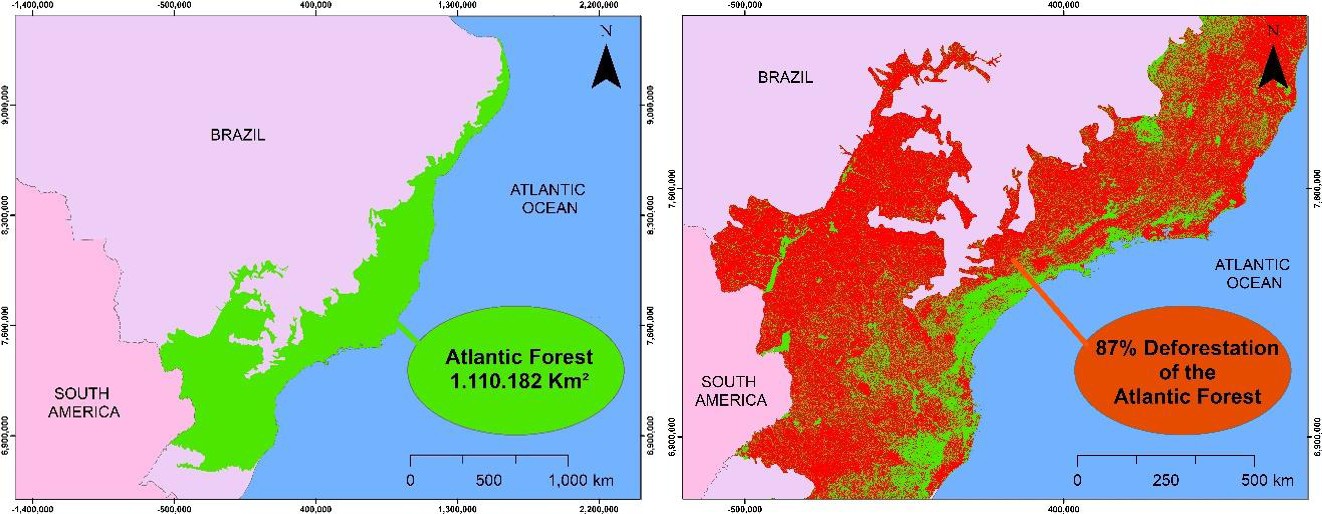
(b) Figure 1: Original size and location of the Atlantic Forest Biome in Brazil (a) and a glance at the current situation due to hundreds of years of deforestation (b).
The Atlantic Forest biome originally occurs, totally or partially in 17 states of the Brazilian territory (Figure 1a). Since colonization by the Portuguese, the biome has suffered and still suffers from severe changes in the ecosystems that compose it, especially due to the loss and fragmentation of habitats. Today the remnants of native vegetation are reduced to around 22% of their original cover and are in different stages of regeneration. Only about 7% are well preserved in fragments above 100 hectares [17].
Even reduced and very fragmented (Figure 1b), it is estimated that in the Atlantic Forest there are about 20,000 plant species (about 35% of the existing species in Brazil), including several endemic and endangered species, which gives the Atlantic Forest to be among the areas of the planet with the highest priority for biodiversity conservation, being one of the “hotspots”, that is, one of the richest areas in biodiversity, with a high number of endemic and most threatened species in the world [2, 16].
In forestry promotion projects for the recovery of degraded areas of the Atlantic Forest, it is important to pay attention to the multiple-use species, which provide the intrinsic ecosystem services of each species, in addition to providing timber and non-timber resources. For species of multiple uses, the management and exploitation plan may include phases for obtaining different products and optimizing the use of their services. For example, a species with fruits and wood of economic interest that is also widely used by the fauna: this can be managed in order to exploit the fruits for years, considering that part of them must be left for use by the fauna, and after the end of their reproductive life being managed to obtain wood [9, 11, 18]. Protected areas: Conservation Units – UCs; Permanent Preservation Areas (APP) and Legal Reserve (LR) Defined by law, the UCs, APP and LR, have use restrictions due to their importance for the conservation of the environment and maintenance of ecological functions of sensitive areas such as springs, water courses water or even steep ravines or hill tops [19, 20, 21]. The areas surrounding protected areas are generally populated by family farmers and traditional communities. According to Neumann & Hirsch [8], forest conservation will only be successful with the inclusion of local communities in decision-making, and for successful conservation projects and reconnectivity between fragments, sociocultural and economic factors must also be present.
This reality is based on several experiences recorded in books and scientific articles, from an agroecological perspective, they promote managements that protect ecological functions even in areas of alternative use, where they transform their properties and agroecosystems into wildlife refuges with microclimates extremely favorable to very high diversity of fauna and flora, characterizing greater resilience to the environment [6, 10, 14, 22, 23, 24, 25]. Agroforestry systems (AFS) in protected areas and areas of alternative use AFS can be defined as forms of land use or management, in which tree species (fruit and/or timber) are combined with agricultural crops and/or animal husbandry, simultaneously or in a temporal sequence and that promote economic benefits and ecological. Thus, it is possible to combine production and environmental protection in the same area, even allowing the maintenance and expansion of ecological corridors outside the UCs [10].
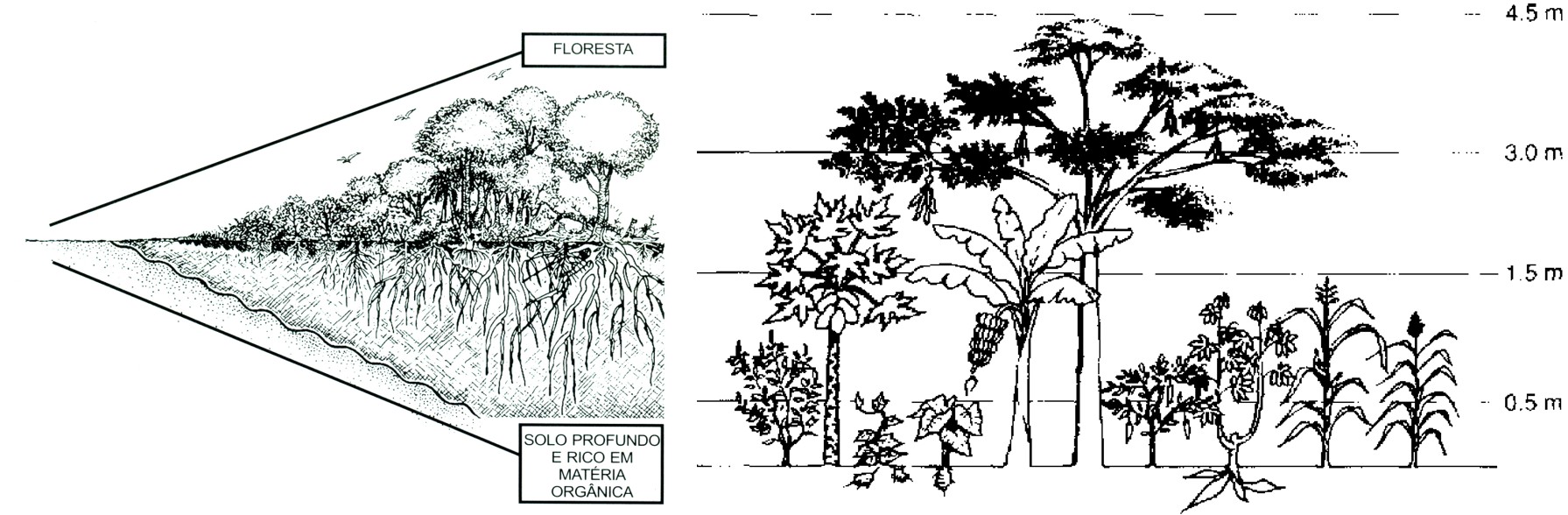
Regarding the management of AFS, pruning, the organization of biomass and even the slaughter of senescent individuals, in a kind of dynamics of clearings (Figure 2), when performed with technique and criteria based on succession, prove to be responsible for the acceleration of several processes that, in a natural environment, require a lot of time and the work of many other living beings [10].
With the approval of the Atlantic Forest Law in 2006 (11428/2006), and the New Forest Code in 2012 (12651/2012), agroforestry production in small rural properties is considered an activity of social interest with low environmental impact that can be carried out in Permanent Preservation Areas (APP) on family properties or possessions or by traditional peoples and communities.
In addition, the Forest Code (2012) defines that “planting of exotic trees, cultivated in an interim system or in consortium with native species of the region in agroforestry systems” can be computed as part of the Legal Reserve (RL) of small properties, or communal lands as long as the limit of up to 50% of exotic species is respected.
Thus, the set of laws related to agroforestry practice has focused on the guidance and regulation of these systems as a form of forest recovery and in preservation areas, such as the Permanent Preservation Areas (APP) and Legal Reserve (RL). In 2013, a Decree (12854/2013) was launched that encourages the implementation of Agroforestry Systems by Family Farming for the recovery of degraded areas.
(a)
(b) Figure 2: The dynamics of clearings and ecological succession (a) should be incorporated as guiding principles of policies and programs to promote sustainable production systems with the intentional use of agroforestry strata (b).
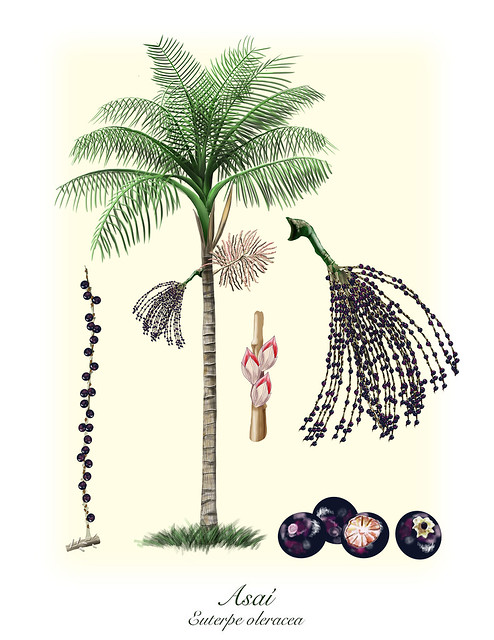
Juçara palm (Euterpe edulis Mart.) Euterpe edulis, described for the first time in 1894 by the botanist Friedrich Phillip Von Martius, is the scientific name of a species of the plant group of Palm trees, a name popularly attributed to the plants of the botanical family Arecaceae (currently) Palmaceae, of the Order Arecales [26, 27]. Ancient taxonomists classified Euterpe espiritosantensis as similar to E. edulis, but both continue to be identified as different species [28].
The species occurs naturally from the south of Bahia to the north of Rio Grande do Sul and receives different popular names being recorded: juçara palm, açaí, southern açaí, juçara, jussara, içara, sweet palm, juçara palm, jussara palm, ripeira, clapboard, palm heart, sweet palm heart, red heart of palm, white heart of palm, ensarova [10, 26, 29, 30]. It occurs in forest phytophysiognomies as well as in areas with a microclimate characteristic of ombrophilous formations, usually in caves and close to water courses [23, 27].
It is necessary to consider that, based on the theory of exception formations [31], the Atlantic Forest may be present in other regions of Brazil, in a geomorphological perspective, which, possibly, will provide conditions for the occurrence of settlements in Juçara, when they are not being introduced, according to reports of occurrence in Goiás, Distrito Federal and Mato Grosso do Sul even in pindoramas.
Unlike its sister species, the Açaizeiro (Euterpe oleraceae), which is widely exploited by traditional communities in the north of the country, the Juçara Palm does not sprout, being of a single stem, causing the death of the palm if it is cut. The predatory extraction due to the high value of its palm heart, target of the Palmiteiros, who without conservation concern cut the trees without management, caused the population of Juçara Palm to be drastically reduced throughout the biome, mainly in the regions of the Brazilian States of RS, SC, PR, SP, RJ and MG. In an attempt to control this situation, the Juçara Palm was included in the list of endangered species of the Ministry of the Environment.
In natural populations, it has a pyramid-shaped demographic structure, with many young individuals (about 70%) and few adults (0.3%) [32]. It is classified as an initial secondary species and of extreme importance in the forest dynamics, as it attracts the fauna that disperses seeds of other species, presenting high levels of interaction with animals, considering that its fruits serve as food for birds of different orders and mammals such as rodents, marsupials, primates and bats [9, 32] (Figure 3).
The seeds are recalcitrant and do not tolerate excessive dehydration. Each seed can weigh from 2 to 5 grams with a single bunch having more than 2 thousand seeds. The viability is high, being around 80% in natural environments with adequate conditions (shade, humidity, soil with organic matter). The large number of flowers with large amounts of floral elements, nectar and pollen makes the juçara to be visited by a wide range of insects, highlighting the orders Diptera (flies), Hymenoptera (wasps), Coleoptera (beetles), and Lepdoptera (moths) [33]. As pollinators and dispersers of fruits and seeds start to colonize the areas where the palm occurs, it becomes a key species in the ecological succession, contributing to the gene flow of other species [9].
The Juçara palm allows multiple uses both as products and in the provision of ecosystem services [10]. As environmental sustainability: promotes the recovery and conservation of the Atlantic Forest; serves as food for wild fauna and attraction for pollinators, compatible with agroforestry systems, component of recovery of spring and spring areas and permanent preservation and legal reserves [10, 21, 23, 34, 35, 36].
Legal Context
This review article considered that the following legal texts at the national level IPEMA [37] directly affect the management of Juçara Palm: Federal Law 9985, of 2000 and Decree 4240, of 2002 that institutes and regulates the National System of Conservation Units (SNUC ); Federal Law No. 10711 of 2003, which provides for the National Seeds and Seedlings System; Federal Law No. 11,428 of 2006 and Federal Decree 6660 of 2009, which provides for and regulates the Atlantic Forest Law; Federal Decree No. 6040 of 2007, which institutes the National Policy for the Sustainable Development of Traditional Peoples and Communities; in addition to the Forest Code, recently amended by Law No. 12,651 of 2013.
Forest Code: The Forest Code, Law No. 12651 of May 2012, amended by Law No. 12727 of October 2012, establishes general rules on the protection of vegetation, APP and LR; forest exploitation, the supply of forest raw materials, control of the origin of timber and non-timber forest products, the control and prevention of forest fires, and provides economic and financial instruments to achieve its objectives [38]. Despite the legislator announcing that in the Atlantic Forest Biome what is written in the Atlantic Forest Law and in other national biomes the forest code is still the main legal instrument to safeguard these areas, the Atlantic Forest Law itself, in its art.. 1, establishes that the forest code must be observed, especially with regard to RL and APP areas, so that, considering the possibilities of using these areas through SAF’s etc, we cannot leave aside the careful study of the commands of the national forest law. Regarding the management of native species, the forest code deals with the social interest in agroforestry carried out on small properties or rural family possessions that do not detract from the vegetation cover of the area and do not harm the environmental functions of the areas. And of low environmental impact as the collection of non-timber products for subsistence purposes and seedling production, such as seeds, nuts and fruits, respecting the specific legislation on access to genetic resources. The collection of non-timber forest products, such as fruits, vines, leaves and seeds, is free to observe the collection periods and volumes established in specific regulations, if any; ripening time of fruits and seeds; techniques that do not jeopardize the survival of individuals and the species collected in the case of collecting flowers, leaves, oils, resins, bulbs, bamboos and roots.
Sustainable forest management of the Legal Reserve’s vegetation for commercial purposes depends on authorization from the competent body and must comply with guidelines and guidelines, not alter the vegetation cover and not harm the conservation of the area’s native vegetation; ensure the maintenance of species diversity and conduct the management of exotic species with the adoption of measures that favor the regeneration of native species. Sustainable management for eventual forest exploitation without commercial purpose, for consumption on the property itself, does not depend on authorization from Organs competent bodies, and the motivation for the exploitation and the volume exploited must only be previously declared to the environmental agency, limited to an annual exploitation of 20 cubic meters.
The exploitation of forests and successor formations, in the public or private domain, not counting those of management for social interest or low environmental impact, therefore, will depend on licensing by the competent body of Sisnama, upon prior approval of a Sustainable Forest Management Plan - PMFS that includes driving technique, exploration, forest replacement and management compatible with the varied ecosystems that the tree cover forms.
Atlantic Forest Law: The text of the Atlantic Forest Law, in its 18th article, allows that in the Atlantic Forest Biome, the collection of forest by-products such as fruits, leaves or seeds, as well as the activities of indirect does not need to be registered with the environmental agency as long as they are not on the endangered species list. The Atlantic Forest Law is the main object of study in the case of Juçara Palm. It lays the foundations for collecting and transporting native and/or planted Juçara fruits. Highlight for articles: 6,8,9,11,13,18,20,21,23,25,27 and 28. Due to the veto of its 27th article, which made possible the sustainable management of native species in the Atlantic Forest, we have been experimenting with several exercises of legal interpretation, in an attempt to seek, in the spirit of the Law, a balanced, well-founded alternative for carrying out the sustainable management of the Juçara palm in the native forest. This is a delicate task, insofar as, on the one hand, the express possibility of carrying out the management was subtracted from the Law with the veto of the 27th article, on the other hand, considering that the Law was proposed and discussed for 16 years, always based on the principles of sustainable management, as a strategy for the balance and conservation of native flora species, and ended up being very restrictive in the end. An example of this are the objectives and principles listed in its 6th article, such as sustainable development and social stability, the socio-environmental function of property, transparency of information, democratic management, speed and gratuitousness of services provided to small and traditional farmers etc., that is, how to meet such principles and objectives, how is the Atlantic Forest used? How is the interpretation of what is the socio-environmental function of property and such social stability?. National System of Conservation Units – SNUC: Established by Law Nº. 9995/2000, it is a system or set of official guidelines and procedures that enable federal, state and municipal government spheres and the private sector to create, implement and manage CUs. This environmental preservation system is composed of 12 categories of conservation units, whose specific objectives differ in terms of the form of protection and uses allowed into two types: Integral Protection Units are those that need greater care, due to their fragility and particularities, and Sustainable Use Units, those that can be used sustainably and conserved at the same time. This last category is more friendly to the proposal of sustainable management of the fruits of sociobiodiversity through the modality of Extractive Reserve, however in several regions of Brazil there are enhancing environmental preservation between the Management of the Units and the surrounding communities in the protagonism of conservation from the use, demonstrating the possibility of advancing the Atlantic Forest conservation policy.
The management of the SNUC is carried out with the participation of the three spheres of public power (federal, state and municipal). The Ministry of the Environment is the central body for the purpose of coordinating the SNUC; the National Council of Environment (CONAMA) acts as a consultative and deliberative body, with the function of monitoring the implementation of the System. The executing agencies of the SNUC have the function of implementing it, subsidizing the creation of proposals and managing the federal, state and municipal conservation units, but in the respective spheres of action: at the federal level, it is represented by the Chico Mendes Institute for the Conservation of Biodiversity (ICMBio) and Brazilian Institute of Environment (IBAMA), on a supplementary basis; at the state and municipal levels, by state and municipal environmental agencies. Establishes criteria and norms for the creation and management of Nature Conservation Units. Any alterations, activities or modalities of use in disagreement with its objectives, its Management Plan and its regulations are prohibited in the CUs (28th Article). Until the Management Plan is prepared, all activities and works carried out in the integral protection UCs must be limited to guaranteeing the integrity of the resources that the unit aims to protect, assuring to the traditional populations that may reside in the area the conditions and the means necessary to satisfy their material, social and cultural needs (Art. 28, sole paragraph). The action or omission of individuals or legal entities that result in non-compliance with the precepts of this Law and its regulations or result in damage to the flora, fauna and other natural attributes of the CUs, as well as to their facilities and to the buffer zones and ecological corridors, subject offenders to the sanctions provided for by law (Art. 38). The 42th Article in turn, discusses traditional populations residing in conservation units in which their permanence is not allowed will be indemnified or compensated for existing improvements and duly reallocated by the Government, in a place and conditions agreed between the parties. National Sociobiodiversity Policy: In 2007, the Ministries of the Environment (MMA), Agrarian Development (MDA) and Social Development and Fight against Hunger (MDS) met with other government and civil society partners to prepare an action plan for the strengthening of sociobiodiversity product chains. This initiative was part of the federal government’s strategy to articulate government policies aimed at promoting sustainable development, income generation and social justice. The elaboration of the action plan involved a series of consultations with different social segments interested in this theme. Between September 2007 and July 2008, seven Regional Seminars were organized in the different biomes, with the participation of around 800 people, including representatives of local communities. An additional seminar brought together representatives from the business sector and government representatives, establishing a platform for dialogue to identify limits and point out proposals for advancing in the consolidation of production chains. The proposals raised in these consultation events were consolidated into a first version of the National Plan for the Promotion of Sociobiodiversity Product Chains. This document was the subject of discussion, review and validation during the “National Seminar on Social Biodiversity Product Chains: Adding Value and Consolidation of Sustainable Markets”, held in Brasília, in July 2008. This event had around 230 participants from different states of the federation, including representatives of traditional peoples and communities and family farmers, federal, state and municipal government agencies, companies and development institutions. The contributions resulting from the National Seminar were incorporated into the final version of the Plan, whose preparation was under the supervision of the Ministries that coordinated the consultation process. After a few years now in May 2015, in Brasília-DF, with the Ministries of Agrarian Development as protagonists; of Social Development and Fight against Hunger and; the Minister of the Environment, the 2nd National Seminar on Sociobiodiversity took place and aimed at debating the proposal for the National Sociobiodiversity Program and rouse subsidies for its consolidation.
In the context of the Juçara Palm, in the face of very successful experiences such as those in the Cerrado Biome with Cerrado products experience, Juçara leads the construction of knowledge around the redefinition of native trees, starting with fruit trees such as well Jabuticaba, Cherry from Rio Grande, Pitangatuba, Araçá, Cambuci, Uvaia, Guabiroba, Grumixama, Cambuí, among others. The perspective of conservation through use must be promoted as a public forest policy in the sense of increasing the areas covered by the Atlantic Forest, while providing food security and autonomy in production and diversification to families.
National Policy on Agroecology and Organic Production: A huge advance in the field of Brazilian sustainability was the approval of Decree Nº. 7794/2012, which established the National Policy on Agroecology and Organic Production. It aims to integrate, articulate and adapt policies, programs and actions that induce agroecological transition and organic production based on agroecology, contributing to sustainable development and the population’s quality of life, through the sustainable use of natural resources and supply and consumption of healthy foods.
In this Decree, sociobiodiversity products here are understood as goods and services generated from biodiversity resources, destined to the formation of productive chains of interest to the beneficiaries of the Law Nº. 11326/ 2006 which with their practices and knowledge, have ensured the resulting rights, to generate income and improve their quality of life and that of their environment.
And in turn, agroecological transition being the gradual process of changing practices and management of agroecosystems, traditional or conventional, through the transformation of the productive and social bases of the use of land and natural resources, leading to agricultural systems that incorporate ecologically-based principles and technologies.
The National Plan for Agroecology and Organic Production (PLANAPO) was then drawn up with the objective of broadening and implementing actions to guide sustainable rural development. The result of an intensive debate and participatory construction, involving different government bodies and social movements in the countryside and forests, PLANAPO is the main instrument for implementing the National Policy on Agroecology and Organic Production. The plan seeks to integrate and qualify the different policies and programs of the ten partner ministries in its execution.
This experience demonstrates the importance of articulating State actions with networks and articulations that discuss and build knowledge about these themes, in a legislative context of innovation from the recent consolidation of the Forest Code, where the exchange of information and knowledge will provide that both state and civil spheres have legal certainty in the procedures related to the sustainable management of the Atlantic Forest’s socio-biodiversity. Seeds and Seedlings Federal Law Establishes the National System of Seeds and Seedlings, which aims to guarantee the identity and quality of plant multiplication and reproduction material produced, marketed and used throughout the national territory. Among the main points of the law are the preliminary provisions, the determination of the attributions of the National Seed Registry - RENASEM and the National Registry of Cultivars - RNC, the rules of production, certification, analysis of seeds and seedlings, internal trade, international trade, use, inspection, constitution of Seeds and Seedlings Commissions–CSM’s, prohibitions, precautionary measures, penalties and final provisions of the system.
Highlight for Article 8th paragraph 3rd, respectively, obliges individuals and legal entities to register the activity with RENASEM and releases family farmers from registration, when multiplying seeds or seedlings for distribution, exchange or commercialization among themselves. This can be used, specifically in relation to returning the seed to the restocking areas after processing at another location outside the property.
Its Decree Nº 5153/2004, which approves the regulation of the Law on Seeds and Seedlings, provides for the limits of competence of RENASEM, the RNC, general rules for the production of seeds and seedlings, the basic criteria for certification, sampling, analysis of seeds and seedlings, operationalization of internal trade, international trade, the limits of the use of seeds and seedlings, inspection rules, organizational structure of the CSM`S, criteria for the production of Seeds of forest species, details the procedures regarding prohibitions and infractions, measures cautions and penalties. Decrees, Normative Instructions, Resolutions and Ordinances In the context of regulation, it occurs specifically for Juçara Palm, to be highlighted here is Normative Instruction nº 6 of 2008 that officially lists the species of Brazilian flora threatened with extinction. Defines the list of flora species threatened with extinction in the national territory. AEuterpe edulis is on the list. It does not prohibit the collection of fruits of endangered species, but requires authorization from the environmental agency for exploitation.
ICMBIO is responsible for establishing plans for the recovery of species. There is a whole controversy about its effectiveness, since it was published 2 months before Decree 6660 - which completely regulated the collection activity and does not require authorization from the environmental agency to carry out the activity - etc.
Defines the list of flora species threatened with extinction in the national territory. Consider Euterpe edulis Mart. (Juçara Palm) threatened with extinction in the states of AL, BA, ES, GO, ,PB, PE,PR, RJ, RN,SE, SC and SP. It says that the collection (fruits, seeds and leaves) of endangered species, for any purpose, will only be carried out with the authorization of the competent environmental agency.
Species threatened with extinction are considered a priority for the purpose of granting financial support for conservation by the Federal Government and should receive special attention in the context of the expansion and management of the National System of Conservation Units-SNUC, including in the management plans of the Conservation Units.
The species Euterpe edulis Mart. is included in the Official List of Species of Brazilian Flora Threatened with Extinction of Normative Instruction no. 06 of the MMA, of 22/09/2008 BRASIL [39] and therefore requires authorization from the competent environmental agency to collect the fruits. Despite having a natural occurrence in Minas Gerais, the state does not appear as a place where the palm is endangered, causing confusion and legal uncertainty for procedures for harvesting, processing and commercialization of pulp and seeds.
Social context
Family farmers, foresters and extractivists
For this document, considering Law No. 11,326 of 2006, which establishes the guidelines for the formulation of the National Policy on Family Agriculture and Rural Family Enterprises, foresters, extractivists and family farmers will be taken as a reference for this work, since this segment of society Palm is used generally for subsistence and local marketing, and collecting products from areas of forest remnants, usually in permanent preservation areas and close to Conservation Units, however supported by legislation due to the consequent low environmental impact.
Inhabitants of forest areas and their surroundings are largely dependent on and use forest products for their own use or as a main or complementary source of income [18]. The organization of rural peoples and communities to disseminate sustainable management practices is a strategy to raise awareness among communities and an alternative for generating income that contributes to the repopulation of Juçara Palm [40]. Planting seedlings in areas with agroforestry practices and valuing the standing forest acts as a strategy for conserving the Atlantic Forest biome [1, 10, 40].
The benefits of using the fruits are seen in the immense potential for economic use of the forest, as well as in the desire of traditional populations to sustainably manage natural resources. Comparing the non-timber forest products of the species, between palm hearts and fruits, in terms of value, it is more economically viable to manage and harvest the fruits than to extract palm hearts [10, 23, 41, 42]. Both palm heart and fruits are considered non-timber forest products with the difference that palm heart extraction kills the palm. The juçara has, inside the upper part of the stem, a palm heart of excellent quality, which also contributed to the fact that the palm was cut down to exhaustion, making it enter, for some years now, on the List of Endangered Species of Flora. Producers and trading companies The states that started the industrial exploitation of palm hearts were Santa Catarina, Paraná and São Paulo in the 40’s, with the installation of several agro-industries that functioned as centralizing poles of raw material coming from natural areas of occurrence without the slightest environmental or environmental concern controlled management. With the decrease in the supply of raw material in the region, some broke and others migrated to the north to exploit the Açaí (Euterpe oleraceae). Even so, illegal palm trees still continue to exploit the cutting of palm hearts and supply to restaurants and inns that take advantage of the low cost, even entering conservation units as in the case of the Itatiaia National Park.
Encouraging fruit management, instead of palm hearts, can contribute to the resolution of socio-environmental conflicts within and around Conservation Units, maintain the species, reducing pressure on it, stimulate natural regeneration, cultivation in agroforestry systems and repopulation [43]. Values attributed to the meristem (palm heart) of Juçara are around R$5.00 per 70 centimeter heart of palm weighing around 400g, being necessary to slaughter the individual. For the same individual focusing on fruit production, each year, on average, we can obtain 4 kg of fruit and sell it at an average of R$0.75 per kilogram, which can be collected [37].
Processing the fruit pulp has been pointed out in several studies as an important strategy for the conservation of the species and native forests, in addition to the potential for food security and an alternative income generation for rural communities and traditional peoples of the Atlantic Forest [44, 45]. But for this, it is necessary to develop a repopulation plan for sustainable management, since the establishment of Juçara plant species crucially depends on where the seeds are deposited. A study carried out in São Paulo showed that the development of seedlings and seedlings of Juçara was five times greater when intercropped with banana trees than in plots within forests, which indicated great potential for management in agroforestry consortia [23].
In this sense, Agroforestry Systems (SAFs) are configured as efficient arrangements for conducting local biodiversity linked to economic exploitation, with Juçara being a key species between the conservation of the Atlantic Forest and diversified production [2, 6, 10, 24, 46, 47]. Planting and management of agroforestry systems with Juçara Palm.
The behavior of Juçara Palm is to have localized dispersion, but the survival of seedlings until adulthood drops significantly, and even with a large dispersion of seeds, not all of them are successful, either due to lack of environmental conditions or even from predator attacks. of seeds and seedlings [23, 34, 45]. Juçara’s life strategy is intense fruit production, in order to form a seed and seedling bank that overcome these adversities, waiting for favorable conditions of light to develop.
Considering planting, good results have been observed in the south of the country, planting Juçara Palm in banana plantations together with other native trees, diversifying and making these systems more complex. At a more complex level, in Vale do Ribeira, COOPERAFLORESTA, a cooperative formed by 130 agroforestry families with their systems based on natural succession with complex production environments, or also called in the literature as SAFRA Agroforestry Regenerative Analog System, in which Juçara is always present in the arrangements.
The sustainable management of Juçara is justified because it is the species with one of the most abundant and valuable non-timber forest products in the Atlantic Forest [41, 43]. Among its various products and uses after harvest, we can highlight: the stem (strain), which provides wood, used for crafts, construction, furniture making, gutters, roofs and coverings; fruits, such as pulp (in natura (juice and pulp) and frozen pulp), other products such as pigments, for making medicinal, cosmetic and culinary products; oils; seeds for biojewels, no-tillage and broadcast sowing, seedlings for landscaping and planting of repopulations; fibers, leaves and bunches in the manufacture of brooms and covers, crafts (paper, basket, lamp, lamp, table support, etc.); flower (honey and pollen).
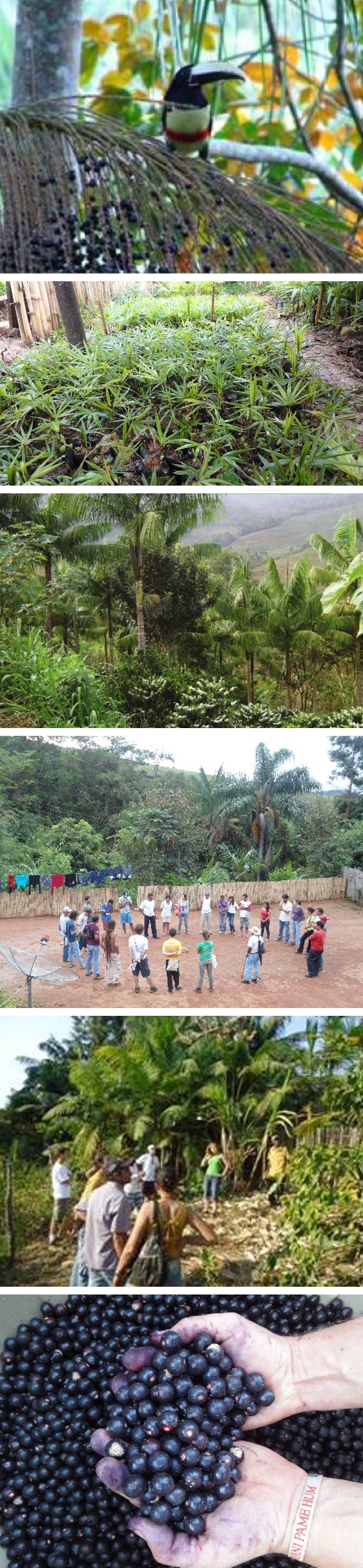
In the State of Minas Gerais, the focus of the work of the Polo Guará, participant pole of the Juçara Network (Rede Juçara – REJU), since 2013 works with the sustainable management of Juçara Palm and has been encouraged based on the experience of farmers from the Pereiras and Destero communities that are located in the buffer zone of the Serra do Brigadeiro State Park. These communities have been planting Juçara Palm since before the park was created, making and selling seedlings, in addition to having Juçara Agroforestry Systems intercropped with coffee and other crops of interest such as pineapple, corn and sweet potato. These communities are examples of guardians of a variety of Juçara, characteristic of the region, having a “fatter” base, early fruiting (4 to 6 years) and lower bunches Figure 4.
(a) (b)
(d) (e) (f) Figure 4: Social context associated with the planting and management of Juçara Palm in the production of seedlings (a), agroforestry systems (b), protecting biodiversity (c), involving the community (d), with exchanges (e) and production of açaí (f).
Good Management and Processing Practices: In terms of fruits more specifically, in the Good Management Practices, four categories of bunches (infructescence) are defined, which form the basis for the harvest parameters: 1) Good bunches: with fruits considered to be of quality for pulp production and adequate maturation (more than 90% of the fruits in the craft); 2) Red bunches: Fruits with quality, adequate maturation but not yet reached the ideal point; 3) Green bunches: which are bunches with irregular (heterogeneous) maturation, usually with 30% to 70% of green and/or red fruits and the rest ripe to the point of falling off or being consumed by the fauna; 4) Anthracnose bunches: bunches with the presence of anthracnose (Colletotrichum gloeosporioides) in the fruits with an incidence greater than 50% [48].
These precautions at harvest time provide better quality of fruits and bunches, as there are risks attributed to green and red fruits, related to loss of quality and lower pulp yield; while contaminants such as bird feces and insects in bunches are a risk to the quality and conservation of the product [48].
As for handling, the Good Practices to be adopted in the fruit pulp processing unit are intended to guarantee hygienic-sanitary conditions and compliance of the pulp with sanitary legislation. They should consider: Cleaning products (types of product, indications and cleaning frequency);
(c)
Mandatory steps in the environmental hygiene process; Hygiene and health of handlers (Aesthetics and Cleanliness, standardization, hand hygiene, operational hygiene, habits); Measures in case of injuries and health problems; Preventive measures (combat of vectors and urban pests); waste management (dry waste and organic waste) [48].
Establishments must consider the Standard Operating Procedures (SOPs) that aim to establish the operations necessary for cleaning in the areas of reception, handling, processing, partitioning, packaging, freezing and circulation of the processing unit regarding: Facilities, Equipment and Utensils (floors, drains, walls, countertops and installation surfaces, sinks and vats, stove, pulper, electronic scale, pedal sealer, freezers, lining and fetus, light fixtures); Water quality control (water tank disinfection and biannual analysis of water samples); hygiene of handlers (washing and asepsis of hands); Waste Management (organic and dry) [48].
Despite the change at the federal level, the Law was maintained and the collection of non-timber forest products, such as fruits, lianas, leaves and seeds, remained free, observing: I - the collection periods and volumes set in specific regulations, when; II - the period of maturation of the fruits and seeds; III - techniques that do not jeopardize the survival of individuals and the species collected in the case of collecting flowers, leaves, bark, oils, resins, lianas, bulbs, bamboos and roots [21].
Bringing legal certainty to the processes and actions listed in this article, it is also described in the Decree that regulates the Atlantic Forest Law, in its art. 28, which specifically regulates the activity of collecting forest by-products, saying that, at the time of collection, criteria related to periods and volumes, techniques that do not jeopardize the survival of the individual or the species collected and the maintenance of the functions relevant for feeding, breeding and sheltering wild flora and fauna. What we call Good Practices [37].
These Good Practices must include health legislation. They are: Ordinance of the National Health Surveillance Agency (ANVISA) No. 1428 of 1993, which presents the technical regulation for food sanitary inspection, guidelines for establishing good practices and production, (...).; ANVISA Ordinance No. 12 of 2001, which provides for microbiological standards; ANVISA Resolution No. 23 of 2000, which provides for the Basic Procedures Manual for the Registration of Food Products; Federal Law No. 8918 of 1994 and Decrees No. 2314 of 1997 and No. 3510 of 2000, which provide for and regulate the standardization, classification and inspection of beverages; and Normative Instruction No. 01 of 2000, which provides for the identity and quality standards for fruit pulp [37].
Paths to Legally Enable Sustainable Management of Juçara Palm
In terms of social sustainability, we can associate social inclusion, protagonism, income generation, spiritual and cultural value, in addition to scenic beauty in the landscape and socio-environmental identity, classified as cultural ecosystem services. Rural populations and especially traditional populations such as caiçaras, quilombolas, indigenous peoples and caboclos, in addition to family farmers, extractivists, floodplains, have their culture, beliefs and ways of life associated with cultural ecosystem services [49].
For the elaboration of minutes and rules of procedure related to the sustainable management of the Juçara Palm, it is pointed out that there are significant differences between Euterpe in relation to the area of occurrence, but very great similarities in the appearance of palm trees, with the exception of Açaí do Norte (Euterpe oleraceae) that tillers.
The genus Euterpe has seven speceis described Lorenzi [26] within the scope of the Atlantic Forest biome, Euterpe espiritosantensis is confused with E. edulis, and its distinction in the field is very difficult, incurring all Euterpe spp. that do not share the popular name of Juçara Palm, Palmito Doce, Palmito, Palmiteiro, among other popular denominations.
This, when inspecting and managing in the field, becomes an issue to be considered as relevant for further study.
The procedure for regulating the management of the Juçara Palm (Euterpe edulis Mart.) must consider that, unlike the rest of the Euterpe, it is on the List of Endangered Species recently updated by the Ordinance of the Ministry of the Environment Nº443 of December 17, 2014. In it, Euterpe edulis is in the Vulnerable, which allows the elaboration of sustainable management plans. Considering that there is no National Action Plan for the Conservation (PAN) of Juçara Palm, which would initially present the indicated measures to be followed for management, there is a gap to be filled for the conservation of the species [50].
Its flowering and fruiting occur at different times for each bunch and as it has more than one fruiting bunch per individual, the production is large and spaced. In Santa Catarina, production of 4.2 bunches of flowers was observed in individuals, with an average of 103 rachillas, male and female flowers in the proportion 3:1 [35]. There is a pattern of variation in reproductive phenological events associated with altitude and latitude, in addition to the relationship between flowering times and fruit maturation, which depend on the flowering season [29, 51, 52].
The sustainable management of Juçara Palm both in SAFs and in native areas must follow criteria in the elaboration of a management plan that considers: the size and access of the area; population density (reproductive individuals), maintenance of gene flow (latu sensu matrices), food stock for fauna; exclusion of harvesting areas (preferred faunal habitats); exclusion of individuals (random or selective); exclusion of bunches (selective or not): anthracnose, verdolengos, etc.; fruit fall to the ground: harvest, rain, winds, birds, etc.; exclusion of certain harvest periods in the crop (eg beginning or end). Consider the existence or not of other fruiting species throughout the season [53].
In view of the commercialization of products and by- products, there are significant restrictions on management, especially where there are already stands of palm trees in areas of remnants close to water courses (places where the species has resisted, expressing the characteristic of occurring in wetlands), which according to the Law are areas that must be kept preserved as APPs.
When necessary, the Management Plans and Technical Projects for Flora Restitution (PTRFs) should provide for the management of Palm trees in Legal Reserve areas, forest remnants and even in permanent preservation areas [54, 55]. The use of agroforestry systems (SAFs) in these areas is also provided for in Law No. 12,853 of August 26, 2013 and presents a promising proposal for the use of native trees by producers, diversifying the areas into productive systems that provide ecological functions [56].
To this end, promoting sustainable management of Juçara should make use of CONAMA Resolution No. 429 of 2011 on APPs recovery methodologies, which in its art. 5 § 5 admits, as a practice to support recovery, the intercropping of native perennial species that produce fruits, seeds, nuts and other plant products, and their use for sustainable non- timber extraction is permitted [57, 58, 59, 60].
It is important to present the distinction when dealing with simplifications of the bureaucratic procedures provided for in the Legislation for traditional peoples, quilombolas and family farmers, among others, who, according to Federal Law nº 11.4326 of 2006, do not have an area larger than four fiscal modules, use predominantly own family labor in the economic activities of your establishment or enterprise and have a minimum percentage of family income originating from economic activities of your establishment or enterprise [61, 62, 63].
Family farming must be based on the perspective of the use of forest resources, where CONAMA Resolution No. 425 of 2010 is considered [64], which provides for criteria for the characterization of agricultural activities and enterprises of family farmers, peoples and traditional communities as of social interest for production, intervention and recovery of APPs. And others of limited use.
CONAMA Resolution nº 369 of 2006 must also be used, which considers environmentally sustainable forest management to be of social interest, which does not detract from the native vegetation cover, or impedes its recovery and does not harm the ecological functions of the areas, together with the Deliberation COPAM normative nº 76 of 2004 where the intervention for the suppression of native vegetation in APPs may be authorized in case of public utility or social interest [65]. All these regulations, despite being old, are legally valid since they are not tacitly contrary to the changes to the Forest Code in 2012.
There is a need for a rule that simplifies the Plans for the Sustainable Exploitation of Non-Timber Products so that family farmers have access to such activity, since it incurs the Biodiversity Framework, by Law Nº 13123/ 2015, in addition to Decree Nº. 43710/2004 that legislates and regulates the National System of Seeds and Seedlings, referring to issues of registration and use of genetic heritage related to the sociobiodiversity of the Atlantic Forest [66].
In MMA Ordinance Nº 443/2014, Juçara Palm is on the list of endangered species in the Vulnerable category (VU), however, it allows its sustainable management based on a Management Plan that is in accordance with the risk assessment of the species and presents the management in accordance with research, forest inventory or monitoring data that support decision-making on the use and conservation of the species.
More specifically on handling, the provisions are considered: in Article 20, of the Forest Code, which provides for the sustainable management of the Legal Reserve [66], selective logging practices in the modalities of sustainable management without commercial purpose for consumption on the property and sustainable management for forest exploitation with commercial purpose; in Article 21 on the free collection of non-timber forest products, such as fruits, vines, leaves and seeds; in Article 22 on sustainable forest management of the Legal Reserve’s vegetation for commercial purposes, subject to authorization from the competent body; and finally in Article 23 where sustainable management for eventual forest exploitation without commercial purpose, for consumption on the property itself, does not require authorization from Organs competent bodies, and must only be previously declared.
The management of the Juçara palm, for harvesting its fruits, can be classified as an economic activity of sustainable basis and of social interest, which adds value to this forest resource typical of the humid areas of forests of the Atlantic Forest and makes it possible to increase the diet of the population. family or perennial income to rural producers in the Biome.
The management of Palmito Juçara palm trees to harvest their palm heart or stem can be classified as an economic activity with a sustainable basis, while a Sustainable Forest Management Plan is prepared together with the PTRF when it is the case of decomposition of degraded areas. The Sustainable Forest Management Plan is understood as selective exploitation, according to the growth cycle of each pindorama, through selective cutting of individuals within the parameters of size and age of the Palm tree, considering the dynamics of growth and increment of individuals by diameter class to be inventoried by sensing (count of all individuals above 5 cm in diameter).
Pragmatically, to contemplate the need for an instrument, tool or registration/declaration system for the Management of Juçara Palm, we will consider the provisions of Federal Decree No. general rules for Environmental Regularization Programs, with the additions of Federal Decree Nº. 8235/2014, in order to make bureaucracy viable and based on the basis declared in the CAR.
The terms of Article 2 of MMA Ordinance Nº 253/2006, which established the obligation to use the Document of Forest Origin - DOF for the control of origin, transport and storage of forest product and by-product and approves the System - DOF, for the computerized control of the System.
The sustainable management of Juçara Palm must follow criteria for the elaboration of a management plan that considers: the size and access of the area; population density (reproductive individuals), maintenance of gene flow (latu sensu matrices), food stock for fauna; exclusion of harvesting areas (preferred faunal habitats); exclusion of individuals (random or selective); exclusion of bunches (selective or not): anthracnose, verdolengos, etc.; fruit fall to the ground: harvest, rain, winds, birds, etc.; exclusion of certain harvest periods in the crop (eg beginning or end). Consider the existence or not of other fruiting species throughout the season [67].
In addition, the following legal regulations can be cited as examples:
• Resolution of the São Paulo Environment Department No. 14 of February 25, 2014 which Establishes criteria and procedures for sustainable planting, collection and exploitation of native Brazilian species in the Atlantic Forest Biome, in the State of São Paulo;
• IDAF Normative Instruction No. 003 of July 31, 2013, which resolves to institute the Rules for a Simplified Sustainable Exploitation Plan for Extracting the Fruit of the Juçara Palm (Euterpe edulis);
• INEA Resolution No. 86 of January 29, 2014, which defines criteria and procedures for the implementation, management and exploitation of forest systems and for the practice of fallow in the State of Rio de Janeiro.
• CONAMA Resolution No. 294 of December 12, 2001, which provides for the Euterpe edulis in the State of Santa Catarina.
When considering the federal and state regulations that have been explained, the Draft Standard for the sustainable management of Juçara Palm will contain guidelines separately for both managements: harvesting the fruits and exploiting the palm heart by cutting the stem. In addition, technical recommendations will be made on harvest/exploitation season, criteria for transport and other specific issues such as proximity to Conservation Units, surrounding areas, among other information that is necessary to verify the suitability of the activity, including general information (Tables , attachments, declarations and terms of responsibility) to be completed by the applicant in the Sustainable Forest Management Plan, simplified (for fruit collection) or more complex (palm heart exploitation).
Final considerations
This article advances in the context of inserting the Juçara Palm as a native species that can be managed sustainably, as well as other native species, which already have an accumulation of regulatory discussion such as Araucaria, Aroeira and Candeia. This synergy may support the processes that must be carried out to regulate other native species in general. The participation of the Ministry of the Environment, IBAMA and ICMBio to provide federal legal support, together with the state secretariats linked to agriculture and technical assistance in rural extension, is important to advance technical leveling to promote sustainable management of the native species of the Atlantic Forest.
The involvement of Civil Society Organizations in the process of building public policies and development programs is essential for the success of the proposal. The path is drawn through training programs for Local Agents and multipliers of the proposal for sustainable management of native species through work efforts, which will be able to promote, similar to successful experiences such as that of brigadistas residing in the surroundings of Conservation Units, which take advantage of the proposal in a different way, significant changes in the reality of people in their communities. Author Contributions: MM performed field work, bibliographic survey and wrote the paper. DBM, DM, NZP and ARCR performed field work. Acknowledgements: We thank the Instituto de Permacultura e Ecovilas da Mata Atlântica – IPEMA, the Centro de Tecnologias Alternativas da Zona da Mata – CTA- ZM, the farmers of Ubatuba-SP and Araponga-MG, the Juçara Network–REJU and to everyone involved in the sustainable management and agroforestry development in Brazil. Conflicts of Interest: The authors declare no conflict of interest
References
-
Cardoso IM, Duarte EMG, Souza MEP, Carneiro JJ, Meier M, et al. (2010) Agrobiodiversidade no Brasil: experiências e caminhos de pesquisa. Recife: Nupeea 1: 75-94.
-
Meier M, Teixeira HM, Ferreira MG, Ferrari EA, Lopes SI, et al. (2011) Sistemas agroflorestais em áreas de preservação permanente. Revista Agriculturas: experiências em agroecologia 8(2): 12-17.
-
Fatima BG, Susan ES (2011) Pagamento por Serviços Ambientais na Mata Atlântica: lições aprendidas e desafios, pp: 1-280.
-
Fadden M, Joana (2005) The production of açai from the processing of the fruits of the palm tree (Euterpe edulis Martius) in the Atlantic Forest. University of Santa Catarina, Center for Agrarian Sciences, pp: 1-112.
-
ICRAF-World Agroforestry Centre (2011) Public policies for agroforestry development in Brazil (Porro, 2011). Roberto Porro e Andrew Miccolis, Brazil, pp: 1-80.
-
FrancoFS (2000) Sistemas Agroflorestais: uma contribuição para a conservação dos recursos naturais da Zona da Mata de Minas Gerais. Tese (Doutorado em Ciência Florestal). Universidade Federal de Viçosa, pp: 1-161.
-
BRASIL (2009) Plano Nacional de Promoção das Cadeias de Produtos da Sociobiodiversidade. Ministério do Desenvolvimento Agrário. Brasília. 2009.
-
Neumann RP, Hirsch E (2000) Commercialization of non- timber forest products: review and analysis of research. Bogor CIFOR, pp: 1-187.
-
Reis MS dos, Reis A (2000) Euterpe edulis Martius (palm tree): biology, conservation and management. Herbario Barbosa Rodriguez, pp: 335.
-
Vivan JL (2000) Ecological knowledge and agroforestry systems: a case study in the Atlantic Forest of the North Coast of RS. Masters dissertation. Postgraduate Course in Agroecosystems, Center for Agrarian Sciences, Federal University of Santa Catarina. Florianopolis, Brazil, pp: 98.
-
Simões LL, Lino CF (2002) Sustainable Atlantic Forest: the exploitation of its forest resources. National Council of the Atlantic Forest Biosphere Reserve, Brazil, pp: 215.
-
FariasM (2009) Reinventando a relação humano- Euterpe edulis: do palmito ao açaí / Marcelo Farias - rianópolis, Paul RMM, et al. (Eds.), Dissertação (Mestrado em Agroecossistemas) Universidade Federal de Santa Catarina, Centro de Ciências Agrárias, pp: 85.
-
Silva JZ (2011) Fundamentals of fruit production and consumption in natural populations of Euterpe edulis Martius. Federal University of Santa Catarina, Center for Agrarian Sciences, Postgraduate Program in Plant Genetic Resources, Florianópolis, pp: 262.
-
Souza SEXF, Vidal E, Chagas GFC, Elgar AT, Brancalion PHS (2016) Ecological outcomes and livelihood benefits of community-managed agroforests and second growth forest in Southeast Brazil. Biotropica 48(6): 868-881.
-
Hirota MM (2003) Monitoring the Brazilian Atlantic Forest cover. In: Galindo-Leal C, et al. (Eds.), The Atlantic Forest of South America: biodiversity status, threats, and outlook, Washington, pp: 60-65.
-
Galindo LC, Câmara IG (2005) Status of the Atlantic Forest hotspot: a synthesis. In: Galindo LC, et al. (Eds.), Atlantic Forest: biodiversity, threats and prospects. São Paulo: Fundação SOS Mata Atlântica, pp: 3-11.
-
São P (2011) Fundação SOS Mata Atlântica/ Instituto Nacional de Pesquisas Espaciais (INPE) Atlas dos remanescentes florestais da Mata Atlântica Período 2008-2010, pp: 1-120.
-
Shackleton S, Shackleton C, Shanley P (2011) Non- Timber Forest Products in the Global Context. Tropical Forestry.
-
LAW No: 11,428 (2006) Provides for the use and protection of native vegetation of the Atlantic Forest Biome, and other provisions. Official Gazette of the Federative Republic of Brazil.
-
DECREE No. 7, 794 (2012) Establishes the National Policy on Agroecology and Organic Production. Brazil.
-
Lei Nº 12.854 (2013) It promotes and encourages actions that promote forest recovery and the implementation of agroforestry systems in expropriated rural areas and in degraded areas, in the cases specified. Brazil.
-
Duarte EM (2007) Ciclagem de nutrientes por árvores em sistemas agroflorestais na Mata Atlântica. Dissertação de Mestrado. Universidade Federal de Viçosa, pp: 1-132.
-
Favreto R, Mello RSP, de Moura Baptista LR (2010) Growth of Euterpe edulis Mart. (Arecaceae) under forest and agroforestry in southern Brazil. Agroforestry Systems 80(2): 303-313.
-
Souza HNDe, de Goede RGM, Brussaard L, Cardoso IM, Duarte EMG, et al. (2012) Protective shade, tree diversity and soil properties in coffee agroforestry systems in the Atlantic Rainforest biome. Agriculture Ecosystems & Environment 146(1): 179-196.
-
Muler AE, Rother DC, Brancalion PS, Naves RP, Rodrigues RR, et al. (2014) Can overharvesting of non-timber- forest-product changes the regeneration dynamics of a tropical rainforest? The case study of Euterpe edulis. Forest Ecology and Management 324: 117-125.
-
Lorenzi H (1992) Brazilian Trees: manual for identification and cultivation of tree plants native to Brazil. Nova Odessa: Plantarum 3: 357.
-
Lorenzi H, Souza HM, Costa JTM, Cerqueira, Von Behr N (1996) Palm trees in Brazil: native and exotic. Nova Odessa: Plantarum, pp: 303.
-
Wendt T, da Cruz DD, Demuner VG, Guilherme FG, Boudet FH (2011) An evaluation of the species boundaries of two putative taxonomic entities of Euterpe (Arecaceae) based on reproductive and morphological features. Flora - Morphology, Distribution, Functional Ecology of Plants 206(2): 144-150.
-
Favreto R (2010) Ethnoecological and ecophysiological aspects of Euterpe edulis Mart. (Arecaceae). Tese de Doutorado. Pós-graduação em Botânica. Universidade Federal do Rio Grande do Sul. Porto Alegre, pp: 1-143.
-
Fávaro L (2012) Ecological and economic study of the juçara palm (Euterpe edulis Mart.) in the surroundings of Serra do Brigadeiro State Park (PESB), MGa. Forest management; Environment and Nature Conservation; Forestry; Technology, pp: 1-112.
-
Whitmore TC, Prance GT (1987) Biogeography and Quaternary History in Tropical America, Clarendon Press, Oxford.
-
Reis MS (1996) Dynamics of allele movement: subsidies for the conservation and management of plants from natural populations in plants. Brazilian Journal of Genetics 19: 37-47.
-
Conte R, Reis MS, Reis A, Mantovani, Mariot A, et al. (2000) Dinâmica da regeneração natural de Euterpe edulis. In: Reis MS, et al. (Eds.), Euterpe edulis Martius (Palmiteiro) : Biologia, Conservação e manejo. Itajaí: Herbário Barbosa Rodrigues, pp: 106-130.
-
Pizo MA, Von Allmen C, Morellato LPC (2006) Seed size variation in the palm Euterpe edulis and the effects of seed predators on germination and seedling survival. Acta Oecologica 29(3): 311-315.
-
Dorneles L (2010) Interactions between Euterpe edulis Mart. (Arecaceae) and floral visiting insects in an agroforestry system on Santa Catarina Island. Universidade Federal de Santa Catarina, pp: 1-111.
-
Minas Gerais. Lei nº 20922 (2013) Assembléia Legislativa de Minas Gerais. Belo Horizonte.
-
Rede J (2009) Relatório de atividades de capacitação e desenvolvimento da cadeia produtiva dos frutos de Juçara (Euterpe edulis Mart.). Projeto Educação Agroflorestal para o Manejo Sustentável nas Comunidades Tradicionais da Mata Atlântica. Instituto de Permacultura e Ecovilas de Ubatuba -IPEMA.
-
Lei Nº 12.651 (2012) Provides for the protection of native vegetation; amends Laws No. 6,938, of August 31, 1981, 9,393, of December 19, 1996, and 11,428, of December 22, 2006; revokes Laws No. 4,771, of September 15, 1965, and 7,754, of April 14, 1989, Brazil 2:166-67.
-
Decreto Nº 6.660 (2008) Regulates provisions of Law No. 11, 428, of December 22, 2006, which provides for the use and protection of native vegetation in the Atlantic Forest Biome. Brazil.
-
Coutinho J, Dia, G, Souza S (2009) Organization of rural landowners through the production chain of Palmeira Juçara (Euterpe Edulis) as an alternative for income and conservation of the Atlantic Forest.. Revista Brasileira de Agroecologia 4(2): 3880-3883.
-
Fantini AC, Guries RP (2009) Forest structure and productivity of palmiteiro (Euterpe edulis Martius) in the Brazilian Mata Atlântica. Forest Ecology and Management 242(2-3): 185-194.
-
Fernandes FCE (2009) Palmito de juçara (Euterpe edulis Mart.): uma revisão segundo um modelo de cadeia produtiva. Monografia, UFRJ, pp: 1-29.
-
Chaimsohn, Francisco P, Chiquetto, Nelci C (2013) Contribuição do Marco Legal para a produção de açaí de juçara-Contribuições da “Oficina Interestadual sobre Legislação, comercialização e marketin para exploração de frutos da palmeira juçara”. Revista Conexão UEPG 9(2).
-
Nogueira OL, Homma AKO (1998) Economic Analysis of Management Systems for Native Açaizais in the Amazon Estuary. Belém, pp: 38.
-
Silva Fo, Joao LV (2005) Economic analysis of production and processing in ARPP, of the fruits of Euterpe edulis Mart. in açai in the municipality of Garuva State of Santa Catarina, pp: 100.
-
Center for Alternative Technologies - CTA (2010) Report: Exchange at the Permaculture and Ecovillage Institute of Ubatuba - IPEMA. Project Agroforestry Systems, Environmental Legislation and Family Agriculture. CTA- ZM/PDA NETWORKS.
-
MMA (2004) National Forest Program. Brazil, pp: 16.
-
Anjos A, Couto HTZ, Batista JLF, Reis A (1998) Analysis of the effect of a management in a sustainable yield regime on the spatial distribution pattern of the palm tree (Euterpe edulis Martius) using the K function of Ripley. Revista Árvore. Viçosa, Minas Gerais 22(2): 215-225.
-
BRASIL (2015) Decreto Nº 4.339 de 22 de agosto de 2002. Institui princípios e diretrizes para a implementação da Política Nacional da Biodiversidade. Diário Oficial [da] República Federativa do Brasil, Brasília, DF. 22 ago. 2002. Disponível em.
-
BRASIL (2009) Lei Nº 12.187, de 29 de dezembro de 2009. Institui a Política Nacional sobre Mudança do Clima - PNMC e dá outras providências. Diário Oficial [da] República Federativa do Brasil, Brasília, DF.
-
Biodiversitas(2014)(http://www.biodiversitas.org. br/florabr/detalhe_especie.asp?especie=Euterpe%20 edulis), acessado em 15 de outubro de.
-
Callegari P (2003) Extração da polpa de açaí a partir dos frutos do palmiteiro (Euterpe edulisMartius) na Mata Atlântica, Trabalho de Conclusão (Curso de Agronomia), Centro deCiências Agrárias, Universidade Federal de Santa Catarina, Florianópolis, pp: 40.
-
Conte R, Nodari RO, Vencivsky R, Reis MS (2003) Genetic diversity and recruitment of tropical palm, Euterpe edulis Mart., in a natural population from the Bazilian Atlantic Forest. Heredity 91: 401-406.
-
Conte R (2004) Estrutura genética de populações de Euterpe edulis Mart. Submetidas à ação antrópica utilizando 102 do marcadores alozímicos e microssatélites. Tese de doutorado apresentado a Escola Superior de Agricultura Luiz de Queiroz, Universidade de São Paulo, São Paulo, pp: 135.
-
Conte R, Reis MS, Venconvsky R (2006) Effects of management on the genetic structure of Euterpe edulis Mart. Populations based on microsatellites. Scientia Forestalis 72: 81-88.
-
Diastrevisan AC, Fantini AC, Schmitt Filho AL, Farley J (2015) Market for Amazonian Acai (Euterpe oleraceae) Stimulates PulpProduction from Atlantic Forest Jucara Berries (Euterpe edulis). Agroecol and Sust Food Syst 39(7): 762-781.
-
Florenzano TG(org) (2008) Geomorfologia: conceitos e tecnologias atuais. Oficina de Textos. São Paulo.
-
Milanesi LS (2012) Dinâmiba de Uso da Paisagem e sua influência nas caractarísticas populacionais de _Euterpe_ _edulis_ Martius. Dissertação de Mestrado, Florianopolis. Universidade Federal de Santa Catarina. Fevereiro de.
-
Ministério do Meio Ambiente (2008) Instrução Normativa Nº 06 de 33 de setembro de 2008. Diário Oficial da União. Brasília.
-
Mortara M, Valeriano D (2001) Modelagem da distribuição potencial do palmiteiro (Euterpe edulis Martius) a partir de variáveis topográficas. Simpósio Brasileiro De (1): 459-471.
-
Nodari RO, Reis MS, Fantini AC, Mantovani A, Ruschel A, et al. (1999) Crescimento de mudas de Palmiteiro (Euterpe edulis Mart.) em diferentes condições de sombreamento e densidade. Revista Árvore 23(3): 285-292.
-
Reis MSG, Euterpe edulis Martius MP (1999) Florianópolis: Projeto “Inventário dos Recursos Florestais da Mata Atlântica”.
-
SÃO PAULO (2014) Resolução Nº 14 de 25 de fevereiro de 2014. Estabelece critérios e procedimentos para plantio, coleta e exploração sustentáveis de espécies nativas do Brasil no Bioma Mata Atlântica no Estado de São Paulo. Diário Oficial do Estadom 27-02-2014, seção I, páginas pp: 37-41.
-
Sgarbi J, da CruzFT, Prezotto LL, Krolow AC (2007) Agroindústria familiar rural: contribuições para o desenvolvimento agroecológico. coordenação de.- Pelotas: Centro de Apoio ao Pequeno Agricultor, Ministério do Desenvolvimento Agrário.
-
Silva M (2009) Estrutura populacional de Euterpe edulis Mart. no Sul da Bahia, Brasil. Braz J Bot 32(2): 393-403.
-
Silva JZ, Reis MS (2010) Effects of Different Simulated Management Intensities on The Genetic Diversity of a Heart-ofpalm Tree Natural Population (Euterpe edulis Martius). Silvae Genetica 59(1-6): 201-210.
-
Silva PP, Silveira diniz GM, Casemiro MF, Helena RC, Spoto F (2013) Physical, Chemical and Lipid Compostition of Juçara (Euterpe edulis Mart.) Polpa*. Brazilian Journal of Food Nutrition 24(1).
- Lessons to Learn: Trees are More than the Lungs of the World
- Community Forestry Enterprises as a Model for Sustainable Forest Development: The Case Of The "Baja Tarahumara" in Chihuahua, Mexico
- Ecological and Socio-Economic Impacts of Chromolaena odorata and Mesosphaerum suaveolens, Two Invasive Alien Species in Central and Southern Benin, West Africa
- Epigenetic Sustainability: Modeling the Human Factor as a Natural Resource through Science 4.0 and the NR3C1 Biological Pilot
- Growth-at-Risk: A Framework for Assessing Economic Vulnerability
- The Rural Territory as a Socioecological System for the Management of Public Policy for Sustainable Rural Development