
Population Status and Distribution of Nigerian White-Throated Monkey (Cercopithecus Erythrogaster Pococki) in Okomu National Park Edo State Nigeria
The population status and distribution of the Nigerian White-Throated Monkey (Cercopithecus erythrogaster pococki) were studied in Okomu National Park in Edo State, Nigeria, over two years using line transects. Data were analyzed using Distance Sampling Analysis (CDSA) engine option in DISTANCE software version 6.0. The results show that after a survey effort of 216 km, 950 troops totaling 39,203 individuals were sighted with the troops' mean encounter rate (mER) of 4.4 km2 and individual mER of 18.29/km2. Furthermore, the dry season distribution estimates of C. erythrogaster pococki were highest in the Arakhuan range (Number of Troops Encountered (NTE) = 31; Number of individuals Encountered (NIE) = 1,350; mER = 2.95/km, density = 5.90/km-2) and lowest in the Babui range (NTE = 26; NIE = 1,120; mER = 0.38/km, density = 2.13/km- 2). Moreover, during the wet season, the Arakhuan range had the highest population of C. erythrogaster pococki (NTE = 22; NIE = 1384; mER = 2.1/km, density = 3.13/km-2) and Babui had the lowest (NTE = 19; NIE = 917; mER = 1.57/km; density = 1.75/km-2). Also, the most common age class of C. erythrogaster pococki in ONP was adult during both seasons. Their mean encounter rates were 3.79 and 2.09/km, while densities were 2.991.86 and 2.241.04/km-2 in dry and wet seasons, respectively. Result shows white-throated monkey in all the Ranges of Okomu National Park, with Arakhuan Range harboring the highest population estimates of this primate specie. The study also shows more adults than juveniles and sub-adults in the ranges during the study area in both seasons. It is recommended that the managers of Okomu National Park must improve their conservation education and community outreach and activities in communities around the park and continue to build goodwill amongst and trust from the residents of local communities around ONP.
Introduction
Primate species, including Nigerian White-Throated Monkey (C. erythrogaster pococki), play essential roles in sustaining tropical biodiversity and maintaining the ecosystem functions, processes, and services. They also play crucial roles in many societies’ livelihoods, cultures, and religions worldwide [1]. Primates’ various socio- economic and ecological roles increase the pressure on their populations and result in the rapid and continuous decline in the primate population in all their natural ranges. A global assessment of Primates by IUCN [2] reported that, of the four hundred and ninety -three (493) extant primate species, 0.1% were Extinct, 16.8% were Critically Endangered, 27.8% were Endangered, 20.1% were Vulnerable, 6.5% were Near Threatened, 23.9% were Least Concerned and 4.5% were Data Deficient.
C. erythrogaster pococki is one of the world’s most threatened primate species and is endangered due to its decreasing population [2, 3]. The major threats to its population include agriculture, aquaculture, biological resource use, pollution, energy production, mining, and human intrusions and disturbances [4]. Wolfheim [5] initially reported that White-Throated Monkey might have been extinct. However, further studies reported the primate occurred in scattered populations in isolated forest patches within South-Western Nigeria. The relics of this animal are found in Omo Forest Reserve [6]; Ise Forest Reserve [7];
Materials and Methods
Oshun Oshogbo groove [8]. Also, Oates [6] reported the presence of C. erythrogaster pococki in locations east of the Niger River, as far as Stubb Creek within the Niger Delta region of Nigeria. Oates [9] also observed the animal in Lama Forest, while Campbell [10] reported the presence of the species in the Benin Republic from locations from 8029’N and as far as Kouffo River being its western limit in the Southern Benin Republic.
Conservation action is required to ensure the survival of this species in the wild. A continuous census that gives information on the current population trend is an integral aspect of the primate’s conservation in achieving this stated goal. It will enhance the ability to assess the success or otherwise of conservation efforts [11, 12]. However, Okomu Wildlife Sanctuary (Okomu National Park) is the best prospect for conserving Nigerian C. erythrogaster pococki in its known range, a reason for the choice of Okomu National Park as the location for this study.
Study Area
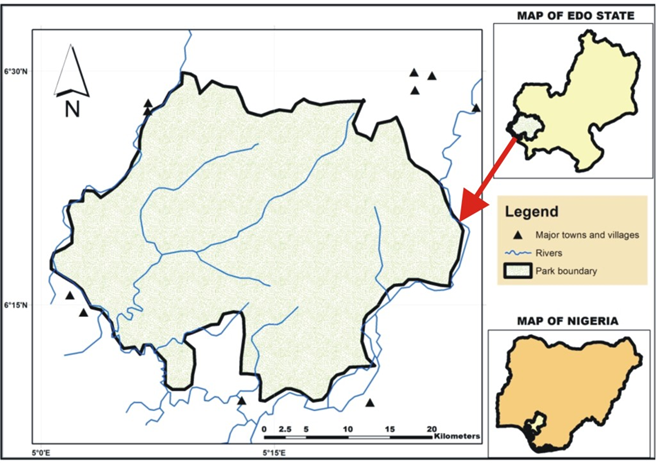
The research was conducted in Okomu National Park (longitude5°.91E and 5°.231E and latitude 6° 151N and 6°251N), Edo State, Nigeria, about 75 kilometers west of Benin City, the state capital. Okomu National Park contains a remnant of Nigerian lowland forests that once stretched 50-100 kilometers from the Niger River in Nigeria to the Dahomey Gap in the Benin Republic. This forest was surrounded by mangrove and swamp forests in the south and southeast, and it merged with the Guinean forest-savanna mosaic ecological region, covering an area of 212.48 km2.
The rainy season of the study area lasts from February to October and peaks between June and September. In the study area, the average annual rainfall is around 2,100mm. The dry season was reported between November and February, with the driest months being December and January. A monthly average temperature of 30.20 degrees Celsius and relative humidity of 65 percent is recorded [13, 14].
The study area is on an elevation of about 54m above sea level. Situated on the western coastline of Nigeria, it is characterized by the presence of sedimentary rock of the Eocene period. The soil is acidic, sandy loam derived from deep loose deposits of the deltas and coastlines called Bini sand. The soil in the study area was ferritic and composed of quartzite and kaolin formed from tertiary and secondary sedimentary rocks. The soil pH is 5.0. [13, 15, 16].
The study area lies within the discontinuous rainforest belt in Nigeria, reported being evergreen in nature, with most of the tree species of the uppermost canopy belonging to the Meliaceae and Leguminosae families. Few endemic tree species observed in Okomu National Park include Entandrophragma cylindrica, E. utile, Khaya ivoriensis, Gurea cedrata, G. thompsoni, and Strombosia pustule. Other tree species in the park include Afzelia Africana, Allanblackia floribunda, Garcinia kola, Ocimum grassimum, Xylopia aethiopica, piper guineerise, Millicea excelsa, Triplochiton scleroxylon, Nauclea diderichii, Terminalia species and Ceiba pentandra [13, 17].
Data Collection
Line transects were used to collect data for this survey. Three established trails, each 3.5 kilometers long, were chosen randomly from the four Administrative Ranges of Okomu National Park (Arakhuan, Iguowan, Julius Creek, and Babui) and designated as transects for this study. Twenty- three (23) people were employed as Research Assistants (RAs), most of whom were Okomu National Park research staff, graduates, and undergraduates of forestry and wildlife. These RAs were already conversant with the ranges in the National Park and could identify the White-Throated Monkey and differentiate them from other species. Before each survey round, the researcher and the more experienced staff of Okomu National Park provided training in judging distance, height, and angles.
Two RAs carried out each transect survey to improve species detection. Each transect was calibrated using interval flagging tapes to enhance enumERators’ location along the transect, as described by Hall and Happold [18].
Over two years, the survey was completed during the dry and wet seasons, with three census rounds per season (early, middle, and late). Dry season surveys were conducted in November, December, January, November, December, and February of the following year, while wet season surveys were conducted in March, May, October, April, August, and September. Surveys were carried out continuously for five days in the first week of each survey round, and when rainfall continued for more than five minutes, the survey was abandoned and repeated the next day. Surveys began at 06.00 hours and walked at the practiced speed of 1.0-1.5 km/ hour as White and Edwards [19] recommended and ended at 16.00 hours. Transect surveys were interspersed with ten (10) minutes period of ‘silent and watch’ to increase the chances of detecting White-Throated Monkeys, which may hide or flee when approached, as suggested by Buckland [20]; Ogunjemite and Olaniyi [21]; Akinsorotan [17]. When sightings were made, the number of individuals sighted, the population structure of the sighted population (age), sighting distance, sighting angle, time of the sighting, location on the transect, and type of canopy cover were recorded. Binoculars were used to enhance sighting during this survey.
Data Analysis
The Distance Sampling Analysis (CDSA) engine option in DISTANCE software 6.0 sampling, as modified by Buckland [22], was used to analyze the data. Data from all ranges were pooled to obtain estimates of density, population, and mean encounter rate for the C. erythrogaster pococki in Okomu National Park for the first category of analysis. In the second category, data were post-stratified using age classes (adult, sub-adult, and juvenile). Estimates of densities, abundance, and mean encounter rates (mER) for each age class were computed. Thirdly, stratum (habitat types) was used as a covariate in modeling detection probability and density. Mean encounter rates and the abundance of the species were obtained for each of both primary and secondary forests to determine the preferred habitat. The fourth category of analysis involved post-stratification of the data using the season as a covariate in modeling detection probability. The density, abundance, and encounter rate estimates were obtained for each season. Finally, ranges were used as strata for modeling detection probability, and estimates of density, abundance, and encounter rate were computed for each range in Okomu National Park.
The four possible models (uniform, half-normal, hazard rate, and negative exponential) in DISTANCE 6.0 with different adjustment factors were tried in all the analyses. The best models were adopted to estimate densities, abundance, and mean encounter rates (mER) based on Akaike Information Criterion (AIC) model selection criteria [20].
Data obtained from the field census survey of White-Throated Monkey were processed using the computer program software DISTANCE, which uses the following statistical model: Half-normal key, k(y) = Exp. (-y2/ (2*A (1) 2)). Density D= E (n) * f (0) * E(s) / 2L Where: D= Animals density (individuals / Km2) E (n) = Expected number of animals in the surveyed area f (0)= The probability density function of detected distances from the transect E(s) = Expected cluster size L= Total length of the transect Data obtained from the study were presented in tables.
Results
Table 1 presents the estimates of the population (density, abundance and mean encounter rates) of C. erythrogaster pococki in Okomu National Park. After a survey effort of 216km, 950 troops were sighted. The estimated density in the area was about 185km-2 (CI: 147.88-230.62), and the estimated number of individuals sighted in the study area was 39,203, with troops’ mean encounter rate (mER) of 4.4 km2 and individual mER of 18.29/km2. The study shows that about 4 troops or 18 individuals of C. erythrogaster pococki can be sighted in a kilometer walk in Okomu National Park, Nigeria.
| Parameter | Point estimate | SE | Confidence Interval (CI) | |
|---|---|---|---|---|
| Lower limit | Upper limit | |||
| D/km2 | 184.67 | 20.83 | 147.88 | 230.62 |
| NIE | 39,203 | 4422.40 | 31392 | 4956 |
| mER | 4.40 | |||
| Transects walked | 12 | |||
| Effort (km) | 216 | |||
| N | 3950 | |||
| AIC | 5012.9 |
Table 1: Density and Abundance of WTM in ONP.
N=Number of sightings; NIE= Number of individuals Encountered; MER = mean encounter rate (nkm-1); D = density; CI = confidence interval; AIC = akaike information criterion Table 1: Density and Abundance of WTM in ONP.
Distribution of C. erythrogaster pococki in Ranges of ONP
Table 2 shows the distribution estimates of C. erythrogaster pococki in all ranges during the two (wet and dry) seasons. The dry season saw the highest C. erythrogaster pococki in the Arakhuan range, with NTE (31); NIE (1,350); MER (2.95/km), density (5.90/km-2) and the lowest population in the Babui range, with NTE (26); NIE (1,120); MER (0.38/km), density (2.13/km-2). Furthermore, during the wet season, the Arakhuan range had the highest population of C. C. erythrogaster pococki with NTE (22); NIE (1384); MER (2.1/km), density (3.13/km-2), and Babui had the lowest population with NTE (19); NIE (917); MER (1.57/ km), density (1.75/km-2). The WTM mean encountered in both seasons was depicted in Figsures 4.1 and 4.2.
| Range | Season | N | N | MER (nkm-1) | Dkm-2 |
|---|---|---|---|---|---|
| Arakhuan | Wet | 26 | 1,184±44.29 | 2.10 | 3.13±1.65 |
| Dry | 31 | 1,350±269.0 | 2.95 | 4.90±2.64 | |
| Iguowan | Wet | 22 | 1,102±267.97 | 2.09 | 2.13±1.06 |
| Dry | 29 | 1,299±495.30 | 2.76 | 3.62±11.96 | |
| Julius Creek | Wet | 20 | 1,101±355.29 | 1.97 | 2.09±0.68 |
| Dry | 29 | 1,167±269.00 | 2.56 | 3.13±1.88 | |
| Babui | Wet | 19 | 917±137.19 | 1.57 | 1.75±0.58 |
| Dry | 26 | 1,120±340.40 | 2.15 | 2.13±0.67 |
Table 2: Distribution of C. erythrogaster pococki in Ranges of ONP.
N.B: n = sightings; N = estimated abundance; MER = mean encounter rate (nkm-1); D =density Table 2: Distribution of C. erythrogaster pococki in Ranges of ONP.
Population Structure of WTM in ONP
Table 3 shows the population structure of C. erythrogaster pococki in the study area. This study found that the most common age class of C. erythrogaster pococki in ONP during both seasons was adult, with NTEs of 115 and 94, NIEs of 1,969, and 1,238. The mean encounter rate (MER) for these adults was 3.79 and 2.09/km, while densities of 2.991.86 and 2.241.04/km-2 were recorded in dry and wet seasons, respectively for this age class. The least age class being subadult, recorded NTEs of 99 and 79, NIEs of 487 and 359, mERs of 2.07 and 1.01/km, and density of 1.49±0.12/km2 in both dry and wet seasons.
| Season | N | NIE | MER (nkm1) | Dkm² | |
|---|---|---|---|---|---|
| Adult | Wet | 94 | 1,238±1012.0 | 3.46 | 2.24±1.04 |
| Dry | 115 | 1,969±1093.0 | 3.79 | 3.99±1.86 | |
| Sub-adult | Wet | 78 | 487±39.18 | 2.26 | 1.49±0.12 |
| Dry | 99 | 359±76.55 | 2.26 | 1.02±0.77 | |
| Infant | Wet | 83 | 494±42.15 | 2.69 | 1.52±0.16 |
| Dry | 104 | 369±86.65 | 2.70 | 1.05±0.83 |
Table 3: Population Structure of C. erythrogaster pococki in ONP.
N.B: N = observations; NIE =Number of individuals encountered; MER = mean encounter rate (nkm-1); D = density Table 3: Population Structure of C. erythrogaster pococki in ONP.
Discussion
Population Structure of C. erythrogaster pococki in ONP
In each troop of C. erythrogaster pococki sighted in the study area, the population structure consists of juvenile, sub- adult, and adult age groups. The mean estimated abundance and density showed that for any troop sighted, the age group structure ratios are 1.34 (juvenile): 1(sub-adult): 2.5(adult) in both dry and rainy seasons. The implication is that a troop of WTM in ONP consists of an average of 3 adult age groups and 1 sub-adult and juvenile age group. Further, the interpretation of this result suggests that based on population size, a troop of C. erythrogaster pococki in ONP consists mainly of the adult age bracket, with the sub-adult age bracket forming the least. The abundance of adult age groups relative to sub-adult and juvenile has implications on the birth ratios, immigrations, deaths, and emigrations of WTM in the Park. Moreover, the BIDE (Birth, Immigration, Death, and Emigration) have been described as four significant determinants of population structure [23, 24].
The predominance of adults per troop in this study suggests that the population of C. erythrogaster pococki in the park is not viable hence the need for concerted conservation effort to protect the primate. This observation, however, contradicts the findings of Obasogie and Ogunjemite [25], who reported higher juveniles and sub-adults relative to the adult age group. Meanwhile, on some occasions, the low juvenile to adult ratio in the troop could be attributed to the emigration of sub-adult and juvenile individuals from the troop occasioned by their high playing frequency. A similar observation was on the activity budget of mona monkey in Ibodi monkey forest, Nigeria Okekedunu [26] and grey-cheeked mangabeys in Kibale National Park, Uganda [27]. Similarly, Kipper and Todt [28] reported that sighting young primates among groups is often difficult because playing behavior formed part of social competition among juveniles in the active period of learning the ways of social relationships. Thus, a colony’s most abundant group varied from time to time [29]. Therefore, it would be worthwhile to carry out an adequate inventory to ascertain the population structure concerning emigration and migration of individual members from a colony.
The result of the study on the population distribution of white-throated monkeys shows that there were populations of white-throated monkeys in all the Ranges of Okomu National Park. However, Arakhuan Range has been observed to harbor the highest population estimates of this primate specie in Okomu National Park. The study shows that the number of adults was higher than those of juveniles and sub- adults in all the Ranges and in both seasons in the Okomu National Park [30].
It is recommended that the Managers of Okomu National Park must improve on their conservation education and community outreach and activities in communities around the park [31]. Also, the need to continue to build goodwill amongst, and trust from the residents of local communities around the park. The community leaders should be encouraged to be more involved in leading their people to buy into the conservation goal of the park, as the residents will respect and abide by community-supported decisions.
References
-
Estrada A, Garber PA, Rylands AB, Roos C, Fernandez Duque E, et al. (2017) Impending extinction crisis of the world’s primates: Why primates matter. Science Advances 3(1): e1600946.
-
IUCN (2020) Cercopithecus erythrogaster. The iucn Red List of Threatened Species Version 2021-3. Retrieved from iucnredlist.
-
Mittermeier RA, Wallis J, Rylands AB, Ganzhorn JU, Oates JF, et al. (2009) Primates in Peril: The World’s 25 Most Endangered Primates 2008–2010. Bio one 24(1): 1-574.
-
Ikemeh R, Oates JF, Imong I (2020) Cercopithecus erythrogaster ssp. pococki. The IUCN Red List of Threatened Species 2020: e.T40004A17984075.
-
Wolfheim JH (1983) Primates of the World, Distribution, Abundance and Conservation. University of Washington Press, Seattle and London. Journal of Mammalogy 65(2): 367-368.
-
Oates JF (1985) The Nigeria guenon Cercopithecus erythrogaster: ecological, behavioural, systematic, and historical observations. Folia Primatol 45(1): 25-43.
-
Ogunjemite BG (1998) A preliminary survey of the primates of Ondo and Ekiti States. M.Tech. Dissertation, Federal University of Technology, Akure, Nigeria.
-
Osun Grove Support Group (2002) Oshogbo Groove: A world class Tourist Spot. Paper presented at the 2nd Symposium of Osun Oshogbo festival, Oshogbo Osun state, Nigeria, pp: 12
-
Oates JF (1996) Survey of Cercopithecus eryhtroagaster populations in the Dahomey gap . African Primates 2(1): 9-11.
-
Campbell G, Teichroeb J, Paterson JD (2008) Distribution of diurnal primates species in Togo and Benin. Folia Primatologica 79(1): 15-30.
-
Kremen C, Merenlender AM, Murphy DD (1994) Ecological Monitoring: A Vital Need for Integrated Conservation and Development Programs in the Tropics. Cons Biol 8(2): 388-397.
-
Gibbs JP, Droege S, Eagle P (1998) Monitoring populations of plants and animals. Bioscience 48: 935-940.
-
Orhiere SS (1992) Okomu Wildlife Santuary, Okomu Forest Reserve, Edo State. The Nigeria Field 57: 91-106.
-
Ejidike BN, Okosodo FE (2007) Food and Feeding Habits of the Thick-Tailed Galago (Otelemur crassicaudatus) in Okomu National Park, Edo State. Journal of Fisheries International 2(3): 231-233.
-
Ikhuoria IA (1993) Vegetation and Land-use Changes in a forest Ecosystem. Nig J of Remote Sensing 1: 73-82.
-
Soladoye MO, Oni O (2000) Biodiversity studies at Okomu Forest Reserve in Edo State. A report of the National Agricultural Research Project, pp: 128.
-
Akinsorotan OA, Ogunjemite BG, Afolayan TA (2011) Assessment of the large mammals of Arakhuan range, Okomu National Park, Nigeria. Ethiopian Journal of Environmental Studies and Management 4(3): 25-37.
-
Hall GT, Happold DCD (1988) The Mammals of Nigeria. Oxford University Press. Western Street, Oxford, pp: 106-405.
-
White L, Edwards A (2000) Conservation in African Rain Forest, A Technical Handbook. Wildlife Conservation Society, New York , pp: 1-460.
-
Buckland ST, Anderson DR, Burnham KP, Laake JL (1993) Distance Sampling: Estimating Abundance of Biological Populations. Chapman and Hall, London 50(3): 1-3.
-
Ogunjemite BG, Olaniyi OE (2009) The Distribution and Abundance of Diurnal Primates of Ifon Game Reserve, South- West Nigeria. International Journal of Agriculture 1: 19-22.
-
Buckland ST, Anderson ST, Burham KP, Laake JL, Borchers DL, et al. (2004) Advanced Distance Sampling. Oxford University Press, London, pp: 346.
-
Fedigan LM, Gouzoules H, Gouzoules S (1983) Population dynamics of Arashyama west Japanese macaques. Int J Primatology 4(3): 307-321.
-
Fedigan LM, Jack K (2001) Neotropical primates in a regenerating Costa Rican dry forest: A comparison of howler and capuchin population patterns. International Journal of Primatology 22: 689-713.
-
Obasogie FO, Ogunjemite BG (2014) Population status of White-Throated Monkey (Cercopithecus erythrogaster pococki) in Okomu National Park of Nigeria. Global Journal of Bio-Science and Biotechnology 3(1): 63-69.
-
Okekedunu JO, Ogunjemite BG, Adeyemo IA, Olaniyi OE (2014) Daily activity budget of Mona monkey (Cercopithecus Mona Schreber) in Ibodi monkey forest, Osun State, Nigeria. FUTA Journal of Research in Sciences 2014(2): 218-227.
-
Arlet ME, Molleman F, Chapman CA (2008) Mating tactics in Male Grey- Cheeked Mangabey (Lophocebus albigena). Ethiology 114: 851-862
-
Kipper S, Todt T (2002) The use of vocal signals in social play of Barbary macaques. Primate in medicine 43: 3-17.
-
Karim K, Anuar MS, Dauda TO, Nidaullah H (2014) Population structure analysis of monkeys in selected protected and non-protected areas of Peninsular Malaysia. The Journal of Animal and Plant Sciences 24(6): 1772-1779.
-
Oates JF (1994) The natural history of African colobines. In: Colobine Monkeys: Their Ecology, Behaviour and Evolution. Davies AG, et al. (Eds.) Cambridge University Press, Cambridge, pp: 75-128
-
Senf MJ (2009) Interspecific and intergroup interactions of mantled howling monkeys (Alouatta palliata) in primary versus secondary forest at El Zota Biological Field Station, Costa Rica. Graduate Dissertations. University of Oregon, USA, pp: 201.
- Lessons to Learn: Trees are More than the Lungs of the World
- Community Forestry Enterprises as a Model for Sustainable Forest Development: The Case Of The "Baja Tarahumara" in Chihuahua, Mexico
- Ecological and Socio-Economic Impacts of Chromolaena odorata and Mesosphaerum suaveolens, Two Invasive Alien Species in Central and Southern Benin, West Africa
- Epigenetic Sustainability: Modeling the Human Factor as a Natural Resource through Science 4.0 and the NR3C1 Biological Pilot
- Growth-at-Risk: A Framework for Assessing Economic Vulnerability
- The Rural Territory as a Socioecological System for the Management of Public Policy for Sustainable Rural Development