
Comparative Studies on the Ethnic Fermented Food Products and its Preservation Methods with Special Focus of North-East India
Most of the people present in the North-eastern states of India are tribal people whose daily diet constitutes of various fermented food products. These food products are mostly prepared by their own traditional methods which they have inherited from their ancestors. This paper brings together a brief comparative study on the different fermented food products which are region specific and have their unique substrate and preparation methods. The substrates like cereals, pulses and vegetables are fermented by the local tribe. The alcoholic beverages produced in the states have unique taste and out siders preferred to take the drink. The common microorganisms like Lactic Acid Bacteria (LAB), Candida sp., Bacillus sp., and Saccharomyces cerevisiae etc., are found in these fermented food products. These products help to improve the economy of the local people and it can be commercialized with proper formulation studies in future.
Introduction
Northeast India is a land of heavy hills and land in the eastern-most region of India, which is connected with east India through a confined corridor between Nepal and Bangladesh. The North-Eastern region, which is covered a bunch of eight states as like Assam, Arunachal Pradesh, Manipur, Meghalaya, Mizoram, Nagaland, Tripura and Sikkim. Approximately 225 tribes are live in this region out of the 450 tribes of India. Northeast India geographically comprises of about 8% of total area of India, nearly having a population of 40 million which is almost 3.1% of the total Indian population. Some of the lineages are unique to the world, like Nepenthaceae, Ruppiaceae, Liliaceae and Clethraceae, Tetracentraceae, Siphonodontaceae, and a few more families can be found in this region. The people of these hilly states have a very rich reserve of traditional knowledge for their livelihood in the terrains. Approximately 75% of the population in this region is largely holding by tribal people. The fermentation is one of the ancient and economic processes of preserving the quality and safety of foods and providing bio-nutrients, minerals and enhancement of flavour and aroma. Fermentation process not only serving as food but also serve as digestible and health-promoting benefits. Locally available bamboo shoots, soybean, fish, meat and cereals are fermented traditionally by the local tribes of northeastern states [1]. The northeastern states are rich in cultural food which includes fermented and non- fermented ethnic food as well as beverages and alcoholic beverages [2]. Especially, the tribal people have their own traditional processing methods for the fermentation of the food materials. The ethnic fermented food products are produced and consumed by the tribal people since more than 2500 years. The preparation methods of all the fermented food products are region-specific and used different substrates by different tribal people giving the individual unique taste to the products. The people of the north eastern states of India prepare and consume more than 250 various types of familiar and unfamiliar ethnic fermented foods and alcoholic beverage (Figure 1). Ethnic fermented foods of northeast India are categorized and named based on the basic materials such as fermented soybean and non-soybean legume, fermented vegetable (gundruk, sinki, anishi, goyang, khalpi, ziang-sang/ziang-dui), fermented bamboo shoot (soibum, mesu, ekung, eup, hirring), fermented soybeanfoods (kinema, hawaijar), fermented smoked fish (ngari, hentak, shidal, tungtap, gnuchi) and fermented beverages (Sekhmai Yu,zawlaidi, kodo ko jaanr, zutho, chuwak) [3].
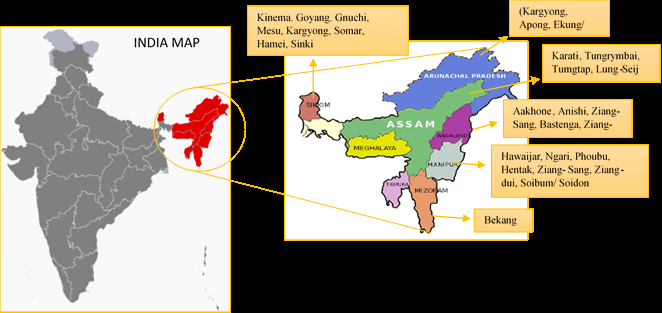
Traditional Fermented Food Products of North- East India
A summary of various microorganisms involved in the fermentation of a variety of products is given in Table
1. Some of the practices adopted by different community of indigenous tribal people of North-eastern India in the production of their respective fermented products are described in this current literature and specifically shown in Figure 1.
| Product | Microorganism found | Reference | |
|---|---|---|---|
| 1 | Kinema | Geotrichum candidum, Candida parapsilosis, Enterococcus faecium, Bacillus subtilis | [4] |
| 2 | Hawaijar | Bacillus subtilis, B. cereus, Staphylococcus aureus, S. sciuri, B. licheniformis, | [5] |
| 3 | Tungrumbai | Bacillus subtilis, Candida parapsilosis, Saccharomyces bayanus, Saccharomycopsis fibuligera, Geotrichum candidum, Enterococcus faecium | [4,6] |
| 4 | Bekang/ Peruyyan/ Aakhone | Bacillus subtilis, and Bacillus sp. | [7] |
| 5 | Soidon | Lactobacillus brevis, Leuconostocfallax, Leuc. lacti | [8] |
| 6 | Ekung | Lactobacillus plantarum, L. brevis, L. casei | [9] |
| 7 | Hirring | Lactobacillus plantarum and L. lactis | [9] |
| 8 | Ngari | Lactococcus plantarum, L. plantarum, Bacillus subtilis, B. pumilus, Miocrococcus sp., Candida sp. | [10] |
| 9 | Hentak | L. amylophilus, Enterococcus faecium, Bacillus cereus, Lactobacillus fructosus, Staphylococcus aureus, B. subtilis, Enterococcus faecium, Candida sp. | [10] |
| 10 | Gundruk | Lactobacillus brevis, L. plantarum, L. paracasei, Leuconostoc fallax, Pediococcus pentosaceus, P. acidilactici | [11] |
| 11 | Sinki | L. brevis, L. Fermentum, Lactobacillus plantarum | [4] |
| 12 | Ziang-sang | Pediococcus acidilactici, Lactobacillus plantarum, L. brevis | [11] |
| 13 | Gnuchi | Bacillus subtilis, Enterococcus faecium, Pediococcus pentosaceus, Micrococcus sp. | [12] |
| 14 | Goyang | Lactobacillus plantarum, L. brevis, Lactococcus lactis, Enterococcus faecium, Pediococcus pentosaceus | [13] |
| 15 | Khalpi | L. brevis and Lactobacillus plantarum, | [14] |
| 16 | Ipoh | Saccharomyces cerevisiae and Candida sp | [15] |
| 17 | Atingba | Lactobacillus plantarum, Saccharomyces cerevisiae, Candida tropicalis, P. guilliermondi, C. Montana, P. Fabianii, Torulaspor delbrueckii, C. parapsilosis | [5,13] |
| 18 | Zutho | Saccharomyces cerevisiae | [16] |
| 19 | Kodo ko Jaanr | Rhizopus chinensis, Saccharomyces cerevisiae, Hansenula anomala, Pediococcus pentosaceus, Candida glabrata, S. bayanus, Saccharomycopsis fibuligera, Cryptococcus sp., Trichosporon sp., Myxozyma sp., Bullera sp., Rhodotorula sp., Mucor cicinelloides, Lactobacillus sp., Saccharomycopsis capsularis, Kluyveromyces sp., Debaryomyces sp., Tremella sp. | [4,17,18] |
| 20 | Eup | Lb. plantarum and Lb. fermentum | [9] |
| 21 | Shidal | Micrococcus spp., Staphy. Aureus, Bacillus spp., E. coli | [19-21] |
| 22 | Soibum | Lactobacillus plantarum, L. brevis, L. coryniformis, L. delbrueckii, L lactis, Leuconostocfallax, Leuc. mesentroides, Enterococcus durans, Streptococcus lactis, Bacillus subtilis, B. licheniformis, B. coagulans, Candida sp., Saccharomyces sp., Torulopsis sp. | [9] |
| 23 | Mesu | Lactobacillus plantarum, L. pentosaceus, L. brevis, L. plantarum, L. brevis, L. pentosaceus | [22] |
Table 1: Fermented food products and their nutritional composition.
Table1: Microorganism found during processing of different fermented food products of NE India.
| Sl. No | Products | Substance | Nutritional Composition | Region of origin | Reference |
|---|---|---|---|---|---|
| 1 | Nagri | Fish | Protein: 34.1%, Fat: 13.2%, Carbohydrate: 31.6%, Food value: 381.6 kcal/100 gm, Ca: 41.7 mg/100 gm, Fe: 0.9 mg/100 gm, Mg: 0.8 mg/100 gm, Mn: 0.6 mg/100 gm, and Zn: 1.7 mg/100 gm | Manipur | [10] |
| 2 | Hentak | Fish | Protein: 32.7%, Fat: 13.6%, Carbohydrate: 38.7%, Food value: 408.0 kcal/100 gm, Ca: 38.2 mg/100 gm, Fe: 1.0 mg/100 gm, Mg: 1.1 mg/100 gm, Mn: 1.4 mg/100 gm, and Zn: 3.1 mg/100 gm | Manipur | [10] |
| 3 | Tungtap | Fish | Protein: 32.0%, Fat: 12.0%, Carbohydrate: 37.1%, Food value: 384.4 kcal/100 gm, Ca: 25.8 mg/100 gm, Fe: 0.9 mg/100 gm, Mg: 1.6 mg/100 gm, Mn: 0.8 mg/100 gm, and Zn: 2.4 mg/100 gm | Khasi tribe of Meghalaya | [10,23] |
| 4 | Gnuchi | Fish | Protein: 21.3%, Fat: 14.5%, Carbohydrate: 47.3%, Food value: 404.9 kcal/100 gm, Ca: 37.0 mg/100 gm, Fe: 1.1 mg/100 gm, Mg: 8.8 mg/100 gm, Mn: 1.1 mg/100 gm, and Zn: 7.5 mg/100 gm | Lepcha community of Sikkim | [12,23] |
| 5 | Suka ko machha | Fish | Protein: 35.0%, Fat: 12.0%, Carbohydrate: 36.8%, Food value: 395.2 kcal/100 gm, Ca: 38.7 mg/100 gm, Fe: 0.8 mg/100 gm, Mg: 5.0 mg/100 gm, Mn: 1.0 mg/100 gm, and Zn: 5.2 mg/100 gm | Gorkha, Sikkim | [12,23] |
| 6 | Sukuti | Fish | Protein: 36.8%, Fat: 11.4%, Carbohydrate: 38.2%, Food value: 402.6 kcal/100 gm, Ca: 17.7 mg/100 gm, Fe: 0.3 mg/100 gm, Mg: 1.4 mg/100 gm, Mn: 0.2 mg/100 gm, and Zn: 1.3 mg/100 gm | Sikkim | [12,23] |
| 7 | Sidra | Fish | Protein: 25.5%, Fat: 12.2%, Carbohydrate: 45.7%, Food value: 394.6 kcal/100 gm, Ca: 25.8 mg/100 gm, Fe: 0.9 mg/100 gm, Mg: 1.6 mg/100 gm, Mn: 0.8 mg/100 gm, and Zn: 2.4 mg/100 gm | Sikkim | [12,23] |
| 8 | Kinema | Soybean | Protein: 47.7%, Fat: 17.0%, Carbohydrate: 28.1%, Food value: 454 kcal/100 gm, Total amino acids: 42618.0 mg/100 gm, Free amino acids: 5129.0 mg/100 gm, Ca: 432.0 mg/100 gm, Na: 27.7 mg/100 gm, Fe: 17.7 mg/100 gm, Mn: 5.4 mg/100 gm, and Zn: 4.5 mg/100 gm | Sikkim | [9,24,25] |
| 9 | Hawaijar | Soybean | Protein: 43.9%, Fat: 27.9%, Carbohydrate: 23.4%, Food value: 521.2 kcal/100 gm, Ca: 357.8 mg/100 gm, Na: 88.7 mg/100 gm, Fe: 92.3 mg/100 gm, K: 835.1 mg/100 gm and Zn: 63.0 mg/100 gm | Manipur | [5] |
| 10 | Tungrumbai | Soybean | Protein: 45.9 gm/100 gm, Fat: 30.2 gm/100 gm, Fiber: 12.8 gm/100 gm, Carotene: 212.7μg/100 gm, and Folic acid: 200μg/100 gm | Khasi tribe of Meghalaya | [26-29 ] |
| 11 | Aakhone/ Bekang/ Peruyyan | Soybean | Protein: 44.6%, Fat: 23.5%, Carbohydrate: 21.6%, Food value: 525.3 kcal/100 gm, Ca: 350.6 mg/100 gm, Na: 87.8 mg/100 gm, Fe: 94.1 mg/100 gm, K: 837.1mg/100 gm and Zn: 62.0 mg/100 gm | aaknone in Nagaland, bekang in Mizoram and peruyyan among the Apatanis of Arunachal Pradesh. | [14,30] |
| 12 | Bhaati jaanr | Rice | Protein: 9.5%, Fat: 2.0%, Crude fiber: 1.5%, Carbohydrate: 86.9%, Food value: 404.1kcal/100gm, Ca: 12.8mg/100gm, K: 146.0mg/100gm, P: 595.0mg/100gm, Fe: 7.7mg/100gm, Mg: 50.0mg/100gm, Mn:1.4mg/100gm and Zn: 2.7mg/100gm | Sikkim | [31] |
| 13 | Eup | Tender bamboo shoot | Protein: 33.6%, Fat: 3.1%, Carbohydrate: 45.1%, Food value: 342.7kcal/100gm, Ca: 76.9mg/100gm, Na: 3.4mg/100gm and K: 181.5mg/100gm | Arunachal pradesh | [9] |
| 14 | Tuaithur | Tender bamboo shoot | Fat: 3.4%, Protein: 4.6%, Carbohydrate: 87.4% and Food value: 398.6kcal/100gm | [32] | |
| 15 | Ekung | Tender bamboo shoot | Protein: 30.1%, Fat: 3.8%, Carbohydrate: 52.1%, Food value: 363.0kcal/100gm, Ca: 35.4mg/100gm, Na: 10.9mg/100gm and K: 168.6mg/100gm | Arunachal pradesh | [9] |
| 16 | Mesu | Young bamboo shoots | Fat: 2.6%, Protein: 27.0%, Carbohydrate: 55.6%, Food value: 352.4kcal/100gm, Ca: 7.9mg/100gm, Na: 2.8mg/100gm and K: 282.6mg/100gm | Darjeeling hills and Sikkim | [22] |
| 17 | Soibum | Tender bamboo shoot | Fat: 3.2%, Protein: 36.3%, Carbohydrate: 47.2%, Food value: 362.8kcal/100gm, Ca: 16.0mg/100gm, Na: 2.9mg/100gm and K: 212.1mg/100gm | Manipur | [8,33,34] |
| 18 | Soidon | Matured bamboo shoot | Fat: 3.1%, Protein: 37.2%, Carbohydrate: 46.6%, Food value: 363.1kcal/100gm, Ca: 18.5mg/100gm, Na: 3.7mg/100gm and K: 245.5mg/100gm | Manipur | [8] |
| 19 | Gundruk | Leafy vegetables | Protein: 38.7%, Fat: 2.1%, Carbohydrate: 38.3%, Food value: 321.9kcal/100gm, Ca: 234.6mg/100gm, Na: 142.2mg/100gm and K: 677.6mg/100gm | Himalayan region | [11,31,35] |
| 20 | Ziang-sang/ Ziang-dui | Mustard leaves | Protein: 38.7%, Fat: 3.2%, Carbohydrate: 41.2%, Food value: 348.4kcal/100gm, Ca: 240.4mg/100gm, Na: 133.7mg/100gm and K: 658.4mg/100gm | Manipur and Nagaland | [11] |
| 21 | Shidal | Fish | Protein: 36.8%, Fat: 11.4%, Carbohydrate: 38.2%, Food value: 402.6kcal/100gm, Ca: 17.7mg/100gm, Fe: 0.3mg/100gm, Mg: 1.4mg/100gm, Mn: 0.2mg/100gm and Zn: 1.3mg/100gm | Arunachol Pradesh, Nagaland, Assam and Tripura | |
| 22 | Sinki | Radish | Protein: 14.6%, Fat: 2.5%, Carbohydrate: 34.1%, Food value: 395.2kcal/100gm, Ca: 16.5mg/100gm, Fe: 0.5mg/100gm, Mg: 1.8mg/100gm, Mn: 0.3mg/100gm and Zn: 1.5mg/100gm | Darjeeling, Sikkim and Nepal |
Table 2: Fermented food products and their nutritional composition.
Fermented Vegetables Product
The tribal person of these regions uses various types of vegetables for fermentation and preserved the end product for further use. Few usual fermented vegetable products on these regions are demonstrated here.
Gundruk
Gundruk is a fermented vegetable product indigenous to Nepali people of the Himalayan region. It is generally prepared during winter season i.e, October to December, when perishable leafy vegetables are abundantly available. These fermented vegetable products mainly include leaves of mustard (Brasiccajuncea), rayo-sag (Brasiccarapa), cauliflowers (Brasiccaoleracea), raddish (Raphanussativus)
and other locally available grown vegetables [9]. Various microbes are associated in gundruk preparation and have been associated as L. plantarum, Lactobacillus brevis, L. paracasei, Leuconostocfallax, Pediococcuspentosaceus, and P. acidilactici [11].
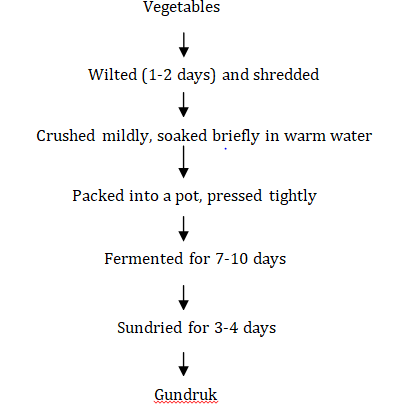
For its fermentation, selected vegetables of fresh leaves are first wilted and shredded using a sickle or knife. These are then crushed mildly and pressed into an earthen pot. The container is then made air tight and left to ferment naturally at room temperature for about 7 to 10 days. After the incubation period the leaves takes a mild acidic taste which indicates the completion of fermentation. The gundruk is then removed and sun dried for 3 to 4 days, which helps in storage. Gundruk is sold in all the local markets of Darjeeling and Sikkim by the Nepali women shown in Figure 2. It is eaten as a soup or pickle. The soup which is prepared after mixing gundruk with certain ingredients serves as a good appetizer [9].
![Figure 2: It is eaten as a soup or pickle. The soup which is prepared after mixing gundruk with certain ingredients serves as a good appetizer [9].](/fulltextimages/9629/fig_2.png)
![Figure 3: The product shelf life can be extended up to 2 years at room temperature after sun drying periodically [9,36]. The protein and fat content of Sinki is a 14.6 g and 2.5 g respectively on 100g basis. It is a more acidic in nature which has the pH value of 4.4 and mainly used for soups and pickles. It is also the good sources for indigestion problem [36].](/fulltextimages/9629/fig_3.png)
Flow sheet for gundruk processing (Sikkim)
Sinki
This is the fermented vegetable product obtained from radish (Raphanus sativus L.). It is a local product of Nepal, Darjeeling and Sikkim. Mainly it is prepared in the months of winter season when the weather is least humid and there is ample supply of vegetables [17, 36]. The microorganism associated with fermentation process includes Lactobacillus plantarum, L. Fermentum, and L. brevis [36]. The tap roots of radish are collected, washed, crush into pieces and sundried for 1-2 days until they become soft. After sundried, the crush radish placed into air tight earthen jar for maximum one month of fermentation. The jars are covered with radish leaves and tighten by lid of the jar. The jar is then kept in a dry and warm place for 15-30 days [36]. Traditionally, it is also made by putting in earthen pit which is having 1 metre height and diameter. The pit is plastered with wet mud and fire is supplied to dry the pit. In order to clean the pit, the ashes are removed and all sides are covered with green banana or bamboo leaves. The crushed and sundried radishes are tight, press into the pit and covered with leaves and additionally pressed by keeping the stones on the top sides of pits. The top is undisturbed for 30-40 days for the fermentation occurred. Once, the fermentation is completed the radish again plastered with cow dung and mud to maintain the air tight condition to inside the pit. The pit is kept are cut into pieces and sundried for 3-5 days to reduce the moisture content as shown in Figure 3. The product shelf life can be extended up to 2 years at room temperature after sun drying periodically [9, 36]. The protein and fat content of Sinki is a 14.6 g and 2.5 g respectively on 100g basis. It is a more acidic in nature which has the pH value of 4.4 and mainly used for soups and pickles. It is also the good sources for indigestion problem [36].
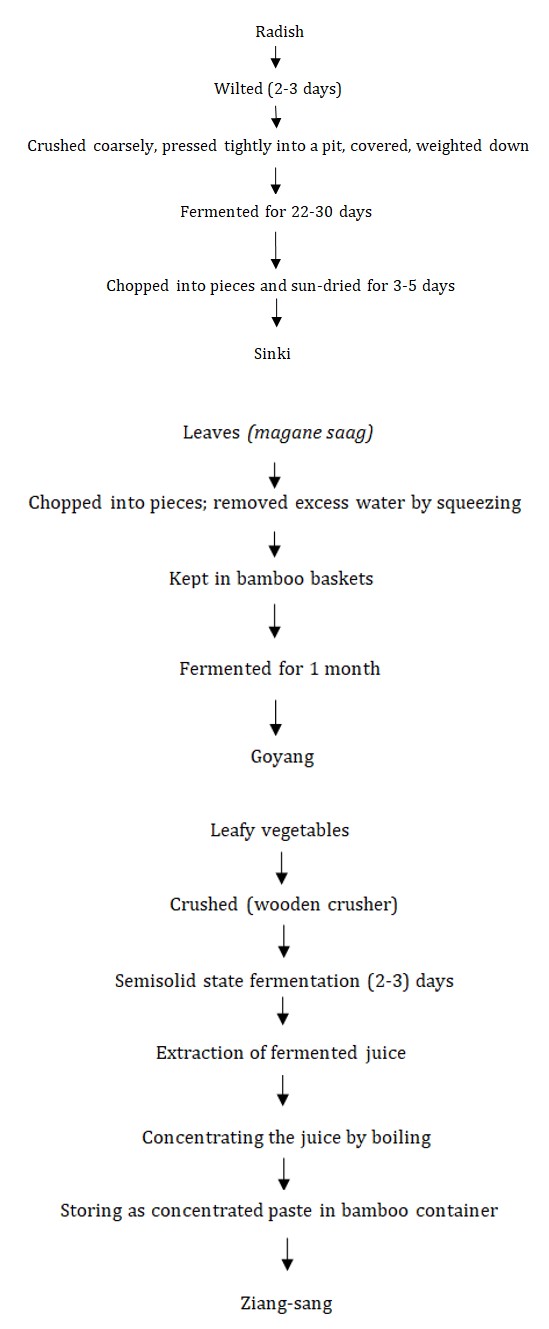
Flow chart for sinki processing (Darjeeling)
Ziang-Sang
Ziang-sang is also known as Ziang-dui and it is the product of leafy vegetable. It is mainly found in Nagaland and Manipur. Mainly, it is processed by the Naga women and sold in the markets [9]. The microorganism responsibilities for fermentation of the substrate include Lactobacillus plantarum, Pediococcus acidilactici and L. Brevis [11].
Hangam (Brassica sp.) leaves used as substrate for making Ziang-sang. The 2-3 days old leaves are collected, crush using mortar and pestle and soaked in warm water. After, soaking for 24 hours the excess water is removing by squeezing with hand and kept in air tight container jar 7 to10 days at ambient temperature (20-30ºC) for fermentation process. Ziang-sang is collected by squeezing the fermented substrate by separating the liquid substrate. The solid substrate of the fermented products is sundried for 4-5 days and can be store for a year. This is known as Ziang-sang. The liquid substrate is concentrated by boiling process and can be stored in traditional bamboo containers for a year which is also known as ziang- dui. Ziang-sang is consumed by making soup with boiled rice and ziang-dui used as a condiment with meals [9, 37].
Flow chart for ziang-sang processing (Manipur)
Goyang
Goyang is the fermented product made from leaves of the wild plant called magane saag (Cardamine macrophylla Willd) [9]. This product is mainly famous in Sikkim and Darjeeling district of West Bengal (Sherpa tribe people). The fermenting bacteria involved in the process are L.brevis, Lactobacillus plantarum, Lactococcus lactis, Pediococcus pentosaceus, and Enterococcus faecium [38]. The leaves of magane saag are mainly found in rainy season. The plant is collected, washed, chopped and squeezed for the removal of excess water. The squeezed leaves are added and pressed in traditionally made bamboo basket by giving some layers of fig (Ficus carica) leaves. The upper portion of the bamboo basket is also covered with the fig leaves keep for the fermentation process with maintaining temperature of 15-25°C for 1months of period. After the fermentation is completed freshly made goyang is taken out and placed in air tight container and people also make the goyang in ball shaped and sundried to extend its shelf life. Local people usually boiled the goyang with beef and noodles to make the thick soups called thupka [9].
Flow chart for goyang processing (Sikkim)
Khalpi
Cucumber is the main raw material for the khalpi preparation and it is mostly popular in Sikkim and Darjeeling. Nepali people mostly consume this product and the fermentation bacteria involved in the process are Lactobacillus plantarum, L. brevis and Lecuonostocfallax. Matured and ripened cucumber is selected for khalpi preparation. In this process, the selected cucumber is chopped into desired sizes, sun dried for 2 days of sunshine period and finally stored in bamboo vessel for the fermentation to occur .Seven days of time is allowed for fermentation to occur at room temperature. After the completion of fermentation process, it is taken out and people use it for pickling purpose with adding other spices like mustard, chillies and salt [9].
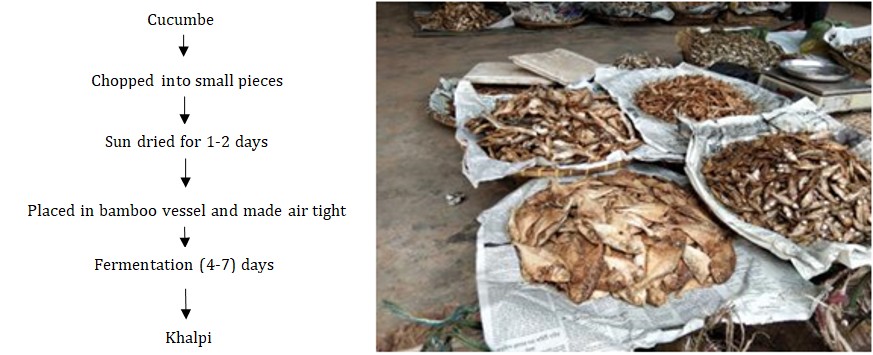
Flow chart for khalpi processing (Sikkim)
Anishi
Anishi is vegetable based fermented product and this product is prepared and consumed by the people of Nagaland. Das, et al. [2] reported that anishi is made from yam (Colacasia sp.) leaves which are collected, washed and pile is made by putting one another and wrapped by banana leaves. It is kept for 6 to 7days for fermentation to occur because of which leaves get turn from green to yellow in colour. The obtained yellow colour leaves has to mix with salts, chilli and ginger which ends up with the preparation of paste by grinding in grinder. The prepared paste has to make in cake form and has to keep in fireplace in kitchen for 2 to 3days for drying to occur completely. This product is used to cook with dry meat especially pork meat to improve the taste and flavor of the meat [3].
Fermented Fish Products
Apart from the fermentation of various fruits, pulses, vegetables, soybean and bamboo shoot, a numerous amounts of fish products have been fermented due to their increased nutritional composition and shelf life edibility. In North East India many tribes prepared the fermented fish, which are locally available small species of freshwater fish. Salting, drying, and smoking are the principal methods among various traditional processing of fish preservation in North East India. Some of these are fermented traditionally and preserved for long year period as reverse food. Other products of this kind include nampha of Thailand, kasmi and ounago of Japan and patis of Philippines [39]. These products with their exquisite taste and smell serve as a source of protein in the diets of the people. Some of them are mentioned here are shown in Figure 4.
Ngari
Ngari, a fermented fish product forms a major part in the diet of Manipuri people. The household production and preservation methods are adopted traditionally with cultural identities and these processes are followed throughout generation [2]. The fish species used for its preparation is Puntius sophore which is locally known as Phoubunga [40]. The microbes associated have been identified as Lactococcusplantarum, L. plantarum, Miocrococcus sp., B. pumilus, Bacillus subtilis, and Candida sp. [10].
The ngari preparation is restricted to small households in the villages. The Puntius sophore is directly incurred from local fish pond or imported from the Brahmaputra river of Assam or Bangladesh or from distant states like West Bengal and Andhra Pradesh [41] frequently during the fishing season i.e. October to January when Puntius fishes are abundantly available. Fresh pieces of these fishes are collected and washed as a whole. After washing, only the intact pieces are selected and kept for semi-drying under sunlight for 3 to 4 days. When the fishes turn out to be some semi-dried, limited amount of essential oils which often includes mustard oils as well as fish oils are rubbed on their body along with some salt which helps to absorb the oils into fish body. These processed fishes are then directly kept for fermentation and stored in gunny bags for further use. Prior to the fermentation, stored fishes are washed properly using porous bamboo baskets and the water is allowed to drain off overnight. On the following day, the fishes are kept in gunny bags and and pressed for the removal of excess water and thereby breaking their head and bones. Oil released from head while pressing is believed to initiate fermentation process. Inner surface of earthen pot/ vat (also called as chaphus) with capacity of 45 to 50 kg, is coated with mustard oil or any other vegetable oil to check the porosity [2, 37, 42].
The oils applied in the process of smearing are a vegetable oil often includes mustard, palm or sunflower oil [43]. The oils applied on the fish body are absorbed with time and become fully dried. After that, another layer of oil is applied and kept for drying once again. New earthen pots require oil coating of 8 to 10 times whereas old pots require only single coating [2] respectively at an interval of 7-8 days. This coating of oil is believed to make anaerobic environment inside the chamber during fermentation process [37]. Therefore, the fishes are tightly packed inside the pots and sealed with polyethylene sheet, oils smear, fish scales, cow dung and mud slurry [2]. Then, the chaphus are fiilled up to top with a cover paste thereby overlaid with cover leaf. At last, the pots are kept in dark place at ambient temperature for about 4 to 12 months [2] until it is ready to be consumed. This end product is also well known as chaphukaiba [2] in the local markets. Nagri has a characteristics smell and a shelf life of 12 to18 months [37].
Most strains of LAB isolated from ngari had a high degree of hydrophobicity, indicating their probiotic characters [10]. It is used in the preparation of various delicacies like eromba where it is added either after frying or steaming. It is also consumed as a side dish with rice.
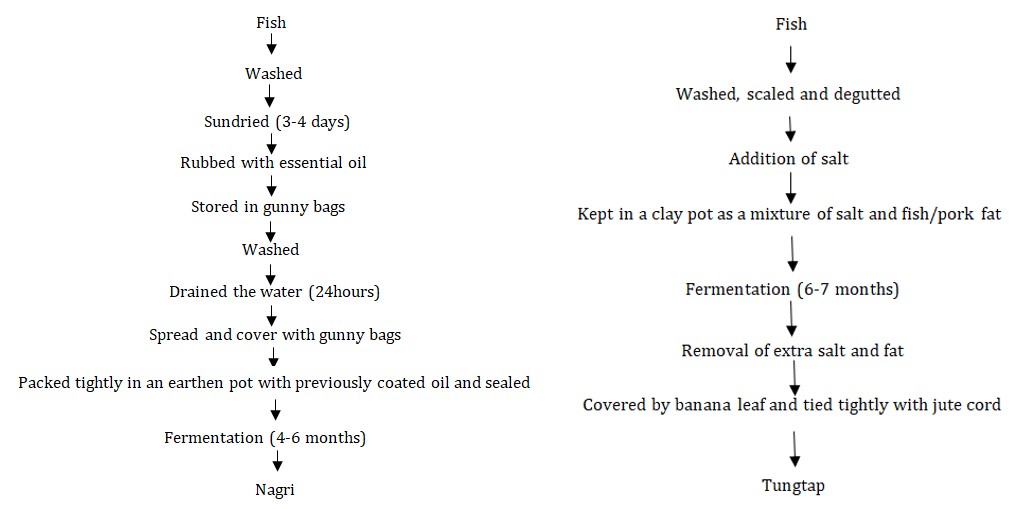
Flow sheet for nagri preparation (Manipur)
Shidal
Shidal is a semi-fermented fish product which is very popular among Tripura people and it is made by using small fish carps (Puntius spp.). The local names associated with it includes seepa, hidal, seedal and shidol in Arunachol Pradesh, Nagaland, Assam and Tripura [19, 44, 45, 46]. In the preparation of shidal fish, carps (Puntius spp.) are mixed with salts and kept under the sun (10-12 days). After sun dried, it is filled in earthen pots/vats and kept for 4 to 6 months under anaerobic condition in order to carry out the fermentation process. After completion of fermentation, the product gains texture, smell, and appearance [44]. The microorganism associated has been identified as Staphy. Aureus Micrococcus spp., Bacillus spp., and E coli [19-21 ].
Tungtap
Tungtap is the fermented fish product which is very popular in Meghalaya khasi tribe people. It is mainly procured at household of villages and sold to the markets of Meghalaya [27, 17]. The microorganisms associated in this fermented fish product are L. fructosus, Lactobacillus coriniformis, Bacillus cereus, L. lactis, B. subtilis, Saccharomycopsis sp. and Candida sp. [2].
For its preparation, the puntius sophore fishes are used [2]. The puntius sophore were washed, scaled and then whole fish body (inside and outside) degutted with the help of salt. After that, the salted fish are transferred to a clay pot/vat which is filled with a mixture of fish fat and salt [2]. The pot/vat is then covered with a jute cord around its rim and stored for incubation periods for 6 to 7 months at room temperature. Cord is untied at the last stages of incubation period and the inside processed fish is taken out, with the help of knife excess salt and fat part is removed which is attached throughout the whole fish body [27]. Das, et al. [2] reported that tungtap fermented fish product has protein and fat content as 40.6% and 19.6% on a dry weight basis respectively. The final tungtap has a soft spongy texture and often used to prepare chutney with green leaves, chillies and onions [27]. It is also consumed in the form of pickle as a side-dish [17].
Flow sheet for tungtap preparation
Gnuchi
Gnuchi is a smoked and dried fish product which is generally consumed by the Lepcha tribe peoples of Sikkim. In Lepcha language, gnuchi is also called as smoked fish. It is mainly prepared by the rural tribe people who also serve as a valuable source of protein in the local diet. The microorganisms associated in this type of smoked fish product have been identified as Pediococcus pentosaceus, Enterococcus faecium, Micrococcus sp. and Bacillus subtilis [12].
The fish used for gnuchi preparation includes Acrossocheilus spp., Schizothorax richardsonii Gray, Channa sp., Labeo dero Hamilton, etc. [2]. For its processing, the fishes are first placed on a bamboo tray which is well known as sarhang [2], to remove the excess water from fish body. After that, fishes are degutted with help of turmeric powder and salt. They are then hung one after another above an earthen-oven with the help of bamboo stripe. After the smoking of 7-10 days, it is ready for an eaten and that smoked fish product can be preserved for 2 to 3 months at room temperature. Thapa, et al. [12] reported that the smoked fish product has protein content of about 21.3% on a dry weight basis. Sometimes, it is used to make curry with the help of vegetables and consumed with boiled rice.
Hentak
Hentak is the traditional fermented fish product procuring in Manipur and sold generally in the form of paste [33]. The microbes used to make hentak have been identified as L. amylophilus, Lactobacillus fructosus, Bacillus cereus, Enterococcus faecium, B. subtilis, Enterococcus faecium, Staphylococcus aureus, and Candida sp. [10].
In its preparation process, species of Esomusdanricus fishes are sundried and crushed into powder. The petioles of Alocasiamacrothiza are cut into small pieces, washed properly with water and kept in sunlight for about one hour. The cut pieces and fish powder is taken in a ratio of 1:1 (equal weights) to make a paste by crushing those together. The paste is made in small balls, transferred into the earthen pots and stored in ambient temperature for fermentation to take place for a period of two weeks. After completion of fermentation process, it is ready to consume and preserved for further uses. This paste gets hardened with time and is then propounded to paste using water when required. It is then stored as balls to reverse the food [37].
Hentak is consumed as curry as well as a condiment as a supplement food with boiled rice [10]. It is also consumed by the pregnant women at their last stages of pregnancy or patients who are willing to recover from injury or sickness [42].
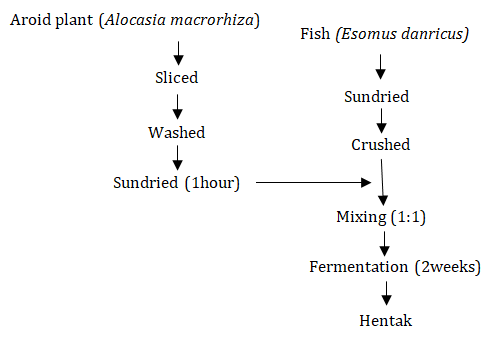
Flow sheet for hentak preparation
Napham
A fermented based fish product made by Bodo tribe of Assam is known as Napham, which is one of the important and favourite dishes of them. For its preparation, small fishes are first degutted, washed and sundried for about 2 hours until the excess water drains off. The semi sundried fish are completely dried using smoke under low frame by burning dry chaff of rice grain. These dried fishes are grounded along with tender shoots of Arum (Colocasia esculanta) by using mortar and pestle locally called as uwal and gaihen. According to the Bado folklore, adding chilly in the mixer of groundfish and stem is a help to remove the bad omen. After the mixer is ready, it is kept in a bamboo container which is covered with dry banana (Musa) leaves. This bamboo container is sealed tightly with clay paste and mixed with straw to ensure the anaerobic fermentation for about 2-3 months. The main purposes of taking this fermented food are to enhance the flavour, taste, nutrition, and preservation for a longer time especially at the time of scarcity and non- availability of fishes.
Flow sheet for napham preparation (Assam)
Nakham
A fermented based fish product prepared by the Garo community of Meghalaya known as Nakham. Garos population is also found in Kokrajhar district of Assam. The dry fishes are grounded first for its preparation and then mixed with a locally prepared alkali called khar instead of Colocasia stem. The mixer of groundfish and khar are kept in a bamboo jar for fermentation time about 1 week to 1month as stated by local Garo people (Narzary et al.).
Nichaow
Nichaow is a fermented fish product prepared by Rabha scheduled tribal community of Assam, in Goalpara District. They are also found in Kokrajhar district with a small mass of the population, who are preparing these as their food habits. Its preparation method is similar to that napham fish product.
Lonailish
Lonailish is a salted fermented fish product, which is originated in Bangladesh about 100 years ago, now it’s circulated to the north-eastern people of India like Assam and Tripura. It became very popular for its typical flavour as well as aroma and also its high-fat content (adult hilsa ranges from 14% to 25%). For the preparation of loanilish, the species of Tenualosa ilisha are washed with water and then its tail and head portion are removed and guts are keeping inside. The fishes are cut diagonally so that more flesh is exposed than that or the skin in steak or chunk, which thickness varies around 1.5 -2.0 cm. The steaks or chunk are rolled in salt in a ratio of 4:1 (fish to salt) and then kept in bamboo basket after layering. The salt is sprinkled between each layer above the top layer and then covered with black polyethene to avoid light inside the basket and stored in a dark place. The self-brine is allowed to drain and then the dry salted condition steaks are kept for about 48 hours and moisture content reduces through this process. The salt- cured hilsa steaks container is kept in a dark room for about 4-6 months undisturbed for fermentation which colour becomes dull white and disturbed or exposed to air or light fermentation becomes pink in colour which is not acceptable in the market. It is taken as popular culinary style is cooking of lonailish with spices wrapped by leaves of curd and also as curry, chutney, or fried items (Majumdar, 2016).
Fermented Bamboo Shoot Products
In India especially the people of North Eastern Region fermented the edible bamboo shoots for their consumption [47]. The fermented bamboo shoots products are rich in functional ingredients, bio active compounds and B- complex vitamins [33, 47]. Some of the fermented bamboo shoots products describe below.
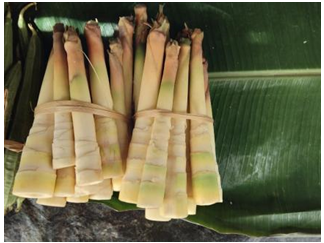
Mesu
Mesu is a traditional fermented bamboo shoot based product and it’s made by the Darjeeling hills and Sikkim tribe limbo women belonging to Nepali community people [22]. Mesu is made from locally available bamboo species choya bans (Dendrocalamus hamiltonii), bhalu bans (Dendrocalamussikkimensis), and karati bans (Bambusatulda) [17, 9, 22]. The microorganism associated has been identified as Lactobacillus plantarum, Lactobacillus brevis, Lactobacillus pentosaccus JP Tamang, et al. [48].
For the preparation of mesu edible bamboo shoot are defoliated, chopped finely and pressed tightly into a green hollow bamboo stem. The tip of the vessel is covered tightly with a bamboo leaves or other wild plants and left to ferment under natural anaerobic condition for 7-15 days at room temperature (20-22ºC). After that completion of fermentation is observed by the mesu taste and flavor. The picture of the product is shown in Figure 2.
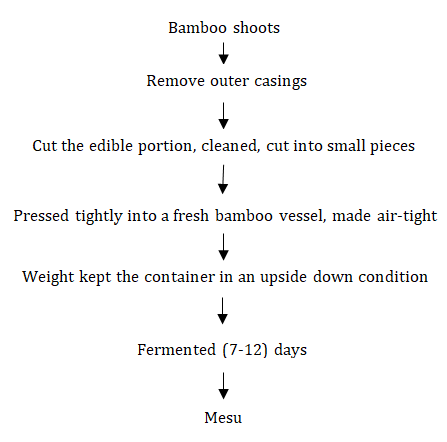
Flow sheet for mesu processing (Darjeeling)
Ekung
Ekung is the fermented product from bamboo shoots and most prepared and consumed by the people of Arunachal
Pradesh. The bamboo shoots chop are made and filled into the bamboo basket and covered with the leaves and sealed tightly. The sealed basket is dug into the 3-4 ft height pit and lined with the leaves. The heavy load is given into take out the excess water from the basket and the time period of 1-3 months is waited for the fermentation to take place. The chief microorganisms present in the ekung are Lb. plantarum, Lb. brevis, Lb. caseiand Tetragenococcus halophilus [9]. The picture of the product is shown in figure 3.
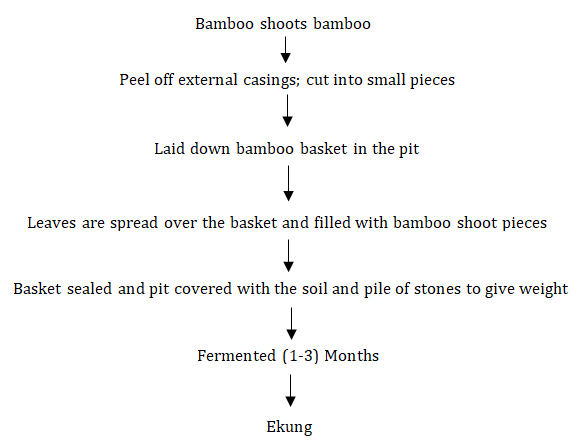
Flow sheet for processing of ekung (Arunachal Pradesh)
Eup
Eup is the tribal bamboo shoot based fermented product of Arunachal Pradesh [14]. The bamboo shoots are cut into pieces and fermented in similar process with ekung. After the fermentation interval of 1-3 months the eup is chopped into pieces and sun dried for another 5-10 days such that color get changed from whitish to chocolate brown. The major microorganisms associated from the eup are Lb. plantarum andLb. Fermentum [9]. The picture of the product is shown in figure 4.
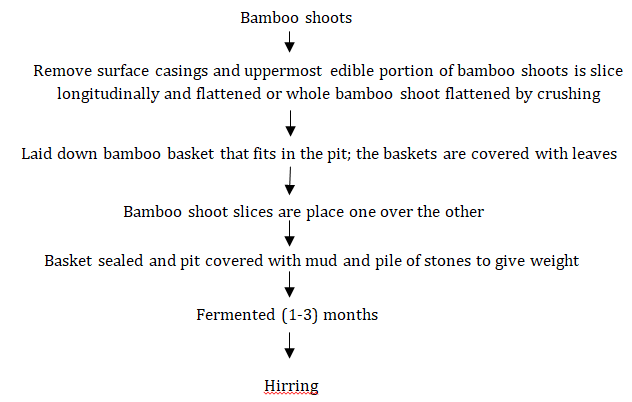
Flow sheet for processing of Eup (Arunachal Pradesh)
Hirring
Hirring is bamboo shoot based fermented product of Arunachal Pradesh. The leaf sheaths parts of the bamboo shoot is removed and cut longitudinally into 2-3 pieces, place into bamboo shoot basket which are lined with the leaves. These sealed baskets are placed into the pit, sealed, lined with the leaves and heavy load is given from the top to drain the water out and keep for 1-3 months for the fermentation to take place. After fermentation bamboo shoot baskets are removed from the pits and ready to eat. Hirring is safe up to 2-3 months at 22-25ºC. The major microorganisms isolated from the hirring are Lb.plantarum and Lc. Lactis [9].
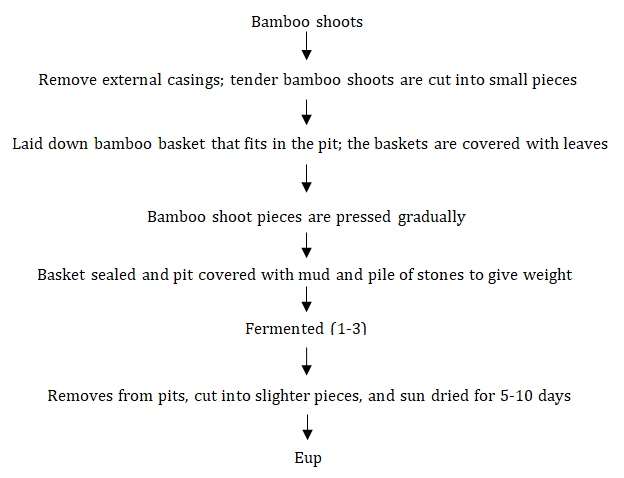
Flow sheet for processing of hirring (Arunachal Pradesh)
Soybean Based Fermented Products
Soybean is the important substrate for the preparation of traditional fermented and non-fermented products in North Eastern region of India and Nepal region [29]. Some of soybean fermented products are described below.
Kinema
Kinema is the soybean based ethnic fermented food and it is mainly processed and consumed in Sikkim, Darjeeling of NE region of India and Nepal. It is sticky, gray colour product and rich is flavonoids [29].
Flow sheet for kinema preparation
Eastern Himalayan people can earn from Kinema and it is consumed as curry as a supplement food with steamed rice. The common microorganisms found are Bacillus licheniformis, Bacillus subtilis, Bacillus circulans, Bacillus cereus, Bacillus sphaericus, and Bacillus thuringiensis [29].
Hawaijar
Hawaijar is the fermented soybean product and it is the local product of Manipur. It has the good flavour and sticky in nature (Premarani & Chhetry 2011). It’s production good income to the people of Manipur [2]. It is considered as protein source food at low-cost to common people [40]. Hawaijar is also considered as potential source of anti- osteoporosis, anti-cancer, and hypocholesterolemic agent [43]. A special Manipuri dish called chagempomba is also made from hawaijar along with rice and other vegetables.
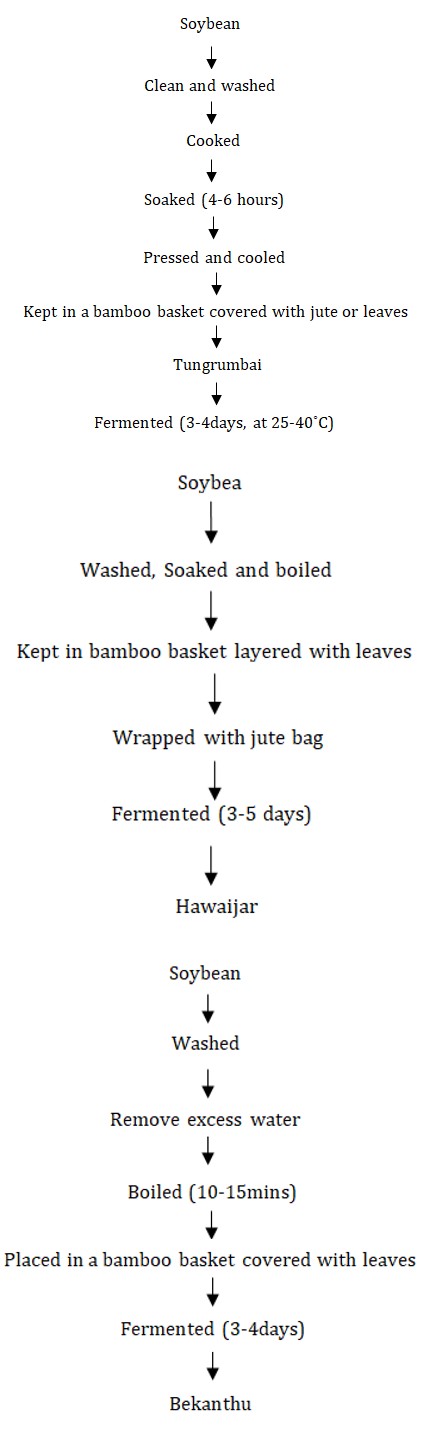
Flow sheet for Hawaijar preparation
Tungrymbai
Tungrymbai is a traditional fermented soybean-based sticky food. It serves as high protein food local diet [6] by the indigenous Khasi tribe in the state of Meghalaya. For preparing tungrymbai product, the soybean seeds are first cleaned, then washed and finally soaked for about 4 to 6 hours in double quantity of water to remove skin of seeds. These are then boiled in same water for about 1 hour till all the water is absorbed present in boiler. The hot and boiled beans are pressed in a bamboo basket whose inner surface is layered with lamet leaves (Clinogyne dichotoma) and allowed to cool. At last, they are placed in a warm place (25–40 ºC) for fermentation to take place for about usually 3 to 4 days. The obtained end product is brown coloured mass which has characteristic odour [6, 37, 27]. It is generally consumed as a side curry along with rice. To prepare this curry, fried ginger, chilli, garlic, salt and black sesame are mixed with water. It is then boiled and stirred continuously until the water fully evaporates [7].
Flow sheet for Tungrumbai processing
Bekanthu
Benkanthu is fermented based soybean product prepared by vaiphei tribes of Indo-Burma in the state of Manipur. The soybean seeds washed with water and boiled for 10-15mins and then keep in a basket or container, which is wrapped with a banana leaf after the draining of excess water. Ashes of firewood are wrapped by another leaf of banana, which is kept in the middle of the container or basket for faster fermentation for 3-4days at a fireplace or fireside. The final fermented product keeps for the whole season and uses as a pickle by mixing with ginger, garlic etc.
Flow sheet for Bekanthu preparation (Manipur)
Aakhone/ Bekang / Peruyyan
These are a similar type of fermented based soybean products taken by various tribes of NE of India. These are prepared from soyabean seeds by soaking them in water for overnight, washed and then boiled till hard seed become soft. The boiled soybeans are wrapped in leaves either banana (Musa sp.) or Phrynium pubinerve Blume or Macaranga indica Wight or Calliparpa aroria, after the draining of excess water in boiled seeds. The wrapped seeds kept in fire or warm place to provide optimum temperature for fermentation about a 6-7days. The final product is known as aaknone in Nagaland, bekang in Mizoram and peruyyan among the Apatanis of Arunachal Pradesh [1]. To increase the shelf life of fermented products its placed above the fireplace in the form of cakes or moulding into pastes. It is used as a chutney along with chilli, tomato and salt, can also be used along the meat to enhance the flavour and taste of the dish [3, 7].
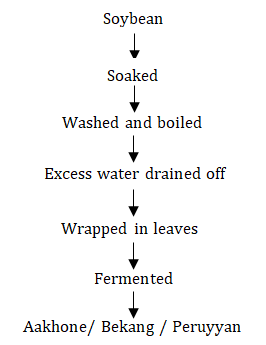
Flow sheet for Aakhone/ Bekang / Peruyyan preparation
Beverage Products
Sekhmai Yu
Sekhmai Yu is the cereal based fermented beverage product which is mainly famous in Manipur state of India. Yuare prepared by using locally available Manipuri rice variety called Kumbi Phou, Moirang Phou,and KD Phou). 5-6kg of Manipuri rice is collected and cooked in aluminium pots and cooled down to mix with Hamei(40-50g/kg of rice) for the fermentation to take place. Hamei is prepared by soaking 3-4kg of white rice in water for 1.5hrs and is dried to remove its moisture. The dried rice is grinded and the powder is made which is locally called as Yam. The Yam is mixed with the powder of the plant materials called Yanglee (Albizia Myriophylla Benth) plant. After the mixing process the paste like material is formed called Hamei. The Hamei and cooked rice mixture is shifted to the dry pot were the opening of the pot is wrapped with clean cloth and keep for 3-4 days in sunlight condition. While in winter season the mixture is feeded in the bamboo basket wrapping with the leaves of Tectona grandis L, Fiscus hispide L, Musa paradisica L for the fermentation to take place. The taste including alkaline, bitter and sweet taste is observed for this product at the final state of production.
Zawlaidi
Zawlaidi is the fermented grapes drinks and it is famous in Mizoram. It is mainly made from black grapes. The grapes are collected cleaned, washed and sundried to remove the free moisture from the grapes. The bark of Quercus serrate Murray is collected and dried are used as the fermenting agent during the Zawlaidi preparation [49]. 4-5 days is considered as the fermentation time for the Zawlaidi preparation and the fermentation is completed it is mix and filtered to obtain Zawlaidi. The alcohol percentages of 11-14% were noted on Zawlaidiwine.
Kodo Ko Jaanr
Kodo ko jaanr is the fermented beverages and it is the regional product of Sikkim. This product is specially made from dry finger millet (Eleusine Coracana (L) Gacrtn) seeds [50]. The common name of finger millet in Sikkim is called Kodo and sao its product name is named as Kodo ko jaanr. During its preparation the finger millet is cooked for 30minutes and the cooked millet is spread over the sheets to drain the excess water.The powder Morcha is added added over the drained millet for the fermentation to occur [22]. Morcha is prepared from the rice which is soaked for 6-8hrs at room temperature. The soaked rice is dried and powder is made by grinding in the pestle. The powdered rice is mixed with root of Plumbago zeylanica L (1.2g) , leaves of buddleja asiatica(1.2g),flower of Sengreknna(1.2g),ginger(5g) , red dry chilli(1.2g) and old marcha powder(10g) with adding small amount of water the paste is formed and flakes are made and wrapped with the ferns(Athyrium nagripis). The wrapped flakes are keep in the ceiling of the kitchen for 1-23days for the fermentation to occur and after 2days interval of time it is sundried for next 2-3days [51]. Best class of jaanr has slightly acidic, mild alcoholic flavor, and sweet taste [52].
Zutho
Zutho is the one of the most popular rice beer in Nagaand, India. It has the acidic taste and the Naga people prepared the rice beer by using different process [1]. Zutho is the product made from the sprouted rice. Saccharomyces cerevisiaeis use as the microorganism for the fermentation to occurs in Zutho making process [16, 17]. Piazu is used as the starter culture during zutho making process which is prepared by germinating the rice grains with the hulls and the powdered to keep for the longer period of time [1]. During the zutho preparation process, the rice is cooked and is cooed and mixed with piazu for the fermentation to take place which is normally kept for 3-4 days of time. After the fermentation is completed water is decanted to another vessel and filtered to obtained zutho. The zutho appeared as the white liquid with having around 5% of alcohol and it is served in bamboo made container [16].
Chuwak
Chuwak is a whiskey type and it is made from Tripura state by local tribes. It is used with plenty of raw materials like pineapple, rice and jackfruit. Rice beer is prepared at the house hold level for regular drinking in almost all the tribes involving a common process. Chuwan beled type of starter culture is used for the preparation of chuwak. It is made from rice and mixed with plant powder which is like a cake structure. During the preparation, local rice husk is soaked for 2h and then make into fine paste. In other way Citrus sinensis (L.) Osbeck, Markhami astipulata (Wall.) Seem., Allophylus serratus Kurz., Litsea monopetala (Roxb.) Pers., Aporusa diocia (Roxb.) Muell.,Combretum indicum (L.) DeFilipps., Artocarpus heterophyllus Lam., and Ananas comosus Mill. leaves are dried and made powdered and screening with mesh. After that plant leaves powder and rice powdered are mixed in a vessel, during mixing little amount of water is added to the mixing. For flavor some chilli powders are added to it. Using a handful of paste, chuwan beleb is made, after that it is dried under sun and kept fermentation process for the preparation of chuwak [53]. After getting the chuwan beleb, it is mixed with ratio of 50kg (cold cooked rice):1kg (chuwan beleb). The mixture is placed in a batikasla (vessel) and airtight with banana leaves to reduce the vapour leakage. Again, this vessel covered by cloth and kept for 3 days to fermentation process. The added water (known as gora bwtwk) is sucked out and to obtained the distilled chuwak [53, 54, 55].
Socio Economic Importance
The Preparation of fermented foods and beverages is an art of technology and is a family secret passed from mother to daughter. All tribal women prepare it and men help them in pounding the soaked rice. Survey result indicated that all the traditional foods and beverages are prepared at home. The ‘ZU’ and starter are sold in the market, local food stalls and restaurants. Some people are economically dependent upon on this product. They sell it in the market and are the only source of their earning.
Conclusion
The people of North-Eastern parts of India are familiar with the production and consumption of the fermented food products. The people use to make the fermented food products using the different substrate like fish, bamboo shoot, soybean and locally available vegetables etc. The people produced the fermented food without using any chemical preservatives, which is an important aspect of maintaining healthy life. The cost involvement in the process of making traditional food is low as compare to the modern process foods. The climatic condition in the North-Eastern region is also favourable for making the fermented foods.
The researcher are trying to develop the standard process to produce the ethnic foods by selecting productive strains of microorganism, process improvement, selectivity of raw materials and probiotic studies of microorganism. Presently people are producing and consuming by them-self but in future the production unit for commercial scale has to set-up with proper facilities of processing, packaging and marketing of fermented food products to increase the shelf-life and economy of the rural people. The ethnic foods may be rich with bioactive compounds which has the health promoting activities for that research has to carry out in future.
References
-
Das A, Deka S, Miyaji T (2012) Methodology of Rice Beer Preparation and Various Plant Materials Used in Starter Culture Preparation by Some Tribal Communities of North-East India: A Survey. International Food Research Journal 19(1): 101-107.
-
Das A, Deka S (2012) Fermented Foods and Beverages of the North-East India. International Food Research Journal 19(2): 377-392.
-
Mao AA, Odyuo N (2007) Traditional Fermented Foods of the Naga Tribes of Northeastern, India. Indian Journal of Traditional Knowledge 6(1).
-
Sarkar P, Tamang J, Cook PE, Owens J (1994) Kinema: A Traditional Soybean Fermented Food: Proximate Composition and Microflora. Food microbiology 11(1): 47-55.
-
Jeyaram K, Singh WM, Premarani T, Devi AR, Chanu KS, et al. (2008) Molecular Identification of Dominant Microflora Associated with ‘Hawaijar’-A Traditional Fermented Soybean (Glycine Max (L.)) Food of Manipur, India. Int J Food Microbiol 122(3): 259-268.
-
Sohliya I, Joshi S, Bhagobaty RK, Kumar R (2009) Tungrymbai-A traditional fermented soybean food of the ethnic tribes of Meghalaya. Indian Journal of Traditional Knowledge 8(4): 559-561.
-
Tamang JP, Chettri R, Sharma RM (2009) Indigenous Knowledge of Northeast Women on Production of Ethnic Fermented Soybean Foods. Indian Journal of Traditional Knowledge 8(1): 122-126.
-
Tamang B, Tamang JP, Schillinger U, Franz CM, Gores M, et al. (2008) Phenotypic And Genotypic Identification Of Lactic Acid Bacteria Isolated From Ethnic Fermented Bamboo Tender Shoots Of North East India. Int J Food microbial 121(1): 35-40.
-
Tamang B, Tamang JP (2009) Traditional Knowledge of Biopreservation of Perishable Vegetable and Bamboo Shoots in Northeast India as Food Resources. Indian Journal of Traditional Knowledge 8(1): 89-95.
-
Thapa N, Pal J, Tamang JP (2004) Microbial Diversity in Ngari, Hentak and Tungtap, Fermented Fish Products of North-East India. World Journal of Microbiology and Biotechnology 20(6): 599-607.
-
Tamang JP, Tamang B, Schillinger U, Franz CM, Gores M, et al. (2005) Identification of Predominant Lactic Acid Bacteria Isolated from Traditionally Fermented Vegetable Products of the Eastern Himalayas. Int J Food Microbiol 105(3): 347-356.
-
Thapa N, Pal J, Tamang JP (2006) Phenotypic Identification and Technological Properties of Lactic Acid Bacteria Isolated from Traditionally Processed Fish Products of the Eastern Himalayas. Int J Food Microbiol 107(1): 33-38.
-
Tamang JP, Dewan S, Tamang B, Rai A, Schillinger U, et al. (2007) Lactic Acid Bacteria in Hamei and Marcha of North East India. Indian J Microbiol 47(2): 119-125.
-
Tamang JP (2009) Himalayan Fermented Foods: Microbiology, Nutrition, and Ethnic Values: CRC Press.
-
Tanti B, Gurung L, Sarma HK, Buragohain AK (2010) Ethnobotany of Starter Cultures Used in Alcohol Fermentation By A Few Ethnic Tribes of Northeast India. Indian Journal of Traditional Knowledge 9(3): 463-466.
-
Teramoto Y, Yoshida S, Ueda S (2002) Characteristics of a Rice Beer (Zutho) and a Yeast Isolated from the Fermented Product in Nagaland, India. World Journal of Microbiology and Biotechnology 18(9): 813-816.
-
Sekar S, Mariappan S (2007) Usage of Traditional Fermented Products by Indian Rural Folks and IPR. Indian Journal of Traditional Knowledge 6(1): 111-120.
-
Tiwari KB, Shrestha ML, Agrawal VP (2007) Abundance of lactose assimilating yeasts from Nepalese Murcha (Yeast cake). International Journal of Life Sciences 1: 1-5.
-
Muzaddadi AU, Basu S (2003) Seedal-An Indigenous Fermented Fishery Product of North-East India. Fishing Chimes 23(7): 30-32.
-
Muzaddadi A, Basu S (2012) An Accelerated Process for Fermented Fish (Seedal) Production in Northeast Region Of India. Indian J Animal Sci 82(1): 98-106.
-
Muzaddadi AU (2015) Minimisation of Fermentation Period of Shidal from Barbs (Puntius Spp.). Society of Fisheries Technologists 52: 34-41.
-
Tamang JP, Sarkar PK (1996) Microbiology of Mesu, a Traditional Fermented Bamboo Shoot Product. Int J Food Microbiol 29(1): 49-58.
-
Thapa N, Pal J, Tamang JP (2007) Microbiological Profile of Dried Fish Products of Assam. Indian J Fisheries 54(1): 121-125.
-
Sarkar PK, Morrison E, Tinggi U, Somerset SM, Craven GS (1998) B‐Group Vitamin and Mineral Contents of Soybeans during Kinema Production. Journal of the Science of Food and Agriculture, 78(4): 498-502.
-
Tamang JP, Nikkuni S (1998) Effect of Temperatures during Pure Culture Fermentation of Kinema. World Journal of Microbiology and Biotechnology 14(6): 847- 850.
-
Omizu Y, Tsukaoto C, Chettri R, Tamang JP (2011) Determination of Saponin Contents in Raw Soybean and Fermented Soybean Foods of India. Journal of Scientific and Industrial Research 70(7): 533-538.
-
Agrahar Murugkar D, Subbulakshmi G (2006) Preparation Techniques and Nutritive Value of Fermented Foods from the Khasi Tribes of Meghalaya. Ecology of food and nutrition 45(1): 27-38.
-
Chettri R, Tamang JP (2015) Bacillus Species Isolated from Tungrymbai and Bekang, Naturally Fermented Soybean Foods of India. Int J Food Microbiol 197: 72-76.
-
Tamang JP (2015) Naturally Fermented Ethnic Soybean Foods Of India. Journal of Ethnic Foods 2(1): 8-17.
-
Singh TA, Devi KR, Ahmed G, Jeyaram K (2014) Microbial and Endogenous Origin of Fibrinolytic Activity in Traditional Fermented Foods of Northeast India. Food Research International 55: 356-362.
-
Tamang JP, Thapa S (2006) Fermentation Dynamics during Production of Bhaati Jaanr, A Traditional Fermented Rice Beverage of the Eastern Himalayas. Food Biotechnology 20(3): 251-261.
-
Chakrabarty J (2011) Microbiological and Nutritional Analysis of Some Fermented Foods Consumed by Different Tribes of North Cachar Hills District of Assam. Shodhganga: A reservoir of Indian Theses.
-
Jeyaram K, Romi W, Singh TA, Devi AR, Devi SS (2010) Bacterial Species Associated with Traditional Starter Cultures Used for Fermented Bamboo Shoot Production in Manipur State of India. Int J Food Microbiol 143(1-2): 1-8.
-
Sarangthem K, Singh TN (2003) Microbial Bioconversion of Metabolites from Fermented Succulent Bamboo Shoots into Phytosterols. Current Science 84(12) 1544- 1547.
-
Tamang B, Tamang JP (2010) _In Situ_ Fermentation Dynamics during Production of Gundruk and Khalpi, Ethnic Fermented Vegetable Products of the Himalayas. Indian J Microbiol 50(1): 93-98.
-
Tamang JP, Sarkar PK (1993) Sinki: A Traditional Lactic Acid Fermented Radish Tap Root Product. The Journal of General and Applied Microbiology 39(4): 395-408.
-
Jeyaram K (2009) Traditional Fermented Foods of Manipur. Indian Journal of Traditional Knowledge 8(1): 115-121.
-
Tamang B, Tamang JP (2007) Role of Lactic Acid Bacteria and their Functional Properties in Goyang, a Fermented Leafy Vegetable Product of the Sherpas. Journal of Hill Research 20(2): 53-61.
-
Crisan EV, Sands A (1975) Microflora of four fermented fish sauces. Appl Microbiol 29(1): 106-108.
-
Devi P, Suresh Kumar P (2012) Traditional, Ethnic and Fermented Foods of Different Tribes of Manipur. Indian Journal of Traditional Knowledge 11(1): 70-77.
-
Tamang JP (2001) Kinema. Food Culture 3: 11-14.
-
Sarojnalini C, Singh WV (1988) Composition and Digestibility of Fermented Fish Foods of Manipur. Journal of food science and technology 25(6): 349-351.
-
Keishing S, Banu AT (2013) Hawaijar–A Fermented Soya of Manipur, India. IOSR-JESTFT 4(2): 29-33.
-
Ahmed S, Dora KC, Sarkar S, Chowdhury S, Ganguly S (2013) Quality Analysis of Shidal-A Traditional Fermented Fish Product of Assam, North-East India. Indian Journal of Fisheries 60(1): 117-123.
-
Kakati BK, Goswami UC (2013) Microorganisms and the Nutritive Value of Traditional Fermented Fish Products of Northeast India. Global J Biosci Biotechnol 2(1): 124- 127.
-
Kakati BK, Goswami UC (2013) Characterization of the Traditional Fermented Fish Product Shidol of Northeast India Prepared from Puntius Sophore and Setipinna Phasa. Indian Journal of Traditional Knowledge 12(1): 85-90.
-
Thakur K, Rajani C, Tomar SK, Panmei A (2016) Fermented Bamboo Shoots: A Riche Niche for Beneficial Microbes. J Bacteriol Mycol Open Access 2(4): 87-93.
-
Tamang JP, Thapa S, Tamang N, Rai B (1996) Indigenous Fermented Food Beverages of Darjeeling Hills and Sikkim: A Process and Product Characterization. Journal of Hill Research 9(2): 401-411.
-
Meetei SB, Singh E, Das AK (2015) Fuel Wood Properties of Some Oak Tree Species of Manipur, India. J Environ Biol 36(4): 1007-1010.
-
Thapa S, Tamang JP (2004) Product Characterization of Kodo Ko Jaanr: Fermented Finger Millet Beverage of the Himalayas. Food microbiology 21(5): 617-622.
-
Thapa S, Tamang JP (2006) Microbiological and Physio- Chemical Changes during Fermentation of Kodo Ko Jaanr, A Traditional Alcoholic Beverage of the Darjeeling Hills and Sikkim. Indian Journal of Microbiology 46(4): 333-341.
-
Ray S, Bagyaraj DJ, Thilagar G, Tamang JP (2016) Preparation of Chyang, an Ethnic Fermented Beverage of the Himalayas, Using Different Raw Cereals. Journal of Ethnic Foods 3(4): 297-299.
-
Ghosh S, Rahaman L, Kaipeng DL, Deb D, Nath N, e al. (2016) Community-Wise Evaluation of Rice Beer Prepared by Some Ethnic Tribes of Tripura. Journal of Ethnic Foods 3(4): 251-256.
-
Tamang B, Tamang JP (2009) Lactic Acid Bacteria Isolated from Indigenous Fermented Bamboo Products of Arunachal Pradesh in India and their Functionality. Food Biotechnology 23(2): 133-147.
-
Tsuyoshi N, Fudou R, Yamanaka S, Kozaki M, Tamang, N, et al. (2005) Identification of Yeast Strains Isolated from Marcha in Sikkim, A Microbial Starter for Amylolytic Fermentation. Int J Food Microbiol 99(2): 135-146.
- Lessons to Learn: Trees are More than the Lungs of the World
- Community Forestry Enterprises as a Model for Sustainable Forest Development: The Case Of The "Baja Tarahumara" in Chihuahua, Mexico
- Ecological and Socio-Economic Impacts of Chromolaena odorata and Mesosphaerum suaveolens, Two Invasive Alien Species in Central and Southern Benin, West Africa
- Epigenetic Sustainability: Modeling the Human Factor as a Natural Resource through Science 4.0 and the NR3C1 Biological Pilot
- Growth-at-Risk: A Framework for Assessing Economic Vulnerability
- The Rural Territory as a Socioecological System for the Management of Public Policy for Sustainable Rural Development