
Effect of Mulching and Amount of Water on the Yield of Tomato under Furrow Irrigation
Maintaining optimal soil water content through the growing season of tomatoes (Lycopersicon esculentum Mill) is required for optimal plant yield and yield components especially in semi arid regions. However, there is limited information on optimum water management practices, or deficit irrigation that would increase tomato crop yield and yield components when irrigation is used. An experiment was conducted to evaluate the effect of mulch and amount of water on the yield of tomato under furrow irrigation system and to assess the potential of deficit irrigation to improve the economic efficiency of tomato production at Pawe Agricultural Research Center, during 2020/2021 cropping season. A factorial combination of four levels of water (namely 50% ETc, 75% ETc, 100% ETc and 125% ETc) combined with three mulch treatments (namely without mulch, dry elephant grass mulch and dry banana leaf mulch) were arranged in randomized complete block design replicated three times. Interaction effects of amount of water and mulching materials significantly affected fruit length, fruit diameter, marketable and total fruit yield. Number of fruits and average of fruit weight were significantly affected by amount of water. Significant difference was also shown among mulch treatments on number of fruits and average fruit weight. The highest net benefit (428, 195.60 birr ha-1) and marginal rate of return (1318%) were obtained from the combination of 75% ETc amount of irrigation and elephant grass mulch. Therefore, application of 75% ETc with grass mulch was found to be economically and agronomically feasible and is recommended for Pawe and its surrounding and other similar agro-ecologies under furrow irrigation system.
Contribution/Originality
This study is one of very few studies which have investigated to evaluate Effect of mulching and amount of water on the yield of tomato under furrow irrigation. As a new concept, the study is original.
Introduction
According to Postels [1], the world population is projected to grow from 6 billion in 1999 to 9 billion in 2044, an increase of 50% in 45 years. The increasing world population may create a demand for more food and agricultural products; if such estimate holds true agricultural producers will simply need to learn how to make more food with less water. Though water has been typically considered the most limiting factor, the beginning of increasing its scarcity in the 21st century is observing less increase in irrigated land availability for food production than in the past. Irrigation and mulching practices need to be tested under local environments, particularly in agricultural production systems in arid and semiarid regions of developing countries. As a result, eco-friendly, biologically feasible, and economically attainable agricultural practices must be undertaken to conserve soil moisture.
Ethiopia is confronting tremendous challenges in meeting the food needs of rapidly growing population. FAO [2] reported that small, medium and large scale irrigation systems are practiced in Ethiopia. Improved management and planning of the water resources are needed to ensure proper use and distribution of the water among competing users. To achieve maximum use of water, there is a need for planning as regards water usage which will include the employment of techniques and practices that deliver a more accurate supply of water to crops.
Deficit irrigation can help to reduce production costs, conserve water, and minimize leaching of nutrients and pesticides into ground water [3]. Furthermore, it is a way of optimizing water use efficiency (WUE) for higher yields per unit of irrigation water asked. Ayana [4] reported that reduction of return as a result of low irrigation, especially under the situation of scarcity of water, may be compensated by increased production from the additional irrigated area with the water saved from deficit irrigation.
Tomato (Solanum esculentum Mill.) is one of the most important vegetables all over the world, and the dominant vegetable crops in Ethiopia mostly grown under irrigation in combination with mulch for their edible fruits and nutritional values [5]. The average yield (10 t ha-1) of tomato in Ethiopia, including the study area, is very low as compared to the world average (19.28 t ha-1) [6]. Some of the reasons for the low productivity of tomato include inadequate irrigation and fertilizer application, use of low yielding varieties, incidence of blossom end rot (BER), pests, and disease incidence [7]. Among other factors, tomato is very sensitive to soil–water conditions, as water stress (drought and flooding) leads to a serious reduction in the yield and quality of fruits [8]. Therefore, irrigation management becomes pivotal for tomato production, as per the varietal potential. Baye [5] reported application of 440 mm ha-1 water in two days interval with straw mulch is found to be economically and agronomically feasible. Biswas [9] concluded drip irrigation with mulch has an explicit role in increasing the land and water produc¬tivity of tomato. Taromi [10] reported due to different mulching materials fruit yield increased by 12–46% over non mulch conditions. In India, Mukherjee [11] showed that mulches can be used to improve crop performance and can be a good option for using water resources effectively without significantly reducing the crop yield. In general, the farmers raise tomato crop by adopting surface method of irrigation without any scientific basis in which appreciable quantity of water is lost due to evaporation and percolation resulting in low application and distribution efficiencies. Mulching is the practice of covering the soil around plants to make conditions more favourable for growth, development and efficient crop production [12]. However, no information is available on the best integrated use of irrigation water and mulch in the study area. Consequently, it is of great interest to growers to adopt practices that optimize irrigation water and mulch that enhance fruit yield of tomato. This research was, therefore, designed to evaluate the effect of mulch and amount of water on the yield and yield components of tomato under furrow irrigation system and to assess the economic feasibility in relation to mulch used in tomato production.
Materials and Methods
Description of the Study Area
The experiment was conducted during the dry season From 2020 to 2021 at experimental field of Pawe Agricultural Research Station (11°18´40´´ to 11º19´29´´N 36º 24´ 26´´ to 36º 25´ 27´´E, 1120 m a.s.l.) to evaluate the effect of mulch and amount of water on the yield and yield components of tomato under furrow irrigation system and to assess the potential of deficit irrigation to improve the economic efficiency of tomato production. Pawe is located in the western part of Ethiopia and regarded as a warm temperate climatic zone where there is distinct dry months in winter. The soil of the experimental field was dark color (vertisol) with clay in its textural class. The area has an annual mean maximum temperature of 32.64 ºC and monthly values range between 27.72 ºC and 37.62ºC while, the mean annual minimum temperature is 16.49ºC and monthly values range between 12.03 and 19.54ºC during the experiment. The area receives a total annual rainfall of 405 mm (Figure 1).
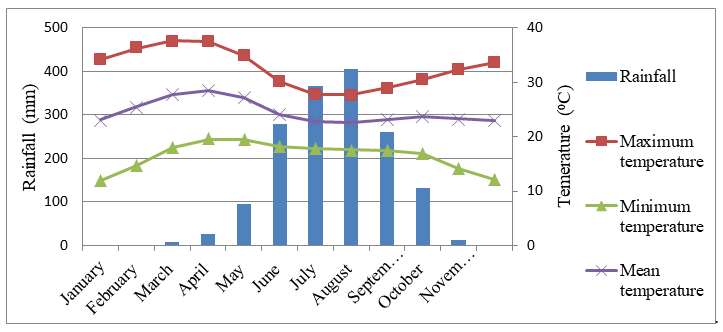
Experimental Design and Field Management
Four levels of irrigation viz. 125, 100, 75 and 50% of crop water requirement (ETc) with three mulches types viz. no mulch (NM); Dried banana leaf mulch (DBLM) and Dried elephant grass mulch (DEGM) were tested. The 4x3 factorial combinations with a total of twelve treatments were arranged in randomized complete block design (RCBD) with three replications. Recommended fertilizer doses (200 kg DAP ha-1 and 150 ka Urea ha-1) were used for all treatments. Total amount of DAP was applied at the time of final land preparation while urea was applied half at the time of transplanting and half at 45 days after transplanting [13]. The variety of Melka-Shola (processing type; released by Melkasa Agricultural Research Center) was used as the testing crop. Seedlings were raised before a month and undamaged, reasonably uniform and clean seedlings were selected and transplanted to properly prepared plots in unit plots of 2.8m×2.4m with 70cm×30cm spacing on December 20, 2020. Each plot consisted of four rows. The spacing between adjacent blocks and plots was 1.5 m and 1 m, respectively. For mulching, the dried and chopped banana leaf mulch (BLM) was applied at the rate of 2 kg m-2 while dried and chopped elephant grass mulch was applied at the rate of 2.5 kg m-2.
For irrigation application, polythene sheet was buried with a width of 60 cm to prevent water flow through seepage. Plot designing, furrow slope aligning and all specification was accomplished using water level. Parshall flume was installed at 7m away from the experimental plots to control the flow rate at different water head. Once it installed, water was released through it for calibration purpose by uniform velocity and constant head. Then, the water pass through the partial flume was directly given to plots and the time required was also recorded. The end of each furrow was blocked to prevent the out flow of tail water and also to maintain the required depth of water within the furrow.
Estimation of Crop Water Requirement
The actual crop evapotranspiration (ETa) was computed by multiplying the reference evapotranspiration (ETo) with crop coefficient (Kc) for different growth stages of the crop (Table 1). The crop water requirement (ETc) in the AquaCrop model was determined using the Penman–Monteith method following the procedures in Allen [14]. Irrigation was set until the soil reaches field capacity (back to field capacity). The Kc for different growth stages of tomato determined locally by lysimeter study were used in the calculation of actual crop evapotranspiration. Thus, volumetric water required for a tomato plant was computed as:
ETa (m3) = Kc × ETo (m) × projected area (0.3 × 0.7 m2).
| Duration (day) | ETo | ETa | Area occupied by a plant (m²) | ETa L/day | Time of operation | ||
|---|---|---|---|---|---|---|---|
| Duration (day) | Kc | mm/day | Area occupied by a plant (m²) | ETa L/day | Time of operation | ||
| Initial | 20 | 0.6 | 4.4 | 2.2 | 0.21 | 0.55 | 9.4 |
| Development | 30 | 0.9 | 5 | 4.4 | 0.21 | 0.92 | 17 |
| Mid season | 35 | 1.2 | 5.4 | 6.2 | 0.21 | 1.29 | 13.85 |
| Late season | 25 | 0.8 | 5 | 4 | 0.21 | 0.84 | 11.9 |
Table 1: Estimated water requirement for different growth stages of tomato ETo -evapotranspiration; ETa - actual crop evapotransp
IWA=AxETcxIixKr/Eax1000
where IWA is irrigation water applied (m3); A is area of plot (m2); Ii is irrigation intervals (day); Kr is coverage coefficient (Kr = (0.10 + Gc) ≤ 1) [15], Gc is ground cover; Ea is application efficiency (85%). Therefore, based on the model output, amount of irrigation water (mm) for 125%, 100%, 75%, and 50% ETc was 679.87, 543.9, 407.92, and 271.95 mm, respectively. Water use efficiency was determined as marketable fruit yield per unit of water applied [16].
Data Collection and Analysis
Soil Sampling and Analysis: A representative soil samples were collected from the experimental field before transplanting at three depths of 0–20, 20–40, and 40–60 cm using an Auger. A composite of disturbed soil sample was collected, dried, composited, and sieved using 2mm sieve to prepare a 1 kg composite sample for the determination of selected soil physical and chemical properties which include soil texture, organic matter, pH, EC, FC and PWP. Texture (particle size distribution) was determined using the Bouyoucos hydrometer method [17]; soil pH in a suspension of 1:2.5 soil-water ratio was determined by using a pH meter [18]; Organic carbon (%) was determined following the wet digestion method or titration method using chromic acid (potassium dichromate + H2SO4) digestion as described by Walkley and Black [19]. Organic matter content of the soil was estimated from the organic carbon content determined using the Walkley and Black [19] method. The FC and PWP were determined using pressure plate and membrane apparatus by applying a pressure of 1/3 (0.33) and 15 bars, respectively on saturated soil paste until no change in moisture is detected [20]. The ECe was determined by measuring the conductivity of saturated soil extract using electrical conductivity meter [21]. Soil analyses were conducted in the soil testing laboratory of Pawe Agricultural Research Center’s Soil Laboratory at the beginning of experiments. Tables 2 and 3 show some physical and chemical properties of the soil at the station.
| Soil depth (cm) | Particle size distribution | BD (g cm-3) | FC (%) | PWP (%) | AW (%) | |||
|---|---|---|---|---|---|---|---|---|
| Sand (%) | Silt (%) | Clay (%) | Texture Class | |||||
| 0-20 | 22 | 14 | 64 | Clay | 1.12 | 45.61 | 27.66 | 17.95 |
| 20-40 | 14 | 18 | 68 | Clay | 1.21 | 36.38 | 25.11 | 11.69 |
| 40-60 | 18 | 14 | 68 | Clay | 1.31 | 39.04 | 26.37 | 12.67 |
Table 2: Some physical properties of the experimental soil BD: bulk density, FC: field capacity, PWP: permanent wilting point, AW
| pH | EC (ds m-1) | OC (%) | OM (%) | |
|---|---|---|---|---|
| 0-20 | 6.4 | 1.51 | 2.64 | 6.93 |
| 20-40 | 6.6 | 1.49 | 2.61 | 6.53 |
| 40-60 | 6.5 | 1.48 | 2.59 | 6.74 |
Table 3: Some chemical properties of the experimental soil EC: electrical conductivity; OC: organic carbon; OM: organic matter co
Table 3: Some chemical properties of the experimental soil EC: electrical conductivity; OC: organic carbon; OM: organic matter content Agronomic Data Collection: Ripened tomato was harvested 9–10 times starting from the first week of February up to the second week of March. Fruit length, fruit diameter, number of fruits per plant, and marketable fruit yield were measured at each harvest time. Parameters like number of fruits per plant and marketable fruit yield (Ym) were summed up at the end of the experiment, while the values of fruit diameter and fruit length in each harvest were summed up and the average value was considered. The tomato plants in the middle rows were considered for data collection. To collect data on fruit diameter and fruit length, five randomly collected fruits were considered while the length and diameter of each fruit were measured using a digital caliper and the average value was computed for each plot. Economic Analysis: The cost of cultivation of tomato includes expenses incurred on land preparation, seeds, transplanting, mulching, weeding, irrigation water, and cost of harvesting. The economic analysis for every treatment was carried out using the partial budget analysis based on the CIMMYT [22] approach which utilizes partial budgeting combined with marginal analysis to determine the most economically acceptable treatment by estimating the varying costs and benefits based on the current market prices. Farm gate price of tomato yield harvested was calculated based on the existing market price. Statistical analyses: All data were subjected to analysis of variance (ANOVA) according to the procedure outlined by Gomez and Gomez [23] using SAS statistical software package 9.4 [24]. Treatment effects were analyzed by Fisher’s least significant difference (LSD). In all cases, differences were considered to be significant if P ≤ 0.05.
Results and Discussion
Tomato Yield and its Components
Tomato number of fruit per plant and average fruit weight was influenced significantly by different levels of irrigation and mulching treatments (Table 4). The number of fruits per plant varied significantly with different levels of irrigation and was maximum with 100% ETc and minimum with 50% ETc without mulch. Similarly, the heaviest fruit (45.95 g) was achieved with 100% ETc however; such result did not significantly differ from the treatment of 75% ETc. This may be due to the sufficient available water in the root zone for the 100% ETc treatment, thereby leading to an increase in both water and nutrient absorption. Table (4) indicates that both number of fruits per plant and average fruit weight were significantly affected by mulch treatments. The maximum number fruits (65.55) and heaviest fruit weight (47.16 g) were attained when EGM was applied; which, however, number of fruits per plant recorded from plants grown under EGM was not significantly different from BLM. On the contrary, the lowest number of fruits (63.88) and average fruit weight (35.38 g) were recorded from tomato plants grown with NM. This could be due to mulch improves the soil microenvironment, cools the soil, conserve soil moisture and return nutrients to the soil through decomposition. When optimum moisture is available for plant, fruits per cluster and total number of fruits per plant increase as flower dropping will be reduced. The result is in line with the findings of Abouziena and Radwan [25] who reported that mulching could mitigate the effects of water stress on plant growth and produce the maximum number of fruits and unit fruit weight. Candido [26] reported that pepper plants subjected to periods of water shortage exhibited a significant reduction in the number of fruit than plants in peppers with those regularly watered plants.
| Number of fruits per plant | Average fruit weight (g) | |
|---|---|---|
| $50 | 61.20^{c}$ | $39.70^{b}$ |
| $75 | 67.22^{b}$ | $45.55^{a}$ |
| $100 | 69.55^{a}$ | $45.95^{a}$ |
| $125 | 62.88^{c}$ | $34.58^{c}$ |
| $LSD (5%) | 2.27 | 4.41 |
| F-test | ** | *** |
| Mulch treatments | ||
| NM | 63.88^{b}$ | $35.38^{c}$ |
| $BLM | 65.21^{ab}$ | $41.80^{b}$ |
| $EGM | 65.55^{a}$ | $47.16^{a}$ |
| $LSD (P < 0.05) | 1.97 | 3.82 |
| F-test | $\cdot$ | *** |
| CV (%) | 3.57 | 10.89 |
Table 4: Main effect of amount of water and mulch on the mean fruit yield components of tomato in 2021/2022 Tomato plants are sen
Means followed by the same letters within columns are statistically not significant at 5% level of probability, NM: no mulch, BLM: banana leaf mulch, EGM: elephant grass mulch, * significant at P = 0.05, significant at P = 0.01, * significant at P = 0.001 Table 4: Main effect of amount of water and mulch on the mean fruit yield components of tomato in 2021/2022 Tomato plants are sensitive to water stress and they show high correlation between evapo-transpiration and crop yield. The statistical analysis in Table 5 indicates that fruit diameter, fruit length, marketable and total fruit yield were positively influenced by the interaction of irrigation and mulching treatments. The fruit diameter, fruit length, marketable and total fruit yield increased by 127% 194% 138%, and 48% due to EGM integrated with 100% ETc irrigation, respectively as compared to NM with 50% ETc irrigation. In general, all aforementioned parameters of tomato increased with the increase in water supply without mulch up to 100% ETc. however, irrigation of the same level without mulch produced the lowest yield. The increased yield under EGM with full water regime might have resulted from better water utilization, excellent soil-water-plant relationship and higher uptake of nutrient. The yield increased due to the applied mulching, which can be attributed to a lower rate of water loss from the soil by evaporation, leading to significant conservation of soil moisture [27].
| Water level treatments (% ETc) | Fruit diameter (cm) | Fruit length (cm) | Marketable yield (t ha-1) | Total fruit yield (t ha-1) | ||||||||
|---|---|---|---|---|---|---|---|---|---|---|---|---|
| Mulch treatments | Mulch treatments | Mulch treatments | Mulch treatments | |||||||||
| NM | BLM | EGM | NM | BLM | EGM | NM | BLM | EGM | NM | BLM | EGM | |
| 50 | 3.40h | 5.06ef | 5.33de | 2.99h | 4.76f | 6.60cd | 16.43f | 21.38e | 23.84cde | 27.61ef | 28.07ef | 29.61cdef |
| 75 | 4.50g | 5.46de | 7.13b | 5.44e | 7.01c | 8.06b | 22.26de | 24.25cd | 33.84b | 31.13cd | 30.27cde | 37.42b |
| 100 | 5.73d | 6.60c | 7.73a | 4.67f | 6.20d | 8.80a | 22.28de | 26.18c | 38.44a | 32.35c | 31.83cd | 40.91a |
| 125 | 3.60h | 4.73fg | 4.53g | 3.00h | 3.74g | 4.76f | 16.69f | 21.45e | 22.15de | 26.84f | 29.76cde | 29.38def |
| LSD (5%) | 0.5 | 0.55 | 2.61 | 2.83 | ||||||||
| F-test | ** | ** | *** | ** | ||||||||
| CV (%) | 5.83 | 6.21 | 6.08 | 5.24 |
Table 5: Effect of amount of water, mulch and interaction of mulch and amount of water on the mean fruit yield and yield componen
Table 5: Effect of amount of water, mulch and interaction of mulch and amount of water on the mean fruit yield and yield components of tomato in 202/2022. Means followed by the same letters within columns are statistically not significant at 5% level of probability, NM: no mulch, BLM: banana leaf mulch, EGM: elephant grass mulch, significant at P = 0.01, * significant at P = 0.001 Furthermore, the applied mulch increased transpiration, thereby leading to more photosynthetic efficiency that resulted in increased yield as reported by Liu [28]. The lowest values of marketable and total fruit yield of tomato at 125% ETc irrigation with all mulch treatments could be due to excess water in the soil decreased the oxygen diffusion rate in the root zone, which negatively affected crop yield. Similar finding was reported by Wan and Kang [29].
Different irrigation regimes combined with mulch has a significant influence on the water use efficiency of tomato. Agronomically, water use efficiency (WUE) is, simply the efficiency in which water is used to produce an economic yield. Table 6 shows that WUE varies both with irrigation regimes and mulches. Under all levels of irrigation, mulches with irrigation gave higher WUE over irrigation alone. As indicated in Table 6, a larger effect of mulches on WUE was observed when it was combined with lower irrigation regime. The application of 100% ETc (544 mm) combined with elephant grass mulch gave the maximum marketable (38.44 t ha-1) fruit yield. However, the highest water use efficiency value (8.76 kg m-3) was recorded at the lowest water level (272 mm) with elephant grass mulch, while the lowest WUE (2.45 kg m-3) was obtained at 680 mm without mulch treatment, which indicated that the dry elephant grass mulch clearly improve the water use efficiency of tomato (Table 6). To maximize WUE it is necessary to conserve water and to promote maximal crop growth. Maximizing WUE requires minimizing losses through runoff, seepage, evaporation, and transpiration by weeds.
| Water levels (mm) | Marketable yield (t ha-1) | Volume of water/ha (m3 / LGP) | Water use efficiency (kg m-3) | ||||
|---|---|---|---|---|---|---|---|
| Mulch type | Mulch type | ||||||
| NM | BLM | EGM | NM | BLM | EGM | ||
| 50% ETc (272 mm) | 16.43f | 21.38e | 23.84cde | 2720 | 6.04 | 7.86 | 8.76 |
| 75% ETc (408mm) | 22.26de | 24.25cd | 33.84b | 4080 | 5.45 | 5.94 | 8.29 |
| 100% ETc (544mm) | 22.28de | 26.18c | 38.44a | 5440 | 4.09 | 4.81 | 7.06 |
| 125% ETc (680 mm) | 16.69f | 21.45e | 22.15de | 6800 | 2.45 | 3.15 | 3.25 |
Table 6: Water use efficiency of tomato under different management practices. Means followed by the same letters within columns a
The result is in accordance with Ayars [30] who reported that the lower the amount of water use, the higher was the WUE, so, low irrigation regime reduced deep percolation and increased water use from root zone soil. Similarly, Seyfi [31]
who showed that drip irrigation with black plastic mulch markedly decreased the amount of water applied, increased water use efficiency (WUE) and increased crop yield of cantaloupe.
Economic Analysis
The highest net return (ETB 480,777) was recorded in elephant grass mulch with 100% irrigation regime. In case of NM and BLM with the same irrigation regime, the returns were ETB 262, 677 and 315,327, respectively (Table 7). In order to recommend this result for farmers, it is necessary to estimate the minimum rate of return acceptable to farmers in the recommendation domain. According to CIMMYT [22], the minimum acceptable marginal rate of return (MRR) must be between 50 and 100%. There is no estimated cost for irrigation water in Ethiopia so far. Hence, considering the cost of irrigation water as zero with 10% prices increment of other variable costs, the highest net benefit was obtained via 544 mm with elephant grass mulch amid a net benefit (480,777 birr/ha) and a marginal rate of return (MRR) 552.40%. The marketable yield advantage of 544 mm/with EGM over 272 mm/without mulch was 134% (Table 8 and 9).
| Water m³/mulch levels | Unadjusted marketable Yield (t ha⁻¹) | Adjusted marketable yield (ton ha⁻¹) | Gross field benefit (ETB ha⁻¹) | Variable cost (ETB ha⁻¹) | Net benefit (ETB ha⁻¹) |
|---|---|---|---|---|---|
| 2720/NM | 16.43 | 14.78 | 221,700 | 19,036.50 | 202,663.50 |
| 2720/BLM | 21.38 | 19.24 | 228,600 | 19,036.50 | 209,563.50 |
| 2720/EGM | 23.84 | 21.45 | 321,750 | 19,036.50 | 302,713.50 |
| 4080/NM | 22.26 | 20.03 | 300,450 | 28,554.40 | 271,895.60 |
| 4080/BLM | 24.25 | 21.82 | 327,300 | 28,554.40 | 298,745.60 |
| 4080/EGM | 33.84 | 30.45 | 456,750 | 28,554.40 | 428,195.60 |
| 5440/NM | 22.28 | 20.05 | 300,750 | 38,073 | 262,677.00 |
| 5440/BLM | 26.18 | 23.56 | 353,400 | 38,073 | 315,327.00 |
| 5440/EGM | 38.44 | 34.59 | 518,850 | 38,073 | 480,777.00 |
| 6800/NM | 16.69 | 15.02 | 225,315 | 47,590.90 | 177,724.10 |
| 6800/BLM | 21.45 | 19.3 | 289,500 | 47,590.90 | 241,909.10 |
| 6800/EGM | 22.15 | 19.93 | 289,950 | 47,590.90 | 242,359.10 |
Table 7: Economic analysis of tomato production (ETB/ha). NM: no mulch, BLM: banana leaf mulch, EGM: elephant grass mulch, ETB: E
| Variable cost (ETB ha-1) | Net benefit (ETB ha-1) | Dominance analysis | |
|---|---|---|---|
| 2720/NM | 19,036.50 | 202,663.50 | D |
| 2720/BLM | 19,036.50 | 209,563.50 | D |
| 2720/EGM | 19,036.50 | 302,713.50 | |
| 4080/NM | 28,554.40 | 271,895.60 | D |
| 4080/BLM | 28,554.40 | 298,745.60 | D |
| 4080/EGM | 28,554.40 | 428,195.60 | |
| 5440/NM | 38,073 | 262,677.00 | D |
| 5440/BLM | 38,073 | 315,327.00 | D |
| 5440/EGM | 38,073 | 480,777.00 | |
| 6800/NM | 47,590.90 | 177,724.10 | D |
| 6800/BLM | 47,590.90 | 241,909.10 | D |
| 6800/EGM | 47,590.90 | 242,359.10 | D |
Table 8: Dominance analysis for tomato fruit yield. D: dominated treatment
| Water m3/mulch levels | Variable cost (ETB ha-1) | Net benefit (ETB ha-1) | ∆NB | ∆VC | MRR (%) |
|---|---|---|---|---|---|
| 2720/EGM | 19,036.50 | 302,713.50 | - | - | - |
| 4080/EGM | 28,554.40 | 428,195.60 | 125,482.10 | 9,517.90 | 1318.38 |
| 5440/EGM | 38,073 | 480,777.00 | 52,581.40 | 9,518.60 | 552.4 |
Table 9: Marginal rate of return analysis for tomato fruit yield. ∆NB: change in net benefit, ∆VC: change in variable cost, MRR:
Conclusion
Results revealed that application of different amount of water was performed better with both types of mulches. The interaction effect of the two factors had shown significant difference on all yield parameters except number of fruits per plant and average fruit weight of tomato. The highest marketable and total fruit yields (38.44 and 40.91 t ha- 1) were obtained via the interaction effect of 100% ETc (544mm) with elephant grass mulch. The marketable and total fruit yields (33.84 and 37.42) obtained from the amount of water at 75% ETc (408mm) with elephant grass mulch were also high. Based on the partial budget analysis, the highest net benefit was obtained via 75% ETc (408mm) with elephant grass mulch amid a net benefit of 428, 195.60 birr ha-1and a marginal rate of return (MRR) of 1318%. In conclusion, the present study points out that 75% ETc (408mm ha-1) of water with elephant grass mulch is economically more profitable than the other treatments around Pawe and similar areas. Therefore, it is the subject of future investigations, to consider water levels below 408 mm and between 408 and 544 mm combined with elephant grass mulch under furrow irrigation, especially in drought prone areas where water is very scarce to produce tomato crops.
Competing Interests
The authors declare that they have no competing interest.
Acknowledgement
The first author wishes to acknowledge the Pawe Agricultural Research Center (PARC), Ethiopia for providing seed, laboratory materials, farm lands, and irrigation water used for the study.
References
-
Postel S (1999) Pillar of Sand: Can the Irrigation Miracle Last? WW Norton and Company, Inc., New York, pp: 313.
-
FAO (Food and Agricultural Organization) (1995) Production Year book, Italy.
-
Kirda C, Cetin M, Dasgan Y (2004) Yield Response of Greenhouse Grown Tomato to Partial Root Drying and Conventional Deficit Irrigation. Agric Water Manag 69: 191-201.
-
M Ayana (2011) Deficit Irrigation Practices as Alternative Means of Improving Water Use Efficiencies in Irrigated Agriculture: Case Study of Maize Crop at Arba Minch, Ethiopia. Afr J Agric Res 6: 226-235.
-
Baye Berihun (2011) Effect of Mulching and Amount of Water on the Yield of Tomato Under Drip Irrigation. J Hortic For 3: 200-206.
-
FAOSTAT (Food and Agricultural Organization) (2017) Statistical Year Book.
-
Yohannes F, Tadesse T (1998) Effect of Drip and Furrow Irrigation and Plant Spacing on Yield of Tomato at Dire Dawa, Ethiopia. Agric Water Manag 35: 201-207.
-
Ezekiel O, Jane OI, Sanusi HO (2013) Vegetative Growth and Yield of Tomato as Affected by Water Regime and Mulching. PAT 9(2): 43-53.
-
Biswas SK, Akanda AK, Rahman MS, Hossain MA (2015) Effect of Drip Irrigation and Mulching on Yield, Water- Use Efficiency and Economics of Tomato. Plant Soil Environ 61(3): 97-102.
-
Taromi AB, Hassandokht MR, Etesami H, Alikhani HA, Dehghanisanij H (2019) Effect of Mulching on Some Characteristics of Tomato (Lycopersicon esculentum Mill.) under Deficit Irrigation. J Agr Sci Tech 21(4): 927- 941.
-
Mukherjee MK, Sarkar S (2010) Role of Irrigation and Mulch on Yield, Evapotranspiration Rate and Water Use Pattern of Tomato (Lycopersicon esculentum L.). Agri Water Manag 98(1): 182-189.
-
Nagalakshmi S, Palanisamy D, Eswaranand S, Sreenarayanan V (2002) Influence of Plastic Mulching on Chilli Yield and Economics. South Indian Horticulture 50: 262-265.
-
EARO (Ethiopian Agricultural Research Organization) (2004) Directory of Released Crop Varieties and their Management. Addis Ababa 4(3).
-
Allen RG, Pereira LS, Raes D, Smith M (1998) Crop Evapo- Transpiration-Guidelines for Computing Crop Water Requirements. Irrigation and Drainage Paper, FAO, Rome, Italy.
-
Valipour M (2015) Future of Agricultural Water Management in Africa. Arch Agron Soil Sci 61(7): 907- 927.
-
Howell TA (2001) Enhancing Water Use Efficiency in Irrigated Agriculture. Agronomy journal 93: 281-289.
-
Lal R, Shukla MK (2004) Principles of Soil Physics. Marcel Dekker: New York, USA.
-
Carter MK (1993) Soil Sampling and Methods of Analysis, Canadian Society of Soil Science. Lewis publishers, London, UK.
-
Walkley, Black IA (1934) An Examination of the Degtjareff Method for Determining Soil Organic Matter, and a Proposed Modification of the Chromic Acid Titration Method. Soil Science 37: 29-38.
-
Southorn N (1997) Farming irrigation: Planning and Management. Reed International Books Australia. Inkata Press, pp: 165.
-
Ali MH (2010) Fundamentals of Irrigation and On-farm Water Management. Springer New York Heidelberg Dordrecht London 1: 583.
-
Centro Internacional de Mejoramiento de Maíz y Trigo (CIMMYT) (1988) From Agronomic Data to Farmer Recommendations: An Economics Training Manual, Mexico.
-
Gomez KA, Gomez AA (1984) Statistical Analysis Procedures for Agricultural Research. John Wiley and Sons: New York, USA, pp: 25-30.
-
SAS (2017) SAS for Windows. V.9.4 SAS Institute. Cary, USA.
-
Abouziena HF, Radwan SM (2015) Allelopathic Effects of Sawdust, Rice Straw, Burclover Weed and Cogongrass on Weed Control and Development of Onion. Int J ChemTech Res 7(1): 337-345.
-
Candido V, Miccolis V, Rivelli AR (2009) Yield Traits and Water and Nitrogen Use Efficiencies of Bell Pepper Grown in Plastic-Greenhouse. Italian Journal of Agronomy 4(3): 91-100.
-
Abd El-Wahed MH, Mosa Al-Omran A, Mohamed Hegazi V, Mohamed Ali Y, Abdelaty Y, et al. (2020) Salt Distribution and Potato Response to Irrigation Regimes under Varying Mulching Materials. Plants 9(6): 701.
-
Liu XE, Li XG, Hai L, Wang YP, Li FM (2014) How Efficient is Film Fully-Mulched Ridge-Furrow Cropping to Conserve Rainfall in Soil at a Rainfed Site? Field Crops Res 169: 107-115.
-
Wan S, Kang Y (2006) Effect of Drip Irrigation Frecuency on Radish (Raphanus Sativus L.) Growth and Water Use. Irrig Sci 24: 161-174.
-
Ayars JE, Phene CJ, Hutmacher RB, Davis KR, Schoneman RA, et al. (1999) Subsurface Drip Irrigation of Row Crops: A Review of 15 Years of Research at the Water Management Research Laboratory. Agricultural Water Management 42(1): 1-27.
-
Seyfi K, Rashidi M (2007) Effect of Drip Irrigation and Plastic Mulch on Crop Yield and Yield Components of Cantaloupe. Int J Agric Biol 9: 134-141.
- Lessons to Learn: Trees are More than the Lungs of the World
- Community Forestry Enterprises as a Model for Sustainable Forest Development: The Case Of The "Baja Tarahumara" in Chihuahua, Mexico
- Ecological and Socio-Economic Impacts of Chromolaena odorata and Mesosphaerum suaveolens, Two Invasive Alien Species in Central and Southern Benin, West Africa
- Epigenetic Sustainability: Modeling the Human Factor as a Natural Resource through Science 4.0 and the NR3C1 Biological Pilot
- Growth-at-Risk: A Framework for Assessing Economic Vulnerability
- The Rural Territory as a Socioecological System for the Management of Public Policy for Sustainable Rural Development