
Safe Farming: Ultra-Fine Sparkling Water can Reduce Insect Pests and Increase Melon Yield and Quality
Melon pest control relies on over-application of pesticides. Reducing pesticide spraying has become a global issue for environmental sustainability and human health. Therefore, it is important to develop a new growing system that is sustainable and environmentally friendly. This study found that melon seedlings irrigated with ultrafine water containing H2 and O2 (UFW) produced more root hairs, increased branch height, and produced more flowers than the control irrigated with reverse osmosis (RO) water. Surprisingly, we also found that UFW irrigation significantly reduced aphid infestations in melons. Based on cryoscanning electron microscopy (cryo-SEM) observations, UFW treatment enhanced trichome development and prevented aphid infestation. To investigate whether it was H2 or O2 to prevent insect damage, we prepared UF enriched water with H2 (UF+H2) and O2 (UF+O2) alone and irrigated the melons. Cryo-SEM results show that UF+H2 and UF+O2 can increase the density of trichomes in melon leaves and petioles. RT-qPCR showed that UF+H2 significantly increased the gene expression level of the trichome-related gene GLABRA2 (GL2). We grow muskmelons in plastic greenhouses and use ultrafine water-rich hydrogen (UF+H2) and oxygen (UF+O2). The SPAD value, photosynthetic parameters, root weight, fruit weight, and fruit sweetness are all better than those without ultrafine water irrigation of comparison. UFW significantly promoted the development of trichomes, enhanced insect resistance, and improved fruit traits. The system therefore provides useful water management for pest control and sustainable agricultural production.
Jo Chi Hung1,2, Ning-Juan Li3, Ching Yen Peng3, Ching Chieh Yang3* and Swee Suak Ko1,2
Keywords: Jasmonate; Melon; Nano-Bubble Water; Insect Damage; Trichomes; Yield
Introduction
Ultra-fine bubble water (UFW), also known as nanobubbles or microbubble water, contains small molecules less than 100 nanometers in diameter that can carry gas on its surface [1]. UFW water can quickly penetrate into the soil and can be absorbed by the roots more efficiently, thus promoting plant growth and development. It has been widely used in crop production [2, 3]. It has been reported that plants irrigated with UFW increased seed germination [4, 5, 6], showed significantly enhanced rooting and adventitious root development [7], and enhanced root nutrient uptake and nutrient utilization efficiency [8]. Many reports show that UFW irrigation improves crop yield and quality, such as rice [9], lettuce [10], tomatoes [11, 12], cucumbers [13], melons [14] and strawberries [15].
Ultrafine water rich in hydrogen can extend the life of the vase and the quality of cut flowers [16, 17]. Additionally, it extended the shelf life of kiwi [18] and strawberry [19]. It also plays a crucial role in plant tolerance to abiotic stress. Hydrogen pretreatment can improve the salt stress resistance of rice and Arabidopsis [20]. It is reported that molecular hydrogen (H2) has antioxidant activity, can remove reactive oxygen species (ROS) and reactive nitrogen species (RNS), and reduce free radical toxicity [21, 22].
Melon or melon (Cucumis melo L.) is a globally popular fruit with important economic value in global markets. Melon crops are susceptible to infestation by a variety of insects, such as aphids, thrips, whiteflies, cucumber beetles, and spider mites [23]. Aphids are tiny insects that suck sap from plants and can cause stunted growth, leaf curling, spread viruses and reduce crop yields. Pathogens such as aphid-borne melon mosaic virus (CMV) and watermelon mosaic virus-2 (WMV-2) [24] cause serious damage to melon plants, resulting in reduced yield and fruit quality. Therefore, farmers often spray pesticides, which lead to food safety issues. Therefore, it is important to develop a new cropping system for Sustainability Assessment of Agriculture and the Environment (SAFE) [25] in melon production.
Trichomes are hair-like growths on the surfaces of plant organs such as leaves, stems, and flowers. Trichomes act as a physical barrier against herbivorous insects by blocking their ability to feed on plants and reducing the insect’s movement. Plants with higher trichome density are known to be more resistant to insects [26], and there is a strong positive correlation between trichome density and insect resistance [27]. In addition, glandular trichomes can produce volatile compounds that are toxic or repellent to insects [28]. Jasmonic acid (Ja) is a herbivory-induced hormone involved in terpene biosynthesis [29]. Methyl jasmonate (Me-JA) treatment significantly enhanced the expression of several monoterpene and sesquiterpene synthases. Studies have shown that knocking out the HD-ZIP IV transcription factor (TF) wool (wo) resulted in significant defects in trichomes and reduced terpene levels, and was associated with insect resistance in tomatoes [30]. Me-JA induces the formation of type VI glandular trichomes in newly expanded tomato leaves, thereby reducing herbivorous insect populations [31]. The gene regulatory network controlling trichome development is complex [32]. It is regulated by GLABRA1 (GL1), GLABRA2 (GL2), GLABRA3 (GL3) and TRANSPARENT TESTA GLABRA1 (TTG). Loss of function of these TFs manifests as a hairless phenotype [33, 34, 35, 36, 37, 38, 39]. GLABRA3 (GL3) is a wound-induced trichome formation that acts downstream of the JA signaling pathway [35]. TRIPTYCHON (TRY) is a negative regulatory factor for hair and root hair development [40]. It has been reported that jasmonate-mediated glandular trichome development is required in Jaz Nicotiana benthamiana [41]
and Oryza sativa [42].
In the past decade, the application of hydrogen in agriculture has attracted widespread attention and has various prospects [43]. However, to our knowledge, there are no reports of UFW-induced increase in JA and trichome development. The purposes of this study are as follows: (i) to observe whether UFW can improve melon seedling growth and fruit yield; (ii) to understand whether UFW can enhance insect resistance; (iii) to understand whether UFW affects the JA pathway and induces melon Trichosome development.
Results
UFW Treatment Improves the Growth of Melon Seedlings
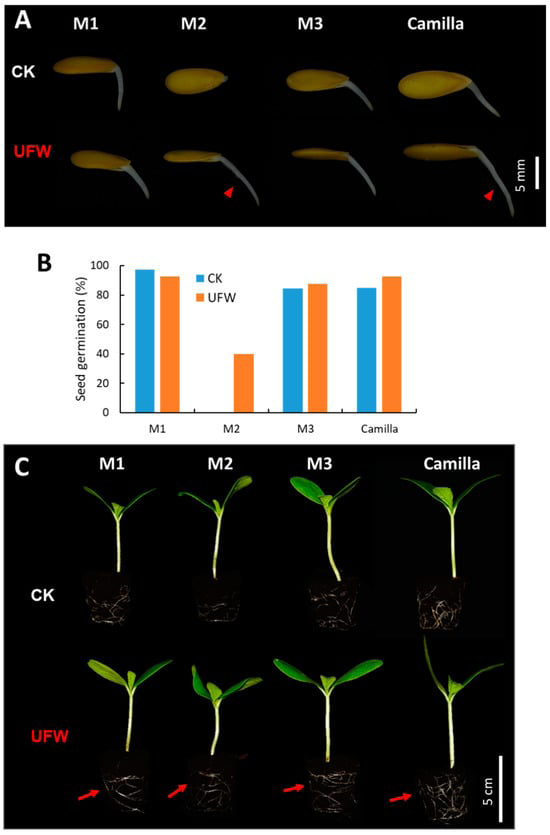
Figure 1: Ultrafine water affects melon seed germination and rooting. (A) Effect of ultrafine water (UFW) on melon seed germination. Four melon varieties, each with 40 seeds, were germinated in Petri dishes containing RO water and UFW. Arrows show the presence of root hairs on roots 1 day after seed germination. (B) Germination rate of melon seeds 7 days after germination. (C) Melon seedlings grown in plug trays containing peat moss 7 days after sowing (DAS). Arrows show vigorous root development.
To understand the effects of ultrafine water (UFW) on seed germination and seedling growth, we tested four melon seed lines: M1, M2, M3 and Camilla. Forty seeds per line were immersed in UFW and RO water overnight and then placed in square Petri dishes containing UFW and reverse osmosis (RO) water as control (CK), respectively. The Petri dish was then placed in a dark growth chamber and set to a constant temperature of 28°C. After 1 day of germination, melon seeds in UFW produced longer and more root hairs than CK (Figure 1A). The germination rates of UFW-treated M2, M3 and Camilla seeds were higher than those of CK seeds (Figure 1B). We transplanted germinated melon seeds into #104 plug trays filled with peat moss and grew seedlings in the greenhouse. Treatment with UFW produced more vigorous roots and seedlings than CK at 7 days after transplantation (Figure 1C).
UFW Reduces Aphid Infestation of Seedlings
To understand the effect of UFW on the growth of melon seedlings, we transplanted melon seedlings from plugs to pots and placed them in the same growth chamber to grow, but irrigated with RO water and UFW. 14 days after transplanting, UFW irrigated melon lines M2 and M3 had higher plant height and more flowers than CK (Figure 2).
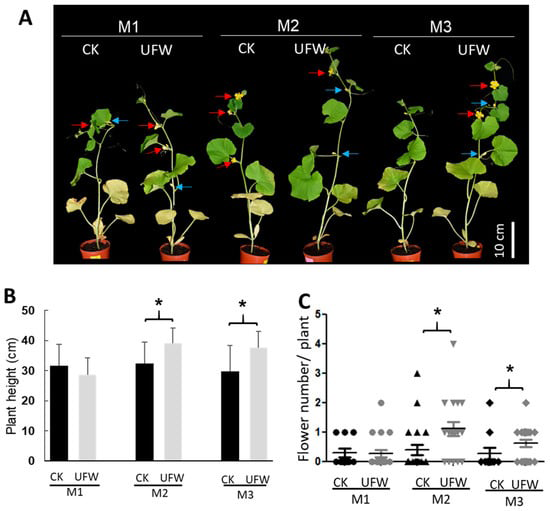
Figure 2: UFW irrigation affects the growth of melon seedlings. (A) Phenotype (DAT) of melon potted plants 14 days after transplantation. Red arrows indicate flowers, blue arrows indicate wilted flowers. Rod, 10 cm. (B) Plant height of melon. Error bars represent standard error of the mean (n = 10–21 per treatment). (C) Scatter plot of the number of flowers per plant at 14 DAT. Horizontal lines represent mean values (n = 10–21). *, Significant differences between CK and UFW treatments were determined using Student’s t test at p < 0.05 (B,C).
We found aphids attacking melon seedlings in the growth chamber at 14 days after transplantation (DAT).
Surprisingly, aphid densities in the leaves and flower buds of melons irrigated with UFW were found to be lower than those in the controls (Figure 3A-C). We performed cryo- SEM and observed that the trichomes of CK were fewer and drooping, and the mouthparts of aphids could easily reach the leaf surface (Figure 3D). However, UFW-irrigated melon plants had erect and dense trichomes that interfered with aphid movement and feeding (Figure 3E).
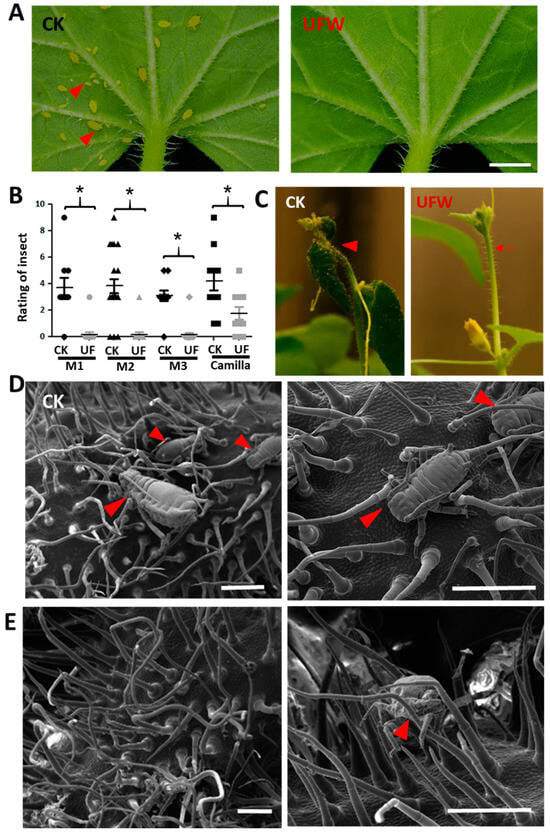
Figure 3: UFW irrigation affects aphid infestation of melon seedlings. (A) Phenotype of melon leaves infected by aphids 14 days after transplantation. Scale bar, 2 mm. (B) Scatter plot of aphid infestation levels. A rating of 0 indicates no aphids were observed and a rating of 9 indicates high aphid density. Horizontal lines represent mean values (n = 10–21). *, Significant differences between CK and UFW treatments were determined using Student’s t test at p < 0.05. (C) Aphids attack tender flower buds of a melon (arrow). Trichosome development after UFW treatment (arrow). (D) Cryo-SEM shows aphid infestation in CK (D) and UFW (E) flower buds. The arrow points to an aphid. Scale bar, 500 μm (D, E).
Effect of Hydrogen-Rich (UF+H2) or Oxygen-Rich (UF+O2) Ultrafine Water on the Development of Trichomes
Our previous experiments showed that UFW containing both H2 and O2 significantly increased trichome density and prevented aphid infestation (Figure 3). Therefore, we were interested to know whether this phenomenon was due to the influence of H2 or O2 molecules. Therefore, we prepared ultrafiltration-enriched water of pure hydrogen (UF+H2), pure oxygen (UF+O2) and RO water (CK) and irrigated melon variety “Camilla”. Melon plant 2 irrigated with UF+H produced taller and denser trichomes on petioles, veins, leaves and leaf tips compared with CK. At the same time, the trichomes of UF+O2-irrigated plants were longer than those of CK (Figure S1). Under a dissecting microscope, we could observe that melon 2 irrigated with UF+H2 produced longer and denser trichomes 2 or CK on the midrib than those irrigated with UF+O2. We took photos and measured trichome density in petioles and found that UF+H2 and UF+O2 irrigation significantly increased trichome density (Figure 4A&D).
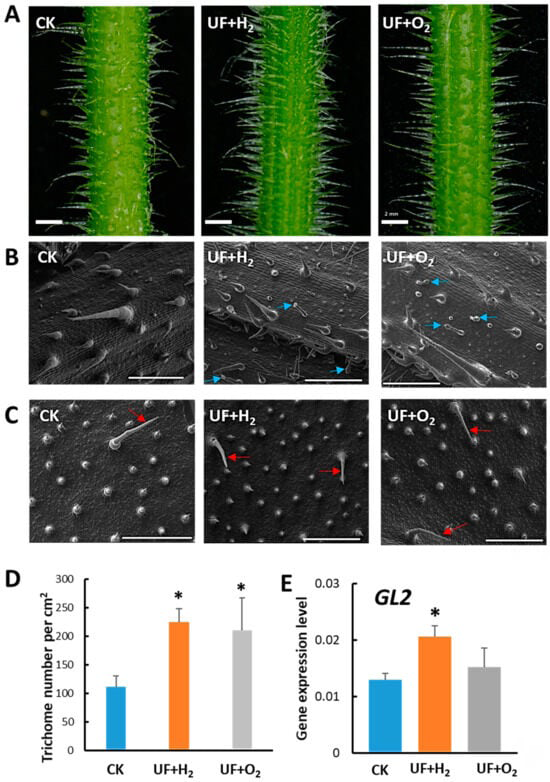
Figure 4: Hydrogen-rich or oxygen-rich ultrafine water irrigation affects the development of trichomes in muskmelon “Camilla”. (A) Dissecting microscopic observation of melon petiole trichome development after irrigation with ultrafine rich water (UF+H2), oxygen (UF+O2) and RO water (Ck). Rod, 2 mm. (B) Cryo-scanning electron microscopy (cryo-SEM) showing trichomes on the melon midrib. Blue arrows indicate the presence of granular trichomes. Rod, 500 μm. (C) Cryo-scanning electron microscopy (Cryo-SEM) showing the development of trichomes on the abaxial surface of newly established young melon leaves (red arrow). Rod, 500 μm. (D) Trichome density in melon petioles irrigated with RO water (UF+H2 and UF+O2, n = 3 to 6. (E) RT-qPCR showing GLABRA2 (GL2) gene expression pattern in young melon leaves irrigated with UF+H2, UF+O2 and RO water control (CK). *, Significant differences between CK and UFW treatments were determined using Student’s t test at p < 0.05 (D,E).
Under cryo-SEM, we observed that long single-cell trichomes and granular trichomes 2 were produced in the middle ribs of melon leaves after UF+H2 or UF+O2 irrigation. However, at the time of the study, glandular trichomes were absent from the CK midrib (Figure 4B). Compared with CK, the morphology of costal gland trichomes in UF+H-irrigated melon leaves 2 or UF+O2 was multicellular, with medium- long stalks and small globular secretory heads (Figure 4B, blue arrow). After UF+H2, the trichome density of abaxial leaves was denser than that of CK2 and UF+O2 irrigation (Figure 4C&D). The results were consistent. We performed RT-qPCR and found that the positive regulatory factor of the trichome development marker gene GLABRA2 (GL2) was significantly increased in early-maturing young leaves after irrigation with UF+H2 (Figure 4E).
Enrichment of Hydrogen-Induced Jasmonic Acid Accumulation
The JA and MeJA contents in melon leaves were detected and JA was found to be significantly increased (6.9 times) under UF+H2 treatment compared with CK (Figure 5A). Although UF+H2 and UF+O2 MeJA content increased slightly, there was no statistically significant difference at p<0.05 (Figure 5B). RT-qPCR results showed that jasmonic acid ZIM domain protein (JAZ) and JA carboxymethyltransferase (JMT) were up-regulated after UF+H2 treatments, but there was no statistically significant difference at p < 0.05 (Figure 5C).
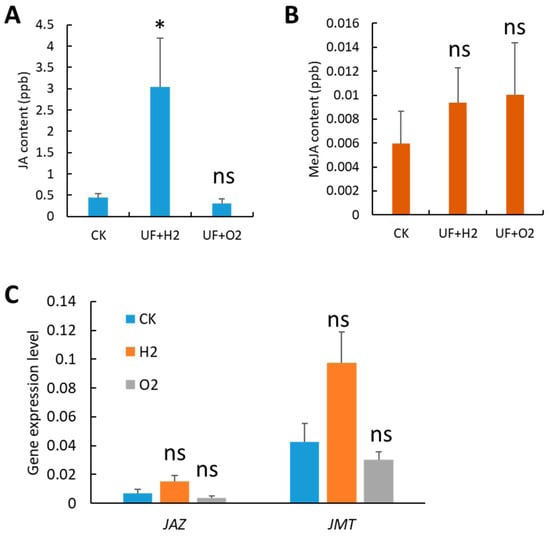
Figure 5: Melon irrigated with hydrogen- and oxygen- rich ultrafine water changed the content and gene expression pattern of jasmonic acid (JA) and methyl JA (MeJA). (A) JA Contents. (B) MeJA Content. (C) Gene expression levels of jasmonate ZIM domain protein (JAZ) and JA carboxymethyltransferase (JMT). Gene expression levels were normalized to two housekeeping genes: actin (MELO3C023264) and ADP ribosylation factor 1 (ADP, MELO3C023630). Error bars represent standard error of the mean (n = 3). Student’s t test was used to find significant differences between CK and UF+H2 or UF+O2 treatments. *, p < 0.05; ns, not significant.
Effect of Ultrafiltration Water on Photosynthesis Parameters, Fruit Yield and Quality
We grow melons in the greenhouse to understand the effect of UF+H2 and the impact of UF+O2 irrigation on melon and fruit production. With the exception of irrigation water, all crop management practices are similar. We used a SPAD meter and a Li-600 aperture meter/fluorometer to measure chlorophyll content and photosynthesis parameters respectively. The results showed that H2 and O2 enrichment significantly increased the SPAD value (representing chlorophyll content) and stomatal conductance (GSW). UF+O2 increases the quantum yield of PSII calculated from fluorescence (ΦPSII) and electron transport rate (ETR) (Figure 6).
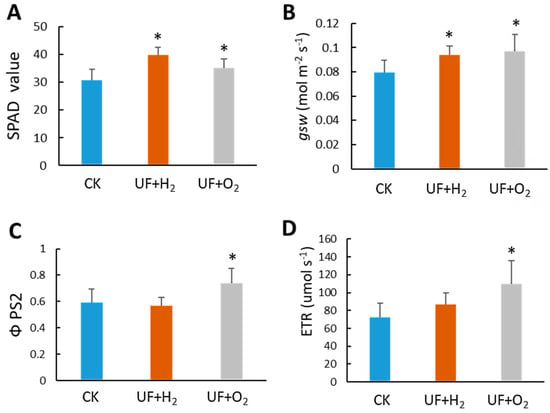
Figure 6: Ultrafine water irrigation affects the photosynthetic ability of melon. (A) Chlorophyll content in melon. The SPAD value was measured on the fourth leaf in the late ripening stage of the fruit. n = 4 strains. The Li600 poremeter/fluorometer detected the photosynthesis parameter of (B) stomatal conductance (gsw); (C) ΦPSII, the quantum yield of PSII calculated from fluorescence; (D) The electron transfer rate of L1 melon leaves (ETR). Student’s t test was used to find significant differences between UFW and regular tap water (CK). *, page < 0.05. Error bars represent standard error of the mean (n = 4).
During late-harvest melon growth, melon plant 2 or UF+O2 irrigated with UF+H2 retained more green leaves than CK irrigated with tap water (Figure 7A, arrow). After irrigation with UFW, the root system of melon plants developed more vigorously, and the fresh weight and dry weight of the root system were significantly higher than those of the control (Figure 7B–D). Ultrafiltration + H2 irrigation increased fruit size and weight (Figure 7E & F). In addition, both UF+H2 and UF+O2 irrigation can increase the sweetness of fruits (Figure 7G).
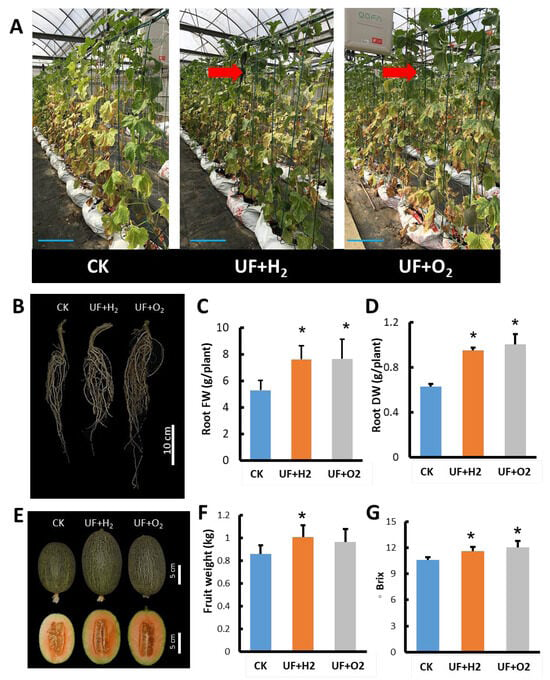
Figure 7: UFW irrigation affects fruit weight and sweetness of melon. (A) Growing melons in a greenhouse. Photo taken 42 days after pollination. Rod, 20 cm. (B) Root morphology at harvest. (C) Fresh root weight of each plant. (D) Root dry weight of each plant. (E) Fruit 5 days after harvest. (F) Average melon fruit weight. (G) Sweetness of fruits. Ultrafiltration + H2, hydrogen-rich ultrafine water irrigation. UF+O2, oxygen-rich ultrafine water irrigation. CK, irrigated with tap water. Bar graph, standard deviation of 22 plants. Student’s t test found significant differences between CK and UF+H2 or UF+O2 treatment. *, page < 0.05.
Discussion
This study showed that UFW irrigation significantly improved melon seed germination, seedling growth and root development. Our greenhouse experiments also showed that UFW enriched hydrogen (UF+H2) or oxygen (UF+O2) to produce higher root biomass than the control group without UFW treatment. A strong root system promotes plant growth and development. Previous studies have shown that hydrogen-rich water increases auxin and GA3 biosynthesis and enhances root development [44]. It regulates the heme oxygenase-1/carbon monoxide pathway and increases root development [13]. Some researchers believe that hydrogen has antioxidant properties that can help reduce oxidative stress in plants, improve plant uptake of nutrients, and improve overall plant growth and development [6, 8, 10, 13, 22]. Molecular hydrogen is not easy to apply. Nonetheless, water electrolysis produces hydrogen, which can be easily incorporated into ultrafine water, providing a good solution for agricultural applications.
Our data indicate that UFW has a positive impact on crop yield compared with previous reports on cucumber [45] and corn [46]. This study shows that hydrogen-rich water is superior to oxygen. Compared to H2 - abundant water, studies of O2 - abundant water for plant growth are rare. Recently, a report emphasized that nanobubbles enrich O2 in water to improve soil structure and microbial diversity, thereby increasing tomato yield [47]. UFW enrichment of O2 can enhance soil oxygen supply and promote aerobic respiration [48]. Some reports indicate that high O2UFW content does not necessarily lead to better crop performance. In a previous study on corn with dissolved oxygen (DO) concentrations of 10, 20, and 30 mg/L, root growth and yield were highest at a moderate DO concentration of 20 mg/L [46]. In this study, we grew melons in a well-ventilated peat moss soilless medium, which may reduce the positive effects of UFW. A more significant impact would be expected if UFW irrigated poorly aerated, high-density clay fields. It was hypothesized that UF+O2 might be beneficial for plant survival under hypoxic conditions caused by flooding.
We observed that melons irrigated with UF+H2 or UF+O2 retained green leaves, and in the later stages of melon development, the leaves contained higher chlorophyll. This is a beneficial trait that can increase the rate of photosynthesis and produce more assimilates for fruit development, thereby increasing fruit weight and sweetness of melons (Figure 7). As mentioned before, hydrogen-rich water increases the flavor and quality of strawberry fruits [15].
Non-glandular trichomes have been reported to play a role in mechanical defense against insects, while glandular trichomes secrete metabolites such as terpenes [49].
In this study, glandular trichomes 2 and UF+O2) were found in the middle ribs of melon leaves after irrigation with UFW (UF+H2), but not in the control group (Figure 4). To our knowledge, this is the first report showing that ultrafine water can increase trichome density and induce glandular trichome development. We found that UF+H2 can induce JA biosynthetic genes and enhance root and trichome development. Trichomes deter herbivores and reduce insect damage. In the future, it will be worthwhile to investigate which secondary metabolites are induced after UFW treatment.
JA is known to be involved in trichome development [30, 31]. In this study, we found that the trichome initiation marker gene GL2 was significantly upregulated in young leaves after UF+H2 treatment (Figure 4E), further supporting that hydrogen may induce JA and enhance trichome initiation to prevent herbivory. Perspectives on animal infestation and improved plant growth. Our data show that the use of UFW (H2 and O2) improves the resistance of melons to aphid infestation (Figure 3). Furthermore, we found that UFW enrichment of H2 plays an important role in trichome development due to upregulation of JA biosynthetic genes and increased JA accumulation in plants irrigated with UFW enrichment of H2 (Figure 5). This enhances trichome formation, deterring insects or interfering with their feeding and growth, making the plant less susceptible to damage. Additionally, reducing pest infestations will reduce systemic viral infection problems. Overall, these data indicate that hydrogen-rich water regulates JA pathway marker genes and increases melon trichome development, which is supported by upregulation of GL2 transcripts. A high density of globular trichomes may help resist aphids. In the future, it would be worthwhile to conduct more extensive research on the potential mechanisms by which UFW induces JA, enhances trichome development, and confers insect resistance.
We demonstrated that UFW increased trichome density and prevented aphid feeding (Figures 3 and 4), induced more flower development, increased fruit weight, and increased fruit sweetness (Figure 7). All these beneficial effects contribute to melon crop production. These results demonstrate that hydrogen-rich water management has excellent potential as a natural, non-toxic pest control method in crop plants. This could lead to reduced pesticide spraying and improved food security. The UFW-induced JA response helps establish a natural defense system in crop plants against insect attack. Therefore, agriculture is safe without relying on pesticides. It is an environmentally friendly agricultural practice that increases crop yields and fruit quality and reduces pest damage. In addition, UFW has hydrophobic and surface charge properties that enhance the release and absorption of soil nutrients, thereby reducing fertilizer requirements [9]. This will reduce the carbon footprint in crop production and enable sustainable agricultural production. Some studies have emphasized enhanced insect resistance through genetically engineered trichome genes, but due to consumer concerns about the biosafety of genetically modified organisms (GMOs), we here propose a hydrogen-enriched UFW irrigation method, as it does not include GMOs and therefore more acceptable to consumers. Furthermore, hydrogen-rich water is safe and easy to use [50].
Materials and Methods
Preparation of Ultrafine Water
We prepared ultrafine sparkling water (UFW) rich in hydrogen or oxygen using the hydrogen-oxygen ultrafine bubble system HOU-3 (Jinong Technology Co., Ltd., Tainan, Taiwan). Hydrogen-rich water (UF+H2) is prepared using reverse osmosis (RO) water to obtain 1000 ppb H2 molecules and oxygen-rich water (UF+O2) is prepared using RO water, containing 10 mg/L O2. Use a portable dissolved hydrogen meter (Trustlex Co., Ltd., ENH-1000, Tokyo, Japan) to measure hydrogen concentration. Dissolved oxygen (DO) content was measured using a dissolved oxygen meter (Lutron Co., Ltd., PDO-519, Taipei, Taiwan).
Plant Material and Growing Conditions
Melon (Cucumis melo L.) seeds were provided by Known-you Seed Co., Ltd. (Kaohsiung, Taiwan). This study used melon lines 6792T-744 (M1), 6792T-LD (M2), 6792T-LQ (M3) and the popular high-quality melon variety “Camilla”. Testing UFW (containing H2 and O2) During seed germination, a total of 40 melon seeds per row were soaked in RO water and UFW overnight and then sown in 125 × 125 × 20 mm square Petri dishes (SPL, Gyeonggi-do, Republic of Korea) on a wet paper towel. Seed germination rate was recorded one day after sowing. Germination is defined as root length exceeding half the seed length. Transfer germinated seeds to a #104 stopper tray containing peat moss (Known-you Seed). Then, the cutting seedlings were transplanted into plastic pots (7.5 cm wide × 7.5 cm high) filled with 140 mL of peat moss. There are 10 to 21 melon seedlings per line, and they are raised in a greenhouse at a temperature of 24±4°C.
The commercial melon variety “Camilla” was used as the research object to evaluate the effects of UF+H2, UF+O2, and the plastic greenhouse (23°06′14.4” N 120°17′31.2” of the Biotechnology Center of Southern Taiwan (AS-BCST) E) Tap water control of growth and fruit production. We transplanted two melon seedlings at the four-leaf stage into an 80 liter bag of peat moss (known to seed). A total of 22 saplings were planted in each treatment. In the plastic greenhouse, we use tap water to prepare hydrogen-rich water (UF+H2) and oxygen-rich water (UF+O2). The control is ordinary tap water. Water is supplied using a drip irrigation system. In this study, melons were grown vertically to keep the fruit cleaner and healthier. The flowers are pollinated at 13 to 16 nodes, and each plant retains one fruit. When the number of nodes on the mother vine reached 26, we removed the top growth points. According to weather and soil moisture conditions, provide an appropriate amount of water (500 mL~1000 mL per plant per day) during planting to ensure good plant growth and avoid fruit cracking in the later stages of fruit maturity, thereby reducing fruit quality.
Insect Materials
Cotton aphids were collected from melon fields in Tainan, Taiwan (23°14′56.0″ N 120°19′32.5″ E). The insects were raised in Camila melon potted plants and placed in insect cages. Place the cage in a greenhouse with a temperature of 24 ± 4 °C. M1, M2, M3 and Camilla melon pot seedlings were placed in a walk-in growth chamber (25 ± 2°C, 12 h photoperiod) with 10-21 seedlings per genotype. Four aphids were released on each melon plant. Each treatment contained more than ten plants. Potted seedlings were irrigated with RO water and UFW respectively. We assessed aphid population development 14 days after infestation and scored the number of aphids per plant. A rating of 0 indicates no aphids were observed, and a rating of 9 indicates high aphid density.
Observation of Trichome Density
To quantify trichome numbers, we collected 3 to 6 newly established leaves (L1) of melon ‘Camilla’ plants, excised the middle part of the petioles and examined them under a dissecting microscope (Leica S9D, Hamburg, Germany). Images of trichomes were obtained at 10× magnification. We counted the number of trichomes and calculated the average number of trichomes per square centimeter.
Cryo-SEM
The first batch of newly developed melon leaves (L1) were used to observe the trichome development and aphid infection of melon seedlings. The abaxial side of a leaf was observed by cryo-scanning electron microscopy (cryo-SEM) using an FEI Quanta 200/Quorum PP2000TR FEI 2007 high-resolution SEM at the Core Laboratory of Plant Cell Biology, Institute of Plant and Microbial Biology, Academia Sinica, Taipei, Taiwan. Briefly, leaf samples containing insect tarsals were loaded onto cryospecimen holders and freeze- fixed in slush nitrogen (-210°C) and then rapidly transferred to a cryostat under freezing conditions. The samples were imaged by cryo-SEM at an accelerating voltage of 20 kV.
Total RNA Isolation and Real-Time PCR
Total RNA from melon leaf tissues was isolated using TRIzol Plus RNA Purification Kit (Thermo Fisher Scientific, San Jose, CA, USA), treated with DNase (Promega, Madison, WI, USA), and cDNA synthesized using M-MLV reverse transcriptase First-strand cDNA was synthesized using a kit (Promega). Quantitative real-time PCR (RT–qPCR) reactions were performed using 2× KAPA SYBR FAST Master Mix (KAPA Biosystems, Wilmington, MA, USA) with complementary DNA reverse transcribed from 2 ng of total RNA in a volume of 15 μL for 35 Circle. RT-qPCR was performed using the CFX96 real-time fluorescence quantitative PCR detection system (Bio-Rad, Hercules, CA, USA), and quantitative analysis was performed using CFX Manager software version 3.1 (Bio- Rad). β-Actin (MELO3C023264) and ADP ribosylation factor 1 (ADP, MELO3C023630) were used as reference genes for normalization. Primers used in this study are listed in Supplementary Table S1. There were three biological replicates for each sample.
Detected JA and Methy lJA Content
Melon leaf samples were snap-frozen in liquid nitrogen and ground into a fine powder using a pestle and mortar. The powder (500 mg) was suspended in 2.5 mL of ice-cold 50% MeOH (-20°C). Vortex the extract for 5 min and then centrifuge at 4000 rpm for 15 min at 3°C. Collect the supernatant and re-extract the pellet using 500 µL of ice-cold 50% MeOH (-20°C). The supernatants were combined and applied to a Sep-Pak Vac 3 mL C18 200 mg cartridge (Waters, Milford, CT, USA) for sample cleanup and concentration. Condition the cartridge with 2 mL of MeOH and equilibrate with 2 mL of water before applying 3 mL of sample to the C18 cartridge. Elute the solid phase extraction (SPE) cartridge with 1 mL of 100% acetonitrile to release MeJA, followed by 1 mL of MeOH cleanup. The eluate was filtered through a 0.22 μm filter, transferred to a chromatography bottle, and detected using ultra-performance liquid chromatography high- resolution tandem mass spectrometry (UPLC-HRMS/MS) (Thermo Fisher Scientific). UPLC separation was performed on a BEH C18 column (2.5 × 100 mm, 1.7 μm, Waters) at a flow rate of 0.3 mL/min. The column oven temperature is 40°C. The gradient program uses 0.1% formic acid (FA) in water (phase A) and 0.1% FA in acetonitrile (phase B). The sample injection volume is 20 μL. SPAD Value and Photosynthesis Rate of Melon The chlorophyll content of the fourth new long melon leaf (L4) 45 d after pollination was measured using a non- destructive portable chlorophyll (Chl) meter SPAD-502 Plus (Konica Minolta Optical, Osaka, Japan). To determine the photosynthetic rate, we used a Li-600 porosimeter/ fluorometer (Li-COR, Lincoln, NE, USA) to measure stomatal conductance (gsw), electron transfer rate (ETR) and L1 leaves according to 23 days after pollination. Fluorescence parameter (ΦPSII) Calculated PSII quantum yield.
Statistical Analysis
Student’s t test was used to compare the differences between CK and UF+H2 or UF+O2 treatments with different genotypes. A p value of less than 5% was considered statistically significant.
Conclusion
This study shows that ultrafine hydrogen-rich water can significantly promote root development and increase fruit yield and sweetness. As shown in the paper, we found that ultrafine water (UFW) significantly increased the accumulation of JA, increased the expression of GL2 gene, and may induce trichome development to reduce insect damage. UFW is easy to use. Farmers can incorporate UFW into their irrigation systems. This could be a promising non- pesticide method of crop protection. It is beneficial for high cash crops and organic farming. Farmers can work to create safer, more sustainable melon production systems. For basic research, the underlying molecular mechanisms of how ultrafine water promotes insect resistance deserve detailed investigation.
Author Contributions
S.-S.K. and C.-C.Y. designed and supervised the study; J.-C.H., N.-J.L., and C.-Y.P. performed the experiments; J.-C.H. analyzed and prepared the data. S.-S.K. and J.-C.H. wrote the article. All authors have read and approved the published version of the manuscript.
Funding
This study was supported by a cooperative research project between the Agricultural Biotechnology Research Center of Academia Sinica and Seasonal Agricultural Technology Co., Ltd., and was funded by Seasonal Agricultural Technology Co., Ltd. (14T-1090311-1C).
Data Availability Statement
Data supporting the findings of this study can be found in this article and its supplementary data published online.
Confirm
We thank Known-you Seed Co., Ltd. for providing melon seeds for this study; the transgenic greenhouse of the Southern Biotechnology Center of Taiwan (AS-BCST) for providing greenhouse and technical support; and the mass spectrometry core facility of AS-BCST for the determination of JA and Me-JA content; cryo-SEM images by Chyi-Chuann Chen; language editing by Miranda Loney.
Conflict of Interest
The authors Ning Juan Li, Ching Yen Peng, and Ching Chieh
Yang are employed by Season Agricultural Technology Co., Ltd., Tainan, Taiwan. The remaining authors declare that the research was conducted in the absence of any commercial or financial relationships that could be construed as a potential conflict of interest.
References
-
Ushikubo FY, Furukawa T, Nakagawa R, Enari M, Makino Y, et al. (2010) Evidence of existence and stability of nanobubbles in water. Colloid surfing A 361(1-3): 31-37.
-
Lingling Li, Zeng Y, Cheng X, Shen W (2021) Application of molecular hydrogen in horticulture. Horticulture 7(11): 513.
-
Takahata J, Takagi K, Sata N, Takahashi K, Fujio T, et al. (2014) Improving plant growth rate by air bubble discharge in water. Jpn J Appl Phys 54: 01AG07.
-
Li SY, Zheng S, Zhao AR, Shim MS, Zhong Y, et al. (2021) Germination and seedling growth response of sprouts and leafy vegetables after application of oxygen nanobubble water. J People plants environment 24(6): 607-617.
-
Oshita S, Boerzhijin S, Kametani H, Yoshimura M (2023) Promoting effect of ultrafine bubbles/nanobubbles on seed germination. Nanomaterials 13(10): 1677.
-
Liu S, Ohshita S, Makino Y, Wang Qi, Kawagoe Y, et al. (2015) Oxidizing ability of nanobubbles and its effect on seed germination. ACS Sustain Chem Eng 4: 1347-1353.
-
Zhu Y, Liao W (2016) The positive role of hydrogen in the development of adventitious roots. Plant signaling behavior 11(6): e1187359.
-
Xue S, Mahaba T (2022) Nanobubble watering affects nutrient release and soil properties. ACS Agric Sci Technol 2(3): 453-461.
-
Wang Y, Wang S, Sun J, Dai H, Zhang B, et al. (2021) Nanobubbles by upregulating nutrient absorption genes and stimulates growth hormone production to promote nutrient utilization and plant growth in rice. Sci Total Environ 800: 149627.
-
Park JS, Kurata K (2009) Application of microbubbles in hydroponic solution to promote lettuce growth. Horticulture Technology 19(1): 212-215.
-
Xue S, Gao J, Liu C, Marhaba T, Zhang W (2023) Unveiling the potential of nanobubbles in water: Impacts on tomato’s early growth and soil properties. Sci Total Environ 903: 166499.
-
Rafael MK, Li L, Sumeth W, Thai NH, Surendra KC, et al. (2023) Nanobubble technology applications in environmental and agricultural systems: Opportunities and challenges. Crit Rev Environ Sci Technol 53(14): 1378-1403.
-
Lin Y, Zhang W, Qi F, Cui W, Xie Y, et al. (2014) Hydrogen- rich water regulates cucumber adventitious root development in a heme oxygenase-1/carbon monoxide- dependent manner. J Plant Physiology 171(2): 1-8.
-
He J, Liu Y, Wang T, Chen W, Liu B, et al. (2022) Effects of underground drip irrigation nanobubbles on the yield, quality, irrigation water use efficiency and nitrogen partial productivity of watermelon and muskmelon. International Agricultural Physics 36(3): 163-171.
-
Li L, Wang J, Jiang K, Kuang Y, Zeng Y, et al. (2022) Preharvest application of hydrogen nanobubble water enhances strawberry flavor and Consumer preferences. Food Chemistry 377: 131953.
-
Li L, Yin Q, Zhang T, Cheng P, Xu S (2021) Hydrogen nanobubble water delays petal aging and extends the vase life of cut carnation (Dianthus caryophyllus L.) flowers. Plants 10(8): 1662.
-
Ren PJ, Jin X, Liao W, Wang M, Niu LL, et al. (2017) Environment. Biotechnology 58: 576-584.
-
Hu H, Li P, Wang Y, Gu R (2014) Hydrogen-rich water delays postharvest ripening and senescence of kiwi fruit. Food Chemistry 156: 100-109.
-
Jin Z, Liu Z, Chen T, Li L, Zeng YC (2023) Postharvest Biology Technology. 206: 112551.
-
Xie Y, Mao Y, Lai D, Zhang W, Shen W (2012) H(2) enhances salt tolerance in Arabidopsis thaliana by manipulating ZAT10/12-mediated antioxidant defense and controlling sodium excretion. PLoS One 7(11): e49800.
-
Russell G, Zulfikar F, Hancock JT (2020) Hydrogenase and the role of molecular hydrogen in plants. Plants 9(9): 1-15.
-
Iijima M, Yamashita K, Hiroka Y, Ueda Y, Yamane K, et al. (2022) Ultrafine air bubbles alleviate osmotic stress in soybean seedlings. Plant Production Science 25(2): 218- 223.
-
Webb SE (2005) Insect management of gourds (cucumber, squash, cantaloupe and watermelon). ENY- 460/IN168, Graz, Austria.
-
Alonso-Prados JL, Arteaga ML, Alvarez JM, Moriones E, Butler A, et al. (2003) Prevalence of aphid-borne viruses in Spanish melon crops. Eur J Phytopathology 109: 129- 138.
-
Cauwenbergh NV, Biara K, Bielders C, Brouckaert V, Franchois L, et al. (2007) SAFE – a hierarchical framework for assessing the sustainability of agricultural systems. Agricultural Ecosystem Environment 120: 229-242.
-
Dalin P, Ageren J, Bjorkman C, Hutunin P, Kärkkäinen K (2008) Formation of leaf trichomes and plant resistance to herbivores. In: Berlin, et al. (Eds.), Inducing plant resistance to herbivores. Springer, Germany, pp: 89-105.
-
Handley R, Ekbom B, Agren J (2005) Variation in trichome density and resistance against a specialist insect herbivore in natural populations of Arabidopsis thaliana. Eco Entomol 30(3): 284-292.
-
Lin SY, Trumble JT, Kumamoto J (1987) Activity of volatile compounds in glandular trichomes of Lycopersicon species against two insect herbivores. J Chem Ecol 13(4): 837-850.
-
Hong GJ, Xue XY, Mao YB, Wang LJ, Chen XY (2012) Arabidopsis thaliana MYC2 interacts with DELLA protein to regulate sesquiterpene synthase gene expression. Plant Cell 24(6): 2635-2648.
-
Hua B, Chang J, Wu M, Xu Z, Zhang F, et al. (2021) Mediation of JA signalling in glandular trichomes by the woolly/SlMYC1 regulatory module improves pest resistance in tomato. Plant Biotechnology J 19(2): 375- 393.
-
Boughton AJ, Hoover K, Felton GW (2005) Application of methyl jasmonate induces an increase in the density of epigonal trichomes in tomato, Lycopersicon esculentum. J Chem Ecol 31(9): 2211-2216.
-
Pattanaik S, Patra B, Singh SK, Yuan L (2014) An Overview of the gene regulatory network controlling trichome development in the model plant Arabidopsis. Front Plant Science 5: 259.
-
Ohashi Y, Oka A, Rodrigues-Pousada R, Possenti M, Ruberti I, et al. (2003) Modulation of phospholipid signaling by GLABRA2 in root-hair pattern formation. Science 300(5624): 1427-1430.
-
Oppenheimer DG, Herman PL, Sivakumaran S, Esch J, Marks MD (1991) Expression of the Myb gene required for Arabidopsis leaf trichome differentiation. Cell 67(3): 483-493.
-
Yoshida Y, Sano R, Wada T, Takabayashi J, Okada K (2009) Jasmonic acid controls GLABRA3-linked induced defense and trichome patterning in Arabidopsis. Development 136(6): 1039-1048.
-
Zhao M, Morohashi K, Hatlestad G, Grotewold E, Lloyd A (2008) TTG1-bHLH-MYB complex through direct targeting toward regulatory sites to control trichome cell fate and patterning. Development 135(11): 1991-1999.
-
Rerie WG, Feldmann KA, Marks MD (1994) The GLABRA2 gene encodes a homeodomain protein required for normal trichome development in Arabidopsis thaliana. Gene Dev 8(12): 1388-1399.
-
Morohashi K, Zhao M, Yang M, Read B, Lloyd A, et al. (2007) Participation of the Arabidopsis bHLH Factor GL3 in Trichome Initiation Regulatory Events. Plant Physiology 145(3): 736-746.
-
Bernhardt C, Lee MM, Gonzalez A, Zhang F, Lloyd A, et al. (2003)The BHLH genes GLABRA3 (GL3) and enhancer of GLABRA3 (EGL3) designation Epidermal cell fate in Arabidopsis roots. Development 130(26): 6431-6439.
-
Schellmann S, Schnittger A, Kirik V, Wada T, Okada K, et al. (2002) TRIPTYCHON and CAPRICE mediate lateral repression during hair and root hair patterning in Arabidopsis. EMBO J 21(19): 5036-5046.
-
Yan (2022) Plant Physiology 174: e13666.
-
Sun B, Shang L, Li Y, Zhang Q, Chu Z, et al. (2022) Ectopic expression of OsJAZs alters plant defense and development. Int J Mol Sci 23(9): 4581.
-
English NJ (2022) Environmental exploration of ultradense nanobubbles: Rethinking sustainability. Environment 9(3): 33.
-
Qi W, Su NN (2020) Huang of elongation. Function Plant Biology 47: 771-778.
-
Zhu Y, Liao W, Wang M, Niu L, Xu Q, et al. (2016) Nitric oxide is necessary for hydrogen-induced adventitious root formation in cucumber. J Plant Physiology 195: 50- 58.
-
Zhou Y, Li Y, Liu X, Wang H, Muhammad T (2019) Micro/ nanobubble water oxygenation synergistically improves spring corn yield and quality. Science Rep 9: 5226.
-
Weijie C, Felipe B, Yanzheng L, Yupeng Z, Jing H, et al. (2023) Nanobubble oxygenated increases crop production via soil structure improvement: The perspective of microbially mediated effects. Agricultural water management 282: 108263.
-
Wang S, Liu Y, Liu T, Pan G (2020) Aquatic macrophytes in morphological and physiological responses to the nanobubble technology application for water restoration. ACS EST Water 1(2): 376-387.
-
Wang F, Park YL, Gutensohn M (2020) Glandular trichome-derived sesquiterpenes from wild tomato accessions (Solanum habrochaites) affect aphid performance and feeding behavior. Phytochemistry 180: 112532.
-
Hancock JT, Lebaron TW, May J, Thomas A, Russell G (2021) Molecular Hydrogen: is this a viable new treatment for plants in the UK? Plants 10(11): 2270.
- Lessons to Learn: Trees are More than the Lungs of the World
- Community Forestry Enterprises as a Model for Sustainable Forest Development: The Case Of The "Baja Tarahumara" in Chihuahua, Mexico
- Ecological and Socio-Economic Impacts of Chromolaena odorata and Mesosphaerum suaveolens, Two Invasive Alien Species in Central and Southern Benin, West Africa
- Epigenetic Sustainability: Modeling the Human Factor as a Natural Resource through Science 4.0 and the NR3C1 Biological Pilot
- Growth-at-Risk: A Framework for Assessing Economic Vulnerability
- The Rural Territory as a Socioecological System for the Management of Public Policy for Sustainable Rural Development