
Study and Assessment of Mineralogical, Chemical and Granulometric Composition of Volatile Soil-Sand Aerosols from Dried Out Part of Aral Sea
This article presents the results of a comprehensive study of the chemical composition, structural characteristics, and porous structure of soil and sand in the dried-out part of the Aral Sea. Chemical analysis of soil samples revealed a high content of basic elements, such as oxides of silicon, aluminium, iron, calcium, and magnesium, which affect chemical activity and interaction with the environment. The structural characteristics of the samples taken in the dried part of the Aral Sea made it possible to evaluate their ability to adsorb and interact with water and other substances. The study of soil's adsorption and porosity characteristics has revealed its ability to retain moisture and other important components in the porous structure. The results obtained allow us to better understand the mechanisms of interaction of soil and sand with water. Data can serve as a basis for developing effective and sustainable water management practices and optimizing the use of soil materials.
Introduction
The drying up of the Aral Sea is regarded as an ecological tragedy, leading the destruction of the natural environment of the region [1]. The mechanisms of soil erosion and deflation are described in detail in numerous works by domestic and foreign researchers [2, 3, 4]. These processes are physical phenomena, typically divided into two stages: the first involves the separation of soil particles from a monolith of soil or underlying rock by external forces, and the second stage involves transportation by rolling, jumping, or wind-borne suspension. The erosive energy capable of performing such destructive work occurs when water falls on the earth’s surface, and flows down the slopes in conjunction with geological wind patterns [9]. Consequently, methods to prevent soil washout and deflation will not give the desired effect if soil’s inherent resistance to the erosive effects of water and air flows is low. The anti-erosion and anti-deflation stability of lands should be understood as the ability of the soil mixtures forming these areas to withstand the destructive effects of water and wind [5]. The work [4] notes that soil stability is determined by a complex of biochemical, chemical, physicochemical, water-physical, and mechanical properties. The drying up of the Aral Sea is regarded as an ecological tragedy, leading the destruction of the natural environment of the region [1, 2, 3]. The appearance of dust and salt storms, desertification of the land, not only along the coast but also far from the sea, and the change in climate and landscape result from this negative effect. In solving the problems mentioned above, it is important to study the chemical, mineralogical, granulometric, and sorption properties of mobile sands and soils to reduce the transfer of salt and dust [4].
Research Methods
The chemical and physical properties of soils and sand were determined using the methods described in [6, 7, 8, 10].
Results and Discussion
The studies used samples of saline mobile soils of the dried bottom of the Aral Sea in the areas of Rybatsky (areas 7,8,9,10 - 20-30 km from the city of Muynak), and Muynak (areas 2,3,4 - 15-20 km from the city of Muynak) and dune sands taken in the area of the Kok-Darya River (the old dried bottom of the Aral Sea 200 km from Nukus). Samples were taken at a depth of 05 cm (Tables 1 & 2).
| Samples section | SiO 2 | AI O 2 3 | Fe О 2 3 | SO 3 | CaO | MgO | К О 2 | Na O 2 | ∑ |
|---|---|---|---|---|---|---|---|---|---|
| Muynak Bay: | |||||||||
| Sec №2 Sec №3 Sec №4 | 52.83 47.38 49.73 | 10.27 9.49 9.72 | 2.85 2.69 3.27 | 1.34 4.27 2.93 | 10.64 13.97 12.20 | 2.41 3.02 2.77 | 1.74 1.62 1.80 | 2.53 2.68 3.23 | 100.85 100.38 100.42 |
| Fisherman’s Bay: | |||||||||
| Sec №7 Sec №8 Sec №9 Sec №10 | 40.55 46.38 43.48 46.21 | 10.11 8.27 10.92 8.90 | 13.29 13.60 0.88 2.64 | 1,43 2.27 10.69 7.29 | 10.76 10.71 12.05 15.10 | 3.59 2.72 3.67 0.93 | 1.99 1.82 0.88 2.46 | 3.32 1.89 3.24 3.67 | 10114 100.54 100.20 100.24 |
| Sand of Kok- Darya | 89.24 | 2.36 | 1.89 | 0.11 | 1.11 | 0.95 | 1.85 | 1.37 | 100.08 |
Table 1: Results of chemical analysis of soil and sand samples from the dried bottom of the Aral Sea.
| Sample | Density, g/cm3 | porousness % | Porosity % | Total pore volume cm3/g | ||
|---|---|---|---|---|---|---|
| by water | by benzene | by mercury | ||||
| Soil of of the dried part of the Aral Sea | 2.96 | 2.98 | 1.56 | 39.1 | 45.5 | 0.71 |
| Sand of Kok- Darya | 2.70 | - | - | 35.2 | - | - |
Table 2: Mobile soils and sands’ structural-porosity descriptions dried part of the Aral Sea.
The results of general chemical analyses showed differences in the composition of the studied samples (Table 1).
Data analysis showed that the composition of soil and sand samples varies significantly depending on the site. In particular, the contents of such chemical elements as SiO2, Al2O3, Fe2O3, SO3, CaO, MgO, K2O, and Na2O and their total content (∑). In the samples taken from different areas of Muynak Bay and Fisherman’s Bay show differences in the content of these elements, which may indicate the heterogeneity of the geological environment in these areas.
There is significant variation in the content of chemical elements even within the same bay (e.g. Muynak Bay, Sec
2 and Sec 3), which may be attributed to differences in the geological origin. Based on the results of the analysis, it can be noted that samples from Muynak Bay and Fisherman’s Bay exhibit differences in composition, especially in the content of SiO2, Fe2O3 and other elements. These differences may be attributed to the characteristics of geological formations and sedimentary processes in different areas.
The sand collected from the Kok-Darya differs in composition from the soils taken from the dried part of the Aral Sea. The content of chemical elements in sand also varies, and this may indicate different sources of origin and diversity of geological processes in the area. The results of chemical analysis of soil and sand samples from the dried bottom of the Aral Sea indicate a wide variety of compositions in different areas. These differences in composition may be related to the geological and geomorphological features of these areas.
It was found that the island’s mobile soils mainly belong to the group of minerals feldspar (for small fractions) and epidosite (for large fractions). In addition to carbonates (up to 20%) and feldspar (up to 10%), these sands also contain quartz (up to 29.6 %), albite (up to 10.1 %), muscovite (up to 12.5 %) and apatite (up to 10.4 %). The Aral Sea region is located in the north-western part of Uzbekistan, primarily characterized by desert zones that consist of saline mobile sands with a particle size distribution ranging from 0.1 to 0.2 mm, up to 97%. These sands begin to move at wind speeds from 4.5 to 6.7 m/sec, measured at a height of 0.1 m from their surface, and larger sand particles of 0.55 mm begin to move at wind speeds from 6.7 to 8.4 m/sec. It is important to evaluate the structure-porosity characteristics of the shifting sands and soils of the dried part of the Aral Sea (Table 2). Soil from the dried part of the Aral Sea has a higher density (2.96 g/cm3) compared to Kokdaryo sand (2.70 g/sm3). This may indicate denser compaction of soil particles in soils from the dried part of the Aral Sea. The sand taken from Kok-Darya has a lower density, which may be due to its geological origin.
The soil porosity of the dried part of the Aral Sea is significantly higher compared to the sand of the Kok-Darya. The soil porosity of the Aral Sea is 39.1 % for water, and 45.5 % for benzene (Table 3).
| Samples | Heat of wetting (Q) j/g | Specific surface (S) m2/g | Bound water (A) % | % |
|---|---|---|---|---|
| Soils of dried part of the Aral Sea | 18.4 | 153 | 5.62 | 327.4 |
| Sands of the Kok-Darya | 5.55 | 52 | 1.71 | 324.6 |
Table 3: The main colloidal-chemical characteristics of mobile soil and sand of the dried part of the Aral Sea.
Porosity is associated with the pore volume of a material and can influence water conductivity and moisture retention. The soils dried part of the Aral Sea also has a higher porosity value (1.56 %) compared to the missing information for the Kok Darya sand. This may indicate a greater number of pores in the dried part of the Aral Sea soil, which may be important for moisture retention and nutrient availability for plants. The dried part of the Aral Sea soil sample exhibits a significantly larger total pore volume (0.71 cm3/g) in comparison to the Kok-Darya sand, for which this data is unavailable. This parameter is associated with the total pore volume in the material and can be essential for estimating the soil’s capacity for retaining water and other substances. Based on the results of the analysis of the sample characteristics, it is evident that the Priaraliya soil (dried pat of the Aral) has higher porosity, and total pore volume compared to the Kok-Darya sand. These differences may be attributed to differences in the geological origin and history of the samples. With these characteristics in mind, it is possible to conduct a more comprehensive study of water conductivity, moisture retention, and other properties of the Priaraliya soil and Kok-Darya sand. This research could be essential for water vapor adsorption isotherms on the samples obtained (Table 3). The heat of wetting for the Priaraliya soil is 18.4 J/g, while for the Kok-Darya sand, the value is 5.55 J/g. The heat of wetting indicates the interaction between material’s surface and the liquid. A higher heat of wetting value for dried part of the Aral Sea soil may indicate higher adhesion and cohesion between soil particles and moisture. The specific surface area for the dried part of the Aral Sea soils is 153 m2/g, and for the Kok-Darya sands - 52 m2/g. Specific surface area characterizes the surface area of a material per unit mass. A higher specific surface area of the Priaraliya soil may indicate a more complex surface structure and a larger number of small pores and cracks. Bound water is the percentage of water that remains in the material after drying. For the soils of the dried part of the Aral Sea, the value of bound water is 5.62%, and for the sand of Kok-Darya - 1.71%. A higher index of bound water near the priaraliysoil may indicate greater moisture retention and water capacity compared to Kok-Darya sands. Isotherms obtained from the adsorption of water vapor on the island’s mobile soils (Figure 1) show an S-shaped slope in the sorption (hysteresis), and the difference in magnitude is very small (P/PS). According to A.V Kisilev’s classification, these isotherms correspond to the fourth type and are characterized by the sorption isotherms of water vapor in clay minerals. (1st growth, 2nd return curves).
Isotherms derived from the adsorption of water vapor in Island migratory soils (Figure 1) show a Sshaped slope in the sorption (hysteresis) and are distinguished by a very small magnitude (R/RS). According to A.V. Kisilev’s grading these isotherms have been observed to correspond to the fourth type, and are characterized by the sorption isotherms of water vapor in these clay minerals (1st growth, 2nd return curves) (Figure 1).
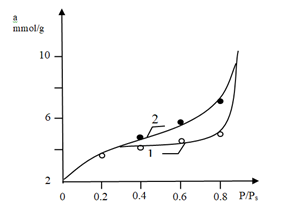
The results of processing the obtained isotherms using the appropriate equations are presented in (Table 4).
| Meanings | |
|---|---|
| ain, mol/g (monolayer capacity) | 0.84 |
| S, m2/g (specific surface) | 153 |
| Sin, m2/g (specific surface area of micropores) | 22 |
| Sout, m2/g (specific surface area of mesopores) | 131 |
| Vs, cm3/g (total pore volume) | 0.26 |
| rsam, nm (average pore size) | 6.2 |
Table 4: Structure-sorption parameters of the dried part of the Aral Sea mobile soils.
The capacity of a monolayer represents the amount of gas (in this case water vapor) that can be adsorbed on the surface of the material. The monolayer capacitance value for the Aral soil is 0.84 mol/g. A higher value indicates more active soil surface to interact with water molecules. The calculated specific surface area based on monolayer capacity is 153 m²/g indicating the total soil surface area available for the adsorption of water vapour. The specific surface area of micropores is 22 m²/g. Micropores can interact more effectively with water and moisture compared to large pores, aiding in moisture retention in the soil. The total pore volume is 0.26 cm3/g. This value indicates the amount of pore space available for the adsorption of water molecules. A large pore volume may indicate the soil’s ability to retain more moisture. The results of the analysis of water vapor adsorption on the dried part of the Aral Sea soils indicate that the soil has a high specific surface area and a diverse porous structure, including micro- and mesopores. These characteristics indicate the high ability of the soil to retain moisture and water.
Conclusion
The study of the chemical composition, structural characteristics, and porous structure of the soil from the dried-up part of the Aral Sea and Kok Darya sand samples provided valuable data on the physicochemical properties of these materials. The analysis allowed for a deeper understanding and evaluation of their ability to interact with water and other substances. A study of the chemical composition of the dried-up part of the Aral Sea soil revealed a high content of oxides of silicon, aluminium, iron, calcium, and magnesium. These elements play an important role in the formation of the chemical structure of the soil and its interaction with the environment. The porous structure of the soil has a significant specific surface area and a variety of pores, including micro- and mesopores, which aid in retaining moisture and other substances. It has been established that the adsorption characteristics of the dried-up part of the Aral Sea soil demonstrate high monolayer capacity, specific surface area, and total pore volume. These indicators indicate the intensive interaction of soil with water and the ability to retain it in a porous structure. Comparison with data from Kok-Darya sand allows us to identify the characteristics of each material in the context of their structural and adsorption properties. So, the results obtained enrich our understanding of the chemical and physical interaction of soil and sand dried-up part of the Aral Sea with water. These data can serve as a basis for the development of improved water management practices, wastewater treatment, and the optimization of soil materials use in agricultural and environmental contexts. Further research in this area could lead to more efficient use of resources and the development of sustainable practices for agriculture and environmental conservation.
References
-
Kuldasheva S, Abdikamalova A, Eshmetov I, Sharipova A, Northodzhieva G (2023) Investigation of changes in the viscosity properties of acrylamide (co) polymers and their hydrolysed forms depending on the conditions of their production. Polymer Bulletin 5.
-
Adizova N, Abdurakhimov S, Kuldasheva S, Akhmadzhonov I (2021) Promising methods of chemical reclamation of mobile soils and sands using compositions from local structure-forming agents, IOP Conference series: Earth and Environment Science 839(4): 042075.
-
Kuldasheva S, Dzhumabaev B, Agzamkhodzhaev A, Aimirzayeva L, Shomurodov K (2015) Stabilization of mobile sands of the drained bottom of the Aral Sea. Journal of Chemical Technology and Metallurgy 50(3): 314-320.
-
Khamraev SS, Artykbayev H, Azimbayev SA, Akhmedov KS (1984) Accumulation and leaching of salts from structured soils. Tashkent: FAN, pp: 127.
-
Kaurichev IS (1973) Practicum on soil science. M Kolos, pp: 273.
-
Dubinin MM (1935) Physico-chemical bases of sorption technology. M NTI, pp: 536.
-
Little L (1969) Infrared spectra of adsorption molecules. M Mir, pp: 47-58.
-
Yu.I. Tarasechev (1968) Determination of infrared spectra of clay minerals and substances adsorbed on them, Ukr. Chemical Journal, pp: 439-445.
-
Christian O, Groll M, Aslanov I, Lotts T, Vereshchagina N (2016) Deposition of Aeolian dust in the Southern Aral Sea region (Uzbekistan) - results of ground monitoring within the LUCA project. Quaternary International 429: 86-99.
-
(2002) Degradation and protection of soils. In: Dobrovolsky GV, et al. (Eds.), Publishing House of Moscow State University, p: 654.
- Lessons to Learn: Trees are More than the Lungs of the World
- Community Forestry Enterprises as a Model for Sustainable Forest Development: The Case Of The "Baja Tarahumara" in Chihuahua, Mexico
- Ecological and Socio-Economic Impacts of Chromolaena odorata and Mesosphaerum suaveolens, Two Invasive Alien Species in Central and Southern Benin, West Africa
- Epigenetic Sustainability: Modeling the Human Factor as a Natural Resource through Science 4.0 and the NR3C1 Biological Pilot
- Growth-at-Risk: A Framework for Assessing Economic Vulnerability
- The Rural Territory as a Socioecological System for the Management of Public Policy for Sustainable Rural Development