
Biocapacity and Environmental Governance in Livestock in European Union and Central America
The European Unions (EU) position in the world economy represents 15.6% of the global exports and imports, being the largest economy worldwide. Its ecological footprint has exceeded the environmental boundaries though, becoming a net importer of biocapacity. 42% of the European water footprint and 31% of the European greenhouse gas (GHG) emissions are located outside the EU borders. A review of the environmental impacts associated with the livestock trade sector was analyzed in both, the European Union and the Central America Region, making use of environmental tools and measures available in both regions to achieve the Agenda 2030 goals. A special focus of the Agenda 2030 is covered by international partnership and cross–country relationships (SDG 17). The current worldwide economy is forced to be agreement, deal, and accord-based. These alliances commonly include the participation of very distant regions and economic blocks. It was found that the association agreements between the two regions - considered a sustainable pillar - can be a platform to replicate the functional instruments of environmental regulation and promotion to achieve sustainability through governance in the Central America region.
Introduction
The appearance of new instruments at the service of the sustainable development policies has increased considerably in the last years, especially since the Stockholm Conference in 1972, promoted by the United Nations, and the contextual creation of the United Nations Environment Program (UNEP) in all areas, international, national, regional and local. These instruments seek to respond to the three dimensions of the theoretical framework of sustainable development, environmental, social, and economic, integrating, therefore, by technological, political, and cultural aspects. Together with the implementation of the ambitious 17 Sustainable Development Goals (SDGs) of the Agenda 2030 [1] adopted by all United Nations Member States in 2015, different legal instruments are essential to walk as close as possible towards sustainability.
A special focus is covered by international partnership and cross–country relationships (SDG 17). The current worldwide economy is forced to be agreement, deal, and accord-based. These alliances commonly include the participation of very distant regions and economic blocks. This linkage has allowed to obtaining of cheaper commodities, enlarged the participation of different economic actors, and increased the efficiency in allocating resources [2]. However, the expansion of international trade can also have negative effects on the environment [3]. The
main reason for the environmental price of international trade in that commodities are produced and harvested in areas where economic profit can be easily achieved, but the environmental aspects of production are normally ignored. The economic growth normally overpowers the protection and conservation of water, soil, and biodiversity [4]. In terms of global commerce of commodities, the position of the European Union (UE-27) represents 15, 6% of the global imports and exports through different alliances and commercial agreements worldwide [3].
A first approximation of the associated environmental costs of the EU position in the world’s economy can be measured by the so-called ecological footprint, performed as a tool to ascertain the surplus or deficit of the environmental impacts related to the biocapacity of a specific country or region. The EU’s environmental footprint is considerably larger than the global average and it is unsustainable when compared with indicative targets that aim to ensure that planetary limits are respected. The EU is also more heavily dependent upon embodied imports of environmental resources than any other region in the world [5]. Within the ecological footprint, a main topic is the displacement effects of trade. For example, 42% of the water footprint and 31% of the greenhouse gas emissions (GHG) caused by consumption within the EU occurred in countries outside Europe [4]. At the domestic level, the EU has established different instruments to achieve the goals listed in the Agenda 2030. These instruments include the definition of an Efficiency Roadmap, the accomplishment of the European Green Deal [6], the application of the EU Green Public Procurement [7], and the EU Circular Economy Action Plan [8] which includes the application of circular economy and bioeconomy principles. Related to all of the above, agriculturally speaking, it is necessary to introduce one of the most important policies in the European Union: the Common Agricultural Policy (CAP) [9], representing the link between agricultural and livestock activities and society. The CAP is a common policy for all EU countries and its management and financing depend on the EU budgets. Some of the main environmental objectives of CAP are to “help tackle climate change and the sustainable management of natural resources” and “maintain rural areas and landscapes across the EU”. At the global level, instead, Europe adopted in 2010 the Communication on Trade, Growth, and World affairs [10] that stresses that the EU trade policy should continue to support green growth and climate change objectives and to support and promote different areas worldwide such as energy, resource efficiency, and biodiversity protection. Maybe, therefore, the economic aspects and environmental sustainability can be considered key tools for effective European governance. This paper analyzes the European Union and the Central American region in the context of biocapacity, highlighting how the two regions converge within the framework of the current Association Agreement between the European Union and the member states of the Central American Integration System (SICA) [11], which entered into force in 2003. The article aims to explore the potential replication of the environmental instruments implemented in Europe within the context of the Association Agreement, specifically focusing on the environmental impact of livestock industries in Central America.
Materials and Methods
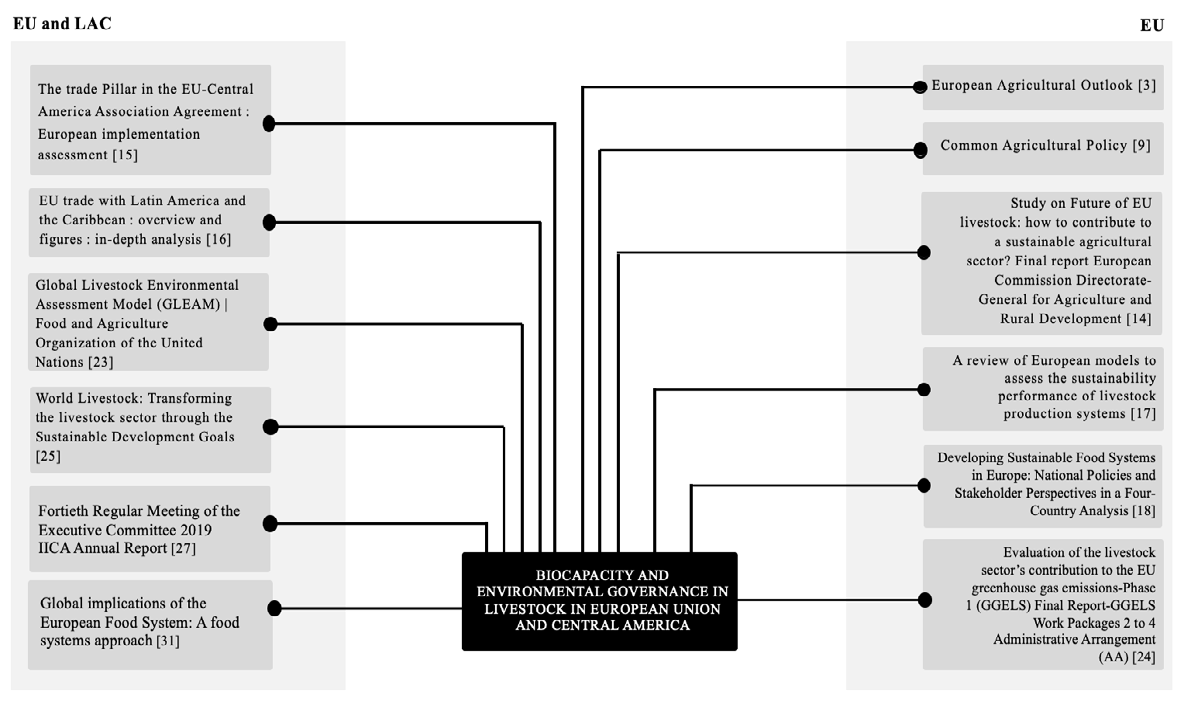
The methodology acquired in the presented papers includes a literature review of the agricultural experience in the European Union and Central America within the framework of biocapacity issues, related policies, and agreements. Data were collected through robust literature analysis, mainly focusing on documents and strategies from the European Commission and other international entities. Specifically, Figure 1 summarizes the documents analyzed during the review and their interconnected synergies.
Results and Discussion
Biocapacity
Biological capacity or biocapacity, defined as “the capacity of ecosystems to regenerate what people demand from those surfaces”, can be considered as an indicator of the planet’s ecological wealth. If biocapacity is larger than the ecological footprint, then there is a biocapacity reserve. In the opposite situation, there is a biocapacity deficit [12]. (Figure 2 illustrates the worldwide distribution of the biocapacity deficit and reserve).
The total ecological footprint of the EU-27 Member States plus the United Kingdom increased rapidly during the 1960s and 1970s. It has remained relatively constant since the 1980s, decreasing slightly between 2010 and 2016. At the same time the region’s total biocapacity decreased as stated by the European Environmental Agency (EEA) [13]. In the case of Central America, reallocation of land from extensive low-input production to export crops might take place. Notably, it is the connection between the increase of area destinated to fruit, vegetables, and nuts crops following the reallocation of production factors and the comparative advantage of Central America. The move from subsistence and extensive traditional grain and animal crops to higher value ones is projected to increase pressure both on land and maritime and on coastal resources. Conversely, it is possible that the Agreement will contribute to a shift towards more extensive crops in the EU, where issues of maintenance of the cultural farm landscape may arise. Considering the evolution of the biocapacity and the ecological footprint of the central region, it can be noted a surplus in terms of biocapacity in the Central America region in comparison to the current UE conditions.
![Figure 2: Worldwide biocapacity deficit and reserve [12].](/fulltextimages/12888/fig_2.png)
The environmental impacts of livestock in Europe
The European policies and institutions are trying to internally manage and positively contribute to more sustainable agriculture. The European beef trade market represents one of the main importers worldwide [14].
According to the European Agricultural Outlook which covers a range of ten years from 2020 to 2030, the specific trade for beef and veal market will keep decreasing its trend starting from 2019 (figure 3) [3]. Beef per capita consumption decreased by 0.9 kg but import and export may slightly rise again.
![Figure 3: EU Beef and veal market. (Source: Eu Agricultural outlook, 2020-30 [3])](/fulltextimages/12888/fig_3.png)
The European Union has a close collaboration with LAC countries. A former study performed in 2012 by the United Nations [4] showed a quite positive trend for the EU – LAC trades, particularly positive for the LAC export market. Regarding environmental concerns, it was expected that the Association Agreement (AA) would cause limited increases in CO2 emissions (+0.0 % of global greenhouse gas emissions) in the EU than the Central American countries. Equally, resource and land use were expected to change significantly especially in Costa Rica and Panama, towards the fruit, vegetable, and nut sector at the expense of livestock and grains. Overall pressure on land use was likely to increase if the effects of mining, deforestation, and biofuels production were taken into account [15]. The Association Agreement (AA) considers the need of stronger monitoring mechanisms to help the Central America countries enhance their efforts to monitor, apply and enforce environmental and social obligations. Interesting to note how economically significant are the food and live animals import and export between the two regions, also if the European trade started quite smoothly with non – agricultural goods and then with an intense increase from 2009 [16].
The agricultural sector in general represents a main driver in today’s European society. The primary need is to supply healthy and secure food to more than 500 million consumers but also to guarantee a sustainable living for farmers and regenerating activities for the environment (European Commission, 2017). Obviously, challenges are many. Since 1962, the European Union established the Common Agricultural Policy (CAP) [9] aimed at supporting farmers in improving productivity and making a sustainable living out of their business. Moreover, it is a partnership born to address additional challenges too: to tackle the climate crisis by developing modern measures and to enforce and keep rural areas and their economies. The overall scope is therefore to integrate environmental sustainability together also with, economic and social sustainability.
The environmental aspect is particularly concerned with three crucial challenges: get to grips with climate change, safeguard natural resources, and strengthen biodiversity. Each of them was studied and designed through specific policies and strategies by the European Commission. In the first place, it is dutiful to underline that climate change enormously affects agriculture performance due to unexpected occurring events e.g., rainfall changes, rising temperatures, and extreme weather disasters. Given so, agriculture itself contributes to climate change-related phenomena by releasing greenhouse gases – methane from livestock digestion, and nitrous oxide from fertilizers above all – way over reasonable thresholds. Furthermore, the presented research aims at addressing especially this issue and to list some of the current measures through which agriculture may be a huge source of help in mitigate and adapt to climate change.
Guidelines concerning the quantity and the quality of the water used, thresholds in order to avoid potential soil erosion and air quality tools are also developed in order to protect natural resources and rural areas. For this purpose, the European Commission set up a series of specific measures grouped in the forest strategy. Moreover, protecting biodiversity is of paramount importance for the living world, and the current EU’s biodiversity strategy is constantly revisited and upscaled. Besides specific supporting activities, CAP incentives low–input agriculture and suggests to responsible use of pesticides and fertilizers but it also recommends minimizing the use of antibiotics. At the same time, CAP highlights the role that digitalization and innovation play in helping farmers and today’s agricultural business. Along with environmental-related concerns an efficient economic sustainability plan needs to be included in order to guarantee worthy incomes to farmers and affordable products to the society. CAP aims to strengthen environmental measure compliance and green payments and protect rural economies. A crucial contribution to the current agricultural market is made by bioeconomy in order to positively contribute to a neutral agricultural sector [14]. Social sustainability is the last consideration [17]. Agriculture is one of the most important sectors to provide food to society and to build the strongest economy for rural communities. Food supply and food security are the core of societies. It is a challenge too as today’s world is asked to combine a growing population with healthy and ethical food standards. In Europe, the Farm to Fork strategy works on developing and reinforcing sustainable food programs. On the other hand, agriculture plays a key role in rural communities as well where it represents the core business and the main living economy.
The agricultural sector is a first player in resource use and a critical business when it comes to environment-related issues. Among many is widely known that the livestock sector is the main contributor to GHG emissions and land use. For that reason, it is particularly important to focus on the livestock sector in order to frame a clearer analysis of the state of the art in the European context.
The livestock sector is a predominant force in several aspects: from an economic value, a social need up to, unfortunately, an environmental weight [17, 18]. According to Peyraud [14] the value of livestock production and products accounted for about 40% of the total agriculture market, with dairy and beef cattle industries consisting the 50% of the European market. Those data are quite reasonable since the meat demand in the European countries (EU27) is still very high, representing 15% of the global consumption and therefore doubling the world per capita average. However, livestock production is a significant environment- demanding sector too. Awareness concerning environmental implications started to increase over the past decades and private and public organizations as well as government institutions are currently working on implementing more efficient and sustainable agricultural models [19, 20, 21]. FAO estimated that the livestock sectors emit 8.1 Gt CO2-eq, which accounts for more than 14 % of all anthropogenic greenhouse gases emissions [22, 23]. In this framework the CO2eq contributions are especially given by methane and in smaller fractions by nitrogen oxide (N2O) and carbon dioxide (CO2).
Bovine’s market, both for beef and for milk production, represents a peculiar polluting industry. As a matter of fact, cattle production is one of the most polluting contributors when it comes to the livestock industry [24].
The environmental damage that this kind of sector is currently generating is unfortunately quite objective. Nevertheless, it is one of the main food sources worldwide and there is the need to establish and develop innovative and sustainable livestock production. A recent FAO analysis [25] explored in depth how and how much livestock helps in the transition to achieve the 2030 agenda. The contribution of livestock to the economy and to the society goes way beyond the production and the food supply but it has a multilateral effect. It needs to be considered that it is a fast-developing sector in low-income economies that could, then, potentially benefit from this recent growth if planned and designed well.
The crucial point addressed is to efficiently balance GHG emissions in livestock activities in order to tackle climate change; several active players are involved and the research is still very dense; there is a need to work on the whole life cycle of the production process and of the products by involving a range of many actors from stakeholders to consumers. At the same time working on the resource–use efficiency will also help to fight climate change and to positively contribute to the food supply chain. The most interesting point is to build strong partnership according to SDG 17 and cooperation in order to address common but site – based solutions to upscale the livestock sector for a more sustainable and heathier planet.
Within the framework of the EU Green Deal, the Eu is moving to efficiently boost the use of resources, to upscale circular economy strategies, cut off emissions, regenerate biodiversity, and policies for more low-impact food production systems. A more practical program for environment-related strategy, the EU Climate Action involves a series of projects with targeted scope and audience: the European Climate Pact aims at engaging communities, learning and sharing climate change-related knowledge; the 2030 Climate Target Plan whose objective is to cut emissions down to 55% by 2030 and to become carbon neutral by 2050.
A great example of practical application is represented by a study conducted on best practices for more sustainable beef production [26] to reduce the cattle emissions. The proposed measures are grouped into three main areas: feeding measures, breeding measures, housing, and manure storage measures. Particularly, the project addressed potential solutions for methane and ammonia – being major contributors -, and in lighter analysis nitrous oxide emission. Although ruminants are characterized by a peculiar biological system, it is possible to better manage the digestive process in order to first reduce GHG emissions in the atmosphere but also to decrease the nitrogen concentration present afterward in the manure.
The environmental impacts of livestock in Central America
Agriculture and cattle raising represents for the region of Central America a basic source of food for the food security of local populations, involving small farmers [25]. In relation to the Gross Domestic Product (GDP), the agricultural sector represents more the 50% of the entire income of the region. Considering the projection of growth in the worldwide consumption of meat, this involves also a challenge for the region in order to manage the frontier back to areas of greater environmental vulnerability. The contribution of livestock to the Central America economy indicates that developing countries are more dependent on the commerce of livestock. Latin America and the Caribbean (LAC) is the second region that generates the most agricultural emissions globally. It accounts for 17% of the total, second only to Asia at 44%, followed by Africa at 15 %, Europe at 12%, and North America at 8 % [27].
In the region of Central America, data acquisition and elaboration are limited; nevertheless, some information can be obtained from international databases. In terms of Greenhouse gases (GHG), on average the member states of SICA emitted about 35 kt of methane as CO2e [28] compared to the 453 kt of the European Union in the same period.
For the specific case of methane emissions, derived from livestock, according to the Statistics Division of the Food and Agriculture Organization [29], the most significant are enteric fermentation (40%), excreta deposited in pastures (15%), synthetic fertilizers (12%), rice cultivation (10%) and excreta management (7%). Agricultural emissions are expected to increase by more than 50% by 2030, if no greater effort is made to reduce them.
The environmental instruments dedicated to the cattle rise in Latin America and particularly in Central America are limited, nevertheless, the States members of SICA have been working on establishing a common general framework to achieve environmental targets related to the management and monitoring of environmental issues related to the agricultural sector of the region. Since the publication of the first version of the agricultural policy of SICA for the period 2008-2017, the approach has focused on creating an umbrella for other regulations that include mainly crop harvesting. On the other hand, the agricultural policy 2018-2030 states the need to reinforce transparency in management, information, and communication processes. This effort is focused on creating favorable spaces for reflection and dialogues that support the governance processes of the Policy.
The Approach of Environmental Governance in Livestock
The increasing of environmental crises worldwide has allowed the recognition and positioning of governance as a key organizing concept, defining institutions that structure access to and control over resources.
For the purposes of this review, environmental governance can be defined as interventions, at different scales, aimed at changing environment-related incentives, knowledge, institutions, decision-making, and behaviors in favor of sustainability and biocapacity preservation [29]. In the context of international trade, the consideration of environmental issues is a common element in the overall balance, nevertheless, the need for a wider expansion converges on the more serious consideration of the governance approach, in particular sectors such as livestock. The need to apply governance is enhanced particularly in regions such as Central America, where nearly 50% of the population in the Central America region is involved in agricultural activities. In terms of the current application of governance in some areas of Latin America, since the turn of the twenty-first century, Latin America has experienced radical developments that have changed the dynamics of environmental governance [30]. Environmental governance in Latin America is the result of the combination of three elements: (a) progress, albeit problematic, of international environmental frameworks; (b) domestic transformations in Latin American states demanding better environmental standards; and (c) international cooperation [31].
In June 2018, the European Union, the Secretariat General of the SICA, the Central American Bank for Economic Integration (CABEI), and the German government launched a “Green Fund for Central America”. The fund aims to support mitigation and adaptation measures to help the SICA region become more resilient to the effects of climate change.
In order to accomplish its mission, it encompasses two programs [15]. Since Latin America’s insertion into the world system, the extraction of natural resources has been central to its economic, social, and political development. This has led to continuous tensions and antagonisms about access to natural resources, the distribution and use of revenues, and the distribution, compensation, and prevention of environmental and social costs.
Considering all elements, it is clear that there is certainly a start in terms of the application of governance in Central America and Latin America in general, nevertheless, there is still room for an enhanced application, which can include the experiences of the current environmental tools applied in the European Union as described in the precedent sections.
Conclusions
The European predominance in the global economy is particularly high and internationally recognized. EU is a member of the World Trade Organization, establishing several bilateral agreements currently in place [31].
When it comes to the food market, the issue becomes even denser since it represents the main living for billions of people. Ensuring food security, enough supplies for all, and a fair and sustainable distribution is one of today’s biggest challenges. In addition to the primary need for nutrition, environment-related concerns started to arise in the past decades. In the agricultural sector, those crucial problems come together: from one side the food system needs to be guaranteed for the society, and on the other hand, environmental boundaries need to be ensured and safe. Agriculture besides being climate change due to intensive resource use, high levels of GHG emissions (particularly in livestock production), and severe water use, is also conditioned itself from environmental disasters, facing extreme weather rare events and unexpected seasonal changes.
The European position in the present situation is particularly centered. At the domestic level, the Commission developed a series of programs to tackle climate change by researching and investing in innovative production systems. New and more sustainable livestock production scenarios are occurring and a combination of different solution approaches are currently being researched and implemented in order to lower GHG emissions and other environmental implications in cattle industries [32]. The question is, contrariwise, if the same regulations and stricter guidelines related to environmental standards are also applied in the European trade market. Considering, in particular, the European and Central America trade partnership, the Association Agreements is one of the main tools that regulates the trade relationship between the two regions. It is an old relationship, characterized by several years of trade market (in particular for food and animals’ products imported from Europe.
The environmental governance in the Latin America & Caribbean region is predominantly characterized by a transition towards a higher environmental standard and stronger international cooperation. Particularly, the Green Fund for Central America was launched in order to support Central America to become more resilient, especially to build a long - term capacity for climate change adaptation projects. The EU is an important partner of the program, as a co – funder and an ethical helper. Further developments need to be undertaken but more sustainable trade agreements might be established. This is because the EU represents one of the leading actors in Central America agricultural sector and market, having a strong import – export footprint on the region. A welcoming suggestion for further studies is therefore to examine in depth whether similar European green infrastructure and high level of social standards will be applied in the CA region too in order to guarantee not only an internal sustainable agriculture but also a more sustainable agriculture trade.
Considered all elements it is clear that there is certainly a start in terms of application of the governance in Central America and Latin America in general, nevertheless there is still place for an enhanced application, which can include the experiences of the current environmental tools applied in the European Union as described in the precedent sections.
References
-
UN Agenda (2030) Transforming our world: the 2030 Agenda for Sustainable Development.
-
Taylor L (1997) Editorial: The revival of the liberal creed -- the IMF and the World Bank in a globalized economy. World Dev 25(2): 145-152.
-
EU agricultural outlook 2020-30: agri-food sector shown resilience, still Covid-19 recovery to have long-term impacts.
-
Bárcena (2013) European Union and Latin America and the Caribbean: Investments for growth, social inclusion and environmental sustainability.
-
Grieger G (2019) EU trade with Latin America and the Caribbean.
-
The European Green Deal (2020) Striving to be the first climate-neutral continent.
-
EU Green Public Procurement (2023) Procuring goods, services and works with a reduced environmental impact throughout their life cycle.
-
New Circular Economy Action Plan (2020) Changing how we produce and consume: New Circular Economy Action Plan shows the way to a climate-neutral, competitive economy of empowered consumers.
-
Common agricultural policy (2023) The common agricultural policy (CAP) is about food, the environment and the countryside.
-
EUR-Lex - 52010DC0612 - EN - EUR-Lex (2010) Communication From The Commission To The European Parliament, The Council, The European Economic And Social Committee And The Committee Of The Regions Trade, Growth and World Affairs Trade Policy as a core component of the EU’s 2020 strategy.
-
Agricultural Policy for the Sica Region (2019).
-
Global Footprint Network (2005) THE ECOLOGICAL WEALTH OF NATIONS Earth’s biocapacity as a new framework for international cooperation.
-
Ecological footprint of European countries (2024) European Environment Agency.
-
Study on Future of EU livestock: how to contribute to a sustainable agricultural sector? Final report EUROPEAN COMMISSION Directorate-General for Agriculture and Rural Development.
-
Isabelle (2018) Ioannides and European Parliament. European Parliamentary Research Service. Ex- Post Evaluation Unit. The trade Pillar in the EU- Central America Association Agreement : European implementation assessment pp: 64.
-
Gisela G (2023) European Parliament. European Parliamentary Research Service. Members’ Research Service, EU trade with Latin America and the Caribbean.
-
van der Linden, de Olde EM, Mostert PF, de Boer IJM (2020) A review of European models to assess the sustainability performance of livestock production systems. Agric Syst 182: 102842.
-
Zaharia A, Diaconeasa MC, Maehle N, Szolnoki G, Capitello R (2021) Developing Sustainable Food Systems in Europe: National Policies and Stakeholder Perspectives in a Four-Country Analysis. International Journal of Environmental Research and Public Health 18(14): 7701.
-
Clemente Cerri (2016) Assessing the carbon footprint of beef cattle in Brazil: a case study with 22 farms in the State of Mato Grosso. Journal of Cleaner Production 112: 2593-2600.
-
Costantini M, Vázquez-Rowe I, Manzardo A, Bacenetti J (2021) Environmental impact assessment of beef cattle production in semi-intensive systems in Paraguay. Sustain Prod Consum 27: 269-281.
-
Lerner M, Zuluaga AF, Chará J, Etter A, Searchinger T (2017) Sustainable Cattle Ranching in Practice: Moving from Theory to Planning in Colombia’s Livestock Sector. Environ Manage 60(2): 176-184.
-
Study on Future of EU livestock (2020) How to contribute to a sustainable agricultural sector? Final report EUROPEAN COMMISSION Directorate-General for Agriculture and Rural Development.
-
Global Livestock Environmental Assessment Model (GLEAM) (2023) Food and Agriculture Organization of the United Nations.
-
Wassenaar T, Grandgirard D, Monni S, Biala K, Leip A, et al. (2010) Evaluation of the livestock sector’s contribution to the EU greenhouse gas emissions-Phase 1 (GGELS) Final Report-GGELS Work Packages 2 to 4 Administrative Arrangement (AA) No.
-
World Livestock (2021) Transforming the livestock sector through the Sustainable Development Goals. FAO.
-
Jose S, Rica C (2020) Fortieth Regular Meeting of the Executive Committee 2019 IICA Annual Report.
-
World Bank (2023) Agricultural methane emissions (% of total) - Nicaragua, Costa Rica, , Dominican Republic, Guatemala, Honduras, El Salvador, Belize.
-
Lemos MC, Agrawal A (2006) Environmental Governance. Annu Rev Environ Resour 31(1): 297-325.
-
Silva-Martínez RD, Sanches-Pereira A, Ortiz W, Gómez Galindo MF, Coelho ST (2020) The state-of-the-art of organic waste to energy in Latin America and the Caribbean: Challenges and opportunities. Renew Energy 156: 509-525.
-
Berkhout P (2018) Global implications of the European Food System: A food systems approach.
-
Hessle KI, Bertilsson J, Stenberg B, Sonesson U (2017) Combining environmentally and economically sustainable dairy and beef production in Sweden. Agric Syst 156: 105-114.
- Lessons to Learn: Trees are More than the Lungs of the World
- Community Forestry Enterprises as a Model for Sustainable Forest Development: The Case Of The "Baja Tarahumara" in Chihuahua, Mexico
- Ecological and Socio-Economic Impacts of Chromolaena odorata and Mesosphaerum suaveolens, Two Invasive Alien Species in Central and Southern Benin, West Africa
- Epigenetic Sustainability: Modeling the Human Factor as a Natural Resource through Science 4.0 and the NR3C1 Biological Pilot
- Growth-at-Risk: A Framework for Assessing Economic Vulnerability
- The Rural Territory as a Socioecological System for the Management of Public Policy for Sustainable Rural Development