
Cascading Nature Risks: Applying the Rumsfeld Matrix to Case Studies on Pollinator Decline, an AMOC Collapse, and Zoonotic Pandemics
This paper uses the Rumsfeld Matrix risk framework to conduct a comparative analysis of three distinct high-impact natural risks with significant cascading societal effects: pollinator decline, an AMOC collapse, and zoonotic pandemics. The complexities of these risks and their ripple effects, as exemplified by a detailed review of literature suggest that the potential impacts of natural risks on global climate and ecosystems are likely underestimated due to their cascading impacts across society. The paper also discusses the economic consequences of sectoral biodiversity dependencies, and the effects of pollinator loss on food security. This study emphasizes the critical need for understanding cascading risks and for integrating scenario-based planning in policy development. In fact, the study suggests that both governments and corporations could benefit from enhancing their efforts to understand 'low probability-high impact' events related to climate and biodiversity. This is highlighted by the unexpected impactful consequences of the AMOC collapse, and the rise of zoonotic diseases such as COVID-19 and H5N1 avian flu. These cases highlight the necessity for risk analysis and enhanced global readiness. From that conclusion, an optimistic outlook is presented given the potential of supercomputing and machine learning to untangle complex natural risks, and fill knowledge gaps in the face of new unknown-unknowns. In the end, the paper advocates for an integrated approach that merges scientific research, technological advances, and economic data through a new and tailored Rumsfeld Matrix for natural risk management. On the basis of the Matrix, a research agenda is developed for more interdisciplinary cooperation on high impact nature risks, as we edge closer to a 2-3°C world.
Introduction
The paper aims to analyze three specific high impact nature risks-pollinator decline, AMOC collapse, and zoonotic pandemics-to comprehend their impact on societal and economic stability. The paper’s focus is on understanding and explaining the cascading effects of certain nature risks that have already started to materialize, but still embody unknowns that the paper also attempts to uncover.
Given the complex nature of nature risks, which are both quantifiable through existing data and filled with uncertainties, this paper employs the Rumsfeld Matrix for classification of risks. This framework, critical in risk management and intelligence analysis, provides a nuanced method for categorizing risks as known or unknown, ranging from clear and quantifiable to obscure and potentially disastrous. Applying this risk methodology specifically to biodiversity loss and extreme climate change scenarios helps to assess gaps in knowledge and identify research needs [1, 2, 3].
Recent climate science has shown why understanding cascading nature risks is of growing importance. As temperature levels edge closer to the Paris Agreement threshold of 1,5°C warming above the pre-industrial level, and we pass through the threshold, new questions emerge about the resilience of our natural systems and the impacts on societal and economic stability. Also, recent Global Risks Reports from the World Economic Forum have placed nature risks at the very top as pivotal issues for global economic decision-makers [4].
The increasing frequency of extreme weather events, prolonged droughts and more frequent floods all underscore the urgency to tackle these interconnected challenges. Furthermore, the uncertainty surrounding biodiversity loss is growing. Understanding biodiversity dependencies is a growing focus among institutional investors [5]. The loss of pollinator species and their implications for economic sectors warrant more research, as agricultural yields appear to be declining due to pollinator loss, but the extent and timing of which is largely unknown [6].
This paper addresses the complexities inherent in nature risks related to biodiversity loss and climate change, posing key questions: How can we understand the risks within the biodiversity-climate nexus, and what research agendas are needed to address them effectively? Drawing on interdisciplinary insights, the paper explores the interplay between risk management, climate change, ecological systems, and their economic impacts. Additionally, the study highlights how technological advancements can enhance our understanding of nature risk dynamics.
Recent work by the OECD and recent work from several climate science clusters at the University of Exeter, University of Copenhagen and University of Utrecht have focused on the severe nature risks surrounding climatic tipping points [7, 8, 9, 10]. This paper explores the cascading impacts from a potential collapse of the Atlantic Meridional Overturning Circulation (AMOC), which connects cascading nature risks to the new research field of ‘catastrophic climate change’ – which focuses on the physical impacts within a 2-3°C world [11]. Non-linear shifts in the regional climate may occur, causing rapid cooling instead of warming, and wider and more significant droughts due to changes in precipitation patterns due to changes in ocean currents [9, 10].
The Rumsfeld Matrix’s Four Quadrants Explained
The complexity of nature risks implies that although we have better datasets (known-knowns) and better predictions on the things we know we have to understand (the known unknowns) due to enhanced computational power – the interconnectedness of risks and the speed with which they now occur, implies that there are many unknown-unknowns surrounding nature risks.
The Rumsfeld Matrix categorizes risks into known- knowns, known-unknowns, unknown-knowns, and unknown-unknowns, and this framework aids in navigating the complexities of risk identification by emphasizing the need for horizon-scanning exercises [12].
- Known Knowns: This quadrant holds data that is both recognized and comprehended. This includes assumptions, facts we know, and goals we want to pursue; that forms our knowledge base, and serves as an anchor for informed decision-making.
- Known Unknowns: This quadrant covers the risks we know exist, but lack complete understanding of, often referred to as gaps. These gaps require further research or bringing in expert advice.
- Unknown Knowns: Elements within this domain are matters unconsciously embedded in our consciousness or in organizational practices, but often disregarded or undetected, sometimes seen as tacit knowledge, or as practices held by indigenous people. Discovering such latent features can improve our decision-making.
- Unknown Unknowns: These risks represent unpredictable and unrecognized elements, posing the most profound uncertainty and tail risks. Their unforeseeable nature can unexpectedly disrupt well-laid plans. Scientific discovery lies here; these are the things we are not aware of, and do not understand.
The Rumsfeld Matrix is presented in (Figure 1), as it is used as a conceptual framework throughout the literature review. The Rumsfeld Matrix not only maps known and unknown risks associated with biodiversity loss, cascading nature risks and tipping points, but also helps us approach where we need stronger efforts to map interconnected biodiversity and climate challenges.
The arrows in the Rumsfeld Matrix signify explorative pathways: from established knowledge (known knowns) we probe into challenges and seek solutions (known unknowns), while uncovering implicit, forgotten and overlooked insights (unknown knowns) and eventually confronting unforeseen challenges. These pathways of questioning guide our exploration of complexities, knowledge gaps, and uncertainties [13].
![Figure 1: The Rumsfeld Matrix – A Framework for Classifying Knowns and Unknowns. (Developed by author on the basis of research by [14-20,2]) Addressing these nature risks and preparing for ‘unknown-unknowns’—events that are unpredictable in their occurrence and highly impactful and disruptive— require an broad-based identification of risks.](/fulltextimages/12928/fig_1.png)
Figure 1: The Rumsfeld Matrix – A Framework for Classifying Knowns and Unknowns. (Developed by author on the basis of research by [14, 15, 16, 17, 18, 19, 20, 2]) Addressing these nature risks and preparing for ‘unknown-unknowns’—events that are unpredictable in their occurrence and highly impactful and disruptive— require an broad-based identification of risks.
Research Objectives
The paper sets out to accomplish four objectives:
- Assessment of Climate Change Impacts: The study aims aim to assess extreme climate change’s impact on society, with the new concerns surrounding tipping points, with a emphasis on the predicted collapse of the AMOC mid-century.
- Sector Dependency Analysis: Another objective is to analyze how economic sectors depend on biodiversity and to assess the cascading impacts of pollinator loss on sectoral stability.
- Link between Biodiversity Loss and Zoonotic Diseases: The paper investigates the connection between biodiversity loss, climate change and the rise of zoonotic diseases. It explores insights from the recent pandemic to prevent future pandemics and associated costly cascading economic impacts.
- Technological Advancements: Finally, the study examines the role of technology in uncovering and understanding cascading nature risks. Research Questions:
• How do economic sectors with varying dependencies on biodiversity align with the different quadrants of the Rumsfeld Matrix, and what implications does sectoral dependency have for conservation strategies?
• How can a collapse of the AMOC be understood from a climate-biodiversity nexus vantage point, and which cascading risks can be identified to society?
• How does biodiversity loss and climate change influence the emergence of zoonotic diseases?
• In what ways can technological advancements illuminate the ’Unknown Knowns’ and ’Unknown Unknowns’ surrounding nature risks?
Research Methodology
This paper uses a literature review to explore high- impact nature risks, relying on a range of sources including journal articles, newspaper articles, and policy documents [21]. The IPBES 2019 report, Cardinale BJ, et al. [22], and Costello MJ, et al. [23], provide insights into biodiversity loss; the paper also considers specialized research such as de Melo m, et al. [24] and Gangireddy R, et al. [25], which explore technological advances in biodiversity data analysis and machine vision application.
Further, the analysis engages with unpredictable elements by referencing Foster GL, et al. [26], who discuss the biodiversity-climate nexus, and EU policy communications related to high impact-low probability events. Discussions on the AMOC’s potential disruptions to Europe’s climate include recent projections by Ditlevsen P, et al. [9] and Westen V, et al. [10], and a range of journal articles on the AMOC’s cascading impacts to society.
Contributions from the World Economic Forum and studies like Page ML, et al. [27] provide context on the economic and ecological stakes of biodiversity loss, focusing on specific cases like the impact of honeybee introductions on native bee populations. The paper also examines how emerging technologies, such as supercomputing, DNA sequencing and machine learning, illuminate the known and unknown aspects of current and future nature risks.
The Usefulness of the Rumsfeld Matrix for Understanding Risks
Explaining the Rumsfeld Matrix The Rumsfeld Matrix provides a nuanced framework for categorizing risks [3]. When applied to nature risks, it helps delineate the scope of the challenges, and the knowledge gaps that appear. However, it is important to explore the origins of the Rumsfeld Matrix to fully understand its application in this context. In fact, the Matrix’s origins can be traced back to a February 2002 press conference held by the U.S. Secretary of Defense, Donald Rumsfeld.
Here, Rumsfeld cautioned against the possible risks posed by the alleged, but yet undiscovered Weapons of Mass Destruction supposedly being developed by the Saddam Hussein regime. Defense Secretary Rumsfeld said: “There are known knowns. These are things we know that we know. There are known unknowns. That is to say, there are things that we now know we donʼt know. But there are also unknown unknowns. These are things we do not know we donʼt know” [28].
Unknown security risks had materialized in major way the year before, on 9/11 2001. No one had imagined that terrorists could use airplanes as bombs, and take down the Twin Towers. The 9/11 Commission later labelled this inability “a failure of imagination” (9/11 Commission). In fact, a lack of imagination is central to keep in mind when attempting to spot most impactful unknown-unknown risks, the so-called Black Swans. For the CIA, the State Department, the FBI and the Department of Defense, another intelligence failure had to be prevented, and the Rumsfeld framework emerged from this tense intelligence situation.
With the unknown-unknowns, Rumsfeld famously addressed a question about what uncertainties could be tolerated, and what knowledge level would be needed before decisive action can be taken. This implied expanding the risk landscape to the unknown-unknowns. Hence, a precautionary approach was now adopted, leading to the notion of preemptive action, which was highly controversial; but for the Bush administration unknown high impact security risks had to be identified, assessed and effectively handled, even if it meant going to war.
This shift towards addressing uncertainties signaled a new era in risk management and decision-making strategy. From Rumsfeld’s statement, several academics went on to elaborate a risk framework, now known as the Rumsfeld Matrix [13, 14, 1, 3]. Rumsfeld’s framework, though intended for geopolitical analysis, offers insights for navigating the uncertainties surrounding nature risks, particular in the 21st century, where we find ourselves in a rapidly warming climate, due to higher greenhouse gas levels.
Similarly to the U.S. intelligence situation post-9/11, in an era of global warming and with the loss of biodiversity leading to species decline and ecosystems disruption, significant unknowns exist; waiting until all facts are gathered about the locations of certain endangered species may well put that particular species at risk, either due to a loss of an ecosystem or due to a changing climate [2].
Growing Awareness but Increased Action Needed on High-Impact Nature Risks
Rumsfeld was not the first to emphasize the things we cannot see or perceive. Also, earlier scientific work focused intensely on unknowns and uncertainty. In fact, Heisenberg’s Uncertainty Principle highlighted the impossibility of simultaneously knowing a particle’s exact position and its momentum. The uncertainty principle illustrated a fundamental limit of knowledge in quantum mechanics. The uncertainty principle reflects the inherent uncertainties in complex systems, where some variables remain unpredictably elusive, outside our analytical and methodological understanding, embodying the unknown aspects of a research situation [16].
Recognizing the Unexpected: High Impact–Low Probability Events Advances in climate science have rendered certain aspects of extreme events more predictable. Understanding the dynamics of high-impact natural risks, such as severe droughts is important, because of the increasing frequency of what were once considered rare, 500-year droughts. Prolonged drought events reduce water availability, triggering a cascade of socio-economic disruptions including crop failures, famine, escalating poverty, and forced migration.
Policy-makers are recognizing the importance of preparing for high-impact, low-probability events. Not least because the COVID-19 pandemic constituted a low-probability event but with far-reaching impacts to society. In the years following the COVID-19 pandemic, the European Commission has emphasizing the need for Member States to take prevention and preparedness measures. The EU’s preparedness includes better mapping of new and emerging risks, supporting risk assessors and decision-makers in conceptualizing high impact risks, and developing no-regret options for managing them. Enhancing preparedness requires an increased resilience of individuals and societies to unfamiliar risks, which also involves preparing citizens for such events [29].
Similarly, the Intergovernmental Panel on Climate Change’s AR6 report from 2021 stressed the potential occurrence of high impact/low-likelihood (HILL) climate events. The IPCC argued that “changes in several climatic impact-drivers would be more widespread at 2°C compared to 1.5°C global warming and even more widespread and/or pronounced for higher warming levels” [30]. This calls for an strengthened approach to risk assessments that factors in the probability of compounded risks from rising temperatures, and the extreme outcomes that may occur more often. One of IPCC members, professor Richard Betts, Head of Climate Impacts Research in the Met Office Hadley Centre and a Professor at the University of Exeter, recently argued: “With rising global temperatures, we are edging closer to the thresholds for more and more HILL events. Greater research into these events will help scientists advise policy makers on their thresholds and impacts”.
Defining Nature Risks The concept of nature risk covers the threats to businesses and societies from environmental degradation, including climate change and biodiversity loss. It refers to a range of environmental uncertainties that can impact economic and social systems through extreme weather such as typhoons or hurricanes, changes in rainfall, and disrupted supply chains due to crop failures or shortages.
Nature risks are worsened by factors such as climate change, land degradation, and biodiversity loss. These challenges demand integrated approaches in both corporate and governmental planning to mitigate potential disruptions. In terms of known-knowns, nature risk involves quantifiable data such as statistics on water scarcity, and the economic impacts of natural disasters.
These known parameters allow businesses and policymakers to plan and mitigate risks effectively. Effective management of nature risks, therefore, is crucial for the resilience and reliability of business and government operations. It requires that these risks be incorporated into broader business strategies for sustainable development, ensuring that organizations can adapt and function amid environmental changes [31].
However, nature risk also encompasses unknown- unknowns—unpredictable elements that cannot be foreseen or planned for, such as sudden ecological collapses or unprecedented natural disasters, which pose significant challenges to risk assessment models. With a comprehensive global inventory of climate impacts at our disposal, governments are better positioned to anticipate and respond to these worst-case scenarios, even those that are unprecedented or involve compounded effects.
However, the complexity of these challenges is compounded when multiple extreme events occur simultaneously. For instance, simultaneous occurrences of heatwaves, droughts, and wildfires can severely strain both natural and human systems. This convergence can overwhelm global emergency response capabilities and disrupt food supply chains, illustrating the feedback loops that worsen the initial impacts.
How can we truly prepare for the unknown? The distinction between knowns and unknowns in nature risk highlights the critical need for robust risk management strategies [32]. The risks of entering into a 2-3°C world implies that climatic tipping points may start to move faster, which can make the climate system unstable, and tipping points may act as severe risk multipliers. Therefore, understanding high impact nature risks particularly associated with climate change becomes increasingly important for governments and for institutional investors with long time horizons.
Part II: Unpacking the AMOC Collapse
Weitzman’s ‘Dismal Theorem’ Revisited: Could Extreme Climate Events Accelerate Biodiversity Loss?
The dismal theorem, as formulated by Martin Weitzman, highlights the limitations of traditional cost-benefit analysis when addressing the risks of extreme climate change. These risks, characterized by their low probability but potentially infinite costs, make standard cost-benefit models inadequate [33]. Weitzman’s work stresses the challenges of applying these models to global climate policy due to the unpredictable and severe outcomes of extreme climate events.
Weitzman’s paper critiques the inadequacy of existing economic frameworks to capture the complex, far-reaching, and difficult-to-reverse impacts of climate change. He emphasizes the need for new economic models that can accommodate the “unknown unknowns” of climate science, pointing to the fat-tailed risks and the uncertainty surrounding extreme climate scenarios [15]. This has paved the way for a research agenda focused on catastrophic climate change, with a growing number of researchers examining high-impact low-likelihood (HILL) events that emphasize the significant risks posed by a 2-3°C temperature increase above pre-industrial levels [11].
The dismal theorem underscores a critical insight: even low likelihood events can have a profound effect on the expected value of climate change impacts, challenging the utility of cost-benefit analysis in forming global climate policies. This calls for a reevaluation of conventional economic models and highlights the importance of developing methodologies that better account for the severe uncertainties and potential catastrophic outcomes of climate change.
Recent research on climate tipping points provides projections of a particular scenario that supports Weitzman’s dismal theorem. These studies suggest a cascading risk situation that may challenge conventional economic theories in severe climate conditions, extending beyond the theoretical speculation associated with the dismal theorem. To the AMOC collapse scenario the paper now turns.
Expected Impacts from Crossing a Tipping Point: The Risks of a Mid-Century AMOC Collapse
Tipping points are key components within the Earth’s climate system vulnerable to rising temperatures. A recent and insightful OECD report identified some 11 major climate tipping points such as the disintegration of the West Antarctic and Greenland Ice Sheets, the thawing of Arctic Permafrost, the breakdown of the Atlantic Meridional Overturning Circulation (AMOC), and the extensive withering of the Amazon Forests. But with the AMOC interacting with several of the other elements as is see on (Figure 2), [7].
![Figure 2: OECD’s mapping of Tipping Points and Their Interactions [7].](/fulltextimages/12928/fig_2.png)
Occasionally, unexpected events, known as ‘tail events’, occur far outside normal expectations [34]. An AMOC collapse is one of Nordhaus’ tail events; severe, impactful and cannot and should not be underestimated in terms of physical climate risk. Caution and attention is warranted [35].
The Rumsfeld Matrix clarifies that we uncover and understand the ‘unknown unknowns’ of an AMOC collapse, underscoring the necessity for a structured approach to anticipate these large unforeseen nature risks [3].
What Recent Science has Revealed about the AMOC's Stability What unforeseen disruptions and risks might arise if the AMOC collapses mid-century? To answer that, let us first start with the basics of the AMOC system: The Atlantic Meridional Overturning Circulation (AMOC) circulates warm and cold water throughout the Atlantic Ocean as part of a larger global conveyor belt. This system begins with warm surface water traveling towards the poles, where it cools, densifies and sinks, flowing southward. In about 1,000 years, it cycles back via upwelling, completing its journey.
Previous assessment reports by the IPCC have underscored an AMOC collapse’s impacts on weather systems and regional rainfall patterns, but been cautious, when it comes to predicting the exact timing of a collapse of the AMOC. In fact, the IPCC assessed that “The Atlantic Meridional Overturning Circulation is very likely to weaken over the 21st century for all emissions scenarios. While there is high confidence in the 21st century decline, there is only low confidence in the magnitude of the trend. There is medium confidence that there will not be an abrupt collapse before 2100. If such a collapse were to occur, it would very likely cause abrupt shifts in regional weather patterns and water cycle, such as a southward shift in the tropical rain belt, weakening of the African and Asian monsoons and strengthening of Southern Hemisphere monsoons, and drying in Europe” [30].
Indeed, a key uncertainty underpinning AMOC research is that it is difficult to identify long-term changes in the AMOC, as it has only been monitored directly since 2004. Recent research uncovered that the AMOC was weaker during the past 150 years than at any other time during the past 1,600 years [36]. Other researchers have found the AMOC has weakened by 15% since 1950 [37].
A critical slowdown in the North Atlantic current was projected by a Danish research team in 2023 [9]. The Ditlevsens used real AMOC data to project that the Atlantic Ocean’s circulation may shut down by 2057 because of an ongoing influx of fresh water from the Greenland melt-off into the North Atlantic under a high emissions scenario.
From a mathematical point of view they also highlight that the AMOC historically has shifted from an ‘on’ state to an ‘off’ state, but exactly when such a phase shift occurs again is yet unknown.
The Utrecht Research Group Found a Physical Tipping Point in the AMOC A physical tipping point in the AMOC has been proven for the first time in a large scale climate model. Until now, only computer models have pointed to a collapse, but recent studies offer new evidence. Van Westen et al., 2024 have identified a warning sign: a change in how much fresh water the ocean current moves at the Atlantic’s southern edge. This new warning method is better than previous research, but still significant research and data collection is needed as the tipping point may get closer mid-century [10].
In their simulation, a regional climate shift occurs in the model ran by a University of Utrecht research team [10]. The Van Westen et al. study points to a significant cooling of Northern Europe with notably longer and colder winters, but also large-scale European drought with implications for water dependent sectors.
Both summer and winter temperatures in Europe will decline, and regional rainfall patterns across Europe will change; Europe is expected to become significantly drier, which may put significant pressure on freshwater ecosystems [10]. Major climate changes and changes to the water cycle represent a critical risk for not just ecosystems but also non- migratory species adapted to specific temperature conditions and a specific water availability.
These projections underscore the ongoing relevance of Weitzman’s early work on cost estimating catastrophic climate change. There is a critical and urgent need for more work to understand tipping points, and mitigate extreme climate change risks. Not just a theoretical risk, the AMOC collapse could be a planetary event [35]. It may amplify physical climate risk requiring immediate policy attention, and rigorous scientific investigation to mitigate its potentially costly impacts to society.
Predicted Impacts of an AMOC Collapse on Rainfall in the UK The consequences expected and modelled by Westen V, et al. [10] point to large-scale abrupt changes on a regional or even planetary scale. A key cascading impact may be on food security which may be influenced by large-scale droughts in the years following an AMOC collapse.
In fact, British researchers have modelled the physical impacts of an AMOC collapse to the United Kingdom [37]. They predict a 30-40% decrease in rainfall and significant reduction in arable land across the UK, as is seen in (Figure 3). The researchers also point to large-scale changes in rainfall patterns, shorter summer growth seasons and longer and more severe winters, in line with the Utrecht study.
![Figure 3: Implications of an AMOC Collapse on Rainfall Availability in the UK [37].](/fulltextimages/12928/fig_3.png)
In other words, an AMOC collapse may be very severe on a key sector underpinning societal stability, and it might drastically alter agricultural practices and the health of ecosystems reliant on summer rains in the UK. Such conditions may also impact biodiversity and forests in the UK.
The British study is important; but additional studies on rainfall and temperatures in North America and Europe in an AMOC collapse scenario is needed, also from a ‘biodiversity- climate nexus’ approach; a 40% drop in summer rainfall would imply habitat changes for many species and may have cascading impacts on biodiversity-dependent sectors such as agriculture and forestry adapted to a different and warmer regional climate. It is advised that similar scenarios are developed for other parts of Europe, and not just in an AMOC collapse scenario, but in a 50% weakening scenario as well. There may be profound spill-over effects between the natural systems we rely on, and human support systems such as agriculture, drinking water supply, etc [37]. The British study and Westen V, et al. [10] studies also point to risks to our food security from an AMOC collapse. Mitigating the effects of the expected drop in precipitation in the UK, such as through widespread irrigation, is assessed as economically prohibitive [37].
The literature review has been unable to find cost estimation on the AMOC collapse to a regional economy such as the EU-27. In fact, when scenarios include extreme climate change and their tail risks, few studies exist that assess the differences in damage costs of known impacts compared to damage costs. But one study saw a 10 factor rise in damages when extreme events are factored in [38].
While the likelihood of a tail event such as the AMOC collapse remains uncertain, their potential risks to society are profound and warrant further research because the sting of extreme climate change is simply greater in the tail, as it is not just a ‘Black Swan’ event within climate change scenarios, but short-term with long-lasting changes to the climate in the Northern hemisphere. The exact cascading economic and ecological consequences of an AMOC collapse may dwarf those anticipated from gradual climate change. The unpredictability of such a non-linear event places the AMOC collapse at the heart of the new research field of catastrophic climate change [11].
Predicting the Unpredictable Cascading Impacts For biodiversity, the modeled impacts on the UK imply changes to its freshwater ecosystems, including forests, rivers and lakes, due to reduced water availability. This reduction threatens vital ecosystem services, such as water filtration, carbon storage, and wildlife habitats, demonstrating the critical interconnectedness of climate, water availability, and land use. It could trigger shifts in species distributions, habitat loss, and disruptions in migratory patterns.
The event underscores the necessity for adaptive conservation strategies that consider extreme climate change scenarios, thereby enhancing ecosystem resilience against unpredictable risks.
A high impact nature risk such as the AMOC collapse illustrates the complex interaction of ecological, agricultural, and hydrological systems at risk. This convoluted risk underscores the urgency for robust, integrated approaches to sectoral risk management that account for the intricate dependencies between human and natural systems, especially when we see major changes in the water cycle, which is expected.
Foresight, scenario development, interdisciplinary research, and policy action are necessary to mitigate potential disruptions to food security, water availability, and biodiversity across the affected societies, based on the impacts described by Ritchie H, et al. [39] and Westen V, et al. [10]. The domino or ripple effects across impacted sectors can be illustrated using a cascading impacts diagram, as shown in (Figure 4).
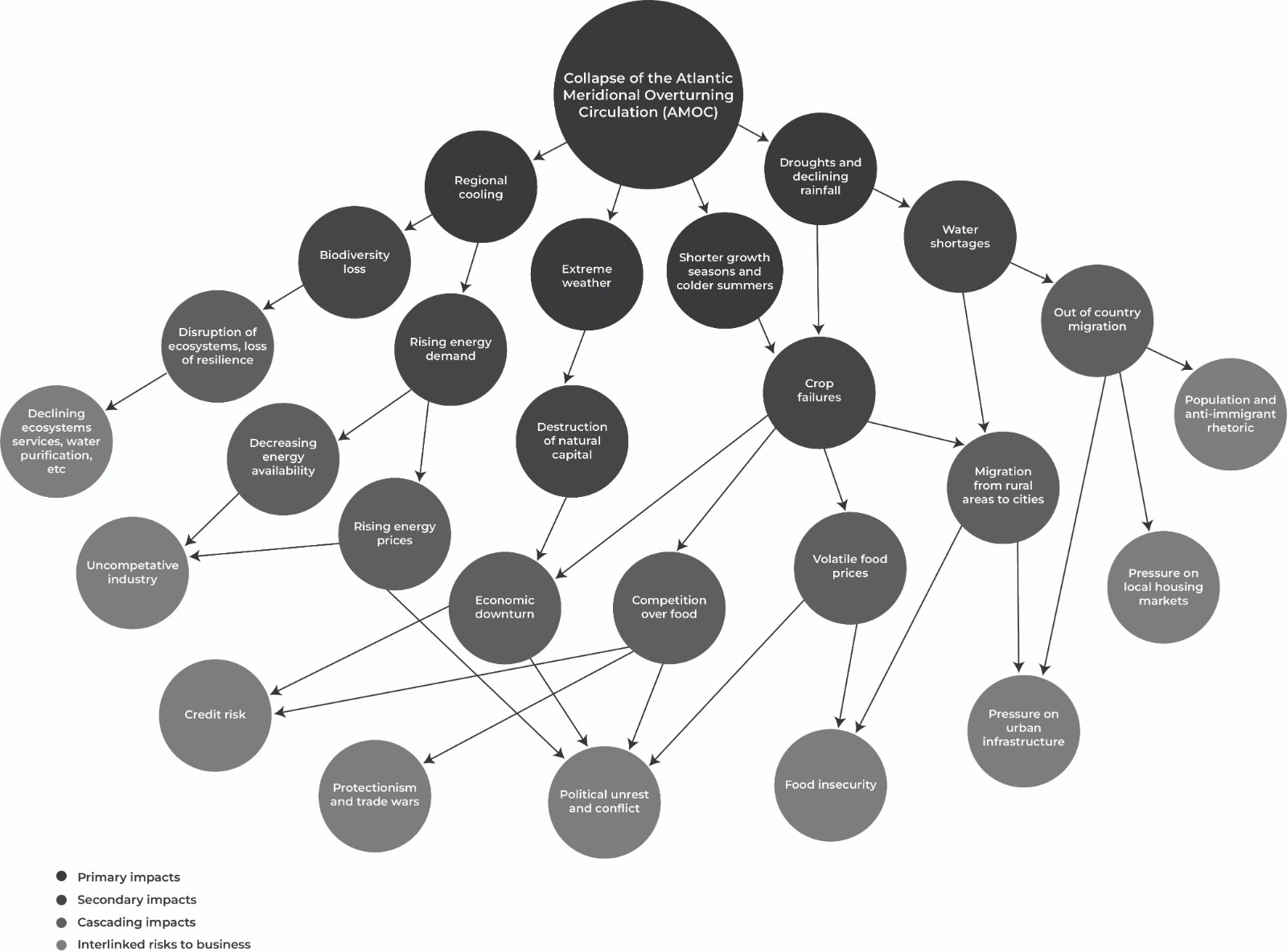
The figure is a modified and expanded version made by the author, inspired by the ‘Verisk Maplecroft Cascading Risks Model’, and based on research from Westen V, et al. [10]; Ditlevsen P, et al. [9]; Yin J, et al. [40]; Velasco JA, et al. [41]; Wang H, et al. [42]; Møller NF, et al. [43]; Ceola S, et al. [44]; Peings Y, et al. [45]; Virna ML, et al. [46]; Ureta C, et al. [47]; Mohammadi Y, et al. [48]; Ionita M, et al. [49], and recent extreme weather examples that illustrate cascading impacts.
From (Figure 4), it is shown that the collapse of the AMOC acts as a significant risk multiplier. It may become a catalyst for a complex web of primary and secondary impacts that resonate throughout social, economic, and environmental systems. An AMOC collapse could lead to severely colder winters [10]. Primary impacts from regional cooling, like the increase in energy demand due to extreme winter conditions could also lead to a rise in energy prices and decreasing energy availability, which could strain industries and increase credit risks as businesses in energy-dependent sectors struggle to adapt to the new economic reality.
Simultaneously, an AMOC collapse leads to longer and more devastating droughts which aggravates the destruction of natural capital [49]. As ecosystems falter, economic effects may worsen. Also economic downturns that are likely to occur due to a reduction in the services these ecosystems provide such as water purification, agriculture support systems, etc. Competition over increasingly scarce natural resources such as freshwater but also biomass and food may intensify, exacerbating political unrest and potential conflicts. More extreme weather may lead to higher food inflation due to droughts and more crop failures [50].
Moreover, reduced rainfall and higher temperatures can lead to water shortages, potential declining crop yields or crop failures, and volatile food prices [37]. These agricultural challenges will have worst consequences for rural areas and contribute to overcrowding in cities as people may of an AMOC collapse migrate in search of better living conditions and employment, placing additional pressure on urban infrastructure.
From here, the expected impacts across societies become uncertain and belong in the ‘unknown-unknown’ category. Expected droughts may be so severe that they resemble the Great American Dust Bowl. From the Dust Bowl, economists have assessed that the U.S. states hit the hardest saw increased migration and lower productivity and investments [51]. But even the worst ecological disaster in U.S. history may fall short in providing a reference that fits the scope and impact of an AMOC collapse.
All in all, the collapse of the AMOC contains several unknown-unknowns; the unpredictability and timing of the tipping point and the associated risks, in particular the impact on water supply, ecosystems, forestry, agriculture but also cascading implications on food prices, ecosystem stability, habitat distribution, impairment of carbon sequestration capabilities in existing wetlands and forests, and ultimately food security and social stability [3].
Additional cascading impacts may be populism and anti-immigrant rhetoric, as locals may perceive newcomers as threats to job security and cultural identity. Such societal shifts may undermine political stability and social cohesion, and could potentially disrupt the fabric of communities, magnifying the geopolitical risks of protectionism and trade wars that can have far-reaching consequences on a global scale. But these second-order impacts are difficult to predict.
Climate Adaptation and Policy Needs: Awareness is low at the moment of such a scenario in the policy community. More modeling is needed, as preparing for such profound impacts not only requires an understanding of the tipping point’s national impacts in Europe, but also further analysis of such a scenario’s impact on the agriculture sector’s vulnerabilities and capacities to adapt to a potentially dryer and colder growth season.
These risks underscore the urgent need for policymakers to enhance their understanding of how changes driven by the Atlantic Meridional Overturning Circulation (AMOC) affect the water cycle. It is crucial to start preserving diverse habitats and to increase investment in research on climate- resilient agriculture as strategic defenses against climate- induced extremes. Furthermore, a deeper comprehension of the interconnections between biodiversity and food production in extreme climate scenarios is essential. Such understanding is vital to address the threats to food security, public health, and freshwater access, which jeopardize local economies and the stability of companies dependent on food systems.
Societal and Environmental Impacts of AMOC Collapse: The potential collapse of the AMOC poses a significant and high-impact risk with potentially permanent and widespread consequences for climate systems, food security, and ecosystems. Direct effects could include altered weather patterns and temperature distributions, not least affecting North America and Europe. Indirectly, it poses threats to water security, agricultural productivity, and biodiversity. These conditions highlight the critical need for scenario- based planning and the development of robust global climate resilience policies.
Underestimation and Impact of Nature-Related Risks: As highlighted earlier, the risks associated with natural systems are often not fully appreciated or understood. A systematic approach to mapping and analyzing the causal chains that trigger widespread, cascading risks can enhance our understanding of why these threats are frequently ignored. The potential collapse of the AMOC, as illustrated in (Figure 4), exemplifies how such an event can have complex and multiplied effects across critical sectors including energy, food, and housing. This complexity underscores the urgent need for research to accurately assess the cost implications of these impacts, when possible.
Policy and Sectoral Strategies May be Needed for Enhanced Preparedness: A key question is how to respond to recent research, given the time horizon mid-century? It seems as prudent advice that government policies and programs are updated and informed by the latest research on an AMOC collapse. Especially given the evidence suggesting we are nearing a tipping point.
The cascading risks uncovered in (Figure 4) underscore the need for further risk mapping and assessment. Government policies that are not only reactive to immediate climate impacts but also proactive in their anticipation of indirect and potentially more destructive secondary effects. The EU Commission’s communication on high impact-low probability events are a good starting point [29]. As these cascading impacts unfold, they create a reinforcing feedback loop that intensifies the primary consequences of an AMOC collapse. And it is perhaps the breadth of impacts and their severity as well as the speed at which they could arrive, which are worrisome. This demands an integrated and robust approach to risk management and mitigation.
From a precautionary standpoint, it is sensible advice that key stakeholders, industry groups and trade associations in high-risk sectors, such as the water supply sector, agriculture, housing and energy, proactively include an AMOC collapse scenario in their strategic planning at this stage. This forward-thinking approach will ensure that these sectors can adapt better to potential large-scale climatic changes mid-century.
Part III: Unraveling How Food Systems Depend on Biodiversity: Cascading Effects Explored
Part III examines the critical connections between biodiversity and global food systems. High impact nature risks, such as severe droughts and floods, exacerbate the threats to biodiversity, further undermining ecosystem productivity and resilience. These risks impair vital processes like crop pollination and water purification. A nexus approach, therefore, not only improves efficiency beyond boosting separate sectors’ output but also strengthens our resilience against these nature risks [52].
Biodiversity loss affects both environment and economy, with over half of global GDP tied to natural capital. This illustrates the economic importance of biological diversity on agriculture, pharmaceuticals, tourism, and water supply [53]. Grasping the economic implications of biodiversity loss is crucial for crafting effective conservation strategies. The agricultural sector, heavily reliant on animal pollination for 75% of worldwide food crop production, is especially vulnerable. Hence, mitigating nature risks stemming from biodiversity loss supports economic growth, resilience and stability.
What We Know: Sectoral Biodiversity Dependencies
The World Economic Forum (WEF) has tremendous agenda-setting power [54]. Increasingly, biodiversity loss has climbed the ladder of the Global Risks reports. Consequently, businesses that have negatively impacted biodiversity are becoming more conscious about mitigating their impacts. But, integrating biodiversity-conscious decisions into business strategies is vital, especially for sectors heavily reliant on natural resources.
Businesses significantly influence biodiversity loss, playing a key role in ecosystem preservation. Torelli R, et al. [55] highlights this, focusing on the approaches of small businesses. Innovation in business can aid biodiversity; businesses can factor in ecosystem impacts in investment decisions, reflecting a growing trend towards incorporating biodiversity in corporate strategies. The ESG movement is evolving, and the adoption of biodiversity risks is a new theme in corporate responsibility reporting. It marks a significant move towards more expansive responsible business practices.
The 2024 Global Risks Report highlights the interdependence between economies and nature’s capital [4]. Economic stability depends on biodiversity - the loss of biological diversity poses risks for businesses, investors, financial systems, and economies. Reliance on natural capital implies inherent vulnerabilities, especially in developing countries. The Global Risks Report brings this to the forefront by ranking biological diversity loss among the top 3 risks to the world towards 2030, in both likelihood and impact.
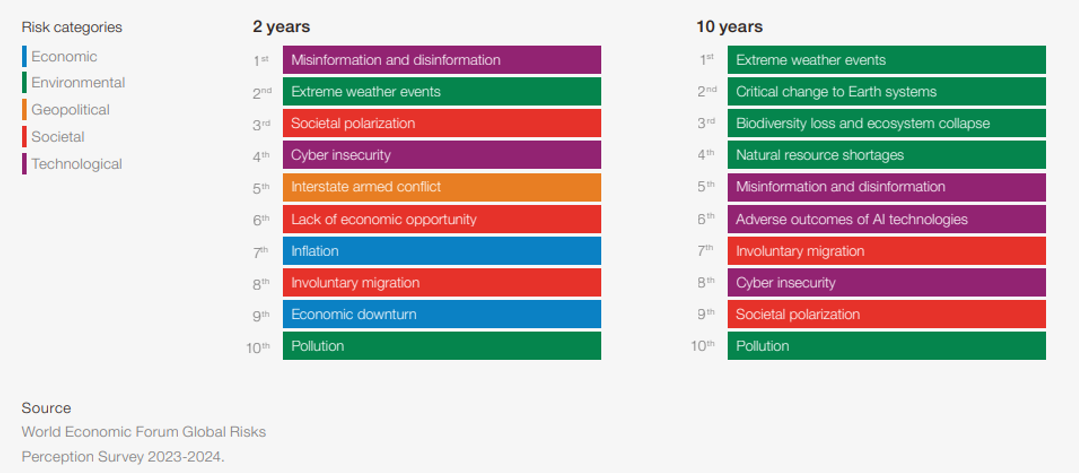
The WEF’s 2023 Global Risks Report anticipates “Biodiversity loss and ecosystem collapse” as not only a threat of abrupt decline this decade but also an intensifying issue. This outlook is supported by the placement of all six environmental hazards, as illustrated in (Figure 5).
The potential cascading economic ramifications are vast due to the entrenchment of biodiversity in certain economic sectors. Sectors including Agriculture, Fishery and Aquaculture, Forestry, and Food, Beverages & Tobacco, which derive over 90% of their value from natural capital, are vulnerable, and the economic impacts from biodiversity loss is detailed in (Figure 5), showing MSCI’s assessment of these dependencies [5]: The Agriculture sector heavily relies on the ecosystem services pollination, soil fertility, and water cycling, making it susceptible to biodiversity loss which can lead to reduced crop yields and increased vulnerability to pests and diseases.
Fishery and Aquaculture are directly dependent on the health of aquatic ecosystems; changes in water temperature, acidity, and habitat destruction can drastically affect fish stocks and the sustainability of these industries. Forestry’s dependence on stable ecosystems ensures the provision of wood and non-wood forest products, while also being crucial for carbon sequestration and water regulation.
![Figure 6: Sectoral Dependencies on Biodiversity [5].](/fulltextimages/12928/fig_6.png)
Integrating biodiversity into risk management is necessary for sectors reliant on natural capital. Agriculture benefits from ecosystem services like pollination. Studies show plant and soil biodiversity positively impact agricultural multifunctionality, enhancing pest control and nutrient cycling, supporting sustainable practices. Transitioning from diverse ecosystems to monocultures, like oil palm plantations, drastically reduces species diversity, leading to food web collapse [56].
Climate change can cause ecological shifts and pollinator loss [57]. Understanding links between climate extremes, agricultural productivity, and food security is essential; climate impacts alter conditions, affecting yields. Extreme weather notably reduces global cereal production, with drought and excessive rainfall primarily impacting U.S. maize.
Recent studies advocate integrating climate and biodiversity risks into environmental-financial risk frameworks. Kedward K, et al. [58] call for transparent disclosure and adjusted financial regulations to mitigate ecological harm. Imposing stricter capital requirements on harmful activities prevents crossing ecological thresholds, necessitating sector-wide coordination. Research linking biodiversity loss with financial instability, like the study on biodiversity-related financial risks (BRFR) in France [59], shows securities issued by entities dependent on ecosystem services, highlighting the terrestrial biodiversity footprint and urging risk assessment reevaluation to include physical and transitional risks.
It is likely that we underestimate the need for resilience of the ecosystems that underpin global food systems, public health, and overall economic well-being. Acknowledging such “missing risks” mark a critical step towards sustainable development and ecological preservation [60].
An Known Unknown: The Cascading Risks to Society of Insufficient Pollinators
How reliant are global food systems on the often- overlooked role of pollinator insects, and what are the potential consequences of their decline? Declining bee and insect populations signify a pressing environmental issue [27]. Pollinators, especially bees, are vital for most crops and wild plants, essential for agricultural productivity and biodiversity [61].
In the ‘known unknowns’ quadrant, we recognize the importance of pollinators but lack comprehensive data on their decline and ecological impacts. The ‘unknown unknowns’ include unexplored effects within ecosystems. Research is necessary to understand the interactions between pollinators, the environment, and dependent sectors [5]. Pollinator loss could decrease plant diversity, affecting food webs and ecosystem services like carbon sequestration and soil fertility.
Inadequate Pollination Implies Cascading Risks to Biodiversity and to Human Health
The decline in pollinator populations triggers effects across ecosystems and societies, reducing agricultural productivity and biodiversity [62]. For example, in Sumatra’s rainforests, oil palm conversions reduce biodiversity, impacting the entire food chain [63].
Cascading impacts include diminished food security, economic stability, and disrupted ecological balances. These decrease plant diversity, impairing food webs and ecosystem services, and emphasize pollinators’ crucial role. This decline in pollination efficacy can escalate market prices of commodities, threatening the global food supply chain, as shown in (Figure 7) [64].
Climate change-induced droughts, pesticides, and habitat loss - these factors stress pollinator populations. Introducing honeybees alone disrupts native bee populations and networks, leading to cascading extinctions [61]. Consequently, Reilly JR, et al. [65] demonstrate a substantial pollination deficit in the U.S., where wild pollinators economically value over $1.5 billion annually.
Smith MR, et al. [66] explore the effects of inadequate pollination on global health by affecting diet-related diseases, emphasizing the vital role of animal pollinators in producing essential foods. Their analysis shows a 3%-5% global reduction in key crop production, with severe economic and health impacts, not least in lower-income regions [66]. Economic losses in Honduras, Nepal, and Nigeria highlight the need for pollinator-friendly practices to protect health and sustainability [66].
The nature risk of pollinator decline affects agriculture, ecosystem biodiversity, and global food security. Loss of pollinators could diminish plant diversity, disrupting food webs and undermining ecosystem services such as carbon sequestration and soil fertility. The direct impacts are seen in decreased crop yields, while indirect effects exacerbate food scarcity and economic instability in agriculture-dependent communities. This necessitates the development of robust conservation strategies.
Given the effects on agriculture, human health, and economic stability, the decline in pollinators is a high- impact risk, underscoring the need for proactive strategies to mitigate biodiversity-related financial risks and ensure stability. Efforts should focus on safeguarding habitats and adopting less harmful farming practices, [67]. Consensus
exist that addressing the primary drivers of biodiversity loss—habitat destruction, pollution, climate change, overexploitation of resources, and the spread of invasive species—is crucial [68, 69].
![Figure 7: How Dependent Are Foods on Pollinator Insects? [64].](/fulltextimages/12928/fig_7.png)
Future investments should aim to bolster pollinator populations and assess their resilience during extreme climate events [70], addressing a critical lever for maintaining global food security, economic stability, and public health. Further research is needed to map and assess the complex interactions between pollinators, the environment, and the biodiversity dependent sectors [5].
Part IV: Mapping the Origin of Recent Pandemics
The Interconnection between Ecosystem Disruption and Zoonotic Diseases
Part IV explores the connection between ecosystem disruptions and the emergence of zoonotic diseases like COVID-19 and avian flu from 2020 to the present. It illustrates how changes in climate and ecosystems contribute to new ‘unknown-unknowns’ and introduce cascading risks, manifesting as unpredictable pandemic threats.
The relationship between habitat degradation and zoonotic diseases is evident from the COVID-19 pandemic [71]. Land use changes like deforestation, intensive agriculture, and the unregulated wildlife trade have impacted biodiversity and ecosystems, increasing pathogen transfer risks to humans.
This disruption leads to wildlife habitat loss and facilitates pathogen transfer to humans. The COVID-19 virus was a complex known unknown in public health; we recognize the existence of animal-borne pathogens and their nature risks but cannot predict their impacts or transfer points. The unpredictability of these events underscores the challenge in predicting and preventing outbreaks despite awareness of biodiversity loss risks.
Over 10,000 virus species, mainly in wild mammals, can infect humans but remain largely unnoticed. Climate change and land use changes may break geographical barriers between species, leading to new interactions and zoonotic spillovers. Researchers use phylogeographical models to identify potential hotspots for novel viral transmissions, particularly in biodiversity-rich but vulnerable regions [72].
Bats, with unique dispersal abilities, are likely major facilitators of new viral transmissions affecting humans. This shift, intensified by climate change, emphasizes the need for coordinated viral surveillance and biodiversity monitoring in the warming tropics to manage emerging zoonotic threats effectively.
The Biodiversity-Climate Nexus: Amplification of Disease Spread by Climate Change
Climate change and habitat destruction accelerate the spread of zoonotic diseases, adding complexity to ecosystem health management. These factors create layers of uncertainty that unpredictably exacerbate conditions conducive to disease proliferation and interspecies transmission.
Climate change influenced the emergence of SARS- CoV-2. Researchers suggest that over the last century, global warming made southern China’s Yunnan Province a favorable habitat for bats, introducing new coronavirus types to the region. They used historical climate data and vegetation maps to track changes in bat species diversity globally [73]. The study highlights the need for addressing climate change to prevent future health crises.
It is essential that our environmental management strategies address the risks posed by environmental degradation, climate change, and emerging infectious diseases comprehensively, combining conservation, surveillance, and public health efforts [74].
Cascading Economic and Societal Impacts of Pandemics
The unfolding of the COVID-19 pandemic has vividly demonstrated the vulnerability of global economic and societal structures to zoonotic diseases. The swift and unprecedented shutdowns in critical sectors such as aviation, hospitality, and entertainment sectors had deep and lasting impacts, showcasing the unpredictable and extensive reach of pandemic-induced disruptions, which in effect were a Black Swan that could be understood and predicted only in hindsight.
These events have served as real-world examples of both known and unknown unknowns, revealing profound weaknesses in our global interconnectivity and underscoring the imperative for more resilient preparedness and recovery frameworks [18].
Strategies for Mitigating Pandemic Risks
The One Health approach integrates human, animal, and environmental health, crucial for addressing zoonotic disease challenges. It promotes a comprehensive strategy that enhances preparedness for disease emergence. Emphasizing global surveillance and cross-sectoral cooperation, the One Health framework strengthens our capacity to handle zoonotic pathogens and pandemic potential [75]. The COVID-19 pandemic reiterated the crucial role of natural ecosystems in maintaining health security and economic stability [76]. Recognizing the risks from ecosystem degradation and biodiversity loss is vital for societal resilience against future pandemics.
Pandemic Nature Risks Revisited: Understanding the Transmission and Impact of H5N1 Avian Flu
H5N1 avian flu, also known as bird flu, is a highly pathogenic virus targeting birds but also capable of infecting humans and other mammals. It raises concerns similar to those during the COVID-19 crisis about the potential for a pandemic sparked by interspecies virus transmission, affecting agriculture, biodiversity, and economic stability.
H5N1 originates in wild aquatic birds and can cause severe respiratory illnesses with high mortality in poultry, posing significant threats to global poultry industries. This virus is monitored closely due to its potential to infect humans and initiate a pandemic, causing widespread outbreaks among poultry, necessitating surveillance and control measures.
Impact and Spread Among Humans and Cattle
The transmission of H5N1 to humans typically occurs through direct contact with infected birds or their environments, underscoring the importance of containment strategies to prevent public health crises.
The 2023-2024 U.S. avian flu outbreak affected 60 million birds, surpassing the 2015 outbreak’s impact. Notably, the outbreak at egg facilities in Texas and Michigan impacted 6 million hens, with national egg supply recovery lagging, leading to increased egg prices.
H5N1 has also caused outbreaks among U.S. dairy farm cows across four states, with a farm worker in Texas contracting the virus, developing conjunctivitis, a symptom in humans exposed to avian flu. The USDA confirms that initial tests show low transmissibility to humans, but the presence of H5N1 in mammals has raised concerns about its potential evolution [77, 78].
Economic and Ecological Consequences: Cascading Risks
The current outbreak necessitates vigilant monitoring of H5N1’s mutation and the development of adaptive response strategies to mitigate potential public health crises. The ability of avian flu to jump species not only poses risks in agricultural settings but also raises significant biodiversity risks with broad economic implications. The outbreak threatens to disrupt agriculture and food sectors, potentially leading to extensive livestock losses, increased food prices, and costly containment measures.
Monitoring cascading risks to the food supply chain is crucial, as seen during the COVID-19 pandemic. Nature risks can influence value chains and impact societal pillars like food security, requiring robust preparedness to manage far-reaching impacts and ensure ecosystem and agricultural stability [79].
The unpredictable nature of H5N1 as it adapts across species emphasizes the need for strategic responses to manage livestock health and stabilize ecosystems integral to agriculture and food production. These scenarios highlight the emergent disease risks requiring substantial resources to address potential outbreaks.
Part IV has explored emergent and existing natural risks, focusing on the uncertainties of zoonotic pandemics and their unpredictable global impacts. It underscores the necessity for reassessing our interactions with nature and promoting sustainable practices to mitigate these risks [74, 18].
Part V: Resolving the Known Unknowns
Part V showcases how advancements in machine learning and DNA sequencing can address the known unknowns in the Rumsfeld Matrix by enhancing conservation efforts and revealing nature risks associated with unknown species. DNA sequencing and machine learning enable exploration of Earth’s species and their extinction risks. Of the 1.5 million known species, many await discovery, both on land and in oceans. Costello MJ, et al. [23] explores biodiversity datasets that show natural ecosystems’ long- tailed distributions: a few species are prevalent, most are rare, helping identify critical conservation areas.
Mapping species distribution helps manage risks like zoonotic diseases or pollinator decline, affecting agriculture and health. Understanding the habitats and behaviors of potential zoonotic carriers aids in preventing global health emergencies. Gangireddy R, et al. [36] 2023 study employs computer vision to recognize previously unidentified species in images, improving species identification and informing biodiversity trends [80].
Artificial intelligence has also enhanced biodiversity monitoring in India, showing promising improvements despite slow initial adoption [81]. A Nature Communications study underscores machine learning’s role in wildlife conservation, from handling diverse ecological data to monitoring ecosystems [82].
Enhancing Climate and Biodiversity Insights Through AI and Supercomputing
Supercomputers and AI represent transformative tools in environmental science, not least in enhancing our understanding of the known unknowns within the climate system, and the intricate nexus between climate change and biodiversity loss. By leveraging the immense computational power of supercomputers, scientists can perform detailed simulations and scenario-based modeling that incorporate an extensive array of variables, from atmospheric conditions to ecological responses. This capability allows for the exploration of complex, cascading impacts that high-impact nature risks pose to societies.
These technologies enable researchers to simulate various future scenarios such as an AMOC collapse scenario in great detail, predicting how changes in one tipping point element of the climate system can lead to significant shifts across entire regions. For instance, by modeling the long- term effects of ice melt on salinity levels and ocean currents, scientists can forecast changes in biodiversity, weather patterns, and even socio-economic conditions.
Ultimately, the integration of AI and supercomputing into environmental research not only deepens our comprehension of ecological and climatic dynamics but also improves our capacity to anticipate and prepare for the cascading effects of environmental disruptions. Better models and scenario building may translate known unknowns into insights on how to manage high impact nature risks.
Part VI: A New Rumsfeld Matrix on Biodiversity Loss - Lessons Learned, Further Research and Conclusions
Part VI explores the Advanced Rumsfeld Matrix derived from the broad literature review on cascading nature risks. It advocates for interdisciplinary collaboration to develop effective strategies and suggests continuous investment in biodiversity research. Future directions include innovation and adaptive policy, strategic conservation planning, and enhanced collaborative efforts to address the complex challenges of halting biodiversity loss.
Below, (Table 8) distills the key characteristics of high impact nature risks examined - pollinator decline, AMOC collapse, and zoonotic pandemics. This comparative overview serves to highlight the complexity and interconnectivity of ecological risks impacting diverse sectors, each characterized by its extensive reach across various sectors and profound cascading effects.
For pollinator decline, the risk poses significant threats to global food security and ecosystem resilience, driven by factors such as habitat destruction and pesticide use. The potential collapse of the Atlantic Meridional Overturning Circulation (AMOC) illustrates a nature risk with far- reaching climatic consequences, potentially destabilizing regional weather systems and impacting water availability on a regional and global scale (Europe, Atlantic and North America). Lastly, zoonotic pandemics, as highlighted by recent global events, underscore the vulnerability of human populations to diseases originating from wildlife, which in turn are influenced by environmental degradation and increased human-wildlife interactions due to urbanization and population growth.
| Nature Characteristics | Risk Global Impact Scale | High Impact | Impacts Across Several Sectors | Cascading Effects | |
|---|---|---|---|---|---|
| Pollinator Decline | Linked to habitat loss, pesticide use, and climate change; crucial for crop and wild plant pollination. | Local to Regional | Yes | Yes | Major agricultural and ecological impacts, affecting food security, biodiversity, and soil health. |
| Pollinator Decline | Impacts nutrient cycling and ecosystem services. | ||||
| AMOC Collapse | Involves the slowing or stopping of major ocean currents, affecting global climate systems and weather patterns. | Planetary | Yes | Yes | Severe regional climate shifts, influencing water cycles, agriculture, and ecosystems globally. |
| AMOC Collapse | Influences global heat distribution and sea level rise. | Potential migrations and socio-economic disruptions. | |||
| Zoonotic Pandemics | Arise from pathogens spilling over from animals to humans, exacerbated by environmental degradation and close wildlife contact. | Regional to Global | Yes | Yes | Global health emergencies, disrupting economies, societies, and ecosystems. |
| Zoonotic Pandemics | Associated with loss of natural habitats. | Leads to international travel and trade restrictions. |
Table 1: Summary of Nature Risk and Impacts.
A New Rumsfeld Matrix Applied to Nature Risks Derived from the Literature Review
The Advanced Rumsfeld Matrix below (Table 9)
condenses the critical insights on nature risks. It aligns known challenges with unpredictable threats.
| Known Knowns | Known Unknowns |
| Extinction rates are 100 to 1000 times higher than natural background rates. | Gaps in understanding of the interdependencies within ecosystems, such as the roles of lesser-known species. |
| Climate change, habitat destruction, deforestation, pollution, and overexploitation are primary drivers of biodiversity loss. | Uncertainty around the impact of climate change on biodiversity. |
| Detailed accounts of species decline in ecosystems, highlighting the impact of activities such as pollution. | Challenges in quantifying the economic value of biodiversity, impacting policy and investment decisions. |
| The economic implications of biodiversity loss, with examples where ecosystem service degradation has led to financial losses. | The exact number of species at risk of extinction due to rapid climate change. |
| Technological advancements such as DNA sequencing, machine learning, and computer vision are crucial in identifying unknown species and monitoring ecosystems, significantly advancing our capabilities in mapping and understanding nature risks flowing from biodiversity. | Effects of biodiversity loss on ecosystem services, such as in under-researched ecosystems. |
| Economic impacts of biodiversity loss on different sectors, highlighting the entrenchment of biodiversity in the global economy. | |
| Develop and implement robust monitoring strategies for H5N1’s mutation potential and cross-species transmission capabilities to enhance pandemic preparedness. | |
| Unknown Knowns | Unknown Unknowns |
| Hidden resilience factors within ecosystems that may offer buffers against biodiversity loss, yet are not fully understood. | Future technological advancements and their impact on biodiversity conservation. |
| Successful conservation strategies that have been documented to work in certain regions, offering models for replication. | COVID-19 revealed critical gaps in our understanding of zoonotic diseases’ emergence due to habitat and biodiversity loss. |
| Past hyperthermals, like the PETM, significant for their high greenhouse gas levels (carbon spiking), offer insights into today’s biodiversity loss during a rapid warming period. | Unpredictable genetic adaptations of H5N1 influence interspecies transmission dynamics, necessitating exploration into how viral changes could unexpectedly impact global health security and trigger cascading economic and ecological risks from zoonotic threats. |
| Dramatic shifts in ecosystems due to the flipping of important climate tipping points such as an AMOC collapse, leading to unforeseen impacts on regional and oceanic biodiversity. | |
| Cascading impact events from an AMOC collapse such as droughts, disturbance of rainfall patterns and colder winters resulting in ecological consequences across both land-based and marine ecosystems. Second-order effects on socio-economic systems such as agriculture, forestry, biomass use in energy systems, fisheries, etc. |
Table 2: An Advanced Rumsfeld Matrix.
The following lessons are derived from the literature review
Deepening the Climate Change-Biodiversity Nexus Agenda: The fourth quadrant contains the unpredictable “Black Swans”. Radical ecosystem interactions could be worsened by human impact and climate change such as the AMOC collapse, impacting regional biodiversity. Future efforts must develop adaptive, proactive strategies addressing unexpected biodiversity challenges, integrating biodiversity into economic models for sustainable development, and enhancing predictive ecological impact modeling under extreme climate scenarios [83].
COVID-19 and the Avian Flu has illuminated the links between biodiversity loss and zoonotic diseases. The pandemic stresses the importance of adopting a One Health approach that recognizes the interconnectedness of climate change, humans, animals, and habitats in addressing nature risks. Future research must focus on this nexus to prevent pandemics [84].
Integration of Technological Advancements: Image recognition technology is crucial for species identification and monitoring. Supercomputing, AI and ML enhance our ability to analyze big data, enabling rapid biodiversity assessments and accurate wildlife inventories, predicting ecological trends and uncovering patterns that might be missed by human analysis [85]. There may be a growing promise in how new nature risks can be uncovered, understood and mitigated.
Strengthening the Research Agenda on High Impact Nature Risks: The synthesis of insights from the Atlantic Meridional Overturning Circulation (AMOC) collapse scenario and the role of pollinators in ensuring food security highlights the necessity of an integrated and robust research agenda that addresses high impact nature risks, employing the precautionary principle in policy-making to navigate the uncertainties inherent in the climate-biodiversity nexus [34, 86, 87].
Scenario Modeling and Technological Advancements in Addressing Cascading Nature Risks: Investments in DNA sequencing reveal unknown species’ genetic blueprints, while image recognition and supercomputing, enhanced by AI and ML, enable better big data analysis. This capability allows for rapid biodiversity assessments, wildlife inventories, and the prediction of ecological trends, uncovering patterns often missed by humans [85].
Scenario modeling and the use of supercomputing simulates interactions between complex systems—climate, ecosystems, human societies—to assess the impacts of extreme events. To better understand cascading risks, we have to account for feedback loops between ecological degradation, social systems and economic systems, showing how a climatic tipping point can have impacts on water, food and natural resources, thereby creating social vulnerabilities, leading to governance challenges and societal instability [88, 89].
Interdisciplinary Collaboration on Nature Risks: Addressing biodiversity loss demands collaboration across disciplines, integrating climate science, artificial intelligence, big data, and statistics to develop strategies. This approach leverages diverse expertise to create better strategies to handle nature risks [90, 91, 92, 93, 94, 95, 96, 97, 98, 99, 100, 101, 102, 103, 104, 105, 106, 107, 108, 109, 110, 111, 112, 113, 114, 115, 116, 117, 118, 119, 120, 121, 122, 123, 124, 125, 126, 127, 128, 129, 130, 131, 132, 133, 134, 135, 136, 137, 138, 139, 140, 141, 142].
Conclusions
This paper has examined three distinct nature risks: pollinator decline, AMOC collapse, and zoonotic diseases like COVID-19 and H5N1, detailing their varying impacts on society. The risk to nature covered in the paper is a silent crisis that requires innovative responses to prevent nature risks from cascading through society. This study utilized content analysis and literature review, drawing from conservation articles and exploratory research to examine biodiversity loss, categorizing insights into Rumsfeld’s framework. The Rumsfeld Matrix has proven useful in this study and may serve as a strategic tool for policymakers and scientists to categorize and prioritize areas for collective action and further research.
Drawing lessons from the COVID-19 pandemic, an ‘unknown-unknown’ and a Black Swan event, underscores the imperative for integrating zoonotic disease surveillance within biodiversity conservation strategies. Enhanced monitoring will help us anticipate and mitigate the disruptive impacts of future unpredictable high impact global health crises. Considering the zoonotic origins of COVID-19 and H5N1, and considering the impact of climate change driving species beyond their traditional habitats, it is essential to map and mitigate new emerging zoonotic threats through the climate-biodiversity lens. This approach underlines the need for a cohesive strategy to prevent new zoonotic diseases.
We know an AMOC collapse could occur this century, and more research deepens our understanding of the tipping point, but we do not know for sure when it will occur. Extreme climate change, highlighted by the potential mid-century tipping point for the Atlantic Meridional Overturning Circulation (AMOC) collapse, emphasizes the urgency of understanding the links between climate extremes, agricultural productivity, and food security. The associated risks, particularly around climate tipping points, could be significant and severe, underscoring the critical need for societal planning. Employing scenario analysis to anticipate these tipping points can strengthen biodiversity resilience in the face of climate unpredictability, highlighting the importance of proactive and integrated strategies to navigate these complex environmental challenges.
This paper calls for innovative, cross-disciplinary strategies that can adapt to the unpredictable dynamics of nature risks, advocating for collaborative efforts among scientists, technologists, data experts, policymakers, and stakeholders to tackle nature risks, including the profound implications of an AMOC collapse on water supply, farming, and ecosystems. This demands an enhanced awareness of AMOC-driven changes, urging the preservation of diverse habitats and the promotion of climate-resilient farming as strategic defenses against climate-induced extremes.
The study has not only outlined our current understanding and knowledge gaps but also emphasized the importance of proactive measures. It introduces the emerging field of ‘nature risk management,’ urging the development of strategies and preparedness to build long-term resilience against unpredictable environmental challenges. This underscores the significance of nature risks as a vital new area of research.
While all pose significant challenges, the potential for enduring, cascading effects from an AMOC collapse could be particularly severe. Consequently, it is now important to develop scenarios and enhance policymaking to prepare societies for such high-impact nature risks. It may well be time for policy-makers and investors to ask themselves: Are we sufficiently aware of high impact nature risks? And how may we prevent future high impact nature risks from cascading through society?
Disclaimer
The contents of this research article are not meant to recommend courses of actions or investment decisions on the basis of the nature risks identified and analyzed. The contents are intended to inform you as a reader, and to identify research and policy gaps for further work. Any financial gain or loss incurred by a reader because of this article will result from decisions taken by the reader as an individual. I am not a certified financial advisor. Every investor must conduct their own due diligence. The opinions expressed in this research article are my own as an individual, and do not reflect the opinions of my current employer.
References
-
Valk DG, Goldbach O (2021) Towards a Robust β Research Design: On Reasoning and Different Classes of Unknowns. Journal of Intelligence History 20(1): 72-87.
-
Loxdale HD, Davis BJ, Davis RA (2016) Known Knowns and Unknowns in Biology. Biological Journal of the Linnean Society 117(2): 386-398.
-
Hald-Mortensen C (2024) Applying the Rumsfeld Matrix: Unknown Unknown Climate Risks in an AMOC Collapse Scenario. Journal of Ecology and Natural Resources 8(1): 1-9.
-
WEF (2024) The Global Risks Report. World Economic Forum.
-
MSCI (2023) Biodiversity in Sustainable Finance.
-
Murphy JT, Breeze TD, Willcox B, Kavanagh H, Stout JC (2022) Globalisation and pollinators: Pollinator declines are an economic threat to global food systems. People and Nature 4(3): 773-785.
-
OECD (2022) Climate Tipping Points: Insights for Effective Policy Action. OECDiLibrary Publishing, Paris, pp: 90.
-
The Global Tipping Points Report 2023. (2023) In: Lenton TM, et al. (eds.), University of Exeter, Exeter, United Kingdom, pp: 1-11.
-
Ditlevsen P, Ditlevsen S (2023) Warning of a Forthcoming Collapse of the Atlantic Meridional Overturning Circulation. Nature Communications 14(1): 18.
-
Westen RMV, Kliphuis M, Dijkstra HA (2024) Physics- Based Early Warning Signal Shows that AMOC Is on Tipping Course. Science Advances 10(6): eadk1189.
-
Kemp L, Xu C, Depledge J, Ebi KL, Gibbins G, et al. (2022) Climate Endgame: Exploring Catastrophic Climate Change Scenarios. Proceedings of the National Academy of Sciences 119(34): e2108146119.
-
Hodge N (2021) How to Address Low-Probability, High- Impact Risks. Risk Management Magazine, New York.
-
Hampton JA, Aina B, Andersson JM, Mirza HZ, Parmar S (2012) The Rumsfeld Effect: The Unknown Unknown. Journal of Experimental Psychology: Learning, Memory, and Cognition 38(2): 340-350.
-
Boring R (2010) Bridging Resilience Engineering and Human Reliability Analysis. 10th International Conference on Probabilistic Safety Assessment and Management 2010 (PSAM 2010) 2: 1353-1360.
-
Martin W (2009) On Modeling and Interpreting the Economics of Catastrophic Climate Change. The Review of Economics and Statistics 91(1): 1-19.
-
Werner H (1927) Über den Anschaulichen Inhalt der Quantentheoretischen Kinematik und Mechanik. Zeitschrift für Physik 43: 72-198.
-
Gadgil M, Berkes F, Folke C (1993) Indigenous knowledge for biodiversity conservation. AMBIO-STOCKHOLM- 22: 151-156.
-
Taleb NN (2007) The Black Swan: The Impact of the Highly Improbable. Random House, The New York Times.
-
Kelly AM (2023) Adopting an institutional approach– moving from silos to mainstreaming inclusion. Making Inclusive Higher Education a Reality. Routledge, pp: 21- 32.
-
Logan DC (2009) Known knowns, known unknowns, unknown unknowns and the propagation of scientific enquiry. Journal of experimental botany 60(3): 712-714.
-
Hannah S (2019) Literature review as a research methodology: An overview and guidelines. Journal of business research 104: 333-339.
-
Cardinale BJ, Duffy JE, Gonzalez A, Hooper DU, Perrings C, et al. (2012) Biodiversity Loss and Its Impact on Humanity. Nature 486: 59-67.
-
Costello MJ (2015) Biodiversity: The Known Unknown and Rates of Extinction. Current Biology 25: R368-R371.
-
De Melo MRS, Caires RA, Sutton TT (2020) The Scientific Explorations for Deep-Sea Fishes in Brazil: The Known Knowns, the Known Unknowns, and the Unknown Unknowns. Brazilian Deep-Sea Biodiversity, pp: 153- 216.
-
Gangireddy R (2023) Knowing the Unknown: Open- World Recognition for Biodiversity Datasets. Master’s Thesis, University of Twente, pp: 1-119.
-
Foster GL, Hull P, Lunt DJ, Zachos JC (2018) Placing Our Current ‘Hyperthermal’ In The Context Of Rapid Climate Change In Our Geological Past. Philosophical Transactions of the Royal Society A 376(2130): 20170086.
-
Page ML, Williams NM (2023) Honey Bee Introductions Displace Native Bees and Decrease Pollination of a Native Wildflower. Ecology 104(2): e3939.
-
Biggs S (2010) Between Zero and One: On the Unknown Knowns. Edinburgh College of Art, pp: 1-8.
-
European Commission (2022) Enhanced Preparedness and Management of High-Impact Low-Probability or Unexpected Events. CORDIS-EU research results.
-
Climate Discussion Nexus (2021) IPCC, AR6: “Low- likelihood, High-impact Events, Unspun Edition.
-
Vegt, GSVD, Essens P, Wahlsrtom M, George G (2015) Managing risk and resilience. Academy of Management Journal 58(4): 971-980.
-
Mc Craine S, Anderson C, Weber C, Shaw RM (2019) The Nature of Risk: A Framework for Understanding Nature- related Risk to Business. World Wildlife Fund.
-
Weitzman ML (2009) The extreme uncertainty of extreme climate change: An overview and some implications. Harvard University, Boston, pp: 1-31.
-
Nordhaus WD (2011) The Economics of Tail Events with an Application to Climate Change. Review of Environmental Economics and Policy 5(2).
-
Rahmstorf S (2024) Is the Atlantic overturning circulation approaching a tipping point? Oceanography, pp: 1-14.
-
Thornalley DJR, Oppo DW, Ortega P, Robson JI, Brierley CM, et al. (2018) Anomalously Weak Labrador Sea Convection and Atlantic Overturning During the Past 150 Years. Nature 556(7700): 227-230.
-
Caesar L, Rahmstorf S, Robinson A, Feulner G, Saba V (2018) Observed Fingerprint of a Weakening Atlantic Ocean Overturning Circulation. Nature 556: 191-196.
-
Ritchie PDL, Smith GS, Davis KJ, Fezzi C, Halleck-Vega S, et al. Shifts in National Land Use and Food Production in Great Britain After a Climate Tipping Point. Nature Food 1: 76-83.
-
Steininger KW, Wagner G, Watkiss P, König M (2014) Climate Change Impacts at the National Level: Known Trends, Unknown Tails, and Unknowables. In: Bednar- Friedl B, et al. (Eds.), Economic Evaluation of Climate Change Impacts. Springer, Cham, pp: 441-459.
-
Ritchie H, Rosado P, Roser M (2019) Environmental Impacts of Food and Agriculture. Our World in Data.
-
Yin J, Zhao M (2021) Influence of the Atlantic meridional overturning circulation on the U.S. extreme cold weather. Communications Earth & Environment 2: 218.
-
Velasco JA, Estrada F, Calderón-Bustamante O, Swingedouw D, Ureta C, et al. (2021) Synergistic Impacts of Global Warming and Thermohaline Circulation Collapse on Amphibians. Communications Biology 4:
-
Wang H, Zuo Z, Qiao L, Zhang K, Sun C, et al. (2021) Frequency of winter temperature extremes over northern Eurasia dominated by AMOC. Research Square Preprint pp: 1-16.
-
Møller NF, Oksbjerg M (2024) The Most Significant Financial Risks from Climate Change and Green Transition. Climate 6: 1-58.
-
Ceola S, Mård J, Di Baldassarre G (2023) Drought and human mobility in Africa. Earth’s Future 11(12): e2023EF003510.
-
Peings Y, Magnusdottir G (2014) Forcing of the Wintertime Atmospheric Circulation by the Multidecadal Fluctuations of the North Atlantic Ocean. Environmental Research Letters 9(3): 034018.
-
Meccia VL, Simolo C, Bellomo K, Corti S (2023) Extreme Cold Events in Europe under a Reduced AMOC. Environmental Research Letters 19(1): 014054.
-
Ureta C, Ramírez-Barahona S, Calderón-Bustamante Ó, Cruz-Santiago P, Gay-Gracia C, et al. (2022) Evaluation of animal and plant diversity suggests Greenland’s thaw hastens the biodiversity crisis. Communications Biology 5: 985.
-
Mohammadi Y, Palstev A, Polajžer B, Miraftabzadeh SM, Khodadad D (2023) Investigating Winter Temperatures in Sweden and Norway: Potential Relationships with Climatic Indices and Effects on Electrical Power and Energy Systems. Energies 16(14): 5575.
-
Monica I, Viorica N, Patrick S, Mihai D (2022) Long- term drought intensification over Europe driven by the weakening trend of the Atlantic Meridional Overturning Circulation. Journal of Hydrology: Regional Studies 42: 101176.
-
Kotz M, Kuik F, Lis E, Nickel C (2024) Global warming and heat extremes to enhance inflationary pressures. Communications Earth & Environment 5: 116.
-
Hornbeck R (2012) The enduring impact of the American Dust Bowl: Short-and long-run adjustments to environmental catastrophe. American Economic Review 102(4): 1477-1507.
-
Hoff H (2011) Understanding the Nexus. Policy Commons. Sweden.
-
World Economic Forum (2020) Nature Risk Rising: Why the Crisis Engulfing Nature Matters for Business and the Economy.
-
Garsten C, Sörbom A (2018) Discreet power: How the world economic forum shapes market agendas. Stanford University Press, pp: 240.
-
Torelli R, Balluchi F (2023) Biodiversity Management Approaches in Small and Innovative Businesses: Insights from a Systems Thinking Perspective. Social Responsibility Journal 19(7): 1297-1319.
-
Buzhdygan OY, Petermann JS (2023) Multitrophic Biodiversity Enhances Ecosystem Functions, Services and Ecological Intensification in Agriculture. Journal of Plant Ecology 16(6): 1-22.
-
Khalfaoui R, John WG, Wali M, Zubair M, Giray G et al. Impact of Climate Risk Shocks on Global Food and Agricultural Markets: A Multiscale and Tail Connectedness Analysis. International Review of Financial Analysis 93.
-
Kedward K, Ryan-Collins J, Chenet H (2022) Biodiversity Loss and Climate Change Interactions: Financial Stability Implications for Central Banks and Financial Supervisors. Climate Policy 23(6): 763-781.
-
Svartzman R, Espagne E, Gauthey J, Hadji-Lazaro P, Salin M, et al. (2021) A ’Silent Spring’ for the Financial System? Exploring Biodiversity-Related Financial Risks in France. Working Paper, Banque de France 826: 1-95.
-
Rising J, Tedesco M, Piontek F, Stainforth DA (2022) The Missing Risks of Climate Change. Nature 610: 643-651.
-
Nasrollahi FSF, Campbell C, Albert R (2023) Predicting Cascading Extinctions and Efficient Restoration Strategies in Plant–Pollinator Networks via Generalized Positive Feedback Loops. Scientific Reports 13(1): 902.
-
Dunne JA, Williams RJ, Martinez ND (2022) Network Structure and Biodiversity Loss in Food Webs: Robustness Increases with Connectance. Ecology Letters 5(4): 558-567.
-
Barnes AD, Allen K, Kreft H, Corre MD, Jochum M, et al. (2017) Direct and Cascading Impacts of Tropical Land-Use Change on Multi-Trophic Biodiversity. Nature Ecology & Evolution 1(10): 1511-1519.
-
(2021) OurWorldinData.
-
Reilly JR, Artz DR, Biddinger D, Bobiwash K, Boyle NK, et al. (2020) Crop Production in the USA is Frequently Limited by a Lack of Pollinators. Proceedings of the Royal Society B: Biological Sciences 287(1931).
-
Smith MR, Mueller ND, Springmann M, Sulser TB, Garibaldi LA, et al. (2022) Pollinator Deficits, Food Consumption, and Consequences for Human Health: A Modeling Study. Environmental Health Perspectives 130(12).
-
Nicole W (2023) Unfulfilled Promise: Pollinator Declines, Crop Deficits, and Diet-Associated Disease. Environmental Health Perspectives 131(2).
-
IPBES (2019) Summary for Policymakers of the Global Assessment Report on Biodiversity and Ecosystem Services of the Intergovernmental Science-Policy Platform on Biodiversity and Ecosystem Services. IPBES Secretariat, Bonn, Germany, pp: 56.
-
Hald-Mortensen C (2023) The Main Drivers of Biodiversity Loss: A Brief Overview. Journal of Ecology and Natural Resources 7(3): 1-7.
-
Mehrabi Z, Delzeit R, Ignaciuk A, Levers C, Braich G, et al. (2022) Research priorities for global food security under extreme events. One Earth 5(7): 756-766.
-
Satapathy MK, Kumar H, Yang CH, Yen TL, Das P (2023) Pandemics, environment, and globalisation: Understanding the interlinkage in the context of COVID-19. Emerging Pandemics. CRC Press, pp: 63-80.
-
Carlson CJ, Albery GF, Merow C, Christopher HT, Zipfel CM, et al. (2022) Climate Change Increases Cross-Species Viral Transmission Risk. Nature 603(7902): 555-560.
-
Beyer RM, Manica A, Mora C (2021) Shifts in Global Bat Diversity Suggest a Possible Role of Climate Change in the Emergence of SARS-CoV-1 and SARS-CoV-2. Science of the Total Environment 761: 145413.
-
Wilkinson DA, Marshall JC, French NP, Hayman DTS (2018) Habitat Fragmentation, Biodiversity Loss and the Risk of Novel Infectious Disease Emergence. Journal of The Royal Society Interface 15(149): 1-10.
-
MconsBiol OKL, Allan HL, Baxter PWJ, Castagnino R, Tor MC, et al. (2021) The COVID-19 Pandemic Is Intricately Linked to Biodiversity Loss and Ecosystem Health. The Lancet Planetary Health 5(11): e840-e850.
-
Thurstan RH, Hockings KJ, Hedlund JSU, Bersacola E, Collins C, et al. (2021) Envisioning a resilient future for biodiversity conservation in the wake of the COVID‐19 pandemic. People and Nature 3(5): 990-1013.
-
(2024) Bird Flu Hits Texas Dairy Cows, Hens, Human; Ducks Migrate.
-
Cohen J. Worries about bird flu in US cattle intensify. Science 384(6691): 12-13.
-
Kozlov M, Mallapaty S (2024) Bird Flu Outbreak in US Cows: Why Scientists Are Concerned. Nature 628(8008): 484-485.
-
Villon S, Iovan C, Mangeas M, Vigliola L (2022) Confronting Deep-Learning and Biodiversity Challenges for Automatic Video-Monitoring of Marine Ecosystems. Sensors 22(2): 497.
-
Shivaprakash KN, Swami N, Mysorekar S, Arora R, Gangadharan A, et al. Potential for artificial intelligence (AI) and machine learning (ML) applications in biodiversity conservation, managing forests, and related services in India. Sustainability 14(12): 7154.
-
Silvestro D, Goria S, Sterner T, Antonelli A (2022) Improving biodiversity protection through artificial intelligence. Nat Sustain 5: 415-424.
-
Paleari S (2024) The EU policy on climate change, biodiversity and circular economy: Moving towards a Nexus approach. Environmental Science & Policy 151: 103603.
-
Pereira HM, Navarro LM, Martins IS (2012) Global Biodiversity Change: The Bad, the Good, and the Unknown. Annual Review of Environment and Resources 37: 25-50.
-
Anna S, Joao MS, Remi W, Richard K, Steffano B, et al. Learning from COVID-19: A roadmap for integrated risk assessment and management across shocks of pandemics, biodiversity loss, and climate change. Environmental Science & Policy 155: 103726.
-
Lewin HA, Robinson GE, Kress WJ, Baker WJ, Coddington J, et al. (2018) Earth BioGenome Project: Sequencing life for the future of life. Proceedings of the National Academy of Sciences 115(17): 4325-4333.
-
Kamalaporn K, Schmidt M, Krawczynski R, Wiegleb G (2012) Has Implementation of the Precautionary Principle Failed to Prevent Biodiversity Loss at the National Level? Biodiversity and Conservation 21(13): 3307-3322.
-
Bartkowski B (2018) Economic Valuation of Biodiversity: An Interdisciplinary Conceptual Perspective. Routledge Taylor & Francis, pp: 182.
-
Lawrence J, Blackett P, Cradock-Henry NA (2020) Cascading climate change impacts and implications. Climate Risk Management 29: 100234.
-
Butsch C, Beckers LM, Nilson E, Frassl M, Brennholt N, et al. (2023) Health impacts of extreme weather events– Cascading risks in a changing climate. Journal of health monitoring 8(4): 33-56.
-
Anadón JD, Sala OE, Maestre FT (2014) Climate Change Will Increase Savannas at the Expense of Forests and Treeless Vegetation in Tropical and Subtropical Americas. Journal of Ecology 102(6): 1363-1373.
-
Benton MJ (2018) Hyperthermal-Driven Mass Extinctions: Killing Models During the Permian–Triassic Mass Extinction. Philosophical Transactions of the Royal Society A: Mathematical, Physical and Engineering Sciences 376(2130): 20170076.
-
Boas I, Biermann F, Kanie N (2016) Cross-Sectoral Strategies in Global Sustainability Governance: Towards a Nexus Approach. International Environmental Agreements: Politics, Law and Economics 16(3): 449- 464.
-
Cavallo A, Ireland V (2014) Preparing for complex interdependent risks: a system of systems approach to building disaster resilience. International journal of disaster risk reduction 9: 181-193.
-
Chenet H (2019) Planetary Health and the Global Financial System. pp: 26.
-
Chenet H, Ryan-Collins J, Lerven FV (2021) Finance, Climate-Change and Radical Uncertainty: Towards a Precautionary Approach to Financial Policy. Ecological Economics 183(2021): 106957.
-
Convention on Biological Diversity (2006) Article 2. Use of Terms. Secretariat of the Convention on Biological Diversity.
-
Dempsey J (2015) Fixing Biodiversity Loss. Environment and Planning A: Economy and Space 47(12): 2555-2572.
-
Vos JMD, Joppa LN, Gittleman JL, Stephens PR, Pimm SL (2015) Estimating the normal background rate of species extinction. Conservation biology 29(2): 452-462.
-
Deprez A, Rankovic A, Landry J, Treyer S, Vallejo L, et al. Aligning High Climate and Biodiversity Ambitions in 2021 and Beyond: Why, What, and How? INIS 53(4).
-
Dunne JA, Williams RJ, Martinez ND (2002) Network Structure and Biodiversity Loss in Food Webs: Robustness Increases with Connectance. Ecology Letters 5(4): 558-567.
-
Earth.Org How Does Climate Change Affect Pollinators and Put Our Food Supply at Risk?
-
Environmental Protection Agency (2023) Climate Change Indicators: Atmospheric Concentrations of Greenhouse Gases. United States Environmental Protection Agency.
-
European Commission (2023) The Common Agricultural Policy: 2023-27. Agriculture and rural development.
-
European Commission (2017) Directorate-General for Environment, et al. Study on the Precautionary Principle in EU Environmental Policies. Publications Office of the EU.
-
European Environment Agency (2022) Carbon Stocks and Sequestration in Terrestrial and Marine Ecosystems: A Lever for Nature Restoration?
-
Foster GL, Royer DL, Lunt DJ et al. (2017) Future Climate Forcing Potentially Without Precedent in the Last 420 Million Years. Nature Communications 8: 14845.
-
Gingerich PD (2012) Paleocene-Eocene Thermal Maximum (PETM) and its Effects on Continental Biotas: Evidence from Polecat Bench in Northwestern Wyoming. AGU Fall Meeting Abstracts.
-
Gleixner G, Kramer C, Hahn V, Sachse D (2005) The Effect of Biodiversity on Carbon Storage in Soils. In: Scherer-Lorenzen M, et al (Eds.), Forest Diversity and Function: Temperate and Boreal Systems, Springer Berlin Heidelberg 176: 165-183.
-
Hald-Mortensen C (2023) Towards Net Zero: Delivering the Forestry Stabilization Wedge. Journal of Agriculture Earth & Environmental Sciences 2(4).
-
Hansen JE, Sato M, Simons LS, Nazarenko LS, Sangha I, et al. (2023) Global Warming in the Pipeline. Oxford Open Climate Change 3(1).
-
Johnson CA, Dutt P, Levine JM (2022) Competition for Pollinators Destabilizes Plant Coexistence. Nature 607: 721-725.
-
Sullivan MJP, Talbot J, Lewis SL, Phillips OL, Qie L, et al. (2017) Diversity and Carbon Storage Across the Tropical Forest Biome. Scientific Reports 7(39102).
-
Malcolm JR, Markhan A, Neilson RP, Garaci M (2002) Estimated migration rates under scenarios of global climate change. Journal of Biogeography 29(7): 835-849.
-
McInerney FA, Wing SL (2011) The Paleocene- Eocene Thermal Maximum: A Perturbation of Carbon Cycle, Climate, and Biosphere with Implications for the Future. Annual Review of Earth and Planetary Sciences 39: 489-516.
-
McWhorter JK, Halloran PR, Roff G, Skirving WJ, Perry CT, et al. (2022) The Importance of 1.5°C Warming for the Great Barrier Reef. Global Change Biology 28(4): 1332-1341.
-
Mehrabi Z, Delzeit R, Ignaciuk A, Levers C, Braich G, et al. (2022) Research priorities for global food security under extreme events. One Earth 5(7): 756-766.
-
Camilo M, Tittensor DP, Adl S, Simpson AGB, Worm B, et al. (2011) How Many Species Are There on Earth and in the Ocean?” PLoS Biology 9(8): e1001127.
-
Myers N (1993) Biodiversity and the Precautionary Principle. Ambio 22(2/3): 74-79.
-
National Commission on Terrorist Attacks Upon the United States (2004)The 9/11 Commission Report: Final Report of the National Commission on Terrorist Attacks Upon the United States. Authorized Edition. W.W. Norton & Company.
-
NOAA’s National Ocean Service (2024) Atlantic Meridional Overturning Circulation.
-
Perry N (2013) The Precautionary Principle, Uncertainty and the Noah’s Ark Problem. Wildlife Research 40(2): 117-125.
-
Pigot AL, Merow C, Wilson A, Christopher HT (2023) Abrupt Expansion of Climate Change Risks for Species Globally. Nat Ecol Evol 7: 1060-1071.
-
Pimm SL (2012) Biodiversity: Not Just Lots of Fish in the Sea. Current Biology 22(23): R996-R997.
-
Rockström J, Steffen W, Noone K, Persson A, Chapin FS, et al. (2009) Planetary Boundaries: Exploring the Safe Operating Space for Humanity. Ecology and Society 14(2): 32.
-
Rosas KM, Pattberg P (2023) 13: Partnerships for SDGs: Facilitating a Biodiversity–Climate Nexus?”. The Environment in Global Sustainability Governance. Bristol University Press, Bristol, United Kingdom, pp: 297-316.
-
Rossi S, Rizzo L (2020) Marine animal forests as carbon immobilizers or why we should preserve these three-dimensional alive structures. Perspectives on the Marine Animal Forests of the World, pp: 333-400.
-
Rutgers (2020) Decline of Bees, Other Pollinators Threatens U.S. Crop Yields. Rutgers University.
-
Stein BA, Rebecca MS (2013) Biodiversity Conservation for a Climate-Altered Future. In: Susanne CM, et al.(Eds.), Successful Adaptation: Linking Science and Practice in Managing Climate Change Impacts, Routledge.
-
Stephenson PJ (2020) Technological Advances in Biodiversity Monitoring: Applicability, Opportunities and Challenges. Current Opinion in Environmental Sustainability 45: 36-41.
-
Talukder B, Ganguli N, Matthew R, Vanloon GW, Hipel KW, et al. (2022) Climate Change-Accelerated Ocean Biodiversity Loss & Associated Planetary Health Impacts. The Journal of Climate Change and Health 6: 100114.
-
The Guardian (2022) Carbon Dioxide Levels Increase Global Heating: Study. Guardian News & Media Limited.
-
Thomas CD, Cameron A, Green RE, Bakkenes M, Beaumont LJ, et al. (2004) Extinction Risk from Climate Change. Nature 427(6970): 145-148.
-
Tuia D, Kellenberger B, Beery S, Costelloe R, Zuffi S, et al. (2022) Perspectives in Machine Learning for Wildlife Conservation. Nat Commun 13: 792.
-
UN News (2019) World is ‘on Notice’ as Major UN Report Shows One Million Species Face Extinction.
-
Waldron A, Miller DC, Redding D, Mooers A, Kuhn TS, et al. (2017) Reductions in Global Biodiversity Loss Predicted from Conservation Spending. Nature 551: 364-367.
-
Williams DR, Balmford A, Wilcove DS (2020) The Past and Future Role of Conservation Science in Saving Biodiversity. Conservation Letters 13(4): e12720.
-
Freeth R, Caniglia G (2020) Learning to Collaborate While Collaborating: Advancing Interdisciplinary Sustainability Research. Sustainability Science 15(1): 247-261.
-
Wilson EO (2002) The Future of Life. Vintage Books, pp: 229.
-
World Economic Forum (2023) 50% of the Global Economy Is Under Threat from Biological Diversity Loss.
-
Li X, Wiens JJ (2023) Estimating global biodiversity: the role of cryptic insect species. Systematic Biology 72(2): 391-403.
- Lessons to Learn: Trees are More than the Lungs of the World
- Community Forestry Enterprises as a Model for Sustainable Forest Development: The Case Of The "Baja Tarahumara" in Chihuahua, Mexico
- Ecological and Socio-Economic Impacts of Chromolaena odorata and Mesosphaerum suaveolens, Two Invasive Alien Species in Central and Southern Benin, West Africa
- Epigenetic Sustainability: Modeling the Human Factor as a Natural Resource through Science 4.0 and the NR3C1 Biological Pilot
- Growth-at-Risk: A Framework for Assessing Economic Vulnerability
- The Rural Territory as a Socioecological System for the Management of Public Policy for Sustainable Rural Development