
Ecological Niche and Conservation Strategies of Spondias mombin L. in the Context of Climate and Global Change in Benin (West Africa)
Spondias mombin L. of the Anacardiaceae family, is sought for their nutritional and medicinal value. In order to have relevant scientific information on how the spatial distribution of Spondias mombin L. could be affected by climate change, its ecological niche was modelled. Occurrences of Spondias mombin L were downloaded from the Global Biodiversity Information Facility (GBIF) website and supplemented with those collected in the field. The present climatic environmental data were downloaded from Worldclim 2.1 and, the projection environmental layers were downloaded from the Africlim website. Soil and population data were respectively downloaded from African Soil Profiles database and SEDAC websites at 2.5 minutes resolution. In total, 1474 occurrence data were used for S. mombin modelling in Maxent. Five variables were selected to predict the ecological niche of the species. Soil, population and bio6 contribute mainly to the prediction of the distribution model of this species. The results show also an extension of the favorable areas of S. mombin. In addition, protected areas in favorable areas are and will remain very beneficial to their conservation. Strategies for sustainable management of S. mombin must encourage reforestation initiatives with this species, raise awareness among local communities close to populations of this species, set up a system to monitor the state of its populations, promote sustainable agricultural and forestry practices.
Yolande Togni* and Jean Cossi Ganglo
Laboratory of Forest Sciences, Faculty of Agronomic Sciences, University of Abomey-Calavi, Benin Keywords: Spondias mombin; Climate Change; Maxent; Favorable Areas; Protected Areas; Benin
Abbreviations
(GBIF): Global Biodiversity Information Facility; (TSS): True Skill Statistic; (SDMs): Species Distribution Models.
Introduction
Plant resources have, for centuries, contributed to poverty reduction and food security for the populations of Africa in general and Benin in particular; by providing them with medicines, food, fuel, etc [1, 2]. Today, their availability is compromised due to the progression of agriculture, the destruction of natural environments linked to urbanization; but climate changes could affect distribution and lead to extinction over the next century, many plant species [3]. Also, human activities are causing global warming of around 1°C above pre-industrial levels with a probable range of 0.8°C to 1.2°C and forecasts at the horizons 2030 and 2052 are of the order of 1.5°C [4]. The impacts of this global warming indicate a possible 15 to 37% extinction of terrestrial species over the next 50 years [5]. Therefore, they will affect the structure and functioning of ecosystems, the interactions between species, their geographic distributions with negative consequences on the products and services associated with these ecosystems [6, 7, 8].
In Benin, forest biodiversity is quite limited and subject to alarming degradation due to the expansion of agriculture, overgrazing and uncontrolled exploitation of resources [9, 10, 11]. While these resources provide substantial income to rural and urban populations, and diversify their diet [12-14). Among these species, Spondias mombin, from the Anacardiaceae family, is sought after for its nutritional value [15, 16, 17] and medicinal [18, 19].
Given that climate change is now recognized as one of the main threats to the survival of species and the integrity of ecosystems around the world, the fundamental question is whether these changes would alter the habitats favorable to the survival of S. mombin in Benin. Predicting geographic distributions and the effects of climate change and selecting conservation areas of S. mombin can contribute to its management and conservation today and in the future.
Nowadays, prediction of species distribution is at the center of various applications in ecology, agriculture, horticulture, forestry and conservation [20, 21, 22] and also plays a key role in assessing the impact of global changes on ecosystems [23]. Species distribution models (SDMs) have been designed and popularized to assess the distribution and impact of climate change on the potential spatiotemporal dynamics of species habitats across the globe [24, 25, 26]. They are used in several works in Benin to understand the ecological requirements of species, predict geographic distributions, select conservation areas and predict the effects of environmental changes [27, 28, 29, 30, 31, 32, 33, 34, 35, 36, 37, 38, 39]. These studies show that climatic variables have a huge impact on the distribution of plant species in Benin.
The present study was carried out to model the spatial distribution and ecological niche of S. mombin in order to better identify favorable areas and factors controlling the distribution of the species. Specifically, this involved: (1) define current and future distribution (horizon 2055) of S. mombin, (2) evaluate the potential impacts of climate and global changes on the distribution of Spondias mombin L. and (3) identify conservation strategies for Spondias mombin L.
Study area
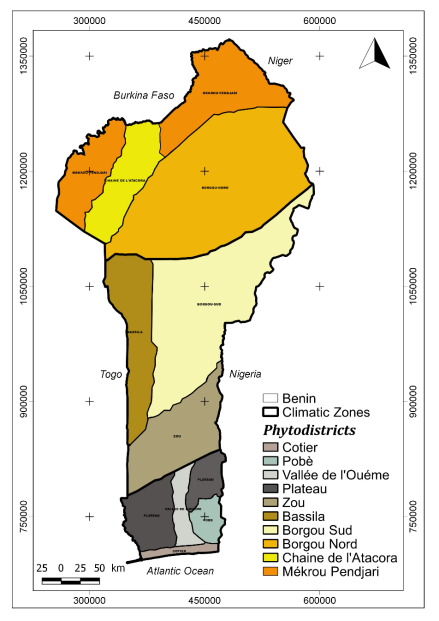
Benin is located between 6º 30’ and 12º 30’N and 1º and 3º 40’E and covers an area of 114.763 km² [40]. Its administrative boundaries are Niger in the north, Nigeria in the east, Togo in the west and Burkina Faso in the northwest. It is subdivided into three major climatic zones, the Guinea- Congolese zone, the Sudano-Guinean zone and the Sudanian zone, and 10 phytodistricts [41]. The Guinea-Congolese zone is located in the southern part of the country and extends from the coast to the latitude of Djidja. It is segmented into four phytodistricts: “Cotier”, “Pobè”, “Vallée de l’Ouémé” and “Plateau”. Annual precipitation varies from 900 mm to 1300 mm. The Sudano-Guinean zone extends from the commune of Dassa to the latitude of the commune of Bembérèkè. Annual precipitation varies from 1100 to 1200 mm. This area is divided into three phytodistricts: “Bassila”, “Zou” and “Borgou Sud”. The Sudanian zone is located beyond 10° N latitude. It is subdivided into three phytodistricts, “Borgou Nord”, “Chaine de l’Atacora “ and “Mékrou-Pendjari”. Annual precipitation varies from 900 mm to 1150 mm.
Methods
Occurrence data
Two main sources were considered to obtain occurrence data: the Global Biodiversity Information (GBIF) (www.gbif. org) Benin and field collection. The occurrences downloaded from the GBIF site were cleaning (elimination of occurrence data recorded in years less than or equal to 1970, duplicates, data without geographic coordinates, occurrences whose coordinates fall outside the area of interest.) to prepare them for modeling. The cleaned file was converted into CSV format for modeling in MaxEnt software.
Biophysical data
Bioclimatic data (15 bioclimatic variables: bio1 – bio7 and bio10 – bio17) from the present (1970 – 2000) were downloaded from Worldclim version 2.1 (https:// worldclim.org) at the resolution of 2.5 arc- minute (a grid of approximate dimensions of 5 km x 5 km). For future data, the corresponding environmental projection layers have been downloaded from the Africlim website. Only the environmental projection layers bio1 – bio7 and bio10 – bio17 are available on the Africlim site, which justifies the consideration of these same layers from Worldclim for the present. Soil characteristics and population were respectively downloaded from the African Soil Profile Database (https:// www.isric.org) and the SEDAC website (https://www.isric. org).
Data processing and analysis
Transformation of climatic and non-climatic variables For the species, a mask was created based on the occupancy of the occurrence points. This mask served as a model, to delimit the different variables which having undergone certain series of transformations were converted to ASCII format for modeling. The QGIS 2.18 software made it possible to carry out the various transformations necessary for this purpose.
Model calibration For the calibration of the model, we used Maximum Entropy which has certain strong points [42]. It can do without absence data for its operation [43, 44], accepts both quantitative and qualitative data for modeling and also offers good discrimination of favorable and unfavorable habitats favorable to a species from a bioclimatic point of view [45].
The calibration itself consisted of checking the logistic format for outputting the results. This involved setting 10,000 pseudo-absence points, a maximum of 1,000 iterations and a convergence threshold of 0.00001. The models were run using Bootstrap as the replication method. 75% of the data was used to run the model and 25% to test the model. Redundancies within the variable grid were eliminated by applying the “remove duplicate” function of the model [42]. The other options were set to default. The final selected variables were used to run the model with 10 replications in the present and future across Benin.
The performance of each model was tested using independent tests of the AUC and the ROC curve [46]. The AUC (Area Under receiver operating characteristic Curve) test provides an overall measure of performance independent of a threshold. The higher the AUC, the better the model. The ROC curve has the advantage of being threshold independent and, as such, does not require decisions regarding thresholds of what constitutes a prediction of presence versus a prediction of absence [47]. The True Skill Statistic (TSS) test was used to evaluate the predictive accuracy of species distribution models. TSS test values can range from -1 to 1. Models closer to 1 are better at discerning presence and absence points.
Assessment of the impact of climate change The impact of climate change was assessed using the “Raster calculator” tool in QGIS desktop 2.18.1 software. It made it possible to identify areas that are favorable in the present and unfavorable in the future or areas that are unfavorable in the present and favorable in the future based on the decision probability threshold calculated. The extent of the impact of climate change on the distribution of species was analyzed by calculating the areas associated with the output of the results of the “Raster calculator” tool. These areas were calculated after reclassification, conversion and polygonization (raster to vector).
Results
Presence data for S. mombin
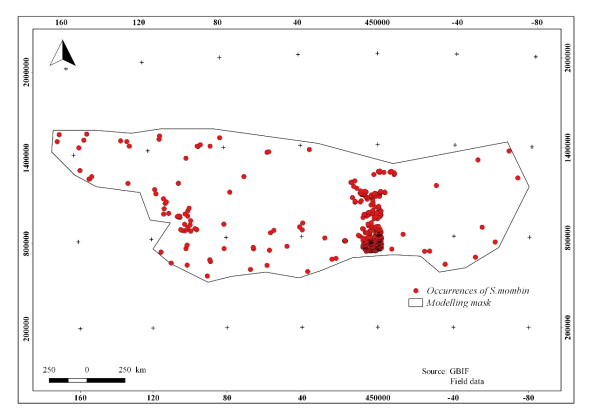
After cleaning efforts, a final dataset of one thousand four hundred and seventy-four (1474) occurrence data was retained respectively to run the models with MaxEnt [35].
Model validation
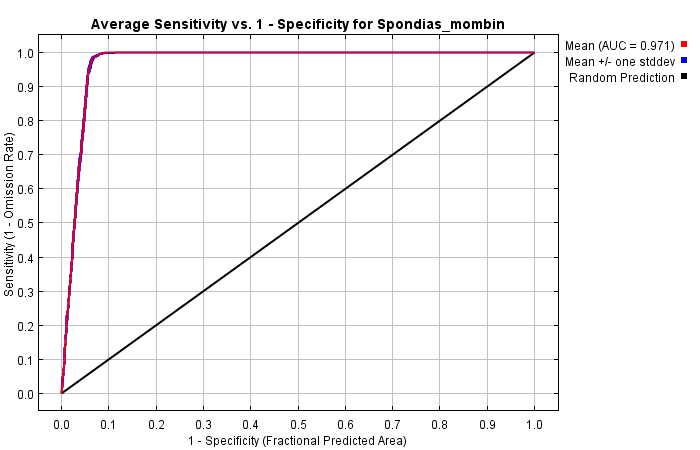
The AUC value (Figure 3), 0.971 ± 0.000, demonstrates very good discrimination. Low standard deviation values indicate limited dispersion of AUC values between replications. The value of the TSS statistic, (0.86 ± 0.01), close to 1 and above 0.6, therefore makes it possible to better discern the points of presence and absence.
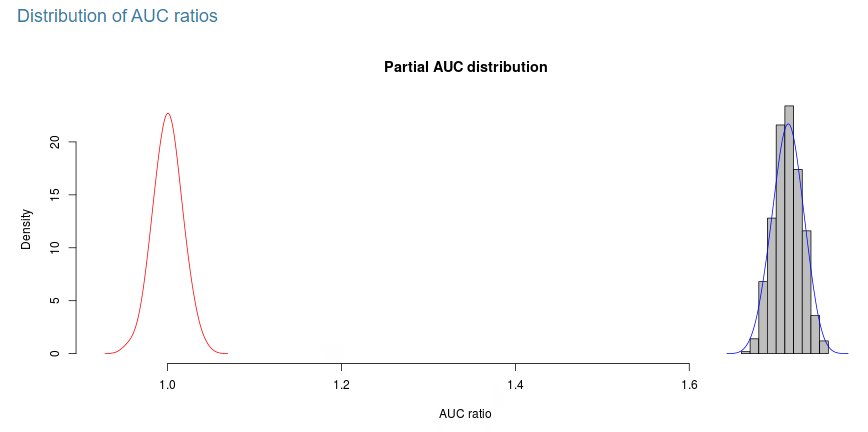
The values of the AUC ratio and the Partial ROC really show a better performance of the model performed for S. mombin in predicting true presence and absence in the context of climate change. Also, the difference between the AUC of the model prediction and the random AUC is highly significant, therefore confirming that the model works better than randomly. The Kurtosis test performed to analyze the shape of the probability distribution gave a zero value for S. mombin. This zero value indicates a mesokurtic distribution which is a normal distribution.
Environmental and social determinants of the spatial distribution of S. mombin
The Jackknife test of the importance of variables (Figure 5) made it possible to assess the importance of environmental/non-environmental variables. The green bar of the Jackknife test shows the total gain without the variable considered. The blue bar indicates the representation of the gain, or the AUC obtained with the model considering only the variable considered. In red the representation of the total gain or the total AUC obtained with the model with all the variables considered. The sum of the contribution percentage and the importance of the permutation allowed the selection of the variables.
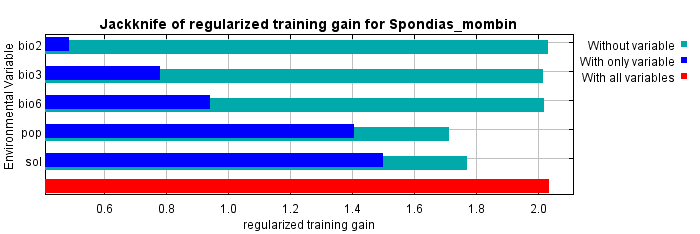
Variable Importance (Table 1) shows that five variables govern the potential distribution of S. mombin. Among these variables, bio 6 has a greater influence on the distribution of S. mombin. Population and Soil together contributes more than half to the distribution of the species.
| Variable | Contribution (%) | Importance of permutation (%) |
|---|---|---|
| Bio 2 | 0.40 | 3.20 |
| Bio 3 | 0.50 | 13.00 |
| Bio 6 | 40.40 | 3.40 |
| Population | 22.50 | 0.00 |
| Soil | 36.50 | 80.40 |
Table 1: Contribution of variables to the ecological niche model of S. mombin.
Current and future distribution of S. mombin habitats
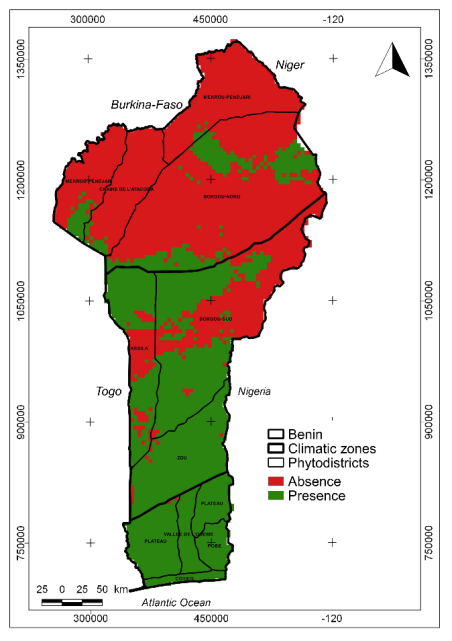
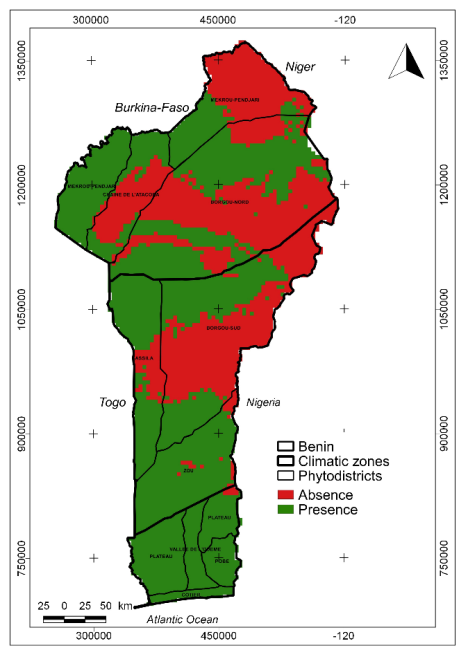
Table 2 shows the proportion of distribution areas of S. mombin in the present and future under scenarios 4.5 and 8.5. The favorable areas of S. mombin occupy 46.51% of the total area of Benin. They cover the entire Guinea-Congolese zone of the country and a significant part of the Sudano-Guinean zone. In the future under scenario 4.5, these areas represent 61.37% of the total area of Benin and exceed those favorable in the present by around 1.32. By 8.5, areas favorable to the expansion of S. mombin represent 69.47% of the total area of Benin. They exceed 1.49 the values observed in the present and are distributed in the three phytogeographic zones of the country with excellent coverage of the Guinea-Congolese.
| Suitability Level | Present | Future scenario 4.5 | Future scenario 8.5 | ||
|---|---|---|---|---|---|
| Favorable | 53377.3 | 70431.49 | 797 | 21.93 | |
| Unfavorable | 61385.7 | 44331.51 | 350 | 41.07 | |
| Total (km²) | 114,763 | 114,763 | 11 | 4,763 | |
| Table 2: Estimated total area (km²) of the distribution areas of S. mombin in the present and future under scenarios 4.5 and 8.5. |
Impact of climate change on the spatial distribution of S. mombin
The impact of climate change on the spatial distribution of S. mombin results in a significant increase in areas favorable
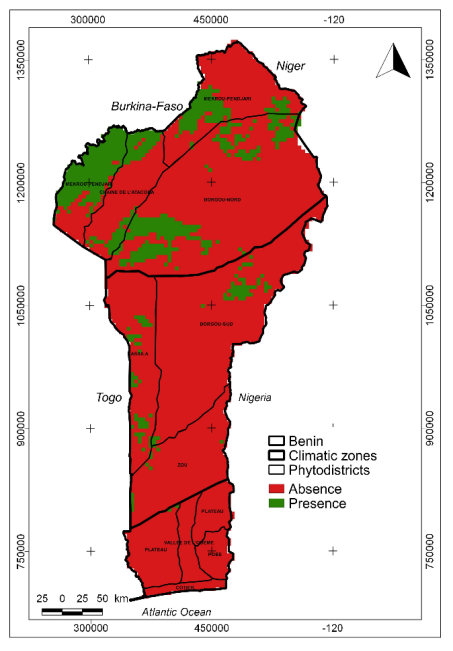
to the expansion of the species. This increase is estimated at 17,054.19 km2 for scenario 4.5 and 26,344.63 km2 for scenario 8.5. Scenario 8.5 seems to be more favorable to the species. The new favorable areas are more concentrated in the Sudanian zone.
Conservation strategies for S. mombin in the context of climate and global changes
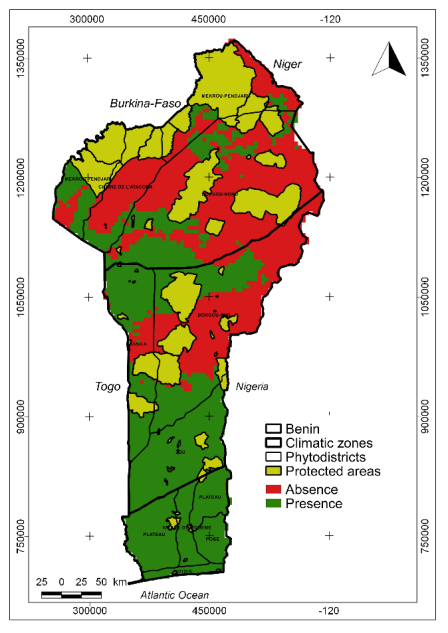
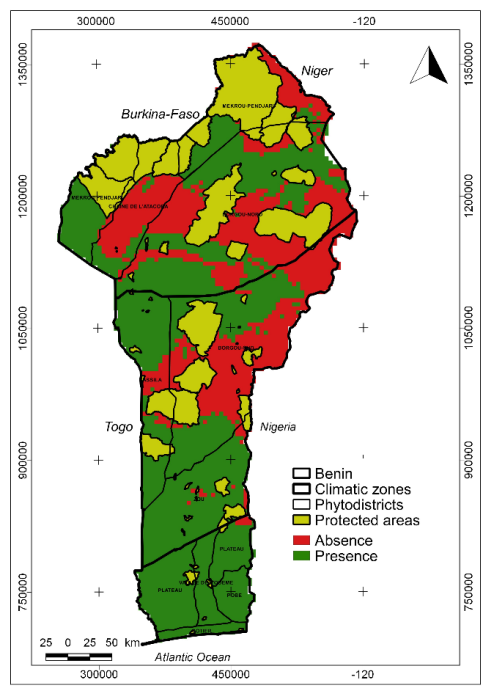
Areas favorable to the expansion of S. mombin are full of a fairly large number of protected areas for its conservation. There are 27 protected areas representing 46.55% of the
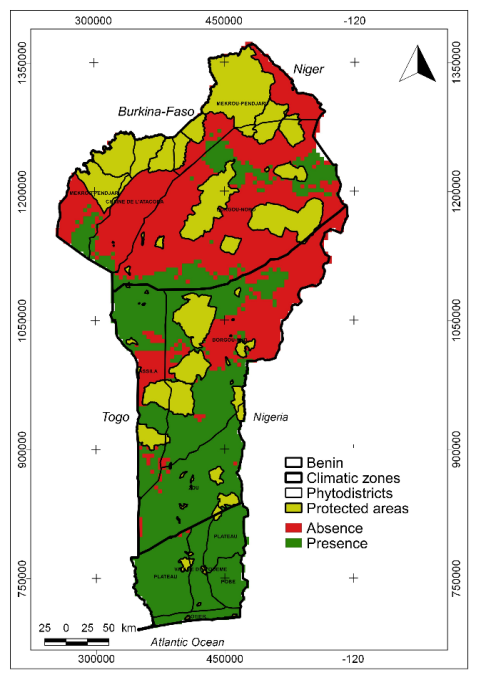
national protected areas network. By 2055 under scenarios 4.5 (Figure 12) and 8.5 (Figure 13), we observe an increase in protected areas, identical in both scenarios, of the order of 9.38% (27 to 32 protected areas) or 55.17% of the national network of protected areas_._ Figure 11: Network of protected areas and the spatial distribution of S. mombin at the scale of Benin in the present.
Discussion
Ecology and socio - environmental determinants of the spatial distribution of S. mombin
S. mombin is a savannah species also present in dense dry forests [48] on all types of soil [49]. In Benin, fields, fallows, plantations, swamps and towns are the main plant formations sheltering this species. Five variables were selected to predict the ecological niche of S. mombin. Soil, population and bio6 contribute mainly to the prediction of the distribution model of this species. Numerous studies have shown the capacity of these variables to improve the quality of species distribution [50, 51]. Edaphic parameters have a physiological action on plant species [52]. This variable with the temperature, directly impact the distribution of S. mombin. This offers a diversity of ecological conditions favorable to the phenology of the species. Indeed, temperature is one of the major climatic parameters in plant ecology [12, 53, 27].
Impacts of climate change
One of the main threats currently weighing on West African biodiversity is the loss of habitats due mainly to climate changes [54, 55, 56] which are undoubtedly modifying the potential distribution area of plants. Considering the extent of habitats obtained, whatever the scenario, climate changes will overall be conducive to the distribution of habitats favorable to the species. In Benin, several authors have shown the extensive trends in areas favorable to the development of certain plant species due to climate change. They are, for examples, [57] on Chrys_op_hyllum albidum, [28] on Dialium guineense Willd. (Black velvet), [53] on Vitex doniana Sweet, [29] on Haematostaphis barteri Hook.f., [33] on Anogeissus leiocarpa (DC.) Guill. & Perr., and Lonchocarpus sericeus (Poir.) DC., [58] on Diospyros mespiliformis Hochst. ex A.De., [37] on Anogeissus leiocarpa (DC.) Guill. & Perr. These individual species responses to climate change could cause cascading and feedback effects in biological systems, affecting ecosystem dynamics [59, 60] and plant species through trophic networks [61, 62].
Conservation strategies for S. mombin
From the Guinea-Congolese zone to the Sudanian zone of the country, the results reveal that climate changes will generally have positive impact to the distribution of habitats favorable to S. mombin. Conservation strategies for the species should focus on diagnostic inventory, regeneration tests, introduction of species into understaffed environments, raising awareness among populations close to species populations, etc. Also, current and future climatic conditions indicate that the protected areas of zones favorable to the expansion of the species are and will remain very favorable to the conservation of S. mombin. The protected areas present in zones favorable to the development of S. mombin are mainly classified forests, belonging to category V (Protected marine or terrestrial landscape) of the IUCN categorization. This category aims to contribute to long-term conservation, preserve species and enable the conservation of intensively used ecosystems [63]. However, in the majority of classified forests, only a small portion is dedicated to protection and exempt from harvesting. Sustained efforts should then be made towards their sustainable management. Therefore, regular scientific monitoring should be carried out on authorized samples in order to verify that they do not harm the viability and regeneration of species as well as the restoration of the environment. The good health of classified forests ecosystems makes it possible to better resist to the effects of climate change.
Conclusion
The analysis of the impacts of climate change on the spatial distribution of S. mombin across Benin revealed that climate change is remain generally beneficial to the distribution of habitats favorable to S. mombin. Soil, Population and bio6 are the main factors which explain this favorable distribution. The results obtained also demonstrate that the protected ecosystems of the study area are suitable for the expansion and conservation of this species. This research brings a valuable contribute to the identification and guidance of strategies for the conservation of S. mombin in Benin. The future research will be done on a diagnostic inventory in the favorable areas to carry out the structure and the regeneration ability of the S. mombin.
References
-
Avakoudjo HGG, Idohou R, Salako KV, Hounkpèvi A, Koné MW, et al. (2021) Diversity in tree and fruit traits of _Strychnos spinosa_ Lam. along a climatic gradient in Benin: a step towards domestication. Genetic Resources and Crop Evolution 68(6): 2423-2440.
-
Vihotogbé R, Idohou R, Vianou A, Spies P, Salako V, et al. (2021) Abundance and effects of climate change on geographical distribution of _Mondia whitei_ (Hook. f.) Skeels (Apocynaceae) in the Dahomey Gap (West Africa). African Journal of Ecology 59(4): 924-933.
-
Bradshaw CP, Koth CW, Thornton LA, Leaf PJ (2009) Altering school climate through school-wide positive behavioral interventions and supports: Findings from a group-randomized effectiveness trial. Prevention science 10(2): 100-115.
-
GIEC (2019) Rapport Spécial du GIEC Réchauffement à 1,5°C, pp: 24.
-
Thomas CD, Cameron A, Green RE, Bakkenes M, Beaumont LJ, et al. (2004) Extinction risk from climate change. Nature 427(6970): 145-148.
-
IPCC (2022) Climate change 2022: Impacts, Adaptation and vulnerability. Working Group II Contribution to the Sixth Assessment Report of the Intergovernmental Panel on Climate Change, pp: 37.
-
IPCC (2021) Summary for Policymakers. Climate Change 2021. The Physical Science Basis. Contribution of Working Group I to the Sixth Assessment Report of the Intergovernmental Panel on Climate Change. In: Masson DV (Eds.), UN Environment Programme, pp: 280.
-
Padonou AE, Teka O, Bachmann Y, Schmidt M, Lykke AM, et al. (2015) Using species distribution models to select species resistant to climate change for ecological restoration of bowé in West Africa. African Journal of Ecology 53(1): 83-92.
-
Ahononga FC, Gouwakinnou GN, Biaou SSH, Biaou S (2020) Vulnerability of the lands of the ecosystems of the Sudanian domain in Benin from 1995 to 2015. Woods & Forests of the Tropics 346: 35-50.
-
Hadonou YA, Houessou L, Lougbegnon T, Adebi Y, Sanni SG, et al. (2019) Diversity and forms of use of woody species in the Mono biosphere reserve (Benin). VertigO: the electronic journal in environmental sciences 19(2): 1-22.
-
Bouko BS, Dossou PJ, Amadou B, Sinsin B (2016) Exploitation des ressources biologiques et dynamique de la forêt classée de la Mékrou au Benin. European Scientific Journal 12(36): 228-244.
-
Dossou EM, Lougbegnon TO, Houessou LG, Codjia JTC (2016) Analyse de l’impact du changement climatique sur l’aire de distribution actuelle et future de _Lannea_ _microcarpa_ Engl. et K. Krause au Bénin, Afrique de l’Ouest. Afrique Science 12: 27-38.
-
Fandohan B, Assogbadjo AE, Kakaï RG, Kyndt T, Caluwé ED, et al. (2010) Women’s traditional knowledge, use value, and the contribution of tamarind (_Tamarindus_ _indica_ L.) to rural households’ cash income in Benin. Economic botany 64: 248-259.
-
Sokpon N, Lejoly J (1996) Les Plantes à Fruits Comestibles d’une Forêt Semi-Caducifoliée de Pobè au Sud-Est du Bénin. L’alimentation en forêt tropicale: interactions bioculturelles et perspectives de développement 1: 115- 124.
-
Assogbadjo AE, Idohou R, Chadare FJ, Salako VK, Djagoun CAMS, et al. (2017) Diversity and prioritization of non- timber forest products for economic valuation in Benin (West Africa). African Journal of Rural Development 2(1): 105-115.
-
Djagoun CAMS, Kakaï RG, Konnon DD, Sewade C, Kouton M, et al. (2010) Potentiel des ressources végétales forestières alimentaires et médicinales de la forêt classée de l’Ouémé Supérieur et N’Dali au Nord Bénin. Fruit Veg Cereal Sci Biotechnol 4: 1-8.
-
Codjia JTC, Assogbadjo AE, Mensah MR (2003) Diversité et valorisation au niveau local des ressources forestières alimentaires du Bénin. Cahier agriculture 12(5): 321- 331.
-
Kakpo AB, Ladekan EY, Dassou H, Gbaguidi F, Kpoviessi S, et al. (2019) Ethnopharmacological investigation of medicinal plants used to treat typhoid fever in Benin. Journal of Pharmacognosy and Phytochemistry 8(6): 225-232.
-
Bio A, Toyi SM, Yoka J, Djego GJ, Awede B, et al. (2015) Contribution aux connaissances des principales plantes antihypertensives utilisées en médecine traditionnelle à Bassila (Bénin, Afrique de l’Ouest). Méd Trad Afr 17(2): 8-18.
-
Elith JH, Graham CP, Anderson R, Dudík M, Ferrier S, et al. (2006) Novel methods improve prediction of species’ distributions from occurrence data. Echography 29(2): 129-151.
-
Welk E, Schubert K, Hoffmann MH (2002) Present and potential distribution of invasive garlic mustard (_Alliaria petiolata_) in North America. Diversity and Distributions 8(4): 219-233.
-
Corsi F, Duprè E, Boitani L (1999) A large‐scale model of wolf distribution in Italy for conservation planning. Conservation Biology 13(1): 150-159.
-
Salinger MJ (2005) Climate variability and change: past, present and future–an overview. Climatic change 70(1): 9-29.
-
Aarts G, Fieberg J, Matthiopoulos J (2012) Comparative interpretation of count, presence–absence and point methods for species distribution models. Methods in Ecology and Evolution 3(1): 177-187.
-
Chakraborty S, Newton AC (2011) Climate change, plant diseases and food security: an overview. Plant pathology 60(1): 2-14.
-
Warton DI, Shepherd LC (2010) Poisson point process models solve the” pseudo-absence problem” for presence-only data in ecology. The Annals of Applied Statistics 4(3): 1383-1402.
-
Fandohan AB, Moutouama JK, Biaou SSH, Gouwakinnou GN, Adomou CA (2015) Le réseau d’aires protégées Bénin-Togo assure-t-il la conservation de _Thunbergia_ _atacorensis_ (Acanthaceae)?. Sciences de la Vie, de la Terre et Agronomie 3(2): 25-31.
-
Ganglo JC, Djotan GK, Gbètoho JA, Kakpo SB, Aoudji AKN, et al. (2017) Ecological niche modeling and strategies for the conservation of _Dialium guineense_ Willd. (Black velvet) in West Africa. International Journal of Biodiversity and Conservation 9(12): 373-388.
-
Moutouama KJ, Fandohan BA, Biaou HSS, Amahowe IO, Moutouama TF, et al. (2016) Potential climate change favoured expansion of a range limited species, _Haematostaphis barteri_ Hook f. Journal of Agriculture and Environment for International Development 110(2): 397-411.
-
Idohou R, Assogbadjo AE, Azihou F, Kakaï RG, Adomou A (2016) Influence of the landscape context on stand structure and spatial patterns of the doum palm (_Hyphaene thebaica_ Mart.) in the Republic of Benin (West Africa). Agroforestry systems 90: 591-605.
-
Dotchamou FT, Atindogbe G, Sode AI, Fonton HN (2016) Density and spatial pattern of _Parkia biglobosa_ under climate change: the case of Benin. Journal of Agriculture and Environment for International Development 110(1): 173-194.
-
Adjahossou SGC, Gouwakinnou GN, Houéhanou DT, Sode AI, Yaoitcha AS, et al. (2016) Efficacité des aires protégées dans la conservation d’habitats favorables prioritaires de ligneux de valeur au Bénin. Bois et forêts des tropiques 328(2): 67-76.
-
Gbètoho AJ, Aoudji AKN, Roxburgh L, Ganglo JC (2017) Assessing the suitability of pioneer species for secondary forest restoration in Benin in the context of global climate change. Bois et forêts des tropiques 332(2): 43-55.
-
Djotan AKG, Aoudji AKN, Yêhouénou Tessi DR, Kakpo SB, Gbètoho JA, et al. (2018) Vulnerability of _Khaya_ _senegalensis_ Desr & Juss to climate change and to the invasion of _Hypsipyla robusta_ Moore in Benin (West Africa). Int J Biol Chem Sci 12(1): 24-42.
-
Kakpo SB, Aoudji AKN, Gnanguenon-Guesse D, Gbètoho AJ, Koura K, et al. (2019) Spatial distribution and impacts of climate change on Milicia excelsa in Benin, West Africa. J For Res 32: 143-150.
-
Aïkpon G, Koura K, Ganglo CJ (2021) Spatial distribution, ecological niche model of pignut and control eradication strategies in the context of climate and global change for Benin, West Africa. International Journal of Biodiversity and Conservation 13(3): 86-97.
-
Apélété E, Koura K, Aoudji A, Ganglo CJ (2023) Modeling of the Ecological Niche of _Anogeissus leiocarpa_ (DC.) Guill & Perr and Conservation Strategies in the Context of Climate and Global Change (Benin, West Africa). Journal of Ecology and Natural Resources 7(2):1-15.
-
Kotin MJ, Hedegbetan G, Aoudji KNA, Ganglo CJ (2023) Ecological Niche and Strategies of Conservation of Sitatunga (_Tragelaphus Spekii_, Sclater) in the Context of Climate and Global Change in Benin “West Africa”. 7(2): 1-15.
-
Kore E, Koura K, Kingbo A, Aoudji AKN, Woegan YA, et al. (2023) Ethnobotanical importance, modeling of the spatial distribution of _Detarium senegalense_ J.F. Gmel and strategies for its conservation in the context of climate and global changes in Togo. Afrique Science 22(1): 142- 158.
-
Neuenschwander P, Toko I (2011) Benin, natural environment and socio-economic data. In : Neuenschwander P, Sinsin B, et al. (Eds.), Nature protection in West Africa: A red list for Benin. Nature conservation in West Africa: red list for Benin, pp: 7-13.
-
Adomou AC, Sinsin B, Van der Maesen LJG (2006) Phytosociological and chorological approaches to phytogeography: a meso-scale study in Benin. Systematics and Geography of Plants 76(2): 155-178.
-
Bargain A, Fabri MC (2016) Methodological guide to predictive modeling of deep habitats in the Mediterranean. In Water Agency Framework Convention Report RM&C/Ifremer, Provence Azur Corse, pp : 128.
-
Thorn JS, Nijman V, Smith D, Nekaris KAI (2009) Ecological niche modelling as a technique for assessing threats and setting conservation priorities for Asian slow lorises (Primates: _Nycticebus_). Diversity and distributions 15(2): 289-298.
-
Phillips SJ, Dudik M, Schapire RE (2004) A maximum entropy approach to species distribution modeling. In Proceedings of the twenty-first international conference on Machine learning, pp: 83.
-
Phillips SJ, Anderson RP, Schapire RE (2006) Maximum entropy modeling of species geographic distributions. Ecol Model 190(3-4): 231-259.
-
Jetz W, Rahbek C (2002) Geographic range size and determinants of avian species richness. Science 297(5586): 1548-1551.
-
Soberon J, Peterson AT (2005) Interpretation of Models of Fundamental Ecological Niches and Species Distributional Areas. Biodiversity Informatics 2: 1-10.
-
Akoegninou A, Burg WJ, Maesen LJG (2006) Analytical flora of Benin (No. 06.2). Backhuys Publishers. Cotonou & Wageningen, pp: 1034.
-
Arbonnier M (2005) Trees, shrubs and vines of the dry zones of West Africa. Versailles: Ed. Quae, MNHN, pp: 574.
-
Issoufou AA, Soumana I, Issaharou Matchi I, Zon AO, Mahamane A (2022) Forecasting the distribution of _Anogeissus leiocarpa_ (DC.) Guill. & Perr. by using an ensemble modelling in Niger, West Africa. Discover Sustainability 3(1): 9-17.
-
Wouyou HG, Lokonon BE, Idohou R, Zossou-Akete AG, Assogbadjo AE, et al. (2022) Predicting the potential impacts of climate change on the endangered _Caesalpinia_ _bonduc_ (L.) Roxb in Benin (West Africa). Heliyon 8(3): 1-17.
-
Badeau V, Dupouey JL, Cluzeau C, Drapier J (2005) Potential distribution areas of forest species by 2100. Foret Entreprise 162: 25-29.
-
Hounkpevi A, Tosso F, Gbemavo DSJC, Kouassi EK, Kone D, et al. (2016) Climate and potential habitat suitability for cultivation and in situ conservation of the black plum (_Vitex doniana_ Sweet) in Benin, West Africa. International Journal of Agronomy and Agricultural Research 8(4): 67- 80.
-
IUCN, UNEP (2015) The world database on protected areas (WDPA). Annual release, pp: 1-4.
-
Leadley P, Pereira HM, Alkemade R, Fernandez-Manjarres JF, Proenca V, et al. 2010. Biodiversity Scenarios: Projections of 21st century change in biodiversity and associated ecosystem services. In: Diversity SotCoB (Eds.), Secretariat of the Convention on Biological Diversity_._ Montreal, pp: 132.
-
Millennium Ecosystem Assessment (2005) Environmental Degradation and Human Well-Being: Report of the Millennium Ecosystem Assessment. Population and Development Review 31(2): 389-398.
-
Gbesso FHG, Tente BHA, Gouwakinnou NG, Sinsin BA (2013) Influence of climate change on the geographic distribution of _Chrysophyllum_ _albidum_ G. Don (Sapotaceae) in Benin. International Journal of Biological and Chemical science 7(5): 2007-2018.
-
Karimou S, Toko II, Ousseni A (2019) Impact of Climate Variability on the Ecological Niche of Diospyros mespiliformis Hochst. ex A.De. in the Sudanian Region in Benin (West Africa). European Scientific Journal 15(36): 1-19.
-
Ricard M (2014) Vulnerability of the biodiversity of Quebecs protected areas to climate change. University of Quebec at Rimouski, pp: 81.
-
Williams SE, Shoo LP, Isaac JL, Hoffmann AA, Langham G (2008) Towards an integrated framework for assessing the vulnerability of species to climate change. PLoS biology 6(12): e325.
-
Duffy JE (2003) Biodiversity loss, trophic skew and ecosystem functioning. Ecology letters 6(8): 680-687.
-
Schmitz OJ, Post E, Burns CE, Johnston KM (2003) Ecosystem responses to global climate change: moving beyond color mapping. BioScience 53(12): 1199-1205.
-
(2013) Categorization of Protected Areas in the Republic of Benin according to the nomenclature of the World Union for Conservation of Nature (IUCN), pp : 66.
- Lessons to Learn: Trees are More than the Lungs of the World
- Community Forestry Enterprises as a Model for Sustainable Forest Development: The Case Of The "Baja Tarahumara" in Chihuahua, Mexico
- Ecological and Socio-Economic Impacts of Chromolaena odorata and Mesosphaerum suaveolens, Two Invasive Alien Species in Central and Southern Benin, West Africa
- Epigenetic Sustainability: Modeling the Human Factor as a Natural Resource through Science 4.0 and the NR3C1 Biological Pilot
- Growth-at-Risk: A Framework for Assessing Economic Vulnerability
- The Rural Territory as a Socioecological System for the Management of Public Policy for Sustainable Rural Development