
Utilization of Distillery Wastewater in a Microbial Fuel Cell Based on Microbial Sulfate Reduction
Simple electron donors (such as lactate, ethanol, glucose, etc.) in the process of microbial sulfate reduction are well studied. In search of new substrates for sulfate-reducing bacteria, multicomponent organic products were investigated. The application of distillery wastewater (vinasse and ethanol stillage) as electron donors in a microbial sulfate reduction process with an integrated microbial fuel cell was studied. The results were compared with those of lactate as a control. The influence of the rate of volumetric sulfate loading on the rate of microbial processes was studied using six different hydraulic retention times: 14, 18, 22, 26, 30 and 34 hours. During the process, sulfate-reducing bacteria incompletely oxidize organic matter in the used distillery wastewater and generate large amounts of acetic acid, and propionic acids as a product of other microbiological processes. The rates of sulfate and organic removal for all three substrates increase with increasing retention time. In the case of vinasse and stillage at the 34th hour, sulfate removal was 98%, and organics removal was 48 and 44%, respectively. The open circuit voltage values for both fuel cells with wastewaters were highest at the 22nd hour. The results showed that vinasse and ethanol stillage were suitable electron donors i
Introduction
Microbial electrolysis and fuel cells (MECs/MFCs) are found to be successfully applied for the removal of both organic and inorganic pollutants from wastewater [1]. The main process is carried out by electrons stripped from the corresponding organic donor, and upon its oxidation, they are transferred, instead of to the corresponding natural acceptors (oxygen, sulfates, ferric ions, nitrates, etc.), to an insoluble anode of the bioelectrochemical system (BES). Various electroactive microorganisms, including mixed cultures isolated from natural habitats, are used to carry out the process [2].
Several studies have examined the use of the microbial sulfate reduction process in MECs/MFCs [3, 4, 5]. The process is based on reducing sulfates to biogenic H2S (a mediator in electron transfer), which is subsequently oxidized to elemental sulfur (S0) and other forms in the anode chamber on the anode surface [5]. Both some simple organic substrates such as lactate, glucose, ethanol and acetate [6] and complex substrates such as - wastewater from drainage flows of municipal waste landfills [7], from animal husbandry [8] from the distillery industry [9] are used as electron donors for the microbial sulfate reduction (MSR) process in the anode zone and others. To reduce sulfates, MSR is applied both in the cathodic (as autotrophic) [10] and in the anode zone (as heterotrophic) of MECs/MFCs [11].
Volatile fatty acids (acetate, propionate, and butyrate) and short-chain acids (lactate, pyruvate, and malate) are the main carbon sources for sulfate-reducing bacteria (SRB) [12]. Various organic wastes (e.g. sewage sludge, whey, wood chips, animal manure, vegetal compost, mushroom compost) can also be used as a source of carbon and nutrients, which can support the growth of SRB for a long time without the addition of other substrates [13].
Straw and wood chips are used in a mixture with easily digestible electron donors such as sucrose, peptone, lactate, pyruvate or formate. Also, waste products containing polysaccharides can be used as a substrate to be degraded to fatty acids and alcohols that support the growth of sulfidogenic bacteria [14]. Optimal for MSR is the use of a mixture of readily degradable products with multiple carbon sources, as the substrate is readily available to SRB [15]. A relationship has been established between the C/N and COD/ SO4 ratios in organic feedstocks and their applicability as a substrate for the MSR of acid mine drainage (AMD) [12, 16, 17, 18]. For effective sulfate removal and optimal growth of SRB, COD/SO4 should be around 0.67 and C/N should be in the range of 5 - 20 [17, 18].
Chai et al. investigated the use of shrimp and crab shells, sugarcane bagasse, straw compost, and propionate as substrate materials for AMD by MSR [18]. They found that crustacean materials improved the process and metal removal, while for other sources, an additional alkalinity source had to be added to ensure process stability. Distillery wastewater can be used as electron donors in the biological treatment of AMD by MSR. The process can be through passive treatment in sulfate reduction bioreactors or wetlands, where both streams can be mixed in appropriate ratios to allow for complete removal of COD, sulfates and dissolved metals [19].
Often, the MSR process is combined with electrochemical systems, most often a microbial fuel cell, where the resulting hydrogen sulfide can be used for metal precipitation and subsequent selective recovery with parallel energy production. As early as the 1990s, research into the application of MSR in MFC began, with initial results showing good removal rates of organic matter (75 %) and relatively low currents generated, limiting its application on an industrial scale [20]. Subsequently, the principle of operation of the hybrid system was established - the resulting sulfide is oxidized to elemental sulfur at the anode [3]. Various publications on the anaerobic treatment of distillery wastewater with integrated MFC have shown the reduction of organic matter and generation of electricity [21, 22, 23, 24]. In a single-chamber MFC with an air cathode, MSR of brewery wastewater was performed, generating 63 mW/ m2 of electricity [25]. In conventional biological methods for sulfate removal, sulfide accumulates, which inhibits the growth of SRB, while in MFC it is converted to elemental sulfur [26, 27].
In this study, the application of vinasse and ethanol stillage as electron donors in a microbial sulfate reduction process with an integrated microbial fuel cell was investigated. The influence of the volumetric sulfate loading rate on the process was tested using 6 different hydraulic retention times. Data on intermediate metabolites and the generated electricity were obtained.
Materials and Methods
The experiments were carried out in three identical laboratory installations (Figure 1). The laboratory installations include - an anaerobic bioreactor with attached biomass for the MSR process (3), a microbial fuel cell (MFC) with an air cathode (6) and a buffer vessel (4) for pH adjustment, dosing (2) and a recirculation pump (8).
The microbial fuel cell was constructed with two chambers of different volumes - anode (0.50 dm3) and cathode (0.068 dm3), separated by a cation exchange membrane (CMI-7000S, Membrane International Inc.) with an area of 0.0028 m2. A graphite rod with a diameter of 8 mm and a length of 100 mm (with a geometric area of 0.030 m2) was used as an electrode in the anode chamber. Pressed activated carbon (fraction with a size of 2-4 mm) was used in the chamber with the air cathode, with a layer thickness of 24 mm. A graphite rod with a diameter of 8 mm and a length of 40 mm was placed in this layer.
The geometric volume of the anaerobic bioreactor (3) with fixed biomass is 0.5 dm3, where 0.3 dm3 was the liquid phase. Natural zeolite (clinoptilolite) was used as the biomass carrier, with a fraction size in the range of 2.5-5.0 mm, with specificity described in previous studies [11, 28]. A solution containing NH4Cl-10 g/l, K2HPO4-5 g/l and MgSO4x7H2O- 4 g/l was used to saturate 200 g of zeolite. The liquid phase was recirculated in the laboratory installation by a recirculation pump (8). The volume of the buffer vessel (4) was 0.4 dm3 and periodic pH correction was performed in it with 1N NaOH solution to maintain the pH value around 7.5. Thus, the total volume of the liquid phase in the installation (bioreactor for MSR, buffer vessel and MFC) was approximately 1.2 dm3 in each.
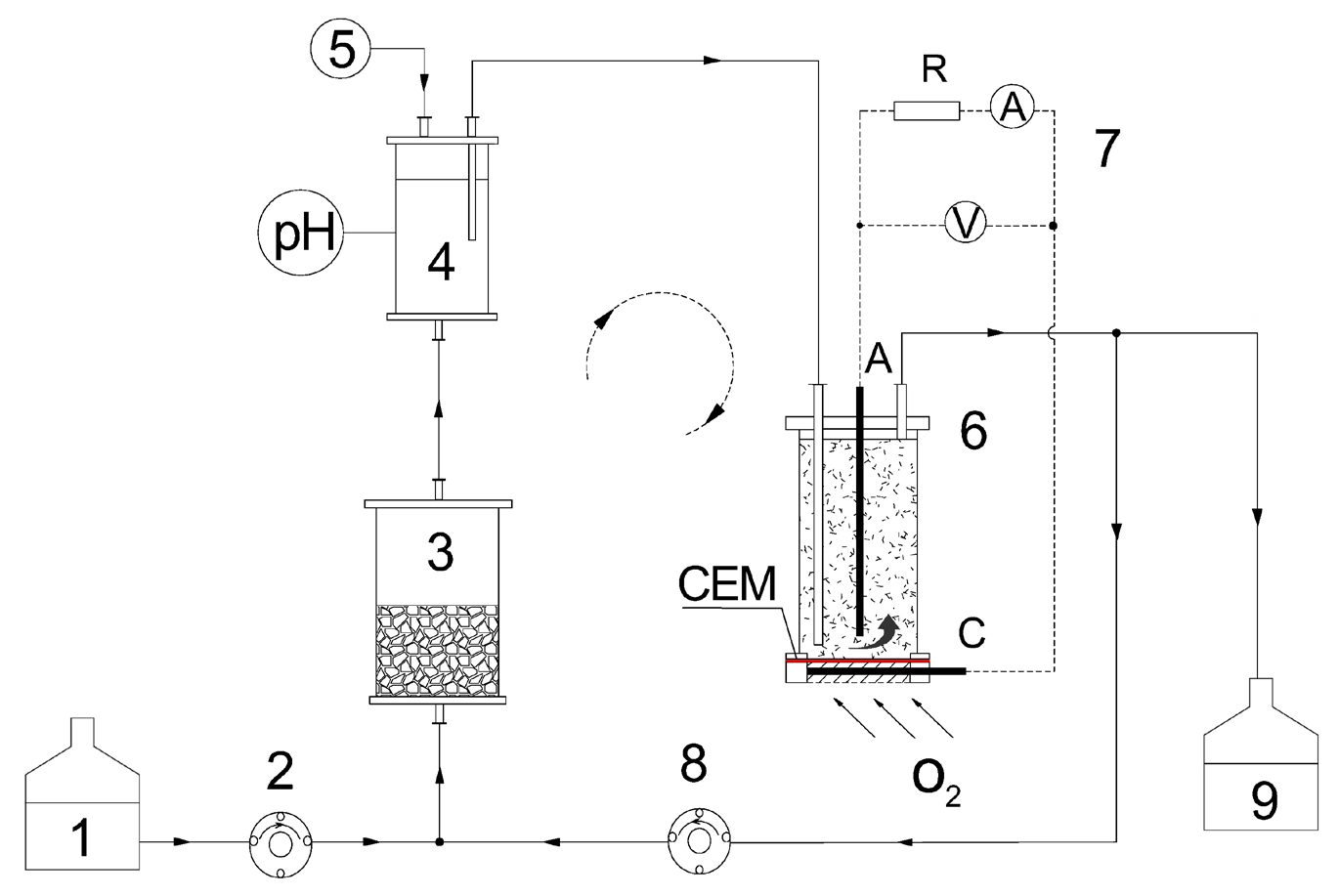
Figure 1: Schematic view of the laboratory installation for the study of waste organic substrates (ethanol stillage and vinasse) as electron donors in the MSR process. 1- feed solution, 2- dosing pump, 3- MSR bioreactor, 4- buffer vessel for pH-correction, 5- 1N NaOH solution, 6- microbial fuel cell with air cathode, 7- MFC load circuit, 8- recirculation pump, 9- outlet solution.
The fixed-bed anaerobic reactors were pre-inoculated with sulfate-reducing bacteria (SRB) grown on a medium containing lactate as the sole carbon and energy source. The composition of the culture is described in a previous article [28]. The diversity in the species composition from class Gammaproteobacteria (37.04%), Betaproteobacteria (12.31%), Epsilonproteobacteria (11.74%), Methanomicrobia (11.53%), Clostridia (5.63%) are a premise for the assimilation of various more complex substrates such as vinasse and ethanol stillage. The dominant sulfate-reducing bacteria from the class Deltaproteobacteria (5.15%) were with the main representative genera Desulfomicrobium (3.21%), Desulfobulbus (0.80%), Desulfovibrio (0.71%), Desulfococcus (0.11%) and Desulfofaba (0.10%). Initially, the bacteria were grown in a batch mode, with 70% of the liquid phase of the bioreactors being replaced with fresh medium once the sulfate concentration dropped below 0.3 g/l. The formation of biofilms on the saturated zeolites lasted for 60 days. The three bioreactors were fed separately with three different types of organic substrates:
- The first variant of the feed solution in the laboratory setup contained lactate as a carbon source and was a modified Postgate medium with 3.0 g/l Na-lactate, 0.25 g/l K2HPO4, 0.5 g/l NH4Cl 2.0 g/l Na2SO4, 0.1 g/l CaCl2, 4.0 g/l MgSO4x7H2O, 0.25 g/l yeast extract, pH 7.5. This variant had the role of control, concerning the other two.
- The second variant of the feed solution in the laboratory installation contained ethanol stillage (pre-diluted with distilled water in a ratio of 1:1) and the same salt composition characteristic of the above-mentioned modified Postgate nutrient medium, with pH adjustment to 7.5.
- The third variant of the feeding solution contained vinasse (previously diluted with distilled water in a ratio of 1:1) and t6he same salt composition characteristic of the above-mentioned modified Postgate nutrient medium, with a pH adjustment to 7.5.
After biofilm formation, all three identical laboratory installations were continuously fed with the studied variants of nutrient media for the MSR process. The influence of the rate of volumetric sulfate loading on the rate of microbial processes was studied using 6 different hydraulic retention times (HRTs): 14, 18, 22, 26, 30 and 34 hours for 3 months. After reaching dynamic equilibrium for each contact time of the treated wastewater, 2-4 samples were taken from the laboratory installations for the determination of sulfates, COD and H2S.
In the laboratory installations, pH, Eh and electrical conductivity (EC) were measured. The total sulfide concentration was measured immediately after sampling using Nanocolor test 1-88/05.09. The sulfate concentration was determined by the spectrophotometric method with BaCl2. The organic content in the different organic substrates was estimated by measuring the chemical oxygen demand (COD) by the APHA method [29]. Organic acids and alcohols were analyzed by high-performance liquid chromatography (Perkin-Elmer Inc. production, Waltham, MA, USA). An
Aminex HPX-87H column (Bio-Rad, Hercules, CA, USA) connected to an RI detector (LC-25RI, Perkin-Elmer) was used. 0.01 N sulfuric acid was used as eluent with a flow rate of 0.6 mL/min and an injection volume of 20 μL. The sugar composition was measured using a Dionex HPLC system (Dionex Inc., CA, USA) and a Shodex RI-101 RI detector (Showa Denko KK, Kawasaki, Japan). Separation was performed using a Hi-Plex H column, 7.7mm × 300 mm (Agilent Technologies, USA) at 65°C with ultrapure water obtained from a Simplicity® water purification system (Merck KGaA, Darmstadt, Germany) as eluent with a flow rate of 0.5 mL/min and an injection volume of 20 μL.
To measure the electrical parameters in MFCs, a portable digital multimeter KAIWEETS, KM601, was used, together with a precision potentiometer with a maximum value of 11 kΩ for external load resistance. During the measurements, the external resistance was varied at stable output voltages. The time to reach steady-state values for current and power varied depending on the external resistance and the organic substrate studied. In the case of ethanol stillage, it ranged from 10 s at a resistance of -11 kΩ to 90 s at a resistance of -10 Ω. For lactate and vinasse, it was 10 s for a resistance of -11 kΩ, while for 10 Ω it was 180 s. During the operation of the laboratory installation, an external load resistance of 100 Ω connected between the anode and cathode of the MFCs was used. The fuel cell’s anode surface was used to calculate the power and current density.
Results and Discussion
Electricity production in MFC and removal of sulfates and chemical oxygen demand (COD) in laboratory installations at different HRTs.
The data on the main technological parameters of the wastewaters from the three laboratory installations at the 6 contact times tested are presented in Tables 1 & 2.
In the experiments conducted with three different electron donors – lactate, ethanol stillage and vinasse, pH values were monitored at 6 different HRTs (Table 1). A decrease in pH values below 7.0 was observed at the shortest contact times of 14 and 18 hours, in the variants with vinasse and ethanol stillage, which was probably due to the more complex organic composition of these substrates compared to lactate, the increased production of organic acids and the decrease in alkalinity due to the lower concentrations of HCO3 - ions. These results were also confirmed by the lower concentrations of S2- at pH below 7.0, where the majority of the microbially generated hydrogen sulfide was in the form of fully protonated H2S, released into the gas phase.
| Lactate | Feed solution | 14 h | 18 h | 22 h | 26 h | 30 h | 34 h | |
|---|---|---|---|---|---|---|---|---|
| pH | 7.51 | 7.69 | 7.77 | 7.82 | 7.86 | 7.89 | 7.91 | |
| Eh (mV) | 32.1 | -387 | -399 | -414 | -409 | -405 | -397 | |
| EC (mS/cm) | 11.12 | 10.99 | 10.99 | 10.99 | 10.97 | 10.92 | 10.79 | |
| SO42- (g/1) | 3.05 | 0.87 | 0.7 | 0.49 | 0.38 | 0.34 | 0.3 | |
| S2- (mg/1) | - | 498.7 | 535.4 | 577.1 | 640.2 | 648.1 | 646.4 | |
| COD (g/1) | 6.5 | 3.4 | 3 | 2.9 | 2.8 | 2.7 | 2.5 | |
| Ethanol stillage | Feed solution | 14 h | 18 h | 22 h | 26 h | 30 h | 34 h | |
| pH | 7.51 | 6.54 | 6.86 | 7.03 | 7.22 | 7.36 | 7.43 | |
| Eh (mV) | 21.1 | -385 | -398 | -412 | -401 | -397 | -383 | |
| EC(mS/cm) | 17.52 | 16.13 | 16.09 | 16.03 | 15.89 | 15.73 | 15.36 | |
| SO42- (g/l) | 3.54 | 0.25 | 0.14 | 0.09 | 0.09 | 0.08 | 0.06 | |
| S2- (mg/l) | - | 541.1 | 569.6 | 620.7 | 580.1 | 565.6 | 543.5 | |
| COD (g/l) | 27.2 | 19.5 | 19.1 | 18.5 | 17.9 | 16.6 | 15.3 | |
| Vinasse | Feed solution | 14 h | 18 h | 22 h | 26 h | 30 h | 34 h | |
| pH | 7.51 | 6.63 | 6.71 | 6.81 | 6.87 | 6.98 | 7.15 | |
| Eh (mV) | 22.5 | -366 | -416 | -420 | -378 | -355 | -354 | |
| EC (mS/cm) | 16.16 | 15.66 | 15.59 | 15.49 | 15.34 | 14.96 | 14.27 | |
| SO42- (g/l) | 3.48 | 0.32 | 0.31 | 0.25 | 0.18 | 0.09 | 0.06 | |
| S2- (mg/l) | - | 441.1 | 455.5 | 471.4 | 457 | 439 | 440 | |
| COD (g/l) | 30.1 | 19.5 | 18 | 17.8 | 16.6 | 15.9 | 15.6 |
Table 1: Dynamics of technological parameters at different HRTs of operation of the laboratory installation for microbial sulfate
| HRT (h) | Volumetric sulfate load, (g SO42- /l). H | Sulfate reduction rate, SO42- (mg/l . h) | Sulfate removal rate, (%) | Volumetric loading with organic matter, (g/l . h) | COD removal rate, (%) | |
|---|---|---|---|---|---|---|
| Lactate | 14 | 0.218 | 0.156 | 71.61 | 0.46 | 46.67 |
| Lactate | 18 | 0.169 | 0.13 | 76.89 | 0.36 | 53.33 |
| Lactate | 22 | 0.139 | 0.117 | 84.03 | 0.29 | 54.42 |
| Lactate | 26 | 0.117 | 0.103 | 87.44 | 0.25 | 55.97 |
| Lactate | 30 | 0.102 | 0.09 | 88.95 | 0.22 | 58.91 |
| Lactate | 34 | 0.09 | 0.081 | 90 | 0.19 | 61.71 |
| Ethanol stillage | 14 | 0.253 | 0.235 | 91.93 | 1.94 | 28.31 |
| Ethanol stillage | 18 | 0.197 | 0.189 | 95.57 | 1.51 | 29.78 |
| Ethanol stillage | 22 | 0.161 | 0.157 | 96.79 | 1.24 | 31.99 |
| Ethanol stillage | 26 | 0.136 | 0.133 | 97.15 | 1.05 | 34.19 |
| Ethanol stillage | 30 | 0.118 | 0.116 | 97.48 | 0.91 | 38.97 |
| Ethanol stillage | 34 | 0.104 | 0.102 | 98 | 0.8 | 43.75 |
| Vinasse | 14 | 0.249 | 0.226 | 90.72 | 2.15 | 35.22 |
| Vinasse | 18 | 0.193 | 0.176 | 91.04 | 1.67 | 40.2 |
| Vinasse | 22 | 0.158 | 0.147 | 92.96 | 1.37 | 40.86 |
| Vinasse | 26 | 0.134 | 0.127 | 94.74 | 1.16 | 44.85 |
| Vinasse | 30 | 0.116 | 0.113 | 96.82 | 1 | 47.18 |
| Vinasse | 34 | 0.102 | 0.101 | 98.25 | 0.89 | 48.17 |
Table 2: Volumetric loading and removal rates of sulfate and COD in the laboratory installation.
In initial studies of the applicability of molasses wastewater as an electron donor in the MSR process with COD 800 mg/l and dosed with 500 mg/l sulfates, Wang et al. found a high rate of sulfate removal - about 97% and a high sulfide content - 9.3 mg/l [30]. In our case, the rate of sulfate removal in vinasse was comparable to their results, varying between 91 and 98% at different contact times, given in Table 2 and Figure 2. In lactate and stillage cases, the rate of sulfate removal was in the range of 72-90 % and 92- 98 %, respectively. The rate of COD removal increased with increasing contact times for all three substrates, and at 36 h it was 62 % for lactate, 44 % for stillage and 48 % for vinasse.
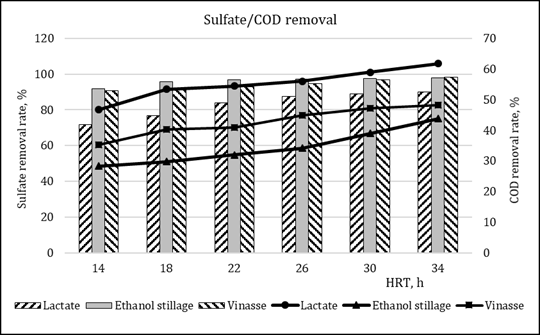
Table 3 shows the HPLC results for the acid and sugar composition in the initial substrates and at the end of the MSR process. The mono- and disaccharides in the ethanol stillage and vinasse underwent various fermentations, the final products of which were a mixture of different organic acids, alcohols, molecular hydrogen and carbon dioxide.
The sulfate-reducing bacteria present in the microbial coenosis carried out incomplete oxidation of organic substances, mainly lactate, which leads to the accumulation of high concentrations of acetate for all three carbon sources used.
Taking in addition the high rate of sulfate removal (Figure 2), then the wastewater from the distillery industry is a potential substrate for SRB.
The composition of ethanol stillage showed the presence of significant amounts of acids, with lactic (7.68 g/l) and propionic (1.56 g/l) acids as the main representatives. At 22 hours, the SRBs had degraded the entire amount of lactate and produced acetate (7.16 g/l). Gonçalves et al. used synthetic drainage water from a zinc-production plant and added a mixture of stillage and lactate as a carbon source in different ratios [9].
The results prove the applicability of the ethanol stillage as a substrate for MSR and the successful removal of heavy metals such as cadmium and zinc.
The main metabolite in the outlets of the three installations was acetic acid, which is the preferred substrate for other anaerobic processes such as methanogenesis.
Propionic acid underwent secondary fermentations with the participation of syntrophic bacteria, with the end products as acetate, hydrogen, and carbon dioxide.
Comparing the three substrates used in the MSR process, the most suitable for the subsequent stage of biomethane generation was vinasse, since the largest amounts of accumulated volatile fatty acids (VFA) - 8.85 g/l acetic and 1.25 g/l propionic acids, and there was also enough residual organic matter in the form of COD (17.8 gO2/l) to be utilized by the methanogens (Table 3).
| Initial substrate | Substrate after MSR (22h HRT) | |||||
|---|---|---|---|---|---|---|
| Vinasse 1:1 | Stillage 1:1 | Lactate | Vinasse 1:1 | Stillage 1:1 | Lactate | |
| D(+)glucose, g/l | 0.3 | 0.14 | - | 0.07 | 0.04 | - |
| D(+)xylose, g/l | 1.12 | 0.07 | - | 0.02 | 0.01 | - |
| D(+)mannose, g/l | 0.2 | 0.27 | - | - | - | - |
| D(+)galactose, g/l | - | 0.02 | - | - | - | |
| L(+)arabinose, g/l | - | 0.04 | - | - | - | - |
| D(+)cellobiose, g/l | 0.26 | 0.26 | - | - | 0.02 | - |
| lactic acid, g/l | 1.2 | 7.68 | 3.01 | - | - | - |
| acetic acid, g/l | - | 0.02 | - | 8.85 | 7.16 | 1.8 |
| propionic acid, g/l | - | 1.56 | - | 1.25 | 1.98 | 0.16 |
| ethanol, g/l | 2.82 | 0.66 | - | 0.77 | 0.23 | - |
| COD, gO2/l | 30.1 | 27.2 | 6.5 | 17.8 | 18.5 | 2.94 |
Table 3: Intermediates of microbial metabolism determined by HPLC.
The open circuit voltage (OCV) values for the studied MFCs at 6 different hydraulic retention times are shown in Figure 3.
Values for MFC with vinasse feed solution were always higher compared to MFC with lactate and ethanol stillage.
Highest OCV values for ethanol stillage (752 mV) and vinasse (902 mV) were on 22 h HRT.
For MFC with lactate was 710 mV on the 30 h HRT. Despite the observed low hydrogen sulfide values by vinasse, the OCV value was higher than stillage and lactate. Power density values were highest for vinasse (2052 mW/m2), followed by ethanol stillage (975 mW/m2), and lactate (390 mW/m2).
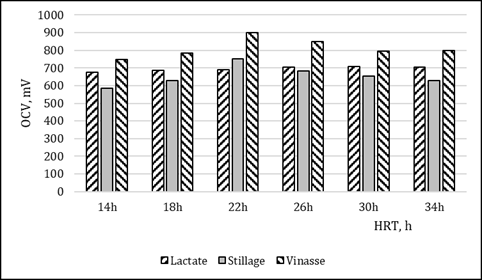
Figure 3: Graphical dependence of the open circuit voltage values (OCV) vs. HRT by lactate, vinasse and stillage The large difference may be due to the difference in the component composition of the substrates. Vinasse has a more balanced composition than ethanol stillage- more easily digestible sugars and a large amount of ethanol (Table 3), small amounts of unfermented sugars, high content of amino acids, organic acids and trace elements (K, N, P) [19]. According to Min, et al. the substrate composition and bacterial community influence microbial kinetics and hence maximum power density in the treatment of swine wastewater, domestic wastewater and butyrate [31]. Velasquez-Orta et al. also demonstrated that the composition of the microbial communities in the anode zone has a major impact on the current, power and coulombic efficiency. The type of substrate and the presence of electroactive bacteria can significantly increase the rate of electron transfer to the anode [32].
In the process of microbial sulfate reduction in a laboratory MFC with an air cathode, it was found that the COD decreased by 12.3 gO2/l in vinasse and an HRT of 22 h resulted in an MFC power of 5.157 W per m3 vinasse. Accordingly, in the variant with the ethanol stillage, the COD in the process decreased by 8.7 gO2/l, resulting in an MFC power of 2.44 W per m3 stillage. To scale up the process adequately, additional optimization studies in terms of electrode area and fuel cell volume are necessary.
The aim of future research will be to identify the dominant species of sulfate-reducing bacteria in the consortium in different wastewaters in order to provide more clarity on the obtained results (e.g., 16S rRNA sequencing). Another direction will be to optimize the MSR process by isolating SRB from natural sources and enriching the microbial consortium. Improving the parameters of the MFC will also lead to increased bioelectricity production.
Conclusion
The results for the application of distillery wastewaters show that vinasse and ethanol stillage can be successfully applied as electron donors in the MSR process. In both distillery wastewaters, the rate of sulfate removal was very high (98 %). Good results were also obtained for the removal of COD (over 40 %). The largest amount of generated electricity was obtained at the 22nd hour from vinasse and ethanol stillage. Obviously, the composition of the microbial community changed with different substrates and led to large differences in the obtained results. The resulting large amounts of acetate (8.85 g/l in vinasse and 7.16 g/l in stillage) and residual organic matter (17.8 g/l for vinasse and 18.5 g/l for stillage) are suitable to be used in a subsequent anaerobic process like methanogenesis.
Conflict of Interest
The authors declare that the research was conducted in the absence of any commercial or financial relationships that could be construed as a potential conflict of interest.
Acknowledgements
This research was supported by the Bulgarian National Science Fund, Grant № KP-06-H67/3, 2022.
References
-
Venkata Mohan S, Velvizhi G, Vamshi Krishna K, Lenin Babu M (2014) Microbial catalyzed electrochemical systems: A bio-factory with multi-facet applications. Bioresour. Technol. 165: 355-364.
-
Kumar R, Singh L, Wahid ZA (2015) Role of Microorganisms in Microbial Fuel Cells for Bioelectricity Production. In: Kalia V (Ed.), Microbial Factories. Springer, New Delhi, India, pp: 135-154.
-
Rabaey K, Van de Sompel K, Maignien L, Boon N, Aelterman P, Clauwaert P, et al. (2006) Microbial fuel cells for sulfide removal. Environ Sci Technol 40: 5218- 5224.
-
Blázquez E, Guisasola A, Gabriel D, Baeza JA (2019) Application of bioelectrochemical systems for the treatment of wastewaters with sulfur species. In Biomass, Biofuels, Biochemicals: Microbial Electrochemical Technology: Sustainable Platform for Fuels, Chemicals and Remediation Elsevier pp: 641-663.
-
Rodrigues ICB and Leão VA (2020) Producing electrical energy in microbial fuel cells based on sulphate reduction: a review. Environ Sci Pollut Res 27: 36075- 36084.
-
Liamleam W, Annachhatre AP (2007) Electron donors for biological sulfate reduction. Biotechnol Adv 25(5): 452-463.
-
Jin Z, Ci M, Yang W, Shen D, Hu L, et al. (2020) Sulfate reduction behavior in the leachate saturated zone of landfill sites. Sci. Total Environ 730: 138946-138958.
-
Zhang M, Wang H (2014) Organic wastes as carbon sources to promote sulfate reducing bacterial activity for biological remediation of acid mine drainage. Miner Eng 69: 81-90.
-
Gonçalves MM, da Costa AC, Leite SG, Sant’Anna GL (2007) Heavy metal removal from synthetic wastewaters in an anaerobic bioreactor using stillage from ethanol distilleries as a carbon source. Chemosphere 69(11): 1815-1820.
-
Agostino V and Rosenbaum MA (2018) Sulfate- Reducing ElectroAutotrophs and Their Applications in Bioelectrochemical Systems. Front. Energy Res 6(55): 1-10.
-
Angelov A, Bratkova S, Loukanov A (2013) Microbial fuel cell based on electroactive sulfate-reducing biofilm. Energy Convers. Manage. 67: 283-286.
-
Zagury GJ, Kulnieks VI, Neculita CM (2006) Characterization and reactivity assessment of organic substrates for sulphate-reducing bacteria in acid mine drainage treatment. Chemosphere 64(6): 944-954.
-
Gibert O, de Pablo J, Cortina JL, Ayora C (2002) Treatment of acid mine drainage by sulphate-reducing bacteria using permeable reactive barriers: A review from laboratory to full-scale experiments. Rev. Environ. Sci. Biotechnol 1(4): 327-333.
-
Chang IS, Shin PK, Kim BH (2000) Biological treatment of acid mine drainage under sulphate-reducing conditions with solid waste materials as substrate. Water Res 34(4): 1269-1277.
-
Jamil IN, Clarke WP (2013) Bioremediation for Acid Mine Drainage: Organic Solid Waste as Carbon Sources For Sulfate-Reducing Bacteria: A Review. J Mech Eng Sci 5(1): 569-581.
-
Gibert O, Pablo de J, Cortina JL, Ayora C (2004) Chemical characterization of natural organic substrates for biological mitigation of acid mine drainage. Water Res 38: 4186-4196.
-
Lin Y, Newcombe CE, Brennan RA (2020) Crab shell amendments enhance the abundance and diversity of key microbial groups in sulfate-reducing columns treating acid mine drainage. Appl Microbiol Biotechnol 104: 8505-8516.
-
Chai G, Wang D, Zhang Y, Wang H, Li J, et al. (2023) Effects of organic substrates on sulfate-reducing microcosms treating acid mine drainage: Performance dynamics and microbial community comparison. J Environ Manage 330: 117148-117157.
-
Magowo WE, Sheridan C, Rumbold K (2020) Global Co-occurrence of acid mine drainage and organic rich industrial and domestic effluent: biological sulfate reduction as a co-treatment-option. J Water Proc Eng 38: 101650-101660.
-
Habermann W, Pommer EH (1991) Biological fuel cells with sulphide storage capacity. Appl Microbiol Biotechnol 35: 128-133.
-
Sonawane JM, Marsili E, Ghosh PC (2014) Treatment of domestic and distillery wastewater in high surface microbial fuel cells. Int J Hydrogen Energy 39: 21819- 21827.
-
Deval AS, Parikh HA, Kadier A, Chandrasekhar K, Bhagwat AM, et al. (2017) Sequential microbial activities mediated bioelectricity production from distillery wastewater using bio-electrochemical system with simultaneous waste remediation. Int J Hydrog Energy 42: 1130-1141.
-
Nayak JK, Ghosh UK (2018) An innovative mixotrophic approach of distillery spent wash with sewage wastewater for biodegradation and bioelectricity generation using microbial fuel cell. J Water Process Eng 23: 306-313.
-
Tanikkul P, Boonyawanich S, Pisutpaisal N (2019) Bioelectricity recovery and pollution reduction of distillery wastewater in air-cathode SCMFC. Int J Hydrogen Energy 44: 5481-5487.
-
Feng Y, Wang X, Logan BE, Lee H (2008) Brewery wastewater treatment using aircathode microbial fuel cells. Appl Microbiol. Biotechnol 78(5): 873-880.
-
Zhao F, Rahunen N, Varcoe JR, Chandra A, Avignone- Rossa C, et al. (2008) Activated carbon cloth as anode for sulfate removal in a microbial fuel cell. Environ. Sci Technol 42: 4971-4976.
-
Eaktasang N, Min HS, Kang C, Kim HS (2013) Control of malodorous hydrogen sulfide compounds using microbial fuel cell. Bioprocess Biosyst Eng 36: 1417- 1425.
-
Bratkova S, Alexieva Z, Angelov A, Nikolova K, Genova P, et al. (2019) Efficiency of microbial fuel cells based on the sulfate reduction by lactate and glucose. Int J Environ Sci Technol 16: 6145-6156.
-
APHA (1989) Standard Methods for the Examination of Water and Wastewater, American Public Health Association, New York, USA.
-
Wang A, Ren N, Wang X, Lee D (2008) Enhanced sulfate reduction with acidogenic sulfate-reducing bacteria. J Hazard Mater 154: 1060-1065.
-
Min B, Kim JR, Oh SE, Regan JM, Logan BE (2005) Electricity generation from swine wastewater using microbial fuel cells. Water Res 39: 4961-4968.
-
Velasquez-Orta SB, Head IM, Curtis TP, Scott K (2011) Factors affecting current production in microbial fuel cells using different industrial wastewaters. Bioresour Technol 102: 5105-5112.
- Lessons to Learn: Trees are More than the Lungs of the World
- Community Forestry Enterprises as a Model for Sustainable Forest Development: The Case Of The "Baja Tarahumara" in Chihuahua, Mexico
- Ecological and Socio-Economic Impacts of Chromolaena odorata and Mesosphaerum suaveolens, Two Invasive Alien Species in Central and Southern Benin, West Africa
- Epigenetic Sustainability: Modeling the Human Factor as a Natural Resource through Science 4.0 and the NR3C1 Biological Pilot
- Growth-at-Risk: A Framework for Assessing Economic Vulnerability
- The Rural Territory as a Socioecological System for the Management of Public Policy for Sustainable Rural Development