
Monkeypox - Unravelling the On-going Stigma-A Mini Review
Introduction: The ongoing public health crises of monkeypox and poliomyelitis amidst the COVID-19 pandemic, have been straining both, the international as well as national health systems significantly. Despite having been first discovered in captive monkeys, thus the name, the information at hand points to the African rodents as the natural reservoir. Rats, mice, monkeys, prairie dogs, squirrels, and humans have all contracted infections [2]. Review: John P Thornhill et al. have reported 528 infections diagnosed between April 27 and June 24, 2022, at 43 sites in 16 countries. It has been reported that WHO officials are working on a new name for the virus and disease commonly known as monkeypox to reduce racism and stigma [1,8]. Owing to the fact of a very low CFR in this type, experts are of the view that the prevailing social stigma is that the monkeypox disease is transmitted sexually, especially through male-to-male sex, which dissuades people from reporting, despite developing symptoms [3,5,6]. Due to gay couples being a societal taboo, there are many unreported cases, hindering the testing process which may further lead to an unchecked spread in the country [6]. Researchers use the term, ‘HMPXV’ which stands for the human version of the monkeypox virus, referring to the virus driving the current outbreaks in Europe and North America, distinguishing it from those more commonly found in animals in Africa. According to the WHO, ‘names should be given with the aim to minimise the unnecessary negative impact on trade, travel, tourism, or animal welfare, and avoid causing offence to any cultural, social, national, regional, professional, or ethnic groups,’ as reported in the British Medical Journal (BMJ). Conclusion: Although monkeys are not the primary route of transmission, the disease is known as monkeypox because it was first observed in monkeys, by Danish scientists. Monkeypox is not known to be particularly contagious, and transmission often involves some level of close contact. Therefore, Monkeypox is not always transmitted sexually, though it is a form of intimate contact.
Background
While the globe struggles to contain the Coronavirus disease- 19 (COVID-19) pandemic, the upsurge of isolated cases of other viral diseases like monkeypox has raised alarm. On July 23, 2022, the world health organization (WHO) director-general, Tedros Adhanom Ghebreyesus, PhD, overruled the WHO emergency committee (EC), which had voted 6-9 against declaring a public health emergency of international concern (PHEIC), and declared the current monkeypox outbreak a PHEIC.
Rapid case identification is essential for containment in the absence of readily accessible prophylaxis or treatment. There are concerns among the masses as some of the cases, out of the nine instances of monkeypox recorded in India, have no travel history, which is indicative of the spread via droplet infection or nuclei or aerosol transmission. The latest outbreak in Europe and North America is most likely sustained by human-to-human transmission, unlike the cases discovered in Africa, according to the letter’s authors. The virus can transfer from one person to another through direct contact with lesions, bodily fluids, respiratory droplets, or fomites. However, the infection is typically a zoonosis in the African continent. Besides, the reluctance of people to even disclose when they have symptoms owing to social stigma, adds to the challenge. In order to combat the common misconceptions, the researchers demanded an ‘urgent’ revision to the term ‘monkeypox.’ In contrast to smallpox, monkeypox disease remains endemic in some parts of the world (primarily West and Central Africa). The outlook is better for the West African clade, which has a case fatality rate (CFR) of less than 1%. Whereas, the Central Basin clade (also called the Central African clade) is more deadly, with a CFR of up to 11% in young unvaccinated individuals.
Introduction
The ongoing public health crises of monkeypox and poliomyelitis amidst the COVID-19 pandemic, have been straining both, the international as well as national health systems significantly. The monkeypox virus, a relative of the smallpox virus, is an enveloped double-stranded DNA virus, belonging to the Orthopoxvirus genus of the Poxviridae family, whereas the poliovirus is a single-stranded positive-sense RNA that originates from the Picornaviridae. The first instance of monkeypox identification among human, dates back to the 1970s, in the suspected smallpox region of the Democratic Republic of the Congo (formerly Zaire) [1, 2]. It was the vaccinia vaccination used against smallpox that provided coincidental immunity against the monkeypox virus. However, subsequent cessation of smallpox vaccination, and post-smallpox eradication, has led to the emergence of the monkeypox virus as an orthopoxvirus of human concern [1, 2].
A variety of animals have been found to be susceptible to the monkeypox virus. Despite having been first discovered in captive monkeys, thus the name, the information at hand points to the African rodents as the natural reservoir. Rats, mice, monkeys, prairie dogs, squirrel, and humans have all contracted infections [2]. An instance had been recorded in 2003, when Gambian pouched rats imported to the US had passed the disease on to prairie dogs, subsequently infecting more than 70 people. Hence, passengers travelling from Africa or those who have come into contact with an unusual animal such as a rat, squirrel, or a non-human primate, are often isolated in Europe and the US, so as to avoid further transmission [3].
In contrast to smallpox, monkeypox disease remains endemic in some parts of the world (primarily West and Central Africa). The outlook is better for the West African clade, which has a case fatality rate (CFR) of less than 1%. Whereas, the Central Basin clade (also called the Central African clade) is more deadly, with a CFR of up to 11% in young unvaccinated individuals. The remainder of patients normally fully recover within four weeks from the onset of symptoms, with the possible exception of scarring and skin discolouration [3].
Review
John P Thornhill, et al. have reported 528 infections diagnosed between April 27 and June 24, 2022, at 43 sites in 16 countries. Overall, 98% of the persons with infection were gay or bisexual men while, 75% were White, and 41% had human immunodeficiency virus (HIV) infection. The median age of the study population was 38 years. The transmission was suspected to have occurred through sexual activity in 95% of the infected persons [1]. Sherwat, et al. in their case series, 95% of the persons presented with a rash (with 64% having <10 lesions), 73% had anogenital lesions, and 41% had mucosal lesions (with 54 having a single genital lesion). Common systemic features preceding the rash included fever (62%), lethargy (41%), myalgia (31%), and headache (27%) (Figure 1). Lymphadenopathy was also reportedly common (56%) [1, 2].
On July 14, 2022, the Indian state of Kerala detected the first case of Monkeypox in the nation, in a 35-year-old, who had flown into Thiruvananthapuram from the United Arab Emirates (UAE). Four days later, the authorities confirmed a second case, in Kannur, also a flyer from the UAE. The state reported its third case, a 35-year-old man, who had returned from the UAE on July 6, 2022 [3, 4, 5].
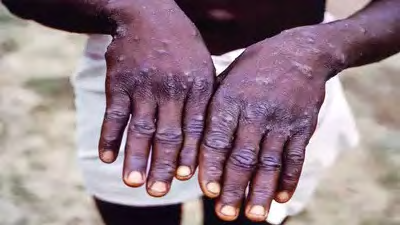
Owing to the fact of a very low CFR in this type, experts are of the view that the prevailing social stigma that the monkeypox disease is transmitted sexually, especially through male-to-male sex, dissuades people from reporting, despite developing symptoms [3, 5, 6]. Due to gay couples being a societal taboo, there are many unreported cases, hindering the testing process which may further lead to an unchecked spread in the country [7].
It has been reported that WHO officials are working on a new name for the virus and disease commonly known as monkeypox to reduce racism and stigma [8]. Though the disease was named after monkeys after being first detected in a primate, in a Danish laboratory, in 1958, its true origin remains unknown [8]. Researchers use the term, ‘HMPXV’ which stands for the human version of monkeypox virus, referring to the virus driving the current outbreaks in Europe and North America, distinguishing it from those more commonly found in animals in Africa. According to the WHO, ‘names should be given with the aim to minimise the unnecessary negative impact on trade, travel, tourism, or animal welfare, and avoid causing offence to any cultural, social, national, regional, professional, or ethnic groups,’ as reported in the British Medical Journal (BMJ). The naming of the virus is the responsibility of the International Committee on the Taxonomy of Viruses (ICTV), it added [8, 9, 10]. Recently, the foreign press association (FPA), Africa, issued a statement urging the global media to stop using images of African people to highlight the outbreak in Europe [9]. It has proposed a novel classification of HMPXV that is non-discriminatory and non-stigmatizing and aligned with best practices in the naming of infectious diseases in a way that minimizes unnecessary negative impacts on nations, geographic regions, economies and people and that considers the evolution and spread of the virus. The proposed classifications of three main clades of MPXV are namely, MXPV 1, 2 and 3, in their order of detection (Figure 2A). According to the ICTV, usage of the placeholder label ‘hMPXV1’ signifies that the human virus has become distinct from MPXV (Figure 2B) and demands a speedy decision and adoption of a new name like Pango nomenclature for SARS- CoV-2, the base of hMPXV1 would be denoted lineage ‘A’ while, the descendant lineages would be named as ‘A.1’, ‘A.2’, ‘A.1.1’ (Figure 2B). The current international 2022 outbreak would be denoted ‘B.1’ as the first detected descendent lineage of ‘A.1.1’
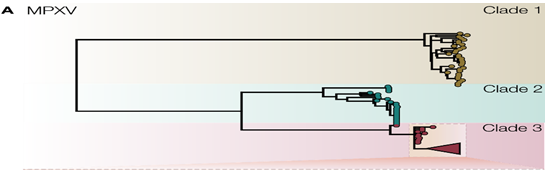
Figure 2A: Clades of Monkey MPXV.
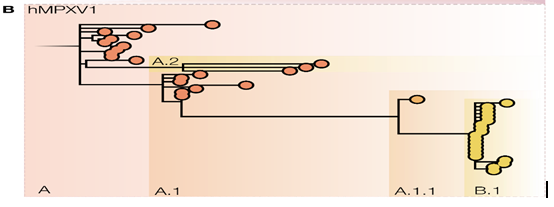
Figure 2B: Nomenclature of HMPXV.
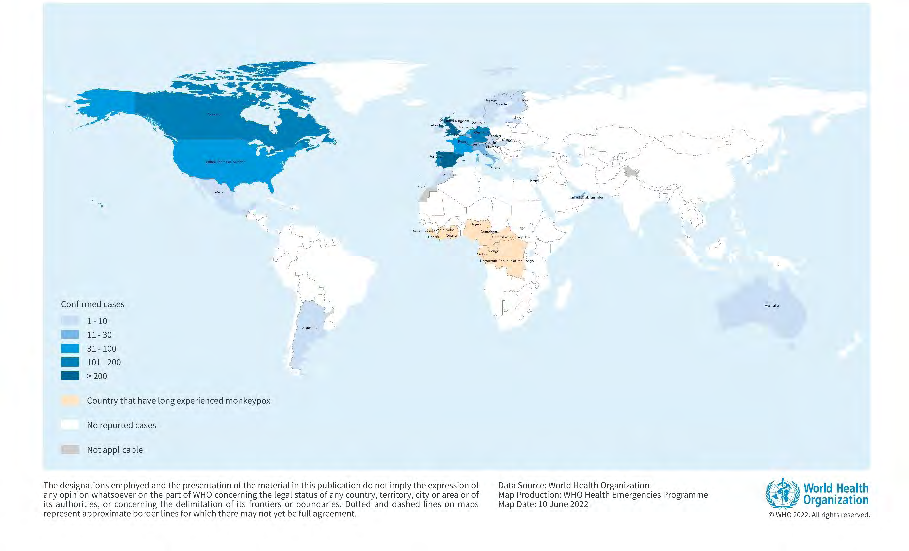
As of 8 June 2022, 1536, suspected cases with 72 deaths have been recorded from eight countries, while 59 confirmed cases have been reported from six countries since the beginning of 2022 [9, 10] (Figure 3). Anyone is susceptible to the monkeypox, regardless of their sexuality. The laboratory workers, designated healthcare or public health workers, geriatric and immunocompromised population form the population at risk [11].
Most of the cases to date have occurred among men who have had a sexual relationship with men (MSM), particularly those with new or multiple partners. Epidemiologic investigations indicate that the predominant mode of transmission is via skin-to-skin and sexual contact and not through contaminated clothing or bed linens. Although respiratory droplet transmission might occur, there is no evidence of airborne transmission, unlike COVID-19 [12].
Genomic analyses have identified multiple circulating viral strains, indicating several points of entry for the virus into no endemic countries and undetected viral spread. Many infections are not linked to other known case, which indicates links in transmission chains are not being identified. Transmission among patients other than MSM may be under recognized due to a lower index of suspicion among clinicians and less frequent testing [13]. Most recent infections have milder clinical presentations, making it more difficult to identify and interrupt transmission. Rigorous clinical trials are needed to evaluate the efficacy of antiviral drugs for treating MPXV infection and should be reserved for individuals in clinical trials or at a high risk for severe disseminated disease, otherwise, their indiscriminate use could lead to the emergence of resistant strains. Furthermore, they are associated with serious adverse events [13, 14].
Given the importance of human–animal–environment interface and transmission dynamics, fostering global and regional ‘One Health’ approach partnership and multispectral collaboration programs have timely and robust sustained investment benefits on poverty-linked monkeypox and other emerging epidemics population-based programs, while leveraging from lessons learnt [15, 16].
Conclusion
Although monkeys are not the primary route of transmission, the disease is known as monkeypox because it was first observed in monkeys, by Danish scientists. Monkeypox is not known to be particularly contagious, and transmission often involves some level of close contact. Therefore, Monkeypox is not always transmitted sexually, though it is a form of intimate contact.
Because of its animal reservoir, monkeypox cannot be eradicated. We must approach this condition as a disease and not as a reason for stigmatisation and societal condemnation. Because every time we’ve done that, it has unjustifiably disgraced races and the essence of being human. It will be another emergent infectious disease that we regret not controlling unless the world adopts and implements an international plan to contain the current outbreak. By working with partners to spread knowledge about monkeypox through a variety of channels and to various populations, the centres for disease control and prevention (CDC) is spreading its message to lessen the taboo. For governments and stakeholders to be prepared to stop, monitor, and contain any potential monkeypox outbreak, timely, trustworthy, and secure information sources must continue to increase citizen and country awareness and education outreach, healthcare decentralisation, and transparency.
References
-
Thornhill JP, Barkati S, Walmsley S, Antinori A, Rockstroh J, et al. (2022) Monkeypox Virus Infection in Humans across 16 Countries-April-June 2022. N Engl J Med 387: 679-691.
-
Sherwat A, Brooks JT, Birnkrant D, Kim P (2022) Tecovirimat and the Treatment of Monkeypox-Past, Present, and Future Considerations. N Engl J Med 387(7): 579-581.
-
WHO (2022) Recovering from monkeypox at home.
-
(2022) High alert as Delhi reports monkeypox.
-
(2022) Monkeypox: Govt on alert as 4th case shows up in Delhi.
-
(2022) Monkeypox spread unchecked in India, stigma hindering testing: Experts.
-
(2022) People hiding Monkeypox in India, Reason: Gay Sex stigma.
-
Taylor L (2022) Monkeypox: WHO to rename disease to prevent stigma. BMJ 377: o1489.
-
Happi C, Adetifa I, Mbala P, Njouom R, Nakoune E, et al. (2022) Urgent need for a non-discriminatory and non- stigmatizing nomenclature for monkeypox virus. PLoS Biol 20(8): e3001769.
-
WHO (2022) Multi-country monkeypox outbreak: situation update.
-
WHO (2022) Monkeypox: public health advice for gay, bisexual and other men who have sex with men.
-
Osterholm MT, Gellin B (2022) Confronting 21st-century monkeypox. Science 19: eadd9651.
-
Nuzzo JB, Borio LL, Gostin LO (2022) The WHO Declaration of Monkeypox as a Global Public Health Emergency. JAMA 328(7): 615-617.
-
Bragazzi NL, Kong JD, Mahroum N, Tsigalou C, Khamisy- Farah R, et al. (2022) Epidemiological trends and clinical features of the ongoing monkeypox epidemic: a preliminary pooled data analysis and literature review. J Med Virol.
-
CDC (2022) Reducing Stigma in Monkeypox Communication and Community Engagement.
-
Tambo E, Al-Nazawi AM (2022) Combating the global spread of poverty-related Monkeypox outbreaks and beyond. Infect Dis Poverty 11(80).
- Epidemiological and Clinical Aspects of Intestinal Parasitoses Among Students in the City of Bocaranga, Central African Republic
- Artificial Intelligence Empowers Global Infectious Disease Prevention and Control: Opportunities and Challenges
- Factors that Affect the Incidence of Babesia and Blood Donor Testing in Select States: A Regression Analysis
- Neuro-TB: The Battle between Tuberculosis and the Nervous System
- The Biological and Health Implications of Cat Fleas (Ctenocephalides felis): Assessing Zoonotic Risks and Hygiene Strategies
- Biostatistical Analysis of Medicinal Plants for Treating Schizophrenia