
Role of Topical Cholecalciferol Therapy in Amputation Stump
Wound healing consists of haemostasis, inflammatory proliferative phases and remodelling phase. A problem with the edge of the wound doesn’t allow healing and causes a delay in the wound healing. In this article, we share our experience with using topical cholecalciferol therapy for wound bed preparation in non-healing ulcer on an amputation stump.
Introduction
Wound bed preparation is a concept using the T.I.M.E method. The Edge involves formation of granulation tissue for better wound healing. Various methods are used to improve the healing in non-healing wounds with supplementation of growth factors and control of infection. Recently we have come across the application of topical cholecalciferol therapy for the management of non-healing ulcer over an amputation stump, and we share our experience.
Materials and Methods
This study was conducted in the department of Plastic Surgery at a tertiary care center after obtaining departmental ethical committee approval. Informed written consent was taken from the patient. The details of the patient are as follows: 37 year old female with no known co morbidities with h/o a road traffic accident 4 months before and underwent right below knee amputation due to vascular injury and degloving injury of the left lower limb which underwent serial wound debridement in cardiothoracic and general surgery department. Now, the patient presented to plastic surgery department with an extensive raw area over the left lower limb and non-healing ulcer over the right below knee amputation stump.
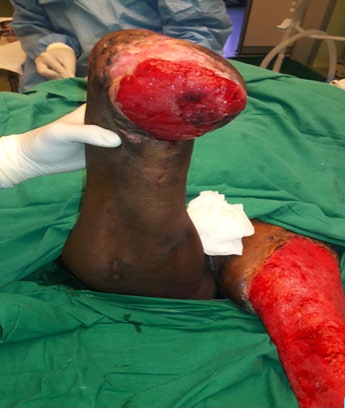
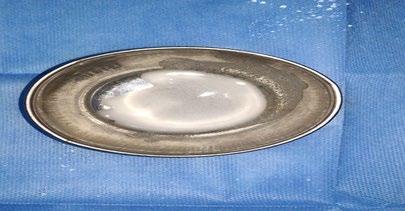
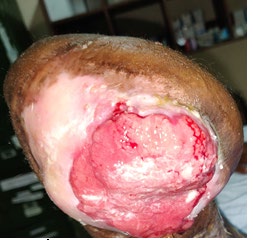
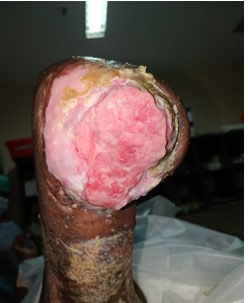
Wound bed preparation was done using topical cholecalciferol therapy along with the dressing changes (Figures 1 & 2). Repeat debridement was done if required and cholecalciferol was applied topically every time the dressings were changed. Six such sessions of cholecalciferol application was done over three weeks. The wound showed healing as evidenced by a healthy granulation tissue (Figures 3 & 4). The cost of cholecalciferol sachet was between 35 to 50 rupees per sachet.
Discussion
Wound bed preparation was redefined as ‘the global management of wound to accelerate endogenous healing or to facilitate the effectiveness of other therapeutic measures’. Wound bed preparation has been given by the acronym T.I.M.E with T for tissue: non-viable or deficient. I for infection/inflammation, M for moisture balance. E for epidermis which was later changed to E for edge. Wound debridement, control of inflammation form essential parts of wound bed preparation that stimulate the edge of the wound to migrate, however if they fail, advanced therapies can be used.
Vitamin-D or cholecalciferol is known for its role in calcium homeostasis and metabolism. It has been found that Vitamin D is useful in healing of diabetic wounds when administered systemically. It also decreases inflammation due to diabetic wounds [1]. Literature also mention the use of cholecalciferol as a drug delivery agent and claim that it can help in the local wound healing. It has been found to improve corneal wound healing.
Vitamin-D act as an antiproliferative, prodifferentiative, antiapoptotic and immunomodulator [2]. Its therapeutic uses (topical and systemic) have been proved useful in various skin diseases. The vitamin-D enhances the production of anti-microbial peptides (AMP) like–defensin and cathelicidin. These AMP increases the keratinocyte formation and migration, and also increase the production of the chemokines like IL-8. It also has an immunosuppressive action in the skin. It decreases the antigen presentation by its effect on Langerhans cells and by starting cytokine production by keratinocyte cells. There are no proven disadvantages of using topical cholecalciferol [3].
In this case, we have used vitamin-D granules in amputation stump. Various topical antimicrobial delivery systems are available such as gentamicin in collagen dressings, minocycline in chitosan-polyurethrane foam, ofloxacin from silicone sheets, dialkylcarbamoylchloride in cotton wool dressing, etc [4, 5].
Conclusion
Topical cholecaliferol therapy was found to be useful in management of non-healing ulcer as it improved the granulation tissue (Figure 5).
Limitations
This was done on a single patient and needs large population based study to apply the finding in clinical practice. Long-term clinical observations are needed to determine whether topical cholecalciferol can be used for wound bed preparation.
References
-
Razzaghi R, Pourbagheri H, Momen-Heravi M, Bahmani F, Shadi J, et al. (2017) The effects of vitamin D supplementation on wound healing and metabolic status in patients with diabetic foot ulcer: A randomized, double-blind, placebo-controlled trial. J Diabetes Complications 31(4): 766-772.
-
Reins RY, Hanlon SD, Magadi S, McDermott AM (2016) Effects of topically applied vitamin D during corneal wound healing. PloS one 11(4): e0152889.
-
Umar M, Sastry KS, Al AF, Al-Khulaifi M, Wang E, et al. (2018) Vitamin D and the pathophysiology of inflammatory skin diseases. Skin Pharmacol Physiol 31: 74-86.
-
Jeffcoate WJ, Harding KG (2003) Diabetic foot ulcers. Lancet 361(9368): 1545-1551.
-
Cowling T, Jones S (2017) Topical Antibiotics for Infected Wounds: A Review of the Clinical Effectiveness and Guidelines.
- Psychogenic Erectile Dysfunction in Late Adulthood: A Case Report on Clinical Intervention and Intimacy Restoration
- Clinical Trials on COVID-19 in 2025: A New Chapter in Global Health Research
- Innovations and Challenges in Contemporary Medical Clinical Trials: An Editorial Perspective
- Innovations and Challenges in Contemporary Medical Clinical Trials: A Critical Perspective
- Reimagining Clinical Trials: The Power of Continuous Feedback from Medical Reports
- Factors Influencing Brain Drain: Perspectives from a Medical School in Turkey