
COVID-19 in Al-Najaf Province Iraq until June 2020
Coronavirus disease, which is called (COVID-19) is an infectious disease caused by a newly discovered coronavirus. Coronaviruses, which describe are a large family group of viruses that leading to illness ranging from the common cold to very severe diseases such as Middle East Respiratory Syndrome (MERS-CoV) and Severe Acute Respiratory Syndrome (SARS-CoV). A cross-sectional study was carried out to describe the total number of people who were infected with COVID 19 in Al-Najaf province in Iraq from February until June 2020. All cases were diagnosed, recorded, and announced at the official web of Al-Najaf Health Directorate\ Center of Training and Development of Staffs. The result of this study reveals that the total number of people who are infected with COVID-19 at the time of this study was 1724 person. The result of this table shows that the total number of patients was irregular, and June was mostly higher than in other months. This situation seems the same for the cure and dies numbers for these months; however, the death rate was high in March and decreased when it reaches to June.
Introduction
Coronavirus disease (COVID-19) is defined as an infectious disease caused by a newly discovered coronavirus [1]. Coronaviruses, which describe are a large family group viruses that are leading to illness ranging from the common cold to very severe diseases such as Middle East Respiratory Syndrome (MERS-CoV) and Severe Acute Respiratory Syndrome (SARS-CoV). A new coronavirus (nCoV) is a new strain that has not been previously identified in humans [2].
Across the globe, countries have implemented several control measures to prepare for and respond to COVID-19 comprehensively. The overarching aim of the WHO global COVID-19 response strategy is for all nations to control and prevent the pandemic by come down transmission and reducing the mortality that associated with COVID-19, with the final goal of reaching and maintaining a state of low- level or no transmission. Based on the local epidemiological picture, some countries are in the process of scaling up social and public health measures, while others are or currently considering scaling down these measures [3]. However, the goal in all countries is to suppress transmission and provide care for all patients. The intensity of implementation of control measures to achieve this including identification, testing, isolation, and care for all cases, tracing and quarantine of all contacts, public health and social measures at individual and community levels, etc. varies based on the transmission scenario each country is facing (no cases, first cases, clusters of cases, or community transmission) [4].
Common manifestations of infection include respiratory symptoms, fever, and cough, breathing difficulties, and shortness of breath. In more severe patients, the infection can cause pneumonia, severe acute respiratory syndrome, kidney failure, and even death [5]. The standardized recommendations to prevent infection spread include regular hand washing, covering mouth and nose when coughing and sneezing, cooking meat. Avoid close contact with anyone appearing symptoms of respiratory illness such as coughing and sneezing [6]. Most suspected people infected with the COVID-19 virus will experience mild to moderate respiratory symptoms and recover without requiring special treatment. Old age people and those with underlying medical conditions like cardiovascular disease, chronic respiratory disease, diabetes, and cancer are more likely to progress severe illness [7].
The best method to prevent and slow down transmission is to be well informed about the disease, which is caused by this virus, and the way to transmission. To protect the people from infection by washing hands or using an alcohol-based rub frequently and not touching the face. The COVID-19 virus transmits primarily through droplets of saliva infection or discharge from the nose when an infected person coughs or sneezes, so it is crucial that you also practice respiratory etiquette such as coughing into a flexed elbow [8]. At this time, there are no particular vaccines or treatments for COVID-19. However, many ongoing clinical experiments are evaluating potential treatments [9].
On February 26, the Iraqi government announced urgent measures launched by the IMoH to contain the spread of the virus including the public health awareness campaign, implementing PCR screening to test for (Covid-19) infection regardless of symptoms on repatriated citizens, case-specific investigation, tracing of contacts, isolation of citizens with suspected or confirmed (Covid-19) infection, quarantine of exposed citizens in addition to a community based, on-site enhancement of infection control and prevention [10]. This study was carried out to describe the number of COVID-19 cases in Al-Najaf province, although all the protocols and the precautions that been taken in this province.
Methodology
Study location
This cross-sectional study was carried out in Al-Najaf province, one of the eighteen provinces in Iraq. This province consists of six districts, namely, Najaf, Hydaria, Munathera, Al-Abbasia, Kufa, and AlMishkhab. In 2018, Al Najaf had a population of 1,471,592, which represent 3.85% of the total population in Iraq [11].
![Figure 1: Iraqi map [12].](/fulltextimages/6246/fig_1.jpeg)
Study design and sample
A cross-sectional study was carried out to describe the total number of people who were infected with COVID 19 in Al-Najaf province in Iraq from February until June 2020. All cases were diagnosed, recorded, and announced at the official web of Al-Najaf Health Directorate\ Center of Training and Development of Staffs. The clinical classification of cases was done in accordance with the Diagnosis and Treatment Protocol for Novel Coronavirus Pneumonia released by National Health Commission-China [13].
Inclusion and Exclusion Criteria
1. The first sight the cases, which are suspected according to the epidemiological picture with COVID-19 isolated and the quarantine down for the contact. 2. The specimen collection and the diagnostic testing were performed following WHO interim guidance [14].
Data Collection
Data was collected from records and announces at the official web of Al-Najaf Health Directorate\ Center of Training and Development of Staffs
Results
The result of this study reveals that the total number of people who are infected with COVID-19 at the time of this study was 1724 person.
| Total case | Cure | Die | Death rate | |
|---|---|---|---|---|
| March | 91 | 6 | 3 | 3.3% |
| April | 154 | 84 | 0 | 0.0 |
| May | 30 | 32 | 6 | 20% |
| June | 1449 | 613 | 37 | 2.5% |
| Total | 1724 | 735 | 46 |
Table 1: Distribution of COVID-19 cases according to months, cure and die.
The result of this table shows that the total number of patients was irregular, and June was mostly higher than in other months. This situation seems the same for the cure and dies numbers for these months; however, the death rate was high in March and decreased when it reaches to June.
| Weeks | Cure | Die | Total Case | |
|---|---|---|---|---|
| June | First W | 27 | 9 | 113 |
| June | Second | 68 | 3 | 465 |
| June | Third | 309 | 16 | 525 |
| June | Fourth | 345 | 14 | 651 |
| May | First W | 24 | 0 | 3 |
| May | Second | 2 | 0 | 1 |
| May | Third | 3 | 6 | 9 |
| May | Fourth | 3 | 0 | 14 |
| April | First W | 0 | 0 | 84 |
| April | Second | 27 | 0 | 29 |
| April | Third | 27 | 0 | 22 |
| April | Fourth | 14 | 0 | 19 |
| March | First W | 0 | 0 | 0 |
| March | Second | 6 | 3 | 51 |
| March | Third | 0 | 0 | 18 |
| March | Fourth | 0 | 0 | 22 |
Table 2: Total cases numbers of COVID-19 per weeks of months.
The result of this table is an apparent variance among the total number of patients per week, especially for June weeks.
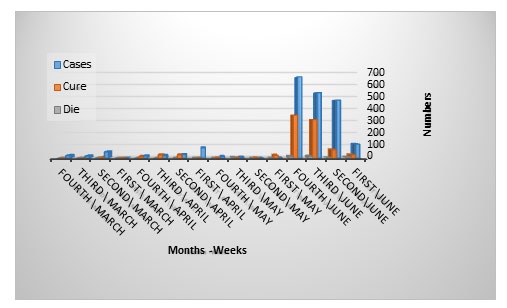
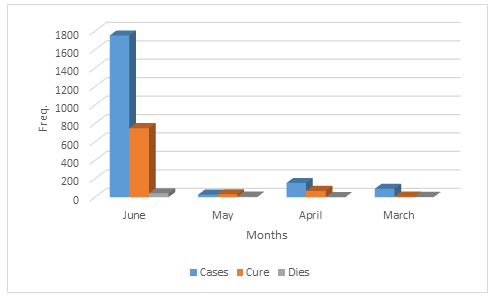
The result of this table has appeared a clear variance among the total number of patients per week, especially for June weeks.
Discussion
The result of this study reveals that the total number of people who are infected with COVID-19 at the time of this study was 1724 person. The result of this table shows that the total number of patients was irregular, and June was mostly higher than in other months. This situation seems the same for the cure and dies numbers for these months; however, the death rate was high in March and decreased when it reaches to June.
Although all the control and prevention procedures that followed by it Al-Najaf Health Directorate, the total number of COVID-19 cases which was diagnosed increased gradually through time. Most of the cases that are diagnosed at the first time of pandemic were imported from different countries such as Iran, Turkey, and many other countries. Besides that, leave the international Al-Najaf airport opening was helped the situation and other factors like the low education level about Coronaviruses [13, 15]. This result was compatible with AL-Shareef, et al. they found that Lack of effective antiviral medications and inadequate adherence to standard supportive therapy might have also contributed to the poor clinical outcomes in some patients for the same place [13]. Cases with a travel history to the Islamic Republic of Iran have also been reported from Afghanistan, Canada, Lebanon, Pakistan, Kuwait, Bahrain, Iraq, Oman, Qatar and the United Arab Emirates. Although, on March 2 2020 – A team of WHO experts have landed in Tehran, Islamic Republic of Iran, to support the ongoing response to the coronavirus disease-2019 (COVID-19) outbreak in the country. Still, the situation uncontrolled [16].
Declaration of Interests
There are no competing interests.
Acknowledgement
This work was according to the Iraqi Ministry of Health (IMH) and Al-Najaf Health Directorate, Quarantine Center (AHQC), in Al-Najaf Province, Iraq.
References
-
World Health Organization (2020) Coronavirus disease (COVID-19) pandemic.
-
Pan American Health Organization (2018) Zika Epidemiological Report. World Health Organization.
-
WHO (2020) Strategic preparedness and response plan for the new coronavirus.
-
Critical preparedness, readiness and response actions for COVID-19
-
Repici A, Maselli R, Colombo M, Gabbiadini R, Spadaccini M, et al. (2020) Coronavirus (COVID-19) outbreak: what the department of endoscopy should know. Gastrointestinal endoscopy 92(1): 192-197.
-
Centers C (2020) Alerts and epidemiological updates.
-
The International Chamber of Shipping (ICS) (2020) Coronavirus (COVID-19) guidance for ship operators for the protection of the health of seafarers (No.Version 2.1). London EC3A 8BH: Marisec Publications.
-
World Health Organization (2020) Coronavirus disease (COVID-19) pandemic.
-
Peter Kenny (2020) No vaccine, specific drug against coronavirus yet: WHO.
-
Government of Iraq (2020) Novel coronavirus (COVID-19): Cabinet receives briefing on measures to contain coronavirus, support for heath sector.
-
Population statistics for countries (2018) Republic of Iraq.
-
Ibadi AK, Hamedon TR (2015) The sociodemographic characteristics of pregnant women with toxoplasmosis in Al-Qadisiyah-Iraq. International Journal of Public Health and Clinical Sciences 2(6): 59-67.
-
AL-Shareef AH, Al-Mudhaffer SA, Mohammed S (2020) Epidemiology and clinical characteristics of the domestic and repatriated (Covid-19) Infections in Al Najaf governorate, Iraq. Journal of the Faculty of Medicine 62(1-2): 13-19.
-
World Health Organization (2020) Laboratory testing for coronavirus disease 2019 (COVID-19) in suspected human cases: interim guidance.
-
Government of Iraq (2020) Novel Coronavirus (COVID-19): Update from Iraq’s Ministry of Health.
-
WHO | Regional Office for the Eastern Mediterranean (2020) Islamic Republic of Iran. WHO team arrives in Tehran to support the COVID-19 response. World Health Organization.
- Psychogenic Erectile Dysfunction in Late Adulthood: A Case Report on Clinical Intervention and Intimacy Restoration
- Clinical Trials on COVID-19 in 2025: A New Chapter in Global Health Research
- Innovations and Challenges in Contemporary Medical Clinical Trials: An Editorial Perspective
- Innovations and Challenges in Contemporary Medical Clinical Trials: A Critical Perspective
- Reimagining Clinical Trials: The Power of Continuous Feedback from Medical Reports
- Factors Influencing Brain Drain: Perspectives from a Medical School in Turkey