
The Relevance of Immunological System in Cancer Progression
Cancer cells can even turn off the immune response so that the immune cells don't attack them. Also, persons with cancer actually have a weakened immune system. The immune system gets less effective when the cancer itself affects the bone marrow. The weakness of immune can equally results from cancer treatment, like chemotherapy or radiation therapy which affects the bone marrow. The immune system is the body's defense mechanism: it mainly protects the body from the harmful effects of pathogens as well as cancer cells. It has been reported that, cancer cells can escape detection and elimination and form tumors. This tumor can weaken the immune response. When normal cells turn into cancer cells, some of the antigens on their surface may change. If the immune system notices the foreign antigens, it launches the body’s defenders, including killer T cells, NK cells, and macrophages. But the immune system cannot patrol everywhere to provide body wide surveillance, flushing out and eliminating all cells that become cancerous. Tumors develop when the immune system is overwhelmed.
Introduction
There are some reports in which Scientists are shaping immune cells and substances into ingenious new anticancer weapons. They are using substances known as biological response modifiers, including lymphocytes and lymphokines, to bolster the patient’s immune responses. In these cases, biological response modifiers are injected directly into the patient. They can also be used in the laboratory to transform some of the patient’s own lymphocytes into tumor-hungry cells, which are then injected back into the patient so they can attack the cancer cells. Antibodies specially made to recognize specific cancers can be coupled with drugs, toxins, or radioactive materials, then sent off like “magic bullets” to deliver their lethal cargo directly to the target cancer Cancer cells can be linked with toxins, drugs, or radioactive substances, which they can deliver directly to the cancer cell. Alternatively, toxins can be linked to a lymphokine and routed to cells equipped with receptors for the lymphokine [1, 2, 3, 4, 5]. Radioactively labeled antibodies can also be used to track down hidden nests of cancer cells. The immune system often responds weakly or not at all to cancer cells. Cancer vaccines try to improve on the natural anticancer response by stimulating strong killer T-cell responses against a tumor. Although such vaccines are generally not able to destroy a tumor if given as the only form of treatment, research suggests they can be effective partners if administered along with other forms of treatment. The responsibility of immune system in cancer. The immune system is a complex apparatus that both protects the body and, in some cases, helps cancer destroy it.
Every second of every minute of every day, a battle of good and evil goes on inside your body. The good is the immune system, armies of cells designed to defend the body from illness and infection. The evil comes in the form of pathogens, viruses, bacteria and mutated cells that are programmed to do harm. When it comes to cancer, the good guys don’t always win. But new immunotherapy treatments, emerging technologies and ongoing research gives more insight as to help the immune system do the job it was meant to: fight back against threats like cancer [6, 7, 8, 9, 10].
The immune system is critical in fighting cancer. The immune system is an efficient and powerful biological machine. It protects us from millions of germs and fights off viruses and infections. So powerful are its responses that they may cause fevers, aches and pains, inflammation and swelling. “It’s because the immune system is doing what it’s supposed to do. And what it does is more than fight off disease [11]. It has been reported that immune cells known as macrophages stimulate cells in the heart muscle, helping to keep the heart pumping and maintain a steady beat. Also, immune cells clear out dead brain cells after a stroke and secrete substances that may allow the brain to repair damage [12].
The immune system has two divisions: innate and acquired. Within each division are regiments of different cells that perform specific immune functions. Innate immunity is the body’s first line of defense. These immune cells are programmed to attack cells they sense as a threat to the host. “Innate immune cells kill first and ask questions later [13, 14].
Among the cells in the innate immune system are
Macrophages
Named for the Greek words that mean “big eaters,” these long-limbed cells are true to their moniker. They are voracious, using flexible tendrils to snag and attack their targets.
Neutrophils
These short-lived cells are the first line of defense against infection. They kill bacteria, then die, forming pus.
Dendritic cells
These are the innate immune system’s traffic cops, directing T-cells and B-cells to their targets.
Mast cells and basophils
They produce histamines that help the immune system attack allergens.
Natural killer (NK) cells
These rapid-response cells attack viruses and may also be aggressive in attacking cancerous and pre-cancerous cells.
The acquired immune system—also called adaptive immunity—is more sophisticated and takes longer to develop a plan of attack.
The cells of adaptive immunity are
B-cells
They develop and mature in the bone marrow and make proteins called antibodies that fight viruses and bacteria.
T-cells
They also form in bone marrow, but mature in the thymus. There are two main types of T-cells: helper T-cells that stimulate B-cells to make antibodies, and killer T-cells that attack cells directly. Adaptive immune cells target viruses or bacteria, using information delivered from dendritic cells and other innate cells, and they store information about these pathogens so they can recognize and target them again should they launch another attack. Indeed, it is possible, even likely, that immune system may regularly fight off cancer or pre-cancer on a regular basis without even knowing it. There is a mechanism to filter out a small amount of cancer cells to prevent us from having visible cancer in the body [15].
The tipping point at which cancer begins to overwhelm the immune system is not always known. There are lots of different reasons why that might happen. Some of it has to do with the DNA of the tumor. Some of it has to do with the aggressiveness of the cancer. But research has shown that cancer cells exert tremendous sway over some innate and adaptive immune cells and recruit them to help cancer grow and travel. It has been reported that cancer cells use immature immune cells called myeloid-derived suppressive cells (MDSCs) to metastasize. Using deceptive signaling, cancer cells stifle the growth of MDSCs and use them to help tumors spread. These cells are essential to successful cancer metastasis [16, 17, 18]. There is a very intricate balance in the immune system that is usually anti-tumorigenic, meaning it eliminates tumors, but in some cases, if this balance is altered, these cells may actually help tumors grow and develop into full-blown metastatic disease.
The Immune System and Cancer
The immune system protects the body against illness and infection that bacteria, viruses, fungi or parasites can cause. It is a collection of reactions and responses that the body makes to damaged cells or infection. So it is sometimes called the immune response. The immune system is important to people with cancer because: cancer can weaken the immune system, cancer treatments might weaken the immune system and the immune system may help to fight cancer.
Treatments Cancer May Weaken Immunity
Cancer can weaken the immune system by spreading into the bone marrow. The bone marrow makes blood cells that help to fight infection. This happens most often in leukaemia or lymphoma, but it can happen with other cancers too. The cancer can stop the bone marrow from making so many blood cells. Certain cancer treatments can temporarily weaken the immune system. This is because they can cause a drop in the number of white blood cells made in the bone marrow. Cancer treatments that are more likely to weaken the immune system are: chemotherapy, targeted cancer drugs, radiotherapy and high dose of steroids.
The Immune System in Fight of Cancer
Some cells of the immune system can recognise cancer cells as abnormal and kill them. But this may not be enough to get rid of a cancer altogether. Some treatments aim to use the immune system to fight cancer.
B cells and T cells
Lymphocytes are a type of white blood cells involved in the acquired immune response. There are 2 main types of lymphocytes: B cells and T cells. The bone marrow produces all blood cells, including B and T lymphocytes. Like the other blood cells, they have to fully mature before they can help in the immune response. B cells mature in the bone marrow. But T cells mature in the thymus gland.
Once they are mature, the B and T cells travel to the spleen $$ ?: $$
and lymph nodes $$ ?: $$
ready to fight infection.
$$ ?: $$
Role of B cells
B cells react against invading bacteria or viruses by making proteins called antibodies. Your body makes a different antibody for each different type of germ (bug). The antibody locks onto the surface of the invading bacteria or virus. This marks the invader so that the body knows it is dangerous and needs to be killed. Antibodies can also find and kill damaged cells. The B cells are part of the memory of the immune system. The next time the same germ tries to invade the B cells that make the right antibody are ready for it. They are able to make their antibody very quickly.
Mechanism of Antibodies
Antibodies have 2 ends. One end sticks to proteins on the outside of white blood cells. The other end sticks to the germ or damaged cell and helps to kill it. The end of the antibody that sticks to the white blood cell is always the same. Scientists call this the constant end.
The end of the antibody that recognises germs and damaged cells varies, depending on the cell it needs to recognise. So it is called the variable end. Each B cell makes antibodies with a different variable end from other B cells. Typical Antibody
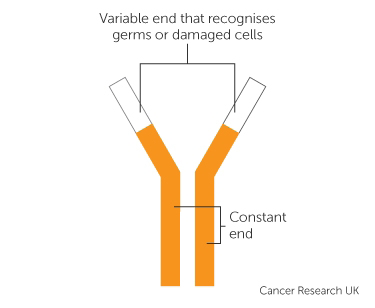
Cancer cells are not normal cells. So some antibodies with variable ends recognise cancer cells and stick to them.
Role T cells
There are different kinds of T cells called: helper T cells and killer T cells. The helper T cells stimulate the B cells to make antibodies and help killer cells develop. Killer T cells kill the body’s own cells that have been invaded by the viruses or bacteria. This prevents the germ from reproducing in the cell and then infecting other cells.
Cancer Treatments that use the Immune System
Some cancer treatments use parts of the immune system to help treat cancer.
Immunotherapy
Immunotherapy is a treatment for some types of cancer. It uses the immune system to find and kill cancer cells. They are helpful in cancer treatment because cancer cells are different from normal cells. And the immune system can recognise and kill abnormal cells.
Conclusion
In the laboratory scientists can produce different chemicals that are part of the immune response. So, they can make different types of immunotherapies such as: monoclonal antibodies (MABs), which recognize and attack certain proteins on the surface of cancer cells, vaccines to help the immune system to recognize and attack cancer, cytokines to help to boost the immune system as well as adoptive cell transfer to change the genes in a person’s white blood cells.
References
-
Cools-Lartigue J, Spicer J, McDonald B, Gowing S, Chow S, et al. (2013) Neutrophil extracellular traps sequester circulating tumor cells and promote metastasis. J Clin Invest 123(8): 3446-3458.
-
Takeshima T, Pop LM, Laine A, Iyengar P, Vitetta ES, et al. (2016) Key role for neutrophils in radiation-induced antitumor immune responses: potentiation with G-CSF. Proc Natl Acad Sci 113(40): 11300-11305.
-
Tanaka A, Sakaguchi S (2017) Regulatory T cells in cancer immunotherapy. Cell Res 27: 109-118.
-
Mukherji B, Chakraborty NG, Yamasaki S, Okino T, Yamase H, et al. (1995) Induction of antigen-specific cytolytic T cells in situ in human melanoma by immunization with synthetic peptide-pulsed autologous antigen presenting cells. Proc Natl Acad Sci 92(17): 8078-8082.
-
Nakatsumi H, Matsumoto M, Nakayama KI (2017) Noncanonical pathway for regulation of CCL2 expression by an mTORC1–FOXK1 axis promotes recruitment of tumor-associated macrophages. Cell Rep 21(9): 2471- 2486.
-
Ng TH, Britton GJ, Hill EV, Verhagen J, Burton BR, et al. (2013) Regulation of adaptive immunity; the role of interleukin-10. Front Immunol 4: 129.
-
Noy R, Pollard JW (2014) Tumor-associated macrophages: from mechanisms to therapy. Immunity 41(1): 49-61.
-
Oldford SA, Robb JD, Codner D, Gadag V, Watson PH, et al. (2006) Tumor cell expression of HLA-DM associates with a Th1 profile and predicts improved survival in breast carcinoma patients. Int Immunol 18(11): 1591- 1602.
-
Olkhanud PB, Damdinsuren B, Bodogai M, Gress RE, Sen R, et al. (2011) Tumor-evoked regulatory B cells promote breast cancer metastasis by converting resting CD4+ T cells to T-regulatory cells. Cancer Res 71(10): 3505-3515.
-
Chowell D, Morris LGT, Grigg CM, Weber JK, Samstein RM, et al. (2018) Patient HLA class I genotype influences cancer response to checkpoint blockade immunotherapy. Science 359(6375): 582-587.
-
Coca S, Perez-Piqueras J, Martinez D, Colmenarejo A, Saez MA, et al. (1997) The prognostic significance of intratumoral natural killer cells in patients with colorectal carcinoma. Cancer 79(12): 2320-2328.
-
Palucka AK, Coussens LM (2016) The basis of oncoimmunology. Cell 164(6): 1233-1247.
-
Papayannopoulos V (2018) Neutrophil extracellular traps in immunity and disease. Nat Rev Immunol 18: 134-147.
-
Pardoll DM (2012) The blockade of immune checkpoints in cancer immunotherapy. Nat Rev Cancer 12(4): 252- 264.
-
Sun WW, Xu ZH, Lian P, Gao BL, Hu JA (2017) Characteristics of circulating tumor cells in organ metastases, prognosis, and T lymphocyte mediated immune response. Onco Targets Ther 10: 2413-2424.
-
Chiba S, Ikushima H, Ueki H, Yanai H, Kimura Y, et al. (2014) Recognition of tumor cells by Dectin-1 orchestrates innate immune cells for anti-tumor responses. ELife 3: e04177.
-
Chong TW, Goh FY, Sim MY, Huang HH, Thike AA, et al. (2015) CD1d expression in renal cell carcinoma is associated with higher relapse rates, poorer cancer- specific and overall survival. J Clin Pathol 68(3): 200- 205.
-
Takahashi M, Miyazaki H, Furihata M, Sakai H, Konakahara T, et al. (2009) Chemokine CCL2/MCP-1 negatively regulates metastasis in a highly bone marrow-metastatic mouse breast cancer model. Clin Exp Metastasis 26(7): 817-828.
- Psychogenic Erectile Dysfunction in Late Adulthood: A Case Report on Clinical Intervention and Intimacy Restoration
- Clinical Trials on COVID-19 in 2025: A New Chapter in Global Health Research
- Innovations and Challenges in Contemporary Medical Clinical Trials: An Editorial Perspective
- Innovations and Challenges in Contemporary Medical Clinical Trials: A Critical Perspective
- Reimagining Clinical Trials: The Power of Continuous Feedback from Medical Reports
- Factors Influencing Brain Drain: Perspectives from a Medical School in Turkey