
Adapting of Yoga in COVID 19 Pandemic: A Cross Sectional Survey
Covid19 pandemic has influenced the whole world for adapting healthy life style. The yoga is a 5,000-year-old Indian body of knowledge and plays a vital role in the healthy well-being. It can be a holistic followed for strengthen body physically as well mentally. In the present study the survey method has been used to check the influence of the Yoga during pandemic. For this 600 questionnaire were distributed using random sampling technique for the age group of 18+, out of that the completely and systematically filled were 502 which were analyzed using descriptive statistics.
Introduction
COVID19 is an infectious disease which spreads out easily and can harm the persons whose immune system is not proper. Not only COVID19, there are many bacterial, fungal, viral infections which can harm the immune system. The well-being of immune system can be maintained by health lifestyle and yoga is one the most important regime that can be incorporated in life. Yoga has several benefits such as it improves strength, balance and flexibility. It helps to ease pains such as back pain, arthritis symptoms. It makes heart healthier and helps to manage stress. During this time of COVID19 pandemic and lock down situation, humans have realized the importance of health and environment and have taken several initiatives for being healthier.
In the present study an attempt has been made to observe the adaptability of yoga among the citizens of NIT area of district Faridabad.
Methodology
The structured and unstructured questionnaire was designed and distributed randomly by covering all the age groups. In total 700 questionnaire were distributed in the NIT area of district Faridabad from 1st December to 15th December 2020, out of which 600 were returned and on screening them, it was found the 502 were filled in all aspects. Henceforth, the analysis of these 502 questionnaires has been done using descriptive analysis. Further, the benefits of Yoga has been observed in 50 respondents by observing them (15/12/2020 to 01/01/2021) and interviewing after a month.
Results and Discussion
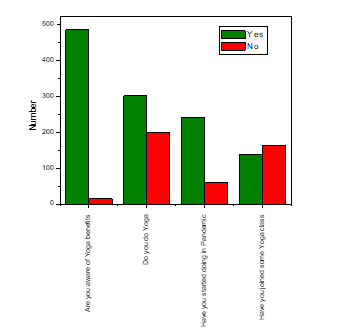
Health has become the prime importance in this pandemic. Out 502 respondents 97 % were aware about the benefits of doing Yoga, but only 60.27 % (302) of them used to practice Yoga. Among these 80.13 % have started doing in pandemic?. This clearly indicates the influence and adaptability of Yoga. Majority of do the Yoga to keep themselves fit, 17.88 % are doing to beat the stress and for mental well-being and approx 19.53 % were doing because of health issues. 45.69 % have joined some Yoga classes and doing yoga under the guidance of trainers. 40.06 % of them spend 50 to 60 minutes daily, 22.18% spends 20-30 minutes. To further analyze the effectiveness of Yoga, out of these 302
respondents the consent was taken from the 50 respondents to participate in study.
They were given a full day plan of healthy diet and Yoga routine for 4 weeks for observing their health parameters. The blood pressure, blood sugar and weight were checked.
On interviewing the respondents after the regular routine, it was founded that there health has improve and became more stable in context to previous situation. Majority of respondents shared they feel for active and fresh now. Even the reduction in weight on average of 2.7 Kg was observed [1, 2, 3, 4, 5, 6, 7].
Conclusion
Thus COVID19 pandemic has open our eyes and shown, the path that holistic life as our ancestors used to live was best and is the long term solution. In this modern age, all were neglecting the health, eating junk food and don’t following a proper regime. But, this pandemic realized the importance of daily regime and majority of people have started following healthy lifestyle, eating healthy on proper timing and doing regular exercise to keep their immune system healthy.
References
-
https://www.covid19india.org/
-
Sahni PS, Singh K, Sharma N, Garg R (2021) Yoga an effective strategy for self-management of stress-related problems and wellbeing during COVID19 lockdown: A cross-sectional study. PLoS ONE 16(2): e0245214.
-
Moreira-Almeida A, Neto FL, Koenig HG (2006) Religiousness and mental health: a review. Braz J Psychiatry 28(3): 242-250.
-
Kirkwood G, Rampes H, Tuffrey V, Richardson J, Pilkington K, et al. (2005) Yoga for anxiety: a systematic review of the research evidence. British Journal of Sports Medicine 39(12): 884-891.
-
Smith C, Hancock H, Blake-Mortimer J, Eckert K (2007) A randomised comparative trial of yoga and relaxation to reduce stress and anxiety. Complementary Therapies in Medicine 15(2): 77-83.
-
Shaikh S, Kumar S (2013) A Comparative Study between Relaxation Technique versus 12 Moves of Yoga on Anxiety in Young Adults—A Randomized Clinical Trial. Indian Journal of Physiotherapy and Occupational Therapy 7(2): 202-207.
-
Desikachar K, Bragdon L, Bossart C (2005) The Yoga of Healing: Exploring Yoga’s Holistic Model for Health and Well-being. International Journal of Yoga Therapy 15(1): 17-39.
- Psychogenic Erectile Dysfunction in Late Adulthood: A Case Report on Clinical Intervention and Intimacy Restoration
- Clinical Trials on COVID-19 in 2025: A New Chapter in Global Health Research
- Innovations and Challenges in Contemporary Medical Clinical Trials: An Editorial Perspective
- Innovations and Challenges in Contemporary Medical Clinical Trials: A Critical Perspective
- Reimagining Clinical Trials: The Power of Continuous Feedback from Medical Reports
- Factors Influencing Brain Drain: Perspectives from a Medical School in Turkey