
Journey from Chronic Hepatitis C to Non-Hodgkin’s Lymphoma: A Case Report
Non- Hodgkin’s lymphomas are diverse group of cancers of lymphocytes which mostly present as enlarged lymph nodes. Hepatitis C is both hepatotropic and lymphotropic virus and there has been a strong link between chronic HCV and nonHodgkin lymphoma. Most commonly chronic HCV has been linked with lymphoplasmacytic lymphoma and splenic marginal zone lymphoma. This is a case of 68-old year male diagnosed case of HCV presented with pain in abdomen, backache and generalized weakness. On investigations, his complete blood picture, liver function tests, renal function tests, serum electrolytes, erythrocyte sedimentation rate, C-reactive protein and electrocardiography were all within normal limits. Ultrasound abdomen showed large space occupying lesion in liver and para-aortic lymph nodal mass. Ultrasound guided biopsy of liver mass showed aggressive non-Hodgkin’s lymphoma. Diagnosis of aggressive non-Hodgkin’s B-cell lymphoma was made. High clinical suspicion is required for exact diagnosis of disease on lateral thinking.
Background
Non-Hodgkin lymphomas are heterogenous group of lymphomas which include various types of lymphoma. Some of these are indolent while some are very aggressive. Among them low grade lymphoma is mainly the disease of older people and more commonly causes bone marrow infiltration. Mostly they are B cell type although T cell and NK cell tumors are now being increasingly recognized.
Several environmental factors have been implicated in the development of non-Hodgkin’s lymphoma which includes infectious agents, chemical exposures and medical treatments. Several studies have demonstrated a strong association between Chronic HCV infection and non- Hodgkin’s lymphoma. Usually low-grade lymphomas regress after antiviral treatment but high-grade lymphomas require both antivirals and chemotherapy. Here is one such case of non-Hodgkin’s lymphoma associated with chronic HCV.
A 68-years male who was successfully treated 25-years back for hepatitis C infection with no complications, presented with vague upper abdominal discomfort and decreased appetite. He was also complaining of backache and mild constipation. There was no history of weight loss or abdominal distention. On examination, he was vitally stable having blood pressure of 120/70mmHg, pulse 86/minute, respiratory rate 16/minute, afebrile and maintaining 98% saturation at room air. Systemic examination of gastrointestinal, cardiovascular, respiratory and neurological systems was all normal.
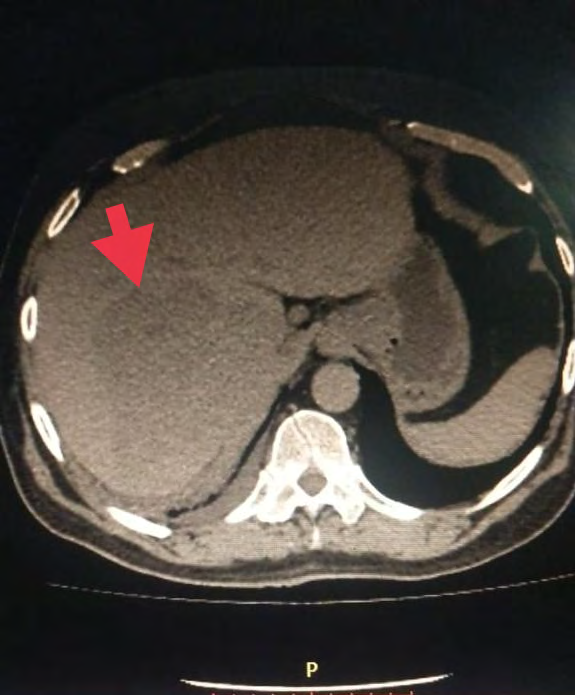
On investigations, blood complete picture, erythrocyte sedimentation rate, C-reactive protein, serum albumin, liver function tests, renal function tests, coagulation profile, electrolytes, PCR for hepatitis C, urine routine examination and electrocardiography were normal. Patient was treated symptomatically but not improved significantly. Patient then underwent ultrasound abdomen which showed single space occupying lesion in liver. Alpha-fetoprotein was sent which came out to be normal. CT-Scan abdomen with contrast showed a large lesion measuring 11*10cm seen in segment VI and VII of right lobe of liver (Figure 1) and single lymph nodal mass in right para-aortic region measuring 6.2*4.0cm. Patient then underwent ultrasound guided biopsy of liver mass and he remained vitally stable throughout the procedure. Immunohistochemistry showed aggressive Non- Hodgkin’s lymphoma which was strongly positive for CD20 and negative for CD30, CD3 and cyclinD1.
Finally patient was diagnosed as a case of non-Hodgkin’s B cell lymphoma and was referred for further treatment with chemotherapy to specialized center
Discussion
Hepatitis C is a common worldwide infection affecting approximately 180 million people which leads to chronic infection of which about one third leads to cirrhosis and HCC and approximately 350000 die of various complications.
Commonest route of transmission in younger individuals is intravenous drug abuse [1, 2]. While in older people, iatrogenic transmission is the commonest cause [3].
Non-Hodgkin lymphoma is a malignant tumor of lymphoid tissue. Various organisms and substances are linked to development of NHL including Hepatitis B and C, Human immunodeficiency virus, Epstein-Barr virus, Human T-cell Leukemia virus, H. pylori and exposure to toxic pesticides [4]. In general, HCV is hepatotropic virus but multiple studies have shown that it infects other organs as well including blood cells [4]. Common extrahepatic hematological manifestations of HCV infection are cryoglobulinemia and lymphoma [2, 5].
Exact pathological mechanism of association between HCV infection and development of NHL is not known [6]. Proposed mechanism for pathogenesis of NHL by HCV infection is chronic antigenic stimulation of specific B cell clones by hepatitis C virus which in turn induces malignant lymphoproliferation [7]. NHL develops particularly in those patients who have HCV infection for more than 15 years [6]. Lymphoma associated with HCV is mainly B cell type [3]. Most common subtype includes low grade marginal zone lymphoma and diffuse large B cell lymphoma followed by follicular lymphoma [8]. B cell lymphoma associated with HCV frequently involves spleen, liver and stomach [8]. Regression of NHL after HCV treatment with antivirals is the most compelling evidence of association of NHL with HCV infection [8]. HCV-related DLBCL are different from HCV-negative lymphomas by having aggressive clinical behavior and patients are usually older with more likely to have spleen/liver or extra nodal involvement and raised Lactate Dehydrogenase [9, 6]. Low grade lymphomas have a very good response to antiviral therapy alone while more aggressive lymphomas need combined antiviral therapy and chemotherapy [1]. Standard treatment for HCV-associated DLBCL is Cyclophosphamide, Hydroxy daunorubicin, Vincristine and Prednisolone (CHOP) combined with Rituximab [1].
To best of author’s knowledge, this is the first case presented from our country [1]. The distinguishing features of our case are as follows: firstly, patient presented with atypical features of just abdominal pain and backache and not with fever, lymphadenopathy and weight loss. Secondly in our patient, presentation of DLBCL is late from occurrence of hepatitis C infection, that is, after 25 years from initial hepatitis C infection although previous reports showed that DLBCL usually presents within 15 years of hepatitis C infection.2
Conclusion
Hepatocellular carcinoma is most common presentation of long-standing hepatitis C infection. Although rare, but it is associated with NHL, so we should have a lateral thinking and high suspicion of disease to diagnose early and treatment started as soon as possible to get greatest benefits of treatment.
References
-
Tasleem S, Sood GK (2015) Hepatitis C Associated B-cell Non-Hodgkin Lymphoma: Clinical Features and the Role of Antiviral Therapy. J Clin Transl Hepatol 3(2): 134-139.
-
Liu B, Zhang Y, Li J, Zhang W (2019) Hepatitis C virus and risk of extrahepatic malignancies: a case-control study. Sci Rep.
-
Khaled H, Abu-Taleb F, Haggag R (2017) Hepatitis C virus and non-Hodgkin’s lymphomas: A minireview. J Adv Res 8(2): 131-137.
-
Zhu X, Jing L, Li X (2019) Hepatitis C virus infection is a risk factor for non-Hodgkin lymphoma: A MOOSE- compliant meta-analysis. Medicine (Baltimore) 98(11): e14755.
-
Lizardi-Cervera J, Poo JL, Romero-Mora K, Castaneda B, Pichardo-Bahena R, et al. (2006) Hepatitis C virus infection and non-Hodgkin’s lymphoma: a review and case report of nine patients. Ann Hepatol 5(4): 257-262.
-
Iqbal T, Mahale P, Turturro F, Kyvernitakis A, Torres HA (2016) Prevalence and association of hepatitis C virus infection with different types of lymphoma. Int J Cancer 138(4): 1035-7.
-
Vannata B, Arcaini L, Zucca E (2016) Hepatitis C virus- associated B-cell non-Hodgkin’s lymphomas: what do we know?. Ther Adv Hematol 7(2): 94-107.
-
Couronne L, Bachy E, Roulland S, Nadel B, Davi F, et al. (2018) From hepatitis C virus infection to B-cell lymphoma. Ann Oncol 29(1): 92-100.
-
Peveling-Oberhag J, Arcaini L, Hansmann ML, Zeuzem S (2013) Hepatitis C-associated B-cell non-Hodgkin lymphomas. Epidemiology, molecular signature and clinical management. J Hepatol 59(1): 169-177.
- Psychogenic Erectile Dysfunction in Late Adulthood: A Case Report on Clinical Intervention and Intimacy Restoration
- Clinical Trials on COVID-19 in 2025: A New Chapter in Global Health Research
- Innovations and Challenges in Contemporary Medical Clinical Trials: An Editorial Perspective
- Innovations and Challenges in Contemporary Medical Clinical Trials: A Critical Perspective
- Reimagining Clinical Trials: The Power of Continuous Feedback from Medical Reports
- Factors Influencing Brain Drain: Perspectives from a Medical School in Turkey