
Hydroconductive Dressing – A Review
Good wound preparation is required in wound healing. Removal of dead and necrotic tissue by autolysis or thorough debridement, followed by effective exudate control, matrix metalloproteinase inhibition, and control of bacterial bioburden should allow treatment for extended periods. Many clinicians rely on the TIME (Tissue, Infection/Infection, Moisture Balance and Wound Edge) framework to help them prepare the wound bed, and many different dressings are available to aid digestion, control exudate, reduce bacterial bioburden and inhibition of metalloproteinase. This review article describes the performance of a hydroconductive dressing containing levafiber, which aids in wound bed preparation through absorption, separation, and retention.
Dwajan A¹, Chittoria RK²* and Amrutha JS³
¹Department of Orthopaedics Surgery, JIPMER, India ²Department of Plastic Surgery and Telemedicine, JIPMER, India ³Department of Plastic Surgery, JIPMER, India
Abbreviations
MMPs: Matrix Metalloproteinases; DFUs: Diabetic Foot Ulcers; VSUs: Venous Stasis Ulcers; Pus: Pressure Ulcers.
Introduction
Wound healing is the result of a dynamic, interactive process that begins at the time of injury and involves soluble mediators, various cell types, and the extracellular matrix. This process is barrier free and follows a specific chronological order. A wound is defined as a serious wound when it completes the necessary and timely healing process and permanently restores the body and its integrity. On the contrary, in chronic wounds, the necessary and timely procedures are not followed to establish a good relationship between the body and the connection. The wound healing process is long, unsuccessful, uncoordinated, and has poor outcomes. Chronic wounds are very painful. There is an increase in proinflammatory cytokines, an increase in proteases such as matrix metalloproteinases (MMPs), and a decrease in growth. Chronic skin inflammation and soft tissue inflammation are similar. All diseases are characterized by repeated trauma, relative ischemia, and persistent illnesses such as infectious diseases.
Use of Hydro Conductive Dressing
Diabetic Foot Ulcers (DFUs) Venous Stasis Ulcers (VSUs) Pressure Ulcers (PUs) All exudative wounds for wound bed preparation
Hydro Conducting Dressings
Hydro conducting non-adhesive dressings have two types of absorbent cross-sectional structures that can work in the wound preparation bed. This dressing actively removes excess fluid and other debris from the wound. Thanks to its unique design, it is possible to remove large amounts of fluid and debris from the wound into the dressing. This dressing uses capillary action to pump fluid from the wound at up to 150 cc per hour and maintain its integrity when moist. It also effectively detoxifies the wound by removing toxic leaks from the dressing. Fibrin can assist in selective debridement of wounds by removing slough and necrotic tissue and keeping granulation tissue in place.
Rapid transfer of fluid into this dressing can break down the weak collagen fibers that hold necrotic tissue to the wound surface. Known as “hydro conductive debridement”, unwanted tissue is selectively removed, leaving healthy and visible tissue intact on digital image analysis [1].
Over time, healthy tissue is preserved and increases as a percentage of the total wound volume, while necrotic tissue is preserved. Selective debridement reduces volume in pain analysis [2].
Mechanism of Action
The treatment process of these wounds is to prepare the wound bed by removing necrotic tissue, reduce wound exudate, reduce infection, remove toxins and close the wounds.
An ideal dressing should keep the pH moist, balance the wound, absorb exudate, prevent infection, reduce interference with healing tissue under the dressing stroke, reduce patient pain, and reduce dressing changes [3]. The thickness of wounds dressing depends on the depth of the wound and the comorbidities. There is no need to use antibiotics for second degree burns. The frequency of dressing changes is arbitrary and is determined by the amount of fluid or the structure of the dressing.
Hydro conductive wound dressings have been shown to release wound exudate, wound debris, bacteria, and MMPs [4]. This dressing is three-layered and uses Leva fiber technology construction (Figure 1). The process appears to result from a combination of physical properties: capillary action, hydro conduction and electrostatic effects work together. This combination of effects is specific to dressing. Capillary action is the ability of a liquid to flow into a narrow space without the aid of and against external forces such as gravity [5]. It is formed by the attraction of liquid molecules to solid molecules. This effect can be seen when liquid is embedded in porous materials such as certain textiles. Water molecules are always attracted to each other and form temporary hydrogen bonds with each other, but they are also similar to other molecules called hydrophilic molecules, such as those in dressing fibers [5]. These forces can pull water to any point. The dressing’s tiny pores act like tiny capillaries, allowing them to absorb large amounts of fluid. Hydroconduction is the movement of water in vertical and horizontal directions. This action is governed by Darcy’s law, which describes the ability of liquid to flow through a porous medium [6]. Liquids can move from a wet surface to a dry surface despite gravity. A subcategory of hydraulic conduction is transpiration and depends on the ability of fluid to evaporate from the edges or surfaces of porous materials to move them. This hydraulic conduction carries, retains and transfers wound exudate vertically and horizontally into the dressing. Static electricity results from the attractive or strong force between two electrical bodies. Although capillary action and hydroconductivity describe the removal of exudates and substances contained in exudates, they do not include their ability to draw bacteria and cellular contaminants (such as proteases) from the wound into the dressing. This process is due to the electrostatic interaction between the bacteria and the material.
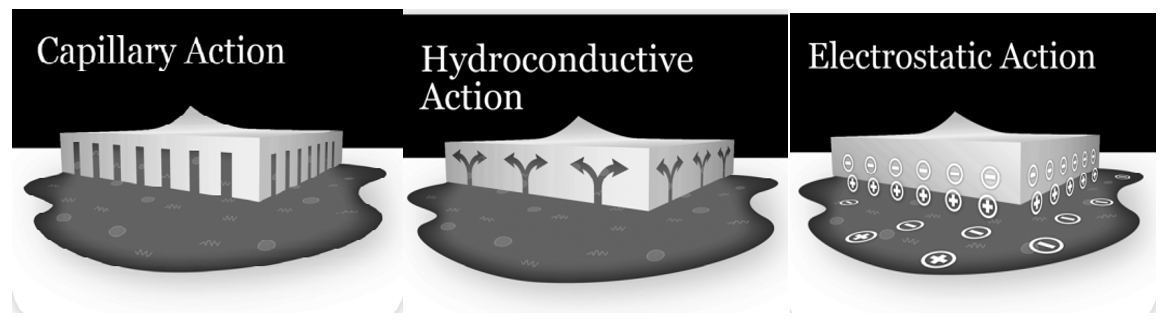
Advantages and Applications
The frequency of dressing changes is optional and is determined by the amount of fluid or the structure of the dressing. In a study by Ortiz et al., it was noted that there was a decrease in the number of bacteria in the culture containing MRSA, and an increase in the number of bacteria in the dressing itself. The decrease in protein concentration over time indicates that the product is able to attract other proteins, such as virulence factors, from the wound [7]. A study published by Diane et al found that MMP-1 and MMP-9 levels in tissues decreased over time, indicating that MMPs were absorbed into the dressing and suggested that this may be associated with chronic wounds [8]. The extracted fluid has also been shown to contain blood necessary to maintain the biofilm and assist in its disintegration. In a study conducted by Randall et al., it was observed that there was no maceration in the wound and there was less erythema. Wound healing also improved: Three wounds healed or were close to healing in the 4 weeks of the study [9].
A report by Rachel, et al. concluded that it controls exudate from drainage of second-degree burns and should be effective as a coating for skin grafts. The ability to eliminate exudate, bacteria, and inflammatory cytokines will help accelerate graft site closure. Terry et al. demonstrated that use of this dressing in patients with Buruli ulcers could reduce necrotic tissue and wound shedding through autolytic debridement; reduce wound drainage; increased granulation tissue in the wound; and reduces the pain of the wound.
Conclusion
A hydro conductive dressing designed to remove off excessive exudate, bacteria and cytokines. It can remove more wound exudate fluid than usual gauze dressings.
Hydro conductive dressing is effective when used with associated other methods for wound bed preparation. It appears to prepare woundbed within a short time. Such a result would remove the deleterious effects of excess wound exudate and help with healing of the wound.
References
-
Couch KS (2021) Discovering hydroconductive dress- ings. Ostomy Wound Manage 5(4): 8-10.
-
Livingston M, Wolvos T (2011) Hydroconductive de- bride-ment: A new perspective in reducing slough and ne- crotic tissue. Presented at 24th Annual Symposium on Advanced Wound Care and the Wound Healing Soci- ety Meeting, Dallas, TX.
-
Saba SC, Tsai R, Glat P (2009) Clinical Evaluation Com- paring the efficacy of aquacel ag hydrofiber dressing versus Petrolatum Gauze with antibiotic ointment in partial-thickness burns in a pediatric burn center. Jour- nal of Burn Care & Research 30(3): 380-385.
-
Ochs D, Uberti MG, Donate GA, Abercrombie M, Mannari RJ, et al. (2012) Evaluation of Mechanisms of Action of a Hydroconductive Dressing for Chronic Wounds. Wounds 24(9): 6-8.
-
(2012) The Free Encyclopedia.
-
(2012) Fluid Flow in the Subsurface (Darcy’sLaw).
-
Ortiz RT, Moffatt LT, Robson MC, Jordan MH, Shupp JW (2012) In vivo and in vitro evaluation of the properties of Drawtex LevaFiber wound dressing in an infected burn wound model. Ostomy-Wound Management pp: 3.
-
Wolcott RD (2012) The effects of a hydroconductive dressing on the suppression wound biofilm. Wound 24(5):132-137.
-
Robson MC, Ortiz RT, Moffatt LT, Jordan MH, Shupp JW, et al. (2012) Innovations for wound bed preparation: the role of Drawtex hydroconductive dressings. In Proceed- ings of a Symposium of Investigators.
- Psychogenic Erectile Dysfunction in Late Adulthood: A Case Report on Clinical Intervention and Intimacy Restoration
- Clinical Trials on COVID-19 in 2025: A New Chapter in Global Health Research
- Innovations and Challenges in Contemporary Medical Clinical Trials: An Editorial Perspective
- Innovations and Challenges in Contemporary Medical Clinical Trials: A Critical Perspective
- Reimagining Clinical Trials: The Power of Continuous Feedback from Medical Reports
- Factors Influencing Brain Drain: Perspectives from a Medical School in Turkey