
Effects of Siddha Thokkanam Therapy in Correction of Spinal Curve in Adolescent Idiopathic Scoliosis in a Female Patient- A Case Report
Objective: This case report illustrates the potential effect of Siddha manipulative therapy (Thokkanam) with varmam/marma chikitsa (energy medicine) on back pain and curve progression in a 15-year old female with adolescent idiopathic scoliosis. Clinical Features: A 15-year-old girl experienced right thoracic scoliosis from past 4 years. She received regular physical therapy, but the curvature of the thoracic spine still progressed. The Cobb angle was measured at 38° and on NPRS the pain was scaled as 8. Intervention and Outcome: This patient was treated with Siddha spinal manipulation (Thokkanam) for five weeks with five times per week for initial 2 weeks, which was gradually decreased in frequency along with 2 energy sessions at week 2nd and 4th. Follow-up after 6 months of consecutive treatment was conducted with radiographs and other examinations. The Cobb angle decreased by 25° and measured at 13° at follow-up. The pain measured at NPRS after intervention of therapy came down to 2 on any activity. There was improvement in the patient's ROM in left arm and lower backache. Her activities of playing badminton, writing and sleeping too showed a positive shift improving her quality of life. Conclusions: The patient responded well to manipulative and rehabilitation techniques. The case highlights the potential of Siddha therapy's holistic interventions in managing Scoliosis in reducing the degree of curvature of adolescent idiopathic scoliosis and giving a good quality of life.
Abbreviations
AIS: Adolescent Idiopathic Scoliosis; QoL: Quality of Life; ROM: Range of Motion; NPRS: Numerical Pain Rating Scale.
Introduction
Scoliosis is defined as an abnormal curvature of the spine with a curve of at least 10° (Cobb angle) or a deviation of the spine, consisting of a lateral curvature with rotation of the vertebrae; mostly appearing at the puberty age of 11–15 years. Typically, the condition of scoliosis can be seen on the posterior-anterior radiograph associated with vertebral rotation with > 10° of spinal angulation, curvatures < 10° are considered as a variation of normal [1]. The condition is present with high severity and more prevalence in girls than in boys with a ratio of 8:1 [2]. Estimated 1% of females require treatment as compared to males which is only 0.1%. About 75-80% cases are regarded idiopathic with no known cause of this deformity and rest are caused due to some of the underlying conditions. The condition shows its progress in growth phase of life and is caused due to many factors mainly congenital, neuro-muscular, some syndrome-related and idiopathic in nature. Recent studies report the incidence of degenerative scoliosis more often in adult patients [3]. Age related low back pain or radiating pain in the lower extremities due to disc herniation can lead to tilt in patient’s trunk causing a mild or moderate scoliosis [4]. Vertebral abnormalities of the spine that are present at birth is a cause to Congenital scoliosis. During vertebral development; on failure of formation or segmentation of vertebrae can result into these anomalies, and can be seen at multiple levels [5]. Neurological conditions like cerebral palsy or paralysis; Muscular deformities eg DMD, Marfan’s syndrome can also cause scoliosis in individuals. Some lateral deviation of the spine can occur without rotation of the spine and without bony abnormalities; resulting into pain, infections, spine abnormalities and tumors (both intraspinal and extraspinal) [6]. The most common form of scoliosis is Adolescent Idiopathic Scoliosis (AIS), occurs in otherwise healthy children between 10-14 years (puberty age) characterized by a structural three-dimensional deformity of the spine and trunk. Routine check-ups and screening in schools facilitate early detection of the curvature and on-time start of conservative treatment, especially bracing, can help avoid surgery and halt curve progression or possibly even reduce it [6]. Generally, postural changes characterized by scoliosis like asymmetry in shoulder level, waistline and hips and leg length discrepancy is noted in screening which is followed by the Adams forward bend test, described by Dr. William Adams to confirm the presence of Scoliosis [7]. The pathological symptoms may include severe back and neck pain, breathing impairment, disablement, poor cognition of body image, and segmental instability. Some might have neurological signs including sensory loss or absent unilateral superficial abdominal reflexes with few facing muscle weakness and gait. Nearly 12% of AIS patients require some form of treatment and up to 0.3% will sooner or later require surgery to improve aesthetics and better quality of life [8]. Decompression and spinal fusion with correction of curvature entails the surgical aspects for scoliosis [9].
However, amidst the conventional approaches, there’s a shift of patients interest in exploring less invasive, alternative and holistic therapies to address scoliosis. The common ground for this shift is not only to visible physical deformities but also the treatment leads to major psychological stress and social boycott. Scoliosis causes a substantial impact on the quality of life (QoL) of patients. Conservative treatments may lead to social isolation, sadness, and reduced leisure activity participation. The demand of wearing a corrective brace in public places or schools, often causes discomfort which is worsened by the low level of acceptance for such treatments within the school environment [10]. Among alternative modalities; Physical therapy, chiropractic has proved a good option for ceasing the deformity and improving the outcome and quality of life [11]. Previous reviews have reported that recommended exercises specific to scoliosis like hamstring stretch, Latissmus Dorsi had beneficial effects on the rate of progression and Cobb angle [12]. Siddha therapy, an ancient traditional system of medicine from Southern India, offers a distinct perspective on healthcare. Its holistic approach with least interventions, has made it a popular therapeutic modality especially in cases of disorders related to musculoskeletal [13]. It highlights integrative approaches of energy medicine including energy manipulation, chakra balancing, therapeutic touch, deep tissue pressure therapy, postural corrections, muscular exercises, nutritional and dietary modification, along with mind-body reading to motivate the healing and corrective process of body. Siddhars believed in addressing the underlying root cause of disease, by working on blockages and bringing relief by regulating the flow of energy which was obstructed due to many causes. In recent times, soft tissue manipulation resembling Siddha Thokkanam therapy, has proved beneficial in many spinal deformities and in precision of postures [14]. Thokkanam is an external manipulation therapy similar to manual therapy employing hand pressure technique to release pain and promote healing. It presents a compelling approach for innovative strategies in managing several musculoskeletal disorders along with curvature betterment by using its traditional pressure therapy. These interventions are designed to improve the strength and the range of motion in arms which are immobilized to some degree in chronic conditions [15]. This technique also results in tissue and muscle flexibility, address soft tissue movement restrictions, and support psychological well-being. Thokkanam therapy is a preferable treatment option to manage pain, reduce negative emotions, address circulatory and respiratory dysfunctions, improve physical appearance, and potentially slow the progression of spinal curvature.
Siddha therapy introduces unique interventions like Varmam treatment or marma chikitsa, which involves pressing, massaging, tapping, and lifting targeted energy spots known as Thodu Varmam. These spots, located at the junctions of muscles, nerves, veins, arteries, and capillaries, are believed to store vital energy or pranic energy, regulating bodily functions and promoting healing when stimulated [16]. Even though it is not the gold standard, the integration of Siddha therapy into scoliosis management provides a comprehensive framework that can help improve range of motion (ROM), spine correction, ease pain and muscle tension. This case report aims to shed light on potential efficacy of siddha therapy in correcting curvature leading to scoliosis in a girl child, potentially offering a promising adjunct or an option to existing treatment modalities. The case presented in this report is of adolescent idiopathic scoliosis with unilateral right side shoulder joint pain.
Case Report
A 15-year-old girl diagnosed with right thoracic scoliosis from past 4 years came to Chakrasiddh, a musculoskeletal healing centre. The patient complained of right shoulder pain radiating to elbow and hand which was restricting her writing. She had immense low back pain while standing and sitting, a major cause of her low self-image. On taking her past history, developmental milestone were normal. She was able to sit at six months, stand at one year and walk at one year two months. She had no previous surgical history. She was physically active and participated in few sport activities. Her mother’s maternal aunt had age-related scoliosis and so it was not mentioned as genetic scoliosis in her previous reports. During her regular school medical checkups, her examination revealed AIS with dropping left shoulder and a prominent right scapula. Her parents went for osteopathy and also for chiropractic sessions but could not apprehend a lot of improvement. She received regular physical therapy from last 3 years, but the curvature of the thoracic spine still progressed. She was suggested for surgical intervention to prevent significant deformity. To safeguard against future psychological impacts upon her health, the patient and her family decided to take siddha therapy due to its non-invasive way of handling such cases.
The time she visited Chakrasiddh, she presented with dull aching pain at the anterior and posterior shoulder joints, aggravating on any activity and especially during sleep. On every visit, a psychological monitoring was done via virtual means. On discussion with her parents to carry out the study, written consent was taken. The permission for publication of this case was taken from them and all rights of the patient were protected. (Since the patient requested of not putting her scoliotic back picture so only x-rays are put in the report keeping her rights intact).
Clinical Findings
On examination, posture assessment was done on all planes. There was slight left leg-length discrepancy noticed. The left shoulder and left pelvis showed a prominent drooping on same side and with minimal waist line asymmetry. A mild to moderate S-shaped spine was noticed with slight right- side inferior angle of scapula in her pre-therapy X-ray. Her vitals were normal, she was weighing 55 kgs (BMI 22) and height measurement was 165 cms. On palpation, there was no sign of temperature. Neurological examination grossly intact. Cardiovascular and respiratory examination were also unremarkable. She rated her pain as 8 on the numerical pain rating scale (NPRS) on upper back and 6 throughout her entire spine, aggravated on more sitting and walking. Slight bony tenderness was observed on hard touch over right scapular region. Scoliotic spine deformity with right side hump was confirmed by Adams bending test. On viewing the Cobb’s angle on X-ray, it was at 38°. Range of motion was assessed with goniometer.
Therapeutic Management
The patient was still in her growing phase, was a Risser 1 and the curve was greater than 30 degrees, there was a high risk of progression, so the therapy was planned accordingly [17]. She was treated with Siddha spinal manipulation (Thokkanam) for total five weeks. She was administered the therapy of 45 minutes five days/week for initial 2 weeks, which was gradually decreased in frequency along with 2 energy sessions at week 2nd and 4th and 15 minutes of scoliosis specific rehabilitation exercises. The scoliosis specific exercises like hamstring stretch, Latissimus Dorsi stretch and thoracic spine stretch were initially implemented alternate days for 1 week, followed by daily till end of therapy. The patient was required to complete the exercise protocol at home daily and was advised to wear scoliosis brace for 4-6 hours daily after the therapy. Follow-up at 6 month of treatment was conducted to confirm the improvement with radiographs and other examinations.
Therapeutic Intervention
• Thokkanam (Physical Manipulation Therapy) Thokkanam is a manual therapy in Siddha medicine. Through manual forces, it treats structural or functional issues by rendering required stimulation to the patient’s body structure, such as joints, muscles, tendons, ligaments, and fascia. It induces corrective effects by rearranging and manipulating the target joints. Also, it increases circulation in targeted soft tissues making the healing much faster and solves the joint malfunctioning [15, 18]. Thokkanam is of nine types: Tapping/Punching, Compressing /Gripping, Grasping/Holding, Twisting, Encompass manoeuvre, Pulling, Supinating, Pressing, Shaking /Mobilising [19]. The therapy was applied for 10-15 minutes for initial 2 weeks to get flexibility and reduce muscle spasm in shoulder joint. Application of strokes on thoracolumbar area was done for 10 minutes to manipulate the curvature.
• Marma/Varmam (Pressure Therapy) and Energy Healing Session The flow of pranic energy is facilitated by Varmam therapy. It is the therapeutic manipulation of Varmam points in which the pranic energy remains concentrated. It is seen that manipulation over these points with a particular force for the specified time will release the pranic energy from these points and bring relief to the affected individual. Special energy sessions are performed for some blockages which might be cause to obstruction of the flow of pranic energy. These hindrances might be generated due to negative thoughts, interactions or assault/trauma on specific points [16, 20]. Specific techniques used to stimulate the Varmam points and adangal points (points where the pranic energy remains in abundance) are mainly Amarthal (pressing), Thadaval (massage) and Thattal (tapping).
These points are intervened for 15-20 minutes per session. Two energy sessions for 20 minutes were given to clear blockages related to any previous trauma, negative interaction or life tragedy which might be causal factor for such condition.
• Varmam Points that were Manipulated [21] The therapeutic manipulation of various points were initiated for the patient to correct her curvature and for pain relief: (Table-1)
| S.No | Name of Varmam Point | Location | Frequency and Duration (In Each Session) |
|---|---|---|---|
| 1 | Kakkatai kalam | Supra clavicular fossa on both sides | For 2-3 mins |
| 2 | Kaichullukki varmam | 4 fingers from spine on each side below kakkatai kalm point | 3-5 mins |
| 3 | Chippi varmam | 2 fingers down of kaichullukki varmam | 2 mins |
| 4 | Nanganapottu | Sacral Groove, Three Fingerbreadths From The Lumbosacral | 3-4 mins |
| Joint (Lateral Aspect) | |||
| 5 | Poovadangal | Nr the ischial tuberosity | 2-3 mins |
| 6 | Enthi kalam | Anterior axillary fold | 2-3 mins |
| 7 | Piratharai | Posterior axillary fold | 2 mins |
| 8 | Addapakalam | Lateral wall of thorax | 3-5 mins |
Table 1: Varmam points and the duration.
Results
Evident transformation were observed in the patient’s variable: pain levels, cobb angle and posture. Rt shoulder joint pain and lower backache reduced to a score of 4 (after five weeks of therapy) and 2 (followup after 6 months) on the NPRS with increased flexibility in the left arm. Clinically, the patient demonstrated an increased ability to stand and sit for extended periods, with mild discomfort during daily activities. Her activities of playing badminton, writing and sleeping too showed a positive shift improving her quality of life. Furthermore, there was a marked advancement in the range of motion for both; the affected upper limb and the lumbar spine. Symmetry in the shoulders and waist line was also clearly visible, reflecting a broader improvement in the patient’s overall walking style. After 5 weeks of intervention, the therapy lead to decrease in the curve; on x-ray the cobb angle had reduced to 20 degrees. At this point, corrective brace was added to increase the 3-dimensional corrective action of the brace and patient was instructed to wear brace for 6 hours daily for next two months in break time. At follow-up after 6 months, the x-ray showed further enhancement in the curve that reduced to 13 degrees (Figure 1). The last x-ray was an out- of-brace x-ray where the patient was not wearing the brace for at least last 3 months. The results shows her spine >20 degree curvature, so according to definition her condition will be classified as a mild scoliosis [22].
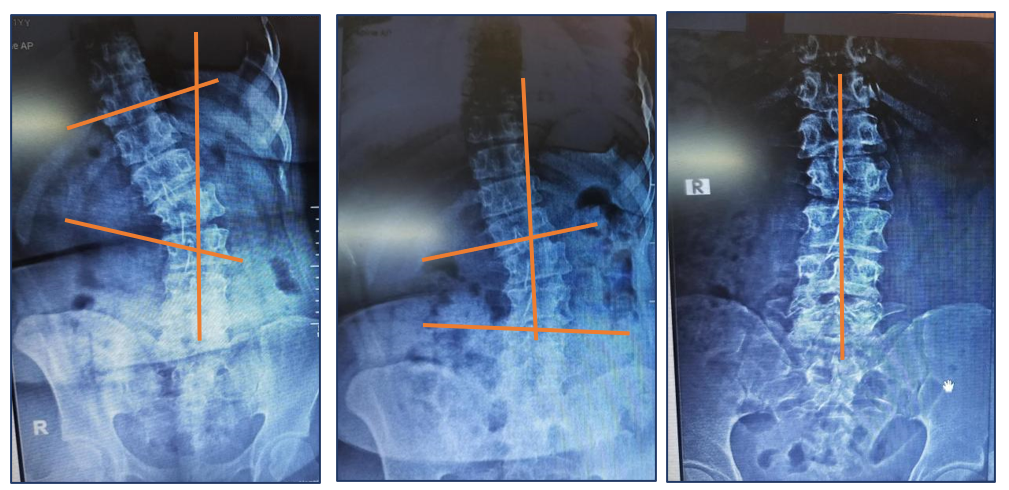
At start of therapy After 5 weeks Follow-up at 6 months Figure 1: X-rays of spine showing curvature corrections.
By the end of the treatment period, the patient reached a Risser grade of 4, indicating near skeletal maturity. The scoliosis curve had reduced to 13°, reflecting a 25° correction in six months of time. The spinal correction revealed continuous improvements over the course of treatment, with the patient’s posture becoming well-balanced and achieving full symmetry by six months. These postural gains were consistently maintained throughout the treatment period. Functional assessments indicated no decline in the strength, endurance, or flexibility of her core muscles and spine. Overall, the therapy improved all variables of patient and she had immense developments in all her physical activities.
Discussion
According to WHO statistics for scoliosis, around 82% patients are having idiopathic scoliosis [6]. AIS patients experience disease progression during growth spurt period with mostly appearing at the puberty age of 11–15 years. Generally this condition is more prevalent in females than males with a ratio of 8:1 [2]. Treatment options includes spinal fusion surgery in more severe scoliosis cases while in those where the cobb’s angle is <35-40 degrees, prefer to go for physical therapy with exercises and other manipulative methods to avoid surgery [7]. Scoliosis specific rehabilitation exercises along with brace for progressive curves or < 30° curves have produced effective results. This case report of 15-year female took physical therapy for 3 years but showed no improvement in curvature so took a chance with Siddha manipulative therapy before opting for surgery. Since, the intervention of other modalities were initiated at correct age, the curvature angulation was under permissible limit of undergoing this therapy [13] Siddha therapy, including manipulative therapy (Thokkanam) and marmam or varmam therapy (pressure); is an ancient traditional system of medicine from Southern India, offering a distinct perspective to healthcare. Its non-invasive holistic approach has made it a popular therapeutic modality especially in musculoskeletal disorders [14]. A multi-dimentional approach to treat the patient was formulated for quick and safe response. She was administered with a proper treatment protocol to decrease pain and cease the curvature deformity. After clinical evaluation, siddha manipulative therapy and energy sessions along with specific designed exercises to strengthen the muscles was incorporated for five weeks. Brace wearing proved beneficial in holding the curvature correction and preventing further deformity after therapy till follow-up [9].
The patient complained of pain over the left shoulder joint and lower back, and lateral curvature of the spine. Gentle pressure was applied over the tightened structures. Thokkanam therapy was used by applying manual techniques, including massage, manipulation of energy points called varmam, removing the blockages aims at balancing the body’s energies, and enhancing holistic wellness of patient [23]. The manual techniques used in Thokkanam, such as kneading, pressing, and stroking, enhances blood circulation in the curved area, increases in delivering oxygen and nutrients to tissues and helps in removing cell debris [24, 8]. Enhanced circulation reduces pain and inflammation, promotes muscle relaxation, and increases spinal mobility, thereby facilitating ease in performing exercises in our case. Increased flexibility in muscles helps in realigning body structures, correcting postures and thus gives feasible results in cases of scoliosis case. In our case report, this technique has been shown to provide a positive effect, releasing restricted structures of the back and decreasing pain. It improved the patient’s physical activity which was hindered and showed a good enhancement in quality of life [12]. Daily stretching exercises which the patient was adhering to at centre and also at home, particularly helped the muscle and tendons stretching, which showed a positive effect in improving elasticity and strength [13, 25]. In our case report, we’ve effectively addressed all the key factors necessary for correcting, strengthening and attaining correct posture for a patient with scoliosis. These insights can be valuable in designing an alternative modality for any patient with idiopathic scoliosis.
Conclusion
In conclusion, this case report suggests that siddha thokannam (manipulative) therapy is efficacious in the treatment of AIS, with beneficial effects persisting for months following treatment cessation. Various techniques involved in thokannam and varmam therapy seems to be well tolerated by patients having scoliosis. Pressures and deep strokes also seems to decrease pain and improves physical function in patient with a better quality of life. Given the limitations and potential adverse effects of surgical, pharmacologic and non-pharmacologic treatments for scoliosis, siddha therapy seems to be a viable option as an adjunct to more conventional treatment modalities. While Thokkanam and Varmam, both are widely practiced in Siddha medicine, it’s important to note that scientific research on their mechanisms and efficacy is limited. Most of its applications are based on traditional knowledge passed down through generations. Even though it is not the gold standard, the integration of Siddha therapy into scoliosis management provides a comprehensive framework that helped improve range of motion (ROM), spine correction, ease pain and muscle tension in our patient. Further study to determine optimal treatment protocols, absolute efficacy, cost-effectiveness, and generalization to other patient groups is clearly warranted. References
1. Asher MA, Burton DC (2006) Adolescent idiopathic scoliosis: natural history and long term treatment effects. Scoliosis 1(1): 2.
2. Weinstein SL, Dolan LA, Cheng JC, Danielsson A, Morcuende JA (2008) Adolescent idiopathic scoliosis. The Lancet 371(9623): 1527-1537.
3. Cho KJ, Kim YT, Shin SH, Se-ll S (2014) Surgical treatment of adult degenerative scoliosis. Asian Spine J 8(3): 371- 381.
4. Jung GH, Lee H, Kong HJ, Ryu HY, Ku YH, et al. (2019) A systematic review of Chuna manual therapy for adolescent idiopathic scoliosis. J Acupunct Res 36: 119- 130.
5. Konieczny MR, Senyurt H, Krauspe R (2013) Epidemiology of adolescent idiopathic scoliosis. Journal of Children’s Orthopaedics 7(1): 3-9.
6. World Health Organization (2020) Screening programmes: a short guide. Increase effectiveness, maximize benefits and minimize harm.
7. Adams W (1865) Lectures on the pathology and treatment of lateral and other forms of curvature of the spine. Br Foreign Med Chir Rev 36(72): 367-372.
8. Sunil KY, Bhawana K, Isha H, Lovepreet, Ankita K (2022) Varma Therapy and Comparison of Varmam Points with Urdhva Jatrugata Marma. Int Jr of Trend in Sc Res Dev vol 6(5): 1173-1176.
9. Athawale V, Phansopkar P, Darda P, Chitale N, Chinewar A (2021) Impact of Physical therapy on Pain and Function in a Patient With Scoliosis. Cureus 13(5): e15261.
10. Kotwicki T, Kinel E, Stryla W, Szulc A (2007) Estimation of the stress related to conservative scoliosis therapy: an analysis based on BSSQ questionnaires. Scoliosis 2:1.
11. Negrini S, De Mauroy JC, Grivas TB, Knott P, Kotwicki T, et al. (2014) Actual evidence in the medical approach to adolescents with idiopathic scoliosis. European Journal of Physical and Rehabilitation Medicine 50(1): 87-92.
12. Meyer C, Haumont T, Gauchard GC, Leheup B, Lascombes P, et al. (2008) The practice of physical and sporting activity in teenagers with idiopathic scoliosis is related to curve type. Scandinavian Journal of Medicine, Science, and Sports 18(6): 751-755.
13. Athanasopoulos S, Paxinos T, Tsafantakis E, Zachariou K, Chatziconstantinou S (1999) The effect of aerobic training in girls with idiopathic scoliosis. Scandinavian Journal of Medicine, Science, and Sports 9(1): 36-40.
14. Karmegam D, Prakash M, Karikalan N, Mappillairajan B (2022) Development of database structure and indexing for siddha medicine system – A platform for siddha literature analytics. Dialogues in Health 1: 100008.
15. Subramani B, Sathiyarajeswaran P (2021) Management of Rheumatoid Arthritis in Siddha System of Medicine—A Case report. International Journal of Ayurvedic Medicine 12(2): 383-385.
16. Marinelli JM, Geisler CC, Hale BA, Munson EJ (2023) Client experiences of virtual energy healing. Explore (NY) 19(6): 797-802.
17. Jacques H, Seth SL (2012) In Brief: The Risser Classification: A Classic Tool for the Clinician Treating Adolescent Idiopathic Scoliosis. Clin Orthop Relat Res 470(8): 2335-2338.
18. Heo I (2019) Chuna manual therapy for spinal scoliosis: a review of clinical study. J Korean CHUNA Manual Med Spine Nerves 14(1): 39-47.
19. Patil SB, Patil MS, Chittam KP, Wagh RD (2014) A Review on Ayurveda and Siddha: Indian Systems of Medicine.
20. Sieler R (2022) Religion, Alchemy, and Medicine in South India: Tamil Siddha Traditions and Siddha Medicine. Asian Medicine 17(1): 1-15.
21. (2024) Siddha, an Indigenous Medical System of Peninsular India.
22. Lenke LG, Betz RR, Harms J, Bridwell KH, Clement
DH, et al. (2001) Adolescent idiopathic scoliosis: a new classification to determine the extent of spinal arthrodesis. The Journal of Bone and Joint Surgery. American Volume 83(8): 1169-1181.
23. Sujatha V (2009) The Patient as a Knower: Principle and Practice in Siddha Medicine. Economic and Political Weekly 44(16): 76-83.
24. Qian H, Lei Z, Zhiwei L, Lingjun K (2020) Manual therapy for idiopathic scoliosis: A protocol for systematic review and meta-analysis. Medicine (Baltimore) 99(34): e21782.
25. Negrini A, Negrini MG, Donzelli S, Romano M, Zaina F, et al. (2015) Scoliosis-Specific exercises can reduce the progression of severe curves in adult idiopathic scoliosis: a long-term cohort study. Scoliosis 10: 20.
- Psychogenic Erectile Dysfunction in Late Adulthood: A Case Report on Clinical Intervention and Intimacy Restoration
- Clinical Trials on COVID-19 in 2025: A New Chapter in Global Health Research
- Innovations and Challenges in Contemporary Medical Clinical Trials: An Editorial Perspective
- Innovations and Challenges in Contemporary Medical Clinical Trials: A Critical Perspective
- Reimagining Clinical Trials: The Power of Continuous Feedback from Medical Reports
- Factors Influencing Brain Drain: Perspectives from a Medical School in Turkey